Portraits: ADARSHA BENJAMIN
HANS ULRICH OBRIST You have many dimensions to your work: you’re an artist, a creative director, a designer, a DJ. What was the first of all these many roles you started?
HERON PRESTON I guess it started in school—it’s skateboarding, it’s music, it’s all of these different avenues of culture that I was embracing. I would start to make friends with kids who were listening to the same things as me or skateboarding. I started doing projects with friends, and one of those projects turned out to be the very first time I started to place my name on garments: Heron Preston. It was a t-shirt, and this was back when I had just graduated high school in 2001. I wanted the brand to sound prestigious because I was elevating t-shirts into a more premium space. My name is Heron Johnson, but my middle name is Preston, and that sounded so fancy to me. The first logo that I had developed was in cursive, and it had two cherubs with wings. My grandfather is a preacher and an artist; he would paint scriptures on canvas. I would see a lot of imagery of angels and cherubs in my house. My slogan was “Live Above Mediocrity,” which I got tattooed. It was my first tattoo because I heard a preacher say that. Then I had discovered a screenprinter in San Francisco that was printing all of the merchandise for skateboard brands, and in the corner they had a four color press that was all manual. They gave me my first opportunity to screenprint.
HUO I have had many conversations with Virgil [Abloh] in the last couple of years, and he said everything started with t-shirts—in a very DIY way. It’s exactly the same for you.
HP Yeah, it was exactly the same for me. That was the very beginning of all of this. San Francisco was very DIY, and I was learning as I went. I was working at a retail shop. It was kind of like the Colette of San Francisco at its time, and it was a very tiny boutique. But then, I moved to New York. I got accepted into Parsons. I thought that since I was making t-shirts, I should then go and study fashion design. As a core fashion designer, I felt like I had ideas, and I really wanted to figure out ways to bring those to life through any type of medium. It didn’t really have to be restricted to fashion, so I didn’t do fashion design at Parsons. I studied design and management, and graduated with a business degree from an art school.
HUO Who are some other people who inspired you? Alexis Pauline Gumbs’ stance is very interesting in terms of thinking with Sylvia Wynter. We can think with other people in our work. So, the question is less by who are you influenced, but with whom have you been thinking?
HP It was a man by the name of Darrel Rhea. He was introduced at a talk as a futurist and an innovator. This was a talk about design, and the best design according to him was design that was meaningful. He wrote a book called Making Meaning. According to him, the best design is understanding the desires of human beings and that’s how you make meaning. He was redesigning Australia’s tax system at the time, and that had totally changed my entire outlook on what design was. I thought design was just fashion design, or interior design, or graphic design. I thought it was only playing with color, or materials, but I learned from him that design was also a form of organization. After I heard him speak, I emailed him, and was like, “Hey, I want to learn from you. I want you to be my mentor.” As I grew into my career in New York City, we always stayed in touch.
Working at Nike, I just didn’t feel like I was growing. So I wrote to Darrel, and I asked him what I should do next. He asked me, “Are you interested in continuing to apply your design and innovation only to art and fashion, or are you interested in applying your design and innovation to a wicked issue?” At the time he was working in the healthcare industry, which needed a lot of help in redesigning the way medical records are shared amongst doctors. He called that a wicked issue. He challenged me, “Do you want to continue applying this to art and fashion, or would you like to design with purpose?” After a year of really thinking about what the answer would be, I stumbled on this beach in Ibiza. I went swimming and this plastic bag was floating in the ocean toward me. I thought it was a jellyfish at first. But once it got closer, I realized it was garbage. All of a sudden the stars aligned, and the answer struck: holy shit, the environment is the wicked issue. I really love nature. I grew up in San Francisco—going on camping trips in Muir Woods, Marin Headlands, and Squaw Valley in Tahoe. So, when I saw litter within a natural environment, I was like, man, I want to start to clean up beaches. I want to start to clean up my own city. And as a designer, I also really love workwear, I love uniforms, and so it all started to hit me: the environment, work uniforms, and then I immediately thought about, as a design project, approaching the Department of Sanitation in New York City to do a collaboration to help clean up the environment.
HUO That must’ve been a major revelation in your life because everything unfolded from that. Before you started your own brand, UNIFORM, Kanye West also played a role. I’m always fascinated because in every art movement there are these offices of professionals who sort of become a school. Not only a school—Andy Warhol had the Factory. I was also trying to find out what it is about Kanye that makes him so inspiring for the people who work with him.
HP When I left Nike, I started working for Kanye. I was a creative director on his internal team called Donda for two years. That’s also where Virgil worked. What’s fascinating about working with Kanye is that he is able to really harness the purity of youth. He’s able to really harness the purity of that point of creation—you embrace risk-taking, you really love to push boundaries, and you love to be playful with your ideas. Working at Nike and other corporations was very safe. But with Kanye, anything is possible. He really empowers everyone around him. I think when you get thrown into the fire like that, you automatically start to grow this second skin or this superpower of learning faster than if you had to teach yourself.
HUO When I did this conversation with Kanye and Jacques Herzog, what I was so excited by is this idea of eternal learning, of eternal curiosity. That’s something I always believed in, which is why I do these interviews. We can always learn so many things.
HP Curiosity has always guided my process. I remember the first day on the job at Nike, I left my desk, and when I came back there was a printout that said: “Once you lose your curiosity, it’s over.” At that moment, I realized why they really wanted me within my role as the marketing strategist. That’s always driven how I make design decisions, and I think that’s also how I’ve been as a little kid with friendships. I was on the chess team, I was the class president, but then I was also an athlete. I think it’s because I was the only child that wanted to make friends with people and discover different cultures. Curiosity is a huge aspect of the qualities that Ye has, that I have, that really guide our creativity and interests.
HUO All these experiences coalesce into these collections you launch. You launched UNIFORM in New York and then a year later you went to Moscow with it, then to Paris. Can you tell me a little bit about these collections and how different they were, and also it’s a very unexpected context to connect fashion, ecology, zero waste, upcycling, recycling with the Department of Sanitation. Fifteen years ago in Zurich there was a sanitation museum, and I curated a show there called Cloaca Maxima about art and sanitation, and I always thought it was so great because whenever an artist, or visitor arrived, they would send someone from the staff in a sanitation uniform to pick the people up.
HP Uniforms have always been a big inspiration of mine. I was really fascinated with the Department Of Sanitation. I felt like everything at the time was so predictable. I was also really inspired by Matthew Barney and his River of Fundament in Detroit. It was a whole day of performances. First, we were escorted down to the theater at the Detroit Museum to watch the film—a car crashes into the river, and then the film abruptly stops. Then, we’re all escorted into a tour bus and driven through downtown Detroit, then we’re escorted into a glue factory where this woman performs, and then we’re escorted into a barge on the river where we’re watching this performance, and then we’re escorted into a car factory, and then there’s this big explosion and the show finishes.
This was an entire performance where he took over Detroit and he coordinated with the police department, he coordinated with the mayor’s office, he coordinated with all the city agencies, and I thought that was just so powerful. I wanted to do my own version of a city takeover. I thought that if I put my uniforms on the back of nine thousand sanitation workers around New York City, I would have that same impact that Matthew Barney had on me. That’s why I really wanted to work with the Department of Sanitation as well, to show the crossover between art and government—shining a positive light on sanitation workers. So, it was these tones of humanitarianism, social structures, and the environment. It was my first time even learning about upcycling. I wanted to just do a project using secondhand t-shirts that would become uniforms for all of the workers. It was all about recovering waste and giving it a second life; this secondhand first philosophy. I really took my creativity and my design to new levels through this project.
HUO An artist Mierle Laderman Ukeles, who is now in her eighties..
HP I had no idea about her! I started researching the Department of Sanitation, and I saw there was a talk happening at the New York City Museum. It was being hosted by a woman named Robin Nagle who is the in-house anthropologist for the Department of Sanitation. She wrote a book called Picking Up: [On the Streets and Behind the Trucks with the Sanitation Workers of New York City] where she basically took the test to become a sanitation worker just so she could study them. She had a talk and told the story of New York City’s relationship with waste management. The city’s waste management agency goes back to the 1800s. There was a prominent figure who was a doctor, and he made the connection between cleanliness and health. He said that if we clean up the city, and we start an agency, we will save more lives. That’s why the Department of Sanitation’s logo is a caduceus, which is that cross that has the snake going around it. When we got to the 1980s in the book, Mierle [Laderman] comes along in her story. Mierle shook the hands of every worker in New York City. It took her one year, and as she did, she said, “Thank you for keeping the city alive.”
HUO It’s called Touch Sanitation. And she shook 8,500 employees' hands.
HP When I learned about this work, I was like, Oh my god! They have an artist there? I need to meet her! She’s going to be the one to understand what I would like to do. I reached out to Robin to introduce me to Mierle. She told me no because she didn’t know who I was. She was very protective of Mierle. So, a couple years later at NADA, I stumbled on another talk. When I look at the projector, I see a photo of Mierle and her Touch Sanitation project. The woman who was presenting Mierle’s work was named Diya Vij who works in the Public Arts in Residence in New York City, called PAIR. I walked up to Diya after her talk and said, “Hey, the woman that you’re talking about, Mierle, I need to meet her. I have a big idea that I would love to present to her. Can you introduce me?” They called me in for a meeting and I presented this idea of recovering waste and doing a secondhand uniform project to raise money for the city. There was this charity component as well because city budgets always get cut. So, if there was a way for the city to raise money, they might approve the project. Funny enough, the DSNY had always wanted to do a fashion show because out of all the agencies within New York City, like the Fire Department, the Police Department, New Yorkers always talk shit about sanitation workers. They hate when a garbage truck is blocking traffic, but imagine what would happen if no one picked up your trash.
HUO The city would collapse.
HP Because of that, the DSNY has always been the coolest agency. They were like, “Hey, would you like to do a fashion show together?” And I was like, “Of course! That’s what I’ve been wanting to do with you guys.” I really wanted this to be a performance like Mierle’s. Through this project, I was able to invite New Yorkers into restricted city access zones like the Salt Shed, which is where we had the performance. That Salt Shed houses nine thousand tons of salt for the winter season and is only accessed during the winter. I also brought out Mierle’s truck—it was in the 1983 New York Art Fair Parade. That truck was all about the reflection of New Yorkers, so she outfitted the truck with mirrors. The whole idea was to see yourself in the garbage truck, and the whole meaning was that we’re all in this together. When you throw your trash away, it doesn’t just end there. So I put her work in my show, I put recycled electronic waste in my show, I worked with different city agencies, I brought bales of old clothes from the Goodwill, I worked with Housing Works to bring in electronic waste, I worked with Sims, which is North America's largest recycling facility and is based here in Brooklyn in Sunset Park, so it was a really big citywide initiative. At the event, you had models and cool people like Virgil, but then you had sanitation workers, and you would never see that at a fashion event. Ever. It was so cool to see my friends mingling with city workers.
HUO The question now is of scale, and in terms of your most frequently quoted quote: “Harness the power of fashion to design a better future.” That leaves us the question: what can then really change mainstream fashion brands? And that brings me to a recent collaboration you’re doing with Calvin Klein. How can you add sustainability to such a large brand? I read that they use raw denim, which uses less water, but there must be more to it, no?
HP It was a really small team. The rest of the company didn’t even know that we were working on this project, so we were able to identify new factories that were vetted, carve out our own supply chain, and activate those factories, and that supply chain. I like to call it our value chain. The very first day that I got in, I started looking at their packaging and it’s all plastic. We then changed all of the plastic packaging into recyclable and biodegradable materials. Then looking at the materials: I decided to do raw denim to save us water, but it also allows the wearer to personalize it. Also, not using too many logos, so that you can make it yours. I’m really big with authenticity and responding to the desires of the community. It’s not that typical approach to picking models or faces. I have people who are known for breaking boundaries, rising stars in culture, and fresh faces. I could’ve done a sanitation-worker-inspired collection and wouldn’t have even had to work with the Department of Sanitation, but would it have been authentic? That was the same with Calvin Klein. What is the core of Calvin Klein? It’s the underwear—a three-pack of white t-shirts—so I started to build it from there in respect of the brand, but in respect of the environment as well.
HUO The architect Peter Smithson always said there is a kind of thing and it’s found. That seems to be a part of your work—you find stuff. I’ve been wearing your coat with the safety belt a lot. What’s the ready-made dimension of the work?
HP I think it’s shining a light on the overlooked and recontextualizing it. It’s about the curiosity of pointing my finger at things I find fascinating, and bringing my friends or my community along the way. It’s about designing or creating these worlds and inviting someone into this world. To experience a kind of a world I would love to live in.
HUO On Instagram, you are often referencing health and culture, animals, and of course seeing these animals in the work, the heron, your namesake, makes us think about extinction because we are living in an age of climate emergency, but actually it’s a mass extinction. And you work with the Audubon [Society], so I want to hear more about that, and your work with animals, and animals through these manifesto type of t-shirts.
HP My father, who is a retired San Francisco police officer, started a program called Operation Dream, which was a program with the SFPD that would give young kids from public housing the opportunity to go and explore their surroundings. They would take kids on camping trips, skiing trips, and white water rafting trips. Or they would take them to woodworking classes, and arts and crafts. My dad was always bringing me on those trips. When I think of growing up in San Francisco, we were surrounded by beautiful parks. Golden Gate Park is in the heart of San Francisco, and I was always visiting these parks. I grew up with a fascination with nature. I’d be volunteering at the Discovery Museum in San Francisco. I remember seeing a great blue heron in Marin when I was about twelve years old, and I took a photo on my disposable camera. I always loved that I had the same name as this bird. I really wanted to put this Audubon painting on the collection as this introduction to the meaning of my name, and my love of nature. It brings some balance into the fashion imagery within streetwear, where you see a lot of graffiti, and you see a lot of references to the streets, but I wasn’t necessarily finding any connections to nature in a cool way. I wanted to do it through the context of a skater.
HUO Orange is the color of your brand, the labels are in orange. I was kind of wondering because I always see orange as a DIY color, but I was wondering what orange means for you.
HP Orange is a very powerful color. It’s super powerful. You don’t need to use a lot for someone to notice it. The season one collection, I was putting orange on everything, then I would step back, and I would see too much orange. Over the seasons, you see me using less and less, and almost reducing it only to the label. On the heron bird, you see a little bit of orange within their beaks. So, there’s that connection to nature. A lot of workwear agencies use orange labels. The DSNY had orange labels as well. It’s the color of safety and PPE, and you see that color orange being used for street signs, or orange cones. It’s this notice-me color. On the Calvin Klein collection, you’ll get these little hints of orange, and it worked because in paparazzi photos, celebrities wearing the collection, with these long lenses, you can still see that little, tiny bit of orange from like a million miles away, and you know that it’s my collection without even seeing the Calvin Klein logo.
HUO Rainer Maria Rilke wrote this book called Letters to a Young Poet. I’m sure a lot of young designers and students will read this interview—what would you advise them?
HP Protect yourself. Have people around you who can protect you, and never give up. Remain curious, challenge yourself, and have fun along the way. And innovate. Look to do something new. I love that Miles Davis quote: “Play what’s not being played.”
HUO We always know about architects’ unrealized projects because they publish them, and very little fashion design or visual artists’, musicians’, composers’, poets’ unrealized projects are published. Do you have any dreams or projects you haven’t been able to do yet that you want to realize in the future?
HP Right now, I’m looking to develop new materials. I really want to be a source for young designers material-wise. Looking at circularity in fashion and design. I want to position myself as that voice, so beyond just selling fashion, can I sell materials? Can I develop my own materials? When you look at materials, you have Gore-Tex, and then you have Zebrum and other materials you don’t really know about. So, looking at developing my own materials but then inviting other brands and other designers to use Heron Preston materials. I have something I’m developing now. I would love to have my own garden one day, my own type of park, for example.
HUO What would your garden look like?
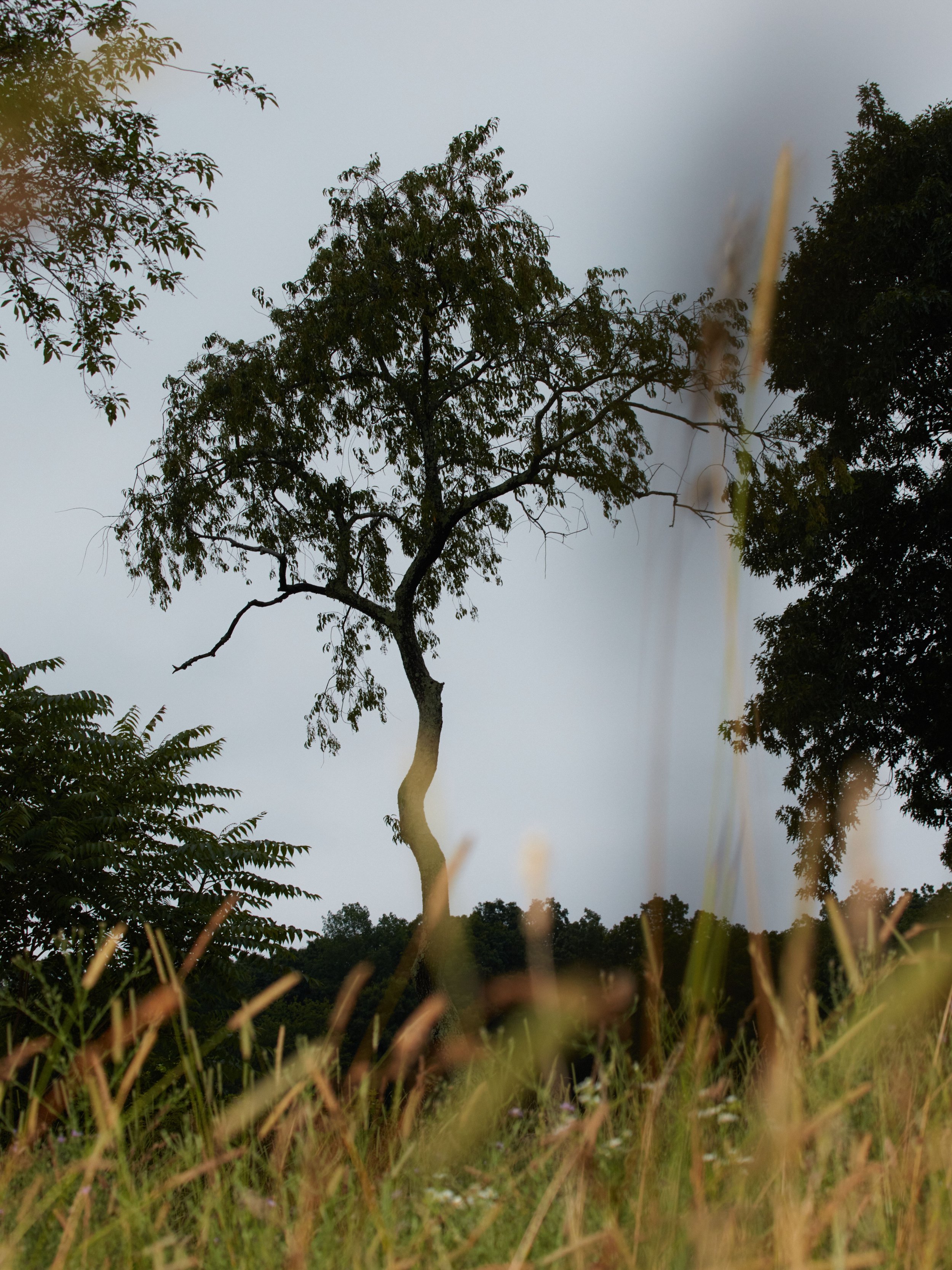
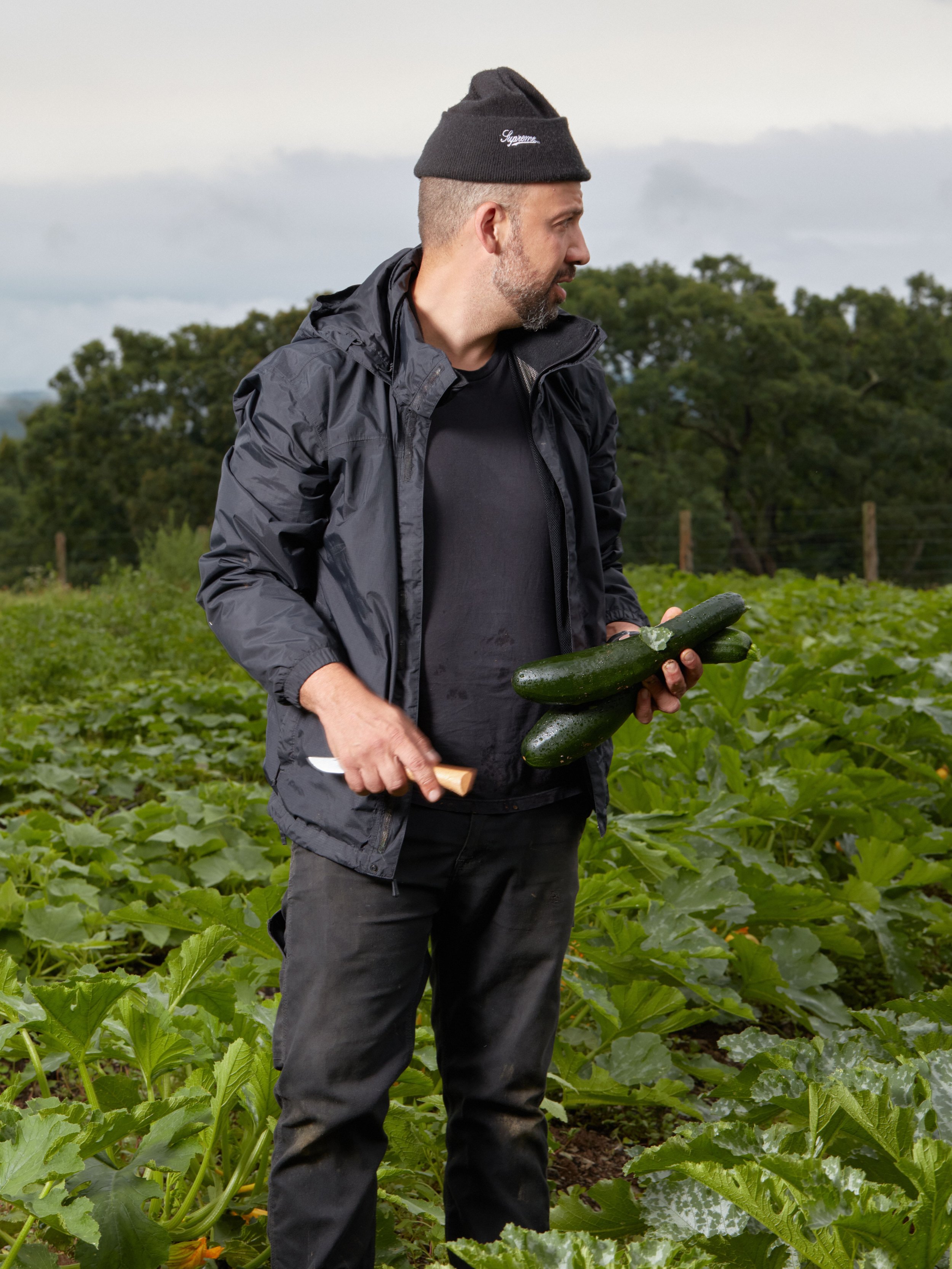
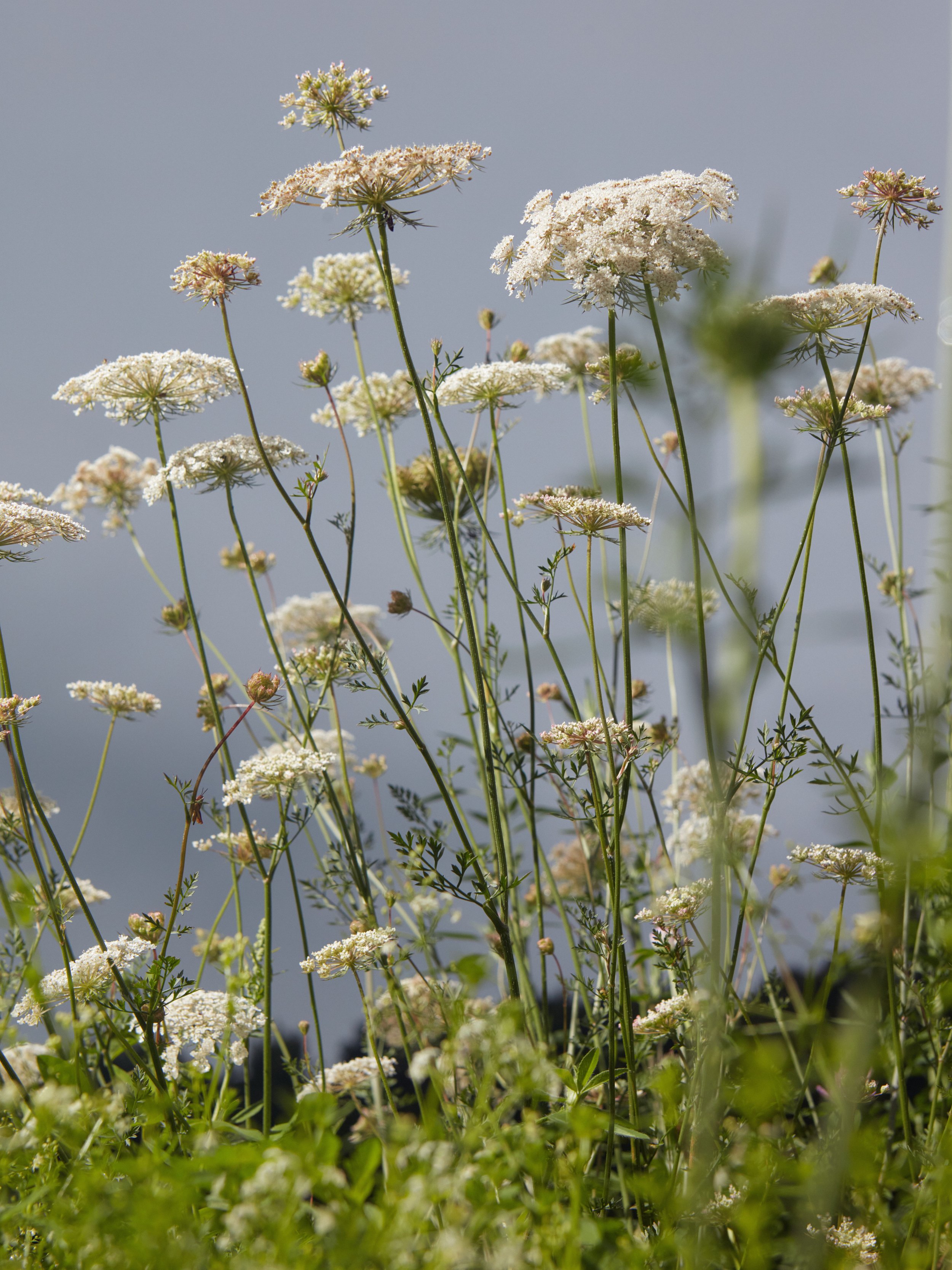
HP My garden would have a lot of trees, and bushes, and flowers, and it would feel like an enchanted forest. A lot of overhanging trees, and branches, and benches to sit, and maybe a pond. I would have amazing birds that would live there. I really wanted to start a farm as well, where I could then start to grow my own cotton, or my own hemp, and develop my own bed and breakfast. Over the pandemic, I was wanting to be out as far away from the coronavirus as possible. I was fascinated with farms because they’re very resourceful and self-sufficient: you have your own food, you have your own resources, and then you have nature. One of my unrealized projects is to start a farm, and then a sculpture garden where I can invite my friends outside of New York City to come and escape. I think it’s all about having an escape within nature.
HANS ULRICH OBRIST You . have many dimensions to your work: you’re an artist, a creative director, a designer, a DJ. What was the first of all these many roles you started?
HERON PRESTON I guess it started in school—it’s skateboarding, it’s music, it’s all of these different avenues of culture that I was embracing. I would start to make friends with kids who were listening to the same things as me or skateboarding. I started doing projects with friends, and one of those projects turned out to be the very first time I started to place my name on garments: Heron Preston. It was a t-shirt, and this was back when I had just graduated high school in 2001. I wanted the brand to sound prestigious because I was elevating t-shirts into a more premium space. My name is Heron Johnson, but my middle name is Preston, and that sounded so fancy to me. The first logo that I had developed was in cursive, and it had two cherubs with wings. My grandfather is a preacher and an artist; he would paint scriptures on canvas. I would see a lot of imagery of angels and cherubs in my house. My slogan was “Live Above Mediocrity,” which I got tattooed. It was my first tattoo because I heard a preacher say that. Then I had discovered a screenprinter in San Francisco that was printing all of the merchandise for skateboard brands, and in the corner they had a four color press that was all manual. They gave me my first opportunity to screenprint.
HUO I have had many conversations with Virgil [Abloh] in the last couple of years, and he said everything started with t-shirts—in a very DIY way. It’s exactly the same for you.
HP Yeah, it was exactly the same for me. That was the very beginning of all of this. San Francisco was very DIY, and I was learning as I went. I was working at a retail shop. It was kind of like the Colette of San Francisco at its time, and it was a very tiny boutique. But then, I moved to New York. I got accepted into Parsons. I thought that since I was making t-shirts, I should then go and study fashion design. As a core fashion designer, I felt like I had ideas, and I really wanted to figure out ways to bring those to life through any type of medium. It didn’t really have to be restricted to fashion, so I didn’t do fashion design at Parsons. I studied design and management, and graduated with a business degree from an art school.
HUO Who are some other people who inspired you? Alexis Pauline Gumbs’ stance is very interesting in terms of thinking with Sylvia Wynter. We can think with other people in our work. So, the question is less by who are you influenced, but with whom have you been thinking?
HP It was a man by the name of Darrel Rhea. He was introduced at a talk as a futurist and an innovator. This was a talk about design, and the best design according to him was design that was meaningful. He wrote a book called Making Meaning. According to him, the best design is understanding the desires of human beings and that’s how you make meaning. He was redesigning Australia’s tax system at the time, and that had totally changed my entire outlook on what design was. I thought design was just fashion design, or interior design, or graphic design. I thought it was only playing with color, or materials, but I learned from him that design was also a form of organization. After I heard him speak, I emailed him, and was like, “Hey, I want to learn from you. I want you to be my mentor.” As I grew into my career in New York City, we always stayed in touch.
Working at Nike, I just didn’t feel like I was growing. So I wrote to Darrel, and I asked him what I should do next. He asked me, “Are you interested in continuing to apply your design and innovation only to art and fashion, or are you interested in applying your design and innovation to a wicked issue?” At the time he was working in the healthcare industry, which needed a lot of help in redesigning the way medical records are shared amongst doctors. He called that a wicked issue. He challenged me, “Do you want to continue applying this to art and fashion, or would you like to design with purpose?” After a year of really thinking about what the answer would be, I stumbled on this beach in Ibiza. I went swimming and this plastic bag was floating in the ocean toward me. I thought it was a jellyfish at first. But once it got closer, I realized it was garbage. All of a sudden the stars aligned, and the answer struck: holy shit, the environment is the wicked issue. I really love nature. I grew up in San Francisco—going on camping trips in Muir Woods, Marin Headlands, and Squaw Valley in Tahoe. So, when I saw litter within a natural environment, I was like, man, I want to start to clean up beaches. I want to start to clean up my own city. And as a designer, I also really love workwear, I love uniforms, and so it all started to hit me: the environment, work uniforms, and then I immediately thought about, as a design project, approaching the Department of Sanitation in New York City to do a collaboration to help clean up the environment.
HUO That must’ve been a major revelation in your life because everything unfolded from that. Before you started your own brand, UNIFORM, Kanye West also played a role. I’m always fascinated because in every art movement there are these offices of professionals who sort of become a school. Not only a school—Andy Warhol had the Factory. I was also trying to find out what it is about Kanye that makes him so inspiring for the people who work with him.
HP When I left Nike, I started working for Kanye. I was a creative director on his internal team called Donda for two years. That’s also where Virgil worked. What’s fascinating about working with Kanye is that he is able to really harness the purity of youth. He’s able to really harness the purity of that point of creation—you embrace risk-taking, you really love to push boundaries, and you love to be playful with your ideas. Working at Nike and other corporations was very safe. But with Kanye, anything is possible. He really empowers everyone around him. I think when you get thrown into the fire like that, you automatically start to grow this second skin or this superpower of learning faster than if you had to teach yourself.
HUO When I did this conversation with Kanye and Jacques Herzog, what I was so excited by is this idea of eternal learning, of eternal curiosity. That’s something I always believed in, which is why I do these interviews. We can always learn so many things.
HP Curiosity has always guided my process. I remember the first day on the job at Nike, I left my desk, and when I came back there was a printout that said: “Once you lose your curiosity, it’s over.” At that moment, I realized why they really wanted me within my role as the marketing strategist. That’s always driven how I make design decisions, and I think that’s also how I’ve been as a little kid with friendships. I was on the chess team, I was the class president, but then I was also an athlete. I think it’s because I was the only child that wanted to make friends with people and discover different cultures. Curiosity is a huge aspect of the qualities that Ye has, that I have, that really guide our creativity and interests.
HUO All these experiences coalesce into these collections you launch. You launched UNIFORM in New York and then a year later you went to Moscow with it, then to Paris. Can you tell me a little bit about these collections and how different they were, and also it’s a very unexpected context to connect fashion, ecology, zero waste, upcycling, recycling with the Department of Sanitation. Fifteen years ago in Zurich there was a sanitation museum, and I curated a show there called Cloaca Maxima about art and sanitation, and I always thought it was so great because whenever an artist, or visitor arrived, they would send someone from the staff in a sanitation uniform to pick the people up.
HP Uniforms have always been a big inspiration of mine. I was really fascinated with the Department Of Sanitation. I felt like everything at the time was so predictable. I was also really inspired by Matthew Barney and his River of Fundament in Detroit. It was a whole day of performances. First, we were escorted down to the theater at the Detroit Museum to watch the film—a car crashes into the river, and then the film abruptly stops. Then, we’re all escorted into a tour bus and driven through downtown Detroit, then we’re escorted into a glue factory where this woman performs, and then we’re escorted into a barge on the river where we’re watching this performance, and then we’re escorted into a car factory, and then there’s this big explosion and the show finishes.
This was an entire performance where he took over Detroit and he coordinated with the police department, he coordinated with the mayor’s office, he coordinated with all the city agencies, and I thought that was just so powerful. I wanted to do my own version of a city takeover. I thought that if I put my uniforms on the back of nine thousand sanitation workers around New York City, I would have that same impact that Matthew Barney had on me. That’s why I really wanted to work with the Department of Sanitation as well, to show the crossover between art and government—shining a positive light on sanitation workers. So, it was these tones of humanitarianism, social structures, and the environment. It was my first time even learning about upcycling. I wanted to just do a project using secondhand t-shirts that would become uniforms for all of the workers. It was all about recovering waste and giving it a second life; this secondhand first philosophy. I really took my creativity and my design to new levels through this project.
HUO An artist Mierle Laderman Ukeles, who is now in her eighties...
HP I had no idea about her! I started researching the Department of Sanitation, and I saw there was a talk happening at the New York City Museum. It was being hosted by a woman named Robin Nagle who is the in-house anthropologist for the Department of Sanitation. She wrote a book called Picking Up: [On the Streets and Behind the Trucks with the Sanitation Workers of New York City] where she basically took the test to become a sanitation worker just so she could study them. She had a talk and told the story of New York City’s relationship with waste management. The city’s waste management agency goes back to the 1800s. There was a prominent figure who was a doctor, and he made the connection between cleanliness and health. He said that if we clean up the city, and we start an agency, we will save more lives. That’s why the Department of Sanitation’s logo is a caduceus, which is that cross that has the snake going around it. When we got to the 1980s in the book, Mierle [Laderman] comes along in her story. Mierle shook the hands of every worker in New York City. It took her one year, and as she did, she said, “Thank you for keeping the city alive.”
HUO It’s called Touch Sanitation. And she shook 8,500 employees' hands.
HP When I learned about this work, I was like, Oh my god! They have an artist there? I need to meet her! She’s going to be the one to understand what I would like to do. I reached out to Robin to introduce me to Mierle. She told me no because she didn’t know who I was. She was very protective of Mierle. So, a couple years later at NADA, I stumbled on another talk. When I look at the projector, I see a photo of Mierle and her Touch Sanitation project. The woman who was presenting Mierle’s work was named Diya Vij who works in the Public Arts in Residence in New York City, called PAIR. I walked up to Diya after her talk and said, “Hey, the woman that you’re talking about, Mierle, I need to meet her. I have a big idea that I would love to present to her. Can you introduce me?” They called me in for a meeting and I presented this idea of recovering waste and doing a secondhand uniform project to raise money for the city. There was this charity component as well because city budgets always get cut. So, if there was a way for the city to raise money, they might approve the project. Funny enough, the DSNY had always wanted to do a fashion show because out of all the agencies within New York City, like the Fire Department, the Police Department, New Yorkers always talk shit about sanitation workers. They hate when a garbage truck is blocking traffic, but imagine what would happen if no one picked up your trash.
HUO The city would collapse.
HP Because of that, the DSNY has always been the coolest agency. They were like, “Hey, would you like to do a fashion show together?” And I was like, “Of course! That’s what I’ve been wanting to do with you guys.” I really wanted this to be a performance like Mierle’s. Through this project, I was able to invite New Yorkers into restricted city access zones like the Salt Shed, which is where we had the performance. That Salt Shed houses nine thousand tons of salt for the winter season and is only accessed during the winter. I also brought out Mierle’s truck—it was in the 1983 New York Art Fair Parade. That truck was all about the reflection of New Yorkers, so she outfitted the truck with mirrors. The whole idea was to see yourself in the garbage truck, and the whole meaning was that we’re all in this together. When you throw your trash away, it doesn’t just end there. So I put her work in my show, I put recycled electronic waste in my show, I worked with different city agencies, I brought bales of old clothes from the Goodwill, I worked with Housing Works to bring in electronic waste, I worked with Sims, which is North America's largest recycling facility and is based here in Brooklyn in Sunset Park, so it was a really big citywide initiative. At the event, you had models and cool people like Virgil, but then you had sanitation workers, and you would never see that at a fashion event. Ever. It was so cool to see my friends mingling with city workers.
HUO The question now is of scale, and in terms of your most frequently quoted quote: “Harness the power of fashion to design a better future.” That leaves us the question: what can then really change mainstream fashion brands? And that brings me to a recent collaboration you’re doing with Calvin Klein. How can you add sustainability to such a large brand? I read that they use raw denim, which uses less water, but there must be more to it, no?
HP It was a really small team. The rest of the company didn’t even know that we were working on this project, so we were able to identify new factories that were vetted, carve out our own supply chain, and activate those factories, and that supply chain. I like to call it our value chain. The very first day that I got in, I started looking at their packaging and it’s all plastic. We then changed all of the plastic packaging into recyclable and biodegradable materials. Then looking at the materials: I decided to do raw denim to save us water, but it also allows the wearer to personalize it. Also, not using too many logos, so that you can make it yours. I’m really big with authenticity and responding to the desires of the community. It’s not that typical approach to picking models or faces. I have people who are known for breaking boundaries, rising stars in culture, and fresh faces. I could’ve done a sanitation-worker-inspired collection and wouldn’t have even had to work with the Department of Sanitation, but would it have been authentic? That was the same with Calvin Klein. What is the core of Calvin Klein? It’s the underwear—a three-pack of white t-shirts—so I started to build it from there in respect of the brand, but in respect of the environment as well.
HUO The architect Peter Smithson always said there is a kind of thing and it’s found. That seems to be a part of your work—you find stuff. I’ve been wearing your coat with the safety belt a lot. What’s the ready-made dimension of the work?
HP I think it’s shining a light on the overlooked and recontextualizing it. It’s about the curiosity of pointing my finger at things I find fascinating, and bringing my friends or my community along the way. It’s about designing or creating these worlds and inviting someone into this world. To experience a kind of a world I would love to live in.
HUO On Instagram, you are often referencing health and culture, animals, and of course seeing these animals in the work, the heron, your namesake, makes us think about extinction because we are living in an age of climate emergency, but actually it’s a mass extinction. And you work with the Audubon [Society], so I want to hear more about that, and your work with animals, and animals through these manifesto type of t-shirts.
HP My father, who is a retired San Francisco police officer, started a program called Operation Dream, which was a program with the SFPD that would give young kids from public housing the opportunity to go and explore their surroundings. They would take kids on camping trips, skiing trips, and white water rafting trips. Or they would take them to woodworking classes, and arts and crafts. My dad was always bringing me on those trips. When I think of growing up in San Francisco, we were surrounded by beautiful parks. Golden Gate Park is in the heart of San Francisco, and I was always visiting these parks. I grew up with a fascination with nature. I’d be volunteering at the Discovery Museum in San Francisco. I remember seeing a great blue heron in Marin when I was about twelve years old, and I took a photo on my disposable camera. I always loved that I had the same name as this bird. I really wanted to put this Audubon painting on the collection as this introduction to the meaning of my name, and my love of nature. It brings some balance into the fashion imagery within streetwear, where you see a lot of graffiti, and you see a lot of references to the streets, but I wasn’t necessarily finding any connections to nature in a cool way. I wanted to do it through the context of a skater.
HUO Orange is the color of your brand, the labels are in orange. I was kind of wondering because I always see orange as a DIY color, but I was wondering what orange means for you.
HP Orange is a very powerful color. It’s super powerful. You don’t need to use a lot for someone to notice it. The season one collection, I was putting orange on everything, then I would step back, and I would see too much orange. Over the seasons, you see me using less and less, and almost reducing it only to the label. On the heron bird, you see a little bit of orange within their beaks. So, there’s that connection to nature. A lot of workwear agencies use orange labels. The DSNY had orange labels as well. It’s the color of safety and PPE, and you see that color orange being used for street signs, or orange cones. It’s this notice-me color. On the Calvin Klein collection, you’ll get these little hints of orange, and it worked because in paparazzi photos, celebrities wearing the collection, with these long lenses, you can still see that little, tiny bit of orange from like a million miles away, and you know that it’s my collection without even seeing the Calvin Klein logo.
HUO Rainer Maria Rilke wrote this book called Letters to a Young Poet. I’m sure a lot of young designers and students will read this interview—what would you advise them?
HP Protect yourself. Have people around you who can protect you, and never give up. Remain curious, challenge yourself, and have fun along the way. And innovate. Look to do something new. I love that Miles Davis quote: “Play what’s not being played.”
HUO We always know about architects’ unrealized projects because they publish them, and very little fashion design or visual artists’, musicians’, composers’, poets’ unrealized projects are published. Do you have any dreams or projects you haven’t been able to do yet that you want to realize in the future?
HP Right now, I’m looking to develop new materials. I really want to be a source for young designers material-wise. Looking at circularity in fashion and design. I want to position myself as that voice, so beyond just selling fashion, can I sell materials? Can I develop my own materials? When you look at materials, you have Gore-Tex, and then you have Zebrum and other materials you don’t really know about. So, looking at developing my own materials but then inviting other brands and other designers to use Heron Preston materials. I have something I’m developing now. I would love to have my own garden one day, my own type of park, for example.
HUO What would your garden look like?
HP My garden would have a lot of trees, and bushes, and flowers, and it would feel like an enchanted forest. A lot of overhanging trees, and branches, and benches to sit, and maybe a pond. I would have amazing birds that would live there. I really wanted to start a farm as well, where I could then start to grow my own cotton, or my own hemp, and develop my own bed and breakfast. Over the pandemic, I was wanting to be out as far away from the coronavirus as possible. I was fascinated with farms because they’re very resourceful and self-sufficient: you have your own food, you have your own resources, and then you have nature. One of my unrealized projects is to start a farm, and then a sculpture garden where I can invite my friends outside of New York City to come and escape. I think it’s all about having an escape within nature.