
photography by Torbjørn Rødland
makeup by Karo Kangas
hairstyling by Amber Duarte
Movement artist and educator Cami Árboles discovered pole dancing while studying at Yale. After graduating in 2020, she founded the Mind Body Spirit Collective (MBSC) to help women and nonbinary people reclaim their bodies through movement. Together with Lebanese-Canadian artist, designer, writer, and advocate, Céline Semaan, they discuss the liberatory power of the body and desire.
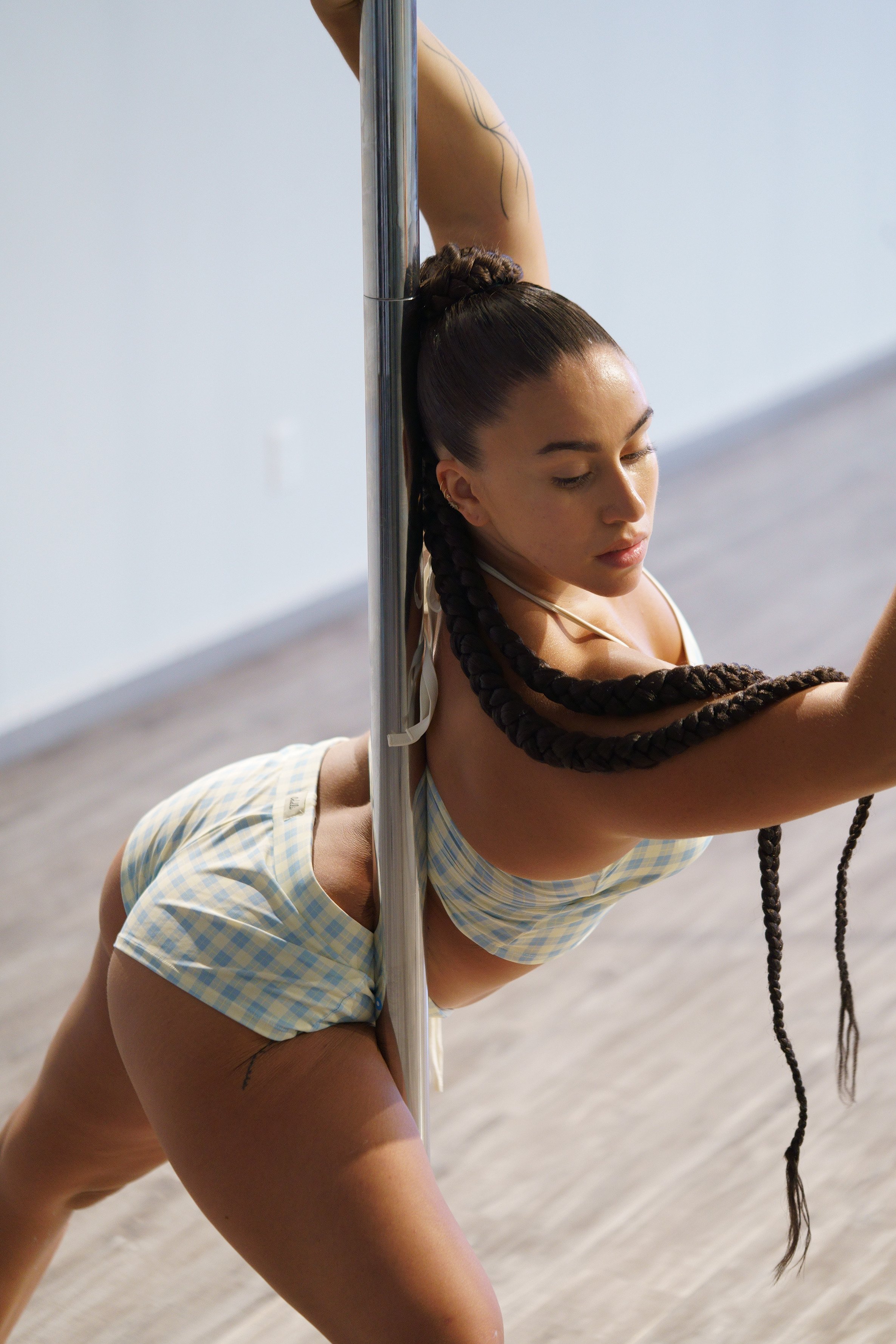
CÉLINE SEMAAN: You’re such an inspiration. Watching you move is a meditative experience, reminding me to reconnect with my body—something I often neglect as an intellectual. In these overwhelming times, your work feels vital, offering a way back to feeling, to embodiment. Even just watching you is transformative—almost like a meditation. (laughs)
CAMI ÁRBOLES: I'm so glad you brought this up. The deeper I get into this work, the more I realize that connecting the mind to the body is a space of healing—of reclaiming what makes us truly human. Growing up, I valued intellect over appearance or physicality. It wasn’t good or bad—it just was. I’m grateful for the emphasis on thinking critically and achieving academically, but as I grew into womanhood, I became aware of my disconnection from my body—along with the shame and guilt attached to it. Now, my work revolves around the body, strengthening the mind-body connection, and reclaiming that space.
In politically turbulent times, we're constantly bombarded with headlines stripping away fundamental rights, especially for women and women of color. It’s almost numbing. But our first line of defense is our body—its physical reactions. When we intentionally connect with it, we strengthen our ability to process, navigate, and ultimately survive in this world. A pole class, for example, is so much more than movement. It’s about reclaiming autonomy, proving to yourself that you can do hard things—that you can survive hard things. The lessons learned in a dance or pole studio extend far beyond those walls. They shape how we exist in our bodies—whether as women, women of color, or people of varying abilities. No matter who you are, you can learn to inhabit your body with power.
SEMAAN: Absolutely. What you mentioned about disconnection from ourselves—it’s a coping mechanism. When we’re overwhelmed, we go into fight-or-flight mode. But connecting with our bodies through somatic healing allows us to process, to reclaim that connection. You spoke about realizing, as you became a woman, the shame you carried around your body. It’s interesting because when you asked me to talk about desire, the first thing that came to mind was shame. In our society, desire is so often wrapped in it. We’re taught not to desire too much, not to be too desirable. If we show too much of our bodies, there’s shame. If we want too much, there’s shame. There’s a reconciliation we have to go through—to accept ourselves as we are, to break through that shame, and fully embody both our desirability and our desires. How was that journey for you?
ÁRBOLES: Great question. I grew up in Catholic school, always in a uniform, valuing intellect and academic achievement above all else. I don’t regret that—it gave me a strong foundation. But in my early twenties, I read The Body Is Not an Apology by Sonya Renee Taylor, and it reshaped my thinking. She writes about how systems like capitalism, colonialism, and patriarchy condition us to apologize for our bodies—to feel ashamed of taking up space, as if it’s not our birthright to be seen. Undoing that conditioning, simply existing in our bodies without apology, is a radical act of resistance and liberation. That idea shifted everything for me.
It helped me embrace sharing my work, my movement, my body. Coming from an academic space like Yale, where achievement was so tied to intellect, I had to unlearn the idea that existing visually—through dance, curation, social media—was somehow less valid. I had to remind myself: this is okay. This is enough. And as I’ve grown, I’ve realized that desire isn’t fixed. It evolves as we do, shaped by our values, our experiences, and how we want to impact the world.
SEMAAN: My next question is about desire as a guide. You're presenting it not just as something to be seen, but as something to be felt and embodied. How do you define desire in your own life and work? How does it show up for you? Is it an internal force, an external calling, or something in between?
ÁRBOLES: I love talking about desire because it’s so exciting. I really think desire is a roadmap. When I feel a desire for something, I just think that it's a message from a future version of myself that I haven't become yet calling out to this present version of myself to take action. That’s why I say desire is a map. When I started my pole and movement work, I was simply following a desire—to immerse myself in pole, in flexibility, in mobility, in visual thinking, in drawing connections. I didn’t always know why, but I knew I wanted to be it, embody it, become it. And the more I followed that feeling, the more it led me to places I never could have predicted.
Looking back, desire took me so much farther in my personal journey than chasing external validation ever could. Desire is such a human experience, but for me, it’s most powerful when it’s about a feeling rather than a fixed goal. I want to desire freedom, embodiment, creativity—not a number in my bank account, a follower count, or accolades. Desire, at its core, feels like an internal, almost spiritual force—one that has the power to map out our destiny.
SEMAAN: I love the idea of desire as a roadmap—your future self pulling you forward, guiding you to spiral upward, much like you do on the pole, ascending into who you're meant to become. So let’s talk about the future of desire. What would it look like to live in a world where desire—especially feminine and non-conforming desire—is truly honored? Imagine a near future where desire is no longer tangled in shame, where society has evolved past that limitation. What shifts? What unfolds when desire is valued rather than suppressed? And in the realm of spirituality, where desire is often seen as something to detach from, what if that changed? What if desire wasn’t seen as a conflict but as a force to embrace? What happens when feminine and non-conforming urges are not only accepted but celebrated?
ÁRBOLES: We often hear that desire is the root of all suffering, but I believe there’s a way to desire without being consumed by it—by seeing it as a guide, rather than an obsession. It’s like checking the weather before choosing an outfit; knowing your desires helps you plan, move forward, and create meaningful change, both for yourself and others. Honoring desire starts on an individual level—getting clear on what we truly want. And when we do, it opens pathways for collaboration and larger transformation. Take my own experience: one day, I simply woke up with an unexplainable urge to start pole dancing. I didn’t have a clear why, just a feeling, a pull toward movement and expression. I followed that desire, and in doing so, the deeper meaning revealed itself—I wasn’t alone in wanting to feel this way. Others needed it too. That’s the magic of desire: when you follow it authentically, you discover you're not alone. Others with the same calling appear, forming a community, a collective. There’s a Carl Jung quote: “If you do your work authentically and conscientiously, unknown friends will find you.” I think desire works the same way. By following your own map, you not only transform yourself but also create space for others to do the same.
SEMAAN: This reminds me of a quote by adrienne maree brown in Pleasure Activism: The Politics of Feeling Good (2019). As you know, my work is rooted in collective liberation, and there’s often an expectation that this work must come from a place of sacrifice—that liberation requires us to be saints, to be pure, to be perfect activists. But what you're saying about desire and this deeper conversation we're having reminds me of brown’s work. She writes: "Liberated relationships are one of the ways we actually create abundant justice—the understanding that there is enough attention, care, resources, and connection for all of us to access belonging, to be in our dignity, and to be safe in community." And then she says, "I touch my own skin, and it tells me that before there was any harm, there was a miracle." I think this relationship between desire, pleasure, beauty, and art is central to liberation. How do you see these coming together—desire, liberation, liberated bodies, liberated minds? Just to bring it full circle, from the idea of separation to the process of coming back together.
ÁRBOLES: I was just reflecting on that this weekend when I traveled to San Diego to teach workshops. After a full day of classes, I sat down to dinner with a few women who were older than me and we talked about embracing pleasure, self-expression, art, and movement later in life. Pole dancing, creativity, and play were the catalysts for that shift. I see this all the time teaching adults pole dance. It’s about reconnecting with the inner child and the artist in us. As adults, we become so risk-averse. A six-year-old will excitedly try a new trick, not caring about looking silly because their whole existence is about play. But as we grow, we’re taught to apologize or feel shame around being expressive or silly.
The beauty is that we can access that inner child and artist at any age. Whether you’re in your twenties or fifties, there’s no timeline for tapping into that creativity. I’ve been diving into The Artist’s Way [Julia Cameron, 1996], and the first week is all about silencing the inner critic and embracing fun and creativity. It’s about nurturing that inner child. I see it in my workshops—at first, everyone feels like the adult version of themselves, but by the end, they’re silly and carefree, giving permission to that inner child and artist to come out and play. That’s when transformation happens. Once you get in touch with those desires, it becomes easier to embrace what you truly want and feel comfortable wanting it.
SEMAAN: What other books have changed your life and how do you see desire as an intellectual practice?
ÁRBOLES: Oh my gosh, reading books is so sexy! (laughs) I actually have a ton of books around me right now. One is a monograph of Frida Kahlo’s work—she's a huge muse of mine. I spent a lot of time in art history during my undergrad, which is why I’m always thinking of visual art references. For one of my thesis projects, I focused on her and what she represents. Frida is such an inspiration because she embodied both the divine feminine and divine masculine, balancing these energies at a time when that was revolutionary. As a movement artist and pole dancer, I see my work as a union of these two energies—fluid and soft yet athletic and strong. Both should be equally celebrated. Frida’s ability to embody that duality so beautifully is truly inspiring to me.
SEMAAN: I love that you mention Frida Kahlo because she's also one of my muses, as she is for so many women around the world. Her use of her body, especially in relation to her disabilities and eventual amputation, is central to her work. Through her suffering, she honored and beautified her body in her paintings, giving birth to a Surrealist movement that expanded her self-expression. What I see in your work is a similar relationship with the body, creating an extension of your dreams and reality. Your art blurs the line between life and art, as your body becomes a medium for expansion—sometimes resembling nature, like a plant or butterfly, other times a flower or something beyond human. In this, you become more than human, creating an imaginative realm. You truly are a muse, and I wonder, are you your own muse, like Frida?
ÁRBOLES: Yes, definitely, especially in how she used her body as a form of self-study, which is a meditative practice in itself. In yoga, it's called "self-study" or "Svadhyaya," and it’s a healing practice to simply observe and notice yourself. Frida mastered this in her work, always being her own muse. When I look back at my own work, especially the collages I've made, I realize that it’s very much the same process. One of my favorite pieces came from a collaboration with a photographer in New York, where we explored the shapes of my body. I remember seeing an image of a cheetah and realizing how similar my spinal arch looked to that of an animal, which sparked this deeper reflection on our shared biological code. This process of musing yourself—of desiring yourself as a muse—is an act of meditation, a deep self-contemplation. I feel so privileged to have the time and space to do this in my lifetime, especially when I think about my ancestors, who likely didn’t have that opportunity. When I share these moments—like the silly or sexy pieces of art—it's deeper than it may seem to others. I do this not just for myself, but in honor of all the women before me who never had the chance to explore or share their own expression. So, yes, it’s fun, but it’s also deeply meaningful to me.
SEMAAN: Not silly at all. I see it as you being an artist, playing with different mediums—whether it’s through the art historical references, the juxtapositions, or your work with collage. It’s making me think about my own work, especially in climate justice, where we’re constantly trying to convey that we’re not separate from nature. The current mindset positions humans at the top of a pyramid, seeing everything else as a commodity, as though we’re separate from the earth. But we are nature; we are not outside of it. The idea of "saving" Mother Earth doesn't fully capture the truth—we are it.
ÁRBOLES: We are it. We literally are. (laughs)
SEMAAN: When I see your collage, it’s like a visual reminder that we are nature. Your practice of self-observation, deep meditation, and being present with yourself aligns with a therapeutic strategy that’s increasingly important in a world where our attention spans are stretched thin. By tuning in and studying ourselves, we recognize our connection to nature and the oneness we share. Our DNA shows it—20 to 60% of our DNA is closer to a tree than we think, and we share 95% of our DNA with chimps and a large portion with mice. Our bodies are mostly water and bacteria, echoing nature in profound ways. When you create through movement, it’s an extension of that connection, a sensual expression that feels so deeply aligned with the Earth. Desire is often seen as something to control or suppress, but your art transforms it into liberation—through presence, sensuality, and the art of noticing. How does your work reclaim desire as a creative force rather than a constraint?
ÁRBOLES: Sensuality is an art form, and I always emphasize this in my workshops. I make a clear distinction between sensual and sexual—though they can overlap, they are not the same. Sensuality is simply about engaging the senses. There’s an Antonin Artaud quote I love: “The body is the first abstraction.” Our bodies are the filters through which we perceive and interpret reality. When we immerse ourselves in sensual experiences—whether it’s lying in the grass, feeling the breeze, sweating through a hot yoga class, or savoring a home-cooked meal—we refine that filter. Movement, then, becomes more than just physical exercise; it’s a way of sharpening our connection to the world, deepening presence, and shifting perception.
SEMAAN: It’s so deep and beautiful—just hearing you talk about it feels like a meditation in itself. What’s even more powerful is that this connection is always at our fingertips. We don’t need a gym or a special setting to access it. What you’re showing is that sensuality and hyper-presence—truly being with our bodies—is an art form in itself.
ÁRBOLES: It really is an art. The more present you are with your body and senses, the more in tune you become with your creativity. The Artist’s Way touches on this with the morning pages—an exercise designed to clear mental clutter so you can tap into your true creativity and desires. What do you really want? What do you want to make? What do you want to put out into the world? You can’t access that if your mind is distracted or disconnected from your body. Creativity, desire, even just being— it all starts with the body, the way we experience and regulate it.
SEMAAN: I feel that deeply. We move from the personal to the universal—connection with others starts with connection to ourselves. Do you see desire as a political force? Because, for me, everything is political.
ÁRBOLES: Everything is political, everything.
SEMAAN: Do you see a connection between desire and political force, particularly in relation to bodily autonomy and freedom of expression? Does that inspire your work?
ÁRBOLES: Absolutely. Simply having a body, expressing it, and creating with it is inherently political—especially as a woman in today’s America, where bodily autonomy is constantly under threat. Any act of reclaiming that autonomy, sensuality, and connection to the body is an act of resistance. Even small acts of noticing, moving, or engaging with the body can build toward collective change. Prioritizing self-care, movement, and presence isn’t just personal—it’s transformative, shaping both individual and collective power.
SEMAAN: Exactly. In today’s political landscape, simply talking about desire is a radical act. Moving, showing our bodies, and embracing joy and pleasure—what adrienne maree brown calls ‘pleasure activism’—is deeply political. In a world that seeks to control and suppress, embodying desire is an act of resistance. Being a woman, in itself, is political.
ÁRBOLES: Absolutely.
SEMAAN: You mentioned prioritizing intellect over body earlier in life. What did you study, and how did movement find its way into your life? And finally, what advice would you give to those looking to reconnect with their bodies?
ÁRBOLES: In undergrad, I studied molecular cellular developmental biology for three years, which deepened my understanding of our interconnectedness with other life forms and the environment. That connection, especially in relation to climate change, really stuck with me. I also majored in theater and performance studies, focusing on music and singing. My journey into movement came through music. A friend in the Aerial Circus Arts Collective at Yale encouraged me to try aerial arts, and I joined. I also explored yoga as a way to help others de-stress in the high-pressure environment of college. I loved seeing the transformation in students, how yoga helped them feel grounded and happy again. That desire to create that transformation for others is what guides my work today. The seed for my current path was planted then, though I didn’t know it at the time. After trying pole dancing at a studio, I set up a pole in my aunt’s living room during the pandemic and followed the desire to create and share something with the world. That desire has since revealed itself as the map of my life’s work.
SEMAAN: You've found your true purpose, and it's incredible to witness. You're an artist through and through, and it's just fascinating to see your journey unfold. I just felt like sharing that with you.
ÁRBOLES: Thank you. I'm so excited to discuss desire because for me, everything shifted when I stopped desiring specific external things and started focusing on desiring a feeling, a way of creating, or just following the flow. When I made that shift, everything seemed to fall into place as it was meant to. Desire is most powerful when it's not tied to a specific outcome. Ultimately, it's about feeling in harmony with ourselves and others. We should never ignore a desire—it’s there for a reason. There are so many ways to look at it. Spiritually, a desire could be a message from god, your ancestors, a guardian angel, or even your future self. Desires are there because life would be so boring without them. They’re a positive force, a good thing.
SEMAAN: You’ve really cracked the code on transforming both the world and your life. When you started desiring a feeling, everything began to fall into place, and recognizing that we should desire values, not outcomes, is the essence of this conversation. You’ve articulated that so brilliantly. Desire is often seen as a physical thing, but as we’ve discussed, it’s also intellectual and spiritual. You’ve truly grasped the holistic nature of desire and its power in shaping our lives.
ÁRBOLES: What does desire mean in your life? You’re such a multifaceted woman, representing art, culture, political change, and revolution. I’m curious—how has desire played a role in getting you to where you are today?
SEMAAN: Like you, I see desire as a calling. Sure, I desire small things—shoes, a dress, food—but often, my desires are rooted in larger values. I desire a world that values women, disabled folks, diversity, nature—not as a commodity but as sacred. I long for education that’s accessible, fun, and engaging, where learning is an active, participatory experience. I want art and nature to be at the center of our lives, with gardens everywhere and fewer parking lots, more farms. I desire clean water and a world that’s truly healed. These desires drive my work. They’re my roadmap, guiding me to create strategies for achieving a world built on love, justice, equity, and art. I know some may think these desires are unrealistic, but I believe everything is possible. Our desires can shape the future if we let them.