
text by Abraham Chabon
photographs by Taylor Weidman
I was standing on the balcony. Next to me were chairs, a mini fridge, and a small table; on the table was a large knife. I think he’s going to kill me. Past the balcony, the casino was enshrined in LEDs that refracted off the buildings around it. Chinese words hung over streets, and crowds swelled and split around buildings and traffic. I think he could kill me. I felt it in my shoulders, my temples, the shaking of my leg. I think he might kill me. He’s going to fucking kill me.
* * *
I approached by car on the Thai side of the Mekong River, up winding, cracked rural roads and across sliding rivers, through short and slanted shanty towns into Chiang Saen, the last Thai town before the Mekong crossing. The casino appeared on the horizon, bursting out of the bright green trees and dark rolling hills of Laos like a towering golden tumor. A shining marble hotel sprouted out of the city like a lotus flower. Towers jutted out from behind well-kept trees, and all around, dozens of construction cranes cluttered around the buildings like braces on teeth. Kings Romans is a Chinese gangsters’ personal paradise, a lawless theme park for the rich, a money laundering city-state for Burmese rebels, a US-sanctioned hotbed for sex trafficking, exotic animal abuse and drug production, a glimmering Gomorrah in the South East Asian jungle.
Chiang Saen is a small town that stays quiet and slow. At night, the rays of city lights refract across the foggy Mekong, as boats whisper up the river freighting stacks of covered goods. I booked a hotel room and paid a group of young boys to drive me down dark and litter-strewn roads on the back of a scooter. No one wanted to talk about the casino; for the locals in Chiang Saen, Kings Romans is a forbidden topic.
* * *
The next morning I walked down to the green banks of the muddy brown river, under a clear blue sky. By the docks sat a drab official building staffed by Thai law enforcement. Blank-faced officers waded through the humidity in stiff khaki uniforms, past posters of crying children behind wire fences—warnings for human trafficking. Chinese nationals shuffled in and out of the building; there were groups of men with Yakuza-style tattoos twisting out of too-tight polo shirts and down their arms to meet oversized gold watches at their wrists. They waited next to wealthy families on vacation, and teenagers who walked together tossing peace signs for photos.
On the other side of the border-control building, a shabby dock buoyed by truck tires was manned by squatting locals with leathery skin. These men would run you across the river, by ferry or fishing boat, depending on how much you paid.
I had too much fun in Bangkok, funds were running low, the ATM conversion rate was killing me, and I had paid that monk too much money to tattoo a protection charm on my arm. But the ferry looked more comfortable, so I bought a ticket.
Standing at the dock, I watched a group of Ethiopian men load hefty plastic-wrapped cardboard boxes onto a small rear-engined fishing boat. It was so obviously suspicious, yet they did it in daylight against the backdrop of a golden Buddha statue tucked among the rooting and knobby trees of the Thai hills—nobody cared.
On the ferry I sat down among the tourists. Those who chose to talk to me at first didn’t believe I was American, when they did, our conversation ended. I sat in silence and watched as we pulled closer to the city.
* * *
The Golden Triangle—the region where Thailand, Myanmar, and Laos converge—was once the world’s largest producer of opium. It has a hard-earned hundred years of ethnic militias, drug kingpins, war profiteering, and CIA meddling. Thick lush jungle and ever-present political instability allowed the Golden Triangle to blossom into a billion-dollar black-market shangri-la. In the past thirty years, meth has become the primary export. It’s trafficked out of the region and into Europe, Asia, and Oceania. Some estimates claim that 250 tonnes of meth are crated down the region’s rivers and dirt roads yearly. Recently, a new source of income has taken over the region: phone scam centers and the enslavement of people to work them. It’s estimated that at least 200,000 people are held in captivity across the region, working the phones at office buildings turned prisons.
The Kings Romans Casino is the child of Chinese national Zhao Wei, a career gangster and casino owner who came from humble beginnings and got his start in Macau before moving his operations to Mong-La, Myanmar, the capital of the Shan-State-Special-Region-4, an autonomous area of Myanmar controlled by the Shan Army. The SR4 is known for a card deck of accused human rights abuses, and after the daughter of a Chinese official lost 1.3 million RMB in a Mong La casino, the Chinese government launched Operation Blue Arrow shutting the region's casinos down.
Zhao Wei rebranded his company as Kings Romans and created—according to the US Treasury—fifteen shell companies. He moved his operation to the Bokeo province in Laos, where in 2007, the government gave him a 99-year lease on thousands of hectares of biodiverse land, which he bulldozed. The region was dubbed the Golden Triangle Special Economic Zone. The area has grown into its own city, ruled by Zhao Wei and his corporation. Ever-growing, home to thousands, and infested with the worst things the region is known for. In 2011, thirteen Chinese nationals working boats carrying 900,000 meth pills bound for the Kings Romans were bound, stabbed, shot, and tossed overboard.
Zhao Wei is a media hermit, and rarely makes public statements, but when he does, he denies everything. He says he is bringing morals and Chinese ingenuity to a “backwards region” He insists that everything that happens in the Kings Romans is done hand-in-hand with the Chinese and Laos governments.
***
In Bangkok, before I headed north, I spoke to one person who had been to the casino, an expat from the States wearing crocs and camo shorts. I asked him for advice. “Don't go,” he told me. He said that people could disappear out there, that sometimes bodies floated down the Mekong, and riverside hotels used long bamboo sticks to push the bloated corpses out of sight so as to not ruin their guests’ vacations. We were sitting on short plastic chairs in a restaurant on the outskirts of the city, I tried to control my reaction, “Yeah, well, that’s fucking crazy.”
* * *
The checkpoint on the other side of the river was an unremarkable building. I was in Laos, but every sign said “Golden Triangle Special Economic Zone,” (GTSEZ) and I was told immediately that my Laos visa meant nothing there. I was charged $40 for a special visa for the GTSEZ, a large shining sticker. And at each of the five desks in the big gray room, tan-suited guards behind plexiglass demanded their own fee. None of the money ended up in a register.
Outside of border control, an African man with a toothy smile asked me if I wanted a ride. I accepted his offer too hastily. As soon as we’d introduced ourselves, he wanted to know what I was doing there, then he asked if I even knew where I was. I told him that I was just a tourist, that I had been backpacking through Thailand. He told me to be careful, that people disappeared out there, and to not take any photos.
Another African man joined us. They worked as translators, said the smiling one, and he wanted to leave it at that. But after twenty minutes of conversation he told me that his real job was helping people get out of the GTSEZ when they needed to. He said two Indian men employed by a local scam center had tried to kill themselves, and he and his partner had been hired to get them out. One of the Indian men had tried to hang himself and the other had slit his wrists. There was blood everywhere, and they needed to go, but first he knew a good spot for lunch.
We drove to the city on his scooter, his friend tailing us. The roads were well-paved and wide, small sidewalks brushed against unkempt, soon-to-be-developed grass plots. Red banners tied to light poles reached over the streets, with a message from Zhao Wei himself, in Lao, English, and Chinese: “Drugs are Not the Answer.”
* * *
From the streets, the city's scale set in. Giant buildings towered above the roads; some resembled office buildings, large and grey with flat roofs. There were long, squat residential buildings that took up whole blocks, side-by-side with upscale hotels clad all in glass. The city doesn’t plan on stopping its growth any time soon.
We passed a two-story-tall poster of a pale Asian girl. Young, wide-eyed, and wearing lingerie, she advertised a private strip club. Under the shadows of five-star hotels, across from private pools, rakish bars, nightclubs, a statue of Confucius, and an abandoned Ferrari caked in dust, locals huddled on the streets, looking poor and ignored. Eye-bagged Indian men in ankle-length pants and sandals waded through discarded cans and cigarette butts on the sidewalks. Thin-armed Burmese men in Longyi skirts shuffled strips of meat around on grills in front of run-down crack-walled stores. One young East Asian man sat on a curb, holding his face in his hands and sobbing into the narrow lap of another, unnoticed by the people walking past them.
Our caravan arrived at a restaurant called Thai Cafe. It was shiny and mundane like an American mall. Everyone there was caucasian. I went to use the restroom, and the men who had brought me ordered me chicken carbonara and a pink lemonade. The blonde women and pale young men at the cafe’s tables stared at me. Some got up to leave as soon as they saw me. While I was eating I chanced a glance at a smiling man’s phone, he was on Whatsapp messaging an unsaved number. It was something about having two girls but needing to take their passports.
They were traffickers; I needed to leave. I said I had to find a hotel. They took me to a hotel just down the block, a tall building with a courtyard and gold windows. All the signage was Chinese, and so were the guests. I waited for them to leave before I booked my room. The room was bland and dirty. It felt smaller on the inside. Thin walls, a stiff mattress, a dust-caked bathroom, it smelled like an RV. The shower spurted a weak stream of water onto a floor that quickly puddled. Later that night the hotel’s lobby was filled with a crowd of older men and sex workers who were barely teenagers. The girls were mostly Thai and Burmese; the undesirables, I was told. The nicer hotels had Japanese girls. They posed on large couches, wearing unconvincing sultry pouts. I avoided making eye contact.
The next day I headed back to Thai Cafe. I ended up in a group of fanny-pack-wearing Europeans, sitting at a round table, burning through packs of cigarettes, and slurping fruit smoothies.
No one there could accept that I was American. Each one of them wanted to see my passport. I had hidden it behind the air conditioner in my hotel room, so I just passed my phone around, with a photo. They asked how I got in. “Why would I ever come?” “Why was I alone?” One of them, a tan, dark-haired man, mentioned blandly that journalists could disappear in the Golden Triangle. People wouldn’t stop reminding me of that. I told him I was just a tourist.
“Just stay away from the Chinese,” he said.
After that there was universal agreement about not trusting each other, a confusing amount of fake names, and an ever growing pile of cigarette butts in an ashtray. One of them—I’ll call him Ivan—offered to show me around. Ivan was a broad-shouldered Central European man, square-faced and handsome, wearing a tank top and a military haircut. He was a teenager, younger than me, though he didn’t look it.
He took me to a swimming pool; private swimming clubs are the hubs of European social life in the GTSEZ. Ivan said that I picked a bad time to come, that it was an officially declared “drug-free month,” but that really meant nothing, so maybe I hadn’t, honestly it was just bullshit, did I want any ketamine?
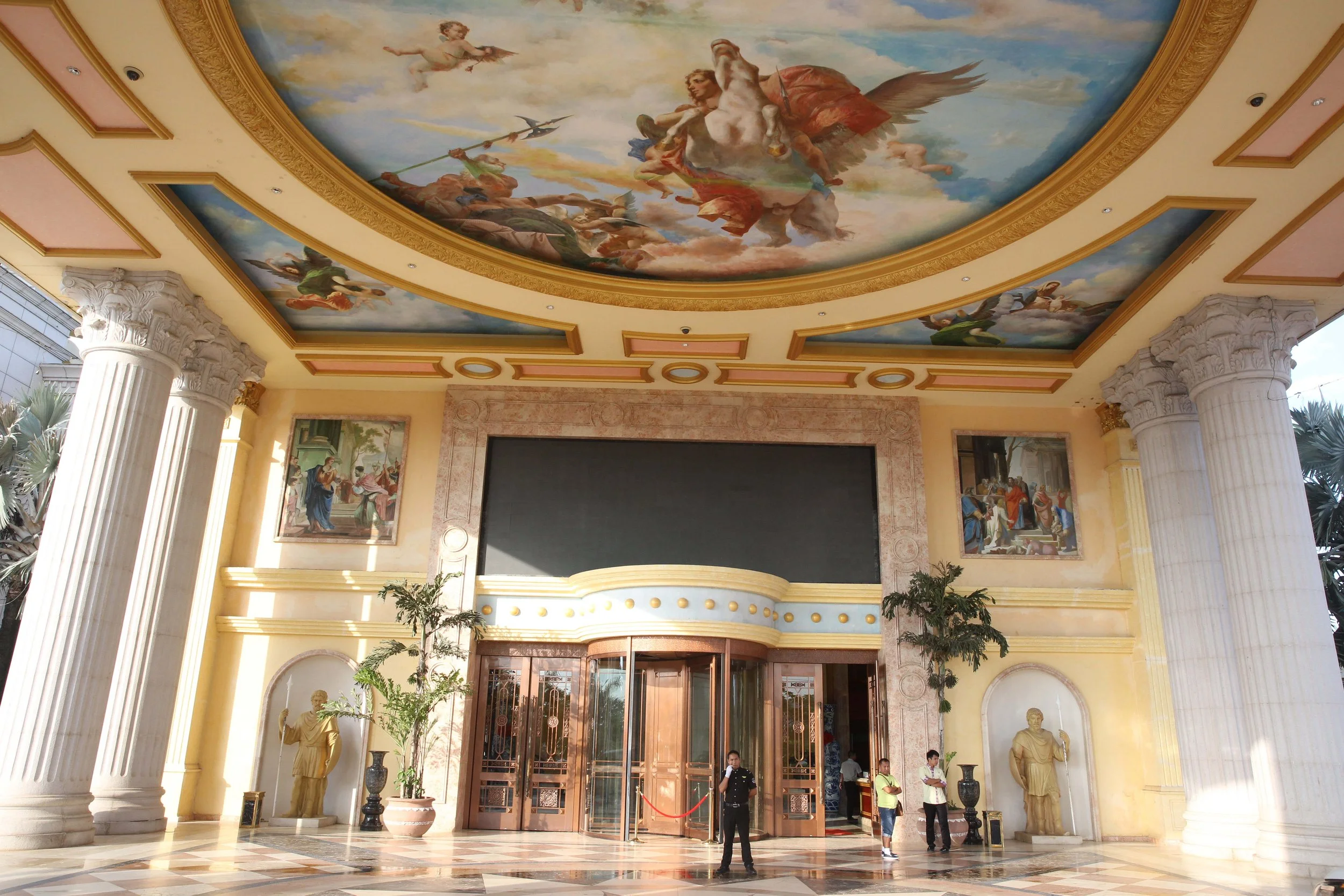
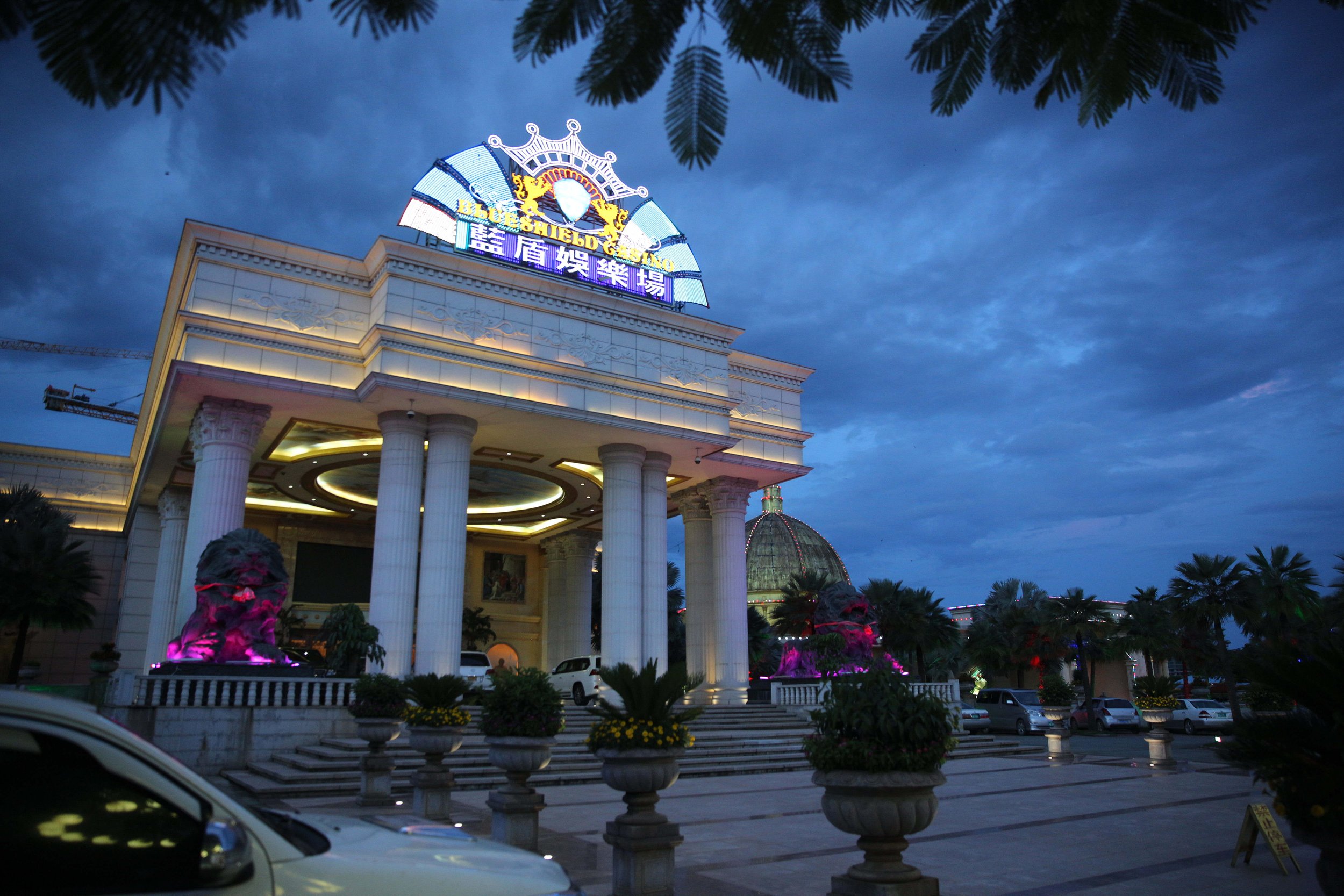
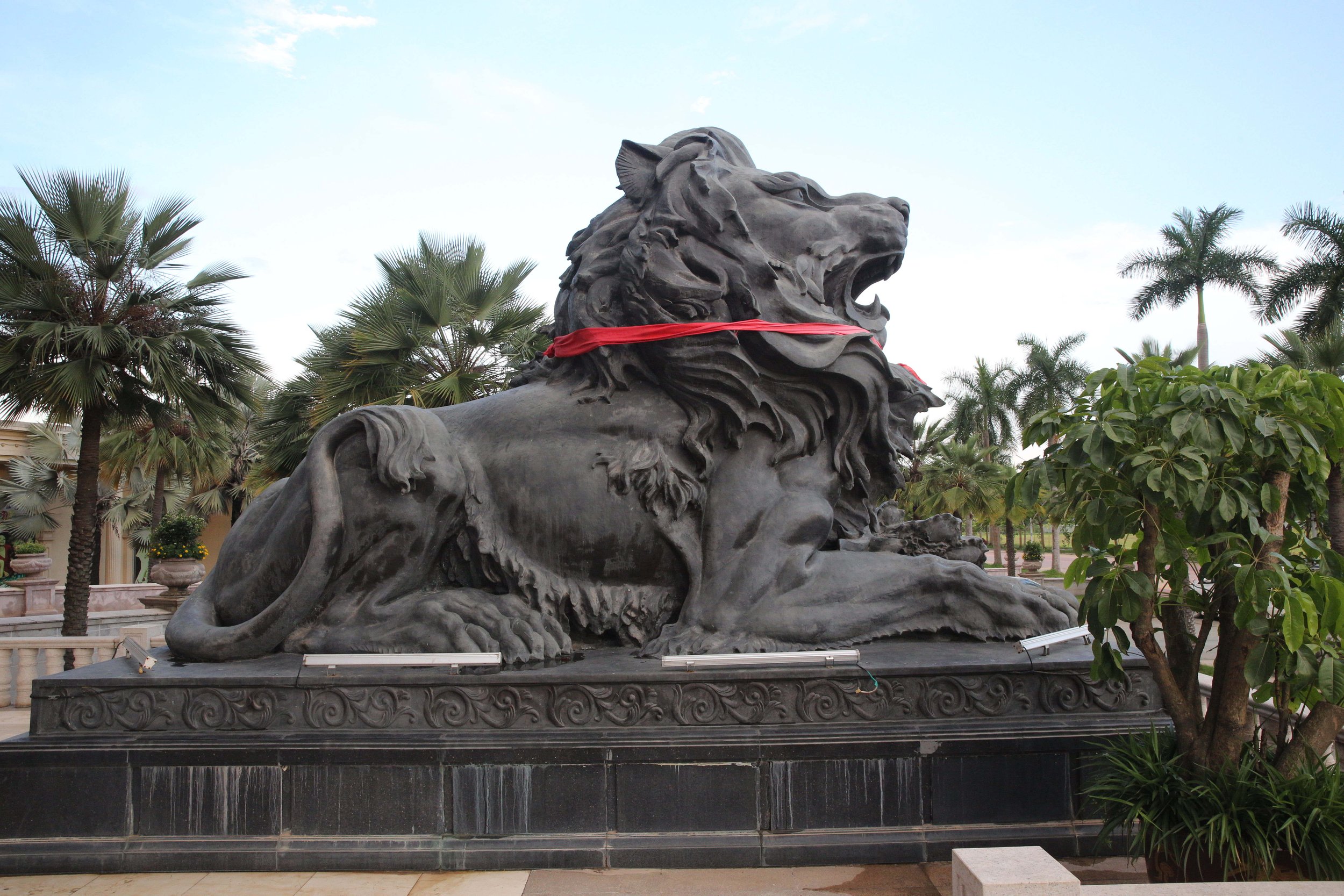
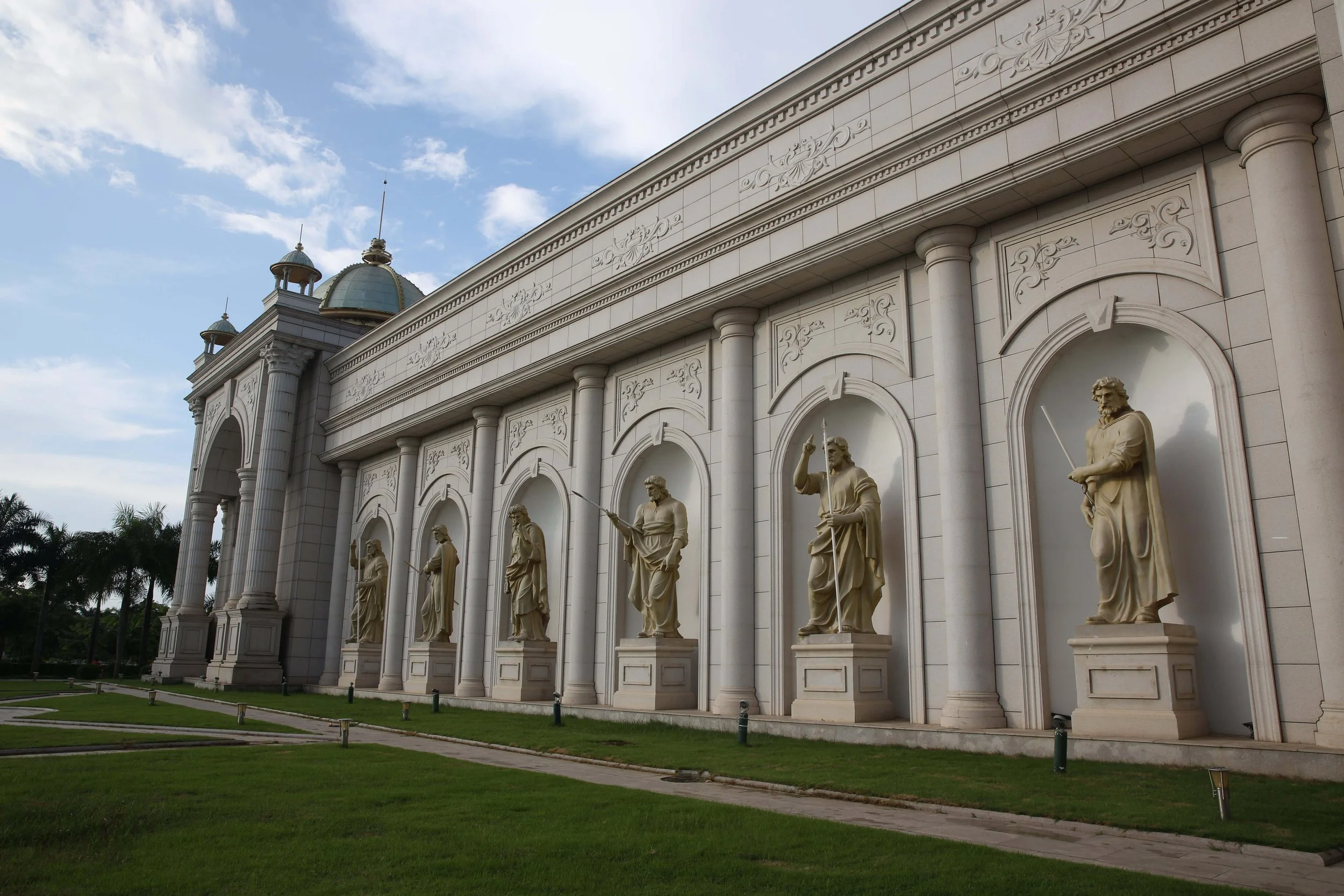
I got my first good look at the casino from up close: a garish mausoleum of embellishment and excess. Pseudo-European floral moldings twisted around its walls, decorative arches wrapped over golden statues of Greek gods, and giant Roman pillars held up Moorish domes. Part Acropolis, part Las Vegas hotel, with a touch of roadside attraction. The largest dome was encased in a gigantic metal crown painted gold that looked like it belonged more at a renaissance fair than a Laotian economic free zone
When we arrived at the pool, a Chinese family was enjoying the water. The men, all pudgy, wore short trunks, and the women, all pretty, wore modest swimsuits. They dove in and climbed out, goggles squeezing their faces, the water catching the sunlight as they splashed each other. It looked like promotional material for a Chinese waterpark. Fun, in the shadow of a Chinese gangster’s money laundering Mecca. Between long puffs of his vape, Ivan explained how the operation worked.
Moving to the GTSEZ was Ivan’s chance at a better life. He didn’t think of himself as a criminal, and he didn’t want to be called one. Most of the people he worked with came for just six months to two years, the entire time wanting to leave. The men were mostly scam callers, and the women sex workers. They got hired through vague online listings or were recruited by friends. Often they didn’t know exactly what they were getting themselves into. For a scammer, the job can feel pretty routine. You work out of large office buildings, clock in shifts, work overtime when you want. You start work late at night. When vulnerable Americans wake up, the phones start dialing. The general method is to pretend to be offering a service, or solving a problem. If the victim doesn’t hang up right away—too lonely, too old, too desperate—you can trick them into buying fraudulent crypto, disclosing credit card information, or making a misguided money transfer. The money goes to the companies, but you score a decent commission. The money added up, Ivan said. Within a few months, if you made enough calls, it could be life-changing.
“You have to make money somehow,” Ivan said.
Back home, for Ivan, there was a war and few opportunities. Moving to the GTSEZ for a few months made sense. Every week he sent money home to his parents who desperately needed it. Bad acts need good justifications. I tried to dismiss him as a criminal, a bad person, but I kept thinking about how young he was, how much he missed his family.
Ivan told me that for Europeans life is relatively safe. They are employees, not slaves. The companies, run by Chinese organizations, treat them fairly. Abusive employers can be reported to authorities, and most of the workers look out for each other.
This consideration was not extended to those in captivity. Ivan wouldn’t tell me much about it, but I thought about the men the trafficker had told me about, the one who hanged himself, the one who slashed his wrists. I could tell Ivan felt ashamed; even if he wasn’t actively engaged in trafficking and imprisoning, even if he was nothing more than a cog in a massive machine.
We got into the water, and changed topics.We dived down to the tiled bottom of the warm pool.
On our way to meet Ivan’s friends at the casino, we passed an imitation European town. It was the most Disneylandesque part of the whole city, the forced perspective, kitsch design. Some buildings had brick walls, large towers with crested windows, plantation-style porches, and the triangle gables of imitation Dutch homes. Behind it all, encroached the dark, jungle hills of Laos and Thailand.
Kings Romans isn't what it pretends to be. It is not a theme park, it is not a family destination; it is a casino city built in the lungs of one of the most morally bankrupt places in the world. It makes criminals out of some, victims out of others, breeding violence and corruption along the way. It's a city of exploitation.
Lined with exotic cars parked carelessly, a long winding driveway led up to the casino. Ivan told me that the cars were rentals. At night, the streets were overrun by luxury cars, erratically driven by licenceless drunk teenagers. They flew around corners, plowing people and scooters out of their way.
As we approached the entrance, the smell of perfume wafted out of the doors of a giant lobby, where Burmese and Thai women staffed the reception desks. I stopped by the ATM to withdraw cash, but the minimum was $15,000.
Past a set of doors, the casino's floor was buzzing with the hum of slot machines and the chatter of gamblers burning through stacks of rainbow RMB bills. The crowd was all ages, the outfits all tacky, the faces all relaxed. Security walked laps around the tables. The LED lights of the slot machines glowed in the cigarette smoke, and slippers slapped across a faded white and gold carpet. Uniformed young women worked at a desk mixing free instant coffee for gamblers who had not come this far to sleep.
Ivan’s friends were pushing numbers on digital roulette screens and tossing away RMB. The money, just the night before cheated out of unsuspecting Americans, disappeared in a few clicks, the spin of a wheel, the unlucky fall of a ball. I imagined the people on the other end of those scams. Stories of second mortgages, upended lives, and suicides spun in my head alongside those of desperate young Europeans, Chinese tourists, Burmese warlords, and Zhao Wei.
* * *
We left the Casino, and went to dinner. We walked down a wide and well paved road parallel to the river. On our left, restaurants glowed with LED lights that twisted around ornate Chinese moldings, on our right, across the Mekong, sheet metal and wood homes were dug into the sloping Thai hills. One of Ivan’s friends—I'll call him Mitri—was vaguely Eastern European with an ill-fitting fake name and flat face. I had spent the past hour creating a version of myself that would get people to drop their guard. I was just a tourist, a backpacker, a burn out. I would never write anything; I’m just here to party; you can trust me. I had lied enough to make Mitri feel comfortable talking about the trafficking victims. He said people are approached in villages and impoverished cities. Some offered a job, others taken. Their passports are confiscated, and they're forced to sign contracts they can’t understand. They are put in decrepit rooms in rundown buildings with filthy bathrooms, and shacklike apartments with barred windows. Girls are forced into prostitution, men held for hours at office buildings making call after call. They are fed chicken feet and scraps. There are no promises of returning home with money to support their families.
I thought back to a phone call I had gotten a few months before, from a man with a thick Indian accent who had introduced himself as ‘John.’ John had informed me that my social security number had been stolen, but he could help me. I told him he was a morally bankrupt criminal, that the world was better off without him. Now I pictured John laying on a thin mattress in a stinking room with steel bars on the windows.
Mitri told me that most of the workers are trafficked into the GTSEZ from South East Asia, but some of them were Chinese. He said the Chinese government routinely sends—sells—its own prisoners, Chinese nationals, to be held in scam centers around the Golden Triangle. Realizing what he divulged, Mitri quickly changed the subject.
Dinner was at an empty bar built on a boat anchored in the Mekong. A group of Europeans were drinking around a table. Servers coagulated around them, constantly refilling their beer glasses. A band sang Chinese pop’s greatest hits. The rotting smell of the river was cut through by sugary clouds blown from vapes and the smoke of cigarettes burnt through by the pack. My presence caused anxiety, but Mitri told everyone that I was okay.
I met three Eastern European girls with thick makeup and painted nails. They said they worked as models. The men around the table smirked. They were cam-girls. They asked me why American men fell for it, but I didn’t think they would like the answer. Once you start imagining the lives of desperate middle-aged men, of divorced fathers isolated by their work and responsibilities, you’d start to feel guilty. It’s easy to scam someone who you think is an idiot; lying to someone who’s hopeless and alone is hard. I knew they didn’t want to think about it, neither did I. So I sat at the table and continued to drink and lie about who I was, and the girls talked more about how unhappy they were.
They didn’t need to explain why they were in the GTSEZ, it was easy to figure out. They came from countries at war, or on the brink of it, from struggling families living under economic instability, violence and fear. They were refugees. Their work arose from desperation. It was never a life they wanted, and their lives in the GTSEZ were harder than the men's.
The models only made commission, so to make their sacrifice worth it, and to support their families, they needed another source of income. White and blonde, they were an expensive treat for Chinese tourists who would pay thousands of RMB. It wasn’t explicit sex slavery, like the girls in my hotel lobby. But if you gave up everything to get there, you had to make as much money as you could. Mitri said the tourists are often riddled with STDs, from Chlamydia to HIV, which they pass to the girls. There is no testing or treatment. When the girls leave, along with the money they earn, they take those diseases home with them.
All the young people I met and got to know in the GTSEZ had accepted the terms that came with where they were, what they were doing. They made it mundane, part of their lives: sleep, drink, scam, sex. They acclimated to the Kings Romans; only then can you spend your days drinking by the pool and dining out, and your nights doing what they did. And I began to acclimate too. I stuck to my story, the version of myself I had created, and the guilt started to go away.
* * *
The next day, at a different pool, a group of men wrapped in tattoos watched as their wives taught the children how to swim. I was invited by three Chinese men crammed into speedos to join them at their table; I ordered a round of beer from a bar that played Christmas music over concert-sized speakers. The men and I exchanged shallow small talk. Their wallets were stuffed with RMB and their jewelry was thick, gold, and drenched in diamonds. One of the men was covered in full-body burn scars, water dripped through the creases of his skin as he ate a platter of chicken wings with rubber gloves.
On the other side of the pool, a group of girls were celebrating a birthday around a table scattered with empty bottles of wine. I made eye contact with one of them, a Kazakh girl older than me, but still in her twenties. She was pretty and unassuming, high cheekbones and a low cut bikini. We exchanged glances, a few smiles, and walked past each other's tables more times than necessary.
I got a message from Mitri. He asked how it was going at the pool, and I told him there were pretty Kazakh girls, and he should come and be my translator. He didn’t respond to my message. It was barely ten minutes before I saw him rushing down the walkway with two other men from the night before. I got up to meet them, to ask if I could get them some beers, but Mitri didn’t give me the chance.
“Those girls?” Mitri asked, pointing at the table of Kazakhs. “Don't talk to those girls.”
He walked to their table, he didn’t shout, he spoke at them in Russian. The girls stopped smiling, Mitri’s friends took place behind him, I started to panic, the girls were getting angry, the families laughed and splashed around in the pool. Mitri came back and said we were leaving. I asked him what was going on.
“You shouldn't trust Kazakh girls here. If you had gone back to a room with one of them, men could come in while you were distracted, they could take you, rob you, anything.”
I followed him away from the pool and to his scooter. I kept looking back over my shoulder.
“You’re fine though, don't worry.” Mitri smiled. Everything that could have happened was dismissed. He asked for a cigarette and we drove to the casino.
* * *
That night, I met the young man who would walk me out to his balcony that night. He was waiting for me at my hotel—I’ll call him Alexei. “Don’t worry,” he said, “I’m not going to hurt you.” I asked to see what was in his bag. He looked amused and unzipped it dramatically. A passport, phone, wallet. No gun, no knife. I told him we could talk in the cafe.
Alexei didn’t speak on our walk to the cafe, but when we sat down he wouldn’t stop. He was from a part of the world that gets its reputation from its warlords and wrestlers. He grew up surrounded by violence. He told me that what he had lived through made him who he was. He wasn’t afraid of who I might turn out to be, like Ivan was. At that table it stopped feeling like an adventure, it was just fear. My confidence had left me, I wasn’t some explorer, some veteran journalist deeply undercover, I was a college student who had lied himself into real danger. And now I was stumbling over my lies, I just wanted to leave.
While we talked I burnt through half a pack of Chinese cigarettes. Alexei said that he knew I wasn’t CIA because he saw how much my legs were shaking. He laughed at me. I was too afraid to feel pathetic. But he wanted to know how I had managed to cross the border. Alexei said Americans weren’t allowed into the GTSEZ. But there I was, and he needed to know why.
So I told Alexei as much of the truth as I could: I had no idea how I had gotten in, I just wanted to go back to my room. But Alexei was never going to let me. We left the cafe, he hailed a cab and pulled out a wad of RMB.
We arrived at another pool. I saw some people I knew, others I didn’t. Everyone ignored me. Ivan was there but he didn’t have much to say either. People spoke to Alexei with a tone of respect, and I realized how many conversations about me were being had in languages I couldn’t understand. I got ready to leave, but Alexei stopped me, “Let's go back to my apartment." It was an order.
On the walk to his apartment, the streets of Kings Romans had come to life. The city was nocturnal; at dusk, the workers crawled back to their homes and the Chinese nationals stumbled out to the streets. The bars and clubs lit up, cars overran the roads, and the prostitutes tossed weak gazes from the windows of hotel lobbies. The boats across the river had stopped for the night, Alexei knew where I lived. There was nowhere I could go.
Alexei was right behind me as we entered his apartment. It was a small, cramped one-bedroom. He locked the door behind us, and told me to go out and stand on the balcony. I didn’t have a choice. There was no authority that cared about me, I had no rights or protection, nobody owed me anything. People disappeared all the time, were massacred, bodies floated down the Mekong. It was just me and Alexei and the knife, out there on the balcony, and whatever happened next was almost entirely in his hands.
I said the first thing I could think of. I asked him if he had a girlfriend, he did and he told me he loved her. When he talked about her, his disposition changed; he started smiling. I asked if he had any beers, and he told me to grab one from the minifridge as he rolled himself a joint. We sat on his balcony and talked. I realized that Alexei, like Ivan, had no one he could be honest with.
Alexei had gone to Myanmar for a gun deal, but was kidnapped and forced into slavery at a scam center. He made his way up the ranks and came to Kings Romans with a newfound authority. Alexei said all he wanted was enough money to buy a home in the countryside for himself, his family, and his girlfriend.
Alexei showed me a childhood photo on his phone. Young Alexei wore a Nirvana T-shirt and skinny jeans, he seemed to be saying, this is who I was. I told him I liked Nirvana and he got excited. He led me back inside the apartment.
I sat on the floor. He got out a guitar, and sat on his bed. He strummed his guitar, tuning it before he began to sing. He chose to perform Nirvana's MTV Unplugged set, starting with “Man Who Sold the World” and ending with "Where Did You Sleep Last Night.” I couldn’t believe what was happening. My shirt was cold with sweat and my heart had pumped itself into exhaustion, but I started to sing. He ended with a song from his homeland. I told him that he sang like he missed his family. He shrugged it off and invited me to a party.
"I’ll rest for a bit, and text you,” I told him.
In the elevator every ounce of adrenaline seeped out of my body and pooled in my battered Vans sneakers. There was no way I was going to the party. I felt like I had exhausted my luck. I didn’t know how many more interrogations I wanted to sit through. I latched every lock on my door, packed my things, stashed spare cash in my shoe, my passport in my waistband, and lay down on the bed. And I started sobbing. I had never cried from fear before, I never thought of what it would feel like. Gasping for air, feeling your muscles tense and drop, digging my nails into the stiff mattress. But my crying ended as quickly as it had started. The first boats wouldn’t start crossing the river until the morning, I had to make it through the night.
That night I thought about what I had seen: criminals, traffickers, gamblers willing to ignore anything to place their bets. But somehow, even there, I had found ways to connect with people who were starved for connection. And it was moving, somehow reassuring, up to a point, but I had lied to all of them. In the streets around the casino, the night clubs and bars, at the parties and pools, it’s all darkness and loneliness and pain. It’s slavery and abuse. Governments, criminals, predators. But also, it’s desperation. I felt like I had to tell the story of what I had seen, not only of those held in captivity, but of the refugees who fled the violence of their homes for the chance at a better life. Ivan, Mitri, Alexei, the girls at the bar. None of them wanted to be there, they felt afraid, guilty, ashamed. And they were all just kids, thrown into a life they weren't ready for. I told myself that the only way I could justify lying to them, was to be honest about who they were.
I woke up at first light and quietly left my hotel; I tossed a taxi driver a handful of RMB and had him take me down to the port. I rushed through immigration, and hired the first longboat I saw to take me across the river. I watched as the buildings of the Kings Romans Casino got smaller and smaller behind me, the brown water lapped against the side of the blue boat, and the boatman made a joke I couldn’t understand.