interview by Oliver Kupper
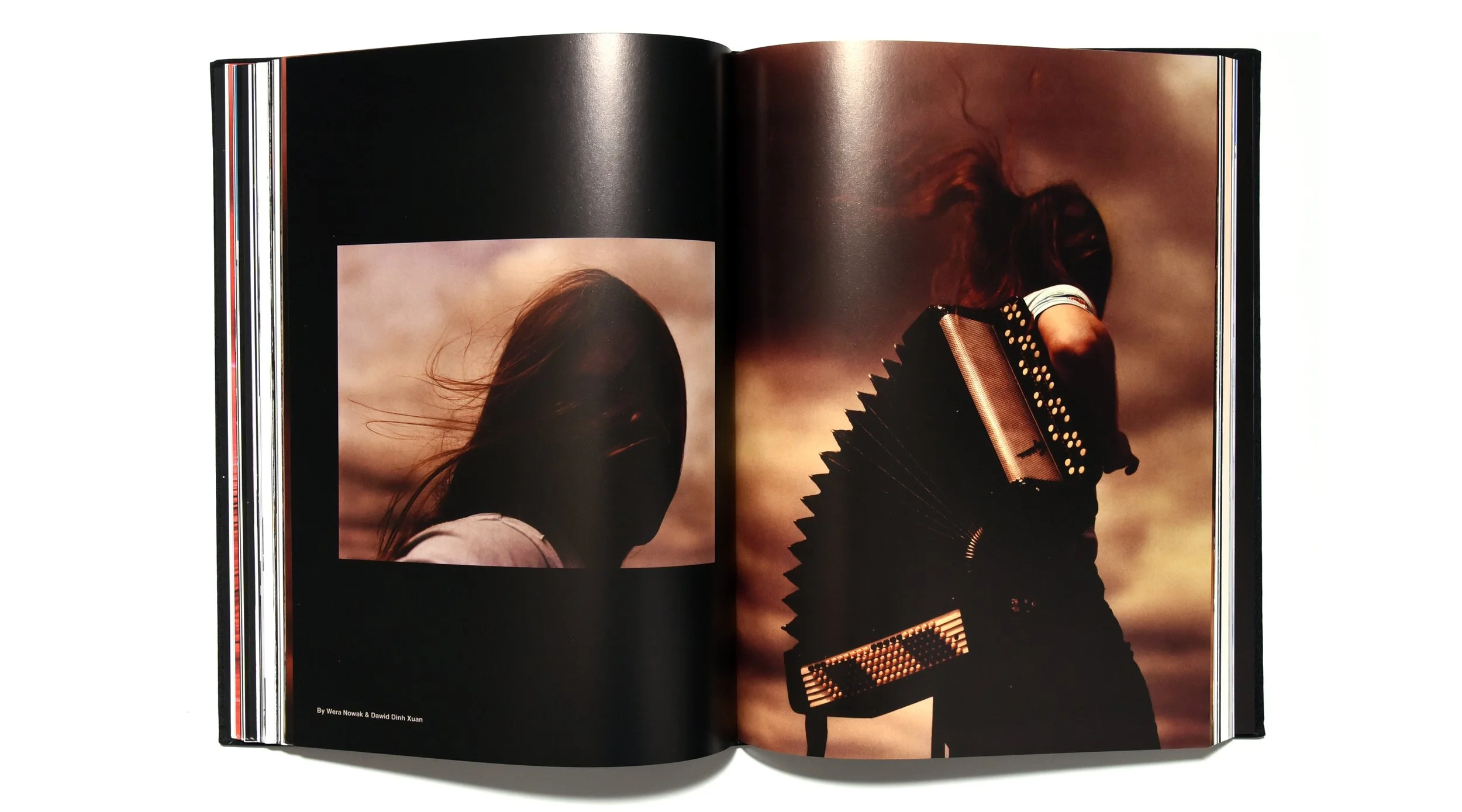
Farmers Publishing presents the long-awaited extended hardcover edition of MSM, the cult zine project by artist and filmmaker Jon Rafman. Expanded in both scope and ambition, this new volume brings together an extraordinary constellation of some of the most influential artists, writers, musicians, theorists, and cultural producers working today.
Conceived in collaboration with Rafman, Alix Ross (Farmer’s Daughter), and architect Liam Denhamer, MSM Vol. 2 assembles a distributed network of voices to investigate the shifting terrain between reality and simulation, myth and information, memory and fabrication. Through essays, artworks, speculative texts, conversations, and visual interventions, contributors explore the emergence of alternative realities, collectively authored worlds, internet folklore, digital belief systems, and the new forms of consciousness taking shape within networked culture.
At a moment when artificial intelligence, virtual environments, algorithmic feeds, and synthetic media increasingly mediate our understanding of the world, MSM Vol. 2 maps the unstable frontier where the real begins to dissolve into the simulated. The result is a sprawling document of contemporary thought and imagination—a collective excavation of the dreams, anxieties, fantasies, and fictions that define life in the twenty-first century.
OLIVER KUPPER: What interests me is that, in different ways, you're all mining the same dark, noxious cave of the post-capitalist digital dystopia we find ourselves living in. I'd love to hear how you first came together, what drew you to these ideas, and how those shared interests evolved into this collaboration.
JON RAFMAN: Oneohtrix Point Never [Daniel Lopatin] introduced Alix [Ross] and me right at the beginning of COVID. Interestingly, Alix had already reached out through an obscure app that allows people to text me directly, and I had never checked it. I’d also bought a bunch of his clothes, so our paths had already crossed in a strange way. Later, I moved to Altadena, and we ended up as neighbors. We became close friends almost immediately. For years, we kept saying we were going to make something together, and in some ways, we already had. Online Ceramics created the merch for Cloudy Heart, Pledge Torment, and Main Stream Media. This book is the first real thing we've finished together, after six years of talking about it on and off. We had also made paintings together, but when Alix’s house burned down, those works were lost.
ALIX ROSS: Yeah, we started the beginning of a collaborative body of paintings, but they're all gone.
RAFMAN: It will survive as a story now, which might suit it better anyway. Through Liam [Denhamer], I was involved in another zine project with the duo behind Opioid Crisis Lookbook. I'd known one of its members, Dustin Cauchi, for years, and he's a major contributor to this book as well. Liam can probably speak more to his side of it, but our connection began when he was curating a show in Berlin that included one of my videos. He designed the installation for the exhibition, and I remember seeing it and thinking, wow, this is incredible. At the time, I didn't know Liam personally. Then, by chance, I learned he was Canadian, teaching at UCLA, and spending part of his time in Los Angeles. I reached out because the installation stayed with me, and I had a show coming up; I thought he might want to work on it.
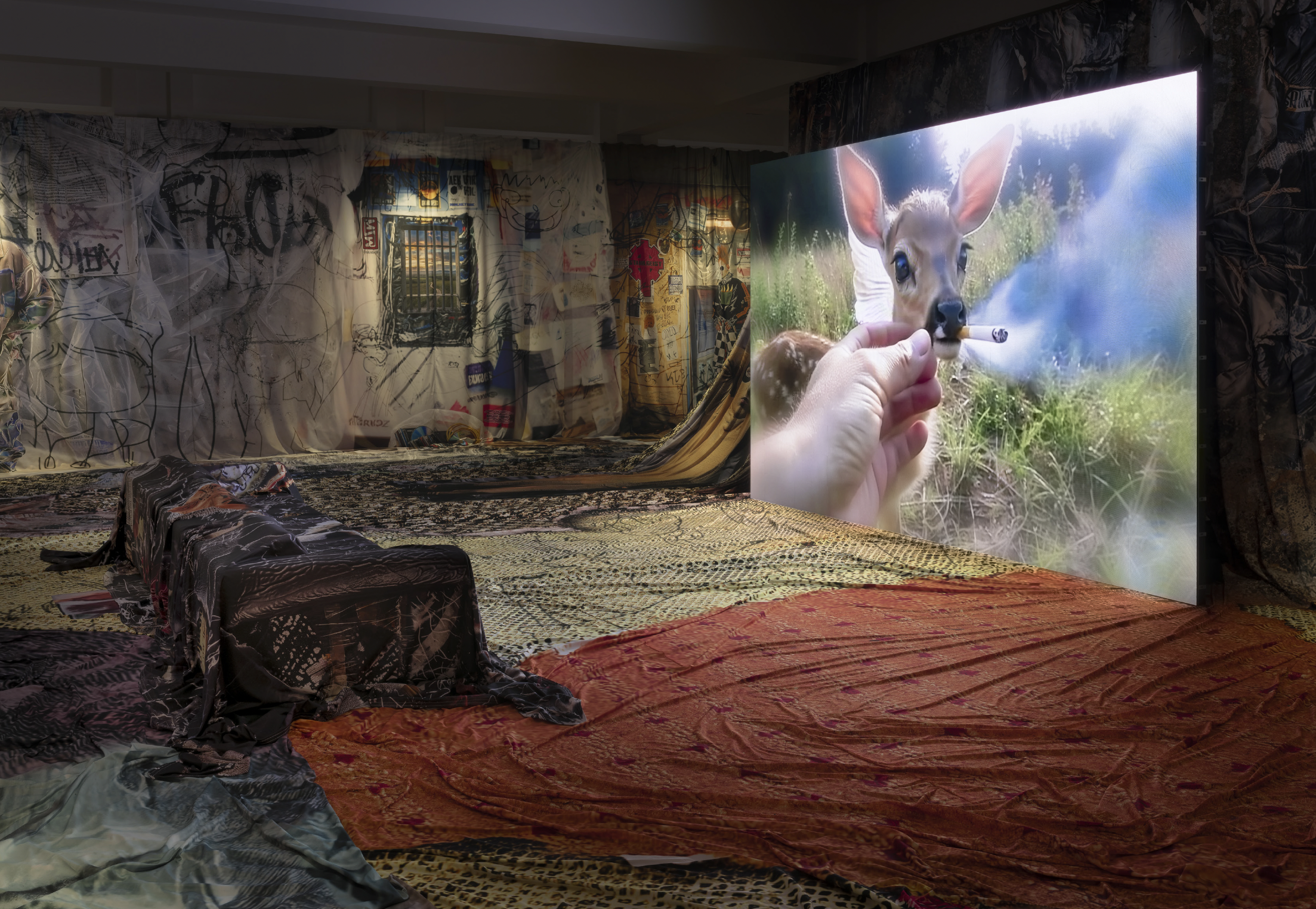
LIAM DENHAMER: The book really evolved out of the show we did at Sprüth Magers in 2025, [Proof Of Concept]. For that exhibition, I put together a zine—a kind of 100-page exhibition publication—that was originally conceived as a TV Guide for all of the videos Jon had produced and that were playing throughout the show. As we worked on it, though, it became something else. We invited friends and contributors to write for it, and it expanded beyond its initial purpose. It was a fairly fast project and, in many ways, something we pulled together at the last minute. But it revealed the potential for a much larger publication. This book grew directly out of that idea. We wanted to expand and develop what the zine had started.
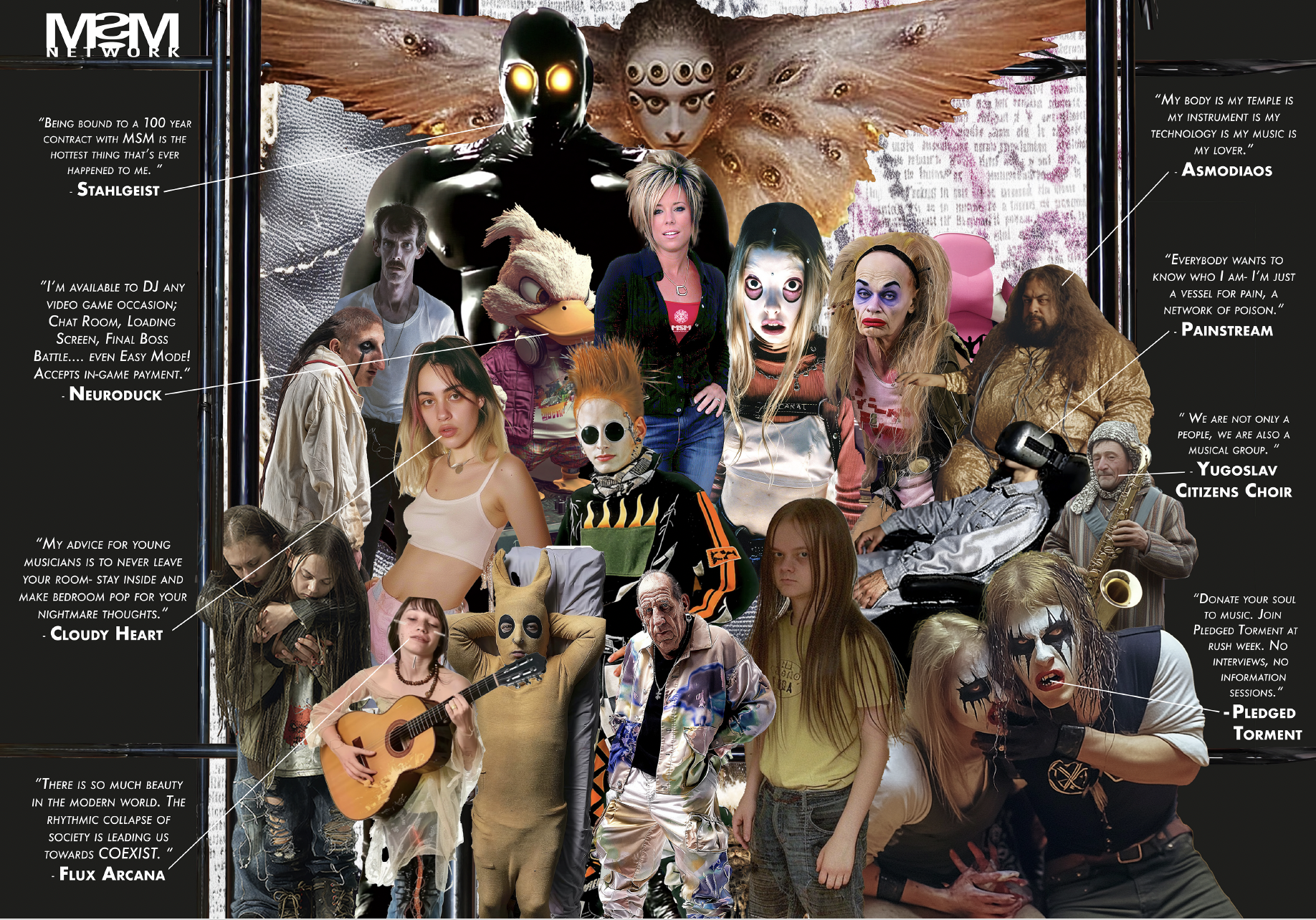
RAFMAN: It came out of a broader desire to create a world. At its core, it's a collaborative world-building project, which is what the Main Stream Media Network originally was—and still is, as it has continued to evolve through projects like my current exhibition in Düsseldorf. The initial idea was to imagine what a youth-oriented music television station—something in the spirit of MTV—might look like in the 21st century. I wanted it to function as more than just a series of videos. Each musician, artist, and character within the project would have their own backstory, discography, music videos, merchandise, and internal mythology. Building that world required collaborating with a large group of people, each contributing to its expanding universe.
The publication became a natural extension of that process. Visitors could walk through the exhibition, watch the music videos, and encounter these characters in paintings, photographs, and other works, but there wasn't always enough context to fully understand who they were or how they related to one another. The book provided a way to deepen that experience. In a sense, if the exhibition was the visible surface of the world, the publication offered a glimpse into everything beneath it. It allowed us to flesh out the histories, relationships, and narratives that couldn't be contained within the gallery space alone. If I were building my own Middle-earth, this would be a way to create some of the lore that makes the world feel lived-in and real.
KUPPER All of you seem particularly adept at disseminating ideas across different media and subcultural networks. Alix, your work moves fluidly between T-shirts, zines, publishing, and art objects. Jon, you've built an entire universe through your artwork and the various media that surround it. Liam, architecture and exhibition design become their own forms of communication and storytelling in your practice. I'd love to hear each of you speak about how you think ideas circulate today and how your work engages with that process.
ROSS: Yeah, I guess the question is really about how you get people to pay attention to what you're doing in a world that's becoming increasingly homogenized. It's really difficult. I don't know whether it's an advantage or not, but I think all three of us—certainly Jon and I—grew up on the internet in a very particular way. I was on message boards, 4chan, Neopets, and all these strange online communities when I was in seventh and eighth grade. In a sense, I was online at the birth of many of the cultural dynamics that now define the internet.
For me, the goal has always been to keep digging deeper into the well. Whenever there's a surface-level idea, trend, or aesthetic, I'm interested in what's underneath it. What are the references behind the references? What's the hidden logic, the overlooked history, or the unexpected connection that people haven't noticed yet? It's how you shift a familiar idea just enough to reveal a new perspective. With graphics and image-making, that process has become increasingly challenging because culture moves so quickly now. The speed of circulation is so much faster than it was even five years ago. Trends appear, peak, and disappear almost instantly. Everything feels accelerated to an exponential degree.
So I think part of the challenge today is finding ways to create work that isn't simply reacting to the churn of culture but is actually uncovering something deeper within it. That's the thing I'm always chasing.
RAFMAN I mean, we don't even have time to process what's happening before we've moved on to the next thing. It's so diffuse.
ROSS: The themes and subjects that interest me today are, in many ways, the same things that interested me when I was twelve years old. I keep returning to the experiences and perspectives that feel genuinely my own—whether that's growing up in the woods, working for the Forest Service, or other formative experiences that shaped the way I see the world. Those are the points I always come back to. The challenge is figuring out how to transmute those experiences into whatever I'm making at the moment. That's what I find exciting and rewarding.I think one thing I struggle with in a lot of contemporary art and music is that so much of it can feel surface-level. I don't mean that as a criticism, but I'm always interested in pushing an idea as far as it can go. If there's a first layer, I want to get to the tenth. I want to find the deepest, most complete expression of a concept and see where it leads. At the end of the day, though, I think you just have to follow your instincts.
RAFMAN: Yeah, the way I see it, you make things on intuition first and only look back at them afterward. If you start by trying to be cool—or worse, trying to be smart—you're probably going to make bad work. The work has to come from a more instinctive place. With Main Stream Media Network—the title itself, the zine, my new exhibition in Düsseldorf, and really a lot of my work more broadly—I'm responding to many of the same transformations that Alix is talking about. I watched the internet remake culture, but I came at it from a slightly older generation. I'd already finished college by the time Web 2.0 showed up.
Part of why I started building this fictional TV network, this whole world, is that it reaches back to a kind of cultural experience that no longer exists. I'm fascinated by the hyper-new, but I'm equally interested in what's been lost. There's something I miss about sitting down with a TV Guide, everyone on a couch, watching the same thing at the same time. That ritual feels almost prehistoric now. The same thing has happened with music and youth culture. It gets tricky when you start making value judgments, but there was a period—particularly in the second half of the twentieth century—when subcultures were deeply organized around music. Were you a punk? Were you into rave culture? Death metal? Hip-hop? Music wasn't just entertainment; it was a framework for identity.
I think that model largely peaked before the early 2000s. Today, with a few exceptions, people don't build their identities around music the way they used to. Culture is more scattered now, more slippery, and increasingly run through platforms. What's interesting about Alix's work is that he still engages with one of the last remnants of that tradition: building identities around bands and cultural projects. In some ways, the identity surrounding the music has become just as important—if not more important—than the music itself. The mythology, the visual language, the merch, the whole world around the work is where the experience actually lives.
That's also why collaborating with Liam felt like such a natural fit. So much of his practice circles around the same questions: how identity gets constructed, how spaces shape how people behave, how whole cultural worlds get built and lived in. The overlap was there from the start.

DENHAMER I think the three of us are similar in the extent to which we're all fascinated by these weird niche pockets of the internet and the people that congregate there...
RAFMAN: …And the nich-ification of culture.
DENHAMER: Yeah, I think all three of us are dealing, in different ways, with the translation of the virtual into the physical. For Alix, that often happens through merchandise and cultural artifacts like band T-shirts. He's creating identities and objects that emerge from content and communities that often originate in digital spaces. Jon takes a different approach, building on those references and expanding them into entirely new worlds with their own internal logic and mythology.
For me, I've always been fascinated by how the energy of online culture—and especially the intensity, awkwardness, and rawness of youth culture—can be translated into physical space. I was drawn to the brutality and immediacy of these strange online worlds populated by angry, creative, obsessive teenagers, and I became interested in how those qualities could manifest architecturally, whether through fictional environments or actual built spaces. In that sense, Jon and I were very much on the same wavelength long before we knew each other. We had been thinking about similar ideas for years.
Even the name of my firm, Juvenilia, points to that interest. The term refers to work produced at a young age, and I've always been fascinated by youth culture and the uninhibited production of ideas. One of my favorite places to look for inspiration was DeviantArt. You'd find kids posting drawings, sketches, and strange personal projects with almost no self-consciousness. They weren't trying to fit into a market or an institution. They were simply making things.
There's something incredibly powerful about that kind of production. It's raw, direct, and often more revealing than highly polished work because it's driven by curiosity and necessity rather than strategy. That's always been a major influence on how I think about architecture, design, and cultural production more broadly—the challenge of preserving some of that freedom and immediacy as ideas move from the virtual world into physical form.
RAFMAN: It's also been a huge source of inspiration for my practice.
DENHAMER: The book is one of these physical artifacts that emerges from the worlds we've been interested in for a long time—those strange message boards, niche online communities, and corners of the internet that have since changed or disappeared entirely. In a way, the project is rooted in nostalgia for those virtual spaces and the identities, cultures, and connections they made possible.
RAFMAN: There's an expression: “everything's downstream from 4chan,” and I truly think, for better or worse, that's true. From memes to every micro-trend, from looksmaxxing to incels to Pepe, it all comes from there. And it’s actually replaced mainstream culture.
ROSS: The movie Backrooms is proof of this. It's the highest-grossing film in A24 history.
RAFMAN: Yeah, it’s finally happening. When we started—when I was a net artist in the late aughts—the internet was already an omnipresent part of life, but there was still this perception that it was a space for weirdos and nerds. When, really, most people in the West were already living half their waking lives in front of a screen.
Now, with Backrooms, online obsessions everywhere, and the way digital culture has soaked into the mainstream, it's undeniable. Even with my show in Düsseldorf, I’ve noticed how engaged audiences are across generations. Boomers, Gen X—it resonates because it’s impossible to ignore that the world is changing.
“It's important that this work functions as part of a larger world-building exercise. What excites me about it is that it catches a moment when the old machinery of media distribution is coming apart.”
KUPPER: Adam Curtis has talked about the idea that we're living in a kind of haunted house, surrounded by the remnants of old systems that no longer function the way they once did, but still shape our lives. I think about that in relation to the internet. For a long time, the digital world felt separate from reality. Now it feels like the opposite is true: reality is starting to imitate the internet, making it harder to tell where one ends and the other begins.
RAFMAN We’ve seen that process accelerate since around 2016, almost to the point of absurdity. But I think that’s exactly what all of our practices are engaging with: the blurring of the digital and the physical, the way the two have begun to bleed into one another and ultimately collapse into a single reality.
Many of our cultural institutions and media industries are still catching up to that shift. Backrooms is a good example: whole new forms of culture are coming out of online spaces, while the legacy media structures still own most of the public conversation. There’s a growing gap between those established systems and what’s actually happening beneath the surface.
KUPPER: Liam, I wanted to ask about one of your essays in the book, particularly your idea of "anti-alone architecture." In the essay, you draw a comparison to hostile architecture, but you're describing something different—an architectural response to a world where people are increasingly connected digitally while becoming more isolated physically. It struck me as another example of how the internet has seeped into the real world and begun reshaping the spaces we inhabit. Could you talk a bit about that essay and what you mean by 'anti-alone architecture'? How does it relate to the social and psychological conditions of the present moment?
DENHAMER: That project grew out of my fascination with The Vessel, the Thomas Heatherwick structure in New York. I became interested in it as a piece of public architecture because it represented something strange about the moment we're living through. It was a massively funded project—an enormous piece of public architecture that functioned almost like a trophy for Hudson Yards. What fascinated me was that, for reasons that were difficult to fully explain, it became associated with a series of suicides. Something about its context, its form, and its position within the city seemed to draw people there to end their lives in a highly public way. I found that deeply unsettling and strangely compelling.
I became interested in the idea that this specific piece of contemporary architecture had, unintentionally, become linked to feelings of isolation, despair, and alienation. That led me to think about architecture as something that could embody those psychological states. The project evolved into a speculative architectural proposal with two opposing conditions. One side was designed around total exposure and visibility; the other around complete isolation. In that sense, it became a building about both connection and loneliness.
The upper levels were inspired by the history of the open-plan workspace, which was originally conceived as a way of fostering collaboration and collective labor. The desks were arranged so that occupants were constantly confronted by the presence of others. It was an architecture of radical visibility.
By contrast, the lower levels were designed as an intensely solitary experience. Visitors descended through a narrow corridor only wide enough for a single person, eventually arriving at a chamber where sound and spatial conditions heightened the feeling of isolation. It was meant to be a visceral confrontation with being alone.
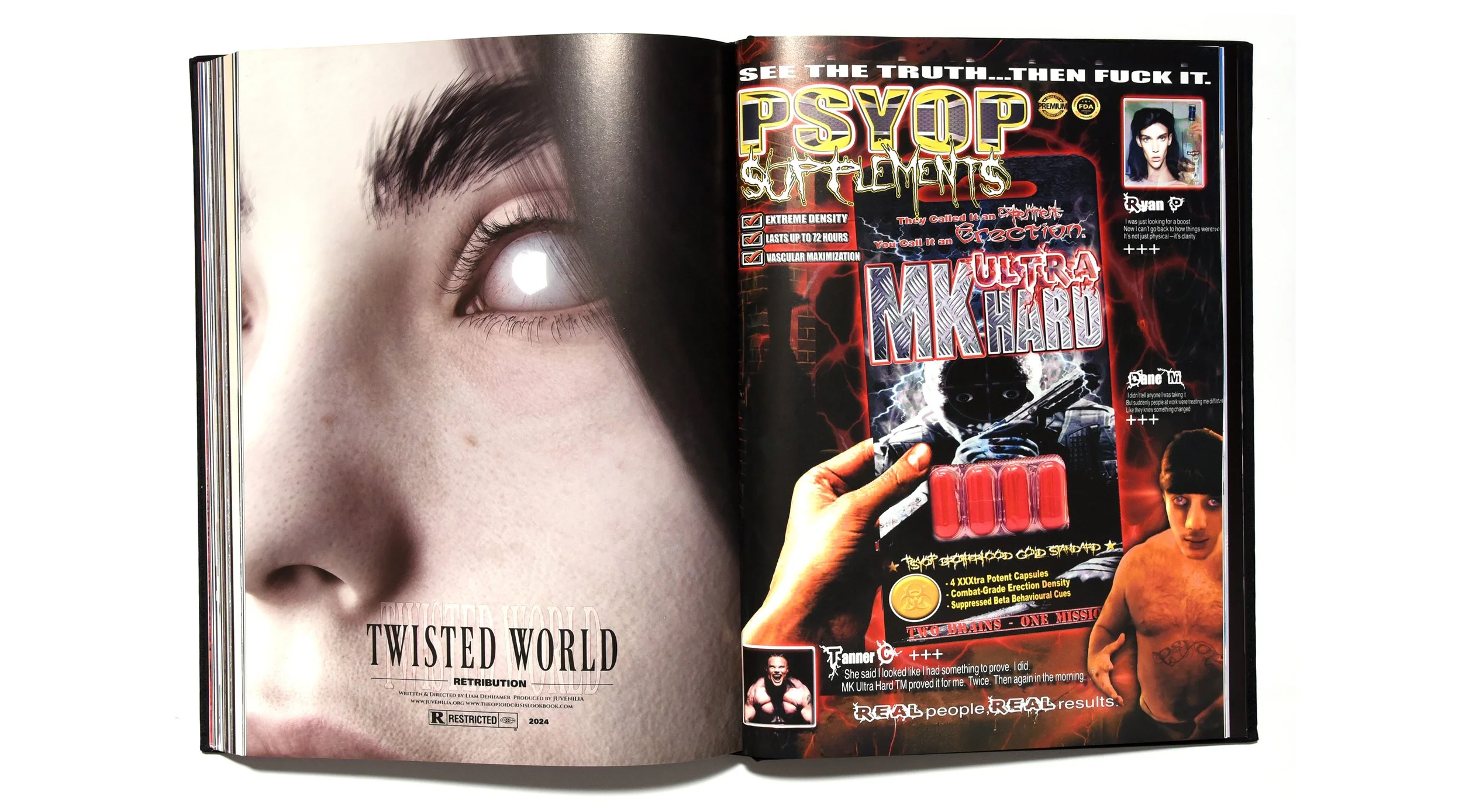
The project was originally created for The Opioid Crisis Lookbook, the publication Jon mentioned earlier. I decided to include the essay here because it felt connected to many of the same themes we're exploring throughout the publication.
At its core, it's another example of how online experiences and digital conditions begin to shape physical space. Like Jon's work and Alix's work, it's a form of world-building, but my medium happens to be architecture. I'm interested in how the emotional and psychological conditions produced by the internet—especially isolation, hyper-visibility, and alienation—can be translated into physical environments.
That's something Jon and I have explored together in exhibition design as well. One installation we developed centered on a long linear corridor punctuated by a series of niches, creating a heightened sense of separation and solitude. In many ways, it was an attempt to give physical form to a feeling that is often associated with digital life: being connected to everything while simultaneously feeling alone.
RAFMAN: There’s a tension between feeling comfortable in isolation—being alone with your laptop, playing a video game, existing in that kind of self-contained world—and the suffocation or sense of being trapped that can come with it. A lot of the imagery works in a similar way. It can be grotesque and appealing at the same time. Those kinds of contradictions can exist within a single thing, and that’s often what makes it interesting.
KUPPER: What was that curation process of putting all these ideas and artists together in the book? There’s even an essay by Norman Klein.
RAFMAN: It started chaotically, and the book still carries some of that. Liam tightened it over time and gave it a real structure. Norman Klein had also written something for my catalog at the Louisiana Museum of Art, but it didn’t quite fit there, since that project was focused specifically on Google Street View. This book has a much broader scope. I’ve admired his work for a long time—since I first came across it when I was at CalArts for a year before dropping out.
We’ve stayed in conversation over the years, and his interests overlap heavily with the themes we’re discussing here, from his writing on Las Vegas to The History of Forgetting, which focuses on Los Angeles and ideas of loss and erasure. It was especially valuable to hear his perspective, having grown up in Coney Island when it was still very much Coney Island.
KUPPER: I mean, LA feels like the internet in a way. It feels like a place that shouldn't exist.
RAFMAN: It's completely constructed. It's also just constantly rewriting itself without any remnants of the past.
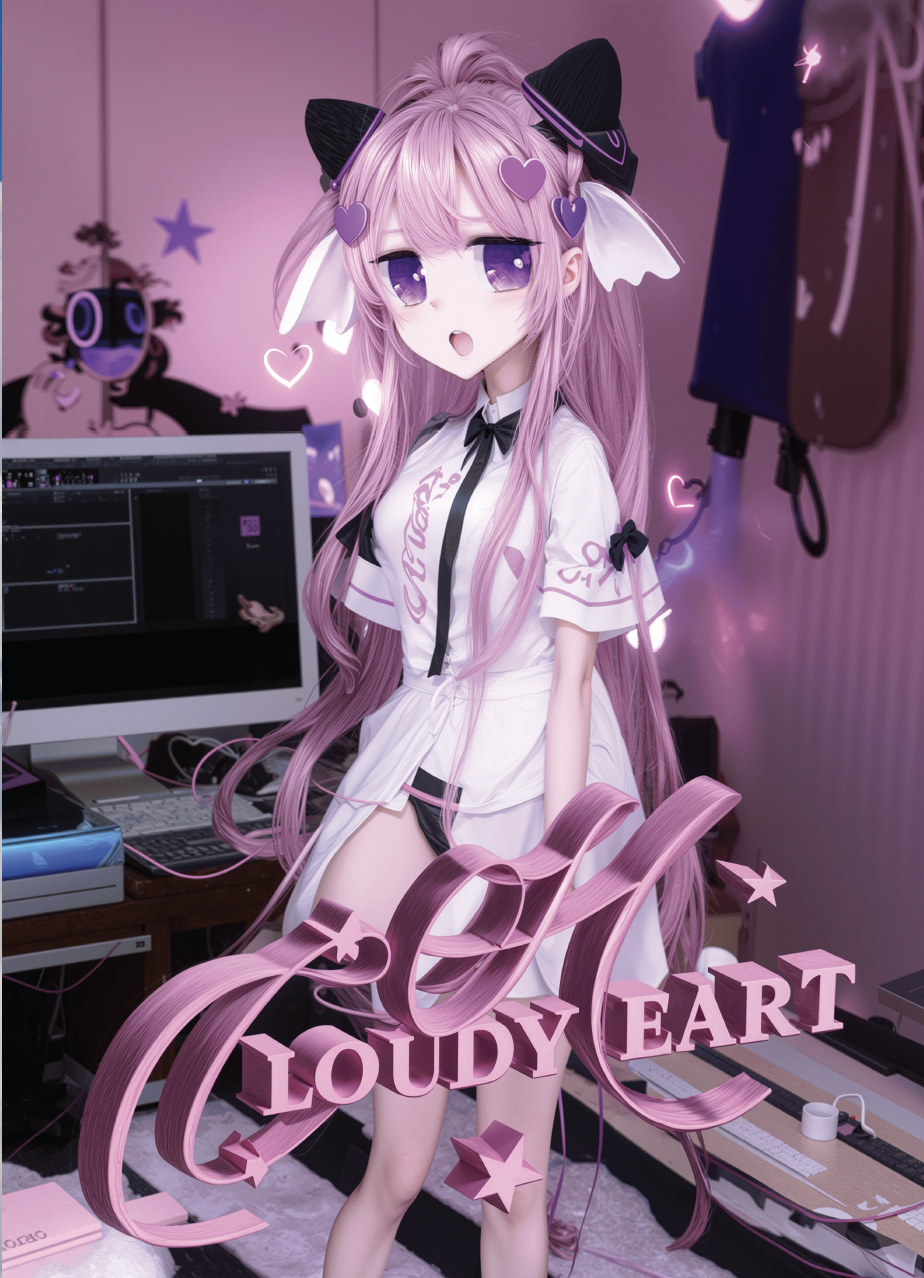
KUPPER: Can you talk a little bit about the characters in the book, like Cloudy Heart, and these imaginary bands and pop stars—and where that inspiration came from? Not just in creating them, but in building out their back catalogs and entire histories?
RAFMAN: It came out of a desire to imagine what could be built using the latest tools—tools that let you make things that used to demand huge budgets, big teams, or years of training, and now run on a subscription, a small crew, and a different way of working.
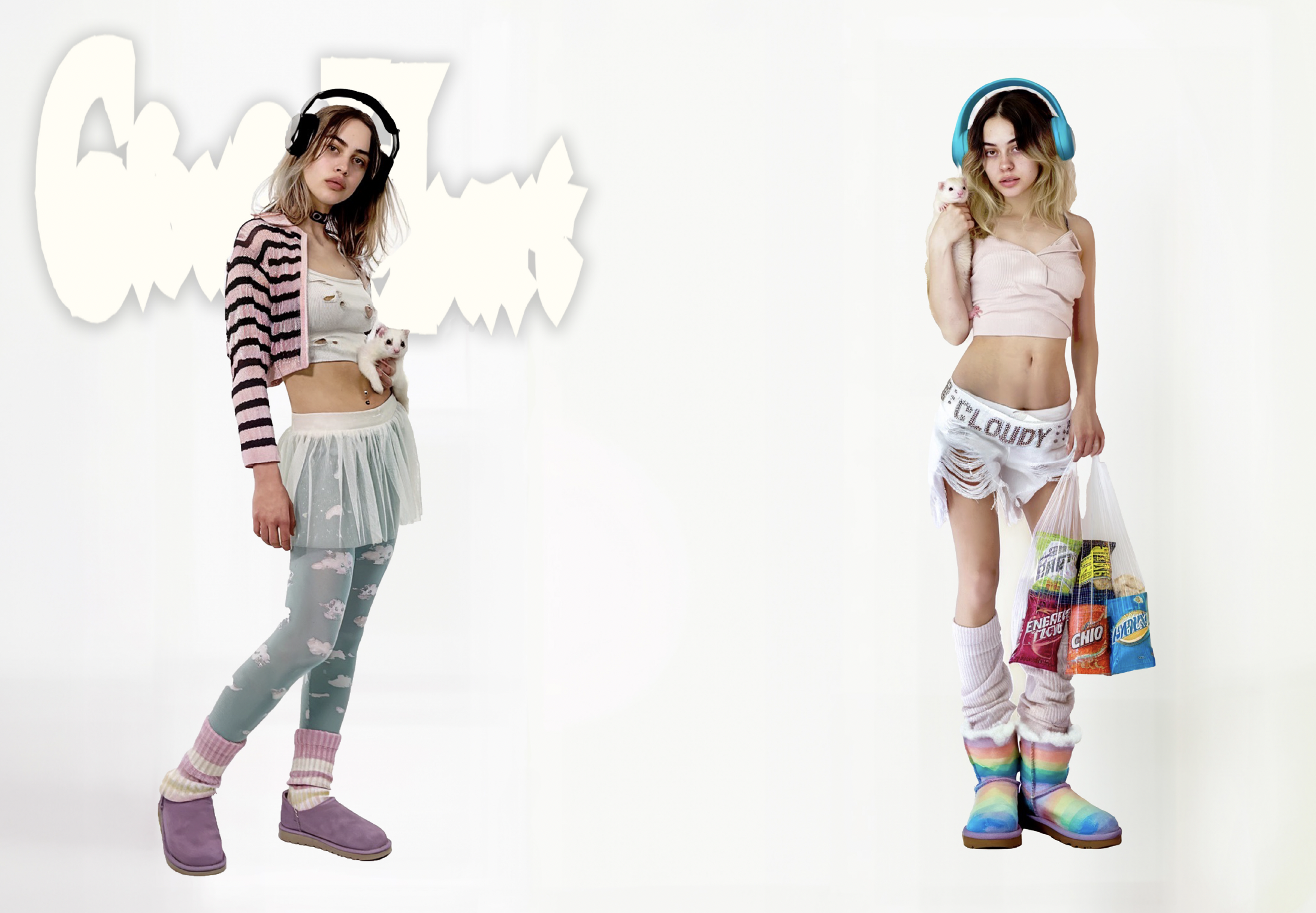
I wanted to catch the present while setting it against what subculture used to mean. For Cloudy Heart, for example, I wanted to create a femcel bedroom-pop star and then build an entire world around her. It made sense for that character to exist in crypto, to have her own meme coin, and to see how that identity could expand and mutate beyond a single work.
Edged Torment was another experiment in that direction—using AI to combine genres that don’t typically intersect, like bebop jazz and death metal, and situating them within unexpected contexts, like Ivy League fraternities.
There was never one fixed goal beyond using these tools to keep a world expanding—something closer to a Marvel-style universe that could keep growing over time, with space for others to contribute, reinterpret, or write within it. In a way, it becomes closer to a wiki structure, where characters and narratives can be taken up and expanded by other people.
I think what connects all of this is a shift in how culture is formed. Band culture, or character-driven culture more broadly, now feels more important than official canon. The most interesting material often comes from outside institutional frameworks—from teenagers in middle America writing Sonic the Hedgehog fan fiction, or from communities building their own mythologies online. That kind of fan-generated culture often feels more alive than the official franchises.
I want to take that energy and turn it into something MTV-shaped, built out of bands, characters, and stories that keep branching. It’s intentionally expansive, and in some ways even a bit presumptuous, but I like that new technologies like AI make that kind of thinking possible. They allow you to operate across music, film, writing, video games, and even meme economies without having to fully master each discipline in the traditional sense.
KUPPER: There's also a religious aspect or a mystical aspect to the book, too. Can you talk a little bit about that aspect of it?
RAFMAN: I think maybe we didn’t approach it with that framing at first. I’m not sure we’re still fully in that moment anymore, but over the past, say, eight years, there’s been something like a Cambrian explosion of identities. Suddenly, you see kids identifying as monarchists, or adopting all kinds of niche political or cultural positions—sometimes clearly LARPing, sometimes not—from trad-Catholicism to highly obscure national or ideological affiliations, all mixed together.
A lot of it traces back to internet subcultures, spaces like 4chan, which carry complicated and often dangerous associations: the overlap with fascist aesthetics, the Wagner and Nazism references. At the same time, there’s a broader pull toward mystical, esoteric, and symbolic systems.
In moments where reality feels harder to interpret, people often gravitate toward imagery that feels more charged or legible in a mythic sense. Occult symbolism, historical iconography, whatever offers a system of meaning becomes a way of making sense of the world. It’s all part of a larger visual and conceptual language that a lot of younger culture seems to be drawing from right now.
DENHAMER: Yeah, that comes through in a lot of the pieces that engage with this connection to religion in one way or another. Many of the contributors are interested in that as well. Some of the artworks similarly draw on imagery of angels and religious iconography. Jon also returns to the figure of the angel quite often in his work—he just made a sculpture recently that continues that exploration.
RAFMAN: I mean, the MSM icon is based on Ophanim, one of the Old Testament angels, which are just these wheels covered in eyes. You know, the actual angel is not this pretty thing with wings. It's terrifying.
KUPPER: Alix, could you talk a little bit about Farmer's Daughter—what its aims and objectives are, and how it differs from some of your previous projects, like Online Ceramics?
ROSS: I haven't really spoken about it publicly in a formal way before. I've talked about it here and there, but I haven't really gone on the record about what it is. At its core, Farmer's Daughter is a brand, but it's also an extension of what I was doing with Online Ceramics. It's a continuation of a practice I've developed over the last decade, and that practice is rooted in collaboration. More than anything, I like working with other people. That's always been one of the driving forces behind what I do.
There are a lot of things currently in development, including clothing and cut-and-sew collections that will have their own world and identity. But it's still very early. I only started building it last fall, so despite having done this kind of work for a long time, the project itself is still in its infancy. There are so many ideas, collaborations, and pieces in development that it's difficult to fully explain where it's headed.
What I can say is that I'm trying to go deeper into the themes and ideas that interested me at Online Ceramics. In some ways, I'm returning to the place I was in just before Online Ceramics existed. Those interests and experiences eventually became the foundation of that project, and now I'm revisiting them with a different perspective and pushing them further.
A lot of it comes from personal experience. There was a period in my life when I didn't really have a home, and the experiences I had during that time shaped the way I see the world. I spent years going to transformational arts festivals, regional gatherings, jam-band festivals, Burning Man, and all kinds of communities throughout the Midwest. At that point, I wasn't really thinking about art at all. I was searching for a different way of living and a different kind of world.
What's interesting is that I can now go online, type in the year, and find footage from many of those festivals. I've built huge archives and mood boards around that period of my life. Those experiences remain central to the way I think and the things I want to make.
At the same time, the project is also very much connected to the present. One of the most exciting things that's happened naturally is that I've started working closely with a number of younger musicians and artists. Through projects with Snow Strippers and others, I've found myself connected to emerging Gen Z music scenes, and that's been incredibly inspiring. It's become one of the central narratives within the project, though certainly not the only one.
So while it's difficult to define Farmer's Daughter in a simple way right now, I think the common thread is that it's an attempt to build worlds around the things that genuinely interest me—through collaboration, culture, music, clothing, publishing, and whatever other forms feel necessary. The project is still taking shape, but that's very much where it's coming from.
KUPPER: Can you talk about the publishing part of this?
ROSS: Yeah, I've always wanted to do books. Being close with Jon, this project felt like a natural place to start. There are several other books in development right now, and I see occasional publishing projects becoming an important part of the brand—books and subjects that I find especially compelling, timely, or culturally relevant.
For example, I've been talking with Krystle Cole about a possible project. In the early 2000s, she lived in a missile silo with Leonard Pickard, who was involved in what was reportedly one of the largest clandestine LSD and MDMA production operations in the world. It's a fascinating story that sits at the intersection of counterculture, mythology, and recent American history, which is exactly the kind of subject matter that interests me. She wrote a book called Lysergic.
When I think about the publishing side of the brand, I don't see it as a traditional art-book imprint. I see it as a constellation of friends, artists, and ideas that speak to one another in unexpected ways. There might be Jon's contemporary visual art book alongside something like a republication of Krystal Cole's Lysergic, her autobiography, or a project with Matt Copson centered on his opera-film Last Days.
It's not simply about publishing art books; it's about creating relationships between different kinds of cultural objects. It's similar to how I think about curating exhibitions, magazines, or any creative project. When you place Krystal Cole's Lysergic next to Jon's visual art book, each changes the way you read the other. New meanings emerge through proximity. So the question I'm interested in is: how do you publish books that, together, tell a larger story?
KUPPER: The book almost feels like a strange edge lord guide to the times we are living in, but not overly intellectualized.
RAFMAN: For me, it's important that this work functions as part of a larger world-building exercise. What excites me about it is that it catches a moment when the old machinery of media distribution is coming apart. Traditionally, culture was divided into separate industries—music, film, publishing, fine art—but that distinction is beginning to collapse.
In many ways, it has already collapsed online. The internet has flattened those boundaries, even if the large media conglomerates that were built around them still exist. We're living through a transitional moment where it's not entirely clear what comes next.
That's part of what interests me about this project. It feels like a time capsule of this particular moment—one that captures a culture in the middle of transformation. The truth is, none of us can fully see where we're headed yet, and the work doesn't pretend otherwise.
RAFMAN I mean, we don't even have time to process what's happening before we've moved on to the next thing. It's so diffuse.
ROSS: The themes and subjects that interest me today are, in many ways, the same things that interested me when I was twelve years old. I keep returning to the experiences and perspectives that feel genuinely my own—whether that's growing up in the woods, working for the Forest Service, or other formative experiences that shaped the way I see the world. Those are the points I always come back to. The challenge is figuring out how to transmute those experiences into whatever I'm making at the moment. That's what I find exciting and rewarding.I think one thing I struggle with in a lot of contemporary art and music is that so much of it can feel surface-level. I don't mean that as a criticism, but I'm always interested in pushing an idea as far as it can go. If there's a first layer, I want to get to the tenth. I want to find the deepest, most complete expression of a concept and see where it leads. At the end of the day, though, I think you just have to follow your instincts.
"I'm fascinated by the hyper-new, but I'm equally interested in what's been lost."
RAFMAN: Yeah, the way I see it, you make things on intuition first and only look back at them afterward. If you start by trying to be cool—or worse, trying to be smart—you're probably going to make bad work. The work has to come from a more instinctive place. With Main Stream Media Network—the title itself, the zine, my new exhibition in Düsseldorf, and really a lot of my work more broadly—I'm responding to many of the same transformations that Alix is talking about. I watched the internet remake culture, but I came at it from a slightly older generation. I'd already finished college by the time Web 2.0 showed up.
Part of why I started building this fictional TV network, this whole world, is that it reaches back to a kind of cultural experience that no longer exists. I'm fascinated by the hyper-new, but I'm equally interested in what's been lost. There's something I miss about sitting down with a TV Guide, everyone on a couch, watching the same thing at the same time. That ritual feels almost prehistoric now. The same thing has happened with music and youth culture. It gets tricky when you start making value judgments, but there was a period—particularly in the second half of the twentieth century—when subcultures were deeply organized around music. Were you a punk? Were you into rave culture? Death metal? Hip-hop? Music wasn't just entertainment; it was a framework for identity.
I think that model largely peaked before the early 2000s. Today, with a few exceptions, people don't build their identities around music the way they used to. Culture is more scattered now, more slippery, and increasingly run through platforms. What's interesting about Alix's work is that he still engages with one of the last remnants of that tradition: building identities around bands and cultural projects. In some ways, the identity surrounding the music has become just as important—if not more important—than the music itself. The mythology, the visual language, the merch, the whole world around the work is where the experience actually lives.
That's also why collaborating with Liam felt like such a natural fit. So much of his practice circles around the same questions: how identity gets constructed, how spaces shape how people behave, how whole cultural worlds get built and lived in. The overlap was there from the start.
DENHAMER I think the three of us are similar in the extent to which we're all fascinated by these weird niche pockets of the internet and the people that congregate there...
RAFMAN: …And the nich-ification of culture.
DENHAMER: Yeah, I think all three of us are dealing, in different ways, with the translation of the virtual into the physical. For Alix, that often happens through merchandise and cultural artifacts like band T-shirts. He's creating identities and objects that emerge from content and communities that often originate in digital spaces. Jon takes a different approach, building on those references and expanding them into entirely new worlds with their own internal logic and mythology.
For me, I've always been fascinated by how the energy of online culture—and especially the intensity, awkwardness, and rawness of youth culture—can be translated into physical space. I was drawn to the brutality and immediacy of these strange online worlds populated by angry, creative, obsessive teenagers, and I became interested in how those qualities could manifest architecturally, whether through fictional environments or actual built spaces. In that sense, Jon and I were very much on the same wavelength long before we knew each other. We had been thinking about similar ideas for years.
Even the name of my firm, Juvenilia, points to that interest. The term refers to work produced at a young age, and I've always been fascinated by youth culture and the uninhibited production of ideas. One of my favorite places to look for inspiration was DeviantArt. You'd find kids posting drawings, sketches, and strange personal projects with almost no self-consciousness. They weren't trying to fit into a market or an institution. They were simply making things.
There's something incredibly powerful about that kind of production. It's raw, direct, and often more revealing than highly polished work because it's driven by curiosity and necessity rather than strategy. That's always been a major influence on how I think about architecture, design, and cultural production more broadly—the challenge of preserving some of that freedom and immediacy as ideas move from the virtual world into physical form.
RAFMAN: It's also been a huge source of inspiration for my practice.
DENHAMER: The book is one of these physical artifacts that emerges from the worlds we've been interested in for a long time—those strange message boards, niche online communities, and corners of the internet that have since changed or disappeared entirely. In a way, the project is rooted in nostalgia for those virtual spaces and the identities, cultures, and connections they made possible.
RAFMAN: There's an expression: “everything's downstream from 4chan,” and I truly think, for better or worse, that's true. From memes to every micro-trend, from looksmaxxing to incels to Pepe, it all comes from there. And it’s actually replaced mainstream culture.
ROSS: The movie Backrooms is proof of this. It's the highest-grossing film in A24 history.
RAFMAN: Yeah, it’s finally happening. When we started—when I was a net artist in the late aughts—the internet was already an omnipresent part of life, but there was still this perception that it was a space for weirdos and nerds. When, really, most people in the West were already living half their waking lives in front of a screen.
Now, with Backrooms, online obsessions everywhere, and the way digital culture has soaked into the mainstream, it's undeniable. Even with my show in Düsseldorf, I’ve noticed how engaged audiences are across generations. Boomers, Gen X—it resonates because it’s impossible to ignore that the world is changing.
KUPPER: Adam Curtis has talked about the idea that we're living in a kind of haunted house, surrounded by the remnants of old systems that no longer function the way they once did, but still shape our lives. I think about that in relation to the internet. For a long time, the digital world felt separate from reality. Now it feels like the opposite is true: reality is starting to imitate the internet, making it harder to tell where one ends and the other begins.
RAFMAN We’ve seen that process accelerate since around 2016, almost to the point of absurdity. But I think that’s exactly what all of our practices are engaging with: the blurring of the digital and the physical, the way the two have begun to bleed into one another and ultimately collapse into a single reality.
Many of our cultural institutions and media industries are still catching up to that shift. Backrooms is a good example: whole new forms of culture are coming out of online spaces, while the legacy media structures still own most of the public conversation. There’s a growing gap between those established systems and what’s actually happening beneath the surface.
KUPPER: Liam, I wanted to ask about one of your essays in the book, particularly your idea of "anti-alone architecture." In the essay, you draw a comparison to hostile architecture, but you're describing something different—an architectural response to a world where people are increasingly connected digitally while becoming more isolated physically. It struck me as another example of how the internet has seeped into the real world and begun reshaping the spaces we inhabit. Could you talk a bit about that essay and what you mean by 'anti-alone architecture'? How does it relate to the social and psychological conditions of the present moment?
DENHAMER: That project grew out of my fascination with The Vessel, the Thomas Heatherwick structure in New York. I became interested in it as a piece of public architecture because it represented something strange about the moment we're living through. It was a massively funded project—an enormous piece of public architecture that functioned almost like a trophy for Hudson Yards. What fascinated me was that, for reasons that were difficult to fully explain, it became associated with a series of suicides. Something about its context, its form, and its position within the city seemed to draw people there to end their lives in a highly public way. I found that deeply unsettling and strangely compelling.
I became interested in the idea that this specific piece of contemporary architecture had, unintentionally, become linked to feelings of isolation, despair, and alienation. That led me to think about architecture as something that could embody those psychological states. The project evolved into a speculative architectural proposal with two opposing conditions. One side was designed around total exposure and visibility; the other around complete isolation. In that sense, it became a building about both connection and loneliness.
The upper levels were inspired by the history of the open-plan workspace, which was originally conceived as a way of fostering collaboration and collective labor. The desks were arranged so that occupants were constantly confronted by the presence of others. It was an architecture of radical visibility.
By contrast, the lower levels were designed as an intensely solitary experience. Visitors descended through a narrow corridor only wide enough for a single person, eventually arriving at a chamber where sound and spatial conditions heightened the feeling of isolation. It was meant to be a visceral confrontation with being alone.
The project was originally created for The Opioid Crisis Lookbook, the publication Jon mentioned earlier. I decided to include the essay here because it felt connected to many of the same themes we're exploring throughout the publication.
At its core, it's another example of how online experiences and digital conditions begin to shape physical space. Like Jon's work and Alix's work, it's a form of world-building, but my medium happens to be architecture. I'm interested in how the emotional and psychological conditions produced by the internet—especially isolation, hyper-visibility, and alienation—can be translated into physical environments.
That's something Jon and I have explored together in exhibition design as well. One installation we developed centered on a long linear corridor punctuated by a series of niches, creating a heightened sense of separation and solitude. In many ways, it was an attempt to give physical form to a feeling that is often associated with digital life: being connected to everything while simultaneously feeling alone.
"Everything's downstream from 4chan."
RAFMAN: There’s a tension between feeling comfortable in isolation—being alone with your laptop, playing a video game, existing in that kind of self-contained world—and the suffocation or sense of being trapped that can come with it. A lot of the imagery works in a similar way. It can be grotesque and appealing at the same time. Those kinds of contradictions can exist within a single thing, and that’s often what makes it interesting.
KUPPER: What was that curation process of putting all these ideas and artists together in the book? There’s even an essay by Norman Klein.
RAFMAN: It started chaotically, and the book still carries some of that. Liam tightened it over time and gave it a real structure. Norman Klein had also written something for my catalog at the Louisiana Museum of Art, but it didn’t quite fit there, since that project was focused specifically on Google Street View. This book has a much broader scope. I’ve admired his work for a long time—since I first came across it when I was at CalArts for a year before dropping out.
We’ve stayed in conversation over the years, and his interests overlap heavily with the themes we’re discussing here, from his writing on Las Vegas to The History of Forgetting, which focuses on Los Angeles and ideas of loss and erasure. It was especially valuable to hear his perspective, having grown up in Coney Island when it was still very much Coney Island.
KUPPER: I mean, LA feels like the internet in a way. It feels like a place that shouldn't exist.
RAFMAN: It's completely constructed. It's also just constantly rewriting itself without any remnants of the past.
KUPPER: Can you talk a little bit about the characters in the book, like Cloudy Heart, and these imaginary bands and pop stars—and where that inspiration came from? Not just in creating them, but in building out their back catalogs and entire histories?
RAFMAN: It came out of a desire to imagine what could be built using the latest tools—tools that let you make things that used to demand huge budgets, big teams, or years of training, and now run on a subscription, a small crew, and a different way of working.
I wanted to catch the present while setting it against what subculture used to mean. For Cloudy Heart, for example, I wanted to create a femcel bedroom-pop star and then build an entire world around her. It made sense for that character to exist in crypto, to have her own meme coin, and to see how that identity could expand and mutate beyond a single work.
Edged Torment was another experiment in that direction—using AI to combine genres that don’t typically intersect, like bebop jazz and death metal, and situating them within unexpected contexts, like Ivy League fraternities.
There was never one fixed goal beyond using these tools to keep a world expanding—something closer to a Marvel-style universe that could keep growing over time, with space for others to contribute, reinterpret, or write within it. In a way, it becomes closer to a wiki structure, where characters and narratives can be taken up and expanded by other people.
I think what connects all of this is a shift in how culture is formed. Band culture, or character-driven culture more broadly, now feels more important than official canon. The most interesting material often comes from outside institutional frameworks—from teenagers in middle America writing Sonic the Hedgehog fan fiction, or from communities building their own mythologies online. That kind of fan-generated culture often feels more alive than the official franchises.
I want to take that energy and turn it into something MTV-shaped, built out of bands, characters, and stories that keep branching. It’s intentionally expansive, and in some ways even a bit presumptuous, but I like that new technologies like AI make that kind of thinking possible. They allow you to operate across music, film, writing, video games, and even meme economies without having to fully master each discipline in the traditional sense.
KUPPER: There's also a religious aspect or a mystical aspect to the book, too. Can you talk a little bit about that aspect of it?
RAFMAN: I think maybe we didn’t approach it with that framing at first. I’m not sure we’re still fully in that moment anymore, but over the past, say, eight years, there’s been something like a Cambrian explosion of identities. Suddenly, you see kids identifying as monarchists, or adopting all kinds of niche political or cultural positions—sometimes clearly LARPing, sometimes not—from trad-Catholicism to highly obscure national or ideological affiliations, all mixed together.
A lot of it traces back to internet subcultures, spaces like 4chan, which carry complicated and often dangerous associations: the overlap with fascist aesthetics, the Wagner and Nazism references. At the same time, there’s a broader pull toward mystical, esoteric, and symbolic systems.
In moments where reality feels harder to interpret, people often gravitate toward imagery that feels more charged or legible in a mythic sense. Occult symbolism, historical iconography, whatever offers a system of meaning becomes a way of making sense of the world. It’s all part of a larger visual and conceptual language that a lot of younger culture seems to be drawing from right now.
DENHAMER: Yeah, that comes through in a lot of the pieces that engage with this connection to religion in one way or another. Many of the contributors are interested in that as well. Some of the artworks similarly draw on imagery of angels and religious iconography. Jon also returns to the figure of the angel quite often in his work—he just made a sculpture recently that continues that exploration.
RAFMAN: I mean, the MSM icon is based on Ophanim, one of the Old Testament angels, which are just these wheels covered in eyes. You know, the actual angel is not this pretty thing with wings. It's terrifying.
KUPPER: Alix, could you talk a little bit about Farmer's Daughter—what its aims and objectives are, and how it differs from some of your previous projects, like Online Ceramics?
ROSS: I haven't really spoken about it publicly in a formal way before. I've talked about it here and there, but I haven't really gone on the record about what it is. At its core, Farmer's Daughter is a brand, but it's also an extension of what I was doing with Online Ceramics. It's a continuation of a practice I've developed over the last decade, and that practice is rooted in collaboration. More than anything, I like working with other people. That's always been one of the driving forces behind what I do.
There are a lot of things currently in development, including clothing and cut-and-sew collections that will have their own world and identity. But it's still very early. I only started building it last fall, so despite having done this kind of work for a long time, the project itself is still in its infancy. There are so many ideas, collaborations, and pieces in development that it's difficult to fully explain where it's headed.
What I can say is that I'm trying to go deeper into the themes and ideas that interested me at Online Ceramics. In some ways, I'm returning to the place I was in just before Online Ceramics existed. Those interests and experiences eventually became the foundation of that project, and now I'm revisiting them with a different perspective and pushing them further.
A lot of it comes from personal experience. There was a period in my life when I didn't really have a home, and the experiences I had during that time shaped the way I see the world. I spent years going to transformational arts festivals, regional gatherings, jam-band festivals, Burning Man, and all kinds of communities throughout the Midwest. At that point, I wasn't really thinking about art at all. I was searching for a different way of living and a different kind of world.
What's interesting is that I can now go online, type in the year, and find footage from many of those festivals. I've built huge archives and mood boards around that period of my life. Those experiences remain central to the way I think and the things I want to make.
At the same time, the project is also very much connected to the present. One of the most exciting things that's happened naturally is that I've started working closely with a number of younger musicians and artists. Through projects with Snow Strippers and others, I've found myself connected to emerging Gen Z music scenes, and that's been incredibly inspiring. It's become one of the central narratives within the project, though certainly not the only one.
So while it's difficult to define Farmer's Daughter in a simple way right now, I think the common thread is that it's an attempt to build worlds around the things that genuinely interest me—through collaboration, culture, music, clothing, publishing, and whatever other forms feel necessary. The project is still taking shape, but that's very much where it's coming from.
KUPPER: Can you talk about the publishing part of this?
ROSS: Yeah, I've always wanted to do books. Being close with Jon, this project felt like a natural place to start. There are several other books in development right now, and I see occasional publishing projects becoming an important part of the brand—books and subjects that I find especially compelling, timely, or culturally relevant.
For example, I've been talking with Krystle Cole about a possible project. In the early 2000s, she lived in a missile silo with Leonard Pickard, who was involved in what was reportedly one of the largest clandestine LSD and MDMA production operations in the world. It's a fascinating story that sits at the intersection of counterculture, mythology, and recent American history, which is exactly the kind of subject matter that interests me. She wrote a book called Lysergic.
When I think about the publishing side of the brand, I don't see it as a traditional art-book imprint. I see it as a constellation of friends, artists, and ideas that speak to one another in unexpected ways. There might be Jon's contemporary visual art book alongside something like a republication of Krystal Cole's Lysergic, her autobiography, or a project with Matt Copson centered on his opera-film Last Days.
It's not simply about publishing art books; it's about creating relationships between different kinds of cultural objects. It's similar to how I think about curating exhibitions, magazines, or any creative project. When you place Krystal Cole's Lysergic next to Jon's visual art book, each changes the way you read the other. New meanings emerge through proximity. So the question I'm interested in is: how do you publish books that, together, tell a larger story?
KUPPER: The book almost feels like a strange edge lord guide to the times we are living in, but not overly intellectualized.
RAFMAN: For me, it's important that this work functions as part of a larger world-building exercise. What excites me about it is that it catches a moment when the old machinery of media distribution is coming apart. Traditionally, culture was divided into separate industries—music, film, publishing, fine art—but that distinction is beginning to collapse.
In many ways, it has already collapsed online. The internet has flattened those boundaries, even if the large media conglomerates that were built around them still exist. We're living through a transitional moment where it's not entirely clear what comes next.
That's part of what interests me about this project. It feels like a time capsule of this particular moment—one that captures a culture in the middle of transformation. The truth is, none of us can fully see where we're headed yet, and the work doesn't pretend otherwise.
Click here to purchase.