
interview by Summer Bowie
photographs by Cristiano Grim
The structure of the natural and manufactured world may be a nodal web of endless coequal expansion, but if enough people accept a longitudinal hierarchy as their shared reality, mass hysteria ensues, and a social ladder becomes solid enough to climb. Such has been the case since the dawn of human imperialism, and ever since, those of us who can see the undressed emperor have always easily picked one another out in the crowd. I picked journalist and author Tea Hačić-Vlahović out from this crowd the first time I read her work. So, too, did Giancarlo DiTrapano, the late and legendary editor/publisher of Tyrant Books. A beloved champion of young and daring writers, DiTrapano resuscitated an indie lit scene that had been idling on life support for nearly a generation. He saw the hidden potential in writers like Hačić-Vlahović, whose unpolished prose needed just the right amount of elbow grease to elevate their natural patina. It was only a month before he passed in March of 2021 when Tea texted to tell me that he was planning to publish her second novel, A Cigarette Lit Backwards, and that she had incorporated a small anecdote I had shared with her a year earlier. Her third and most recent novel, Give Me Danger, builds on this lived reality, only in this fictionalized version, her lead character Val’s first novel is a lowbrow bestseller, and her dreams of gaining clout in the indie lit scene are dashed by the news of her would-be publisher’s demise. Val struggles to wade through the gatekeeping social climbers who constitute his outer entourage so that she can simply pay her respects, and her experiences navigating the pomp and circumstance of those who consider themselves the cultural elite are a left-of-center mirror reflecting under an alternating strobe of moody and halogen lighting.
BOWIE: The premise of Give Me Danger starts from the real story of Giancarlo DiTrapano [whose name is Luigi in the book], offering to publish A Cigarette Lit Backwards before his untimely death. How was Giancarlo originally introduced to your work, and can you talk about the significance of this lost opportunity?
HAČIĆ-VLAHOVIĆ: So, I sent him my first manuscript, and he passed on it. Being accepted by him—as anyone who follows his legacy or was familiar with him at the time knows—was a big deal. It wasn’t being published with Penguin, but some things matter more than numbers. Why does Taylor Swift hate Charli xcx? Because Taylor’s not cool and she’s never, ever, going to be, no matter how many billions she makes. So, I wanted to describe this feeling in a way that people outside the industry would understand.
With my second novel, I sent Gian the manuscript, and he loved it. He was planning to start his own publishing company, and he was like, “Yours is gonna be one of the few novels I publish this year with my new company.” Sean’s [Thor Conroe] Fuccboi was one of the others he planned to publish. Then, for some reason, there were all these articles about his other authors, but I was left out, and I later found out through various sources that this was a conscious choice made by someone big in PR.
I lived in Italy for a long time, in New York for a very short time, and then moved to LA, so I never got accepted into the New York scene. This book was really written from the perspective of feeling like an outsider.
BOWIE: After living in Milan, you developed a very sizable Italian audience on social media, and I’ve heard you described as an influencer, which is sometimes used against you as an author, but I’ve never seen you use your following to sell anybody else’s products.
HAČIĆ-VLAHOVIĆ: The only thing I ever sell is my own work, but when you have a large following, people like to call you an influencer, which did discredit me a bit in the American publishing world. People were like, “Who is this blonde girl screaming in Italian on her Instagram account? Like, why should we take her seriously as an author?” Now, I’m not blonde anymore, so I think that’s healthy.
BOWIE: Did you attend his memorial? Was that part of the book real?
HAČIĆ-VLAHOVIĆ: Yep. About 90% of what happens in this book is based in reality. I was in LA when he passed, and was told by Rachel [Rabbit White] before the news was out. So, I was invited to the memorial and flew out to attend. And a memorial is supposed to bring a community together around a person, but instead, someone physically prevented me from entering the room, then tweeted, “Some people bring out the gatekeeper in me.” To be honest, I’ve never experienced that much clickiness in my life, and I’ve worked in fashion. I’ve organized parties for Dolce & Gabbana and worked backstage at fashion shows in Milano, but none of it compares to the cattiness of the independent publishing industry.
BOWIE: This is part of why I love the rat character in this book. Anyone who follows your Instagram knows you have this strong bond with animals that are traditionally considered pests, like pigeons and rats. Where does that come from?
HAČIĆ-VLAHOVIĆ: Yeah, so in my first book, Milano is represented by the pigeons, and my protagonist speaks to the pigeons; they’re really her best friends. The rat in the third book may or may not be the late editor reincarnated—people can decide that for themselves. But people overlook animals like rats and pigeons; animals that you see all around and take for granted. They’re watching you, they’re studying you, they know so much, and you could learn so much from them if you give them a chance. We can find a lot of wisdom through animal companionship.
BOWIE: You also have a very particular way of fictionalizing your friends and various institutions, like magazines, restaurants, bars, and hotels. I’m curious how you approach adapting those real moments that you’ve experienced. What parts do you keep, and what parts do you tend to change?
HAČIĆ-VLAHOVIĆ: The parts that I keep are the ones that are brilliant and teach us lessons. Like, you can go out with your girlfriends, and maybe three hours are the same stories about the same ex-boyfriends. But then, a few genius phrases will pop out that change your life. You might have said something to someone ten years ago, and then they tell you one day that they think about it all the time. Everyone in our lives has these moments of brilliance, and luckily, I’ve got a really good memory, so I retain entire conversations.
I’m lucky to have really funny friends who say iconic things that I can’t take credit for, but I can adapt them into stories. But all writers leech off of the relationships in their lives, and I have only had exes who have been like, “Why did you write me like this?” And I’m always like, “Well, if you wanted to be written better, you should have behaved better.” Because I only ever make people look better than they are. If you’re doing me the great honor and service of being an inspiration in my life, I’m gonna at least do you justice. I never try to just bash someone. Even the quote-unquote villains in my books, including this one, I still always show either how hot they are, or how interesting they are, or why people are so obsessed with them. It’s never one-sided.
I have some regrets, but too few to mention, as Sid Vicious would say. It’s his song, not the other guy’s fucking song.
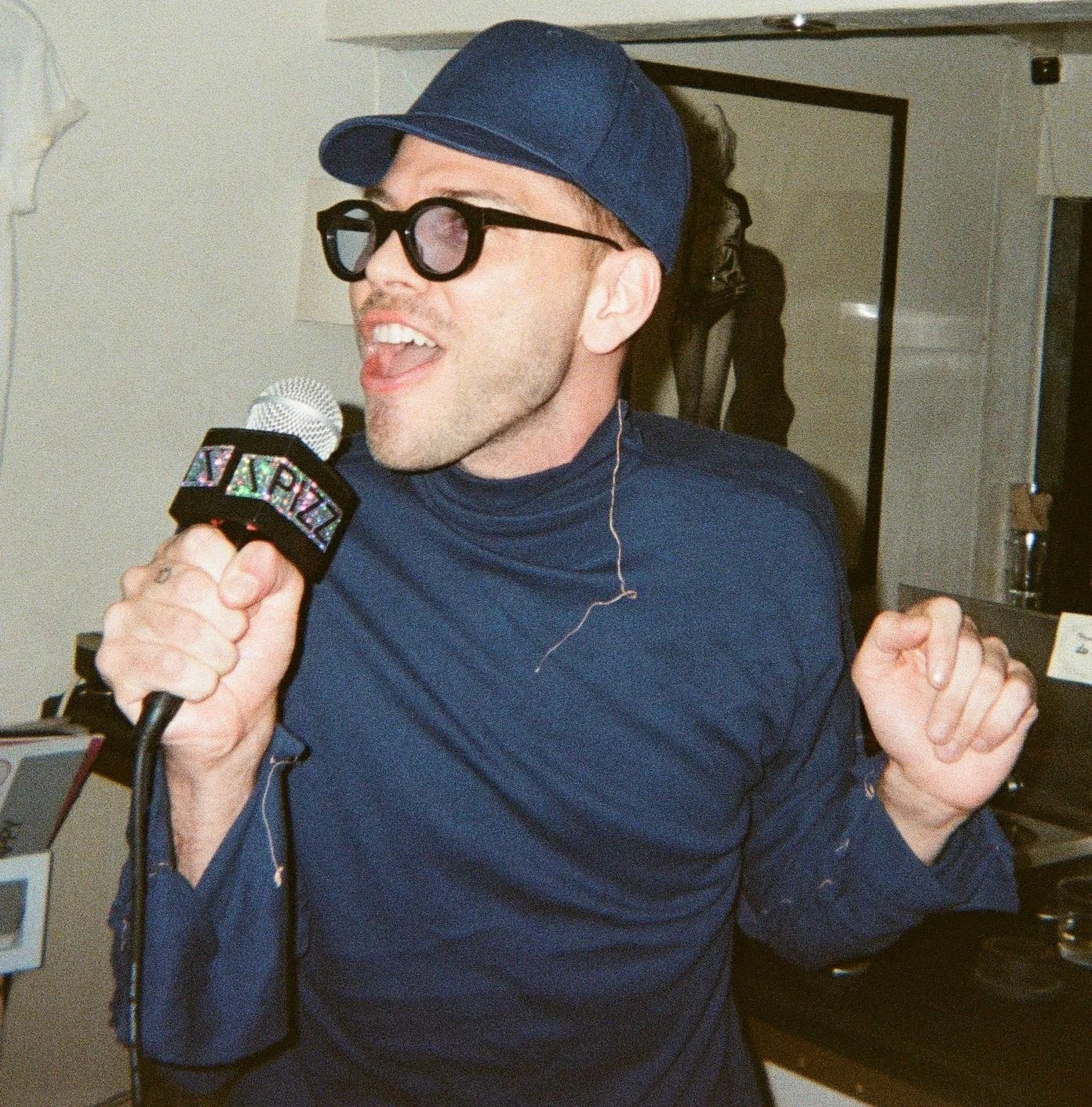
Mur performing at the launch of Give Me Danger
BOWIE: There’s an amazing scene of overheards within the lit crowd. Are those all real quotations, or are some of them made up?
HAČIĆ-VLAHOVIĆ: A lot of those are real, or things I’ve said, or I’ve thought. Nothing is completely made up. Even a plotline with a talking animal still comes from something real. It comes from an idea you had while talking to someone real.
BOWIE: I love the rat because there’s this magical realism to it that I’ve never seen you explore before. You once told me you had been holding back in your writing while you were still married. But when I read your books, I wonder what you could possibly be holding back. Were there moments when you would go, Oh, I can’t write that because it will make him uncomfortable?
HAČIĆ-VLAHOVIĆ: It wasn’t necessarily because of him, per se. It was more about being a person whose reputation affects other people, and I was always afraid of embarrassing him. There were things he read in this book, and he was like, “You can’t publish this.” Meanwhile, Will Watkins, my agent at CAA, was like, “This specific part is genius.”
So, I just realized that I should try to not think of the people in my life while I write in that way. I already think about my mother when I write. I’m always afraid she’ll be worried about me. She already told me that when she’s reading my books, she’s like, “I can’t read this. It’s so dark.” I thought A Cigarette Lit Backwards was gonna be a young adult novel. I thought I was writing a book for teenagers. That’s maybe how out of touch I am with what’s normal. Because when I think I’m writing something really sweet, and when I think I’m holding back for other people, I get told it’s too much. So, I don’t know what this next era’s gonna bring now that I’m living alone and I can do whatever I want. I’m almost frightened of it, but maybe it’s gonna be my Russian literature era.
BOWIE: Your parents play such significant roles in A Cigarette Lit Backwards. It’s really a play-by-play of your loss of innocence. Whereas in the first and third novels, your characters are in their twenties and thirties, respectively, and you talk very casually not just about sex, but sexual assault, to the point that it feels like you’ve accepted sexual assault as a normal consequence of being a woman. Would you say that’s more or less a reflection of your tendency to throw caution to the wind?
HAČIĆ-VLAHOVIĆ: I think I share a lot of those experiences with other women, but I can’t take credit for my attitude. It’s a very Balkan attitude. And it’s due to my love of punk rock. I wanted to be Iggy Pop. I always wanted to be Johnny Knoxville when I watched Jackass. I wanted to be my own protagonist, and I just knew that if I lived the way I wanted to, bad things would happen to me. I’m not saying it’s okay or that the world should be violent towards women, but it is. No matter what, the people you love the most are gonna die, or you’re gonna die before them, so you may as well just do what you want in the meantime. I really have lived that way, and I have some regrets, but too few to mention, as Sid Vicious would say. It’s his song, not the other guy’s fucking song.
BOWIE: I’ve always known women who have chosen not to go out because they’re scared to walk alone at night or they don’t want to wear something because they’re afraid it will attract the wrong kind of attention. But I can’t think of a worse consequence than missing out on life because you were too afraid of what might happen.
HAČIĆ-VLAHOVIĆ: Oh my god, that’s exactly it. Because, yes, you can experience an act of violence, but you’re violating yourself every single day that you don’t do what you want to do. This hypothetical danger does potentially exist, but they do this to us on purpose. They make us afraid to live.
Poet Rachel Rabbit White reading at the launch of Give Me Danger
BOWIE: Tell me about this character, Sandboy, and where he comes from.
HAČIĆ-VLAHOVIĆ: Okay, so Sandboy is based on a real person. When I was living in Santa Monica, I would skateboard to Venice and back, and he was this boy living on the beach in this sleeping bag by these beautiful houses. He’s this beautiful blonde boy, and we never really talked, but I would give him things sometimes. I loved Sandboy. I used to give him things, and seeing him there every day in the sand was very comforting to me. He and this other drug dealer character are my main character’s best friends in LA. It’s just such an isolating city that the two people you feel closest to might be totally random people who don’t care about you at all. The book is really about ambition and failure and competition, how life fucks you one way or another. So, I wanted to compare his experiences with those of the coastal elite.
BOWIE: I love the way that your character is constantly the one feeling rejected by him, versus the other way around. In your books and your real life, you’re constantly exhibiting a certain socioeconomic code-switching because you grew up outside of these elitist industries, but you float in and out of them. You can dress and act the part to a certain degree, but you have an unwavering empathy for those who are intentionally kept out.
HAČIĆ-VLAHOVIĆ: Being an immigrant my whole life helped me with this. I was an immigrant as a kid, going to America with my family, but then I moved to Italy as a college kid, and now I don’t belong anywhere. I’m an outsider with the poor punks, and I’m an outsider with the rich cunts in the fashion world, and so there’s a freedom to that, like the freedom that Sandboy has.
BOWIE: Speaking of freedom, how has being divorced changed your approach to writing?
HAČIĆ-VLAHOVIĆ: Honestly, having more free time is its own challenge. Before, I only had so much time alone, and I’d really shove it all in when I could. Aside from the actual devastation and heartbreak, being divorced is, at first, like being a kid on Christmas, when you can eat cereal all day and watch cartoons. But then, after a while, the cartoons make your head hurt, and the cereal hurts your stomach, and you need to be your own husband. Just like my dog makes sure that I leave the house at least three times a day to walk her, I have to make sure I have a good writing schedule. But aside from the scheduling, I have so much more pain to draw from now, and if the mood strikes me, I can write through the night, and no one’s bothered. I’m still learning how to inhabit my new life, though.
We should all be lifting each other up, like Rose, it’s time to let Jack on the raft with you, bitch.
BOWIE: One of the last times we spoke, you were like, “I forgot that I have a whole fan base out here and that life is much easier than it is in LA.” What’s that been like?
HAČIĆ-VLAHOVIĆ: Aside from being a bit of a local celebrity (laughs), it’s just more humane here. Not to mention the fact that I’ve already gone to the emergency room and had a bill of zero dollars. And aside from the fact that you can walk everywhere, and Los Angeles has one cafe [Figuero Cafe] that’s cosplaying European life, where you can sit down and watch the highway, and you have to walk down the block if you want to smoke your cigarette.
I moved into this apartment in June, and since then, all the places that I walk into where nobody knew me before, like the tabaccheria or my local bar where I go to use the wifi and steal the toilet paper, every single person that works at these places remembers my name. I see them do it with other people too. And I know for a fact that if my toilet exploded, I could run to the kebab place and one of the guys would help me. After seven years in LA, I never had that. And I feel like New York is the height of that level of people being in their own little moving silos.
BOWIE: This coterie of writers and writer-adjacent people that you portray in the book is so emblematic of a very particular corner of New York cool kid culture.
HAČIĆ-VLAHOVIĆ: There’s this mentality of you can only survive by making sure others don’t. Whereas here, you can only survive if everyone else does. Of course, I’m exaggerating and generalizing, and there are exceptions to everything. But being an outsider and never having been accepted into that particular group in New York has actually given me the freedom and obligation to share the truth about how unkind it is, and on no basis aside from the desire to maintain this arbitrary sense of I’m better than you-ness that usually comes from family lineage or private schooling or other forms of privilege. These seem like old-world traditions that should be outdated, considering how all of these industries are drowning. We should all be lifting each other up, like Rose, it’s time to let Jack on the raft with you, bitch.
BOWIE: You write from this very personal experience that sometimes problematizes your aspiration to be accepted in certain circles, which are known for a very controlled self-mythologizing and curation of identity, but you’re very steadfast in your honesty and self-deprecation. Most people’s approach to securing their place in those circles is one of hiding all that could be interpreted as unflattering.
HAČIĆ-VLAHOVIĆ: I try to be very fair with all of my characters. Val has this moment at the beginning of the book where she’s describing the feeling of coming from absence and having ascended to a certain level of wealth, and being embarrassed by it. Whenever she’s around the help, she wants the maids and the valet people to know that she’s still one of them at heart. I love the high and the low. I don’t like what’s in the middle as much, who does, you know? But there’s beauty and sadness in both, and I’m really lucky that I know both, because I can’t imagine coming from a purely privileged mentality. People who are less privileged are more generous with their money because they know what it’s like to be in need. Meanwhile, a lot of really wealthy people I know are so stingy, they make you Venmo them for a potato chip because they feel like money is all they have, so they don’t want to give it up.
BOWIE: It’s also worth mentioning that coming from outside of these worlds gives you a perspective that appeals to people outside of the shrinking, inbred readership that is desperately in need of new voices and ears.
HAČIĆ-VLAHOVIĆ: Exactly. If you’re already in the room and have been since you were a kid, you’re not going to notice the same things that someone who’s in that room for the first time would. Somebody did deliberately keep me out of the conversation. I will also say that it is in poor taste to be mean to people. It’s in poor taste to be mean to people who have never merited that behavior. It’s in poor taste to want to maintain the culture of bullying and exclusivity. If someone wants to say it’s in poor taste to write about Giancarlo’s legacy, I will say that his best friend, Catherine, and his husband, Giuseppe, are the ones who championed it and gave me the residency to do so.
BOWIE: What was it like at the residency?
HAČIĆ-VLAHOVIĆ: Oh my god. I didn’t have the residency with other artists. I was the first-ever director’s guest, as they called it, and they invited me to stay alone in the casetta where Giancarlo stayed. The main house was empty, and I would just go there to use the kitchen or connect to wifi. But it was in the middle of nowhere, in this old kind of castle.
Everyone warned me that it was haunted, and I kind of went out of my mind during that visit. Giuseppe would sometimes come for a day or two, or this construction guy would come and bring me croissants sometimes, but otherwise, I never saw anyone. I’d spend all day seeing weird, distorted faces in the mirrors while I was trying to work, and I’d drink a bottle of wine by myself just to get through it. I’d go to sleep as soon as it got dark at like 7 PM, and I’d wake up at dawn just to avoid the darkness.
I would open my Instagram—and my algorithm is gay as shit, it’s just beautiful girls doing makeup tutorials and animals—but while I was there, my algorithm got creepy. I would open my discover page, and it was all gory, weird fucking haunted shit. Maybe because my phone overheard me telling my friends and my mom how scared I was, but the book is way better because I was there to finish it.
BOWIE: What do you think Giancarlo saw in your work that wasn’t immediately apparent to his outer circle?
HAČIĆ-VLAHOVIĆ: He always rooted for the underdogs. At one point, he said he was only going to publish unsigned authors, and it made everyone go crazy. He just saw the beauty that other people overlooked and took what others considered lowbrow and turned it highbrow. That’s why there’s a rat in this book that potentially represents his spirit. A rat is overlooked because you have to look down to see it; it’s a powerful survivor. It’s the coolest animal there is, and Giancarlo would see the beauty in a rat. And I’ve always looked down. Like, I love the Duomo, but what about all the pigeons shitting around it? They’re the ones making it special.
Give Me Danger was published by Clash Books. All photographs were taken at the November 4 launch at LULLABY bar in New York