
Nina Hartmann
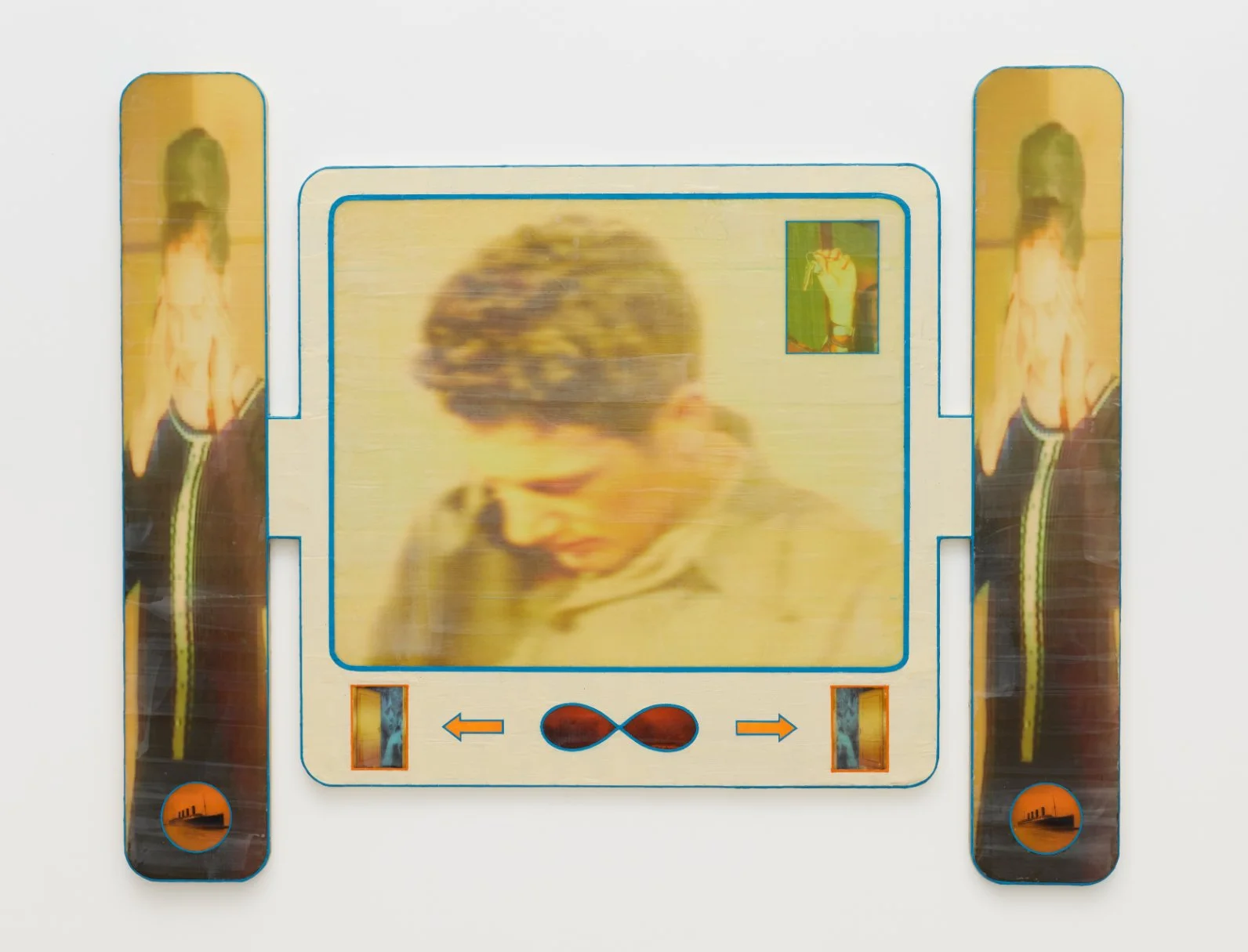
Hypnosis Tracking, ESP Research (Wilderness of Mirrors) (Diagram 4), 2026
Encaustic medium, pigment, inkjet print on wood panel
73 x 93 x 1 inches
Courtesy of the artist and Silke Lindner, New York
text by Arlo Kremen
photos by Chris Herity
Former State Department officer John Marks brought light to CIA operations involving LSD experiments, truth serums, mind control, brainwashing, and other paranormal and psychoactive practices in his meteoric 1979 book, The Search for the “Manchurian Candidate.” The attempts to discover and utilize supernatural psychological abilities were another part of this operation, which also involved the study of hallucinogenic properties and practices of hypnosis. Under the name of MKUltra, the US government spurred the program out of fear that the Russians had beaten them to the punch, already researching mind control methods to brainwash US operatives and arming soldiers with supernatural abilities. There was also Project Stargate, which aimed to advance forms of psychic espionage. These covert projects were launched shortly after videos of telekinetic and mind-reading demonstrations in the USSR began circulating in the West. A psychic militarism ensued, and mountains of money funded these parapsychological programs in the hopes of results that were never proffered. Nina Hartmann’s Actualization Machine at Silke Lindner features sculptural paintings, lightboxes, and resin reliefs that support diagrammatic images of ESP training and mind control techniques. Hartmann turns her head toward this uncovered history, swollen with conspiracy, faith, and mysticism, seeking to rethink the ways in which choice and free will are rendered in a social landscape saturated with suggestive words and images.
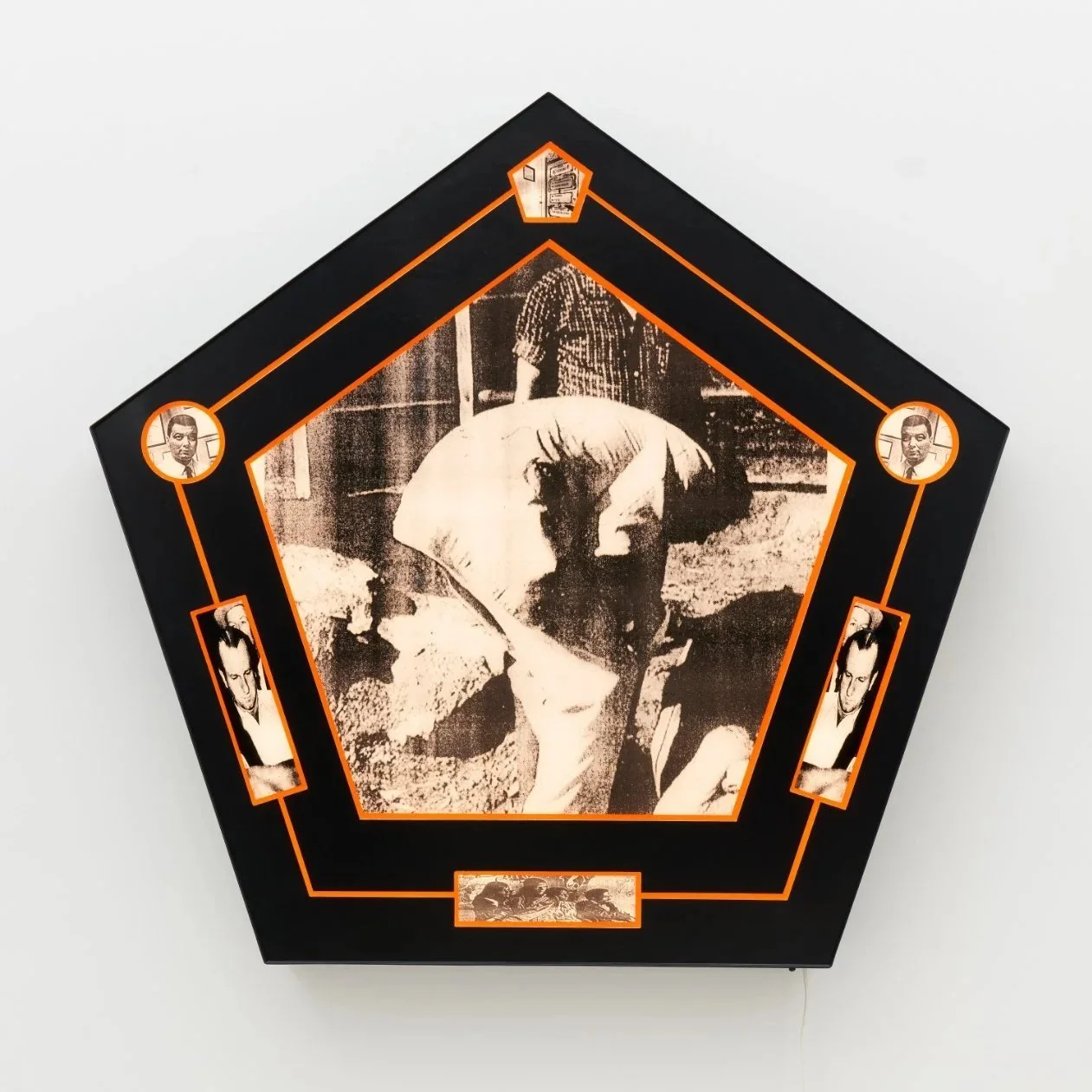
In her recontextualizing of found imagery, there is a smoothness that, in its diagram background, appears nearly propagandistic. Using images she came across while sifting through declassified documents, her work in creating instructive connections and relationships between previously hidden photos presents a counter-propaganda seeking to elucidate systems of power and social influence. This propagandistic quality of her work, however, is complicated by the general anonymity of her found images. Although they likely could be traced to the collection of files from this period of psychological and psychedelic experiments, the many faces, bodies, and scenes are presented with titular context alone. This effect is particularly felt in Trickery and Deception Star (Destabilization Diagram) (Diagram 3), where the title manages to accentuate this work’s uniquely dislodged images. The seven-point star’s images are unclear but have an atmosphere of violence. Its central image is burning, radiating reds, oranges, and yellows off of a nude man. Possibly a bodily experiment, possibly just an action of harm. (Potential) LSD <-> Mind Control Connections (Diagram 2) is similarly obfuscated. A black-and-white image of a hunched-over man caught in the central hexagon is surrounded by a second hexagon with images of people and places that imply a causal relation, but both the cause is and the people’s identities come up against another blockade.

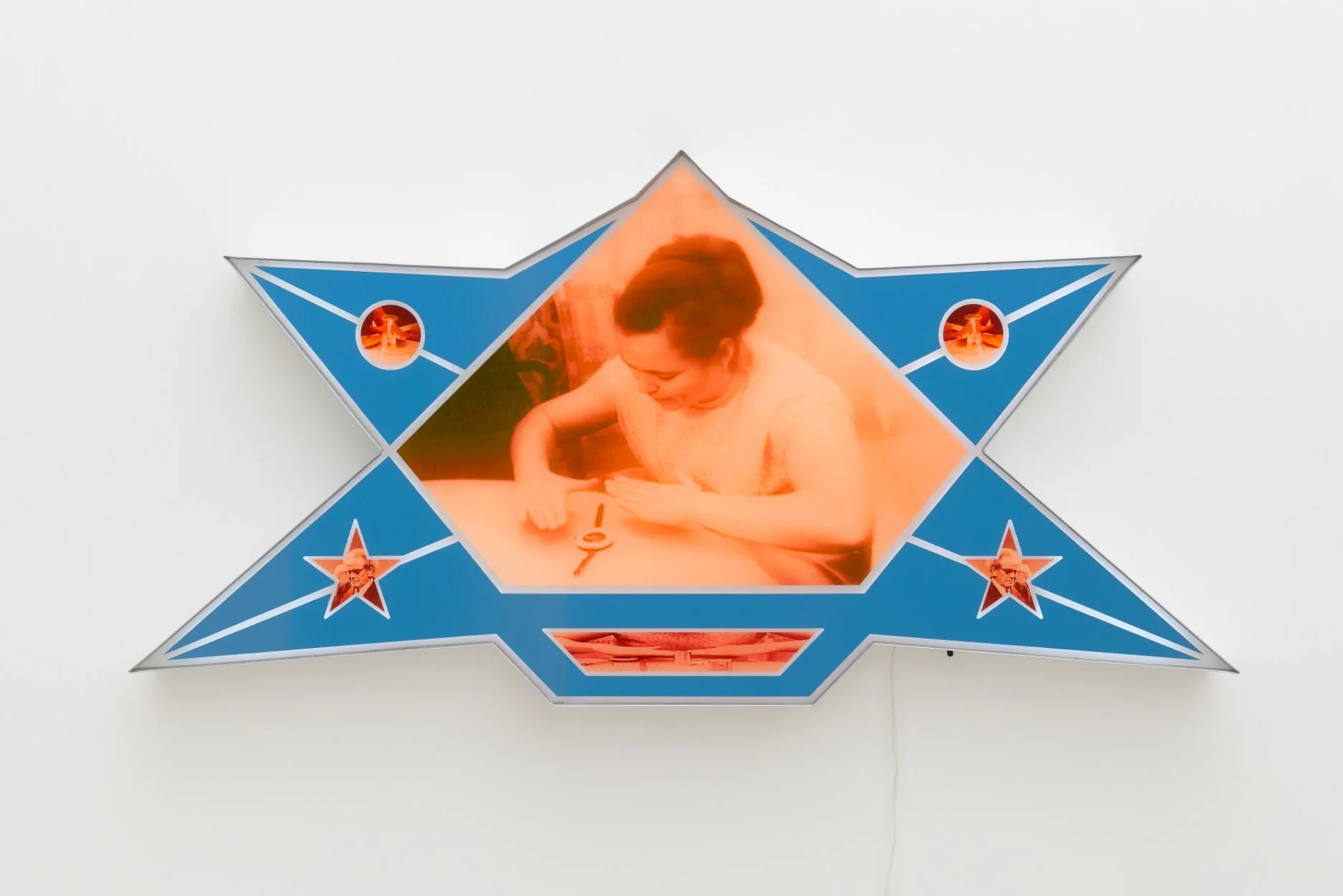
ESP Star (Diagram I), on the other hand, bears a very recognizable figure and scene as its centerpiece—Nina Kulagina. It was images and videos of Kulagina, a self-professed psychic and psychokinetic housewife from Leningrad, that propelled the US into psychomilitary research. Another star figuration, this time a five-point star, colored blue with red-tinted images, Kulagina is pictured moving what seems to be a watch with her mind. She claimed these abilities, tested them on video, and then underwent experiments by a herd of scientists looking to validate her self-professed skills, even being asked to stop the heart of a living frog floating in solution, which, according to her researchers, she did. Although many have disputed her abilities, commenting on the uncontrolled testing environments and the simplicity of her feats in the context of sleight-of-hand magic tricks, films of her accomplishments inspired many around the world to begin researching psychic abilities. A person of global fascination, the found imagery of this work is less than esoteric; it is practically a relic of pop culture, having allegedly inspired the character of Eleven in Netflix’s Stranger Things. But, in fairness, it was Kulagina who inspired it all—MKUltra, Project Stargate, and every other government research project for psychoactivity during the Cold War. Crucially, however, it was not her feats that triggered the development of these research programs, but the disseminated photographic and filmic documentation of her feats. The strength of her images launched a number of senselessly abusive and exploitative research methods into existence. Kulagina may not have had the psychic powers or skills she claimed, but the images of her surely did.

Nina Hartmann
Remote Viewer I (Diagram 5) (PL Logick), 2026
Resin, UV print
24 x 17.5 x 1.25 inches
Courtesy of the artist and Silke Lindner, New York
In Hartmann’s use of mind control and parapsychological experiments, she attends to the image’s function as a tool of influence. Hartmann’s Remote Viewer I (Diagram 5) (PL Logick) culminates in Actualization Machines' questioning of the social operations of the image. The work is shaped out of resin and is much smaller than the larger sculptural paintings. Remote Viewer is a jumble of the US seal’s symbols. Now a circle with human legs merged with a hexagram, Hartmann appears to nod toward systems of statecraft. The upside-down aspect of the hexagram boasts small triangular embellishments depicting a military submarine, and the circle contains another set of three identical images of a hand holding a knotted string. The central image is an older woman with a hand to her head, perhaps being hypnotized, with her eyes blurred into nonexistence. This act of, if not mind control, identity erasure, is imposed on a Frankensteined national seal. The phrase, “Architecture as a way of undoing choice," repeats around the circle and the five-point star in which the central image sits.
Images may not be architectural by themselves, but since advertisements have become the sides of skyscrapers, architecture has absorbed the image. Images of clothing brands, food delivery apps, streaming services, fast food joints, and any other business with enough money to slather its branding on any surface available for rent. Ads have become an integral segment of built space. Digitally, images are everything. Whether encased in a scrolling grid or not, all there is to online life are images and pictures and logos. Words, too, are images, fixed to look a certain way, which further standardizes what might pass for an ‘o’ versus a ‘0,’ which regulates people’s mental conception of the two characters. Technology has always had this kind of effect on human psychology, but changes to digital culture have been uniquely forceful, with companies coding addictive platforms to maintain usage or provide AI models with conversational abilities, driving many into what has been colloquially termed ‘AI psychosis.’ And although these images are sourced from companies, the distinction between private commerce and the government is negligible when many of these companies lobby government officials and aid in weapons development, like OpenAI. Images of the current era might be described as having the mind-controlling powers of the projects Hartmann engages with in Actualization Machine. If images could be considered a form of mind control, perhaps it is time to recognize MKUltra as an incidental success.
Nina Hartmann’s Actualization Machine is on view through May 30 @ Silke Lindner, 350 Broadway, New York City.