

![NILPT005 [hi-res].jpg](https://images.squarespace-cdn.com/content/v1/544cb720e4b0f3ba72ee8a78/1717368393454-GA4K3W4IEEIJ6XW8NWFF/NILPT005+%5Bhi-res%5D.jpg)
interview by Bill Powers
photography by Magnus Unnar
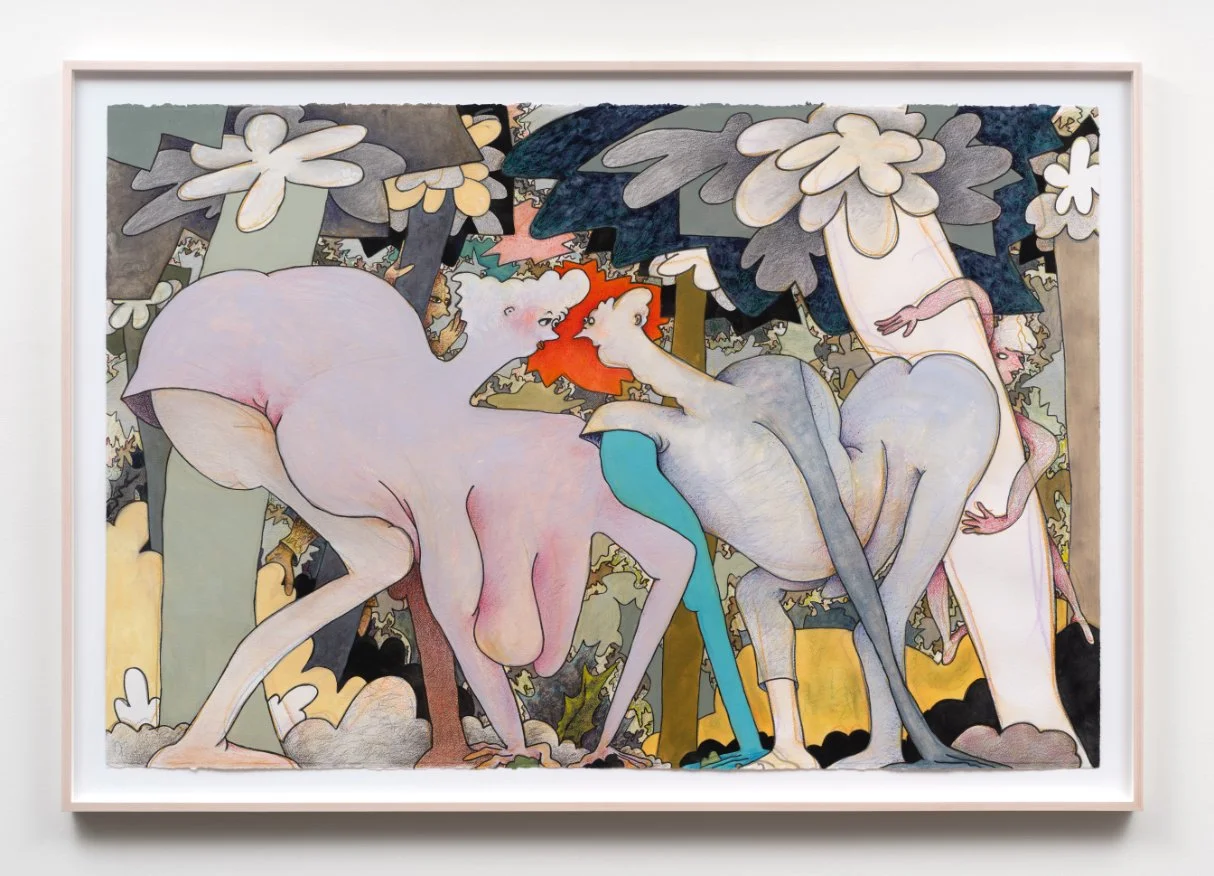
Full of humor, wit, and sexual innuendo, Glady Nillson’s paintings are a bacchanal of delirious, kinetic figures in prismatic color fields. A founding member of the Hairy Who, a loose collective of six artists that graduated from the Art Institute of Chicago, the group organized a series of exhibitions at the Hyde Park Art Center starting in 1966. Primarily rendered in watercolor, her voyeuristic tableaux are riotous countercultural paeans to libertine expressions of free love and compersion. In 1973, Nilsson was one of the first women to have a solo exhibition at the Whitney Museum. Fifty years later, she remains prolific.
BILL POWERS Is there a difference between observational painting and representational painting?
GLADYS NILSSON The term ‘observational painting’ was introduced to me by Charles Parness who was Janet Fish’s husband. Charles would say, “First I observe, then I paint.” It was during a summer art camp where we were all teaching. His work was lively and funny and strange.
POWERS So, basically all the same markers by which people would describe your pictures.
NILSSON (laughs) Yes, you could say that. He would use himself as a subject, he would say jokingly, because here was a model that was never prone to cancel or be late.
POWERS I read in an essay that your paintings often borrow from the Egyptian pose.
NILSSON I always liked Egyptian hieroglyphics and Assyrian reliefs, which people considered static imagery, but I don’t see them that way. And for whatever reason, my work is always presenting figures in profile.
POWERS Do you think about whether your figure is making eye contact with the viewer?
NILSSON There’s always some eye contact in my work. It’s a slyness to bring the viewer in. Almost like a sly wink, as if to say, “You think you know what’s going on, but you better take another look.” Some people would equate it to breaking the fourth wall in a movie, but to me that’s different.
POWERS Has your approach to sexuality evolved in your paintings as you get older?
NILSSON I always said at a certain age if I wanted to wear my bedroom slippers out of the house, I would. It’s sort of like those purple hat ladies. When you’re older, you can take that liberty. My figures have always been coy rather than blatant. If I go to a film, I want playfulness, not the actors immediately ripping each others’ clothes off.
![NILPP074 [hi-res].jpg](https://images.squarespace-cdn.com/content/v1/544cb720e4b0f3ba72ee8a78/1717369681069-RWA3ZEW6QLZGFHJSN6IV/NILPP074+%5Bhi-res%5D.jpg)
POWERS Never state what’s implied.
NILSSON But on another level, all art is seduction. I’d just rather be slowly romanced. There’s a courtship dance.
POWERS I had pointed out in one of the new drawings what appeared to be a shaved armpit, only it was the crux of a woman’s elbow and you assured me that there’s never any body hair.
NILSSON I used to have little squiggle lines for beards or mustaches to indicate it’s a man, but never in pits or crotches.
POWERS Do you feel that your embrace of whimsy over the years sometimes caused critics to take you less seriously?
NILSSON My work is comical looking, this is what I do, no matter how seriously I take it. And I think for a long time, because my work is funny, it was somewhat dismissed. That was frustrating, but I wasn’t about to change everything to satisfy someone else’s taste.
POWERS What is a funny painting most people might not see for its humor?
NILSSON Yesterday, I sent a picture to my husband [artist Jim Nutt] of The Dragon Slayer by Franz von Stuck at the Getty Center. It’s so over the top, I could burst out laughing: the knight in armor, the nude damsel in distress, the slayed serpent. I’m sure the artist would be horrified to see me laughing in front of his painting.
POWERS What’s the best compliment you ever received about your work?
NILSSON I remember during the early days in Chicago, these neighbors of ours bought a plexiglass painting I made for the second Hairy Who ? show, and they kept it for a long time. They had two kids the same age as my son who would all play together. I ran into the mom years later, and she said, “Gladys, I must tell you that every time my daughter walks past your painting she stops and says, ‘Gee, I never noticed that before. I always see something new.’” Maybe it was more endearing because the praise came from a little kid. Such a simple little comment.
POWERS Did you paint on plexiglass in response to Duchamp’s large glass?
NILSSON Karl Wirsum did a number of things on glass, as did my husband [on plexiglass] and that sparked my curiosity. It looked like too much fun. I never knew what it was going to look like because you were painting the whole thing in reverse where the bottom-most layer was the foreground.
POWERS John Baldessari once said, “Anything worth doing is worth doing badly,” almost as a warning against perfectionism.
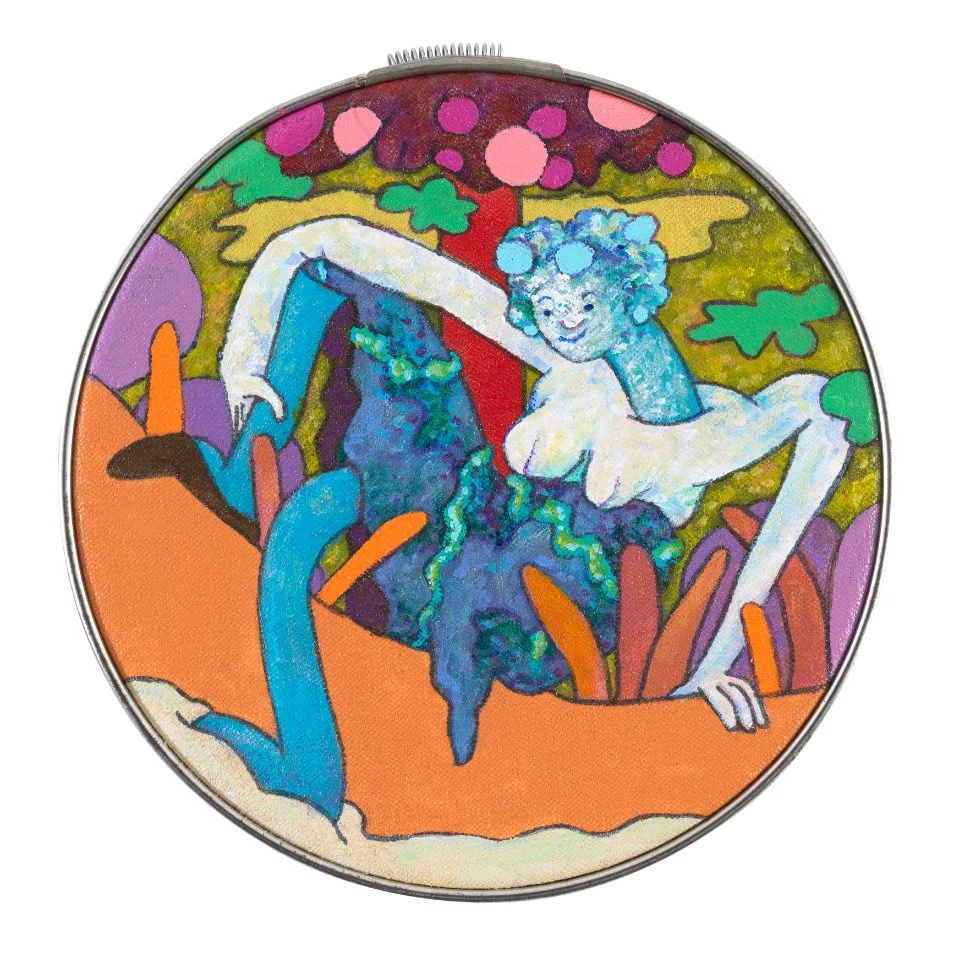
NILSSON I can see that. Watercolor is a very unforgiving medium. Once you get a passage down there’s very little you can do to alter it. Working in watercolor demands a certain level of acceptance. And it’s my primary medium.
POWERS How would you define art?
NILSSON Art is anything you like to look at that pleases you. I think comedy isa very high form of art because it’s harder to achieve than drama.
POWERS What is your relationship to scale?
NILSSON The important people in the piece are the large figures, and then the smaller ancillary figures run around doing weird stuff. I am influenced by constructs of religious painting, but also the old Sears catalogs, something about their layouts. They’d have little figures showing the alternate colors of bathrobes or whatever they were selling.
POWERS So, the cherubs are doomed to be featured extras for eternity.
NILSSON It’s like a character actor in a film. They’re important. Jim and I used to go toa lot of movies.
POWERS I remember John Currin saying that The Bitter Tears of Petra von Kant (1972) changed his life. Is there a cinematic experience that resonated like that for you aesthetically?
NILSSON I’ve always been partial to The Lady Eve (1941) by Preston Sturges. What’s going on in the foreground is obviously essential, but it’s what’s going on in the background that most viewers ignore. You can’t only watch the stars!

POWERS Have you ever been starstruck?
NILSSON I did meet Leonard Nimoy, and that was a thrill.
POWERS Spock from Star Trek? And wasn’t he a painter?
NILSSON We were in town for the Parallel Visions exhibition at LACMA in 1992. Jim and I had lent work for the show and we were both in it as well. Nimoy was collecting some outsider art at the time. He was a beautiful man. I was an enormous Star Trek fan.
POWERS The way you render figures can sometimes have an angular, severe profile reminiscent of Nimoy’s silhouette.
NILSSON For a short period, between 1968 to 1970, I did a whole series based on Star Trek. It was strangely influential on my content.
POWERS Any other influences come to mind?
NILSSON Botticelli’s Birth of Venus. I remember I was in a lull. Jim and I went to Florence for the first time. We walked into the Uffizi Gallery and they had Birth of Venus and Primaverain the same room. Anyway, Jim and I both blurt out, “It’s so big,” and “It’s so small,” at the same time. Turns out we were both right because we had only ever seen them in books and never bothered looking up the dimensions (laughs)