
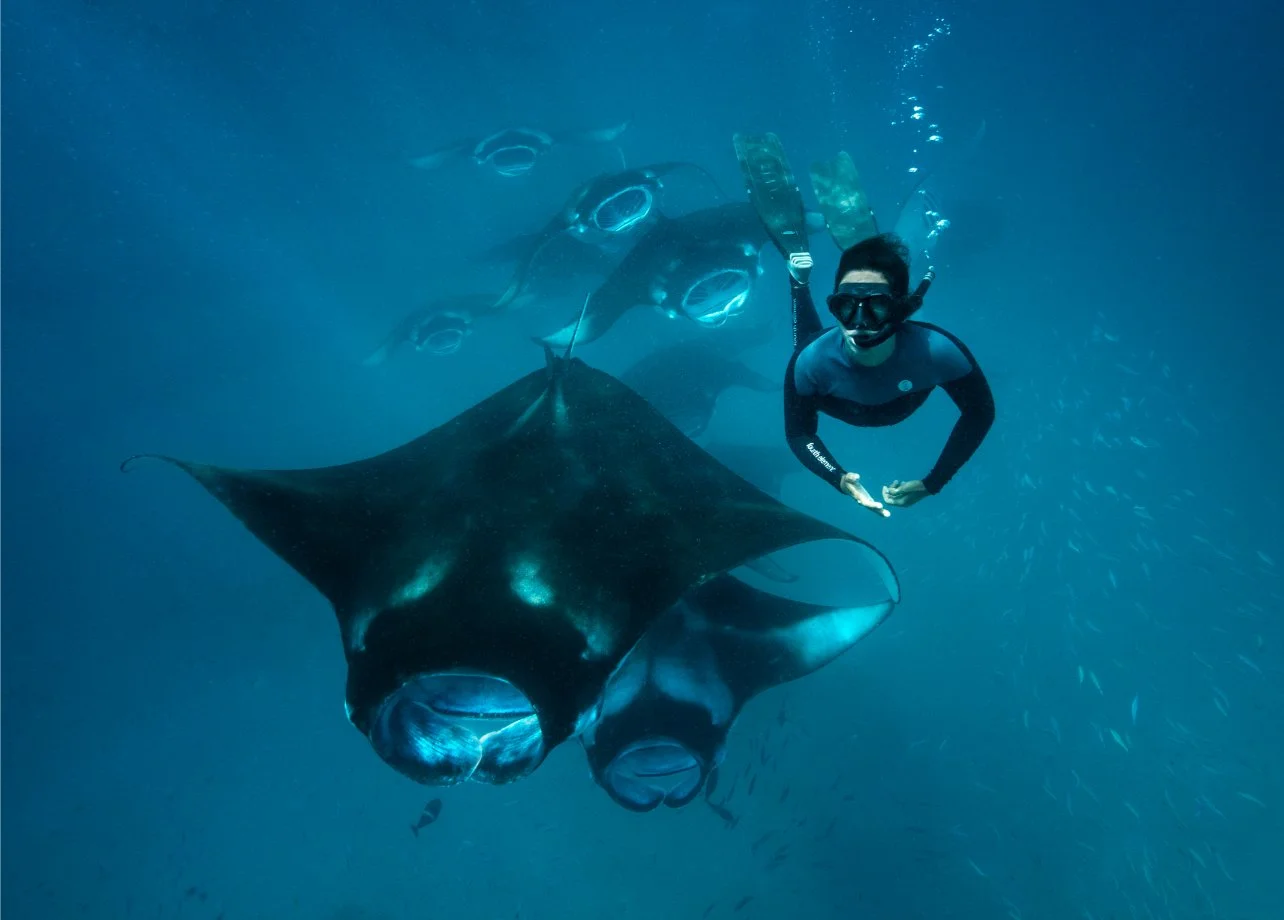
Diva Amon diving with Manta Rays. Photograph by Michael Pitts. Courtney Diva Amon
interview by Kaylee Gibson
Back in 2021, I found myself at the Venice Architecture Biennale, curated by scholar Hashim Sarkis, which sought to answer the question: “How will we live together?” One of the most poignant exhibitions was held at the Danish pavilion, which was completely transformed by Architecture studio Lundgaard & Tranberg and curator Marianne Krogh. In an exposed cyclical system of piping, rainwater was collected from outside and taken on a closed-loop journey through the space. Visitors become part of this system—a poetically visible merging of nature—by drinking a cup of tea brewed with leaves from herbal plants that absorbed the water. Sipping my tea, listening to the calming streams, traversing the city by water taxi through its famous canals that pour out into the Adriatic Sea, I pondered our planetary water system, and how it links us all. Deep sea marine biologist Diva Amon feels the same obligation and urgency to highlight this link. The deep sea, which is defined as a depth where light begins to fade, is the largest habitable ecosystem of our planet, yet it lies furthest from our reach. Not only does it regulate our planet’s climate at large—it also has the potential to solve some of humanity’s greatest challenges.
KAYLEE GIBSON: What roles do the deep oceans play in our planet’s ecosystem?
DIVA AMON: Our deep oceans are a reservoir of biodiversity, but it goes beyond that—it is a journey through time. Because of their huge size, they provide over 96% of the habitable space on Earth, they cover a vast percentage of our planet's surface, and that size is what really allows them to play such a significant role. They regulate the climate by absorbing heat and sequestering carbon. They provide food for billions with their provision of fisheries. And then, there’s nutrient cycling. Cycling nutrients on the planet is everything ... it is life as we know it. It also plays a large role in detoxification. So, we have nutrient cycling, elemental cycling, and really big services like primary production. They provide a home for so many animals. There are also so many potential pharmaceuticals that could come from the deep sea. Life in the deep ocean evolved in these extreme conditions: high pressure zones, close to freezing temperatures, darkness, so many of those animals have genetic material that could be quite interesting to us in the future—for pharmaceuticals, or biomaterials, or for industrial agents.
GIBSON: Biomaterials are so interesting. Can you give a few examples of these?
AMON: Sure, there’s a species called a glass sponge, it’s not actually made of glass, it’s made of silica. They look like fiber glass and have these beautiful, intricate structures. These creatures have actually been used as inspiration to make more efficient fiber optic cables. Another example of biomaterial comes from dead whales. When whales die, they usually end up down in the deep sea where they become food and shelter. There are bacteria that break down the fats in whale bones most effectively at deep sea temperatures, so 3-4 degrees Celsius. These enzymes have been utilized for more climate-friendly laundry detergents because they remove stains at lower temperatures.
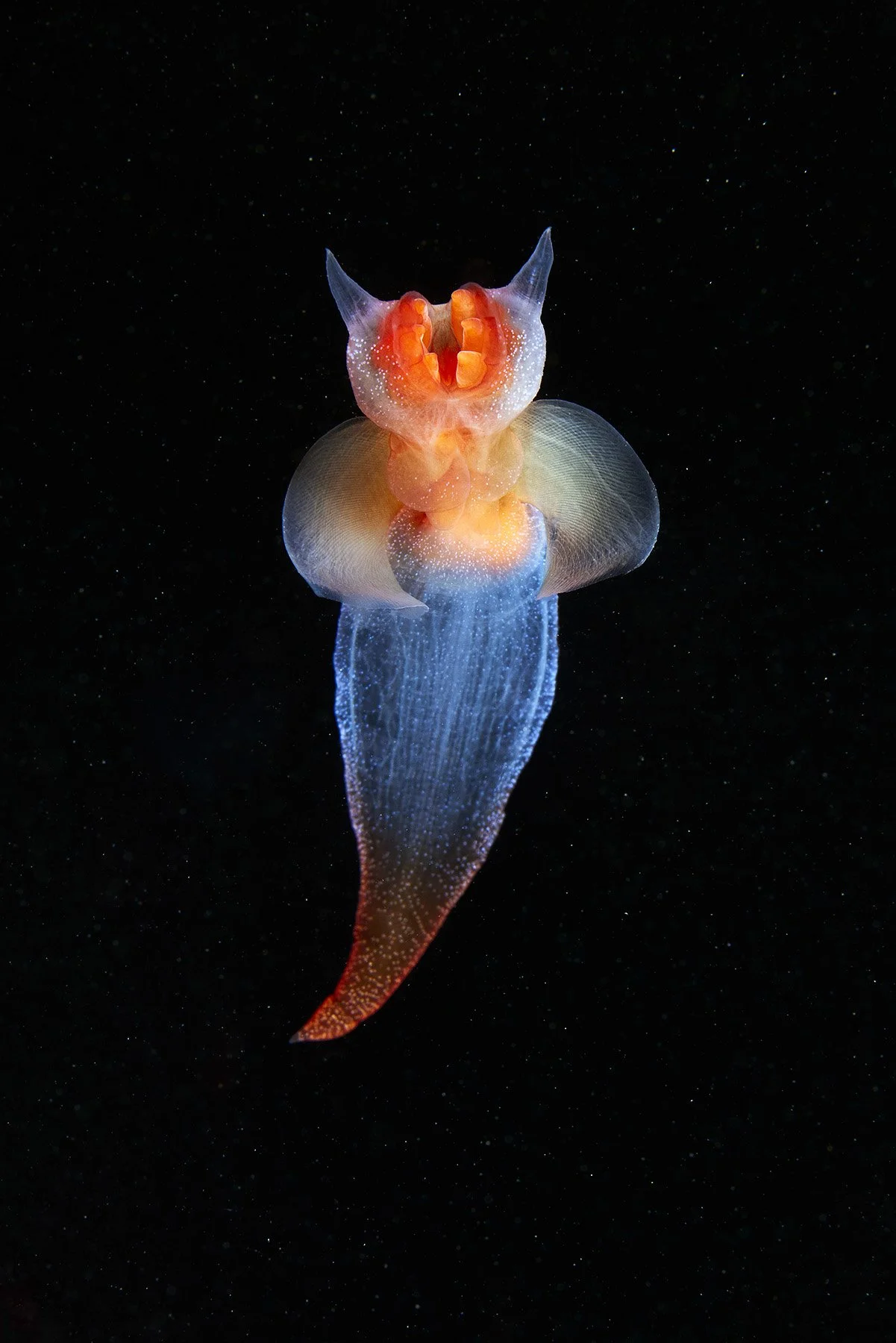
Sea Slug. Photograph by Alexander Semenov
GIBSON: These are very new findings and applications, but it seems like there’s still a lot to discover.
AMON: We’re just scratching the surface. There’s only maybe thirty of these applications so far. We know probably 1/3 of the multicellular species. They think there’s close to 1 million species that live in the deep sea, and about 2/3 of those still have not even been discovered, and that’s not even taking into account unicellular species. There’s so much to be discovered, so much that we could potentially use. All of that life is linked to the functions and the services that keep our planet ticking. There’s this untapped reservoir of potential use and benefit to us that could help with some of the most profound challenges of the future.
GIBSON: Can you predict the potential of those undiscovered species in anyway?
AMON: In terms of microbial life, there will be things that are entirely unexpected. And there are single corals that can live for over 4,000 years. Think of how much has happened in human history in that time. There are sponges that live for over 10,000 years. Not only are we seeing new life, but we are also seeing it in new ways. There are these teams in California that have been doing amazing work on bioluminescence, a phenomenon where animals create their own light. In the past ten years, we’ve realized that it’s far more common than previously thought. The majority of the species in the deep sea create their own light, and because of the vastness of the deep sea, bioluminescence is possibly the most common form of communication on the planet. So, it’s really rewriting paradigms, which is what I think we’ll see more of in the coming years. We’re at a pivotal point in ocean exploration, and we’re conducting research in more effective ways, which is leading to discoveries that we never could have dreamed of.
GIBSON: That’s so fascinating. So, much of our understanding of life on Earth has been linked to our reliance on both oxygen and sunlight, but our deep oceans function so much differently.
AMON: It wasn't very long ago that we realized there are entire ecosystems in the deep sea that are able to exist completely in the absence of sunlight or oxygen. A lot of life in the deep sea relies on food from the sea surface: dead animals like whales, plankton, and fish. But about fifty years ago, hydrothermal vents were discovered, and those are these incredible environments where life doesn’t actually use the photosynthesis-related food chain that 99.9% of life on Earth relies on for its existence. Instead of using sunlight as their ultimate source of energy, they use chemical energy. So, there’ll be methane seeping from the sea floor, or hydrogen sulfate, and life has evolved to use that as the starting block of their food chain. You get to those places in the deep sea and they are booming with life.
GIBSON: What do you think this means for the future of society and how we think about our oceans?
AMON: A hundred years ago we thought of the ocean as this deep, dark place, like a vacuum with no life. Since then, our explorations and discoveries have shifted so many paradigms, allowing us to realize that life not only finds a way, but thrives in these places, changing everything we previously thought was possible. I think that lends itself to life on other planets. If life can exist in these extreme places on our own planet, what’s to say it doesn’t exist on other planets that exist under extreme conditions? It’s really about showing what’s possible and rewriting the laws of biology. Apart from that, the slightly cynical answer is that while more people are engaging with the deep sea than ever, it’s still not enough. Many people still have this idea that there’s not much to conserve there, and as a result, I worry that it’s seen as this final frontier on Earth, which is a very challenging mentality. Economists have a term called the ‘blue economy.’ It’s a real push to harness all the resources the deep ocean has to offer.There’s nothing wrong with that as long as it’s done in a way that is not just sustainable, but also restorative. What we are seeing now with some of the industries that are pushing into the deep sea are attempts to exploit it. Fisheries have been operating for decades in the deep sea and there’s been purposeful dumping in the past, but now there’s an accidental sort of pollution. We’re seeing oil and gas going deeper and deeper, we’re seeing deep sea mining on the horizon, and a lot of those industries benefit from the notion that there’s not a lot of life down there. All of this knowledge is not as mainstream as it should be, so we risk losing species, losing habitats, losing those functions and services that we rely on.
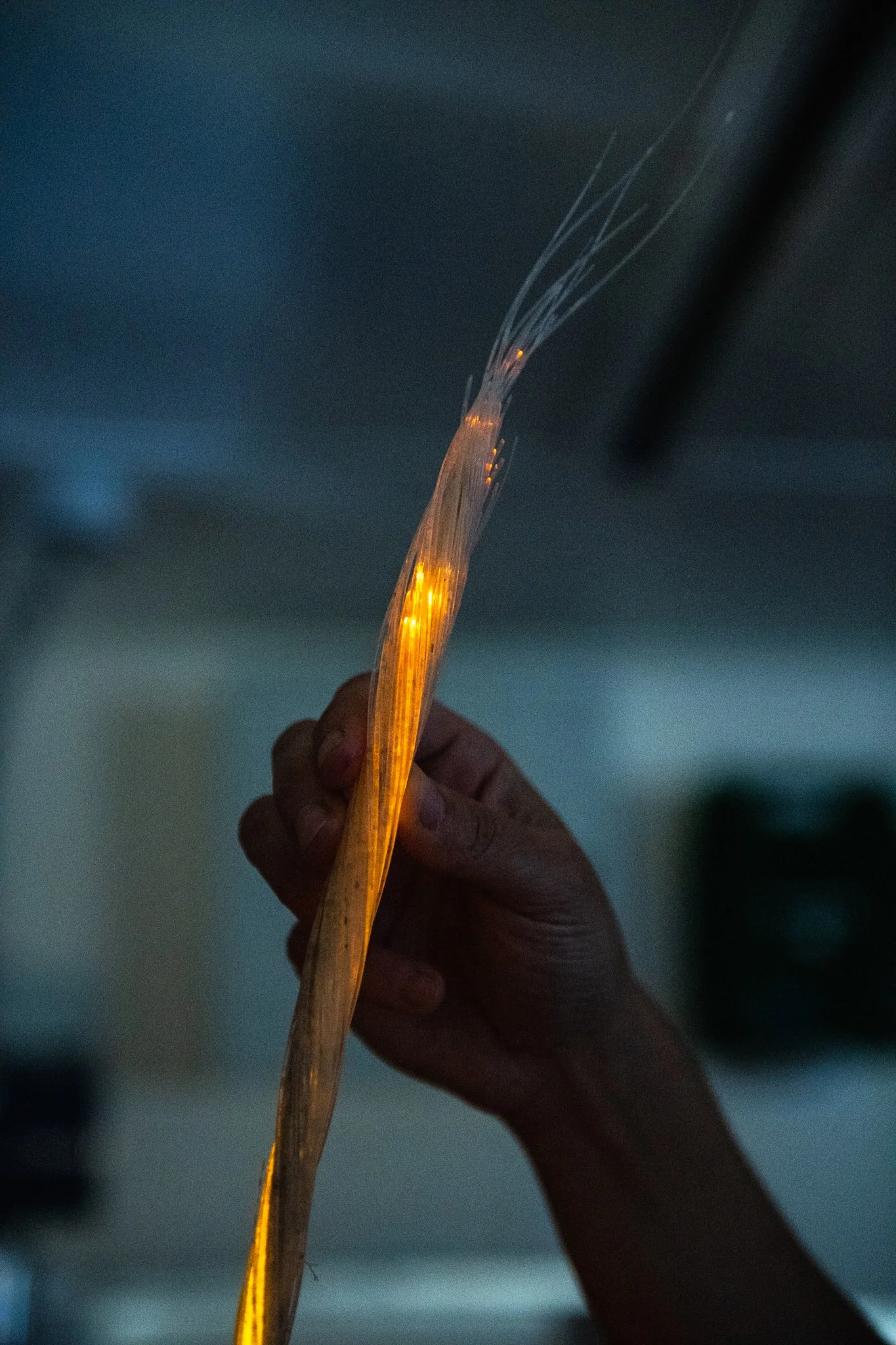
Glass spicule stalk collected from Cape Range canyon, showing fiber optic properties. Courtesy Schmidt Ocean Institute
GIBSON: How can we engage the public more? What do you think that looks like?
AMON: That's really the challenging question. Unfortunately, deep sea exploration and deep sea science is incredibly expensive. It's akin to space exploration. It’s very high tech and very high skill, which means it’s not accessible to the majority of humankind. And that has resulted in it being colonized by a small set of humanity. If we can begin to remove those barriers so that more of humankind can participate in those conversations, we can develop a better understanding of what’s there and how best to manage and protect it. Ultimately, there's a big geopolitical issue here. Scientists have had the privilege of conducting research on these parts of the planet that no one else has seen. I do wish that more scientists would utilize that privilege to the benefit of the deep sea itself. Thankfully, we’re seeing a rise in scientific exploration being live streamed. We're also seeing more mainstream documentaries being made such as it being featured on The Blue Planet. There’s a lot in the works that will bring the deep sea to millions of people around the world. We need to take it to the policy makers who are drafting regulations now that will be in place for decades, if not centuries, and will be pivotal for our ocean and its management. We ourselves have abig role to play.
GIBSON: It is so wild to me that the International Seabed Authority (an off-shoot agency of the UN) is essentially deciding the fate of the deep oceans. Are they playing an effective role in their protection?
AMON: There are so many issues happening around the ISA. Since 2018, I've been going to their meetings twice a year, and you see in the room that not every country is at the table. They all have a seat, but they're not necessarily present. That is often due to a lack of resources. It’s not considered a priority. Many countries can't afford to send delegates there for three weeks a year. As a result, the voices that tend to be the loudest are the ones that are ultimately going to benefit. Intergovernmental processes are not perfect, but it's particularly glaring at the ISA.
GIBSON: I had no idea until recently that there are permits being issued to mine the deep sea, nor that the ISA even existed. How likely is it that deep sea mining will happen?
AMON: Very likely, unfortunately. That devastates me. But I think there are so many brilliant organizations doing their best to at least delay it. As of now, the Republic of Nauru, Pacific Island triggered a two-year rule. That means by June 2023, they could be issued an exploitation license and that’s it. Not only is this entirely out of step with much of what humankind is talking about now, what’s most distressing is the fact that biodiversity loss is the highest we’ve seen within human history, the climate crisis is spiraling out of control, and here is this UN-related body that is essentially trying to kick-start what is going to be an extremely disruptive industry in one of the most pristine parts of the planet. It’s completely at odds with what we should be doing. A lot of people are saying, “Well, we need the metals for the climate crisis.” But that's a band-aid. Let’s not mince words. We’re working our way through the planet's resources and ultimately just finding new things to use and destroy.
GIBSON: If deep sea mining were to happen in just a small area, would that have effects on very large areas?
AMON: We really don't know. A big part of the problem is that more than 99% of the deep sea floor has never actually been visualized with human eyes, nor with a camera. A lot of it is based on modeling. We're using the best data we can to inform those models, but it's still mostly unverified. I used to work for the University of Hawaii and the contract I was working on was for one of these mining companies trying to understand which life forms exist in the Clarion Clipperton zone (between Hawaii and Mexico). We went out on a cruise in 2013, which was the first time anybody had seen that sea floor and over 50% of the large animals we saw were entirely new species to science. And now, more scientific teams have been observing through the CCTV that 70-90% of the species there are new to science. And that's just multicellular species. We're not even talking about microbes. So, we're operating in this real dearth of information, and not just about what's there, but how it might be impacted. If we don't know how the animals will be impacted, we don't really know how the functions and services that we rely on will be impacted. The parts of the planet that have been licensed off in these areas, and there are about eighteen licenses out there, each of them is about the size of Sri Lanka. These are not small places, and we know that all life in the path of the machine will be killed. There will be huge dust plumes kicked up off of the sea floor from the mining machinery, all of the minerals will be pumped up to the surface, they will be separated from the water, and that water will be pumped back into the ocean. That water will have metals, it will be a different temperature, it'll be a different chemistry, and it will essentially be a form of pollution. That's going to create another one of these plumes that has the potential to suffocate animals, or render them blind. The currents have the potential to take these plumes to further areas and the footprint will be much, much larger, and we're not even talking about noise, which travels huge distances in the deep. There’s so much to consider and it's been acknowledged that there will be species extinctions. Ultimately, when those things happen, there will be impacts to the fisheries that much of the world relies on. There’s grave concern about the impacts on the carbon sequestration capability of the deep ocean. There's so many unknowns that it's really worrying to think about an industry on this scale. We should be taking a very precautionary approach. And, if we do decide that we absolutely need these metals for our survival, then we should start small—just license one entity to begin with, and then do lots of monitoring around it. But that's not what’s expected to happen. There have been thirty-two licenses granted globally, and most of those places don't have protected areas in place yet. Most of those places don't even know what lives there.
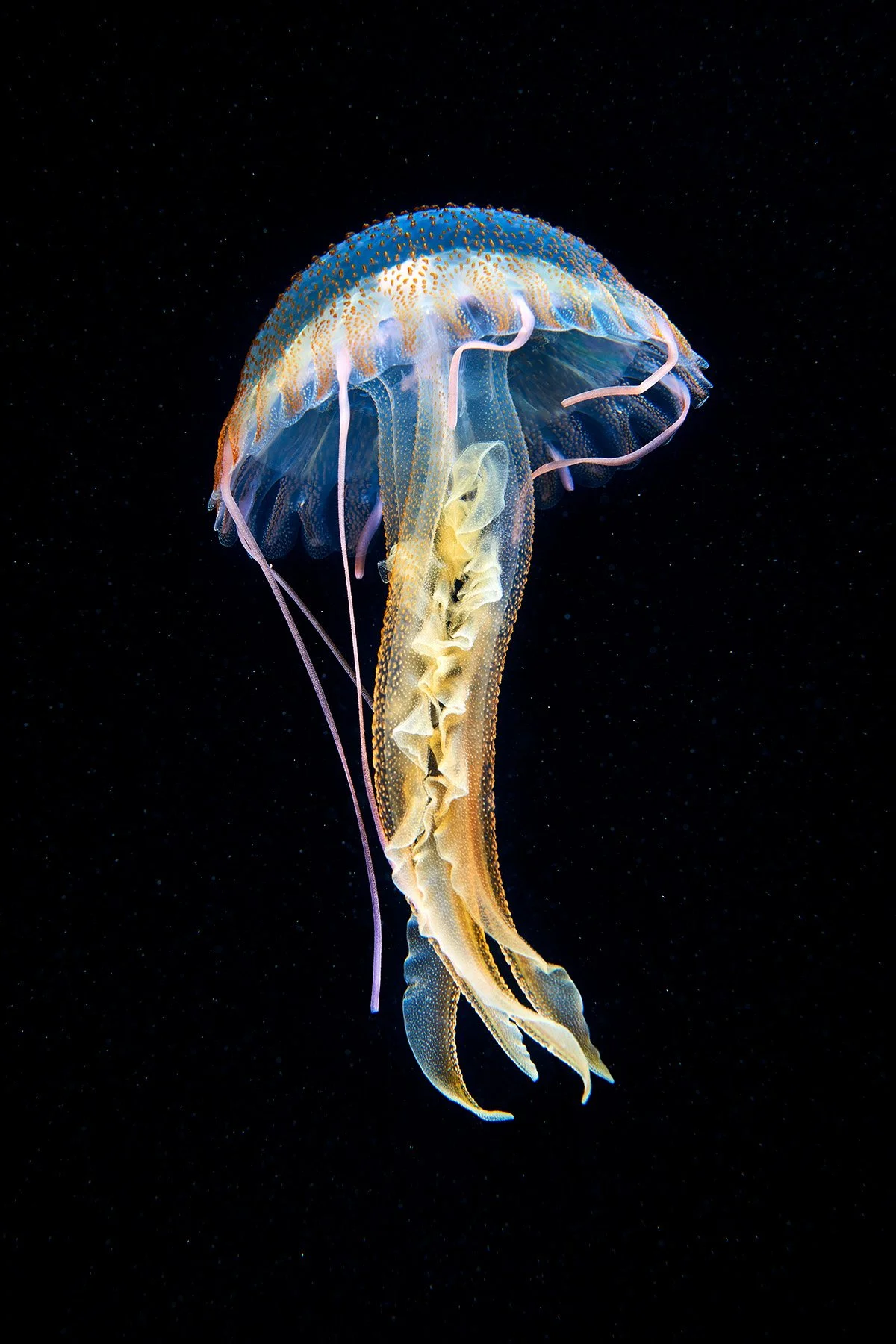
Pelagia noctiluca. Photograph Alexander Semenov
GIBSON: Is there anything we can do to keep this from happening?
AMON: That's the real challenge about the deep sea. It’s not like we can go out there and protest. So, the first thing we can do is talk about this, the more people who know about this, the better. Many well-known countries are participating in deep sea mining. France has a contract area, Germany has several contracts, and so does the UK. Apart from that, it's about consumption. The oil companies came up with ‘carbon footprints’ to try to put the onus on us, the individuals, for pollution, rather than themselves. But there is something to be said about living more consciously, and thinking about where everything we buy comes from. Each of us has a cellphone, and those use about sixty different types of metals. So, trying to consume less is important and also pushing for technology that can be recycled more easily, or technology that can be fixed. I think we are seeing those shifts in society. It's just not happening quickly enough. It's a tough one. People aren’t engaging first hand with the environment of the deep sea, so it’s a hard one to get people on board with, even though it’s absolutely essential to us being here.
GIBSON: I did read that Samsung, BMW, Google, and Volvo vowed to not use anymetals mined from the deep oceans.
AMON: Yes. There are steps happening. These four major corporations have come forward and pledged to not source any of their production materials from the deep sea, at least until it is deemed to not be destructive. Seeing these big corporations willing to take a stand on this was probably the most hopeful thing that has happened. I hope it really is this pivotal event where after these four, we see more and more coming forward. Ultimately, many corporations know that they are rewarded for good behavior by their consumers, so their leadership in this area has been very refreshing.