
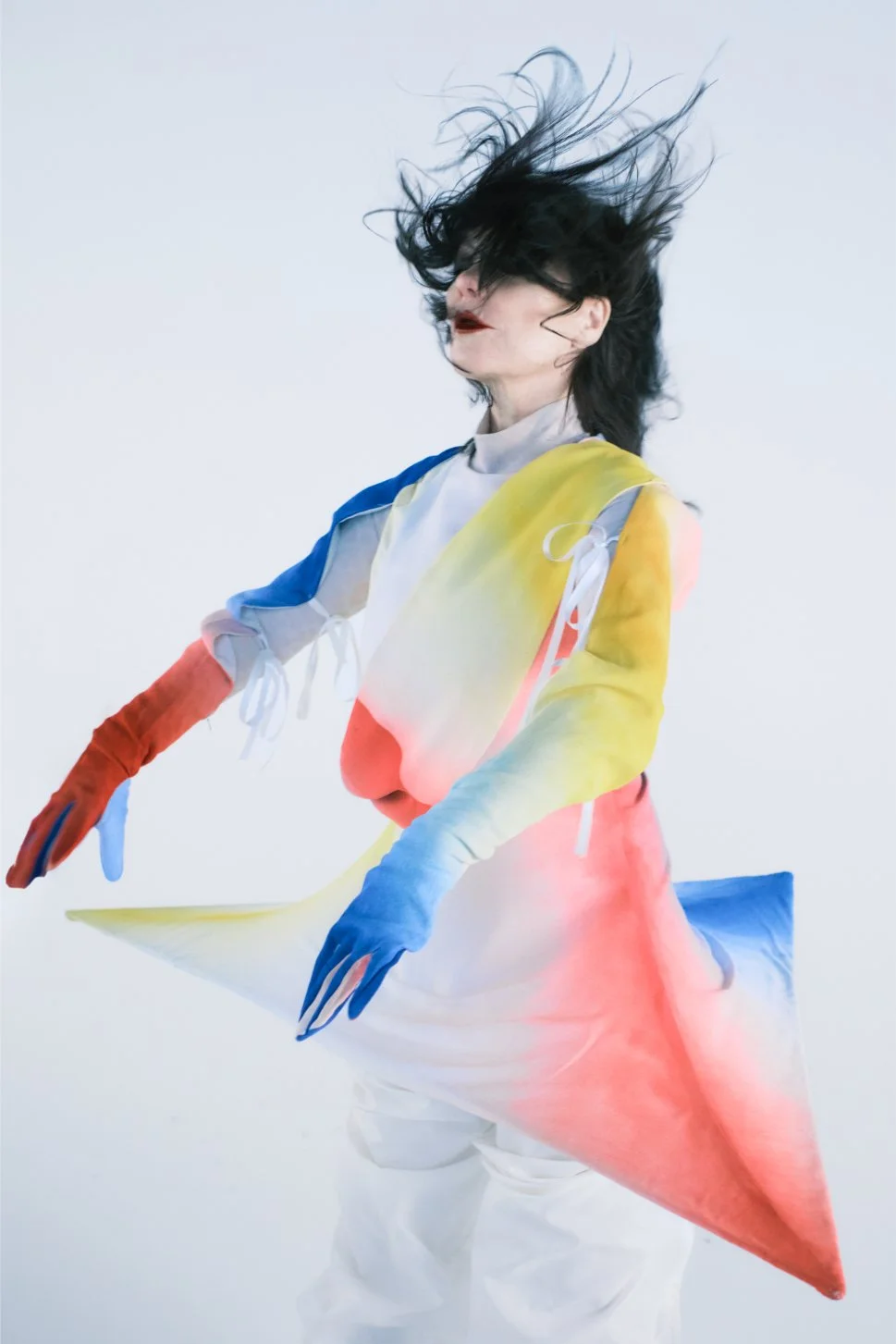
Outfit JARNO KETTUNEN
White bodysuit CRITTER
From the jagged, icy, volcanic fjords of Iceland, on the edge of the Arctic Circle, Björk emerged into the mainstream with a shape-shifting, metamorphic fluidity that remains cutting-edge, revolutionary, and hauntingly prescient. Even today, she exists as an enigma—a spectral force within culture—while simultaneously being one of the most recognizable figures in contemporary popular music. Born just two decades after Iceland gained independence from Denmark, she was raised in a landscape where industrialization arrived swiftly and forcefully, producing a generation of artists, writers, poets, and musicians grappling with globalization and the looming threats of extractive capitalism. Among them, Björk stands as Iceland's most iconographic export. Over five decades—from her anarcho-punk origins as a teenager in bands like Spit & Snot, Exodus, Jam-80, Tappi Tíkarrass, Kukl, and The Sugarcubes, through her breakout as a solo artist in 1993—she has drawn upon diverse cultural influences, technological advancements, and a sensual, eco-musicological ethos to push the boundaries of songwriting. For Björk, desire is more than raw, libidinous energy; it is an ecological and biological forcefield, a conduit of care and hope for a fragile world. Nature becomes both muse and backup dancer. Over the past decade, she has been conceptualizing and realizing the most audacious performance of her career: Cornucopia, a "digital theater" tour that traversed the globe, culminating in a book and an upcoming feature-length film set for theatrical release this May. With a sharp focus on the climate crisis, Cornucopia wields the power of sci-fi and fantasy—reminiscent of Octavia Butler—to envision an unimaginable future. A Gesamtkunstwerk of audio, visuals, and digital avatars, it constructs a "post-optimistic" vision where music serves as a blueprint for renewal. Björk carves through mountains of apathy, forging a pathway for hope. She conjures the first light after catastrophe with orchestral flutes and choral jubilation. As wildfires consume landscapes and climate denial persists, the film's global message grows ever more urgent. Musically, Cornucopia sees Björk mining her vast solo repertoire—looking forward by looking back. Standing beneath her avatars projected onto kinetic curtains, she literally and figuratively reconstructs her past. The setlist spans decades, from Post's "Isobel" (1995) and Vespertine's "Hidden Place" (2001) to selections from Utopia (2017) and Fossora (2023). With visionary stage direction by Lucretia Martel and stunning visuals by Tobias Gremmler, the performance employs a breathtaking range of bespoke instruments and sonic architecture: a magnetic harp, an aluphone, a circular flute, and a reverb chamber housed in her own chapel. Björk's fusion of technology and music is nothing new—Biophilia (2011) came with an interactive app featuring narration by David Attenborough, and Vulnicura (2015) incorporated a VR experience. But with Cornucopia, she merges 21st-century digital tools with 19th-century theatricality. Once again, Björk bends time itself, dismantling the binaries of past and future, nature and technology, art and science. She does not simply exist in the present—she is always a step ahead, reshaping our understanding of what music, performance, and storytelling can be.
interview Hans Ulrich Obrist
photography Vidar Logi
styling Edda Gudmondsdottir
makeup Andrew Gallimore
hair Hiroshi Matsushita
HANS ULRICH OBRIST: I'm excited that we can do this new interview. We have so many exciting interviews from the past. One day we need to do a book.
BJÖRK: That could be fun. Yeah, totally.
HANS ULRICH OBRIST: I wanted to begin today with what is most urgent: the climate emergency. For your exhibition, Nature Manifesto, at Centre Pompidou, you wrote: “It's an emergency. The apocalypse has already happened. And how we will act now is essential.” The exhibition has to do with the climate emergency, but also biology. You also write, “Biology will reassemble in new ways. And micro-organisms will mate with other life-forms to heal and adapt.”
BJÖRK: I always align myself with more biological things. Whether it’s architecture, design, clothes—they are more biomorphic. I come from a second world country where we didn't industrialize until really late and we still haven't fully industrialized. So, this idea that you can live in nature and have technology—that it's not two separate things—it's not a fantasy. I'm sitting right next to you now, looking outside my window, it’s snowing, and there’s a beach, but I'm still doing a Zoom meeting with you. I don't think this is utopian. I’m always trying to look for philosophers who understand this idea, because it doesn't really align with a lot of European philosophers. The conversation I had with Timothy Morton was the beginning. Ocean Vuong is here in Iceland now and he was telling me about this Japanese philosopher called Nishita Kitarō, who was more about joining nature and technology, biology and civilization. That they're not enemies. I mean, obviously both the Nature Manifesto and also Cornucopia, which we started in the Shed five years ago and is now a concert film—it’s a sci-fi tale, it's fantasy. Sometimes it's easier, like with Octavia Butler and other sci-fi writers, to grow and reach our potential through sci-fi or through the imagination because when we are stuck, it's impossible to imagine the future. For example, the Paris Climate Accord [Paris Agreement] does feel quite utopian. We’ll never ever reach all the goals, but it's a state of mind. And I think that's what the artist or musician is good at: the imagination. Of course, we have to go forward and try to deal with all the environmental challenges. We will do it with any means: activism, politics, anything. But our imagination is quite important. And Nature Manifesto is trying to encourage us to imagine a future that will morph with nature. In that way, it's more optimistic. I call it post-optimistic.
HANS ULRICH OBRIST: You mentioned Kitarō, the Japanese philosopher from the 20th century, because he went beyond the binaries of nature and non-nature. He wanted to overcome the subject/object distinction that anchors Western philosophy, and that idea is also essential if we want to be in communion with the environment. In an interview with Dazed, you talked about this idea of musicians being about vibrations and energy, and that you actually don't look at the world, you rather listen to the world. And when you go into nature, you change, you feel the change of energy, that you're part of something much bigger. Etel Adnan, one of the last things she told me, when she was in her nineties before she passed away, is this idea that we need to learn to listen again. I wanted to ask you about the importance of learning to listen again.
BJÖRK: The dominant way to sense the world in our civilization is through the eye. It's the quick way—both through visual art or fashion or all the visual mediums. Sound is the more obedient, hidden force. But I think it's just as important. I tend to be the defender of that way of sensing things. What happens when you get a little older is that the next generation is looking to you for advice, which comes to me as a big surprise. I never thought of myself as some sort of teacher. But what I'm seeing in a lot of the younger generations is that they are obviously online a lot and there is isolation from the body. So, my advice is to sense the world through sound, through nature, through walks. That it's not binary: your everyday life is not just about having this isolated intellectual existence in the city and then once a year go for two weeks into nature like it’s some paradise bubble. It’s about actually having a physical life and a biological sensory life. And I think this is also related to sound. When you go on walks, take in the whole valley that you are walking through, or the beach. This is also going to help us to go into the next stage of technology, artificial intelligence, which is going to be even more merged with our bodies, our blood, our heart, our pulses. It's going to be even more important to be able to listen to nature—for the well-being of the next generation—so that they can feel calmness, enjoyment, celebration, and satisfaction. That's why I was always really attracted to cities like Havana, or Rio de Janeiro, or Reykjavík, where you can have both the city and nature.
HANS ULRICH OBRIST: Nature Manifesto is a commission for the escalator at the Pompidou. Can you talk about the piece and how you composed it?
BJÖRK: The Manifesto was installed in the escalator of the Pompidou, or what they call the “caterpillar.” (laughs) I worked a lot—with a few months of editing—in collaboration with IRCAM (Institut de Recherche et Coordination Acoustique/Musique) and sound artist Robin Meier Wiratunga. We had access to all the latest AI software, and I went through collections and libraries of extinct and endangered animals. I was trying to merge them with my voice; trying to give these animals a microphone. I felt it should be more like a spoken word, like a call to action. Usually the activist in me and the musician in me are very separated. So, it was an attempt to combine the two.
HANS ULRICH OBRIST: I would love to hear more of what you did with Robin at IRCAM, because I knew Pierre Boulez well, and he explained to me his vision for this interdisciplinary laboratory for sound. How did you use this toolbox?
BJÖRK: A few times a week, me and Robin would dive into the whole world of AI. Of course, much has been documented online about AI's capacity to deal with structures, like you can say, “Do Beethoven in the style of the Beatles,” or whatever. I'm not really that interested in the structural elements of AI; maybe because a lot of my music and my songs are very bespoke. I sometimes spend months on writing the structure of each song; the singular songwriting element. I like to do it manually. But I reached out to IRCAM more just about the sound, or the timbre, merging with different elements. I also reached out to them to do some research on where AI is at the moment, and I'm very excited. I will probably continue to collaborate with some of the people from IRCAM. It’s a very exciting place, and the energy down there in the building is amazing. (laughs) It's just incredible for any musician to go into this kind of institution that’s all devoted to sound. And they were the inventors of the software, like Max that I used to write Biophilia (2011). So, the history goes way back.
HANS ULRICH OBRIST: Obviously, AI is on everybody's mind. At the same time, a lot of discussions have been held about the ethics of AI. What could be an ethically sourced dataset and who owns the dataset? What is your experience with AI? Have you used a lot of AI in your music or in your work, and how do you see the implications of it?
BJÖRK: We’re all at the beach—it’s the beginning of something. It's humongous. I’m excited about how we're going to interact with it. I mean, obviously there are things to worry about and that are scary. My stance tends to be the same as it was from the 90s when I was asked why I wasn't in an indie band anymore. Like, how dare I use a drum machine—it doesn't have a soul?! So, I've been having this kind of debate for decades. My answer is always, if it doesn't have a soul, it's because nobody put it there. I also understand that it's not so black and white, and that maybe what is scary about AI is that the merge is so immense. There are people who write music for films that might not be needed anymore. You just can just prompt AI to write a sad composition that's a certain length. This is obviously very worrying, but I do think we have to navigate it and go through the morality of it. There are gonna be disasters, for sure, but I also think technology is coming whether we like it or not and we have to find humanity in it. We have to find where the soul and technology can coexist. I think that is the role of the musician, and musicians are good at that. That's what we do. We go into a room and we pick up an instrument, we write a song, we are always tuning, equalizing and harmonizing with the environment. Where is the next song? The singer songwriting element, you know, Oh, should I write it with a car alarm? Okay, let's do that. But, to be honest, I'm not a prophet. I have no idea where AI is going to be in five years. I used quite a lot of different AI softwares with IRCAM, and to be honest, what I actually ended up loving most was editing the belugas, orangutans, dolphins, and myna birds by hand, choosing each sound—sound by sound. And when you hear something that took two or three weeks to edit—that's only one minute—it's like the cathedral ceiling: you can tell that it's done in the energy of prayer. It has a different kind of energy, like embroidery. I will always love craft. I'm a craft girl, but I think I’m also an old punk at heart. I do love spontaneity. So, if there is some way for AI to somehow enable a musician or a performer or a singer or a cellist or a harp player to communicate faster in a more immediate way online with people who are on the other side of the planet, I will be very excited about that as a musician.
HANS ULRICH OBRIST: In early computer games, synthesizer sounds were compressed into 8-bit formats to save space. These small, harsh sounds not only fit into games but also evolved into an aesthetic and even a new music genre. You use a form of frugal AI. You mentioned in an interview that this frugality can become an artistic gesture. Do you think artists should be more aware of frugal AI?
BJÖRK: When I put the Pompidou project online, a lot of my fans—who are total nerds, in the best way—started asking questions in the comments about AI. They’re amazing people with a lot of integrity, but many of them were suspicious of AI. I thought, great, let’s have this conversation. So, I ended up meeting with the head of IRCAM and he introduced me to a researcher named Philippe Esling who knows a lot about frugal AI and its environmental impact. He explained AI’s serious environmental costs. For example, cryptocurrency is one of the biggest offenders right now; it devours energy and is extremely anti-environmental. But then there’s something called frugal AI. To put it simply, frugal AI is capable of generating audio in real-time on local servers without a GPU. Just using our phones or being on Instagram—that’s an example of frugal AI because it uses much less energy. As artists, it would be great to have this information so we can make a choice. For the Pompidou project, the audio and also the visuals, which were created by Sam Balfus, used frugal AI software. I also realized that when there’s space for the artist’s imagination to come in, that’s usually the more frugal route. You don’t need the most complex, energy-guzzling gadgets in the world to write a song or create something meaningful.
HANS ULRICH OBRIST: At the Serpentine, we are very interested in artist campaigns that address the extinction crisis. You have an ongoing campaign to protect the ecosystem in Iceland against industrialized salmon farming. And recently, you collected funds through an artistic collaboration with your friend Rosalía from Spain. Can you talk a little bit about this collaboration and how that evolved? Beyond the music, you are actually organizing court cases to help change the laws around fish farming. Last time we spoke, you said that it's important to write laws to protect nature.
BJÖRK: Yeah, I still feel that way. In my 25 years of activism, I've gotten to this point where I'm just like, “See you in court.” (laughs) I think that's the best method: to fight them with the same things they fight us with. Rosalía was incredibly graceful and sang on my track, Oral. It’s been a year and a half, and we actually collected an incredible amount of funds. We started this company here in Iceland where all the funds go into. At the moment, we are running four different court cases. I actually was at a meeting yesterday. Obviously, I'm not a lawyer, but I am fascinated by how innovative one has to be with legal cases. The language doesn't even exist to protect nature, even for lawyers. But the cases that seem to be winning are the fight for biodiversity. You know, if the farmer says, “Listen, I need biodiversity in my fjord.” That is a language everybody seems to understand. Also, when young people say, “Listen, you are destroying my future. My fjord is not gonna be livable in twenty years.” These cases are also winning. We have one case, which is about the quality of water—if we can win that case, it could have a domino effect because it would set a precedent. We have mostly been fighting in the Eastfjords—close to where we went, Hans, in Seyðisfjörður.
HANS ULRICH OBRIST: We were together there having a conversation. This was one of our previous interviews. It was beautiful. We crossed the Highlands from Reykjavik.
BJÖRK: I think it’s interesting to be Icelandic because we still have the biggest, untouched area in Europe. And the Norwegian business guys who came here and created this fish farming disaster, they were just venture capitalists who did a lot of this stuff in Norway. Norway went berserk and put up all these laws, so they couldn't do what they were doing anymore. So, they just went to Iceland. Now we have to implement these laws, and hopefully we can take them even further. We have been working with environmental groups internationally. The song was also quite big in South America, so we worked in Argentina and Chile, where fish farming has progressed much further than in Iceland. We are sort of in the beginning stages in Iceland. But in Chile and Argentina, it's pretty serious. So, we are hoping that if the laws go through, we can share them online too, that they could become precedents. We are very aware that this is a marathon, and this is gonna take a long time.The good news is that the song I did with Rosalia has given us the funds to fight it.
'HANS ULRICH OBRIST: That brings me to something I’ve been curious about. There’s Björk the activist and Björk the musician—and of course, many other dimensions to your work—but I thought today we could focus on these two aspects. What’s fascinating is how your activism naturally flows into your music. There’s no barrier between the two; they intertwine seamlessly. This idea of being in communion with the environment seems to have been present from the very beginning. I remember watching your 2003 documentary, Inside Björk, and there’s this incredible scene where you talk about walking home from school in Iceland’s harsh weather—storms and all—and creating melodies inspired by the landscape. You sang to the moss, with the sea, and I find that so beautiful. It shows that even as a child, you had this deep connection with nature. It didn’t just influence your music; it might have been the very thing that led you to music in the first place. I’d love to hear you talk more about how this connection continues to shape your music. Many of your albums—Biophilia, Vulnicura, Utopia—are deeply rooted in this idea of communion with the environment. They tie into so many of the themes we’ve discussed today.
BJÖRK: Yes, I think it's been quite consistent. That's one of the beautiful things about getting older—you suddenly gain another point of view on all the things you've done. And it’s interesting when that perspective stays pretty consistent. Normally, singer-songwriters have a guitar or some kind of accompaniment. For me, my instrument was always nature. Walking is like the voice, and the landscape is my grand piano. I think it has changed through the years because I spend more and more time editing music on my laptop. Now that I've had the laptop for 25 years, it’s a pretty organic part of me, and I love editing. I did a lot of crocheting, knitting, and embroidery as a child in school, and for me, it's a continuation of that. I can spend months just doing one string arrangement or editing beats. If you were going to count the hours, you’d put Björk as an editor first, and a singer second—at least today.
But now I’m writing more complex things on my laptop, which I then sing over. Because sometimes, when I walk outside and sing, it’s more modal, like a lot of Indian music. One of the reasons I went into Biophilia using Max programming, and finding natural elements to incorporate into computers, was to explore more irregular musicology inspired by nature. I wanted more than just the structure of normal electronic music. A lot of software, like iLogic—and I’m not grilling iLogic—but the kind of software used to make dance music is very much like Legos. It’s very four-on-the-floor, very square. What’s great about Max is that the programming is more like architecture with curves, not squares. Biophilia was very much about finding software that could be in the shape of lightning or a pendulum.
But as I grow, I try not to eliminate parts of myself. The Björk who walks in nature and sings in a valley still exists, you know? I have two cabins now, forty minutes away from each other. But I also think it’s important to grow. So, the Björk who sings with more complex structures I’ve written inside my laptop—she exists too. And there’s also the Björk writing songs on top of a flute or bass clarinet arrangement, or the Björk in conversation with Arca, which is a whole other side of me—a collaboration between two equals.
HANS ULRICH OBRIST: I remember years ago, before Arca was well-known, you set up a lunch for the two of us. You said we should meet, and we did—really early in Arca’s career. It’s a memory I’ll never forget. What stands out to me is how you’ve always supported the next generation, championing the future of music and art, and helping young artists find their way. So, I’m curious—now in 2024, what are you listening to? What excites you?
BJÖRK: (laughs) Oh my God, there are so many incredible things. We started this record company when we were punks called One Little Independent Records—it's sort of like the Rough Trade of Iceland. We still run it and we put out contemporary classical music, techno, and poetry. I actually had a meeting with them yesterday, talking about next year, and we are always in conversation with the next generation. I think that’s a very Icelandic thing too—it's like a small village and all the generations hang out with each other a lot more. But I could name so many people. I love Mun Sing. I love Clarissa Connelly who is Scottish. She’s incredible. Her last album I've been listening to non-stop. I really love the label SVBCVLT. They actually came here to Iceland. We did an amazing summer solstice concert here on the 21st of June with SVBCVLT and Mica Levi.
HANS ULRICH OBRIST: I'm super curious about your own music, as always. Biophilia is really this idea of a Gesamtkunstwerk because it goes far beyond music. It was not only a concert, it was an exhibition, a digital project, a multimedia project, a concert, books, and text. This evolved even more with Utopia. I am wondering if you can talk a little bit about how this whole idea of a gesamtkunstwerk evolves, and what's next.
BJÖRK: For me, the core has always been live performance. I started performing early, playing in bands, and that really shaped my voice—figuring out what a concert is. That’s the spine for me. When I build things around that, it feels like the foundation. I’m really interested in that. Even though my work can get complex, with all these interdisciplinary layers, at its heart, it’s actually about simplifying things. I feel like in certain ways, I've been doing the same thing over and over again, which is to tear off all the unnecessary luggage of each album or each period, and see what attaches to a live performance and what is current now. I love the zeitgeist, of course, but that’s not my focus. For me, it’s about being present as a singer-songwriter—connecting with how I feel right now, with my family, friends, or even people at the record shop. It’s about that moment. In today’s world, playing just drums, guitar, and bass doesn’t feel true to the life I’m living. Each album feels like a murder mystery to solve: what sounds reflect where I am now?
After Utopia, where I spent years arranging and playing flutes, the element was air—light and weightless. There was no soil, no bass. It felt like the opposite of Vulnicura, which was dark and intense. Utopia was this celestial celebration with no roots. But with Fossora, it shifted. During COVID, I was grounded in one place for two years, putting down roots. That’s where the bass clarinet arrangements came in, and singing alongside them became the starting point. That became the core, the live performance, and everything else built from there.
Now, with my next album—I'm halfway through—it feels like the opposite of Cornucopia. That project was overflowing: choirs, flutes, thousands of instruments. It was a once-in-a-lifetime thing, blending digital theater with 19th-century stage design. For Vulnicura, I worked on seven VR pieces, fully immersed in 360 visuals and sound for years. When we set up at The Shed in 2019, we brought that 360 VR experience—both sound and visuals—into a traditional theater space. But this new project is heading in a very different direction. I’m hesitant to say too much, though—you can jinx it! (laughs)
HANS ULRICH OBRIST: And 20th century cinema in a way—you also brought Lucrecia Martel to direct Cornucopia?
BJÖRK: Yeah, totally. It was like a magic lantern for the 21st century—trying to create a VR experience, but for the stage. For me, it was kind of designed for me to be a megalomaniac, like this was as big as I’d ever go, you know? (laughs) It’s been a seven-year project from start to finish, and I’ve been there for every single part of it because I care so deeply. I was there for the color correction, the editing, the sound mixing—everything.
When we first filmed it, it felt very 2D, and I was like, no, no, no, we have to add animation in front of the film. So we layered a lot of animation on top of the live concert footage to bring back that 3D feel. It really became my baby. And when I started working with these incredible editors and cinematographers, I realized how strange the project was. I worked closely with all the animators—there was a unique animation for each sequence of every song. Every ten seconds had its own visual identity. Then figuring out how to open and close the screens felt a lot like editing a film, but it was all done live.
The way the screens moved and the animations flowed, it took as much work as an animated feature from Studio Ghibli or something. The cuts and edits were just as intricate, but happening in real time. I also felt like a curator, making sure each animator's work stayed true to the vision. I was really protective of the colors—like, this shade of blue belongs to this song, and it has to stay consistent. So I’ve been deep in the post-production world, but I think my next project will be the opposite—going back to something simple, more stripped down.
HANS ULRICH OBRIST: I’ve always been really interested in the idea of utopia, because the traditional, static, Western concept—like in Thomas More’s work—is obviously problematic. But thinkers like Édouard Glissant offer a different perspective, seeing utopia as something trembling—more alive and dynamic. Ernst Bloch defined utopia as something missing from the present reality. I think that’s an important way to frame it, especially now. It’s crucial to explore different notions of utopias. I wanted to ask you about your Utopia project and how it continues to evolve.
BJÖRK: Yeah, I think that’s where it really helps to be an old-school singer-songwriter. Utopia has 14 songs and each one approaches the idea from a different emotional angle. One song might be, wow, I feel so alive, my senses are heightened, or I’m in utopia, everything’s new and amazing. Then the next might be, I’ll never, ever reach that—it’s impossible, like a blues song, you know? Even though the album is called Utopia, there’s also something ridiculous about that kind of optimism. When I asked James [Merry] to make those silicone plant pieces for my face—like on the cover—that was part of it. It’s kind of absurd to want utopia so badly. I’m also making fun of myself, there’s a bit of absurdism; taking the piss. But humor is really important to me, even when it’s sincere.There are songs like Future Forever that are very sincere, about my work relationship with Arca. It’s full of hope—genuine hope. That’s the beauty of the singer-songwriter element: you can approach a concept from all these different, deeply human, old-school emotional points of view.
HANS ULRICH OBRIST: You’ve brought so many amazing ideas to life, but we rarely hear about the ones that haven’t materialized. Of course, the idea of an unrealized project can cover a lot of ground. Some projects are too big or too expensive to pull off. Others are just too time-consuming. I remember talking to György Ligeti when he was in his seventies—he told me he had another 50 years of music in him, but obviously, he knew he didn’t have that kind of time left. Do you have any unrealized projects that are especially dear to you? Maybe something you still hope to bring to life in the near future?
BJÖRK: Yeah, I definitely have to agree. I’d need about 500 years just to finish everything I want to do. Every time I get distracted by something else, it feels like I’m cheating on my main mission. But, thank God, I have a sense of humor about how ridiculous I can be.
One great thing about being a solo songwriter is that when you write, you can project as far as you want—you can throw your net super, super wide. The trajectory of your intentions, what you want each song or album to be, can be huge. But at the end of the day, you’re still just you. That moment when you’re singing, with your blood and flesh and breath, you’re fully present. I love that humbling part of being a singer. I have to warm up my voice every day, and it’s like, oh, this is how many notes I have today. That reality always pulls me back into the moment, into time itself, and grounds me.
So, with each album, I try to cast the net far, keep it vibrant, and explore new things. When you’re 55, you can only make the album you can make at 55. The same goes for 65, 75, 85, 95—it’s kind of beautiful. And sometimes, when I listen to music by artists I love, half of it is great because of their intention, what they wanted the album to be. But what’s even better is what they weren’t aware of. You can hear the oxygen in the room, the little things they didn’t even realize were there. I think that’s beautiful.
I do try to keep my overambitious side in check (laughs)—the part of me that wants to do 500 projects at once. I try to reel her in by staying in the moment and saying, okay, let’s just write this lyric. A lot of my lyrics are about that—being here, in this time and place, and dealing with it.
I’ve said it before, but I feel even more strongly about it now. I was really inspired when I read Anaïs Nin’s diaries. The way she documented every stage of her life, the democracy of all the ages she was—it moved me. She wrote until her death, and each decade, each entry, felt completely different as she changed. I love that idea, that each decade is just as important as the last. It’s not like it stops being meaningful when we’re 100 years old. I was actually talking to Anne Carson about that—the author—she lives in Iceland now.
We were talking about writing in your seventies or eighties—how it feels like going to the moon or discovering a new planet because there aren’t many comparisons. It’s pioneering work to document that stage of life. Anne and I discussed this a lot while she was working on her last book. Writing from your twenties to your hundreds really becomes more about mental energy and staying present in the moment.
As a musician, as a singer-songwriter, there’s definitely going to be a scruffy-voiced album when I’m 90. (laughs) I’m actually pretty excited about using that as an instrument, almost like a diary. I’d say yes to your question—but I also love the challenge of reeling it in, finding meaning in what you create at different stages. The work you did in your twenties? You were meant to do that in your twenties. The work you’ll do in your sixties? That’s exactly where it belongs. There’s a certain humility in accepting who you are, decade by decade.
HANS ULRICH OBRIST: Rainer Maria Rilke wrote Letters to a Young Poet as advice to aspiring writers. What would your advice be to a young musician, songwriter, artist, or poet—really, any kind of artist—reading our interview?
BJÖRK: Oof. Wow, that’s a tough one. It’s hard to sum up in just one sentence. You’ve really got me thinking. I guess I’d say—it’s important to find your voice. And I don’t mean that literally, like a new sound or style. I mean, dig into your DNA. What makes you unique? I think that’s what is really going to stand out in a world with AI. As we express our individuality—whether it’s through social media, AI, or the endless flood of information—holding onto that personal essence will become even more precious. So, I’d encourage young artists to focus on that. It probably sounds a bit sentimental, but since you mentioned Rilke (laughs), I guess it’s in the same spirit as his advice. I’d say: find your voice, and discover what sets you apart from everyone else.
HANS ULRICH OBRIST: I came across some conversations you had with Meredith Monk and it made me think about how, from the beginning, you’ve explored ecology.
BJÖRK: I’m really into healing and acupuncture now. Meredith and I talked about that—how she went to New Mexico to heal herself, recharge, become whole, write songs, and then bring them back to the city to heal the other urbanites. We talked about that because she still works and lives in the same loft she’s had since the seventies. It was incredible seeing that space because it helped me understand the minimalists. I could see how they were writing and moving between each other’s lofts, and even how disco and house music were born in those spaces. That minimalism—the way they separated the subwoofer from the tweeter in the speaker systems—I think that’s beautiful.
But I’ve always had a more complicated relationship with that idea. For me, going to Iceland, hiking, finding balance, and then coming back to the city to “heal the urbanites” felt kind of artificial. I was more radical, like, Why don’t we bring more nature into New York? I wanted to change the whole idea of what a city could be. Some cities are better suited for the 21st century—places where you can interact with nature and have technology. But, of course, I respect Meredith’s angle. Her south-north is my east-west—it doesn’t have to be the same.
Some of my favorite moments in New York were having lunch with her, sitting in her loft while she cooked, sharing her wisdom. Especially when I was frustrated with the city, she was so generous with me. I visited her in May, and we were just sitting there, crying at the same table, in the same loft, drinking the same tea. She’s so special. She’s a very healing, very spiritual person.
HANS ULRICH OBRIST: This was an amazing conversation. I really hope we'll see each other soon in London because I want to continue our conversation.
BJÖRK: Perfect.
HANS ULRICH OBRIST: While preparing for our conversation today, I realized we’ve known each other for 40 years. As a teenager, I came to see a concert you gave with the Sugarcubes at the Red Factory in Zurich.
BJÖRK: Oh, that’s insane. That's crazy.
HANS ULRICH OBRIST: Yeah, I was at that concert—that was the first time we met. We saw each other for a few minutes, and that was 38 years ago. So, we’ve known each other for 40 years. It’s kind of amazing.
BJÖRK: I mean, mind blown, as the young children say. (laughs)
HANS ULRICH OBRIST: (laughs) Thank you so much.