
photography by Jack Bool
makeup by Holly Sillius
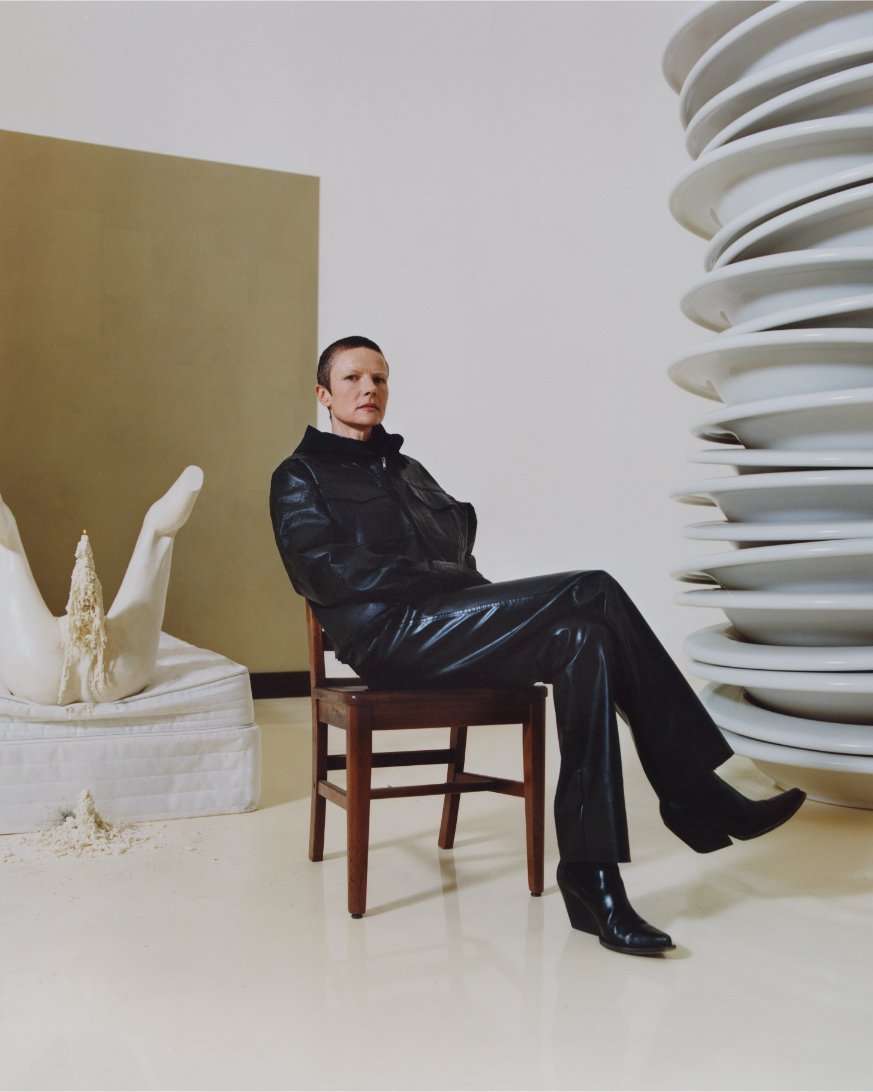
Isabelle Albuquerque and her partner Jon Ray, who once made music together under the moniker Hecuba, discuss desire not as a linear dynamic between subject and object, but as a zone–a porous, immersive field that one inhabits rather than directs. Rejecting the classical notion of desire as a gaze emanating outward toward an object, desire originates from within the body, radiating outward, and is experienced as something that moves through us–more like weather or atmosphere.
RAY: I think for both of us, desire isn’t so much a subject-object dynamic, but rather something much more multivalent—a zone, something that exists from within.
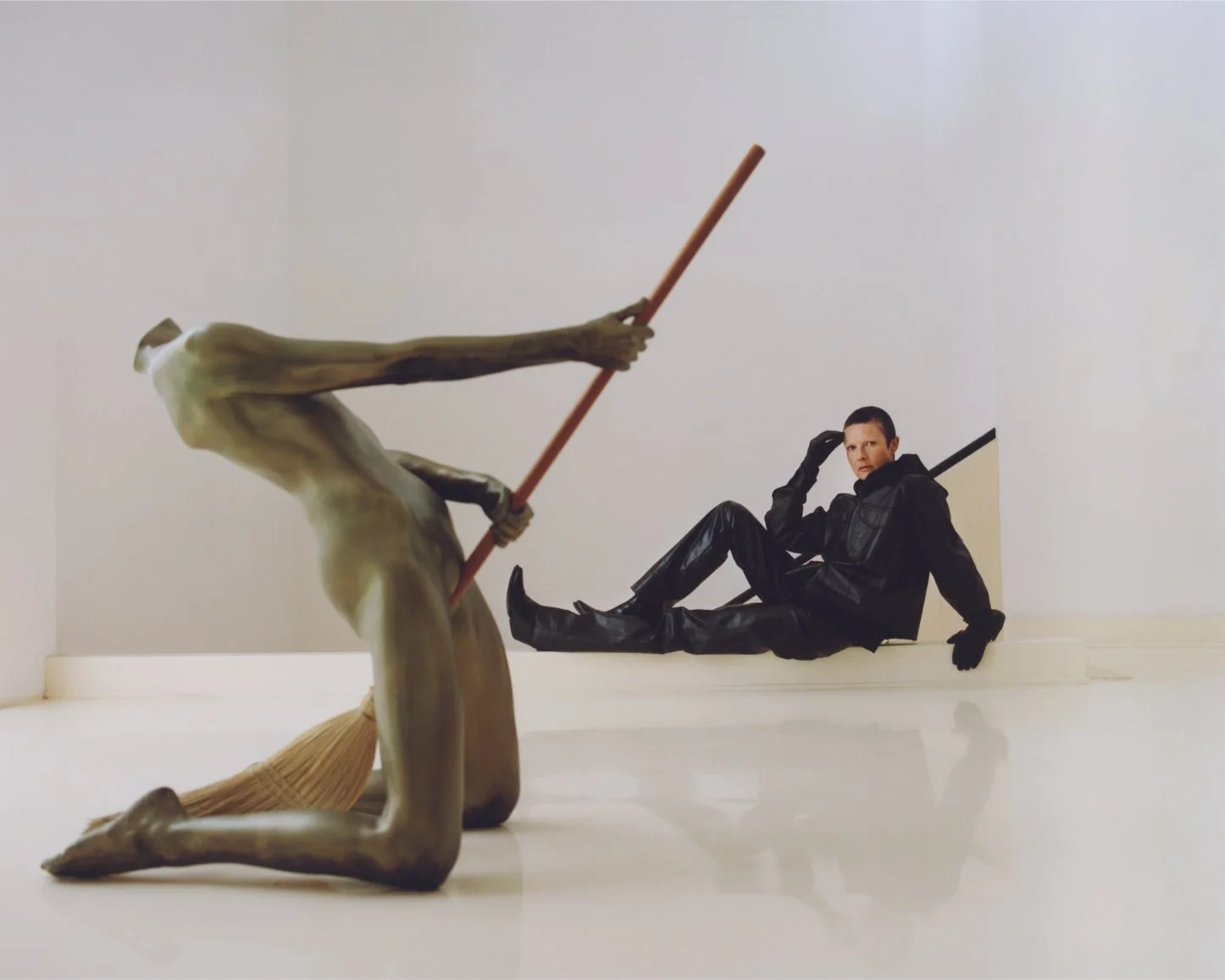
ALBUQUERQUE: When I look back at the orgy series, I realize it was essentially a deconstruction of the female nude. Throughout art history, we've seen reclining nudes, where the desire emanates from the painter or sculptor, directed onto the body. In the orgy, I wanted to flip that—making the desire originate from within the body, radiating outwards. This shift created something more natural, more wild, and sometimes, the desire would surprise me. Each sculpture in the orgy represented a different aspect of desire. In the first, it was a kind of phallic desire; in the second, it was a slow, burning desire—reflecting on how desire intersects with time. For me, there's a deep connection between desire, sculpture, time, and even sexuality. I recently read that women need an average of 40 minutes to an hour of foreplay to reach orgasm. That fact alone was incredibly relaxing to me, because there’s something about the slowness of female desire, about taking time. In the second piece, for example, I incorporated a candle that would go inside the body. Many of the sculptures in the orgy had elements that would interact with the body in this way—never just touching on the outside but always going inside. It’s a reflection of where desire originates: from within. In this piece, the candle wax becomes almost a metaphor for her cum, slowly melting over time. The idea was that the gallery would slowly fill with this "cum" over months, days, years—representing a kind of eternal ecstasy or a continual state of becoming, not a single instant but an ongoing, timeless process.
RAY: It makes me think of the headlessness of the orgy series, where desire isn't something you're necessarily willing into existence, but rather something you're sensing. In the orgy, there's this sense of recentering, of embodiment, where desire is more about tuning into and experiencing a deeper, almost instinctual connection, rather than forcing it into being.
ALBUQUERQUE: Well it's interesting because when I was working on the orgy series, which was basically ten headless beings, you were working on Ancephelas, which was a film on 5 different screens, also about headlessness. I think the way I think of headlessness in the orgy in the Bataiile where you distribute the power. If I remember correctly, Bataille had a secret society called Acéphale?
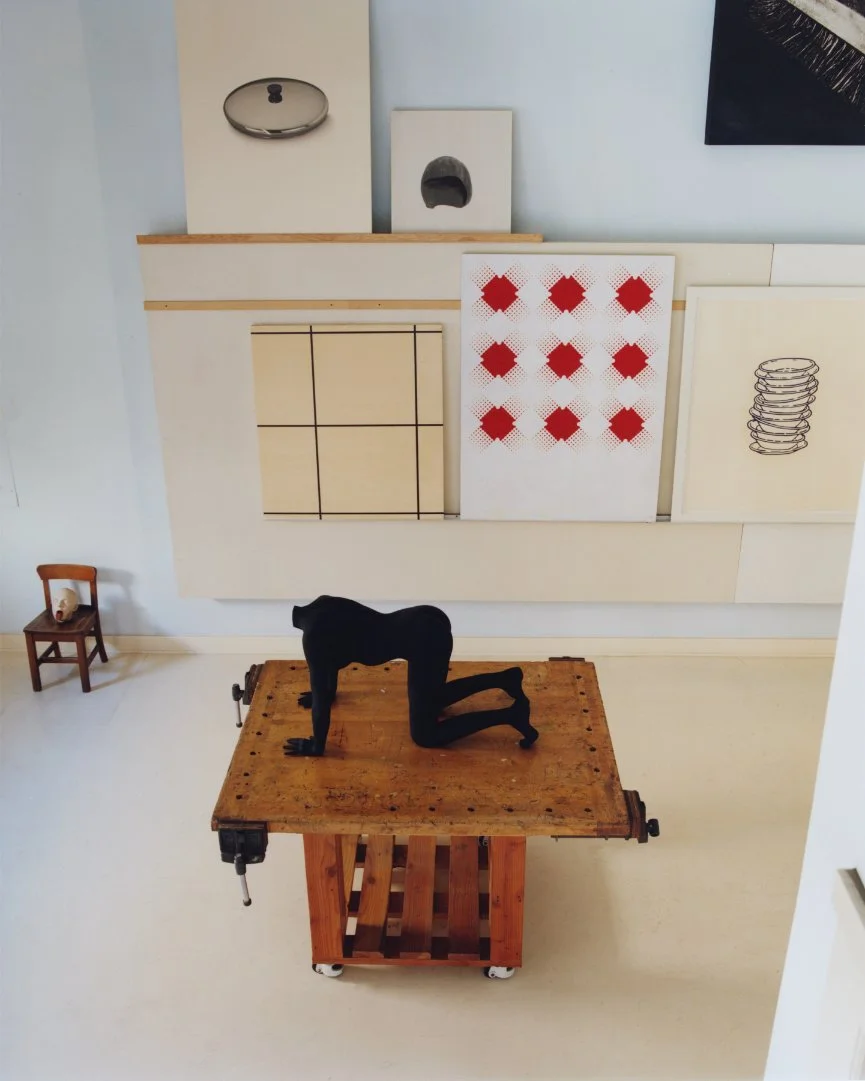
RAY: Yes, the society of Acéphale—part of the ritual was that you had to volunteer for decapitation. But for me, the headless body is much less about hierarchies of power and more about a different kind of distributed intelligence, something akin to an octopus. The absence of a head wasn’t just a lack of a singular perspective or an overarching principle of selfhood. Rather, it suggested a continuity of self composed of multiple streams of consciousness running in parallel rather than in sequence. I was more interested in this kind of distributed intelligence—where meaning doesn’t stem from a single actor but emerges from a collective web of activity.
ALBUQUERQUE: I wonder if desire works the same way—not as something linear, but as something connected to our hormones, our histories, our families, and our culture. One thing I found while working on the orgies was that every time I tried to talk about my own desire, there was no singular desire. I was always caught in this web of pressure and history, with no real way to escape cultural or historical desires. It didn’t even make sense. I kept telling myself, I thought this was about defining my own desire outside of society’s expectations, right? Which is so interesting because I started making this when I thought I was going to have kids—arguably the ultimate societal expectation. And instead, I made an orgy. I couldn’t escape it. There is no singular desire, no single way of thinking about these things.
RAY: In a way, if that’s just a projection—like how we construct our experience of conscious reality through projections and assumptions onto a chaotic, non-singular experience—then the narrative of a singular desire might be just as problematic as assuming we see the world as it truly is when we move through it.
ALBUQUERQUE: Totally. There’s something untrue—and almost violent—about believing you have a singular desire for someone else, as if it’s just one fixed thing when, in reality, it’s anything but. Desire is a system.
RAY: Or maybe a zone of desire. I like that idea because “system” still places a lot of power on each individual part, making them more separate and individuated. But desire doesn’t really work that way. Moving through desire feels more like moving through a zone—one without clear boundaries, where social and cultural forces are porous and intertwined. It’s like being in the Zone in Stalker—you’re in the zone of desire. That zone can feel deeply personal, but it’s also an environment, something you move through, witness, and embody. It reminds me of how consciousness is often defined in research—the idea that to be conscious is to have something it is like to be. If there’s something it’s like to be a bat, then the bat is conscious. We can’t define it externally, only recognize that felt experience from within. Maybe desire works the same way—it’s not a fixed thing but an experience of being in something.
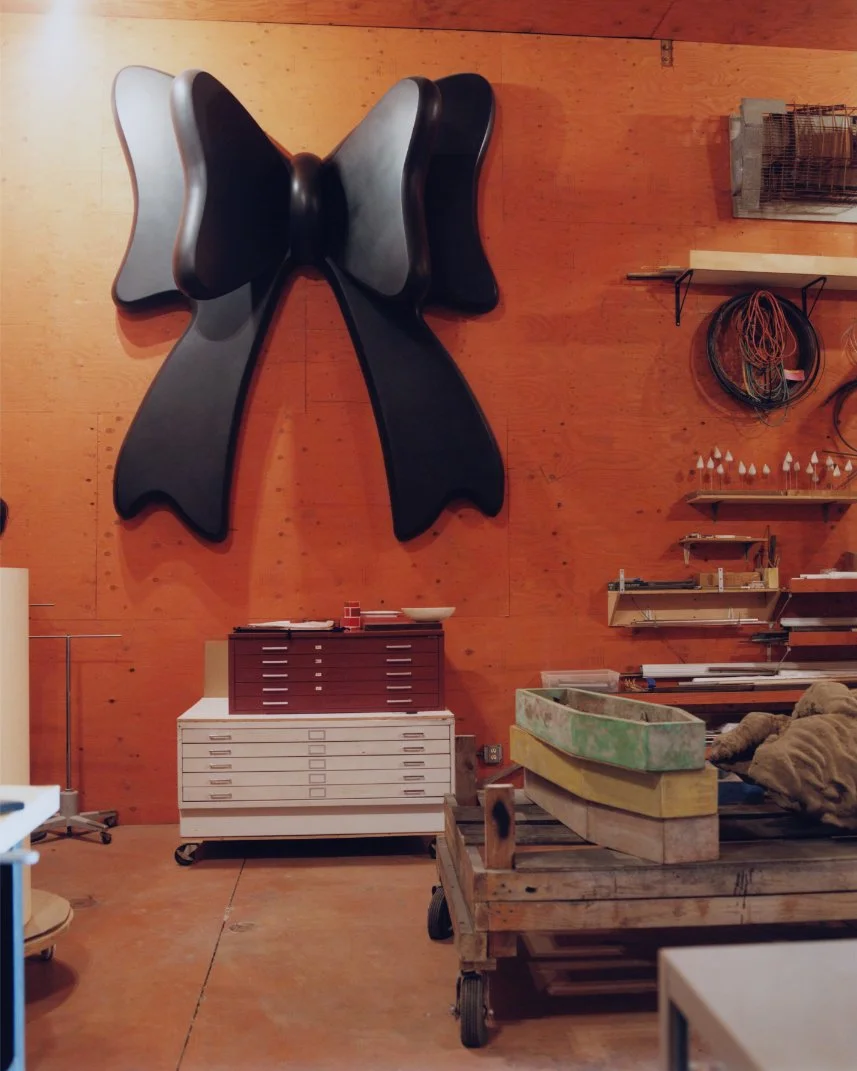
ALBUQUERQUE: I think that’s why, when you desire another person, you suddenly become more in touch with yourself. In desiring someone else, you recognize who you are. And that’s so powerful between two beings—or even multiple beings. It’s this simultaneous recognition of the other and the self, all in the same heartbeat.
RAY: And I think even in that, there’s an interesting interplay with the need for a gap, which we’ve talked about before. I don’t necessarily want to frame desire in a subject-object way—but in this case, maybe it fits. There’s a need for that space between the one experiencing desire and the object of desire. Desiring the self, on its own, has its limitations.
ALBUQUERQUE: I mean, we had an experience when we did Hecuba where we tried to live as two people in one body. We shaved all the hair off our bodies, dressed exactly the same. At the time, we were making music together, and we tried to create as if we were one being. Creatively, it was a pretty interesting experiment. But as partners, it completely killed the eroticism between us. There was no gap, nothing to reach toward in the other—because you were the other. I remember feeling so deeply depressed. I guess that’s what I love about desire: it turns you on because you’re reaching—like a caterpillar, or like an astronaut—stretching into the unknown. And when we became one, or at least tried to, the reaching stopped. And that was the deepest depression I’ve ever felt.
RAY: That was very intense. And I think reaching into the unknown is really interesting too because there’s something about desire that always remains a question mark. There’s no definitive answer—the unknown is the point.
ALBUQUERQUE: And in fact, when you do answer it—even in a relationship between two, three, or however many people—once desire is fulfilled, it often fades. Which is so confusing and upsetting because you wanted it so badly, and then you get it, it’s like holding a dead body.
RAY: Because I think what you're saying—the desire is the reaching. That feels really key, like the act of desiring is desire itself. And in our little experiment, the unknowableness of the other was replaced with the self—and that was the end of desire.I find it interesting, too, when working with AI-generated material. A lot of the desire I felt came from engaging with something so unknowable that it made the urge to see more even more intense.
ALBUQUERQUE: Totally. It’s interesting—someone asked me the other day, since we worked with AI for so long (mostly you, but together too), if I was still interested in it. And I said, not really. I’m not so drawn to an alien intelligence that’s run by corporations. But I think what we were both really interested in—and this is something you kind of gave me as a gift—wasn’t AI itself, but alien intelligence. Something you could reach toward. An unknown that, in the act of reaching, ignited something in you. That’s what was exciting—engaging with something so different from yourself that it made you more you in the process. A few weeks ago, Jaron Lanier made the point that AI won’t destroy humanity through violence—but that the real end of humanity comes when we fall in love with AI. And some might say we’re already there. Because, as we were saying earlier, the end of humanity is the loss of desire for the living. The moment we redirect that desire toward generalized AI, we give away something fundamental—our energy, our humanity itself.
RAY: Isn’t there something similar that happens in sculpture? By materializing these works, you’re giving form to desire—translating it into something that no longer exists purely in the human realm. It’s still communicating with us, but it now belongs to a different reality, existing on a different plane of time and materiality.
ALBUQUERQUE: Well, it exists in a different timeframe than us. It’s not so much that it occupies a different reality, but rather that sculpture moves through time differently. If you think about something like the deer—how I feel about it now will shift over time, just as my potential daughter or granddaughter might experience it differently. And something cast in bronze, potentially lasting for centuries, carries an even more enduring presence. The form itself becomes more static, more fixed in time, yet it continues accumulating meaning across generations.
RAY: Maybe we should talk about desire as a material. Because in a lot of your work, it seems like desire itself functions as a material, almost as a subject in its own right. One of the materials you’re actively engaging with is desire. And what’s really interesting is the way desire connects to how you handle materiality—how it manifests in the physicality of your work. It shows up not just thematically, but through an aesthetic language of desire, shaping the way the materials themselves are experienced.
ALBUQUERQUE: I always want you to want to touch the work. Almost to the point where you can’t control it, where it’s not just happening in your mind but in your body—a physical urge to reach out. That’s why I work with hair, soft fur, flocking, reflective surfaces, warm wood—materials that almost demand to be stroked. That creates an entire aesthetic of seeing that ignites touch. And isn’t that the essence of desire? First, you see the object of your longing, the other, and then comes the chase—the reaching toward touch. There’s so much vitality in that in-between space, between seeing and touching. Sometimes those moments are years apart. Sometimes the touch never comes at all. But it’s always that reaching, that endless stretch toward something just out of grasp.
RAY: It is—but what’s interesting is that the desire exists in between. It doesn’t have to be physically realized to be real. Desire can live entirely in the mind; it doesn’t need to be activated through touch to hold power. And what about the subject-object relationship in your sculptures?
ALBUQUERQUE: It was so important to me that the sculptures in the orgy didn’t follow the traditional subject-object relationship. In art, we’re used to this dynamic: the subject looks at the object. But I wanted the works in the orgy to exist in a subject-subject relationship. So when you encountered them, you weren’t just a subject looking at an object—you were a subject experiencing another subject.
And that creates an entirely different conversation, one that shifts the dynamic of power and perception. I have to say, not always, but in some moments, that was successful. There were people who truly engaged in a subject-subject relationship with the beings in the orgy, and that was so exciting to me. That idea also shaped the aesthetic of the orgy itself—I wanted them to feel so alive that they had their own lives, their own agency.
They’re wearing wedding rings, they look like they could stand up and walk away at any moment. That kind of aliveness emphasizes their subjectivity. And when you're working within the history of the nude—especially the nude female body—you’re inevitably engaging with the history of ownership. Ownership turns the body into an object. My way of pushing back against that, while still making objects, was to make the objects into subjects. That was my fuck you to the history of sculpture. It’s not about owning the body—it’s about the relationships between bodies across time.
RAY: As I look at the drawings on the wall, I’m thinking about how the subject-subject relationship becomes even more intriguing when you step outside the figure and into botanical forms. It opens up a new way of approaching desire and other sensing modalities—how we understand plant behavior as responsive to stimuli, possibly even possessing an internal experience of some kind. But what happens when that evolution extends into botanical-human hybrids? When desire takes on a new form, where a vagina blossoms at the end of an alien stem?
ALBUQUERQUE: The drawings you are looking at on the wall now are flowers. I'm working on a new body of work—an erotic meadow. Flowers have always been symbols of desire. They wear their genitals on their faces—on their flower faces. In the sculptures I’m working on, I’m also incorporating the roots of the flowers, the part we so often don’t see, the part that remains underground. The roots are hidden, but they’re essential. They’re how flowers communicate, how trees connect—it’s an entire underground system. We only see the bloom, the beautiful genitals of the plant, but beneath that is a whole network of intelligence, communication, history, and resource-sharing. The flower is just a fleeting symbol of something much deeper. And yet, when we desire someone, we give them flowers—cut flowers, rootless flowers. Just the genitals. And, actually, one of the places that these flowers came out of was that you had made this database of flowers to train your own AI to make AI generated flowers.
RAY: Flowers—or rather, the first layers of learning in an AI model—capturing flowers in a state of anthesis. Anthesis is when the flower reaches a state of sexual fertility. As the AI begins to form generalizations about the flower and its structure, I’m not trying to create a facsimile. Instead, the model is generating its initial layers of knowledge. In an adversarial algorithm—where forms are continuously created and compared to a dataset—the AI attempts to learn what a flower is in full bloom. But what emerges aren’t perfect replicas. Instead, the process produces these strange, alien-like forms, drawn from nature yet entirely
ALBUQUERQUE: It’s so crazy because I’m making these flowers now. And so much of my work feels like this silent dialogue between our works. We don’t even really talk about it—well, we are now, but we usually don’t. And yet, we end up developing these strikingly similar ideas. Yours often engages with AI or those kinds of systems, while mine takes a different route, but there’s always this unspoken resonance between them.
RAY: Maybe we should talk about ecstasy—because desire, in all its forms, is fascinating in the way it asks: What are we desiring toward? In every sense—artistically, formally, sexually, even in companionship—desire seems to carry an inherent pull toward a loss of self. At its core, it feels like a kind of workaround, a way of escaping the locked-in syndrome of conscious experience. A way of slipping past the self and into la petite mort.
ALBUQUERQUE: Of course, in desire, there’s a longing for alienation, for annihilation. When you’re in a state of ecstasy or orgasm, the most intense part is that sense of annihilation—you lose your sense of self. For that brief moment, you’re no longer just one; you become two. And in that, everything expands, becoming something even bigger.
RAY: Or even more extreme, you don’t become a two—you become a zero.
ALBUQUERQUE: Totally. And if you think about it—after orgasm, the woman may never be just one again. Because, you know, that experience can lead to pregnancy. And with that, there’s the potential for a permanent shift. At least in heterosexual encounters, there’s always the possibility of a complete loss of self, or at least a transformation into a new role, like becoming a mother. Each time you reach ecstasy, there's not only the loss of self in that moment, but the potential for an entire shift. You might not just lose yourself temporarily—you might actually become two people that day. You could begin growing another life inside you, experiencing the sensation of being two bodies at once.
RAY: Or even more so—two consciousnesses at once. So much is shared between the fetus and the mother’s body, an entwined existence. But I also think, in that sense, the Italian notion of orgasm as a volcanic eruption speaks to something deeper—a search for death.
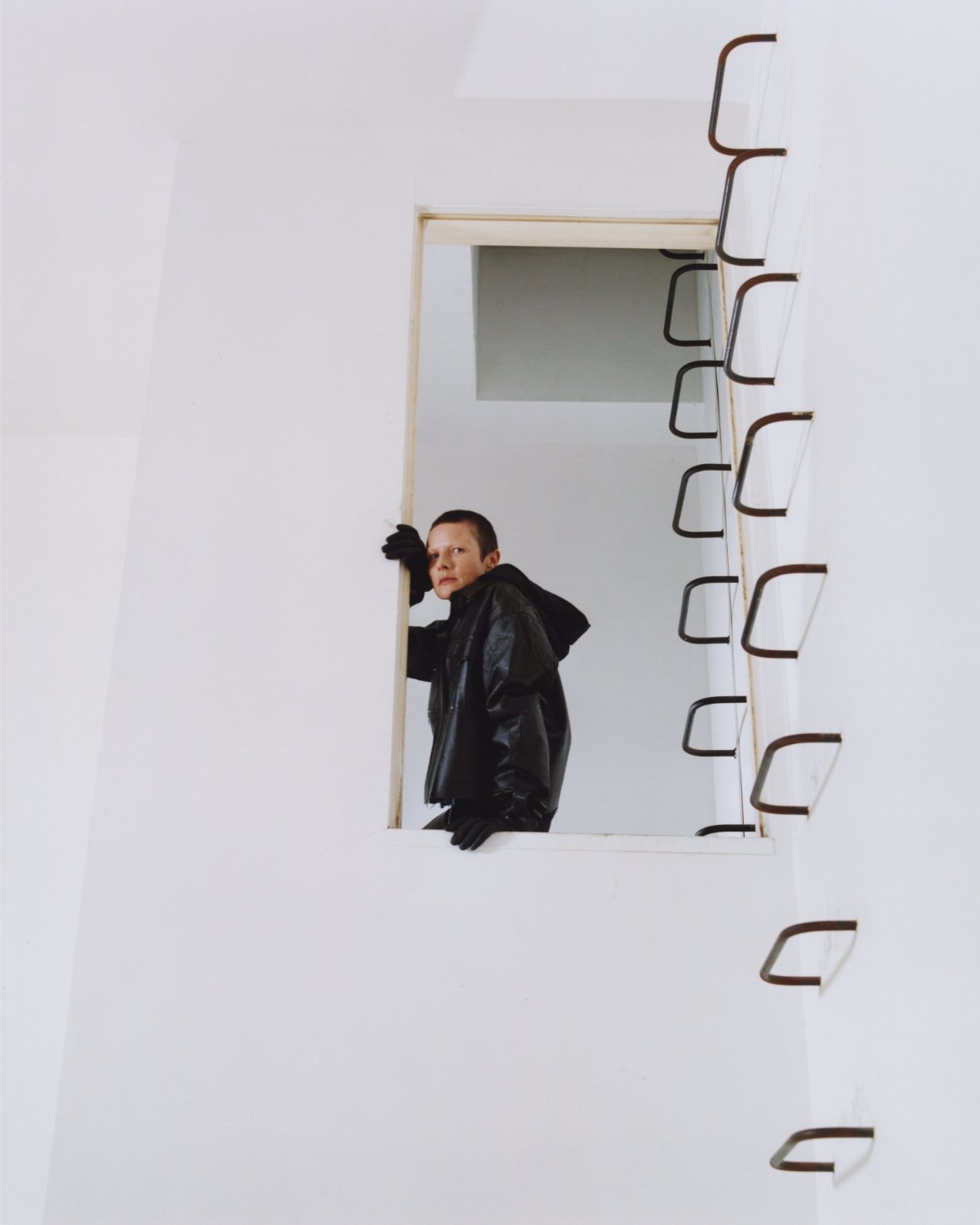
ALBUQUERQUE: It's making me think of this quote by David Wojnarowicz: “Inside my head I wished for years that I could separate into ten different people to give each person I loved a part of myself forever and also have some left over to drift across landscapes and maybe even go into death or areas that were deadly and have enough of me to survive the death of one or two of me—this was what I thought appropriate for all my desires and I never figured out how to rearrange it all and now I’m in danger of losing the only one of me that is around.” And I relate to that so much. My whole experience of being on this planet, of having just one body—maybe that’s why we wish for the annihilation of the one, to have multiple bodies. Because I genuinely don’t know how to hold all the love and desire inside this one body. I need many bodies to love all the people I love.
RAY: Maybe that’s where the ache comes from too. The ache of desire—a feeling we both love and hate. What’s interesting is that part of that ache might come from the wish that will played a greater role in desire than it actually does. Even the David Wojnarowicz quote, in a way, feels like a wish—that he could will another set of experiences into existence, to feel more desire, to reach for more.
ALBUQUERQUE: Well, in some ways, every desire carries the death of all the other possible desires. Because you’re only one person, and it’s so hard to embrace multiplicity fully. I mean, my whole project is about loving multiplicity—but is that even possible? Is it just a fantasy?
RAY: Or does it actually expose the limitations of our narratives of desire? If we start thinking about your plants, about other sensory modalities, maybe we begin to see the projections we’ve accepted as the playing fields for desire. But in reality, there could be so many more vibrations of desire—ones we overlook simply because they don’t fit the forms we’ve been taught to want. If we stopped asking desire to resemble what we think we want, maybe it could be more. Or maybe the sense of loss or lack in desire comes more from our own projections—what we wish desire could be—rather than from any inherent absence. In reality, desire operates across so many bandwidths and frequencies; it’s an animating force.
ALBUQUERQUE: No, this is why I love you—because you're reimagining desire, pushing it beyond its limits. We don’t even have the language for it yet—just look at us struggling to find the words.
RAY: I also thought it would be interesting to talk about how, in your work on the orgy, performance was embedded in the pieces. Each work required a bodily performance, which connects in fascinating ways to the enactment of desire—the way desire itself is performed.
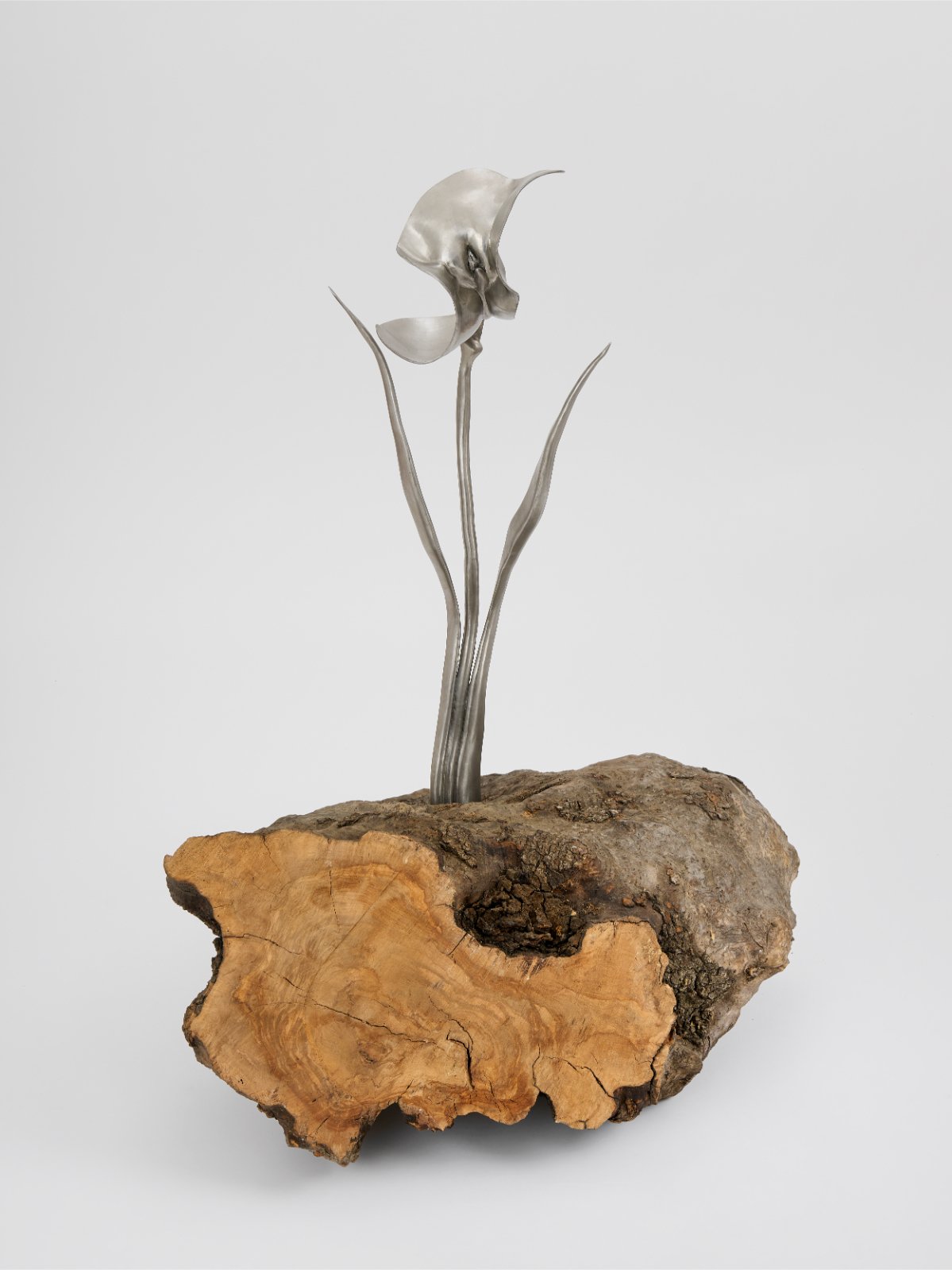
Isabelle Albuquerque Fleur Sauvage, 2024
Stainless steel, walnut 40 x 21 x 30 in / 101.6 x 53.3 x 76.2 cm
Unique
Courtesy of the Artist and Nicodim.
Photographer: Lee Tyler Thompson
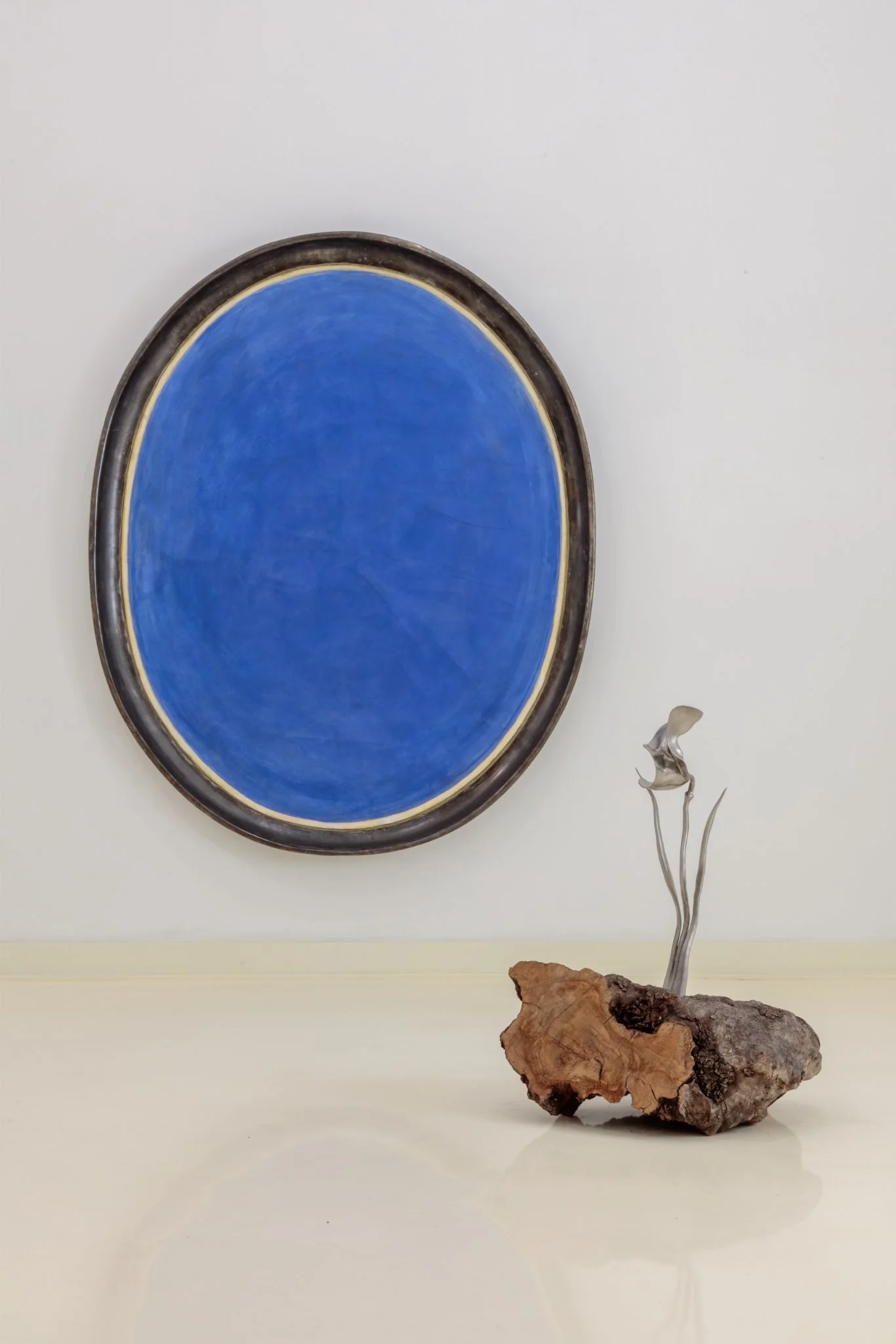
Robert Therrien
No title (large blue oval), 1988
Enamel on paper mounted on wood, silver and copper on brass frame
84.5 x 69.5 x 4.5 inches / 215.6 x 176.5 x 11.4 cm
Artwork: Robert Therrien Estate, los Angeles
Photo: Joshua White / JWPictures.com
ALBUQUERQUE: When I started the orgy, in some ways, it was a way to reconnect with my own desire—to pull myself out of depression. Yeah. And to do that, I couldn’t just sense desire; I had to perform it in order to access it. As we do, you know? And in that performance, I found my way back to it. It’s like watching a play—performance allows us to connect with emotions that might otherwise be too vast, too overwhelming to hold on our own. It creates a space that can safely contain immense desires, even those that feel like they might break us. I was thinking about what you said about aching. Yeah. For me, that ache comes from a feeling that the desire is too big, too consuming—how will I hold it? How will I contain it? But when you perform desire, it shifts into something larger than yourself, something that can hold you instead.
RAY: If you perform it, it goes into something larger.
ALBUQUERQUE: Like performance itself—or theater, you know—the act of performance can sometimes hold more than reality can.
RAY: Interestingly, I was thinking the performance allowed it to become something smaller—more graspable. In a way, it distills desire into a single instance, making it more tangible, more contained, rather than trying to hold the vastness of desire in its entire, nebulous form.
ALBUQUERQUE: I also think desire is creation—it’s the act of reaching toward something. I was just thinking of Bernini, those incredible moments in his sculptures where a hand presses into the flesh of another body. It’s about desire, but at its core, it’s really about the longing to create. It’s art. The two are completely entwined.
RAY: For me, so much of that is tied to the desire to see something that hasn’t yet existed. That feeling of creation is deeply wrapped up in longing—to witness something entirely new, something that may come partially from me but ultimately takes on its own form, its own entity. Something that is genuinely a surprise.
ALBUQUERQUE: Well, there’s such a parallel between what we’re talking about—the desire in art-making, the creation of a new form—and the act of having a child as a new form. Right. I think that idea runs deep in the orgy too, the sense of creating lives, in a way. There’s a real connection there. Do you think so?
RAY: I do, but I also think it connects to that David Wojnarowicz quote—it’s maybe less about reproduction and more about production, you know? Right. The creation of new forms. He wanted multiples of himself, to reproduce himself. But— I don’t know, does that make sense? No, it does. There’s something about having a child that’s tied to creating a new human from yourself, but when it comes to making work, I feel like it’s something adjacent but different. Like, maybe it’s not so evolutionary or biologically driven. There’s an impulse for things to live on, but they can also just be, without carrying the weight of reproduction. The desire is to manifest something new, but it’s not necessarily about bringing a new life into the world.
ALBUQUERQUE: I was just thinking back to our conversation about when we become two people. I was reflecting on cycles of desire. When I hit that big depression, the way we were able to move back toward a state of desire, or that zone of desire we talked about, was through individuation. We became others to each other again. For me, that involved some basic shifts—regrowing my hair, becoming more feminized. I moved from a more neutral sexuality to a more feminine one, as a way to differentiate myself from the other. It’s interesting to think of gender as a tool for differentiation. So there’s more space for reaching.
RAY: Thinking about the flourishing of gender, I feel like there's still a tension with me around the binary formulation of desire.
ALBUQUERQUE: And that’s what interesting—so much of desire is upsetting that binary.
RAY: I also mean the binary of subject and object. Your formulation of the subject subject is interesting because it highlights how desire—whether for someone, something, or some state—often collapses in a way, much like the collapse of a waveform.
ALBUQUERQUE: So often, desire transforms into a struggle for power, for ownership of another, which can easily slip into violence. The question becomes: how do you remain in the zone of desire without collapsing into the zone of violence? There's such a fine line between the two.
RAY: Especially because, in the process of desire, you create mental models of what you’re desiring and what you want it to be. The scenarios and the ways those desires play out are often not with the other, or in a subject-subject dynamic, but rather ways of owning the experience.
ALBUQUERQUE: Or are more about domination. It makes desire in all its vitality and power also so delicate.
RAY: I also think there’s always an element of fear in desire. I’m looking at this Ugo Ronin on the wall, with the lightning bolt, and it makes me think of desire in its most alien form—being struck by lightning, being struck by desire out of nowhere. We’ve been talking about it more as something that grows, but there’s also that sudden, unpredictable intensity. Sometimes you're struck by lightning and…
ALBUQUERQUE: …It changes your entire life.
RAY: Right. And I think there's a fear embedded in desire.
ALBUQUERQUE: It's a force of transformation.
RAY: It's a force. It's not necessarily coming from you,
ALBUQUERQUE: It's out of your control.
RAY: In order to give into it, sometimes you have to get out of control.
ALBUQUERQUE: And lose yourself.
RAY: Even though that's the desire in the end—to lose yourself.
ALBUQUERQUE: Just because you want something doesn't mean that it's not terrifying.
RAY: And that our fear of losing ourself is maybe compensated for by desire. We're so afraid of losing ourselves, but we have desire whether we want it or not,
ALBUQUERQUE: Because it’s kind of a good feeling. It gives you a lot of energy.
RAY: And it pushes you towards the inevitable loss of self in ecstasy. Or…
ALBUQUERQUE: ...Death.