photography by Mat + Kat
styling by Masha Orlov
interview by Mykki Blanco
Crystal Waters is both a legend and an anomaly in the annals of dance music. When her platinum-selling hit “Gypsy Woman (She’s Homeless)” landed in 1991, it didn’t just change the course of house music—it made her an overnight sensation. Like her contemporaries—CeCe Peniston with “Finally,” Robin S. with “Show Me Love,” and Martha Wash’s unmistakable vocals powering Black Box and C+C Music Factory—Waters helped usher house music out of the clubs and onto the radio airwaves and into global pop culture. But “Gypsy Woman” stood apart: while its infectious “la da dee, la da da” hook made it irresistible on the dance floor, its subject matter was strikingly socio-economic, casting light on homelessness against a backdrop of hypnotic organ riffs. It was both a celebration and a critique, a reminder that the euphoria of house always carried with it the shadows of struggle. From working at a probation office in Washington, D.C., to topping international charts, Waters’ rise was meteoric. And the song’s afterlife has been just as enduring: sampled more than a hundred times by artists from T.I. to Alicia Keys to Katy Perry, it continues to ripple across genres. On TikTok, slowed-down edits and remixes of “Gypsy Woman” have introduced the track to Gen Z, who embrace it as both a nostalgic throwback and a fresh soundtrack for irony, glow-ups, and everyday memes. Thirty years later, “Gypsy Woman” is still a mirror—reflecting both the resilience of house music and the social realities it was born to express.
MYKKI BLANCO: For everything you have achieved, not only in electronic and house music, but in defining pop culture itself, you are very humble. What does gratitude mean to you? And is humility a virtue?
CRYSTAL WATERS: No one’s ever asked me this before. Bravo. Gratitude, for me, is everything. It goes back to that saying: you don't know what you got till it's gone. So, you need to appreciate it now. I do a lot of spiritual work and gratitude is one of the biggest things you have to do. You have to be grateful for everything. Humbleness is a very big part of it as well. I remember Quincy Jones said, “Once you start thinking you're better than sliced bread, then it's over for you.” I also know that my creativity comes through me—it is not from me. So, I have to be grateful for the spirit that comes through me. Once you let your ego take over, that's where you see all the problems come in.
BLANCO: What does it mean to be a work in progress?
WATERS: It’s one of the things I like about myself: I always try to make myself better. I always try to learn something new. I always want to try something a little different; not what everybody else is doing, what they're telling you, what you're indoctrinated to do. I like to think that I still am a work in progress.
BLANCO: You were there at the inception of house music culture and you’ve seen the pendulum swing so many times. Why do you think that house music went underground, had a resurgence, then went underground again—and then back and forth again.
WATERS: Isn’t that nice? Well, you know, it started out underground in the ’80s. Frankie Knuckles used to say, “House music is disco's revenge.” After the big disco record burning [in 1979] at Comiskey Park in Chicago, disco had to go underground. What came out of that was house music. I think I was one of the first people who actually crossed over to radio. But that community had been built and it was thriving for a long time. And it was about community. I was one of the lucky ones that crossed over. Then the mainstream got wind of it. And then, you know how the music industry does: they wear it out and once they can’t make any more money off it, they make it go away.
Hip hop came in, and we went back underground. Lucky for me, there was still life in the underground and I got to thrive. There was still money to be made and places to perform. Europe took on house music back in the ’90s. They weren't so good at it, but after a couple years, they learned how to do it and became really good at it. They kept house music alive for a long time. They kept the underground scene going. I haven't seen it come back to mainstream until just recently with Beyoncé and Drake doing those house music albums. And then, all of a sudden, people remember my songs. I think it's important to have that space in the club to be free and to just be yourself. And I think it will always survive and thrive because of that.
BLANCO: I am an artist who has always been openly gay my entire career. In the very beginning, around 2011 and 2012, I had a lot of mainstream artists, like Björk and Kanye West support me. But the general public did not. And so I had to go to Europe to find that success. Why do you think America turns its back on certain kinds of artists, while Europe is always there with open arms?
WATERS: It’s a good question. There’s a long history of Black artists going to Europe to escape racism in America. The Europeans are loyal. They know good music. They love good music. They want to dance. And they have regulations for radio that we don't have here in America. They have to play a certain amount of certain types of music. You can't just play what the record labels tell you to play. This lets other types of genres of music survive. But what is it exactly? It must be a cultural thing.
BLANCO: What defines a class act?
WATERS: I think it’s someone who is talented, humble, and understands. The first person that popped in my head is Diana Ross. That's a classy lady. I'm seeing it from an artist's perspective. You're here with a gift to share with the world. It is not about standing on stage saying, “Look at me, look how pretty I am, and look at what I can do.” And you can tell the attitude of different artists who do and don't do that. A class act is someone who's here to share their gift with the world and understand that's their purpose.
BLANCO: I was listening to the extended version of your latest track “Umm Bop,” which is wonderful by the way. Can you tell me how that came about and what inspires you these days?
WATERS: The producers, ManyFew, they just gave me this track, which has the modern sound of house, but with classic house tinges with strings. When I heard it, I just wanted to do something jazzy. “Umm Bop” came right to me. What inspired me is that urban vibe—more of a street vibe—which I remember from the ’90s. I think the reason why I'm writing these days is I still get inspiration from the music.
BLANCO: “Gypsy Woman” was most definitely not the first song you ever wrote, but it was the first dance song. Can you describe that inner light or that energy that was coming through you at that time?
WATERS: At that time, I wanted to be the next Sade. Look at the “Gypsy Woman” video. I had the ponytail, the red lips, and everything. (laughs) I was writing from more of that kind of vibe. I come from a jazz family, so I think it was more of a jazzy vocal. When I met the Basement Boys and they gave me the track for “Gypsy Woman,” I said, “You know, I have never done house music before.” And they said, “Don't worry about it. We love the style of your writing, so just keep that same style and write over these beats.” Basically, that's just what I did: I kept my same jazzy type vibe and put it over the beats.
BLANCO: I read that your father was a jazz musician. What role has jazz played in your life?
WATERS: Music was always around the house. I remember packing my bags and going on tour with my dad every summer. He would do the lounges at Holiday Inn. Back in the day, it was a big place to have dinner. While he was in the lounge bar, I would sit in the hotel room and go through all his albums. My favorite was Ella Fitzgerald. I always picked up the females, but I loved Ella because no matter how sad the song was, she sounded like she had a smile on her face. She always felt upbeat to me. She never, never over sang the song. And my uncle was Zach Zachary who was a lead saxophonist for MSFB (Mother Father Sister Brother). They did those songs, “Touch Me In The Morning” and “Love Is The Message.” They would hang out all the time and I would get to go backstage whenever they played. I remember watching them and analyzing the music.
BLANCO: You come from quite a musical family!
WATERS: Yep, everybody did something. Everyone played an instrument except me. My father could play anything. My brother could pick up anything and play. My sister played piano.
BLANCO: As a younger woman, you described yourself as relatively shy and introverted. What did it feel like for a shy girl from South Jersey to all of a sudden be a global superstar of a relatively new genre for radio?
WATERS: I hated being shy. I have worked on it for years, but I think it allowed me to sit back and watch. They taught me about the business side of music, about keeping your publishing. And watch out for this and watch out for that.
BLANCO: What a godsend! A lot of people don’t get that.
WATERS: My father said, “You wrote that song, you wrote the lyrics and the melody, they can't do nothing with it without you. Don't let them take any more than they deserve.” So, going from that to crossing over, I think that helped me from the business side of it.
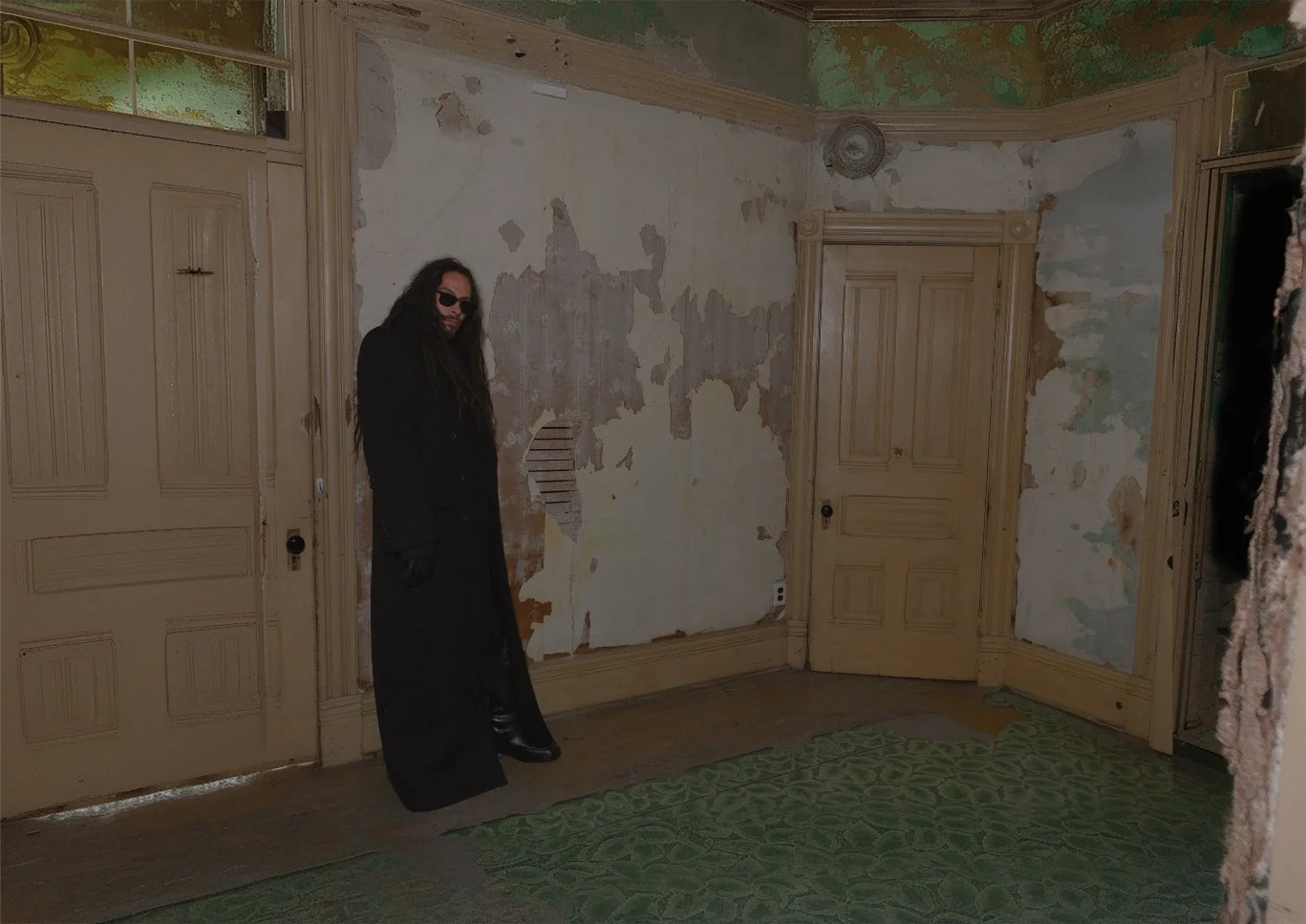
blazer: Vintage Comme Des Garçons
trackpants: Jeremy Scott for Adidas
BLANCO: What did your first televised performance feel like?
WATERS: I didn’t know what was happening. I’ll be honest. I was sitting at work one day and I got a phone call that said, “You have a hit.” I thought maybe a hit in DC or maybe New York, because club music was just on the East Coast in my mind. I didn't know it was worldwide. The first thing they did was send me to London to do Top of the Pops. I didn't even have a passport. And I had never performed in front of anyone. I flew back on the Concorde and did my first show at The Palladium in New York.
It took maybe two hours of staging before the show, but I went out there and I did it. I had never done it before. And it was great. I always pat myself on the back because I didn't have any fear, which told me that this is what I was meant to do. I should have been terrified. I should have said no, turned around, and ran out the building. But I didn't.
BLANCO: When people talk about God, when they talk about the divine, do you think you were a conduit?
WATERS: It was a calling. It's what I'm mandated to do. So, I do believe that it's coming through.
BLANCO: I know that you have children and you have seen so many seismic shifts in the industry. What is it like to be a mother and be Crystal Waters?
WATERS: Nobody knew I had kids when I started. And they were really young then. So, in the beginning it was very hard because back then you couldn’t be a mother. If someone got pregnant at the label, they got dropped the next day. So, they would hide the fact that I had kids. I didn’t mind it because I was protective. It was also hard because they would pit my being a mother against me doing shows. If I had my kid’s birthday, they would threaten to drop me. And then, I couldn't travel with the kids because I was going through a divorce. So, in the beginning it was really hard.
But right in the middle, when they got to be ten to fourteen, I really got to appreciate it more and be home with my kids. And I will tell you, the kids don't care if you're a star or not. They just want their mommy. Someone at the label said, “You have to be two people. You can't take this Crystal Waters that’s on the road—that star—you can't take her home. Nobody cares about that.” And I have always remembered that. So, when I came home, I always left that Crystal at the door and just became mommy. And it’s still kind of like that.
BLANCO: To riff off that, I wanted to know, do you enjoy cooking? And is there a dish that you make that your family and friends enjoy?
WATERS: I don’t like telling people I cook because the first thing they say is that they’re coming over. Once I became an empty nester, I really stopped cooking. I think the joy of cooking is when you cook for other people. And I always had to cook for large amounts of people, for the family. But I do cook during the holidays.
BLANCO: What’s the dish that everybody wants?
WATERS: You can guess what it is. We do traditional soul food for Christmas. I do fried chicken. We do ribs, we do mac and cheese, greens. It’s very basic, I’m not a real foodie.
BLANCO: I have two more domestic questions for you. Your skin is fabulous. Is there a go-to Crystal Waters skincare routine?
WATERS: Oh, there’s a routine, definitely. But the first one is water. I drink a ton of water, water, water, water. And I do actively take care. I do the facials, I do microneedling. I got more cosmetic creams than I know what to tell you about.
BLANCO: I have one more domestic question: what's your favorite perfume?
WATERS: Tom Ford Jasmine Rouge.
BLANCO: I pretty much fell into songwriting as an extension of my poetry and performing poetry. And the idea of working with music producers was not my own. Actually, my first manager saw me doing a poetry performance and was like, “Have you ever written music? Do you write poetry? And is poetry something that's important in your life?”
WATERS: I started writing poetry when I was really young and I got published. When I started getting into music, I got a job as a background singer. When I got that job, I was like, This is it. This is what I wanna do. I want to sing. And I kept hanging around the studio, hoping to get more work. When I wasn't, I realized I needed to write my own songs. I was like, oh, I know how to write poetry. That’s when I hooked up with a guy on keyboards and we started writing songs together.
BLANCO: Were you a club kid?
WATERS: Yep. I went to Howard University, but I spent a lot of time in the clubs, probably a little bit more than doing my homework. I was in the middle of the dance floor. Wednesday night was a big night.
BLANCO: Do you remember some of the clubs that you used to go to?
WATERS: This was thirty years ago in Washington DC. (laughs) My friends were all DJs and would go clubbing. Afterwards, everybody would come back to my apartment and hang out. And they used to give me all their promo vinyls, because they would get two or three copies. I always wondered why I didn't become a DJ. I guess females didn't do that. But I remember Tiffany’s Drink and Drown night on Wednesdays. That was the best one. I would go out with like a dollar in my pocket, get on the bus, not knowing how I was gonna pay to get in, but I always got in and I always got a ride home.
BLANCO: What are some of your favorite house DJs or house musicians?
WATERS: You know, I know everybody. (laughs) Of course, there’s David Morales and the whole gang from the ’90s. I still listen to them. I'm still good with DJ Spin, out of Baltimore. When I do my podcast, I just love hearing all these new cats coming through. I just like hearing all the new stuff.
BLANCO: When did you start the podcast and what was it about the format that you clicked with?
WATERS: The first podcast I started was back in 2009, called Clubheads Radio. It kept me current and in touch with what was going on. The one I have now, I Am House Radio, has been around about six years. The idea was simple: a place to showcase house music that wasn’t getting heard. There was so much great music out there, before the resurgence: Robin S., Cece Peniston, even my own stuff. If you weren’t in a club, you had nowhere to hear it. I also wanted to give credit where it was due. A lot of tracks are just known by the DJ’s name, but you don’t know who sang or wrote them, and so many of the singers, especially women, weren’t getting recognition.
BLANCO: You strike me as someone who despite all the hits is still quite hungry. So, I just have to ask, are you somebody who's going to be recording for the rest of their days?
WATERS: I'm not going to be stomping across that stage for the rest of my days. Some of my contemporaries are like, “Oh, we’ll do this until the wheels fall off.” I’m like, I don’t know about that. I feel like I have just a couple more things I want to say. I want to get a whole album out of my system.
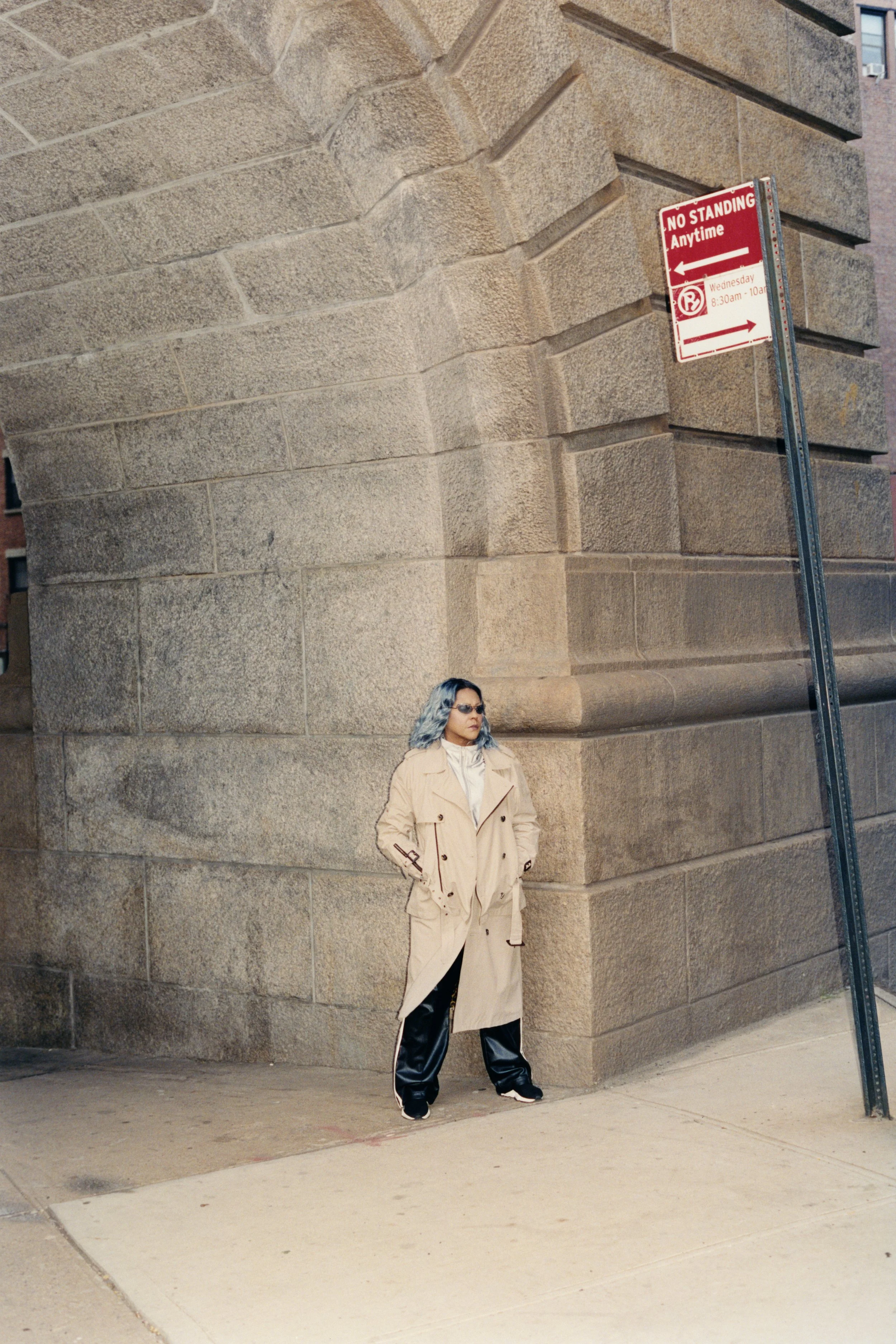
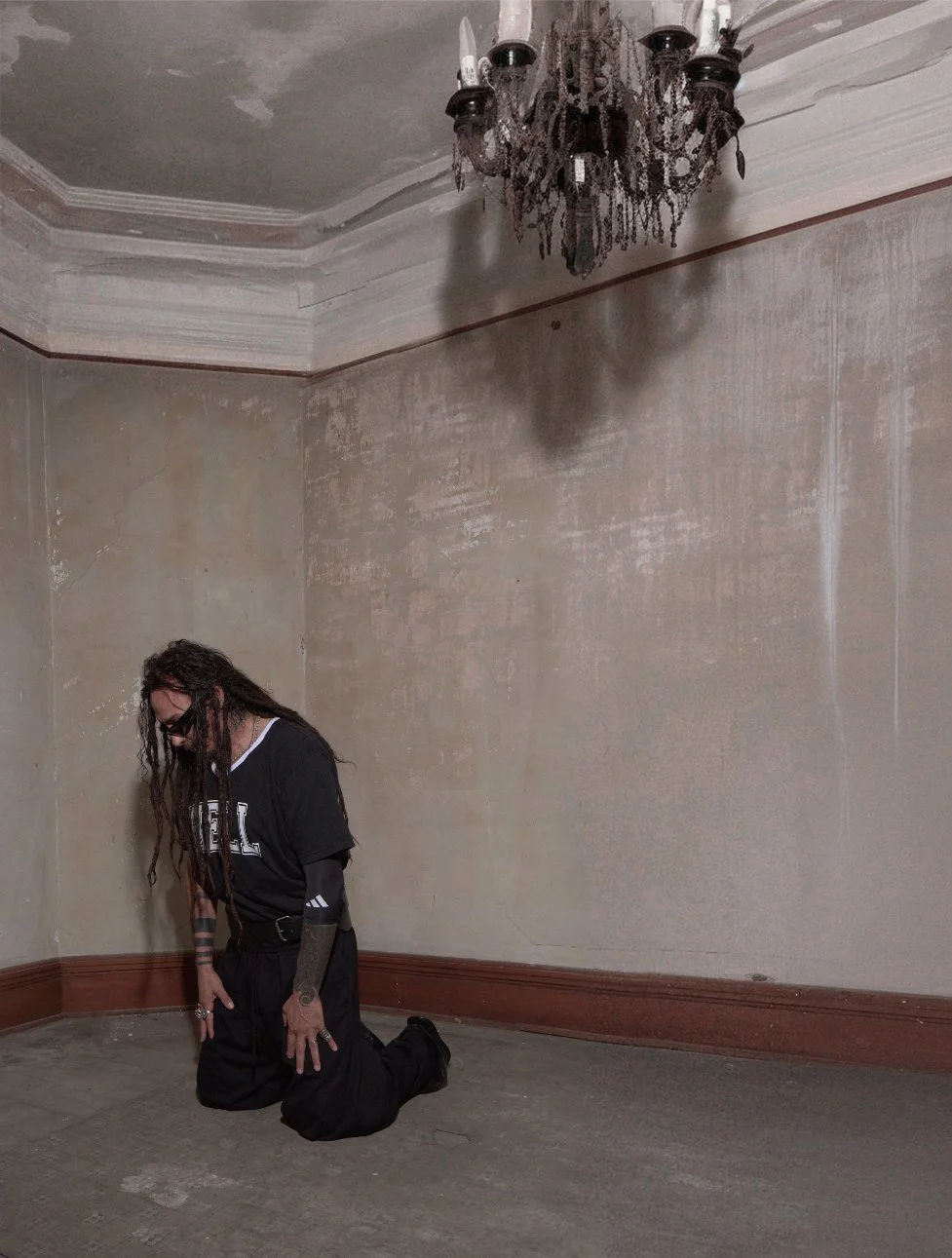
coat: Vintage Jeremy Scott
track jacket: Vintage Adidas
pants: Jeremy Scott for Adidas
sunglasses: Henrik Vibskov
BLANCO: Can we talk about the documentary that they are making about your life?
WATERS: It just started, but I feel like the documentary isn’t only about me. It’s about what I represent at this point. I have to let people know the history of house music. A lot of people right now think David Guetta started house music. And it’s like, no, he didn’t. As long as I’m alive, I'm going to make sure that story is being told.
BLANCO: What has it been like allowing someone to film your life?
WATERS: It’s not easy. I’m a very private person. I’m not a socialite. I’m not looking for fame in that way. The filmmaker still wants to come to the house, but we’ll see. It’s a little uncomfortable.
BLANCO: And you also have a project coming up where you, Robin S., Cece Peniston, and more are playing some of your biggest hits to a live orchestra. Can you talk about this project, because it sounds remarkable.
WATERS: They’ve been doing this orchestrated dance music stuff in Europe for at least ten years. And they always invite maybe one American over to do it at a time. It’s really an experience to hear the music elevated with the strings. It left a big impression on me. So, I said, “You know, I want to do one. I want to do it here.” I mean, we have all the singers here in New York. It’s our music, you know, let’s bring it home. It’s called “I Am House Orchestrated.” It’s being presented by Susanne Bartsch on November 20th at Sony Hall. Everybody’s doing two songs. They’re doing their own songs and the people who aren’t there, we have background singers. We got Robin S., Cece Peniston, Barbara Tucker, Inaya Day, Black Box, Duane Harden, Dawn Thomas, and more.
BLANCO: This is going to be huge.
WATERS: We have a twenty-two piece orchestra. Next time, I want to go bigger, but we’re starting small. We’ve got all the songs picked and we’re just getting into it. Next month we should be advertising and getting people in there.
BLANCO: Throughout the years, what has been your relationship to fashion?
WATERS: When I first started, everybody wanted to dress me: Armani, Versace, anything, you can name it. It has never been on purpose, but I think back in the ’90s—when fashion and music were merging—that’s just what happened. And I had a lot of big time photographers. They were doing a lot of my photographs. So, I was just in that mode.
BLANCO: Do you have a spiritual practice?
WATERS: Yes, I do. As soon as I wake up, I usually tell myself something positive to have a happy, great day. I do a fifteen to twenty minute meditation. Then, after ten minutes of breath work, I read my spiritual book for about ten to twenty minutes. And then I do a set of prayers. When I have time, I actually write down all my affirmations. So, that takes me about an hour and a half, maybe two hours. Just do one thing at a time. Sometimes, I think I’m doing too much, (laughs) but you know, this is when I’m home and I’m not really traveling and having to catch a flight every day.
BLANCO: Instead of asking what’s next, what are you hoping for in the future?
WATERS: I’m hopeful to expand and grow. I mean, I love music. I will always do music; be a part of music. I’m so grateful that music is a big part of my life. There are so many new opportunities. Traditional ways of making my music have kind of gone, like going with a major label. I want to start getting more behind the scenes. I love the idea of this orchestrated event I’m doing. I also want to do more live streaming events with my radio show. I’m also working on a project to bring the house music experience to a play or experiential format. And I am working on the album. I still have a few more songs to write, so I can’t give you a release date, but it'll either be the end of this year or beginning of next year. That’s what gets me up in the morning.
BLANCO: And then my final question is, if you could tell Crystal Waters at eighteen years old one thing, what would you say to her?
WATERS: You are going to make it. Because at eighteen, I didn’t know if I was going to make it. I’m just talking about in general. So I’m glad I’m still here.
hair Chuck Amos @StatementArtists
makeup Marc Cornwall
director of photography Andrew Garcia
movement director Jorge Dorsinville
photo assistant Ari Sadok
styling assistant Roberto Grangeiro
A HISTORY OF HOUSE MUSIC
1800s–Early 1900s: Harmonium Roots
1840s–1850s (Europe & America) – The harmonium (patented c.1840) is invented as a small reed organ. Unlike the pipe organ, it’s portable and affordable, making it a common instrument in middle-class homes, chapels, and schools. Its sustained drones and chords foreshadow the textures of pads and organ stabs in house.
Late 1800s–1900s (Colonial Africa & South Asia) – Missionaries bring the harmonium to India, West Africa, and East Africa.
In India, it becomes central to bhajans and qawwali devotional music, with its droning quality shaping ecstatic song structures.
In Nigeria, Ghana, and coastal West Africa, the harmonium is incorporated into church music and later blends with highlife and juju.
Its portability allows African congregations to create call-and-response hymns with organ chords, a structure that mirrors the later relationship of house divas with pulsing synths.
1930s–40s – Gospel quartets and African-American churches use organs and harmoniums for ecstatic worship. The spiritual repetition and layering of harmonium chords in hymns prefigures the way house tracks build momentum around a looping vamp.
1950s–1970s: Foundations of Groove
1950s – In Chicago and Detroit, R&B groups use the Hammond organ (a harmonium descendant). The lush, swelling organ tone is a direct ancestor of the M1 organ stab that would define ’90s house.
1960s–70s – African musicians fuse the harmonium and Western organs with local rhythms. Fela Kuti’s Afrobeat includes organ drones layered against polyrhythms, a rhythmic interplay that feels house-like in repetition.
Disco, European Disco & Italo Synth Influence
Before house coalesced in Chicago, European electronic disco was already shaping the sounds DJs would later manipulate.
Giorgio Moroder (Italy, 1977): “I Feel Love” with Donna Summer introduced hypnotic arpeggiated synth basslines, a mechanical pulse, and repetitive song structures that presaged house loops and trance-like grooves.
Italo Disco (late 1970s–early 1980s): Italian producers (Gazebo, Righeira, Klein + M.B.O.) created synthesizer-heavy tracks with driving four-on-the-floor beats, catchy melodies, and minimal vocals. These records circulated via European clubs, record imports, and mixtapes.
UK Synthpop: Bands like Depeche Mode, New Order, and Yazoo blended sequenced synthesizers, drum machines, and melodic hooks—offering a palette of textures for early Chicago DJs to sample, re-edit, and integrate into extended mixes.
Early 1980s: Birth of House in Chicago
1981–83 – Frankie Knuckles, resident DJ at the Warehouse (Chicago), uses reel-to-reel edits of disco and European synthpop to extend grooves. House emerged from Black, Latinx and queer club communities seeking ecstatic, inclusive dance spaces — the sound and culture grew together. The term “house” comes from this club.
Around the same time, Ron Hardy (DJ at the Music Box) pushes the sound darker, faster, and more experimental, cementing house as underground and raw.
Vince Lawrence collaborates with Jesse Saunders on early house singles and helps define its DIY production ethos.
1983 – Jesse Saunders’ “On and On” is released — often called the first house record. It fuses a drum machine (Roland TR-808) with repetitive basslines and minimal vocals.
Trax Records (founded 1984) becomes the main label for Chicago house, releasing many of the genre’s most iconic early tracks.
1984–85 – Marshall Jefferson, Chip E., and Farley “Jackmaster” Funk experiment with deeper piano and organ-driven house tracks.
Mid–Late 1980s: The Classics Emerge
This is the golden phase of Chicago and New York house, with many iconic records that laid the groundwork for the ’90s diva era.
1985 – Farley “Jackmaster” Funk & Jesse Saunders – “Love Can’t Turn Around”
Gospel-style vocals by Darryl Pandy bring theatricality to house.
1986 – Chip E. – “Time to Jack”
One of the first records to explicitly reference “jacking,” a style of dance tied to house culture.
1986 – Steve “Silk” Hurley – “Jack Your Body”
A minimal, percussive house track that hit #1 on the UK charts, proving house’s global potential.
1987 – Marshall Jefferson – “Move Your Body (The House Music Anthem)”
The first piano house anthem, blending gospel ecstasy with pounding four-on-the-floor beats.
1987 – Mr. Fingers (Larry Heard) – “Can You Feel It”
A landmark deep house track—smoother, jazzy, atmospheric. Establishes “deep house” as distinct from raw Chicago house.
1987 – Frankie Knuckles & Jamie Principle – “Baby Wants to Ride”
Political house: combining gospel fervor with civil rights critique.”
1988 – Royal House – “Can You Party”
Sample-heavy house emphasizing the party/jack culture of the late ’80s.
Chicago Meets Detroit
While Chicago refined house, Detroit’s Belleville Three (Juan Atkins, Kevin Saunderson, Derrick May) were creating techno, a futuristic, machine-driven electronic sound.
Inner City (Kevin Saunderson & Paris Grey, 1988–1989) exemplifies the dialogue between Chicago and Detroit: soulful house vocals meet Detroit’s mechanical synth precision, creating tracks that resonated in clubs and on international charts.
This cross-pollination highlights the early transregional conversation between two American electronic music hubs.
1988–1990: Acid, Ibiza & UK Expansion
1987–1988: Phuture’s “Acid Tracks” introduces the squelchy TB-303 sound that defines acid house.
Ibiza’s Role: Legendary clubs like Amnesia, Pacha, and Ku provided multi-day, open-air party spaces where DJs could experiment with extended, hypnotic sets. European DJs visiting from the UK and beyond absorbed these tracks and styles.
Second Summer of Love (1988–1989): Ibiza DJs and imported Chicago/Detroit tracks fueled the UK rave scene. Ecstasy use and the island’s permissive club culture amplified the euphoric, communal experience of house.
Vinyl, cassette mixes, and pirate radio ensured house tracks spread rapidly, establishing a European house identity deeply indebted to American roots.
UK DJs pick up Chicago house and acid tracks, remixing and extending them, creating the blueprint for UK rave culture.
House music’s combination of Chicago groove, Detroit futurism, and Ibiza’s euphoric environment sets the stage for the 1990s “diva era” and global house explosion.
1990–1993: Mainstream Breakthrough (The Diva Era)
This is when house formally enters pop culture consciousness—led by Black women whose voices redefined the genre’s global reach.
1990 – Snap! – “The Power” (not pure house but house-adjacent eurodance) primes mainstream audiences for house vocals.
1991 – Crystal Waters – “Gypsy Woman (She’s Homeless)”
A hypnotic organ riff + minimalist groove + “la da dee, la da da” hook. An overnight global hit, reshaping house as chart-ready.
1991 – CeCe Peniston – “Finally”
Written from a poem, delivered with gospel ecstasy. A quintessential diva-house anthem, topping the US dance charts and hitting international pop charts.
1992 – Masters at Work (Little Louie Vega & Kenny Dope) begin remix dominance
Their remixes (for Madonna, Barbara Tucker, etc.) solidify New York vocal house with Latin percussion and gospel vocals.
1993 – Robin S. – “Show Me Love” (StoneBridge Remix)
Defined by its sharp M1 organ stab riff. Becomes one of the most recognizable house tracks of all time.
Mid–Late 1990s: Consolidation & Global Reach
1994 – Barbara Tucker – “I Get Lifted” continues the gospel-house tradition.
1996 – Armand Van Helden – “The Funk Phenomena” blends funk with house, moving toward big-beat styles.
1997 – Daft Punk – Homework brings French house worldwide, looping disco with raw machine grooves.
1999 – Stardust – “Music Sounds Better With You” becomes an international house-pop anthem.
2000s: House Goes Global & Splits into Subgenres
2000–2003: Vocal House & Diva Legacy
Barbara Tucker, Ultra Naté, and India continue gospel-inspired house.
CeCe Peniston and Robin S. are celebrated as icons, frequently performing at Pride festivals and club events, keeping their hits alive in queer dance culture.
Crystal Waters tours internationally, her tracks remixed by new DJs.
2001 – Daft Punk’s Discovery
Songs like “One More Time” bring house into mainstream pop consciousness. The robotic vocoder vocals echo the repetitive trance of house divas, but filtered through French touch.
2005–2008: Electro-House Boom
DJs like David Guetta, Steve Angello, and Benny Benassi push a harder, club-ready sound.
This “superstar DJ” wave temporarily sidelines soulful diva house in favor of festival energy.
Mid-2000s: European Labels & Nu-Disco Revival
Ed Banger Records (France)
Founded: 2003 by Pedro Winter (Busy P).
Sound: French electro-house with punchy synths, playful hooks, and punk-inspired energy.
Notable Artists: Justice (D.A.N.C.E.), SebastiAn, Mr. Oizo, Breakbot.
Impact: Popularized a high-energy, club-friendly French electro aesthetic that reinterpreted house structures for international festival stages.
Italians Do It Better (Brooklyn/Italo Influence)
Founded: 2006 by Johnny Jewel and Mike Simonetti.
Sound: Slow, synth-heavy, retro Italo-disco revival with dreamy, cinematic grooves.
Notable Artists: Glass Candy, Chromatics, Desire, Mirage.
Impact: Revived the hypnotic, melodic loops of classic Italo disco, influencing nu-disco and synthwave, and connecting European electronic traditions to contemporary house-inspired music.
*2009 – Black Eyed Peas – “I Gotta Feeling” (prod. David Guetta)
House structure + pop vocals = a blueprint for the EDM-pop hybrid of the 2010s.
2010s: EDM Era & House Revival
2010–2015: Big-Room EDM & Crossover
Swedish House Mafia, Avicii (“Levels”), and Calvin Harris dominate. The sound is bigger, shinier, festival-scale, often removing the gospel/organ roots of house.
Yet, samples of Robin S. and CeCe Peniston’s vocal styles appear in remixes and mashups.
2012 – Disclosure – “Latch” (ft. Sam Smith)
Marks the return of deep house to the charts. UK garage and house hybrid, but deeply indebted to 1990s vocal house structure.
2015 – Robin S.’s “Show Me Love” resurges
Sampled in countless EDM tracks, from Jason Derulo’s “Don’t Wanna Go Home” to Robin Schulz’s remixes. The organ stab remains a universal shorthand for “house.”
2016–2018: Afro-House & Global Sounds
Artists like Black Coffee (South Africa) globalize house by re-centering African rhythmic traditions—a full circle, since the harmonium and organ had once traveled to Africa with missionaries.
This brings house closer to its African diasporic heartbeat.
2020s: House Revival in Pop (The Diva Returns)
2020–21: Lockdown Streaming
House classics like CeCe Peniston’s “Finally” and Crystal Waters’ “Gypsy Woman” see streaming spikes as younger audiences rediscover 1990s house.
2022 – Beyoncé – Renaissance
A watershed moment: Beyoncé reclaims house as Black, queer-rooted dance music.
“Break My Soul” directly samples Robin S.’s “Show Me Love” organ stabs, a deliberate homage.
The album overall echoes Crystal Waters’ minimalist grooves and CeCe Peniston’s gospel ecstasy.
2022 – Drake – Honestly, Nevermind
Drake’s pivot to house-inspired beats (produced by Black Coffee and others) signals mainstream rap’s recognition of house’s cultural dominance.
2023–2025: Ongoing House Renaissance
Younger artists like Honey Dijon, TSHA, and Peggy Gou bring soulful and global flavors back into the club scene.
CeCe Peniston, Robin S., and Crystal Waters are regularly sampled, remixed, and honored as foundational figures.
TikTok virality breathes new life into “Gypsy Woman,” “Finally,” and “Show Me Love,” often introduced to Gen Z in snippets that bring them back into charts.