
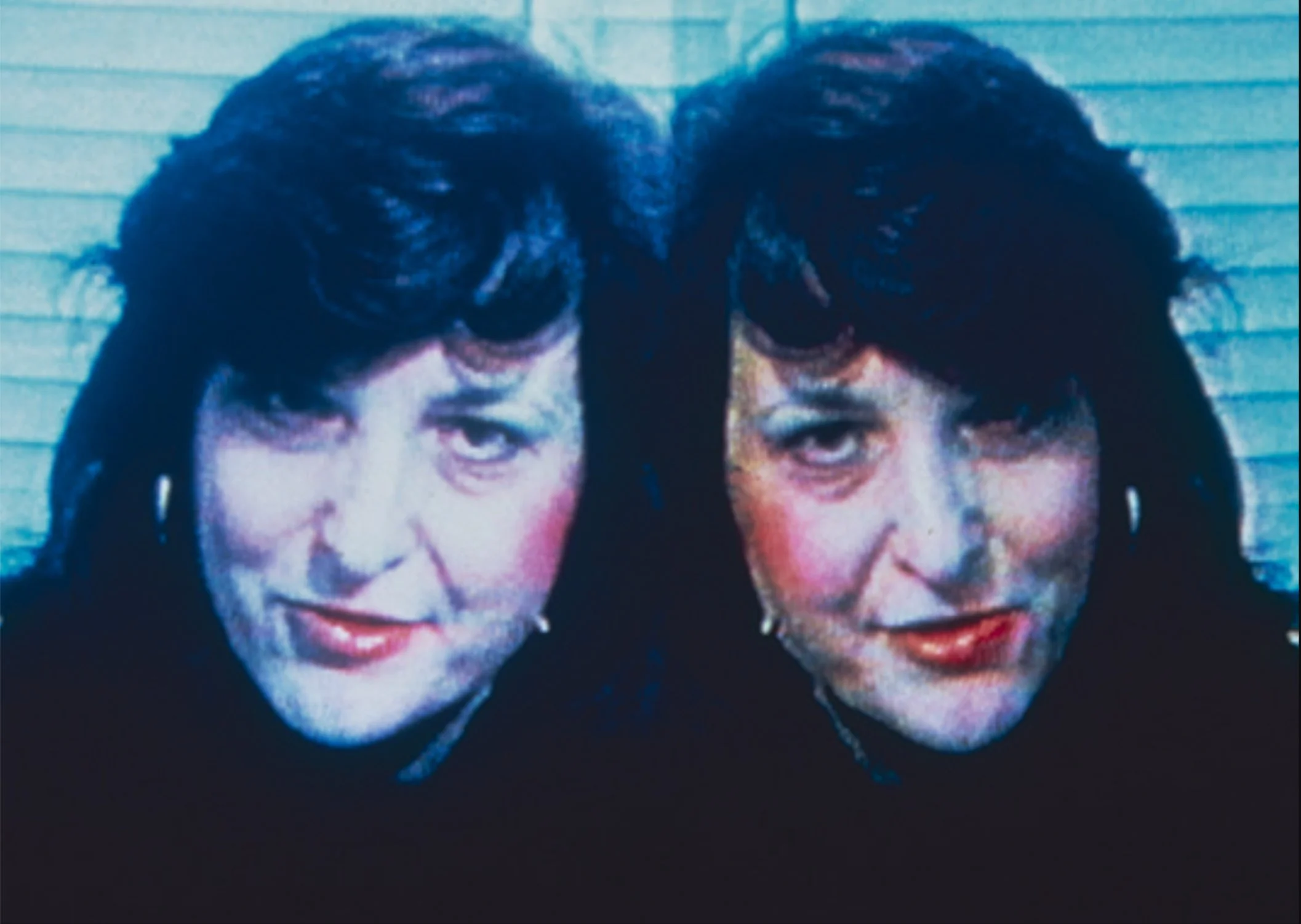
The Electronic Diaries of Lynn Hershman Leeson,
1984-2019. (Video Still) 4K video (color, sound)
75:29 minutes
interview by Summer Bowie
In 1973, Roberta Breitmore took a bus to San Francisco and checked into Room 30 of the Dante Hotel, where she scattered the ephemera of her life: driver’s license, bank statements, cosmetics, wigs, clothing. She attended Weight Watchers and went to a psychiatrist. She immersed herself in the community, took on jobs, and went on dates. But Roberta Breitmore wasn’t real. She was the invention of pioneering media artist Lynn Hershman Leeson. For the past six decades, Leeson has been exploring technology, identity, and surveillance with startling prescience. Algorithmic chaos, digital persona building, data accumulation—her oeuvre mirrors the online/irl identity split endemic to our current post-truth world.
SUMMER BOWIE: What technology would you say is currently the most pernicious to you?
LYNN HERSHMAN LEESON: I don’t think it’s really about technology. I think it’s about humans and how they use it. You could have a technology that appears very innocent, naive, and useful, and then it gets turned into something pernicious, depending on what a person or a company wants to achieve, and the technology is constantly changing.
BOWIE: There’s an element of horror you explore that examines everything from the darkness of our inner psyche and how it plays out in the technologies we build, to the ways technologies are shaped by their users. But in early works like your Breathing Machines (1967-68), you also explore how horror can be used as a mechanism for overcoming fear.
LEESON: You have to be aware of the possibilities of what these things can be turned into, depending on who’s using them and how they’re adapted in culture. You can’t control everything. Or really, very little.
BOWIE: Computer technology is so often characterized as a masculine pursuit, and while it is dominated by men, half of its users are women, and women’s contributions are hardly ever recognized. Most people still don’t know that the first computer algorithms were conceptualized by a woman.
LEESON: Yeah, exactly. People forget that. It’s easy for a male-dominated culture to try to own everything, but this is something that was bred by Ada Lovelace and other women. So, it can’t be completely pulled into the ways that culture wants it to. I think you have to sustain those parts of it that reject and don’t want to be absorbed into a different kind of culture. I think we also need to make people aware of how influential women were, even though they were not often noted historically. Mistaken credits, especially those that were misattributed to men, need to be scrutinized and corrected.
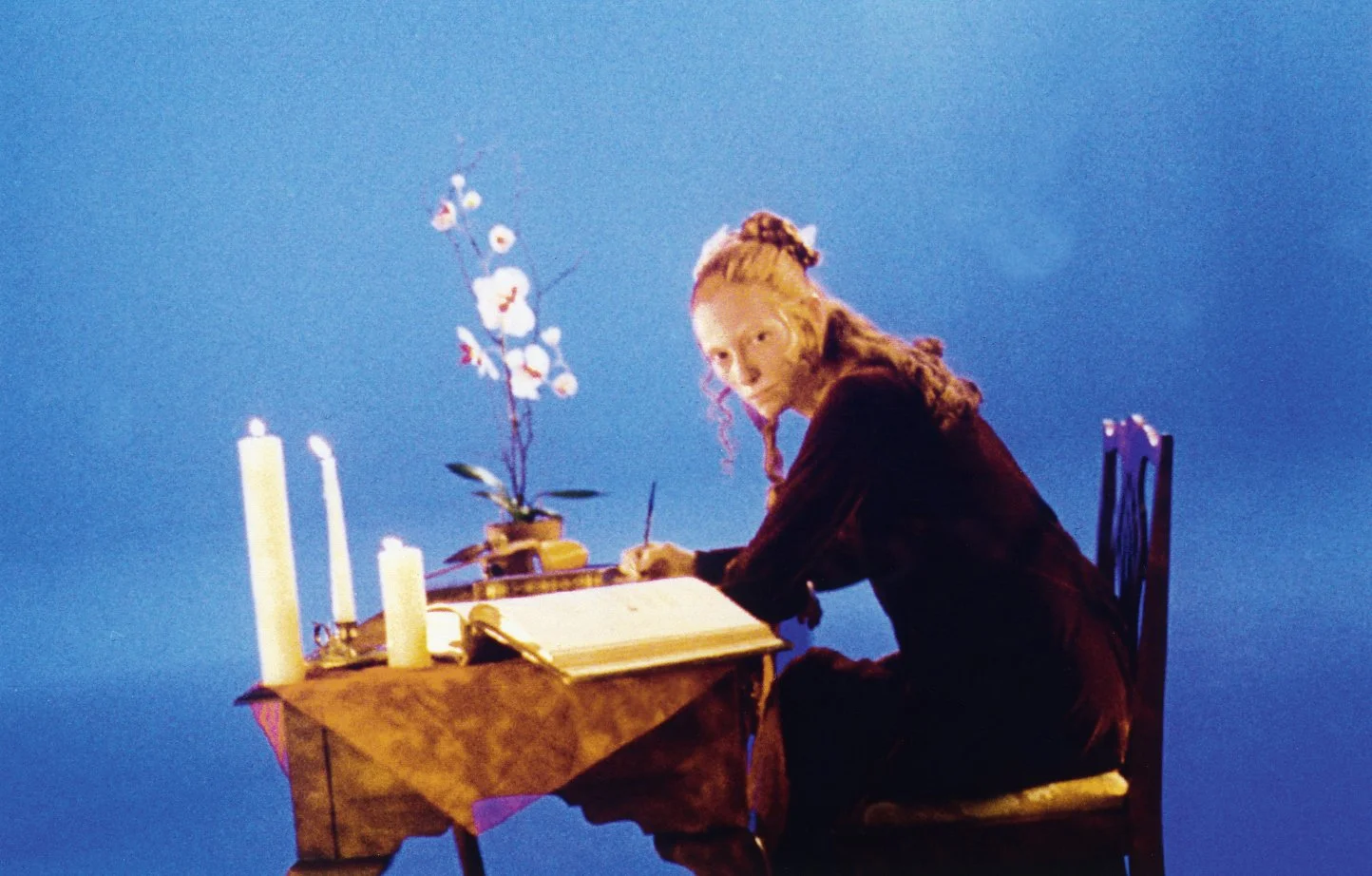
Conceiving Ada, 1994.
(Video Still) 4K print from 35 mm film (digitized), color, sound
84:54 minutes
BOWIE: In 1997, you released your film Conceiving Ada, which is a sort of speculative historical reimagining of Ada Lovelace, who designed the first algorithm for a machine in the early 19th century. Yesterday, Meta and YouTube were found guilty of intentionally designing their algorithms to be addictive for children. I’m really curious about what first drew your interest in algorithmic computer technologies, and how much of this you saw coming.
LEESON: Well, I was doing a documentary on the history of the telephone when I became aware of Ada Lovelace. I had never heard of her before—I don’t think many people had. And, of course, I went to the library and looked her up, and there was only one tiny book on her. I just felt that this was critically important, something that would change our whole world. So that’s what drew me to make that film about her. I didn’t know algorithms would take over our lives or become so addictive. I just knew that it was a critical factor of communication on a global scale in a way that had never been possible.
BOWIE: In the mid-1970s, when you created Roberta Breitmore, we were in a very analog state of government surveillance. One of the things I find really interesting about this project is that you were able to procure a driver’s license, a social security card, a credit card, blood samples, dental x-rays, and other documents for her. How were you able to procure such a robust proof of identity?
LEESON: Well, I just felt it was important to create examples of what would be considered reality and what would be taken seriously. I didn’t explain anything to anybody. I just applied for them, and I got them automatically, because nobody was doing anything out of the ordinary with identity in those days. So, they just believed me. That’s who I was and what I needed.
BOWIE: Were you ever nervous about falsifying information with government agencies like the DMV or Social Security Administration? And were any of them more difficult than others?
LEESON: No, it had no precedent, so people did not expect falsified information in those days.
BOWIE: The other thing I find really fascinating about her is that you were living out the life that you constructed for her. Knowing how our ad consumption, media diet, and social interactions play such a vital role in shaping our identities on a very core level, did attending Weight Watchers meetings, going on dates, and reading beauty advice in women’s magazines start to seep into your own psyche at times?
LEESON: Not really. I mean, I made every effort to keep her separate from me. I was very aware of what she was doing, as opposed to what I was doing, and of how she reacted, versus how I would react to a situation. Because I was so aware that she had her own reality, I tried to clarify that in everything she did—especially since people thought I was schizophrenic and that I couldn’t tell the difference.
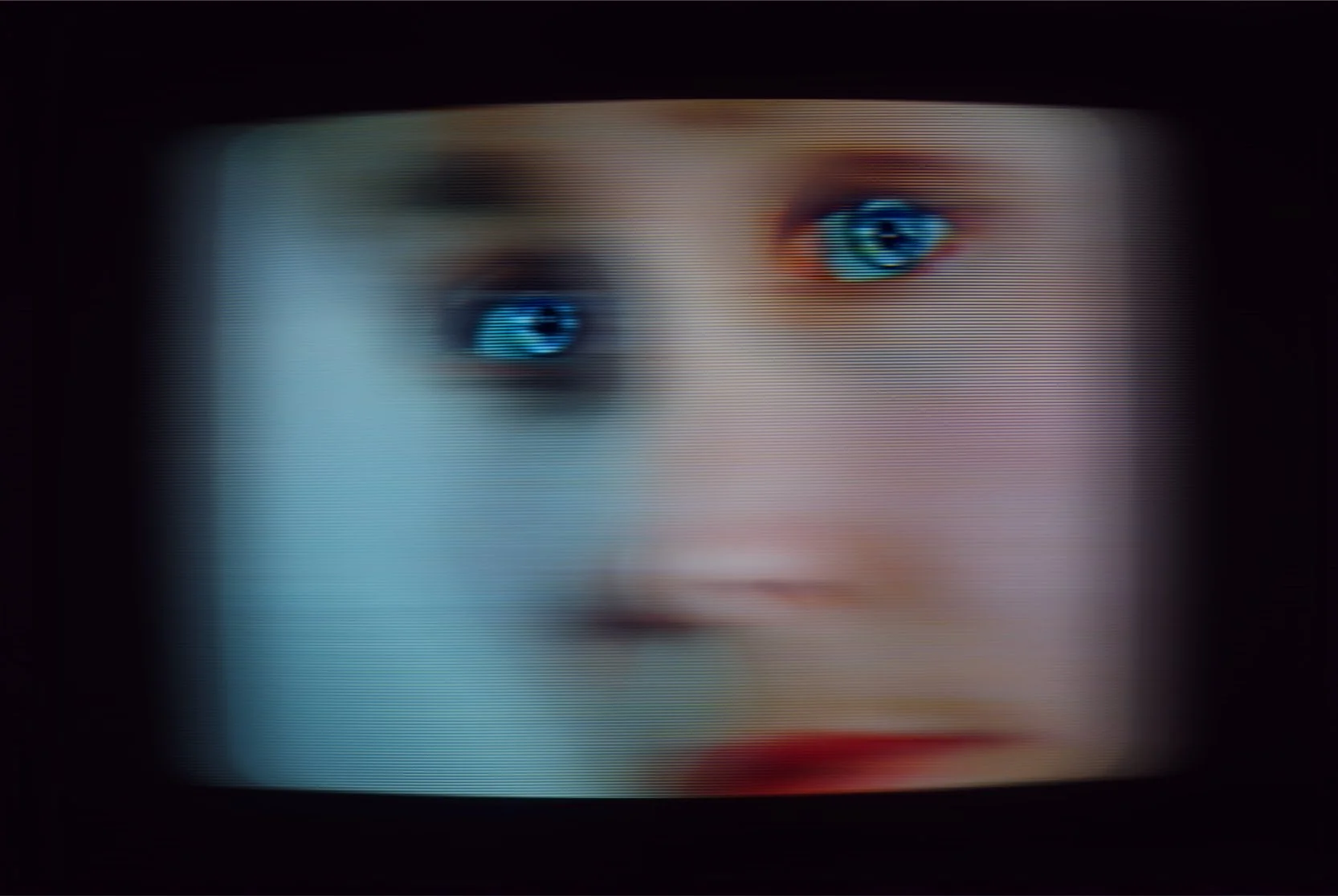
Seduction of a Cyborg, 1994.
(Video Still) Video (first digital video projection), color, sound
6 minutes
BOWIE: And then, with CybeRoberta (1995), you created a doll version of Roberta Breitmore, who is a very early nanny cam. She broadcasts video footage taken from her eyes onto the internet. I remember covert domestic surveillance being far more controversial in that era, as the technology was becoming commercially available. Did you ever expect it to become so socially acceptable over time?
LEESON: Yes, I knew it was coming. And it will, in the future, integrate into our lives even more.
BOWIE: At this point, constructed identities have become so inextricably integrated within our social landscape. Do you think they are a necessary byproduct of the surveillance state?
LEESON: I think so. It’s a means of protecting ourselves. We create these other representations of ourselves, but the core remains hidden.
BOWIE: Is it even possible at this point for these avatars to meaningfully protect us, or does it just give us a false sense of peace while the surveillance apparatus sifts through every trace of our existence?
LEESON: I don’t think that anybody can get away from that because it's so deeply ingrained in our culture. Everything is surveilled.
BOWIE: There have been a number of studies and articles over the last few years citing the negative effects of social media on young girls in particular. Do you feel like they’re especially predatory toward young girls?
LEESON: I think it’s that young girls need to communicate in a broader sense than just through technology, and probably in a greater way than anybody else. So they’re more prone to use it and to be affected by it—more than other people who have a wider range of possibilities.
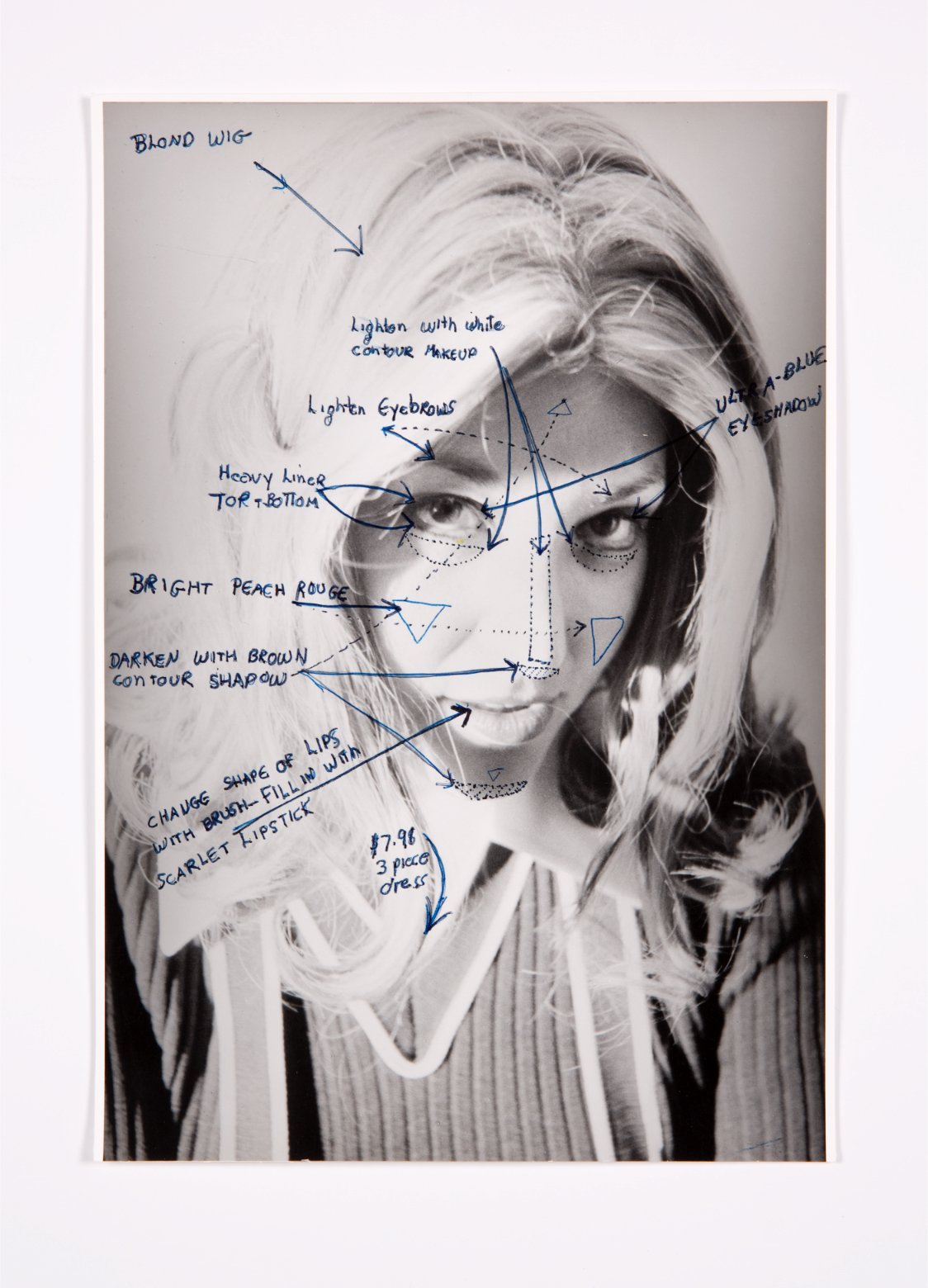
Construction Chart Drawing, 1973. Ink on gelatin silver print
9¼ x 6½ inches (23.5 x 16.5 cm)
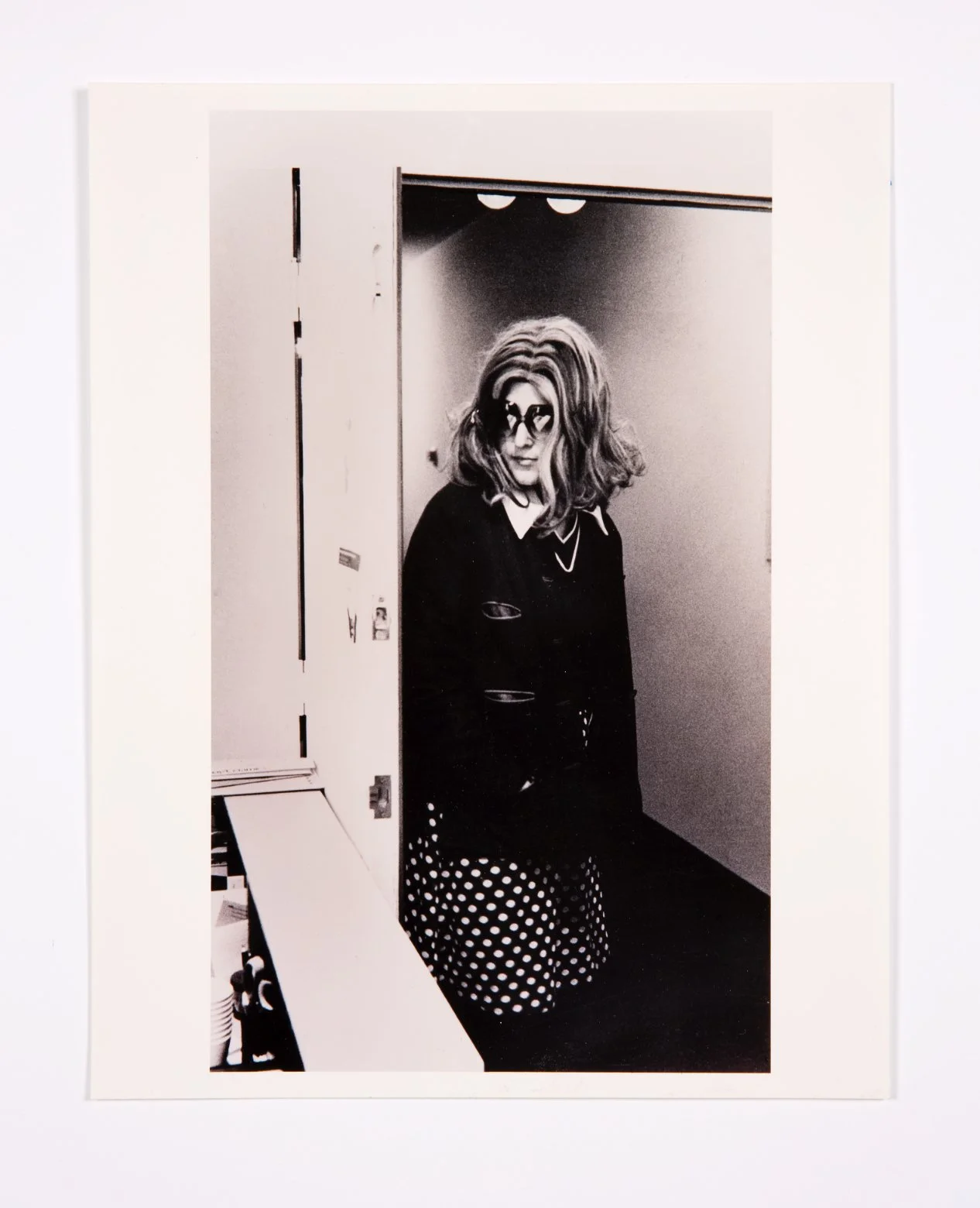
Roberta at Gallery Opening, 1976. RC print,
10 x 8 inches (25.4 x 20.3 cm
BOWIE: In A Room of One’s Own (1990-1993), you created a series of voyeuristic moments via the kinetograph, yet you interrupt this scopophilic impulse so that any pleasure in voyeurism is frustrated in various ways. Can you talk about the purpose of that intervention?
LEESON: I didn’t exactly mean to incite frustration. I could only do so much in that piece. I think I was just trying to make people aware of how we’re all being surveilled. I don’t think many people are really aware of the lengths to which our lives are captured by other people. And you can’t create an infinite protection of surveillance. There are limitations. And certainly it’s based on the technology that’s available and becoming available. Even now, people are not aware of how fully surveillance owns them. Technology becomes more and more capable of capturing our privacy.
BOWIE: Whether via tabloids in the past or social media now, we have this craving for “behind the scenes” access, and, of course, those private moments are their own reconstructions. There’s a very zero-sum tension between the desire to access somebody else’s privacy and the desire to protect one’s own.
LEESON: And then there’s also the question: if privacy even exists anymore. Or can it exist now in our culture? And what does that mean?
BOWIE: That’s really the enduring question of this issue. Your Synthia Stock Ticker (2000) is a simple yet poignant visual representation of the relationship between global finance and the emotional morale of a nation—two paradigms that are deeply interconnected and interdependent. How would you say the advent of social media has affected that relationship?
LEESON: I think more people became aware of that relationship. Social media makes it more easily manipulated in a way that can control the value. We rely on these external factors as a basis for who we are, rather than having it contained in any more secure way—something that’s constantly being manipulated by external forces and shifts, by things that people want to happen, which then affect personal privacy.
BOWIE: So much of your work revolves around the symbiotic relationship between technology and identity, and many of your works were created in real time alongside technological developments that were either nascent or, at times, still theoretical. What was coming up for you as you observed this relationship develop over the turn of the century?
LEESON: Well, I was lucky. I live in the Bay Area, so I was privy to ideas that people were working with. And as different elements of technology became reality, it just seemed to me that they affected who we were, how our perceptions operated, and even how we perceived ourselves.
BOWIE: It becomes an interesting mirror through which we observe ourselves. Aside from our literal use of the selfie cam as a mirror, our smartphones have become a definitive intermediary between our identity and its projection. As both the projector and the screen, our sense of self is defined as much by what we put onto the internet as it is by the response those posts receive.
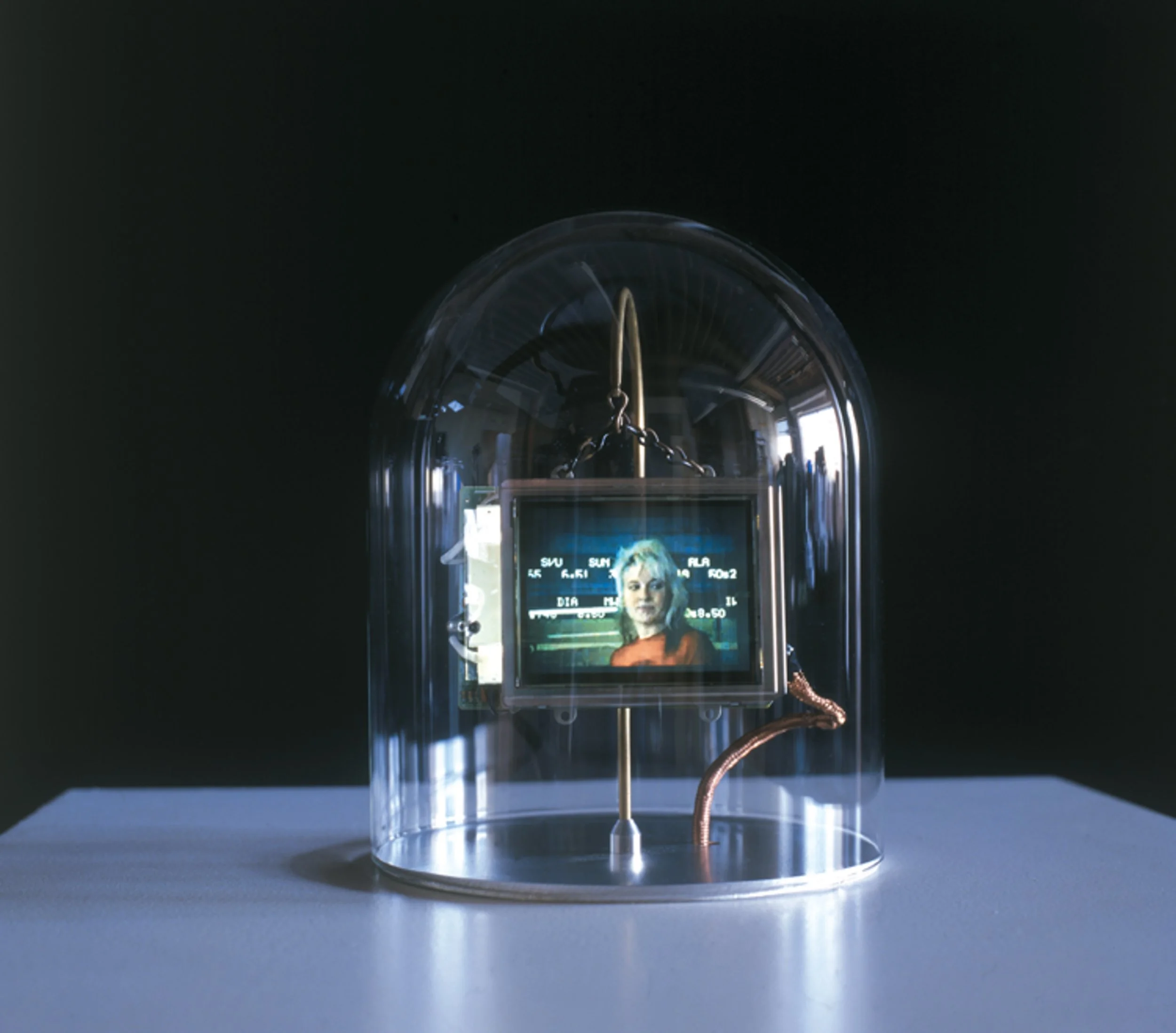
Synthia Stock Ticker, 2000-2002. Custom software, LCD, glass and electronics, first use of stock date and behavior as net motivation, 15 x 11 x 11 inches (38.1 x 27.9 x 27.9 cm
LEESON: And how much we know about how the internet works and how we place ourselves in it.
BOWIE: In your 2002 film Teknolust, a bio-geneticist uses her own DNA to create three self-replicating automatons, one of which was named Ruby. Contemporaneously, you were commissioned by SFMOMA to create Agent Ruby, an artificially intelligent internet entity that converses with online users. She was basically a proto-chatbot. One version of Ruby is a cyborg in the corporeal sense, while the other in more of an uncanny cognitive sense. What did you ultimately want her to do for people?
LEESON: I originally wanted to create this other entity that could be online and communicate with people. I didn’t have any expectations about what she would do. So, everything was a surprise, and she kind of grew into fitting a need that culture had in communication. And also, it brings people in more direct contact than before. Our histories become public. I do not think privacy exists. I wanted Agent Ruby to be a guide for people to access the possibilities inherent in surveillance technologies.
BOWIE: Last year, a survey conducted by the Center for Democracy and Technology found that about 20% of teenagers either knew somebody or were themselves in a romantic relationship with a chatbot.
LEESON: That doesn’t surprise me. And I think it can also become dangerous if it’s not checked, because they assume that it’s a real being in their communication, and it could imply doing destructive things that people sometimes follow.
BOWIE: On one hand, I see a culture that has lost its ability to hold people in community and to support one another through an increasingly complicated world. So, I see how it fills a dire need for people who aren’t socialized to talk about their feelings or ask vulnerable questions.
LEESON: It becomes an aid for that for sure.
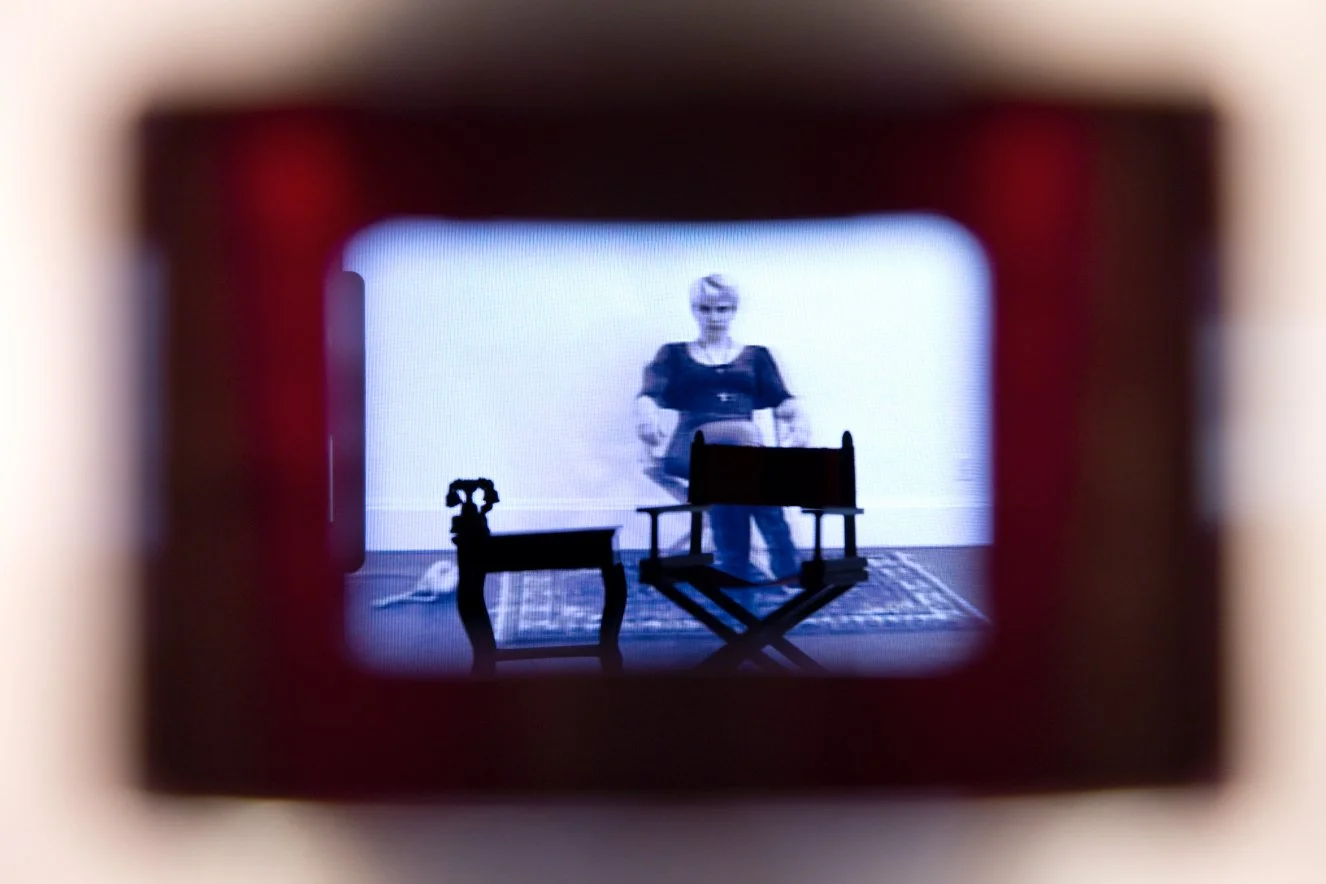
Room of One’s Own, 1990-1993. (Detail). Transferred laser disc, miniature furni-ture, surveillance system, cameras, projection15 x 16 x 35 inches (38.1 x 40.6 x 88.9 cm)
BOWIE: On the other, it feels safer, more private, even though it certainly isn’t. OpenAI has been developing an “adult mode” that would allow users to sext with ChatGPT. It’s currently on hold because there’s concern that it will create an unmitigated mental health crisis.
LEESON: People will lose the awareness that it’s just a computer and start interacting as if it were another human being. And that’s really dangerous.
BOWIE: How does it feel to see these technologies emerge, many of which are versions of ideas you had been theorizing from the late ’80s into the turn of the century?
LEESON: It feels frustrating, particularly when I’m not acknowledged. You don’t do these things just to be acknowledged, but you know how hard they were to do, and it’s like your ideas and what you’ve contributed are being stolen and put out without any reference to the origin.
BOWIE: How do you think the feminine approach to technology acts in contrast to the masculine?
LEESON I think it’s just a respect for individuals, for the eye, and for not being absorbed into cultural commodities—sustaining an individual presence that is aware of what’s around it, but also sustains itself and its own possibilities. It doesn’t lose those things.
BOWIE: How would you like the cultural understanding of your work, and your contribution to both art and technology, to be understood and carried forward?
LEESON: Well, I’ve got all of my records at Stanford, and they’re poised to assume everything I’m doing and incorporate it into their library, making it available. So it will be preserved as my work and then used as cultural changes occur in the future. You can’t predict how it’s going to go.