
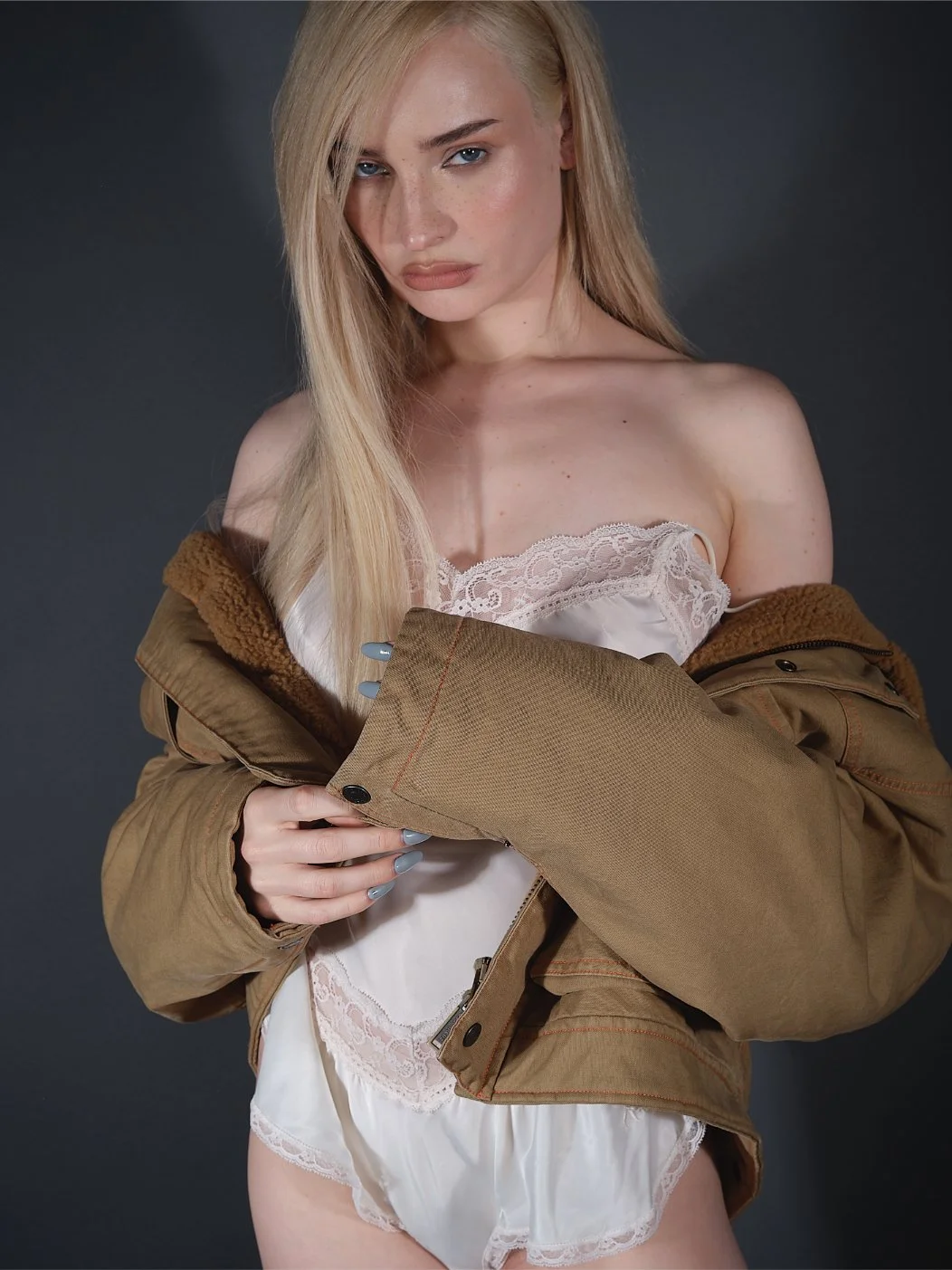
romper VINTAGE CHRISTIAN DIOR
jacket DSQUARED2
interview by Oliver Kupper
photography by Paulo Sutch
Grammy Award-winning German singer-songwriter and pop provocateur Kim Petras wields a virtuosic ability to craft psycho-pop playgrounds populated by meticulously constructed cyborgian female identities—from the iconic blonde bombshell to the horror heroine. Her new album, Detour, functions as both a kaleidoscopic mixtape and a bold testament to her unparalleled skill in both persona building and destruction.
OLIVER KUPPER: I want to start with the music video for “I Like Ur Look,” because it really sets the tone for your new album, Detour, and the visuals around its branding. The video opens with you staring at a computer screen, which connects to the themes in our issue: living in a world where we are constantly watching and being watched.
KIM PETRAS: Well, in the video—and just in my life—the internet and screens have a really nostalgic quality for me. I associate a lot of childhood and teenage memories with being in chat rooms with my friends and things like that. I also sort of clumsily started my career on the internet, realizing that I could connect with people through it. And I’ve been making music on computers for most of my life, since I began as a bedroom artist. So in that sense, it’s been the ultimate tool for me. Aesthetically, with that video, it’s really about wanting to be a version of myself that’s more likable than I think I am. It’s about trying out different personas and personalities to impress someone you feel is better than you and has this fixed, confident identity. I’ve always felt like I needed to invent images and versions of myself in my art, because I often thought the real me was too boring. So I created these characters through my music, videos, and performances that felt more captivating than I am. Living through them makes life more bearable—it gives things a kind of logic and also offers an escape.
I’ve always had this strange desire to create characters who don’t feel human emotions as intensely, or who can just get whatever they want, or who are hypersexual and don’t care what that means. On one of my records, I even sing about killing people. It’s all part of building these exaggerated personas. With the new album, it’s interesting because I feel like all those characters finally come together and form a kind of “super version” made out of all the others. “I Like Ur Look,” in particular, feels like a kind of starting point. It reflects the idea of being moldable—being signed to people who tell you what you should be, what works, and what doesn’t. You internalize that and think, maybe if I just adjust myself and become all these different versions, I’ll be successful, or lovable, or whatever it is. That mindset really runs through the video. Even when I write songs, I’ll put on an outfit, even if I’m just in my home studio. I sort of get into character first. Everything is connected to the idea that, in my art, I constantly feel the need to become a character, which I actually love doing.
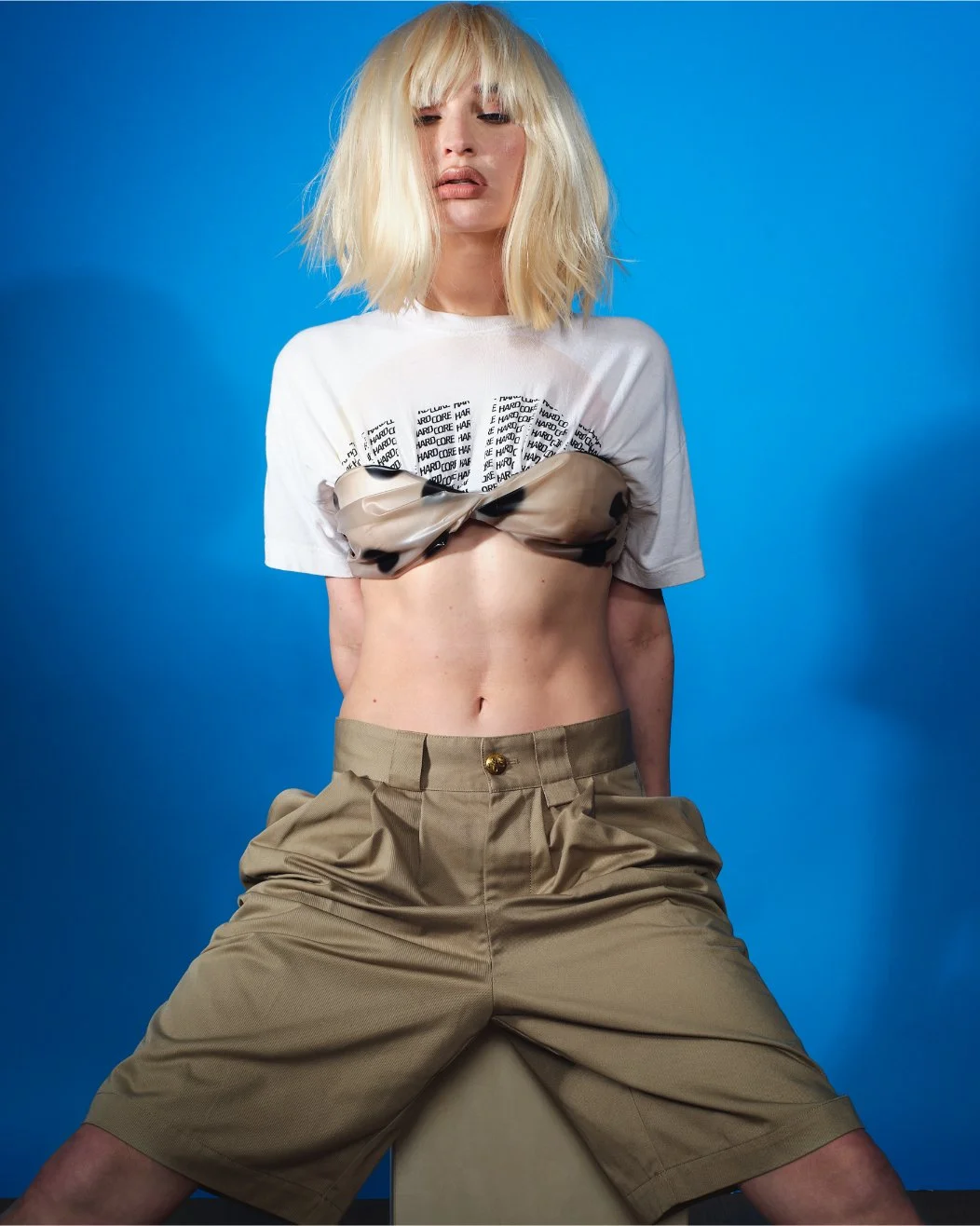
top MARC JACOB
Shorts WILLY CHAVARRIA
KUPPER: The internet not only mediates our lives but can also shape who we are and algorithmically influence our behavior, which is interesting when it comes to building characters.
PETRAS: When it comes to algorithms, though, I think they’re really scary. My biggest issue with them is censorship, especially right now. I almost feel like I need to stay somewhat outside of the algorithm in order to see it clearly. In the past, I was very online and deeply inside it, but over the last few years, it’s felt important to keep some distance so I can observe it without getting completely absorbed. What scares me is that algorithms tend to push everyone toward the same influences. People start seeing the same things and eventually become a kind of monoculture. These days, I’m careful not to look at it constantly, because even if you don’t want it to influence you, it does. For me, it’s important to stay outside of that system so I can stay true to what I actually like—curating my own references instead of being fed them. It’s tempting as an artist to look at what everyone agrees is cool or acceptable and just follow that, but I’ve always wanted to go in the opposite direction. I’m more interested in pushing against what’s socially acceptable and exploring the more taboo side of things.
KUPPER: I think the most exciting thing about your work is that you create this kind of pop playground that feels totally your own. Madonna touched on something similar in the ’90s—playing with the sacrilegious and the sexual, especially with projects like her Sex book —pushing ideas that went against the norms of the industry.
PETRAS: That’s definitely something I’m really interested in. I’m also a huge defender of bad taste. I think a big component of pop music is really good taste mixed with really bad taste. A lot of the stuff everyone wants to scream out at a party is usually the stupidest thing. The repetitiveness, the structure of pop, the fact that it can feel calculated—that’s all a little bit bad taste. But that’s what makes it interesting to me. I like playing with what people consider bad songwriting or “not art” and putting that into my music in just the right way. Because I think that’s what makes pop pop.
KUPPER: Do you feel like what you do leans more towards an art project or a pop musical project? Or is it somewhere in between?
PETRAS: I like to think of myself as an art project. It’s really freeing to think of yourself—your body, your image, all of it—as art. I think anyone can do that. There’s something liberating about approaching your life that way. So, at the center of everything for me is the art. That’s what I care about the most. But I’ve definitely dabbled in pop commercialism and been curious about it. I’ve tried to learn how that whole system works. I’ve even put out projects where I thought, okay, I’m going to let people in the music industry tell me what to do. And that, in itself, becomes a kind of commentary, especially when you place it in opposition to my other music. It raises the question of what happens when labels—or people who think hits are the only measure of success—start directing the artist. To me, that’s just as interesting as an artist doing exactly what they want.
For me, success is about moving people—making something that resonates, something people talk about, or something I personally feel proud of. If I write a song that I think is perfect, that feels like success. It’s about executing the vision and seeing it through. But for a lot of people, success means numbers and money. And I can’t say I’m completely anti-commercialism. I do want to play big shows. I don’t want to self-sabotage. I want to make things people can relate to, because that’s part of what music does—it puts emotions out into the world so someone else can hear it and think, I feel that too.
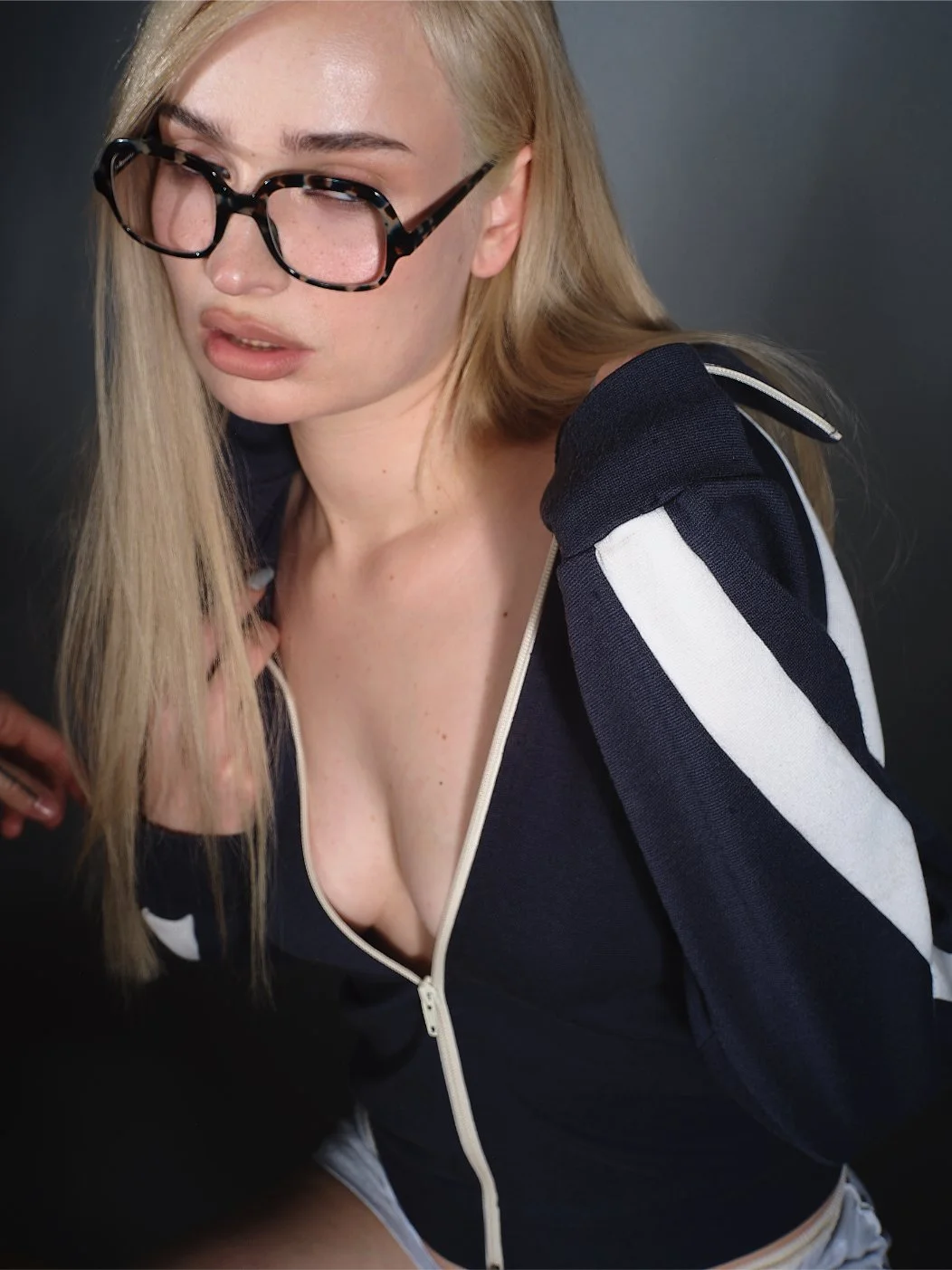
jacket STYLIST’S OWN
glasses l.a. EYEWORKS
At the same time, I’ve always resisted this songwriting idea you hear a lot in places like Nashville—that the most creative thing you can do is just “tell the truth.” That idea always kind of enraged me. I’ve never believed that truth-telling is the only creative principle. A lot of songwriters seem to follow that rule, but I’ve always been more interested in creating alternate universes than just describing what’s right here in front of us.
KUPPER: Speaking of alter egos, do you feel like your new album is almost like a super group of all of your alter egos together in one musical arena?
PETRAS: Yeah, I do. Especially vocally. I think you can really hear it in the way the vocals are treated—the different textures and characters that have built up over time. It feels like the repertoire of characters I’ve created over the years, all the ones I love, coming together. So, in a way, it does feel like a kind of “supergroup” of my characters. But at the same time, it’s also rebelling against every version of myself that came before it. This is probably the least perfect pop vocal record I’ve ever made. There are a lot of cracks, a lot of imperfections in it, and I’ve actually come to find that really refreshing. I’ve done the polished, perfect pop vocal many times before—that felt like chapter one of my career as an artist. It was about figuring out how to achieve that classic sound of pop perfection.
Now, it feels like the only way forward is to break that perfection and do the opposite—be raw instead. You can hear it in the mixing, the processing, everything. It’s intentionally opposing that earlier approach. In a way, it also mirrors the music world right now. Nostalgia is so huge—so much music sounds like a nostalgic ’80s song. And I love that too, I really do. I’ve enjoyed working with those sounds. But for me right now, that’s probably the least interesting thing I could be doing. This project feels like an opposing mirror to that. Nostalgia feels a bit boring to me at the moment, and I want to make something that feels like the future rather than the past.
Ironically, when you start thinking about the future, you end up looking back too. For me, that optimism about the future really lived in the early 2000s. That period has always been fascinating to me because it was such a formative time. In a funny way, that’s, in and of itself, nostalgic too—it’s just a different kind of nostalgia. The kind that sounds like people imagining the future. To create something that feels forward-looking, you often end up pulling from a different moment than everyone else. But honestly, with this album, most of the songs didn’t start from a sonic reference at all. They started with the songwriting—the lyrics, the ideas—and then the sounds came later. That’s new for me. Earlier in my career, the track and the production would come first, and then I’d write songs on top of them. This time it was the opposite: I had the songs first, and then we built the instrumentation around them. It made the whole process feel really different from anything I’ve done before.
KUPPER: Do you feel like there’s more vulnerability in that?
PETRAS: Yes. It’s a very vulnerable moment for me as an artist. My career started with this feeling of knowing that I wanted to be a performer and a songwriter, but also relying a lot on other people’s opinions about how to get there. Now, it feels like the rug has been pulled out from under that. I really don’t listen to anyone’s opinion except my own and my friends’, and I just want to make the music I actually want to listen to. Of course, people have opinions about that—like, am I ruining my career or not? But I actually find that really interesting, because I’ve always thought the downfall of an artist can be just as fascinating as their rise. So, there’s a bit of an orchestrated downfall happening here, even in the imagery. The hair is messy, the wigs are thin and synthetic—and not expensive wigs. The makeup is smudged, and there are bruises on my legs. It’s not that polished, perfect look anymore. I’ve always found the destruction of something perfect you built to be incredibly interesting.
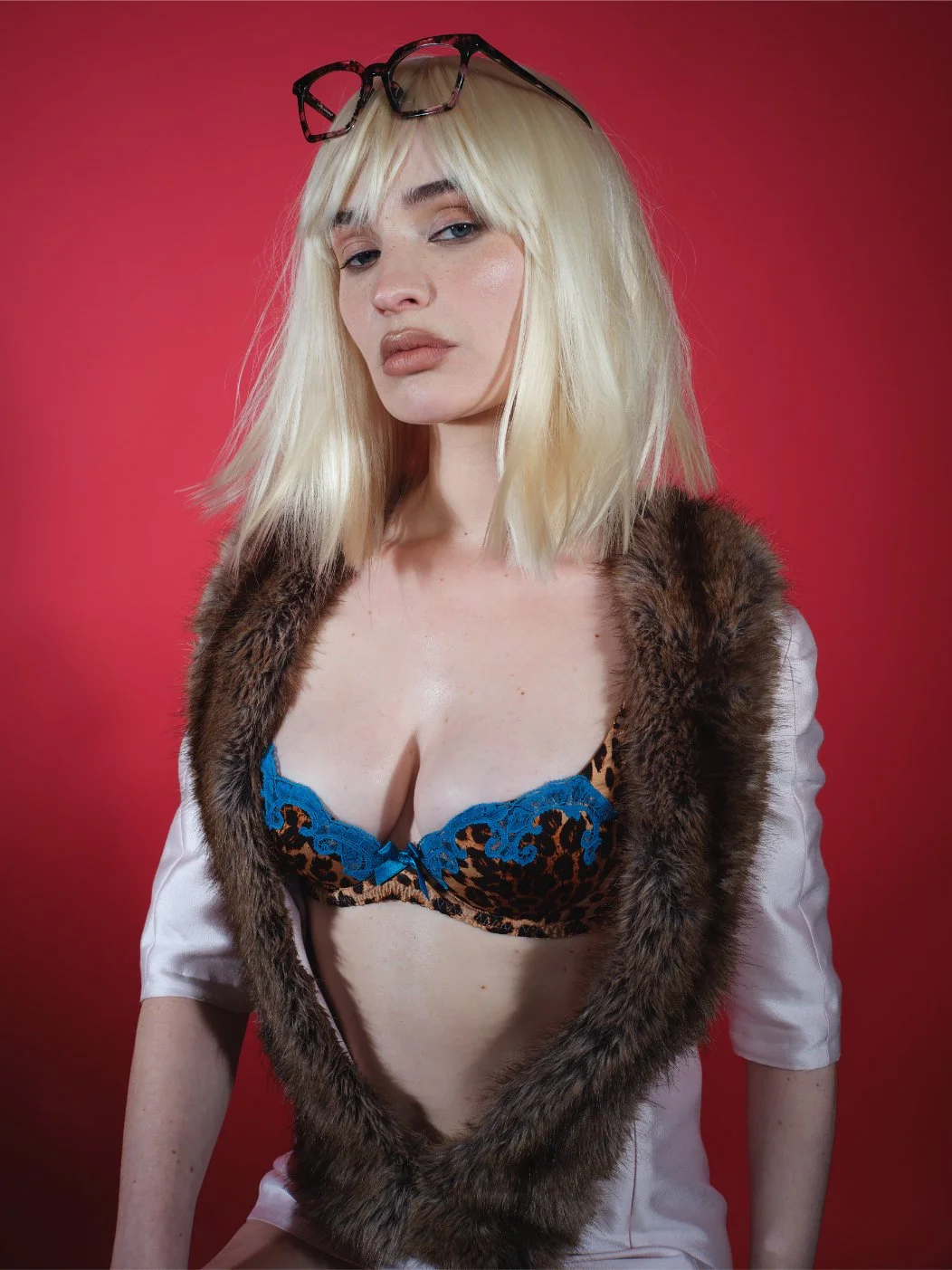
glasses L.A. EYEWORKS
dress FANCI CLUB
bra AGENT PROVOCATEUR
KUPPER: That’s a rare epiphany for an artist.
PETRAS: Well, the new album is called Detour because it’s about being at a fork in the road and not choosing either path. Just going off road, saying, “I actually don’t want to stick to any road. I just want to drive this pretty pop Corvette I have off a cliff and see what happens.” Maybe none of the roads get me where I want to go, and right now I just need to take a detour. I’ve always been super sure of myself, but there was a period where my compass felt broken. Being on a number-one song with someone didn’t feel like I “made it.” Winning [a Grammy] doesn’t feel like I’ve “made it.” The only thing that feels like I’ve made it is singing songs with my fans, in whatever size rooms, and creating, being in the studio constantly. That’s where I really just want to be. Also, having a life outside of my career is something I care about now, which I never did before. It feels clumsy—my life has been nonstop, just working a lot and loving the speed of pop star life.
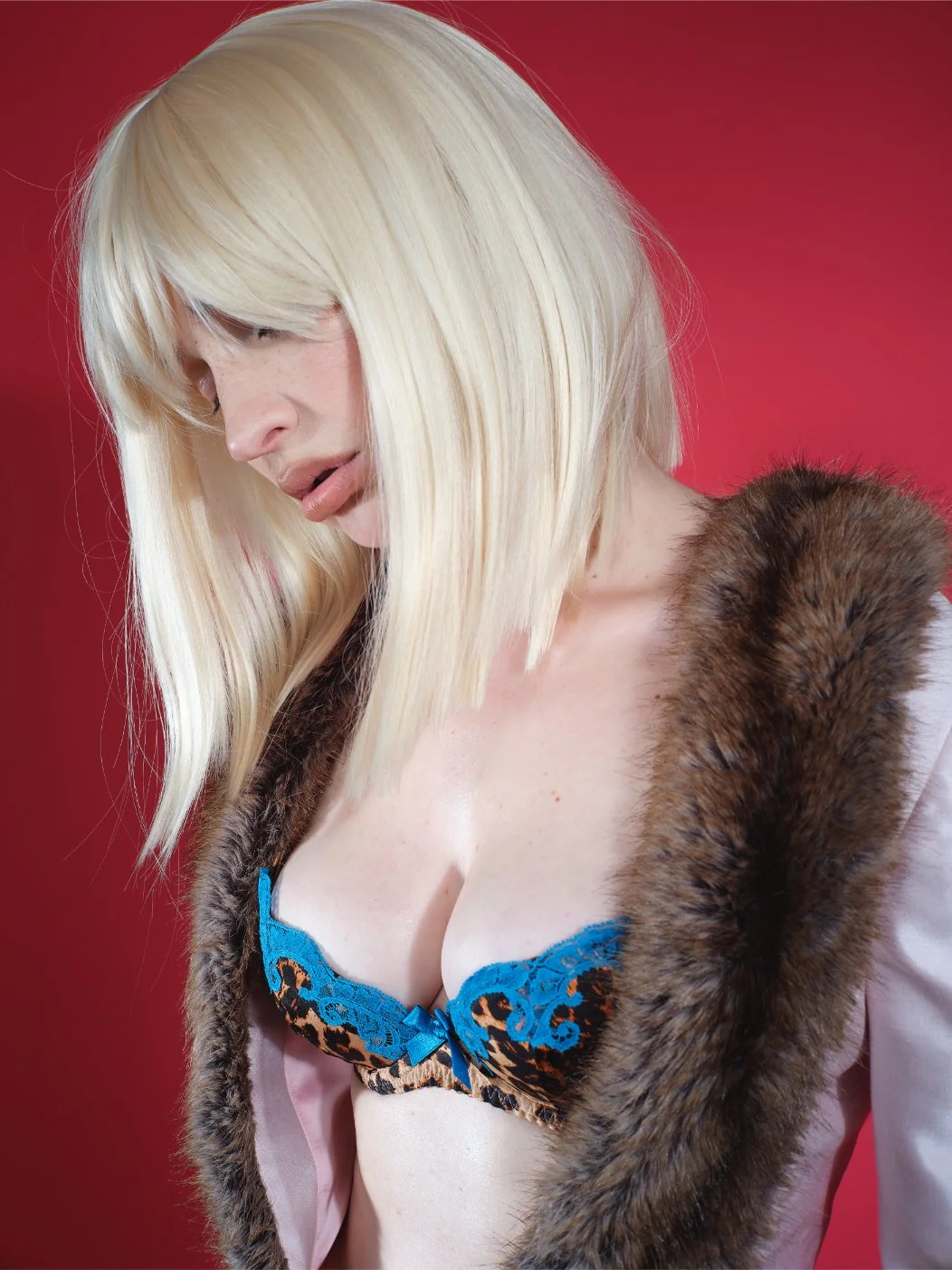
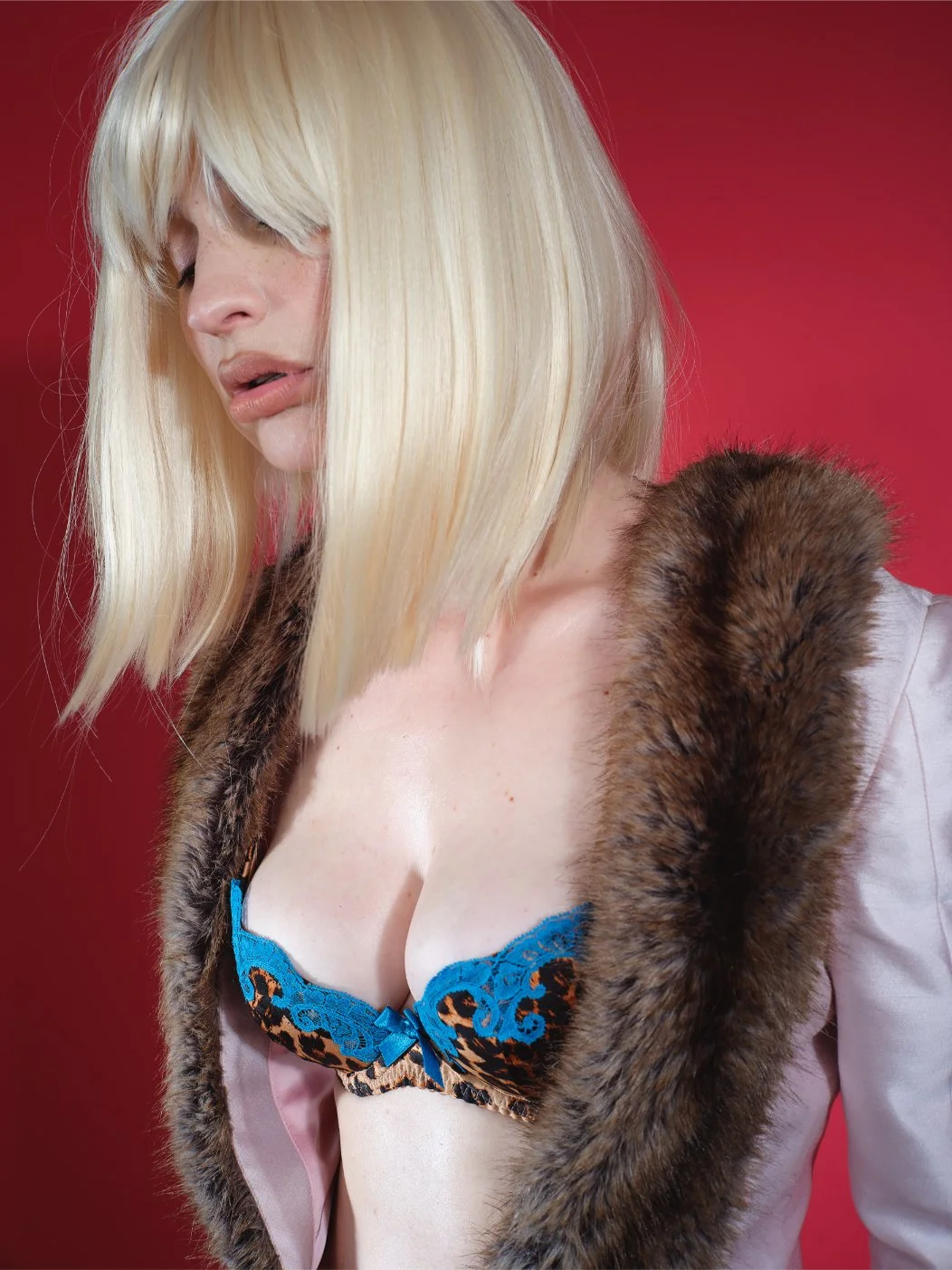
KUPPER: How do you deal with fame and hypervisibility?
PETRAS: Well, it’s something I’ve always strived for. In the past, I thought I needed more visibility. I needed my image to be perfectly crafted. There was so much conversation about marketing, about having a brand, like “Oh, a rebrand that’s perfect can really change your career if you just package it nicely.” And honestly, that’s just so boring to me now. The idea of the perfect brand has lost its appeal. Someone being “crafted” feels inauthentic to me. I never wanted to lock myself into a box: this is my image, this is my perfect little package that I sell. Because that box can easily become a prison. I’m really interested in breaking that character. That’s more shocking to me than doubling down on branding; making it simple, digestible for everyone. Not that I don’t love personas in general, because it is an escape for me. This is also a persona. It’s not suddenly the truest, most authentic version of me. It’s still calculated. I’m consciously trying to break the character, which is also a character. The character that wants to break itself.
I also think hypervisibility now isn’t exclusive to celebrities anymore. Everyone is hypervisible, surveilled all the time. Everyone can relate. I’ve been in songwriting sessions where people say, “It’s not relatable if you sing about being famous.” And I’m like, “Well, everyone has to manage their brand and image now. Everyone.” To be successful, to be popular, to be liked—everyone builds a brand. So for me, my friends, and even my fans, there’s this urge: I just want to throw away how everyone sees me. I want to get away from it. And that’s what this album is about.
KUPPER: Do you think that the delay in releasing the album gave you a chance to think about different approaches to how you were going to release it?
PETRAS: I think it actually was a blessing in disguise. Everything started to fall into place—especially in terms of the album’s narrative. That earlier phase, even the look, feels like a version of me that wanted to conform, to become something more easily likable. But with the next release—the official single—it’s like I’m driving that image straight off a cliff. So in a way, the delay gave me the perfect jumping-off point. I also dropped a kind of super-deluxe version before the album—what we called Pretour. We put it on YouTube and SoundCloud since I’m not allowed to officially release it, so you can’t really stream it in the usual places. But those songs are basically the map of how I got to the album. I actually think it’s a really cool way into the project: giving away the deluxe before the album even comes out. It lets people hear the extra songs that led me here, and gives you a deeper way inside the world.
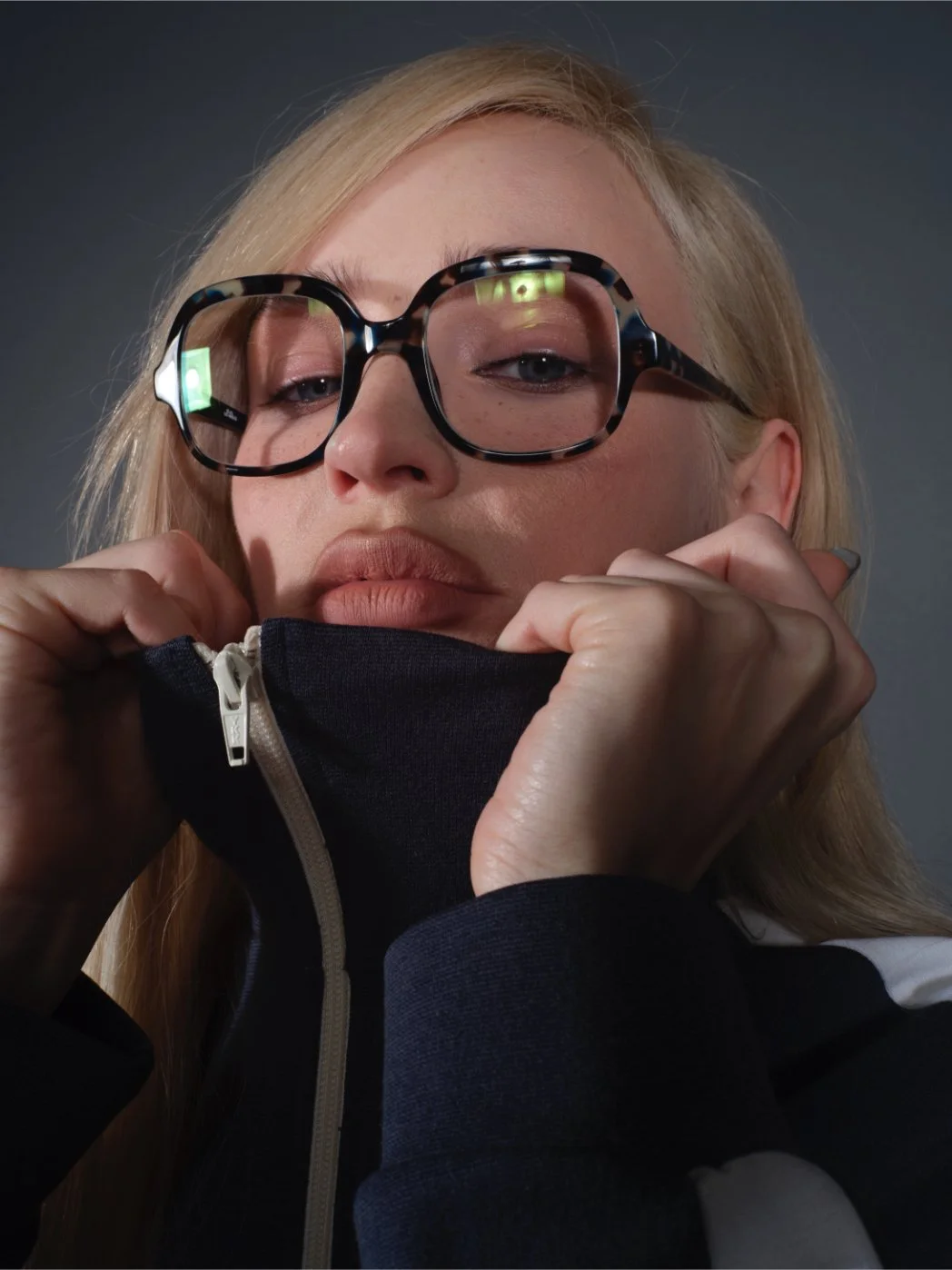
jacket STYLIST’S OWN
glasses L.A. EYEWORKS
KUPPER: Your song “Pop Sound” has that line: “Made for the masses, made for the money / Made for the thrill, factory girl / It’s an illusion, it’s an oasis.” It really encapsulates how a pop star exists within the machinery of the music industry.
PETRAS: To a certain extent, that is me—how my career started was very calculated. I’m going to create this character because she’s marketable, and we’re going to sell her. It feels really cathartic that the song goes there—pulls back the curtain and just says it outright: I am a product. I made myself a product, and now I have to deal with the consequences of that. At the same time, it’s also kind of a love song to music—to the craft itself. That line: “all week I tweak for your sound.” It’s about the discipline, the obsession, everything that goes into building the perfect pop product, really laboring over it. But with me, there’s always also the trans layer to it—having literally taken control of my body, and people projecting onto that, saying you’ve gone against nature, you’re manufactured, you’re fake. So the song touches on that too—on pop, on perception, on what it means to make decisions about your own body.
KUPPER: Can we talk a bit about these personas you’ve created across albums—from the horror-pop era to the blonde bombshell? Which ones do you feel most connected to? Who feels the most distant from who you really are? And who were the hardest to step into—where did they come from?
PETRAS: I think they’re all coming from different places. But honestly, none of them feel that distant. My whole music career, and why I’m an artist at all, is because I needed to invent characters in order to be myself, to express myself. Early on, I felt like I wasn’t interesting enough. I wanted to be more confident than I am, more expressive. I’m actually very shy, and I don’t always feel like I can be those things in real life. So creating a character—someone who can go on stage for me—unlocks that flow state. And that’s what I’m always trying to reach, because just thinking and being can feel overwhelming.
So, all these characters come out of that desire. If I put it behind an image, a mask, something defined, then I can perform it. I can access what makes me feel alive through that. First, there was the blonde bombshell—bratty, “I get whatever I want,” that whole thing. That early phase was very much about this exaggerated idea of the German girl going to America: vapid, blonde, hot, rich, skinny, and that’s all she cares about. That was iteration one.
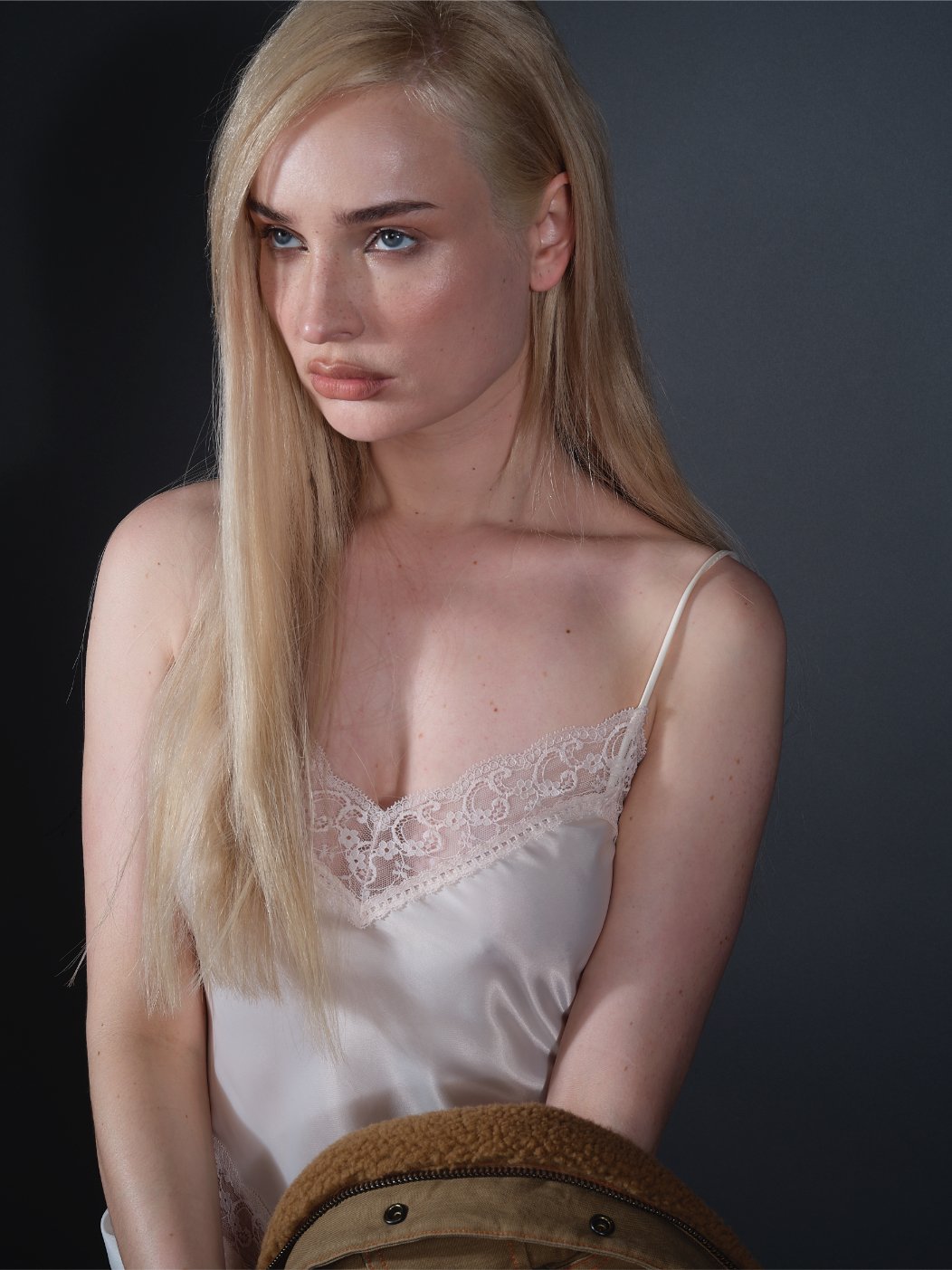
romper VINTAGE CHRISTIAN DIOR
KUPPER: When did things get dark?
PETRAS: That vapid blonde character developed a shadow side—like, what if underneath that, she’s actually dark? What if she’s killing for power, for fame? What’s behind the mask? After that, it shifted into something more exposed—clarity—where it’s like, okay, this is my actual inner world. Those other things are characters, but now I’m talking about real feelings. And then, that opens into hypersexuality, which was a whole other break. Before that, sex wasn’t really central to the work. But stepping into that space—being able to say whatever I want, to perform this totally sexually free version of myself—felt like breaking the character again. Even though that version isn’t fully me either.
In reality, I come from a more complicated place: a religious upbringing, a lot of family trauma, being told early on that my transition was something perverse. I have these very vivid memories of being questioned, of people trying to define me in that way. So that inevitably fed into exploring sexuality in the music. I think a lot of people saw that shift as breaking the “pop princess” image, which I’ve always been interested in doing. But it also gets you labeled really quickly—and those labels stick. It’s strange how, in some ways, the world still feels very sanitized, almost like the 1950s, in terms of what’s acceptable. There’s a line, and it’s very clear when you cross it. So, that era was kind of like, let’s just break everything. Because I admire people who are sexually free, who can just be whatever they want. I find that inspiring. But at the same time, there’s still this idea that being open about sexuality is somehow harmful or corrupting, especially for younger people.
When I think about my own childhood, it was just about singing ridiculous pop songs with my friends—it was fun, it didn’t define my life. So, it’s interesting that this fear still exists, especially when you think about how long this conversation has been going on. At the end of the day, it felt worth exploring. But it’s also not that serious—it’s not some grand political statement. It’s just fun.