
interview by Hans Ulrich Obrist
photography by Roman Kova
Gus Van Sant’s films are subtle, poetic studies of rupture—elegies for the marginalized, fissures in the mythology of the American Dream, and quiet reflections of the inequities that shape it. Now, a first monograph from Blue Moon Press brings his expansive, lesser-seen painting practice into focus, revealing a parallel language running alongside the films. His latest feature, Dead Man’s Wire, turns to a true 1970s hostage story, extending his long-standing interest in the strange, fragile edges of American life.
HANS ULRICH OBRIST: So, what were your beginnings in filmmaking? I’m always curious about how it starts, especially for artists who didn’t necessarily set out to be filmmakers.
GUS VAN SANT When I went to art school in the mid-70s, everyone was a painter. That was kind of the default identity—you were a painter. But at the same time, everyone was trying to do other things. It was a very open environment in that sense. The guys who became Talking Heads were there, and they started playing music. Painters were moving into photography. There wasn’t this strict separation between disciplines. In my case, I started doing films. But that wasn’t because I had always wanted to be a filmmaker. I actually really wanted to pursue painting. That was my main interest. Film was something I began experimenting with alongside that. It felt like an extension of what painters were already doing in the ’60s—people like Stan Brakhage, who were literally painting on film, scratching on film, treating it as a material.
OBRIST: Structuralist film, that whole approach.
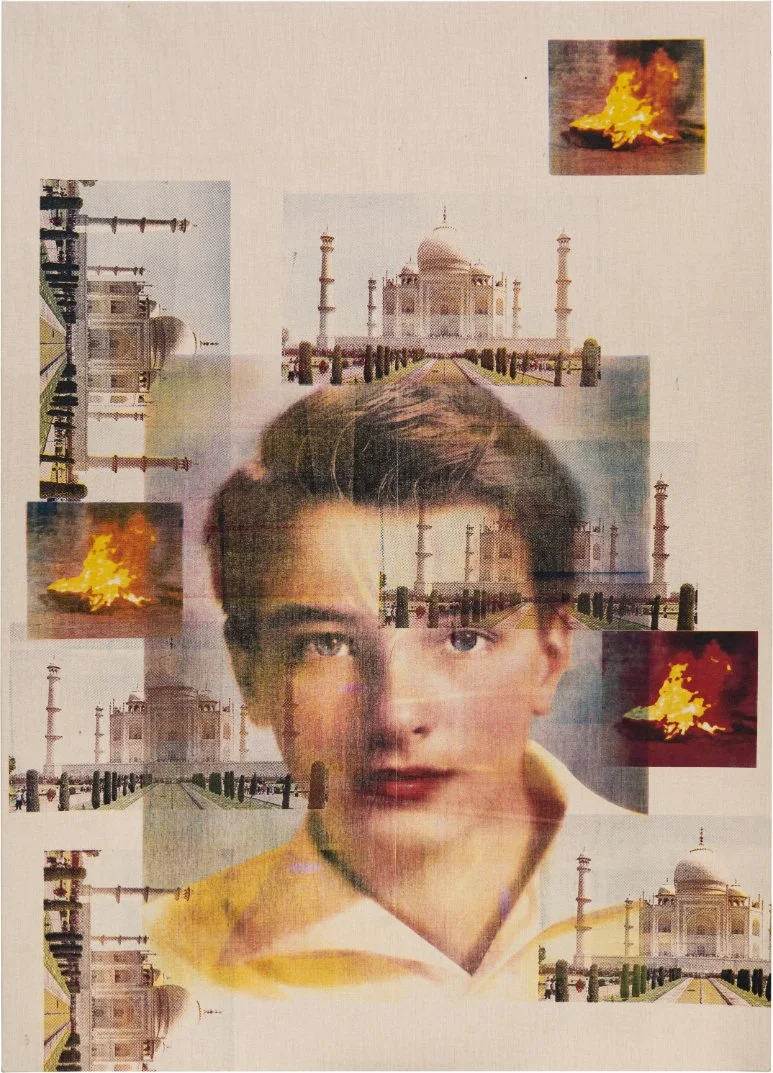
Untitled, 2016, silkscreen on linen, 108 x 78" (274 x 198
cm), photo by Ben Marvin
VAN SANT: Exactly. It was very material, very hands-on. So, when I got to school and realized there was a film department, I thought, okay, this is great—I can play there. But once you entered the film department, there was this expectation that you would stay there. They wanted you to focus, to specialize, not to keep moving between mediums. For me, though, it never felt like traditional filmmaking. Everyone was doing something unique. Some people were doing documentaries, others were doing animation. There wasn’t really a single model. I think I was trying to see if I could make something that resembled Hollywood films, but coming out of that experimental context. So I started working with characters, with storylines, and gradually it began to move more toward what we’d recognize as narrative cinema.
OBRIST: Are there any student films from that time that you still consider valid, or that you look back on as important?
VAN SANT: There’s one—my senior project. It’s called Late Morning Start. It’s about twenty-five minutes. It’s technically a student film, but it actually looks kind of good. I still feel okay about it.
OBRIST: Does it have a plot, or is it closer to that Brakhage style?
VAN SANT: It doesn’t really have a plot. It sort of follows one character to the next. It’s more like drifting between people. Almost like Elephant, actually. And later, I realized that Elephant was kind of a return to that structure—it’s like my senior project again, in a way.
OBRIST: So, already there, at the beginning, you can see elements that reappear later.
VAN SANT: Yeah, definitely. I think that happens a lot—you circle back to things you were doing early on, even if you don’t realize it at the time.
OBRIST: And then painting—because you mentioned earlier that you originally wanted to be a painter—you returned to it later in a more focused way.
VAN SANT: That happened unexpectedly. James Franco had taken My Own Private Idaho and recut it into his own version, and he was going to show it at Gagosian. This was around the time he was hosting the Oscars and also doing art, so there was a lot of attention on that crossover. They asked if there was anything I could put on the walls to accompany the film. So, I made some big watercolor paintings. And through that process, I realized, okay, maybe I should actually start making paintings again—not just casually, but seriously.
OBRIST: So, it wasn’t a gradual return. It was more like a re-entry through a specific moment.
VAN SANT: Yeah, exactly. Before that, I had been making paintings, but mostly as gifts for friends. Small things, personal things. I wasn’t thinking of them as part of a larger practice.
OBRIST: I remember seeing one of those, actually, many years ago, when I went to Prospect Cottage, the Derek Jarman house. It was a small painting, and I later found out you had given it as a gift.
VAN SANT: Yeah, that sounds right. I was doing those kinds of paintings back then. I remember giving one to Derek when he was sick, toward the end of his life. We met at the Berlin Film Festival and worked on projects together.
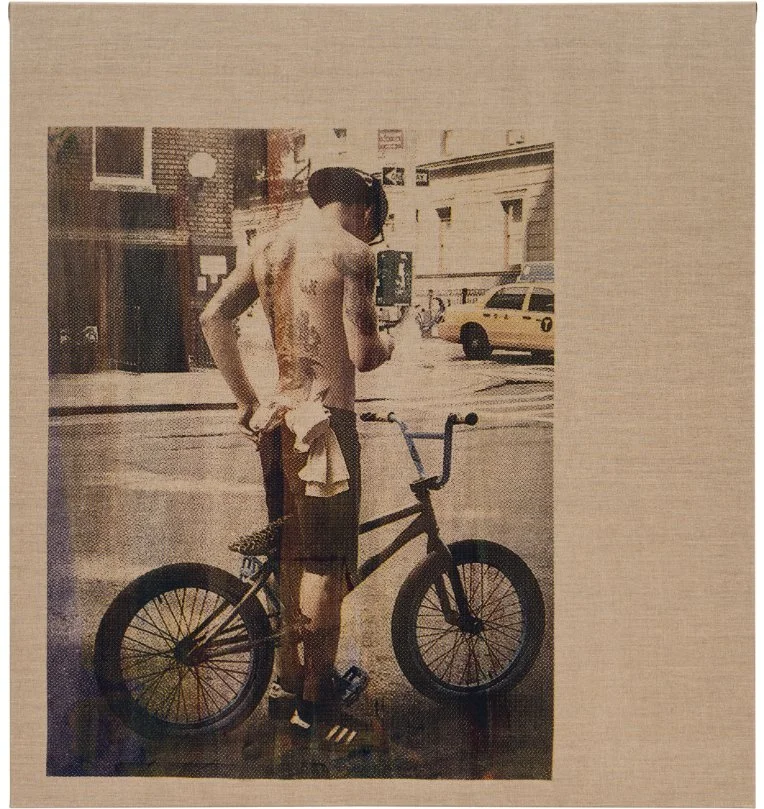
Untitled, 2016, silkscreen on linen, 54 x 52” (137 x 132
cm), photo by Ben Marvin
OBRIST: That was actually the first painting of yours I ever saw.
VAN SANT: Oh, that’s interesting.
OBRIST: Have you since exhibited the paintings more formally?
VAN SANT: Yeah, those early, larger works were part of an exhibition at Vito Schnabel’s gallery in New York. That was one of the first times they were shown in a more public way.
OBRIST: You mentioned earlier that you started very young with art.
VAN SANT: Yeah, around eleven. We had a really good art teacher who made a big impression. He was painting in class—acrylics—and we were all kind of copying him, emulating what he was doing. We were making abstracts, semi-abstracts, sometimes fully abstract. It felt very free. We were also doing silk screens. We’d make posters for school dances, things like that. There was already this combination of fine art and practical design. And I’ve continued doing prints—I still do silk screens.
OBRIST: And then, later, when you moved to Los Angeles, Hollywood Boulevard became a kind of subject for you.
VAN SANT: When I first moved here, I lived right on Argyle, near Hollywood and Vine. At that time—and still, in some ways—Hollywood Boulevard was like a center—like your town. You could walk up and down, go to the library, the post office, and find food. Everything you needed was there, and a lot of the people there were in a similar position—just arriving, trying to get work in Hollywood. There were musicians playing on the street, people performing, trying to get noticed. A lot of people without steady work just improvising their way through the day. I still live relatively close, so it stayed in my mind. I started thinking about that street as a kind of ecosystem—the people on it, the routines, the atmosphere.
OBRIST: And the characters—you have these recurring figures.
VAN SANT: It was kind of crazy. You’d see people dressed as Batman or Superman, buskers, people who had been there for years. Some kids hanging around cafes, sometimes homeless, sometimes just drifting. At one point, I started writing a version of My Own Private Idaho based on those kids on the street. They were fictional, but inspired by what I was seeing—kids playing video games in stores, hanging out in cafes. The street itself was almost like a stage. Movies were playing in theaters, people were sleeping inside them, and at the same time, something like Star Wars would have a premiere.
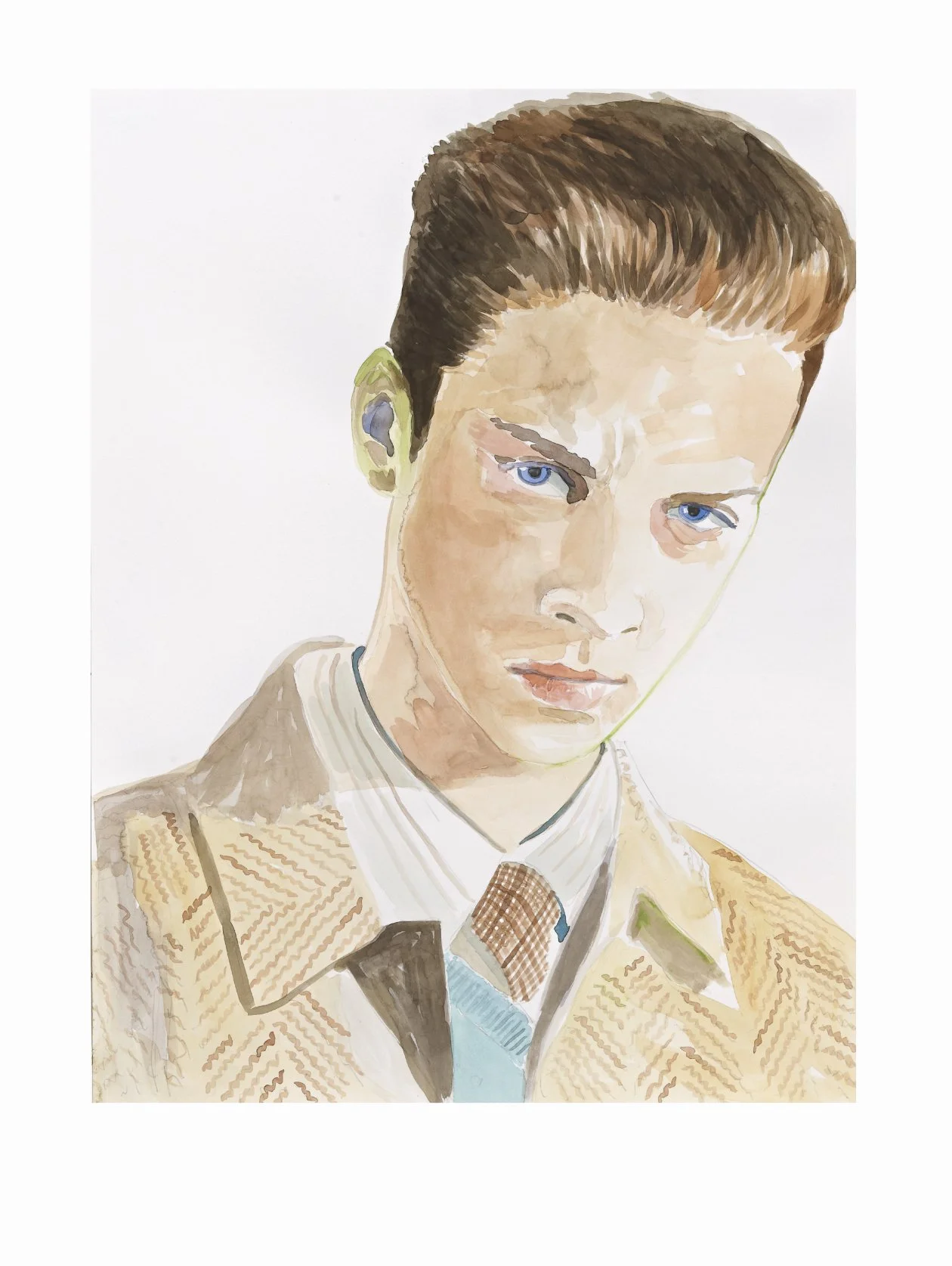
Untitled, 2011, watercolor on paper, 24 x 18” (61 x 45.7 cm), courtesy of Gagosian Gallery, photo by Douglas M. Parker Studio
OBRIST: So, the boundary between cinema and life is very thin in that environment.
VAN SANT: Yeah, exactly. It all overlaps.
OBRIST: And your painting practice evolved alongside that. You moved into different materials—large resin paintings on aluminum, larger formats.
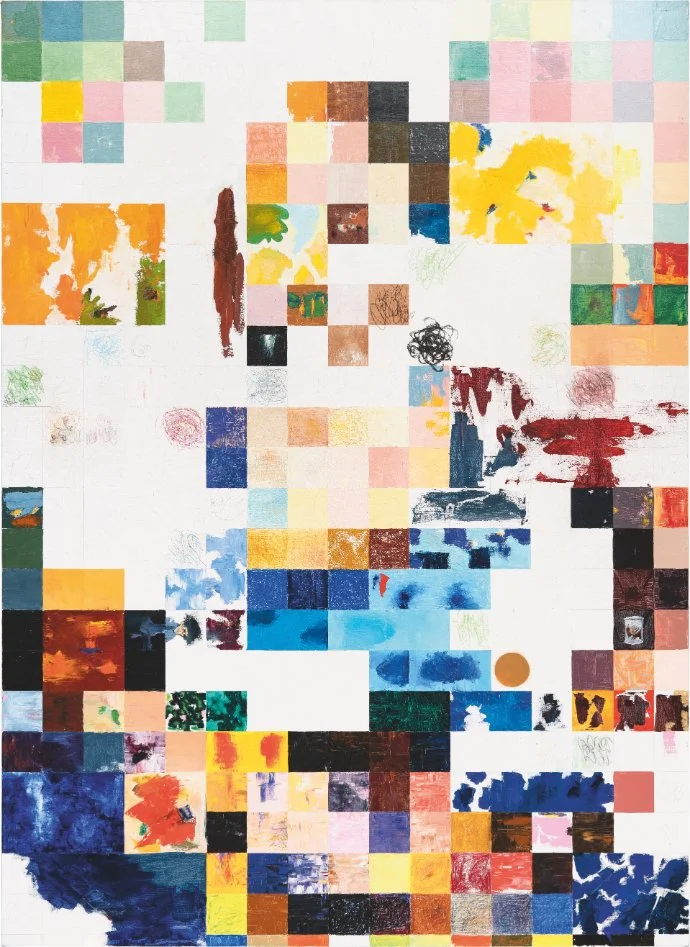
Mona Lisa #1l, 2022, oil on linen, 150 x 96” (381 x 244 cm), photo by Ben Marvin
VAN SANT: Some of the later works are on aluminum panels, larger, more constructed. They’re still often based on photographs. Over the last fifteen years, I’ve made a lot of different series. There was also a pixelated series that started as an experiment—I just wanted to see if the image would show up at all. And then I kept going, and it became a whole body of work.
OBRIST: And the pixelated Mona Lisa series—there’s this idea of repetition and variation in the Deleuzian sense.
VAN SANT: Some of them are deconstructed versions of the Mona Lisa. Others only resolve if you view them in a certain way—through a phone, or from a distance. So perception becomes part of the work.
OBRIST: Do you think of those as optical experiments?
VAN SANT: Yeah, in a way. It’s about how the image comes together—or doesn’t—depending on how you look at it.
OBRIST: And drawing—does that remain central?
VAN SANT: Most of the paintings start as drawings. I sketch them out, and then I scale them up.
OBRIST: And your photographic portraits of actors—that’s another thread.
VAN SANT: Those were originally very practical. At the time, there was no internet, no easy way to look someone up. If an actor came in, you’d take a picture so you could remember them. Otherwise, they’d just disappear.
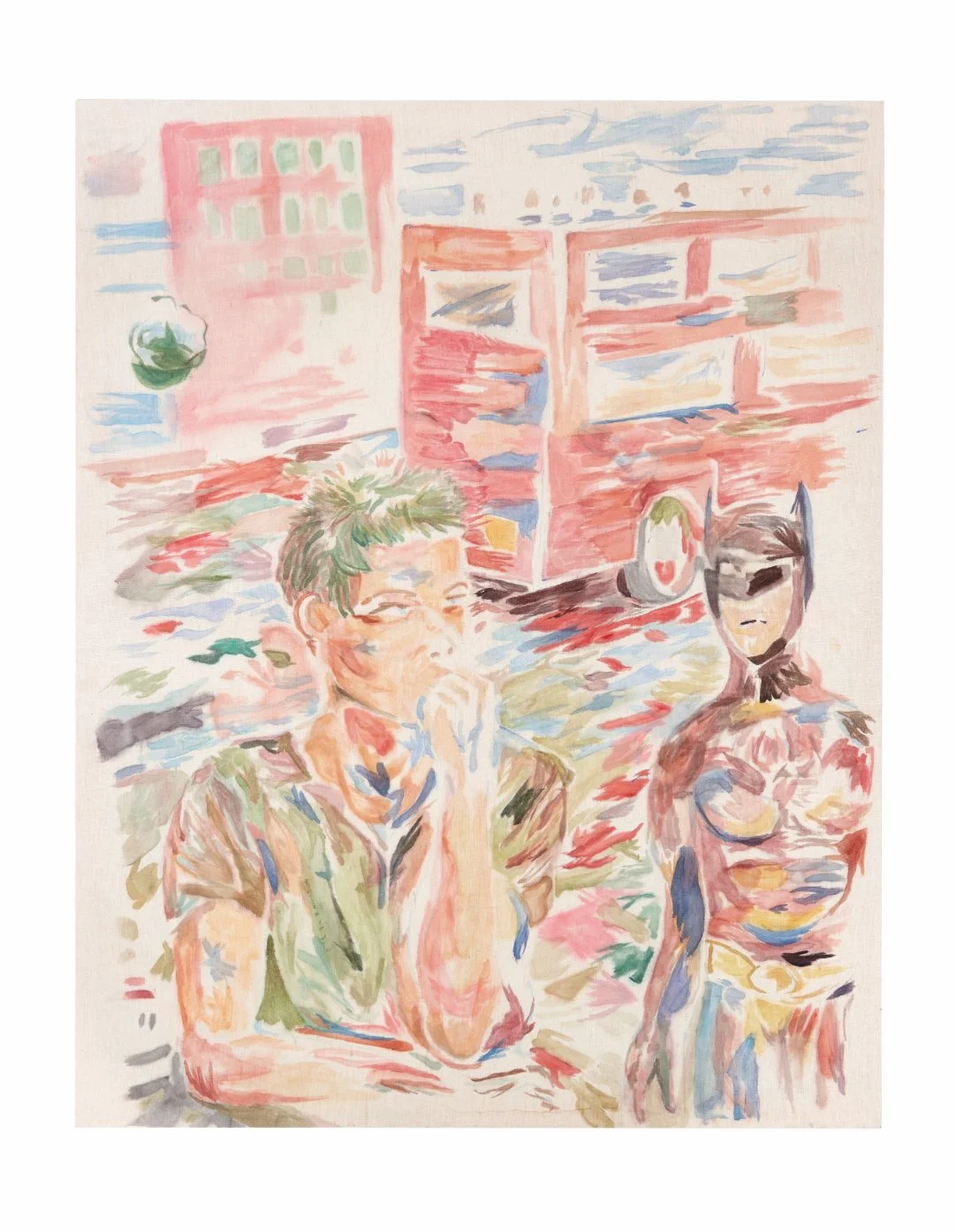
Untitled (Hollywood 5), 2019, watercolor on linen, 84 x 66” (213.4 x 167.6 cm),
courtesy of Vito Schnabel Gallery, photo by Argenis Apolinario
OBRIST: Have you thought about film beyond the cinema space—installations, environments?
VAN SANT: Only really through collaborations. With Franco, we showed the entire rushes of My Own Private Idaho—like twenty hours—in an installation. That was interesting because it changed how you experienced the material. But I haven’t fully explored that idea myself. It would be interesting to use film as an environment.
OBRIST: And unrealized projects—you mentioned there are many.
VAN SANT: Yeah, hundreds. That’s pretty normal, I think. A lot of them get started—you write something, you work on it for a week, and then it stays in that one state. There was one about Warhol that eventually became a play in Portugal. Another called The King’s Story is set in medieval times. It’s a story about a lowly character that attracts the king’s attention. And one I really like is about a retirement home—Kirkland Only Hearts Club Band. That came from my father being in a rest home. The people there had these incredible pasts—bush pilots, adventurers—and then they all ended up together in this one place. That could still be a film, or even a series. There are others—a vampire story, a fashion story set in Paris. Too many to count.
OBRIST: And your most recently completed film?
VAN SANT: It’s called Dead Man’s Wire. It’s a true crime story. A man abducts his mortgage broker because he believes the mortgage company is stealing his idea for a mall. It’s set in the 1970s in the Midwest. He builds this device, a gun attached to a wire around the victim’s head. So they’re physically connected. If the victim moves, it could trigger the gun. They’re together like that for three days. It’s almost like a Samuel Beckett situation—two characters bound together. He demands that the news broadcast his statement, so he can speak directly to the public. Eventually, he gives up, gets arrested, but becomes something of a local celebrity and receives a relatively light sentence.
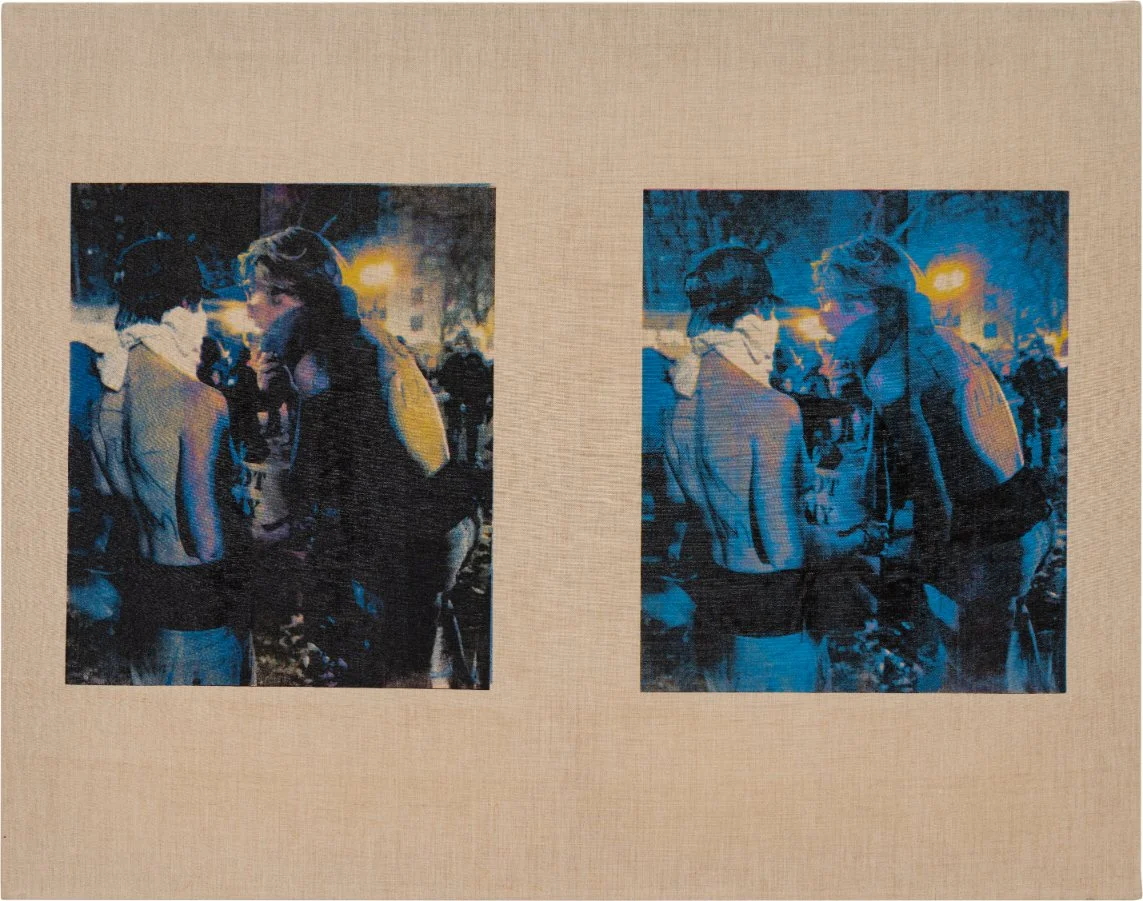
Untitled, 2016, silkscreen on linen, 48 x 38” (122 x 96.5 cm), photo by Ben Marvin
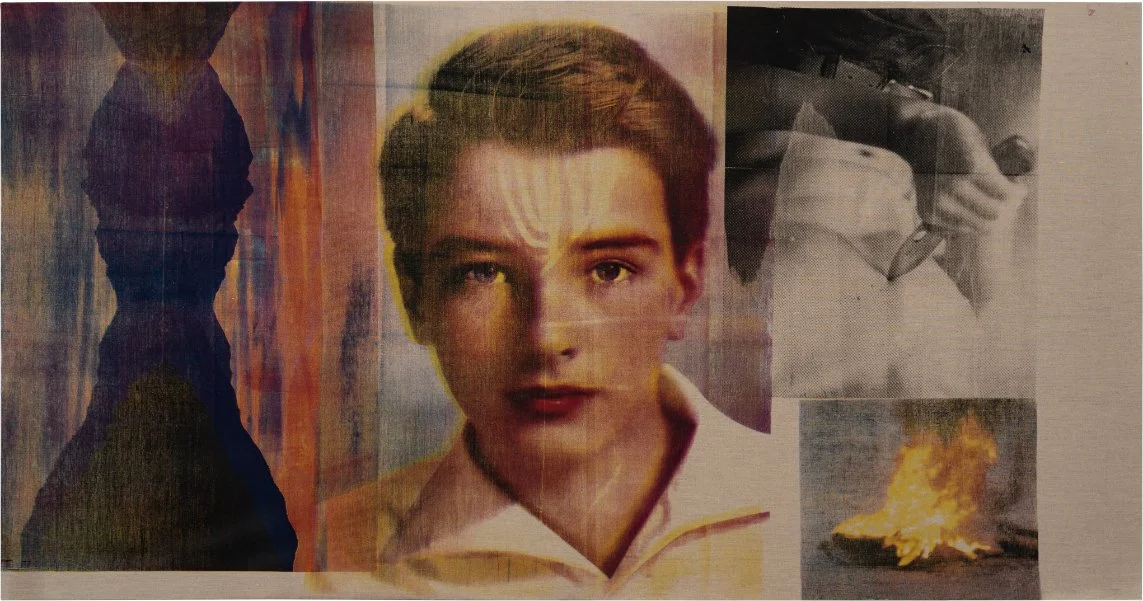
Untitled, 2016, silkscreen on linen, 84 x 120” (213 x 305 cm), photo by Ben Marvin
OBRIST: And what are you thinking about next?
VAN SANT: There are a few things in development, but I’m most excited about doing a rom-com. I want to write it myself. That’s the part I enjoy the most, when it comes from your own writing.
OBRIST: Do you write everything on a computer?
VAN SANT: Yeah. It’s just faster. You can edit as you go, move things around. I sometimes wish I still wrote longhand, but the computer makes it easier.
OBRIST: And your scripts—sometimes they’re entirely yours, sometimes adaptations.
VAN SANT: Exactly. My Own Private Idaho is completely mine. Drugstore Cowboy, I adapted it, but it was based on an unpublished manuscript written by James Fogle while he was in prison. So, sometimes I’m adapting, sometimes it’s just my own ideas.
OBRIST: Have you ever written poetry?
VAN SANT: Not really. But I’ve written songs, and those are basically poems. I made a few albums in the early ’80s. One was a collaboration with William Burroughs, The Elvis of Letters. Another was 18 Songs About Golf. I had one of those four-track recorders—the one Springsteen used for Nebraska. That was a big revelation. You could just record at home very simply. It was very DIY.
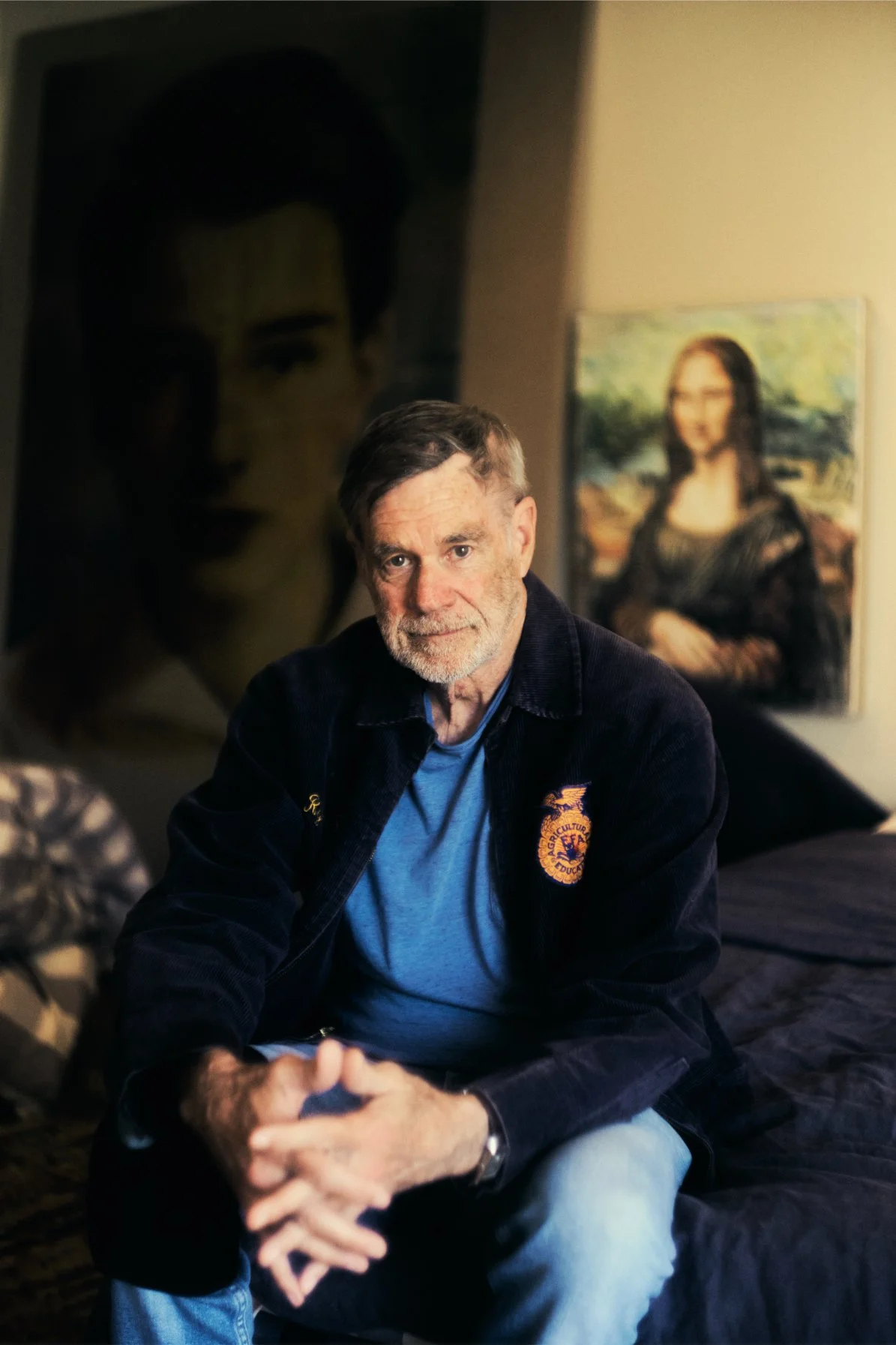
OBRIST: And golf—there’s a recurring connection.
VAN SANT: Yeah, I grew up with it. My family played. I also worked on adapting Golf in the Kingdom by Michael Murphy. That became another unrealized project for me.
OBRIST: So many of these ideas remain open, still possible.
VAN SANT: Yeah, that’s the thing. They don’t really disappear. They just stay there. There was also a project I was developing about the world of spiritual healers, as a kind of business structure. Like an art fair, but for spiritualists. They’d have booths, agents, managers, their own philosophies. It was fictional, but based on real dynamics in that world.
OBRIST: That sounds like something that could still happen.
VAN SANT: Yeah, it could. A lot of these things could.
OBRIST: And now, you’re returning again to writing something entirely your own.
VAN SANT It’s been a while, and it’s the most fun. So I want the next one to come from that place.