Isamu Noguchi at the debut of Unidentified Object (1979)
Photo: Donna Svennevik. The Noguchi Museum Archives, 04144.
text by Hank Manning
In celebration of its 40th anniversary, the Noguchi Museum presents Noguchi's New York, highlighting the artist’s attempts—many of them unsuccessful—to beautify and improve the city. The exhibition presents more than 50 works, including sculptures, photographs, and plots for landscape architecture; and celebrates the museum and sculpture garden, situated in Noguchi’s former home and studio, as one of his gifts to the city.
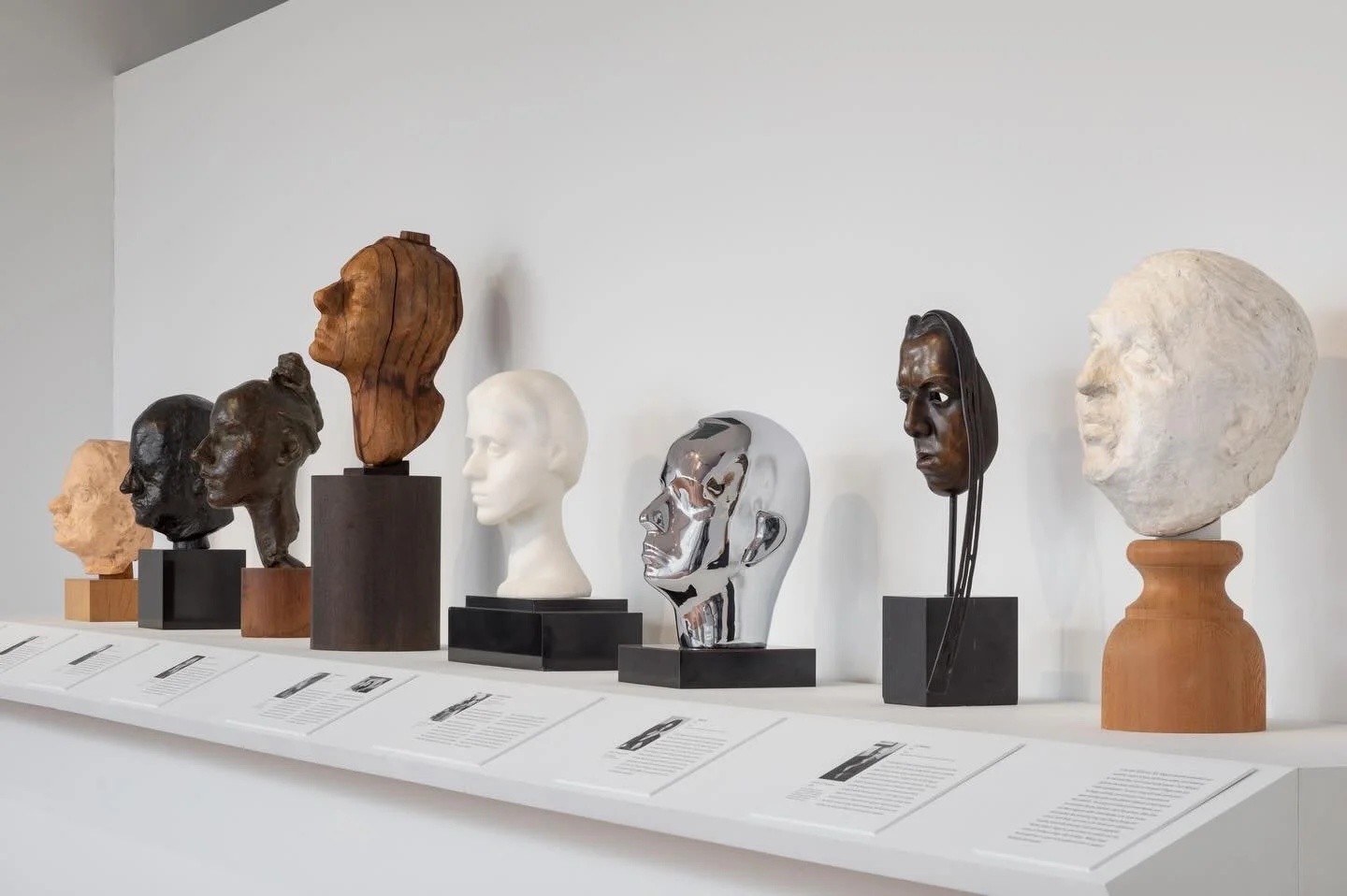
Installation view. Photo: Nicholas Knight
Noguchi saw cities as inseparable from their people, particularly enjoying the feeling that, like him, every New Yorker came from somewhere else. In the 1920s, after dropping out of Columbia, he befriended a diverse group of artists. To fund his world travels, he sculpted busts of these friends in various materials meant to represent their personalities—Claire Boothe Luce in marble, Buckminster Fuller in chrome, Suzanne Ziegler in wood. As a central figure in New York’s intelligentsia, he even testified as a character witness at John Lennon’s immigration hearing.
Noguchi’s oeuvre grew to be as diverse as his social circle. After voluntarily spending time in a Japanese American internment camp as a means of protest, he produced more abstract statues, including the geometric Red Cube, installed outside an architecture firm’s office, and Unidentified Object, an eleven-foot monolithic piece reminiscent of a totem. He designed set pieces for Martha Graham’s Broadway production of Phaedra. Noguchi’s first retrospective took place at the Whitney in 1968. He worried that he might be pinned down by the museum’s framing of him as a “throwback modernist carver” more so than a “vital contemporary artist.” This experience strengthened his opinion that “Sculpture is no good if it’s just put in a gallery—It must be a part of daily living.”
Isamu Noguchi
News (Associated Press Building Plaque), 1940
Photo: Miguel de Guzman
In spite of—or possibly because of—his frequent travels and long periods away from the city, Noguchi defined himself as a New Yorker. He saw his public works as attempts to make the city more interconnected, thought-provoking, and playful. His first-implemented sculpted environment was Sunken Garden, which contains seven large stones extracted from the Uji River in Japan. He described it as “a turbulent seascape from which immobile rocks take off for outer space.” News, a stainless steel plaque depicting a team of heroic journalists, adorns the former Associated Press Building, now 50 Rockefeller Plaza.
Isamu Noguchi
model for United Nations Playground, 1952 (cast 1963)
bronze
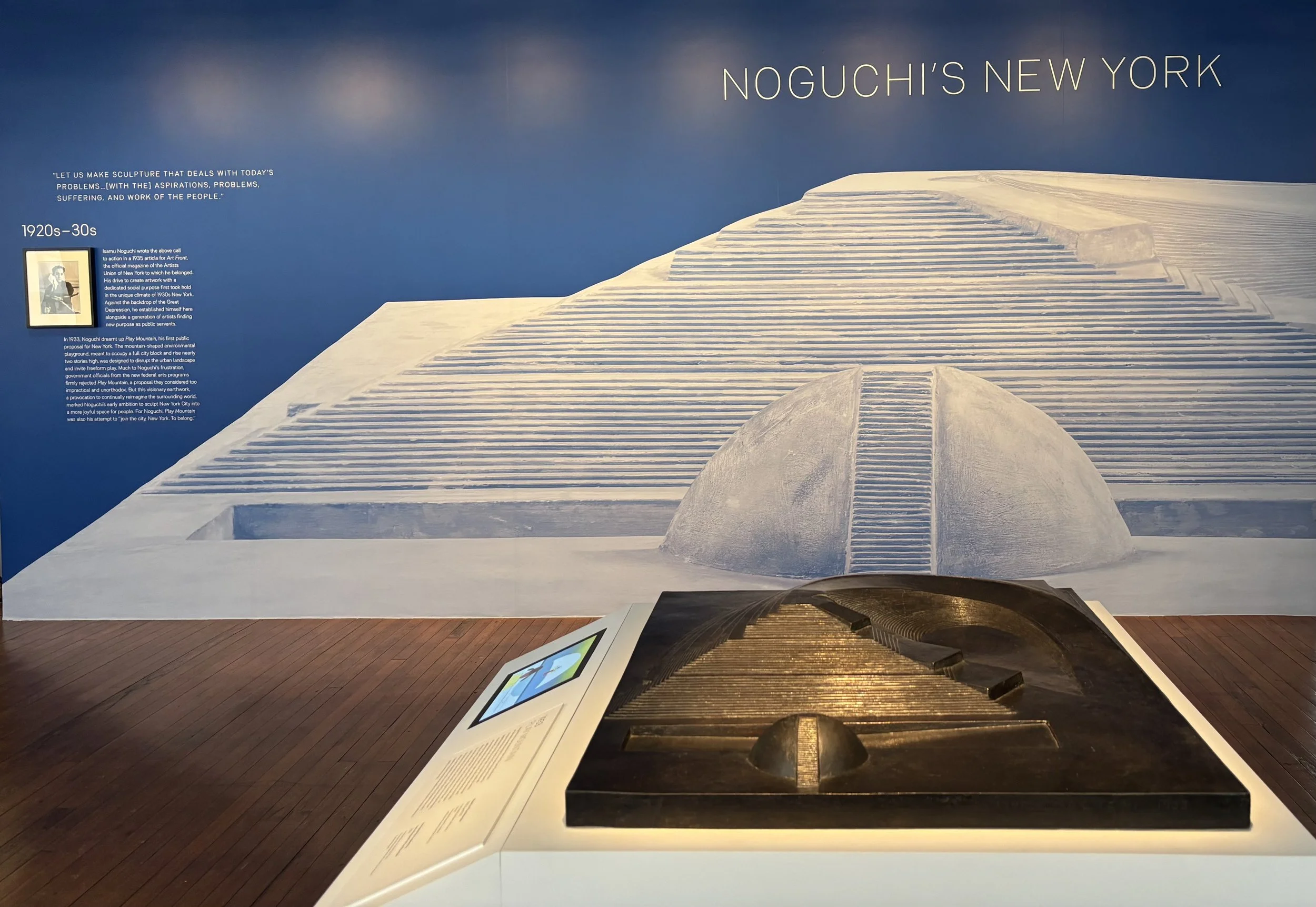
Unfortunately, dozens of Noguchi’s most ambitious designs fell victim to political fights and were never realized. He had a strong desire to enhance playgrounds so that children could find their own creative paths. To this end, he both redesigned the particulars—slides, swings, and jungle gyms—and planned to reshape large sections of public parks. In 1933, he unveiled his first public proposal for the city—Play Mountain, which would have occupied an entire block and included steps in the shape of a pyramid’s side, an amphitheater, a summertime water slide, and a winter hill for sledding. These and similar rejected proposals for redevelopment at Washington Square Park, Riverside Park, and United Nations Plaza are now brought to life through animated films at the exhibition. Rejected as well were playscapes at the Bronx Zoo’s Great Apes House, a totem greeting visitors at Kennedy Airport, and MoMA’s sculpture garden.
The exhibition envisions a world where idealists like Noguchi had triumphed, unlike the real city, overly sanitized by powerful urban planners like Robert Moses, who focused on building new highways rather than revitalizing existing communities and at times laughed Noguchi out of his office. Although some of the park plans do seem fanciful—reminiscent of landscapes out of a Dr. Seuss book—we can certainly appreciate the consistent vision, as well as his adaptive spirit—when critics worried children would fall off his playground equipment, Noguchi designed the curved, hilly but not steep parks that made serious falls impossible. He felt equally proud of his unrealized works as of the five public pieces currently standing in the city, understanding that rejection need not be permanent. His work reminds us of New York’s potential to continue improving and serving as a beacon for the rest of the world.
Noguchi’s New York is on view through September 13 at the Noguchi Museum, 9-01 33rd Road, Queens