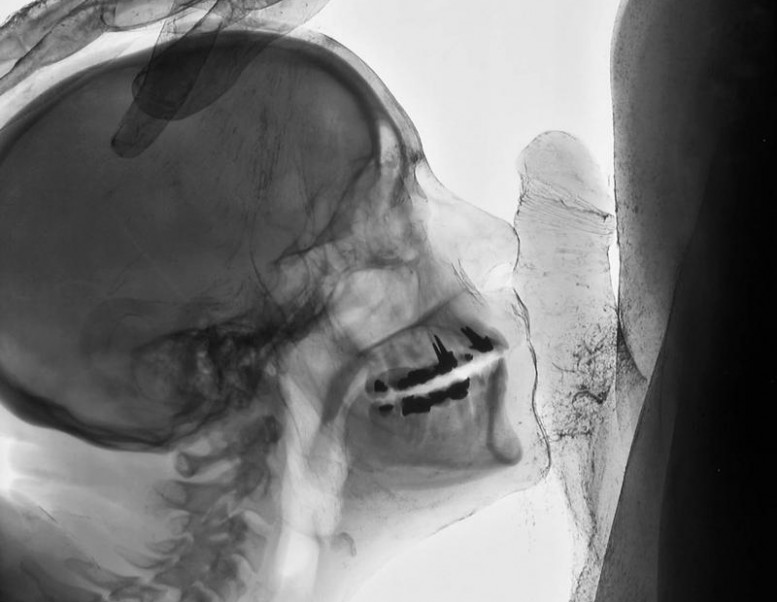
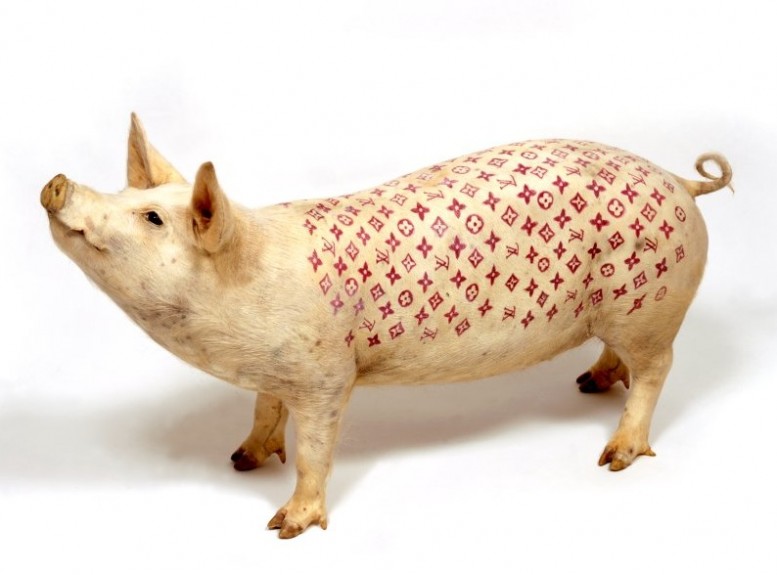
He’s made friends perform explicit sexual acts in medical clinics and had them recorded with X-ray scans, which were then sandwiched between colored glass to make windows in the tradition of medieval stained glass. Instead of human flesh, you see skeletons engaging in kissing, fondling and pleasuring each other. It’s a rather unfamiliar sight, yet it’s both realistic and real. Delvoye runs a pig farm in Beijing and sells tattooed pigskins and stuffed, tattooed pigs. And above all, he has made machines that digest food and discharge excrement. “If you really want to show a portrait of mankind, you have to look for the humanness.” And for that matter, Wim Delvoye’s works revolve around two pivotal axes: “one is the world of the frieze - decorative, the elegance of arabesques; the other is excrement.” The artist, however, sees little difference between the two: “The ornament, to an extent, is a form of waste.”
Cloaca, probably by far Delvoye’s best-known work, is a large-scale installation that duplicates the functions of the human digestive system and exists in a variety of models and incarnations. To put it simply, Cloaca is a machine that eats and shits. When exhibited, regular food is prepared by chefs and fed regularly (usually twice a day) into the workings of the machine, or should we say, the human machine. It then dutifully extrudes the remaining solids onto a conveyer belt, which is finally vacuum-packed and sold in plexi cases for $1,000 each.
“If you really want to show a portrait of mankind,
you have to look for the humanness.”
Cloaca was not simply a meditation on waste. The fact that a machine that produced shit was accepted and highly valued in the art circle was rather a provocation to an art world that had become increasingly commercialized since the mid-1990s, with the arrival of the Internet boom and dotcom economy. During an era when everything could potentially carry a price tag as an art object, Cloaca and its wide acceptance and popularity were a parody of the art system itself and what was considered valuable at the time. It mocked the very structure that supported its presentation and operation. Dan Cameron, former Senior Curator of New York’s New Museum has written of Cloaca, “by replicating one of our most crucial biological functions, Delvoye forces viewers both to consider our social discomfort with such functions and to question the elaborate cultural mechanisms that we have constructed to keep them from view.”
With another ongoing project, his “Pigskins” and “Stuffed Tattooed Pigs” series, Delvoye once again challenged the level of tolerance and the notion of worthiness in both the art system and our societies by tattooing patterns on live pigs and selling both tattooed pigskins and stuffed pigs as his artworks. His act of tattooing pigs has caused reactions and strong opposition from animal right activists in Europe, and he has since re-established a pig farm on the outskirts of Beijing, which he calls Art Farm. What makes the whole operation even more thought provoking is the fact that these art products are still exhibited and consumed in the international art context. While Delvoye found it impossible to continue having pigs tattooed withoutcausing controversy in Western societies, does their status as artworks make the products of this operation immune to criticism and allow it to acquire a certain positive value within the system again? Delvoye, however, wouldn’t want us to continue turning a blind eye to the underlying currents of such a mechanism, and instead brings it to us without disguise. Art Farm is a documentary of the full operation of his pig farm in China, shot on video from three different angles. We can’t pretend to know the easy part - the beautiful pigskin - without knowing how it has been made. There is no illusion or mystery left.