text and interview by Jill Di Donato
Last February marked conceptual artist Erika Blair’s debut solo show, entitled This Is Only A Test, which took on ideas of surveillance, the art of cruelty, trauma, subjugation, sex, and oppression. Blair, who holds BFA in printmaking from the Maryland Institute College of Art lives in Bushwick, and is the type of artist who’s always making art, even when not directly engaged in the process.
Is she an Instagram girl? I’m not sure I like what that term means, but yes; her Instagram is sexy as fuck. She’s got an artistic and seductive feed, and that’s important because it so seems social media like Instagram help artists and viewers connect on messages of aesthetics. The images in Blair’s feed are morbid, literary, witchy, erotic, nostalgic and give vibes of its curator: part pin-up girl, part tech-nerd, part La Femme Nikita. The type of woman to listen to 1960s California surf on a Hi-Fi and Bad Brains in a cassette player. She calls herself a feminist, but fiction is her favorite “F” word. “This Is Only A Test,” anti-authoritarian work by a female artist isn’t necessarily an outwardly feminist exhibition but rather a statement about more universal schemes of oppression.
Let’s just say Blair likes to dance with the devil.
Jill Di Donato: Since you’re a conceptual artist, what’s the concept behind “This Is Only A Test”?
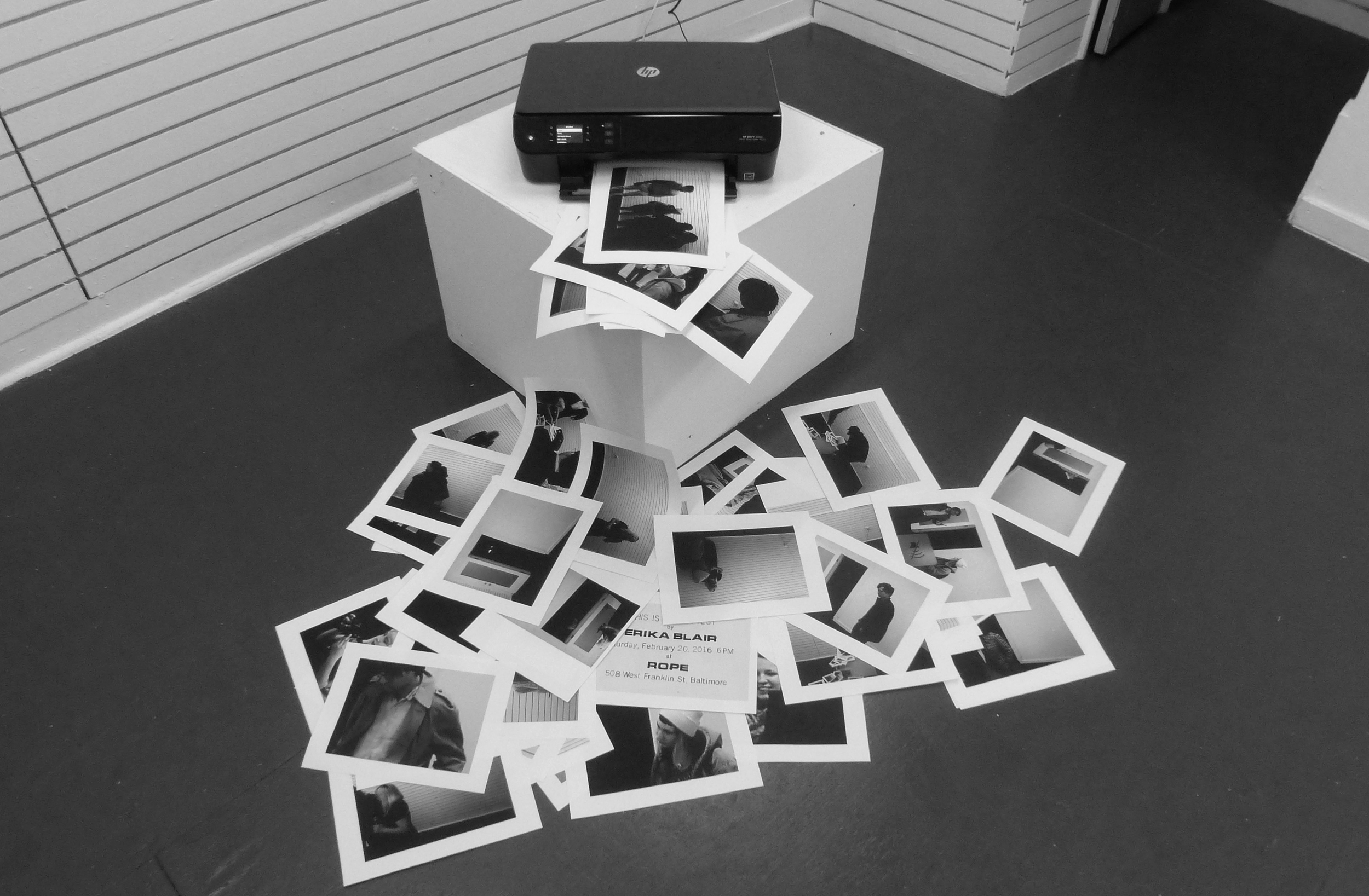
Erika Blair: “This Is Only A Test” was a site-specific performance at Rope in Baltimore, Maryland. For this solo exhibition, I sat in the unfinished basement beneath the gallery’s floor and watched a live feed of gallery attendants in the space above. The gallery was left barren except for a wireless printer, three surveillance cameras and two large speakers that were blaring audio that I’d ripped from a 1990s Chicago Emergency Broadcast test. I looped this audio for three hours, the duration of the performance. The cameras sent a video feed to my laptop, which I took screenshots of, then printed upstairs every five minutes. The printed images would fall directly onto the gallery floor. In reference to use of LRAD technology against protesters, I asked the gallery for the volume of the audio to reach the highest potential decibel level that we could, “without the cops being called.”
I don’t particularly like authority.
Donato: Immediately, your concept makes me think of Michel Foucault’s idea of panopticism, derived from the late eighteenth century philosopher, Jeremy Benthem, who designed the Panopticon. This was a new type of prison, circular in design, with a “watchman” at the core. Because it was impossible for a guard to check in on all prisoners all of the time, the Panopticon by design, would leave the inmates thinking that at any moment, they could be under surveillance. Foucault uses the Panopticon as a metaphor to explain social power relations.
Blair: And also I think of the architect Claude Nicolas Ledoux who, after the French Revolution built this structure, the Arc-et-Senans for the people as a utopian city, a place to exchange innovative ideas about progressive social economic living. It became known as the Salt Works, though was closed in 1926. Everything can be spun. Decades and decades later, the Nazis used it as a gypsy concentration camp. Ledoux’s structure was constructed with one ideology, and it was used for the complete opposite purpose. The devil is in deception.
Di Donato: Since we’re on the subject, this reminds me of Marx’s statement about capitalism, and that its greatest evil is the mask it wears. But seriously, all of this just seems so relevant given high-profile acts of oppression of late in our world.
Blair: I do have an interest in surveillance capitalism and its potential to strip agency from the complacent user. I wanted to bring the context of current political events—such as the documented police murders of unarmed African American citizens, the work of whistleblowers Chelsea Manning and Edward Snowden, and the increase in corporate data mining—to a small scale durational performance. My goal was to distill these themes down to a set of temporary artist-made conditions. As a conceptual artist, I used discomfort as a tool in the sterile setting of a gallery. Viewers are aware that there is an end. At any point, the viewer can walk out of the space, flip the record, change the channel. In other settings, in our social world, the participant is not awarded the luxury of choice.
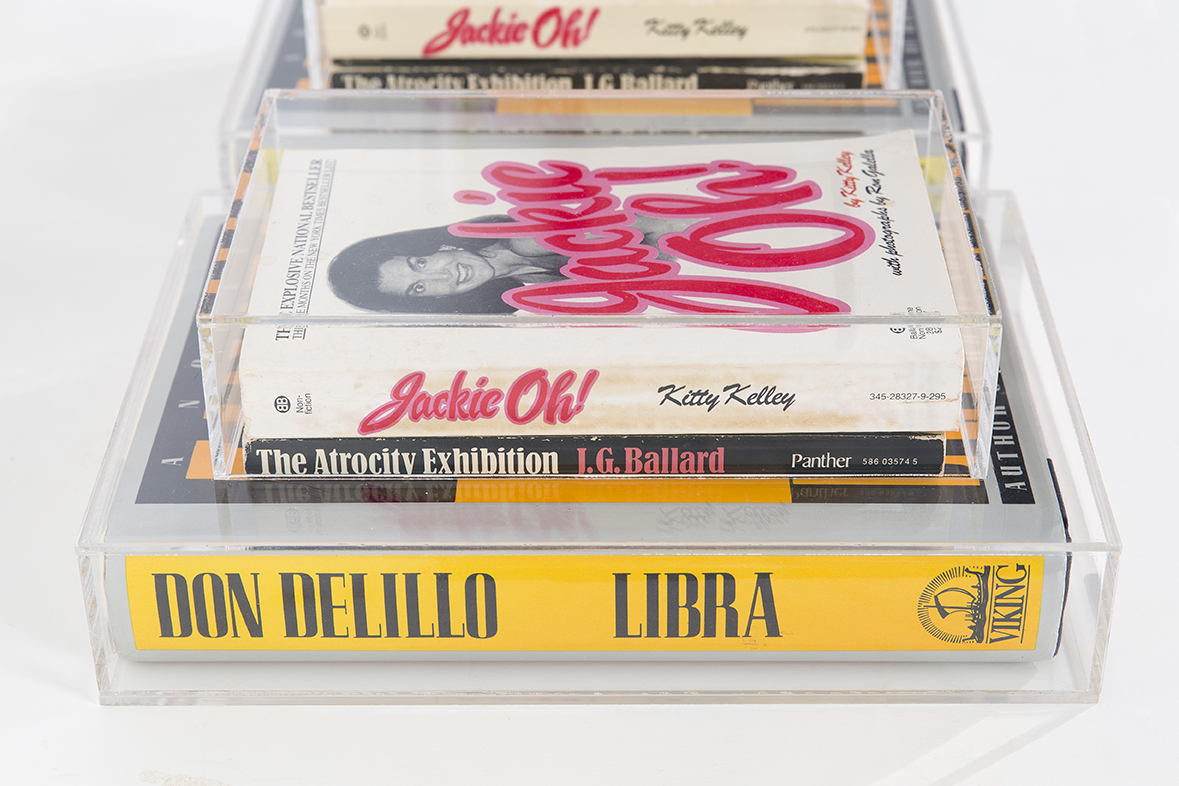
I’m also interested in the coaxing language used by government agencies in emergency situations. Words seeped in Pathos. Phrases that would not seem out of place in the dark between lovers. Control tactics. In order to prepare for this show, I read Maggie Nelson’s, The Art of Cruelty and reread an old favorite of mine, Don DeLillo’s, White Noise.
Di Donato: Nelson seems to dance with the devil, or toe the line between fascination and revulsion with cruelty. Such an interesting read. I see you doing much of the same in your work. There’s a “look/don’t look” tension that makes viewers squirm a bit.
Blair: Yes. We are both uncomfortable, suspended in pain, and yet we continue in our roles. A symbiotic relationship forms between myself and the viewer. The show must go on.
Di Donato: So let’s talk about a modern-day panopticism. How has the internet and Instagram helped shape your work?
Blair: I’m known for my performative online work and social media presence, which employs varying degrees of the real, pop cultural references, and my physical body. This show also references 1970s performance art, such as Vito Acconci’s, “Seedbed” (1972). When I use my body, I typically use it in formats that are critical of the stereotypical male gaze and male ego in art.
Di Donato: What do you think of the term GIRL GAZE?
Blair: I was unfamiliar with the term until now. I assume it means the resulting work when women are the acting agents in their practice, rather than being tethered to the archetypical role of, “muse.” I like Leah Schrager’s term, “Man Hands.” Can my small, feminine hands have one hand on a knife and one hand seductively on my lower lip? Ask me about the scars covering my hands.
Di Donato: What’s up with the scars on your hands?
Blair: I have tiny scars all over my hands because my twin brother, who has special needs, had motor skill and sensory issues as a child and would scratch the tops of my hands because he couldn’t feel things as well and wanted a reaction.
Di Donato: So it’s fair to say you grew up keenly aware to the sensory awareness of others. I can see that as a through-line through “This Is Only a Test.” There’s also an urgency to the show’s title—even though “only a test” seems to imply we’re on the brink of something apocalyptic, like those horrible emergency broadcasts. This goes back to dancing with the devil. Care to elaborate on the implication of exigency in the show’s title?
Blair: I wanted the experience of the show to be both repulsive and seductive. I watched a lot of viewers stay right in front of the printer for long periods of time. It seemed as if they grew to enjoy being watched. They also seemed interested in who I would “focus on” via the images I chose to print. As if they could take part in the voyeurism, themselves. I got a sense of, “Well, at least the cameras aren’t pointed at me for this run of prints.” I also wanted to invoke a sense of panic, which I think was accomplished with the high volume of the looping emergency broadcast.
Di Donato: Who and what inspires you?
Blair: I’m inspired by fighters, whores, and punks. The type of women that were burned at a stake for their ideas. The very women that I share a bloodline with, and my peers. In the art world, those who don’t fake it. The ones who recognize and comment on repeated trends in our collective history. One long record, continually skipping. People that are unashamed to reveal their frailty. Also, book people, people who feel most comfortable around books. I recently had a one-night stand and grabbed the person’s copy of Salinger’s “Nine Stories” and slept with it next to me on the bedside table, as if it could protect me and make me feel some semblance of intimacy in this stranger’s bed. Short list: Richard Prince, Hannah Wilke, Tracey Emin, Renata Adler, Richard Brautigan, Bettie Page, Martin Kippenberger, Russ Meyer, Sophie Calle, and Elvis Presley. Lenny Bruce was the world’s greatest performance artist. I collect rare books, punk albums, vintage smut, and 1950s Red Scare propaganda.
Di Donato: Free association game: In your mind, what’s one incident that connects sex/death/trauma/art?
Blair: The plane that killed Ricky Nelson remains dangling from a ceiling at a tourist trap somewhere in Texas. He was allegedly overheard reciting lines from, “To Have and Have Not” as the plane went down.
Di Donato: What’s your process?
Blair: It varies by the series that I’m working on but I’m always watching and absorbing cultural information. I’m a receptionist by day, so I’m constantly reading and I watch at least two films every night. I tend to focus on one facet of either my personal history, or American history to delve into per body of work. It usually involves collecting original ephemera from that event, and pairing it with words and images that are already in my mind, or collection. Some results of my note taking are visible on my Instagram. I use that as a marker. When resources and funds are available, I have things fabricated. My running joke is that I’ll keep making unseen solo shows until they overrun my apartment and smother me to death.
Di Donato: What’s next for Blair?
Blair: I’m trying to write every day, and currently working on finding funding to publish an artist book titled, “Miss November Nineteen Sixty-Three.” I have also recently finished a new series titled, “Ursula.” Both projects pair American pop-cultural artifacts with personal mythology and tragedy. I think my next self-portrait should be an image of Jayne Mansfield’s car.
You can stay up to date with Erika Blair's work by visiting her website or following her on Instagram. Text and interview by Jill Di Donato. Follow Autre on Instagram: @AUTREMAGAZINE