
interview by Lara Schoorl
portrait by Coco Olakunle
Zippora Elders Tahalele has been designated Director of the Nederlands Fotomuseum effective mid-April, as she is running for Amsterdam’s city council elections, and election day is today, March 18. Currently number 14 on GroenLinks’ list of candidates, a party she joined as a young adult, Elders intends to step up for art and culture in the city and beyond. Her platform is built on inspiring people to use their imagination in every aspect of life, which mirrors her curatorial approach as well. In her most recent exhibition Make Some Noise - Desire. Stage. Change at van Abbe Museum, Elders invites the audience to listen to and sense what moves them (emotionally, physically, socially) in a world full of fractured infrastructures. It does so by presenting work that offers deeply personal methods to amplify voices beyond oneself in an effort to ignite change. Elders was motivated to actively take on that charge at home in Amsterdam after having witnessed and fought cancellation, in addition to the exclusion of programming and dissenting perspectives in Berlin while in her role as head of the curatorial department and outreach at Gropius Bau.
LARA MACARENA SCHOORL: In a conversation we had a few months back, you mentioned that, for you, entering local government felt like a civic responsibility. Can you elaborate on that? And, perhaps, why specifically as someone working in the arts, who will continue working in the arts?
ZIPPORA ELDERS TAHALELE: I’m running for [the Amsterdam] city council, a municipal body that acts as the peoples’ representatives on various topics such as public transport, benefits, youth services, etc. and that checks the mayor and alder(wo)men. Representation is of utmost importance, especially today when so many democratic rights are under pressure. Worldwide.
And, as a curator I hope to emphasize the importance of art, and culture at large, as an inherent part of the fabric that makes up a healthy and happy society. The arts have been highly neglected in the Netherlands, as an intrinsic value to society. Perhaps this is hard to believe for people who live elsewhere, but it is barely mentioned anymore because we got used to it. It all started 15-20 years ago with neoliberal policy changes and the rise of the radical right. You can see it in how, for example, art and museums are secondary programming in children’s education, and how ruling parties call for governmental support for art focused on large, “classic” (their words) institutions, rather than on attempts to extend access to the arts and creativity, both within the city and throughout the country.
Calling the wish to program in socially engaged ways problematic, or pushing it out, is in itself an anti-democratic tendency. We need people from the arts represented in the city council, because they know the work and daily challenges, but they also bring creative thinking, beyond the ruling norm. Art fosters resilience, and cultural workers shape society around us, artists are system thinkers fueling change. With curators, it is even in the name of their title: it is about care for culture and heritage, about channeling creativity and stories, and bridging art to the public. Culture is what makes humans human, so it’s extremely important to not do away with it. Rather, to protect it, to nurture it, and to bring it closer to everyone. If, as many of us as possible can inspire their own creativity, I firmly believe the world will be a healthier and happier place.
“[art] creates connection, but it also creates a critical mindset. It brings poetry to life, and poetry is such a beautiful and wonderful thing: bending one’s mind by challenging language, our everyday tool. Art nurtures the ability to rethink the norm, which will eventually lead to system change. System change is necessary, because we see the world collapsing as it is organized now.”
Selma Selman, Painting on metal (Satellite Dish). Installation view Make Some Noise - Desire. Stage. Change., Van Abbe Museum, Netherlands, 2026. photograph by Peter Cox
SCHOORL: About a year ago, after the 2024 US presidential elections, my family and I moved (back) to the Netherlands from Los Angeles. This was partly a political decision, although globally, here as well, the political climate can feel eerily homogenous. Yet, while current global political actions feel so visceral and close, they seem to remain so intangible. Can you speak more to how you see the relationship between local politics to national and global politics. Or rather how would you wish for local politics to create connections to change beyond their immediate environment?
ELDERS: For international context, it is important to know that the past few years, the Netherlands had a very right wing-oriented national government, while Amsterdam remained a more green and social leaning city. Local governments can, to a certain extent, balance and compensate what is decided nationally, and therefore act as models for possible alternatives. For example, against the current call for criminalization of those not having documents.
Municipalities [in the Netherlands] have agency, they can make certain decisions by themselves. Not everything has to follow or be run by the national government; there can be nuances. As such, local governments can show that alternatives to the inhumane, oppressive forces of this moment are possible. Many right-wing politicians currently show their way as the only, and “necessary, reasonable” way to carry our world forward. What I think is necessary and common sense is collaboration. I stand behind a collective and communal mindset, rooted in multiplicity rather than singularity. One in which we prioritize taking care of each other, including the planet and our fellow inhabitants of the planet. In the end, it is about how people live their life; I believe that lives lived healthily—emotionally, politically, environmentally and collaboratively—sustainably and positively influence society at large.
SCHOORL: Leading up to this conversation, I have wondered if, or how, a conversation about local politics in Amsterdam might be of interest to a readership elsewhere. And simultaneously, how inclusive the conversation in Amsterdam is, for those who may not speak Dutch. While I understand that Dutch is the default election language, is there something in particular you might want to share with an audience that is more comfortable in English?
ELDERS: I’m a city council candidate with GroenLinks. This is the last election for which GroenLinks will exist as such and that you can vote for it as an independent party. Over the course of 2026, we will merge with PvdA. I would say GroenLinks’ objectives are close to other green parties internationally: founded in a strong progressive, climate-oriented, social base. It has a long history with social values and also is the outcome of previous party fusions in 1990. GroenLinks is rooted in a strong sense of solidarity that believes in progress and change from a climate and increasingly also a planetary perspective. In Amsterdam, our current focus is on resistance, hope, and change. I think that is extremely important, to encourage and to stimulate people, especially young people, to make themselves heard, to be active in society, and to be able to think independently from Big Tech, algorithms, and other paralyzing tendencies. We have to continue to include our own feelings, our own visions, our own creativity in our lives, but also in politics. Free expression is essential in a democratic rule of law and there is a technological dimension to that as well.
Jack O'Brien, Semblance. Installation view Make Some Noise - Desire. Stage. Change., Van Abbe Museum, Netherlands, 2026. photograph by Peter Cox
SCHOORL: In a recent interview by Yuki Kho, you said that “societal engagement and love for art go hand in hand; everyone lives with art and creativity.” Do you think that art can make a difference, politically? Personally, I believe that art can heal, help process, mourn, it can be a form of therapy; and if it can bring on change it may be by its possibility to share perspectives different from what one knows or has experienced, therefore making alternatives visible.
ELDERS: Absolutely. I hope we can also do that beyond the commercialized versions of “self care” and individual lived experiences. Art shares other interpretations, stimulates one’s own imagination, and encourages us to deepen our interest in frameworks; perspectives we don’t know yet. It creates connection, but it also creates a critical mindset. It brings poetry to life, and poetry is such a beautiful and wonderful thing: bending one’s mind by challenging language, our everyday tool. Art nurtures the ability to rethink the norm, which will eventually lead to system change. System change is necessary, because we see the world collapsing as it is organized now. It is very important that people also vote in local elections, including the internationals living in Amsterdam. It is our capital, Amsterdam is for all of us, and we all contribute fresh and valuable visions that bring forward multi-perspective thinking and hopefully more health and peace.
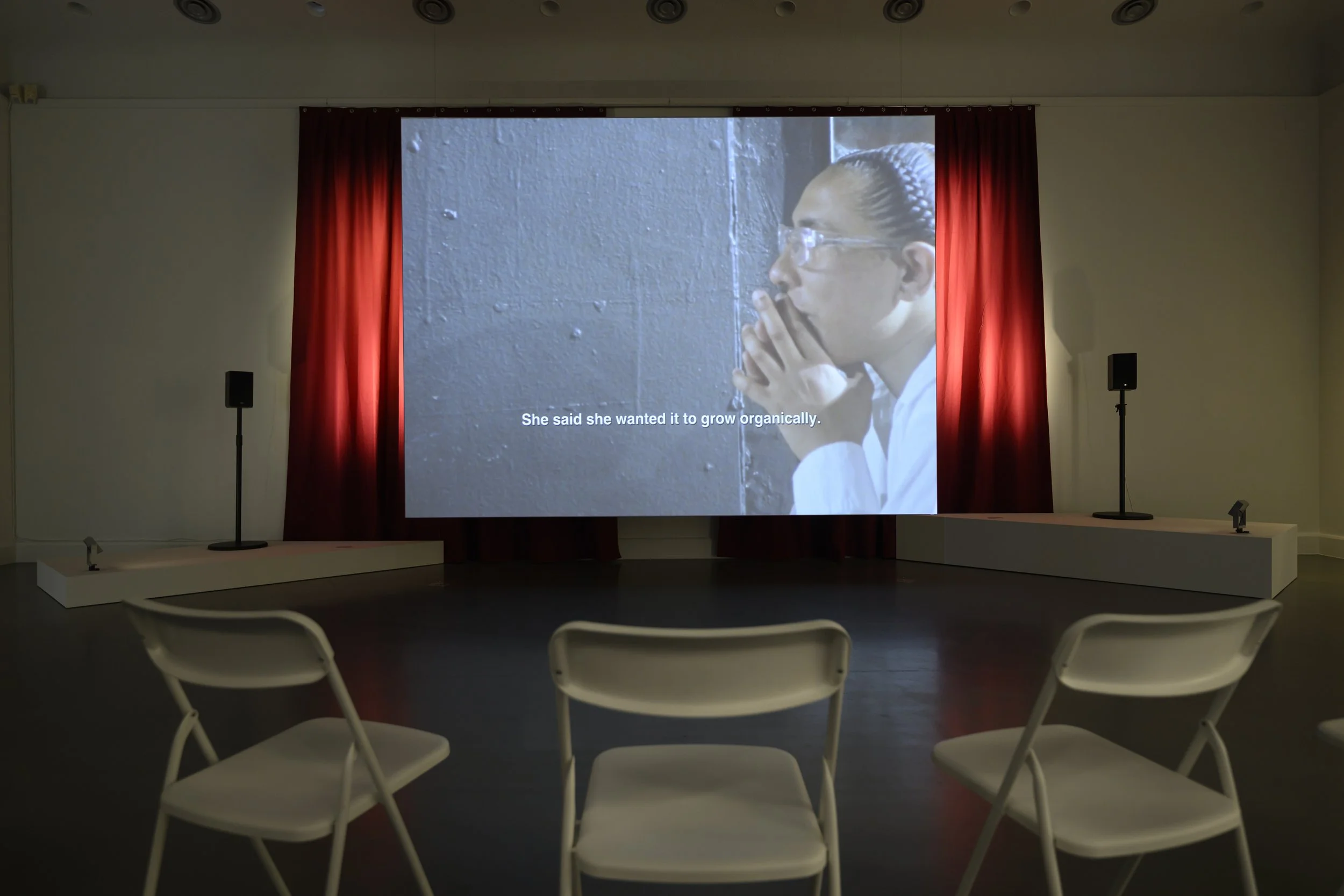
Calla Henkel and Max Pitegoff, New Theater Hollywood. Installation view Make Some Noise - Desire. Stage. Change., Van Abbe Museum, Netherlands, 2026. photograph by Peter Cox