
“He must have had a really bizarre experience. He was sitting on his porch watching the movie of his life.”
interview by Poppy Baring
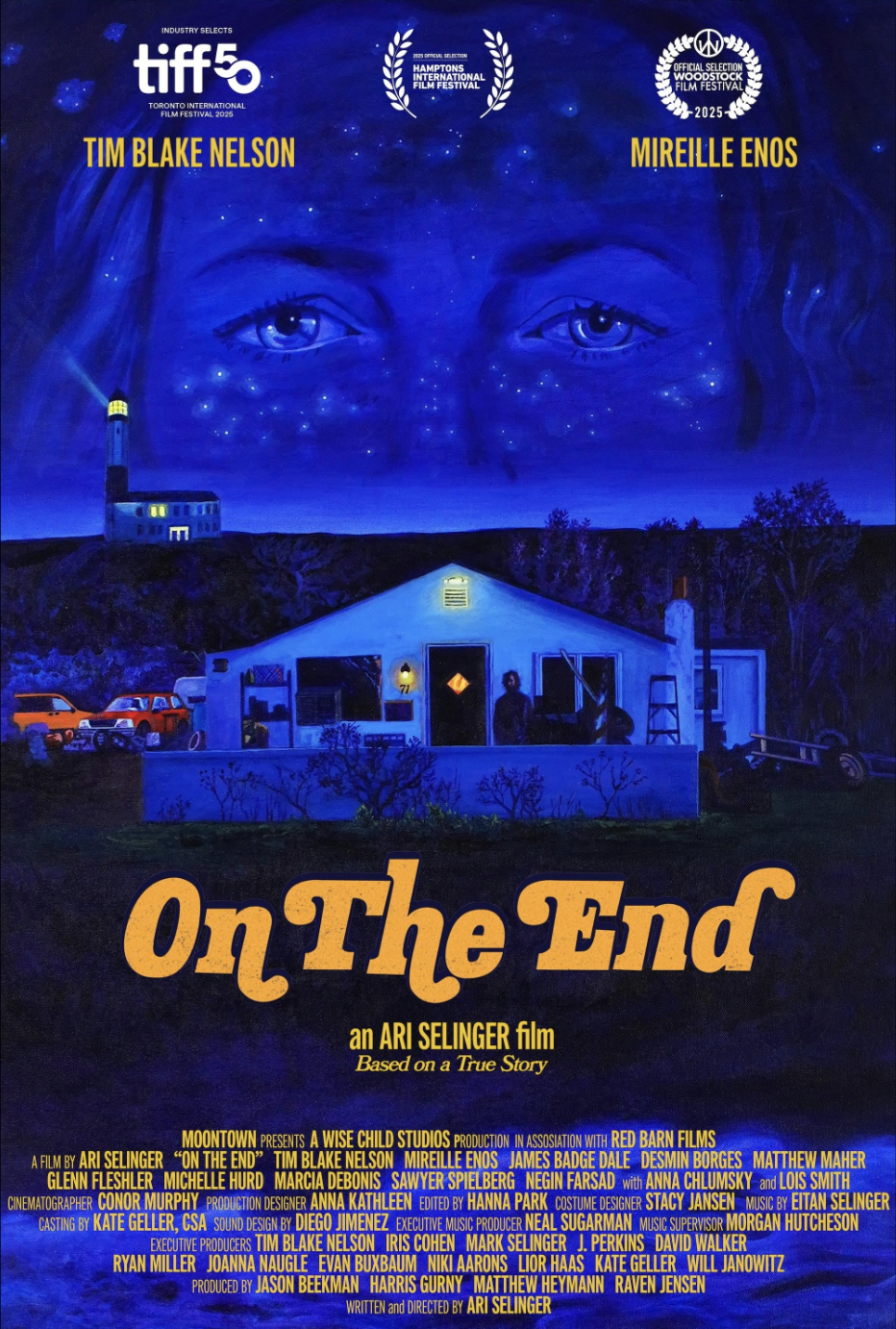
On The End, directed by Ari Selinger and scored by Eitan Selinger, tells the story of Tom Ferreira, a mechanic living in Montauk at the end of the glamorized Hamptons town. The film, which is heavily based on a true story and was made within feet of the home that inspired it, is a highly emotional chronicle of a contestable yet ultimately good-hearted man being bullied by property developers. The film not only reveals issues of greed and corruption, but it also tells the story of love and loss between Tom and fellow outcast Freckles. With local actors Tim Blake Nelson playing the former and Mireille Enos as the latter, a certain intimacy with the community lends the film a sense of sincerity. In this interview, Ari Selinger and his brother Eitan Selinger discuss their fraternal dynamic, their choices behind the score, and they reflect on the real Tom who inspired the film and passed shortly after it was made.
POPPY BARING: Eitan, you once said it was always a dream of yours to work with your older brother. How does that dynamic make your job easier or more challenging?
EITAN SELINGER: I’ve always been used to Ari being the boss. We grew up together playing music, and we have the same taste in music pretty much, so it was easier to know where we wanted to head with the score. Where it was tricky was that he had the freedom to call me at any time, and I couldn’t really be upset about that. It was extremely involved, which is a good thing and…I wouldn't say it's a bad thing.
ARI SELINGER: The grandmaster plan was to get this kid to play music and use it to my own abilities. I always wanted him to be part of that artistic arc that I long to build, and where I knew there was always gonna be enough space for tons of people.
BARING: Were there moments when something you felt strongly about including was fought against?
EITAN: Ari always gave me the freedom to push my own ideas. I was more in love with the idea of making the soundtrack organic in a way where I could have non-instruments, household items, even car parts. I wanted to get very rhythmic with it. I maybe went too far with that, and Ari wanted me to do a bit more on the nylon guitar and find more melody, but we met in the middle.
BARING: Did you end up using those sounds from car parts?
EITAN: We did, actually.
ARI: During some of those scenes where you want to have a sound that’s ineffable, we had Natalia Paruz come in and play a saw in the subway of New York. She played it on the Coppola movie [Megalopolis] and Joker [Folie à Deux]. It's saved for some of the more cerebral moments.
BARING: When you first read the script, were there any songs that you immediately knew you wanted to include?
EITAN: Ari always knew which songs he would pull from. With the score, there were certain scenes that, in order to keep everything cohesive, it was tricky. The first sex scene was originally very erotic music and jazzy, and we couldn’t figure out what would go there, but after a while, we took the music from this song that I wrote called “Run the Show,” and it shone in the movie, which was a nice surprise.
ARI: It’s kind of an anti-sex scene, so we needed something saucy, but also more about the heart. We ended with this very folksy sound, taking his lyrics and just playing them on a nylon string guitar. I really love nylon string, like the way Willie Nelson plays. It reminds me of honey or vanilla, just something very, very sweet and textural.
EITAN: We discovered that different strings and instruments fit different environments. For the scenes outside, nylon worked better, and we stuck to that, then when we went inside Tom’s place, it was grittier, the way that steel string is.
BARING: There were two songs you spoke about after we came out of the theater. The first song that opens the film, and the second one, which is called “Long Black Veil.” What was the significance of those?
ARI: This was how I got Tim Blake Nelson on my side. He’s such a music guy and on one of our first calls, I was telling him the reason I had the narration; I wanted the audience to feel like Freckles is holding your hand throughout the movie, maybe throw you off a little bit, but when I brought “Long Black Veil” up to Tim, he was like, “Oh yeah, I love that song. That song’s written by…” and I knew it was Marijohn Wilkin, very obscure, and he suddenly liked me after that.
That song, it’s like the American Beauty thing, where Lester is describing his last day, and you’re thinking, what does he mean by that? You find out at the end what he means, but because of that, it has this eternal quality, because he’s presenting you the story. It’s like a skeleton telling the story.
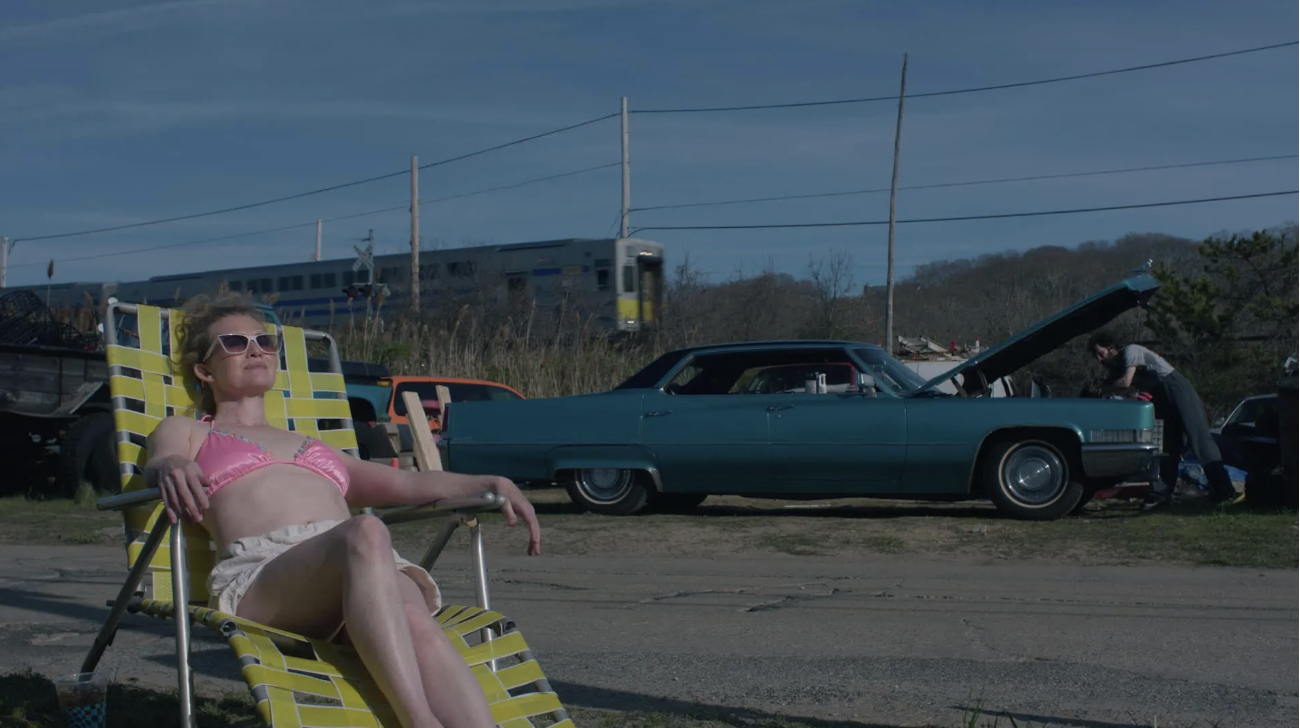
Mireille Enos and Tim Blake Nelson in On the End
BARING: You filmed it in a house that was a few doors down from Tom’s real house. Was that environment all a product of the set design, or was it equally as cluttered as the actual house?
ARI: We were gonna shoot at his house, which didn’t need any production design; it’s one of the worst-looking houses you’ll ever see, but he had a little bit of a meltdown, and we had to find another spot. My heart was set on shooting that street, and there was a house that was bought by the town and was set to be knocked down a month before we shot. We went to the town board and asked to use it as our canvas. My production designer, Anna, then decided to bring all of Tom’s nicest crap to the yard, which was probably less than 50 yards, maybe less from where Tom’s house is. It was by design, but also with the actual junk that the town wanted to remove. They then knocked the house down a little after we shot.
BARING: What does the actual house look like now?
ARI: Because people need places to stay during the summer, and because Tom had very cheap housing at the side of his house, he took on tenants every year. When he died, the tenants who loved him so much stayed to take care of his brother, Milton. They stayed and cleaned the place out. It does not look like the same place, maybe it does a little bit, but they got rid of years’ worth of hoarded junk. I shot a movie there in 2011, that’s how I met Tom, and it was dangerous just to walk in there, you would be like, somebody's gonna lose a limb.
I don’t know what this was, but a couple of days before he died, he was like, “I’m gonna order some dumpsters and clean the place out.” He never got to do it, but at the very end of his life, he was like, I’m gonna do it, which I think is very poetic.
BARING: When people started taking stuff out of his house to transport it to where the film was being shot, did he protest against parting with his things?
ARI: He probably did. There are two things. One, he knew he was gonna get it back, and the other thing was he was very sick right around the time we were filming. I believe he had a stroke, and he was not fully cognisant of what was happening when we were actually shooting.
I will say this was his idea to make this movie. He was the one who bothered me to make it for the longest time. I think he also felt bad that he bailed on letting us use this house. It was a little bit of those two things.
BARING: Do you think it would’ve been possible to make the film if it weren’t his idea?
ARI: It never would’ve occurred to me. I had no interest in the town politics of the Hamptons. That is not what I find interesting. I found him interesting. I loved him a lot, even though a lot of people did not. It was like South Park. He just made fun of literally everybody and was mean to everyone, and he got a pass for it all. Everybody thought he was an asshole, but his intentions were beautiful and clear. He let us shoot in his backyard; he didn’t even ask for money. He had that goodness in him. He may not have been the prettiest book cover, but he lived something that was very genuine.
BARING: The love story is extremely sad. Were there ever times when you were wary of making the film in such close proximity to him and his house? Did you ever think it was potentially too close to home?
ARI: I worried sometimes that he would stop talking to me, because he was very sensitive about his teeth. Other than that, there were no barriers or limits at all. His daughter told me after he passed that he stayed alive for the movie. He almost died in 2020, and she told me he was sticking around so that he could see this happen.
EITAN: He must have had a really bizarre experience. He was sitting on his porch watching the movie of his life.
ARI: Honestly, it was a surreal experience for me just to make it. I can’t imagine what his mind was doing while watching us tell his story and having a bunch of little people just running around, setting up lights.
BARING: Are you guys both still in contact with his daughter, and when did their relationship improve?
ARI: Through the movie. He told her for years, “Uh, they’re making a movie about me.” I think it was his way of being like, I’m virtuous enough for there to be a movie about me, and then he sent her the script, and I think little by little she was like, I guess he’s not BS-ing me.
She called the day after he died and was like, “He was an idiot as a dad, not a bad dad. He didn’t do anything wrong, but he would bring me to the bar so he could pick up chicks.” I was like, “Ooh, Michelle, that’s bad,” And she was like, “But you know, his love language was all twisted,” and I think she really connected with him towards the end.
BARING: Do you ever think you’ll go your separate ways and stop working together?
EITAN: No, never. This was the whole plan.
BARING: As in you’re always gonna work together on each other’s projects.
ARI: Oh, yeah. If he lets me.
EITAN: I’m still trying to get him in the band. I still have a belief that it’s gonna happen. The first class I took at Berklee College of Music, they asked, “What do you wanna do? What is your dream?” I said, “I wanna make music for my brother’s movies.” It’s very exciting to do with Ari, and I think we’ll always do it.
ARI:We’re like the Partridge family. We’re the beach boys.
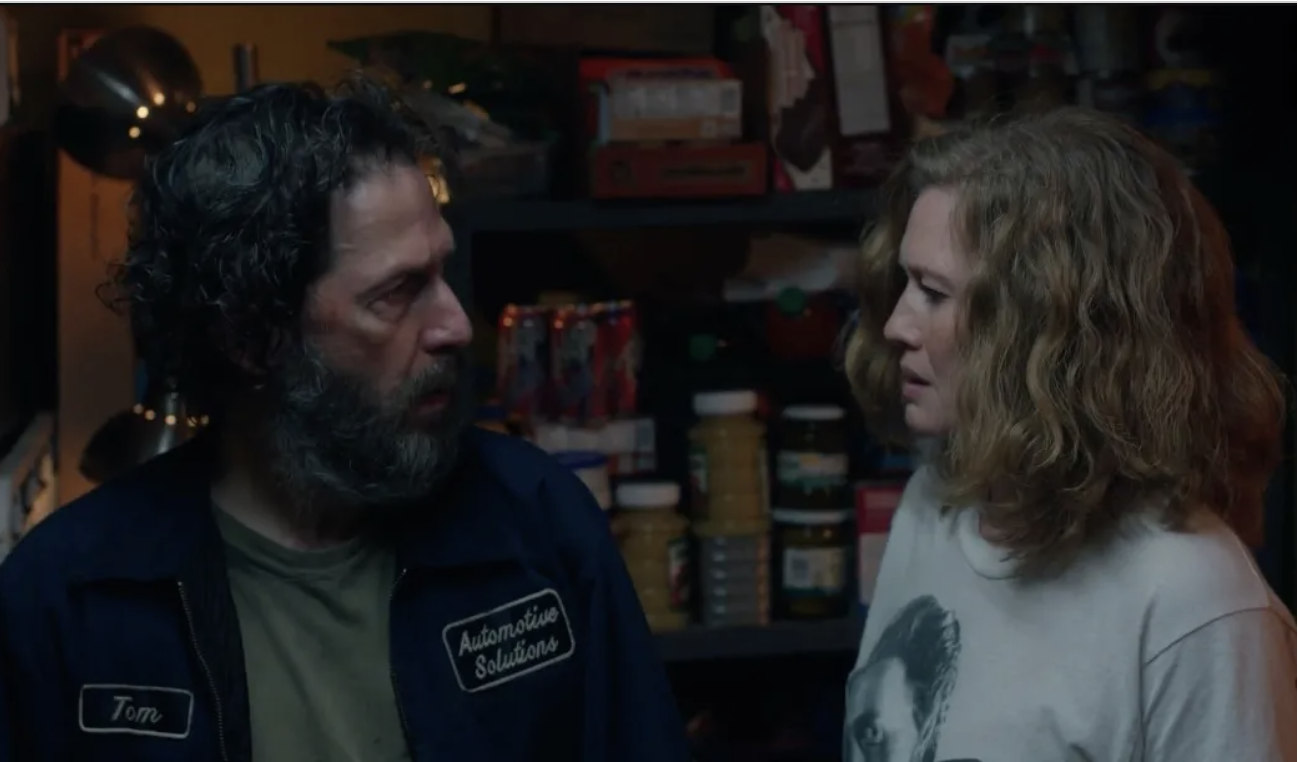
Tim Blake Nelson and Mireille Enos in On the End