
Nayland Blake
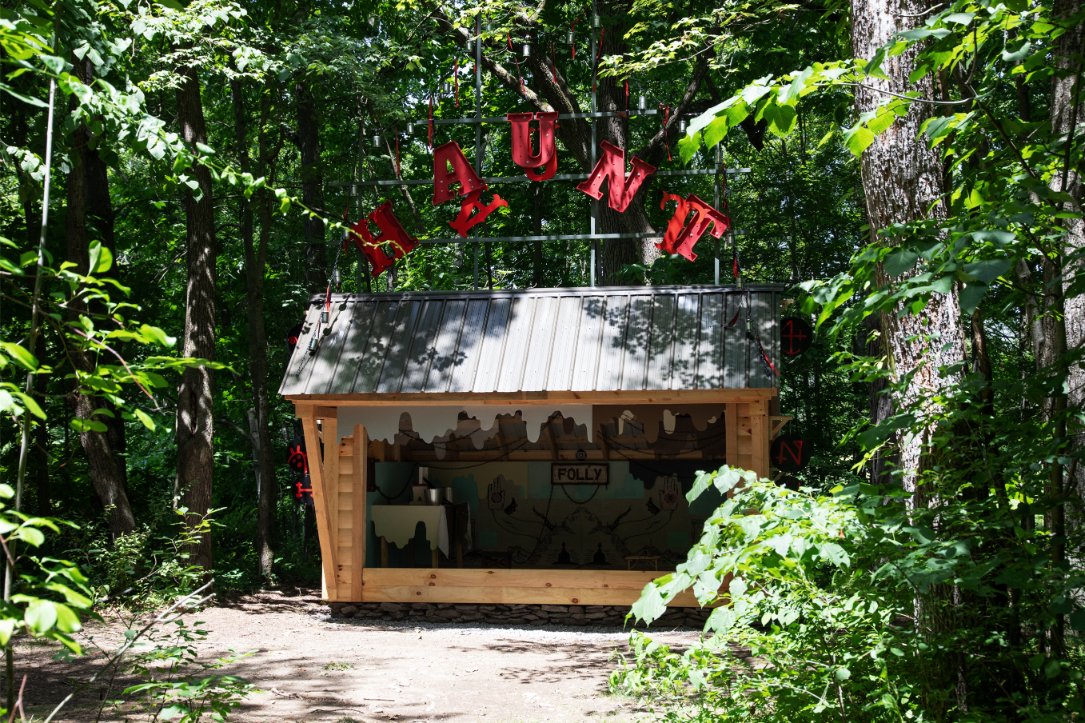
“Haunt”: Being the Folly of One Victorya Spectre, 2026
Courtesy Nayland Blake and Art Omi
interview by Emma Grimes
Across decades of practice, Nayland Blake’s work has explored identity, desire, power, and subcultures while posing incisive questions around freedom, bondage, gender, shame, and the complexities of human relationships. Born in New York City, Blake attended Bard College before earning an MFA from CalArts in the 1980s.
Blake’s newest work, Haunt, premiered at Art Omi on June 27. Marking their first outdoor installation, the work draws inspiration from the figure of the ornamental hermit—a historical practice in which wealthy landowners hired men to live in seclusion on their estates for years at a time. With Haunt, Blake continues their ongoing investigation into how discourse and exchange can take place beyond the limits of the white cube.
GRIMES: This was your first outdoor installation. How has preparing for this setting influenced what you wanted to make?
BLAKE: I had been out to Art Omi before. I came out for Pippa’s [Garner] show, so that was my first time going around the space. When Sara [O’Keeffe] proposed doing something, I was a little panicked, then thought about it some more and was really thinking, okay, I like the idea of the less-trafficked space. I’ve always been really interested in the parts of the space where you can make meaning where it’s not normally expected. It’s often the overlooked spaces that become the refuge for marginalized activity. I was wondering if there’s anything like that around Art Omi. So, we started looking around at potential sites. While we were doing that, I was rolling over a number of ideas in my head because I’m generally not much of an outdoor person. I was like, okay, I don’t want to make something that just seems permanent. How could I make something that shows its age over time? I’ve always really liked dark rides at amusement parks and ghost houses. There’s something about going on that subterranean trip, even when they’re not very convincing. Then, other pieces began to come together as I was thinking about different sorts of ruins or grottos. I began thinking about grottos in English gardens and the ornamental hermit thing. It all relates to decay and things that are falling apart.
GRIMES: How long will the installation be there?
BLAKE: It’s up there for five years.
Nayland Blake
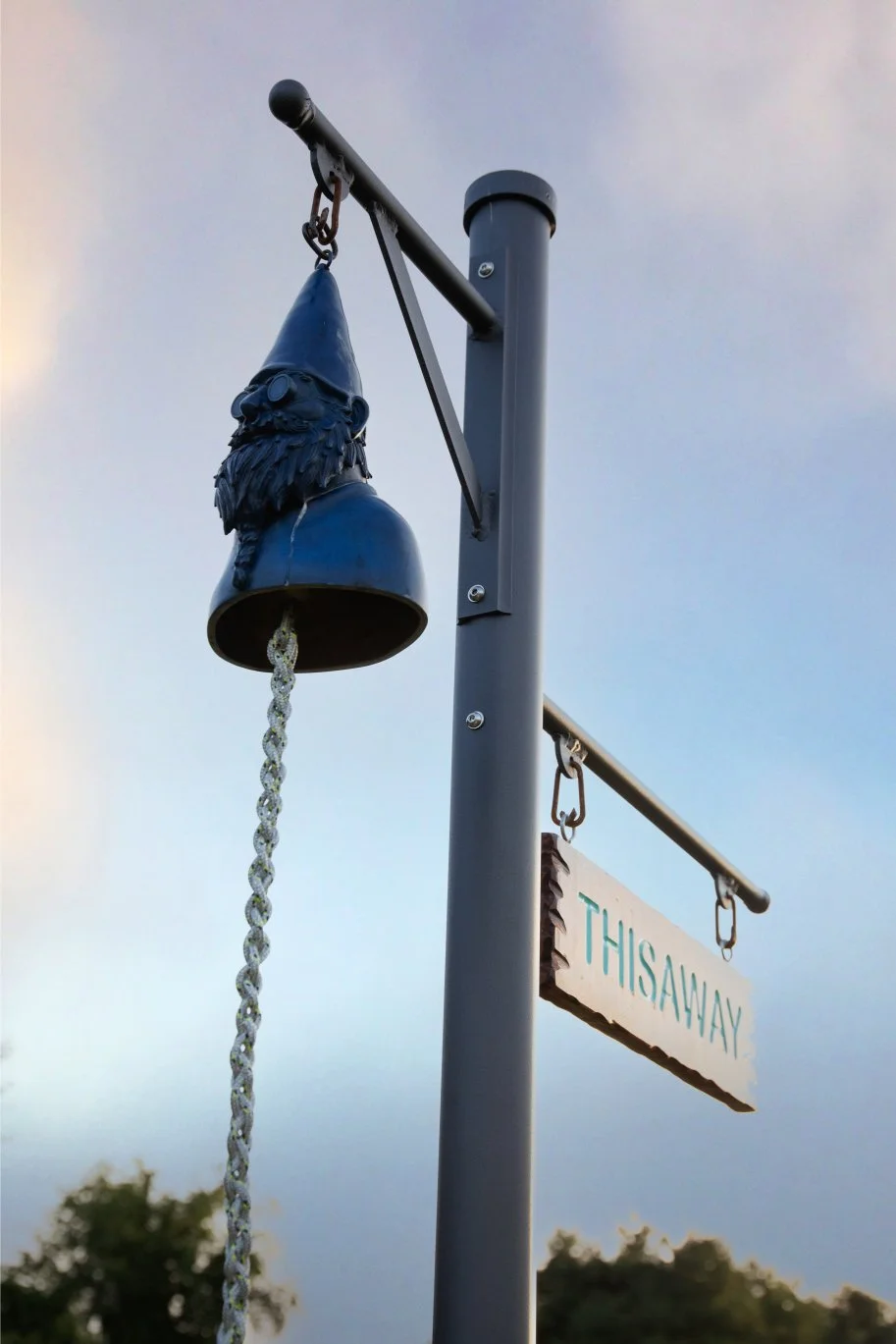
“Haunt”: Being the Folly of One Victorya Spectre, 2026
Courtesy Nayland Blake and Art Omi
GRIMES: You told Hyperallergic that Haunt is about your “desire to be a crone. A different kind of invisibility.” Can you expand on that?
BLAKE: When I think about feminine archetypes, I’m not really drawn to youth. I love seeing older folks who are at home in their bodies and at home in who they are. Thinking about a crone as somebody who’s satisfied with where they are, and exploring the power of that, but not necessarily power over other people. It’s also thinking about obscurity; the possibilities of obscurity, and what we can do with that. I think we’re living in a time where the assumption is that you want to be a star. That’s the only role that’s possible—that you want to be on center stage and exercise a kind of power of attention, right? I really like the stuff that’s percolating under the surface. I like the fact that there would be aspects of what I do that would not be immediately apparent to people, but that they could find. For this next phase of my life, I’m starting to explore stuff that I don’t know definitively yet. My work has always been a vehicle for that exploration. It’s not necessarily about putting it at the center of the art world, but about wanting to be in this more peripheral state. I think a lot about Agnes Martin in her latter years, living in a double-wide and just painting out in the Southwest. Just there, painting in a matter-of-fact way and not in a showy New York way.
One other thing I will say about that: I like how this piece is going to be up for five years, and I intend to go back and work on it and add stuff over that time. It’s my little alchemical lab that I can think about and inhabit in this weird, nest way. I don’t know where it’s going, or where my physicality will be going, or where my emotions are going in relation to it. I'm grateful to have the opportunity to have something that's a vehicle for that, as opposed to having to make a definitive statement about it and then present that to people.
GRIMES: I wanted to ask you about living in uncertainty. You’ve talked about creativity being a necessary habit to form so we can create and imagine a better future. We’re living in a political climate with nostalgia for an idealized past. I’m curious how you understand this widespread craving for certainty.
BLAKE: Because people are in fear. What we’ve learned is that we’re stuck with a generation of politicians who have no interest in governing but a great interest in just manipulating people through fear. Their conception of what human society could be is limited and inhumane. But what they offer people in the midst of their fear is not, okay we have to think through this together. This is a complex situation that wasn’t born overnight, and it will take all of us coming together to solve it. Instead of that, they’re like, This is the answer. Whatever we’ve done, we’re right. We’re never wrong. Trump cannot say that he did something wrong, even for something as stupid as hiring the wrong guy to deal with his pool issue. He can’t even say that. He can only say, no, no, no, somebody else fucked it up. It’s not me. That’s been his entire business career. It’s been his entire leadership style. It’s to fuck things up and blame somebody else. And to offer the certainty of the denial as a way of reassuring people that things are okay, which is cowardly.
The only alternative is that we have to connect to our creativity. But creativity is a twin with doubt. You can’t make anything meaningful without trying something and being like, Let me see if this works. How does this feel to me? How does this feel to you? If we disagree about it, what are we going to do about that? Maybe there are things that we disagree about, and we’re both right. When that happens, how do we handle it? How do we let those differences coexist? I think it is a process that people are frightened of because it means that they have to be vulnerable. When you’re confronted with authoritarians who get up every day and decide who they want to hit, everyone spends all their time worrying about whether or not they’re going to get hit, which makes it nearly impossible to be thoughtful and engage in doubt and to find a solution that isn’t an immediate solution.
The idea that there was a better time is very seductive to people. In some ways it’s always an appeal to childhood. There was a time when I didn’t have to worry about this. When I didn’t have grown-up problems. When I could just say, I want a national fair for my birthday, and I want rides, and it just appeared. There’s a mournfulness in being an adult with agency who has to think about their role in solving intractable problems. Racism is pervasive and has gone on for so long that there’s no way you could just be done with it. There’s this idea that we didn’t have racism until Black people started talking about it, let’s go back to that. When I was a kid, I didn’t have to think about it. But you were a white kid, so yeah, you didn’t have to think about it. If you were a Black kid, you would have had to think about it. I lay the blame for a lot of this at the feet of Reagan. Carter was, to me, the last American president who said that there are times when the moral right in the world is not the same as the desires of the United States, and we have to deal with that. Reagan got rid of him by saying, I see no problem there. We’re always right. Reagan’s style was so successful that it became the template for every presidential candidate after him. And thus we’re stuck with it. This notion that there was a time before we had to be adults and think about other people’s actual feelings, and the consequences of our actions.
GRIMES: Speaking of the need to be creative, can you talk about Victorya Spectre? Who is she?
BLAKE: Victorya Spectre used to be Victor Spector, who had a short-lived career in the adult film industry, and then started to live as Victorya. The name is spelled with a “Y” because it’s about victory and about triumph. It’s also about ghosts and the ways in which, as we age, we feel less like the central character in the places we go to, and the pleasures and pains of being ghostly, in that sense—being not really recognized as hot, not recognized as desirable or meaningful. Victorya was born out of the folks that I used to see around New York and San Francisco, who were characters, eccentrics. There was an amazing composer named Moondog, who basically lived on the streets of New York. I remember seeing him on occasion as a kid.
He had a leather cowl with horns coming out of it. If you look him up online, you can find him. I think a lot about Ms. Colombia, who died not that long ago. She’s a really amazing person who would appear at every Pride event in an incredible, gaudy outfit. There’s a pair of famous twins in San Francisco, and going further back in San Francisco, there was the Emperor Norton. People whose presence in the urban space was this fantastical character who didn’t capitalize on it. This is who they were, what they did. To me, they’re a reminder of the possibilities for how you could live your life as a spectacle, but also just as a spirit that inhabits the streets, inhabits other people’s lives in a way that isn’t trying to sell them something. You’re there as an example of a possible way to be. That’s something that has really been stamped out in typical urban spaces. Nobody makes an effort anymore. Most people are dressed in a way that is so bland, or so unconsidered, or safe.
Victorya has also become a way for me to assert more of a femme identity. I’ve been thinking a lot about famous bearded ladies and asserting that identity in a very clear understanding of the gender that I was raised within. But also thinking about how we scramble those signals. How do we engage with the full range of our gender? What does that mean for us going forward? The thing about this piece and most of my work is like, on one hand, I want to make a goofy thing. For me, the goofy things are also the sexy and funny things. They’re also the gateway into the ways in which we think about our presence in the world, and the kind of marks we want to leave, or the people we want to honor. What’s nice about getting this chance to return to Victorya is that it’s opening up new chapters. We’ll see where those go.
GRIMES: You co-curated A Different Life in 1995. In our current political climate, how would you approach a show like that?
BLAKE: I really feel like the curatorial strategy that we engaged in in A Different Life still holds today, which is that we started from the works of art. We started from particular objects that we wanted to see in dialogue with each other. Then we built out the ideas in the show from the connections that we saw between those objects when they were in alignment. It’s the only real way that I know how to curate—I’m not a trained curator. I’m just somebody who’s been lucky enough to be able to do it for thirty-something years in a bunch of different contexts. To me, shows fail when they start with an idea and then come up with a list of artists who fit that idea, and then go and get a piece of work from those artists. The thing that’s interesting about curating is seeing objects in relation to each other. When I curated the show last fall at Matthew Marks, it was really about like, I have some ideas about these things, but I want to see these things in dialogue. I want to see a Betye Saar box in dialogue with a Joseph Cornell box.
I want to see that in dialogue with a Lucas Samaras box. I want to see these particular pieces next to each other and see what they spark off each other. That’s ultimately the approach I would take, thinking about that show today. We were hoping at the time that that show would really spark a whole range of shows, and I feel like it kind of did, but not for at least ten years. What’s interesting to me in relationship to that show is that we thought it was really going to build on this momentum, go in a bunch of different directions, and then other shows would come out in response, but it really took at least a decade before that got taken up.
The other thing about curating right now, and I’ve talked to Sara [O’Keeffe] about this, is that we need more regionalism. We need people to really think about what’s happening in their backyard and to make art spaces in different locations that are distinct from one another. This idea that there’s a bunch of artists who need to go everywhere is uninteresting. Particularly in an era of social media, where you see these barrages of images all over the place. I want to be able to go to Hudson and find out what’s happening in Hudson. I think there needs to be more of that.
GRIMES: You work backwards. I was watching a lecture, and somebody asked, “What does the rabbit mean?” and you were like, “I don’t think about what I’m trying to symbolize and get the object. I start working with the object, and then I go back.” It’s like what you said about curating: you find the works first…
BLAKE: …and then there is an idea there. Because the idea that emerges is not what you would have thought of at first, and that’s where you actually learn something. For me, the luxury of curating is that I get to learn something. It’s the same with making this piece here. Don’t tell folks (laughs), but I’m getting away with starting my crone training by making this commission. But I mean that’s what it is. I don’t know what that would mean for me. We’ll find out over the coming years. I would say, finally, I want that luxury for everyone. I want everybody to have a working method where they can learn about something through the work, instead of having to decide what something means, turn it out, and get it out into the world. I want all of us to be able to investigate and grow through making something.
“Haunt”: Being the Folly of One Victorya Spectre is on view through January 10, 2027 in the Newmark Gallery. The exhibition in the Sculpture & Architecture Park is on view until the fall of 2030 at Art Omi, 1405 County Route 22, Ghent.