
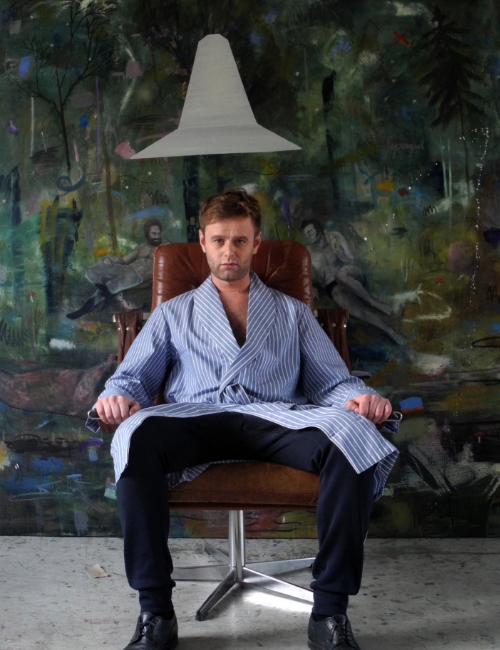
text and interview by Oliver Maxwell Kupper
Viennese artist Phillip Mueller’s art is mythical, fantastical and deranged. It exists on a plane somewhere between Hieronymus Bosch splashed with modern pop references, Thomas Kinkade on acid and a print out from your brain of a recurring nightmare. However, there is also something so sweet, alluring and romantic about his work. Mueller, whose solo show opens tonight at Carbon 12 Gallery in Dubai, is a genuine painter and he is studious about his work. In a world devoid of figurative meaning in painting, Mueller uses his paint and brushes almost like a protest, and the depth of his work is a war against contemporary’s artist stodginess. His current exhibition in Dubai, entitled “Dreams In Blue. The Year Phillip Mueller Didn’t Wake Up,” is described as a “dream-inspired road-movie.” One of my favorite pieces by Mueller is a portrait of Byron holding a pack of cigarettes, wearing camouflage and a pope hat – it is painted on a surfboard, which is a regular platform the artist works on. In fact, the surfboard isn’t just a medium, it is yet another piece of the puzzle and symbolism for the artist’s seemingly voracious desire for freedom and rich excess. Rich, not in the sense of monetary wealth, but rich in the sense of life. There is a distinct vitality in Mueller’s work that spills over the canvas edge like an orgy. We got a chance to speak with Mueller shortly before Christmas, when he was still working on his current exhibiton at Carbon 12 Gallery, to discuss his practice, mythology and his desire to get back in the studio and back to work.
Oliver Kupper: When did you know you first wanted to become an artist?
Philip Mueller: I never wanted to do anything else. I was painting my whole life. When I was 8-12 years old, all of the other boys went to play soccer, and I had painting lessons at the studio. I had lessons from a Croatian painter. I was always painting.
OK: Did your parents support you as an artist?
PM: Mostly my father did. My mother didn’t want to see me as an artist.
OK: Why’s that?
PM: She was scared I would always be broke, you know? I wouldn’t be able to feed my child.
OK: Your work deals with a lot of allegory and mythology. Where did your interest in mythology originate? Why does it play so heavily in your work?
PM: It was always interesting for me. It’s an imminent level. There are so many strong stories and strong figures. You can tell these stories for the next ten thousand years, and it won’t get boring. You can see all these stories in our contemporary life too.
OK: You can turn to them to find answers, or to figure stuff out.
PM: They exist because of explaining life and humanity.
OK: I want to talk about some of the mediums you use. You use surfboards, which is really interesting. When did you first start exploring the surfboard as a canvas? Have you ever gone surfing? Vienna is kind of far away from surf culture.
PM: Actually, near Vienna there is a lake that is quite big. It’s a well-known place for windsurfing. About 4 to 5 years ago, I bought a windsurf board and started to paint on that. Since the late 50s and early 60s, the surfboard has stood for absolute freedom. It’s also a myth for freedom. It fits on this narrative level.
OK: Freedom seems to be a major theme in your work. Would you say that freedom is one specific theme that you’re chasing? Is there any specific theme that you’re chasing in your work?
PM: Not only in my work, in my whole life. I’m looking for freedom in everything.
OK: When you conceptualize a work of art, what is that process like? Do you have visions that come to you? It seems like there’s a lot that goes on in your mind before you put paint to canvas.
PM: There are these stories, and I can talk about them. Then, there is a sketch. The canvas is like a playground. It’s like playing. It has to be playing from the start, in the end. Otherwise, it would get boring. It’s very important to have storytelling, but it doesn’t completely inform what I’m painting. Colors, structures, figures—they all come together during the painting. The longer it takes to finish a painting, the more complex and interesting it gets, for myself. When I think it’s finished, I sit in front of it. That’s the part when the painting tells me what I have just done. The work reflects when it’s done. It’s a very exciting moment.
"There’s a lot of stuff that has to be done. I get really depressed if I haven’t painted for more than three days. Last week was tough because I barely had time to paint. Christmas is coming and I hate it."
OK: You apprenticed with Hermann Nitsch. We did an interview with him, actually. He’s amazing.
PM: He’s fit at the moment. He’s strong again.
OK: Yeah, he seems like it. I still owe him some California wine. What was it like working with him? What kind of impact did that have on your work?
PM: I was working with him at the Castle in Vienna where he lives and works. Normally, his assistants are working for him for 5 to 8 years. I quit after 1 ½ years because there was no time for my own work. Still, I think that time with him was very important for me. He’s one of the most intentioned and sophisticated artists I know. It was also quite heavy. It was good to see this industrial, factory kind of working. I learned things that I would have never learned at university. Creating exhibitions, dealing with art dealer and collectors. It’s quite romantic. There are lots of animals there. In winter, it’s like a Nazi movie.
OK: It’s like a fairytale.
PM: Yeah. Actually, I met him five days ago. He looks good. I didn’t see him for a while.
OK: He seems reinvigorated by something. Maybe more people are appreciating his work.
PM: Yeah. There was a time when the state of Austria was fucking with him.
OK: A lot of countries were.
PM: Yeah, but especially Austria. Now, they want everything from him.
OK: Exactly. Now he’s a national treasure. As soon as American audiences (or another big audience) appreciate his work, the country where he’s from ignores the past completely. Now, you’re a national treasure, no matter how controversial. You could be in jail for twenty years.
PM: [Laughs.] Once the American market embraces an artist, you’re perfectly right. Everything changes suddenly.
OK: Speaking of reception to your work, has there been a certain perception to your work in Dubai? Is there a controversy? What has the response been to your work in Dubai or the Middle East?
PM: Dubai is so international. People from all over the world come to those exhibitions. They are really happy to have my work there. There was this performance I did at my first solo show, “Eat when you can, sleep when you can.” You can watch it on YouTube. It was quite disturbing for most of the audience, I guess. I’m sure they went home and thought, “Wow, what the fuck, but good to have such things here.”
OK: Is there going to be a performance aspect to this new show?
PM: No. I don’t want to do performances at the moment. For the past two years, I haven’t been doing performances. I really want to be a painter.
OK: Do you think people are coming back to figurative work? It seems figurative painting is coming back as a more appreciated art form.
PM: It will come back. On the other side, I don’t care because it’s the only thing I want to do. I will do it anyways. Maybe it will come back because of me. [Laughs.]
OK: You asked people to watch Holy Mountain by Alejandro Jodorowsky (another person we interviewed) before seeing your show. Why Holy Mountain?
PM: It’s one of his strongest and most complex works. I’m impressed by the project itself, the grand scale of it. Every thirty seconds, you have an idea that is so unique and great. It leads to the next idea. Jodorowsky is interesting because he’s a logistical genius.
OK: And it’s full of symbolism.
PM: Yeah, of course. That leads to my work. He uses symbols that are already socially visible. Skulls, crosses, all of this occult stuff. he brings his own ideas onto those symbols. When you do that, you can create something really big based on those symbols that are already in our heads.
OK: What’s next? Is there a new body of work? You said you would focus on painting.
PM: Yeah, I will focus on painting. I’m so happy with the new works I will exhibit in Dubai. I already started a new series that is based on the works I did for Dubai. There’s a lot of stuff that has to be done. I get really depressed if I haven’t painted for more than three days. Last week was tough because I barely had time to paint. Christmas is coming and I hate it.
OK: You just want to be in the studio.
PM: Yeah, and there’s so much to be done.
Phillip Mueller “Dreams In Blue. The Year Phillip Mueller Didn’t Wake Up" opens tonight in Dubai and runs until March 6th, 2016 at Carbon 12 Gallery. Unit 37, Alserkal Avenue, Street 8, Al Quoz 1 - Dubai. Photographs courtesy Carbon 12 Gallery. Text and interview by Oliver Maxwell Kupper. Follow Autre on Instagram: @AUTREMAGAZINE
