
portrait by Oliver Kupper
interview by Oliver Kupper
Few figures have shaped the contemporary art world as quietly yet decisively as Monika Sprüth. Since opening her gallery in Cologne in 1983, she has built one of the most influential international programs in contemporary art, championing artists including Cindy Sherman, Barbara Kruger, Jenny Holzer, Rosemarie Trockel, Andreas Gursky, George Condo, Thomas Ruff, Sterling Ruby, and many others. What began as an attempt to create greater visibility for women artists developed into a gallery that has consistently introduced artists whose work expanded the language of contemporary art while maintaining an unusually long-term commitment to their careers.
The very first artist Sprüth chose to represent was Andreas Schulze. His inaugural exhibition at Galerie Monika Sprüth in 1983 marked the beginning of a collaboration that has lasted more than four decades. Throughout that time, Schulze has developed a singular body of work populated by distorted furniture, domestic interiors, cakes, household objects, and improbable architectures. His paintings occupy an unusual position within postwar German art, drawing from everyday life while resisting easy categorization through their flattened perspective, humor, and formal precision.
Their relationship also traces the transformation of Cologne from one of the most vital centers of the international art world during the 1980s into an important chapter in recent art history. As painting reemerged after the conceptual and minimalist movements of the previous decade, Cologne became a meeting point for artists, dealers, collectors, and curators from Europe and the United States.
Autre brings together artist and gallerist to reflect on the circumstances that brought them together in the early 1980s, the evolution of their partnership, the changing structure of the art market, and what it means to sustain an durational artistic dialogue.
OLIVER KUPPER: I want to start by talking about your lives before the explosion of the Cologne art scene in the 1980s. Where were you both in the cosmology of everything going on?
SPRÜTH: Before I opened the gallery in 1983, I was an architect and urban planner and a bit of a failed artist. Around 1981, I met Rosemarie Trockel, and we wanted to work together as an artist duo, but I soon realized she was a much more interesting artist than me. Rosemarie and I had a studio together—this is where you did your first show, Andreas. Since Rosemarie was a really great artist, I developed the idea to show her work, and I told her, “Maybe I will open a gallery for two years to see if our idea to show the most interesting women artists of the moment could get some recognition. Showing Cindy Sherman, Jenny Holzer, Barbara Kruger and Rosemarie could draw some attention and help create role models for other female artists.”
However, I was aware that in Germany, especially in the male-dominated art scene in Cologne, it might be a bit of a problem to start only with women. I didn’t want to limit our message by limiting the program. It would be better to bring it more in a context. And, of course, I knew very interesting male artists too, for example the artists from Mülheimer Freiheit, a group of male painters that pioneered “bad” painting in Cologne. The group included Peter Bömmels, Walter Dahn, Jiří Georg Dokoupil.
Andreas wasn’t really part of it, but he was friends with them.
SCHULZE: I studied at the Kunstakademie in Düsseldorf, and then, one day, toward the end of my studies, this group came to the class at the Academy—just for fun—and we became friends.
KUPPER: How did you both originally meet
SPRÜTH: We met through Rosemarie. She was friends with Walter Dahn and Jiří Dokoupil.
SCHULZE: I had just finished my studies in Düsseldorf and had moved to Cologne. For me, Cologne was more interesting, because Düsseldorf was too conceptual at that time, too traditional.
SPRÜTH: The Mülheimer Freiheit Group from Cologne was already getting a lot of attention because of their attitude and new approach to painting. They were a bit hot, so to speak. They were even on TV. There was also a strong connection between New York and Cologne at this time, with a lot of young artists traveling between the cities. All of a sudden, painting was back—a development which also later helped older artists such as Sigmar Polke, Georg Baselitz and Gerhard Richter.
Andreas Schulze Installation view, Le Consortium, Dijon May 16–November 2, 2025 Photo: Rebecca Fanuele Copyright Consortium Museum, Dijon
KUPPER: It seems like there was a rebellion against the hyper minimalism that was going on before the ’80s. In the ’80s, there was a grandeur that exploded—both painting and new ways of looking at photography, like what the Pictures Generation was exploring.
SPRÜTH: It is true. But in Cologne in these days, it was all about painting—a bit Picabia-orientated, a bit bad painting. There were already great painters like Polke, Richter, Baselitz and, of course, Penck, and then came the younger generation from the bad painting movement, like Mülheimer Freiheit, and later Kippenberger and Oehlen became visible. Painting was rediscovered. Emotion was important again.
SCHULZE: But it was possible then to show Twombly and Richter and Baselitz, and somebody like Michael Heizer at the same time. Minimalism was still visible and not negated. The focus was just different.
KUPPER: What was it about Andreas’ paintings that made you choose him for the inaugural exhibition at your gallery?
SPRÜTH: As I said, there was this great and very interesting painterly discourse in Cologne. And Andreas’ paintings were different. The other paintings came from a certain kind of expressionism, you know, a bit…
SCHULZE: Dirty. It had to be a little bit—a lot of—dirty. (laughs)
SPRÜTH: Yes, that is true. But they were also very good painters, like Walter Dahn, a very talented painter who had this Beuys background, which meant that being a painter always felt a contradiction to him, and at some point he gave up painting completely. However, Andreas was different. He felt more like a painter … a more conceptual painter with his own style from the beginning—joyful, celebratory, voluminous, inventive, but very anchored in art history. I hoped he would be the perfect start for my gallery.
SCHULZE: And the others from Mülheimer Freiheit already had galleries. So, they were booked. (laughs)
SPRÜTH: Yes, but I was not so interested in them, Andreas. Your work was different, authentic and special. There were people who wanted to show you.
SCHULZE: But you were the first one who asked me.
SPRÜTH: And that was my luck.
Untitled (Giotto 80), 2023 Acrylic on nettle cloth 220 × 360 cm (2 parts) | 86 5/8 × 141 3/4 inches (2 parts) MSPM ASC 52452 Copyright Andreas Schulze / VG Bild-Kunst, Bonn Courtesy the artist and Sprüth Magers Photo: Mareike Tocha
KUPPER: It would be great to look back at Germany during that time, because I think Americans don’t really understand the landscape of what was going on in Cologne during the ’70s and ’80s, this period of rapid change. Can you paint a picture of what that time was like?
SPRÜTH: The cultural center in Germany back in these days was the Rhineland. Düsseldorf, with its important Kunstakademie, and galleries like Konrad Fischer and Galerie Schmela, which focused more on minimalism and conceptual art. And then in the ’80s in Cologne, painting was “in” again with the younger generation, but only Cologne. There were galleries with a strong painting tradition, like Rudolf Zwirner showed paintings, and later Max Hetzler. It was very lively and very young—almost wild compared to Düsseldorf. All the artists hung out together; they would drink and party, but also discuss a lot. There were some legendary bars and clubs where they all met. It was a very mixed subculture, and there was an intense exchange with New York! A lot of international artists, especially the American artists, were coming to Cologne. One of these was George Condo, who came in 1983. He seemed interesting, so I showed his work that same year.
SCHULZE: Nowadays, they all would have gone to Berlin.
SPRÜTH: Yes, that’s true, but in those days it was Cologne. Because also the whole region was lively. Düsseldorf had, and has, this very important and internationally influential Kunstakademie. Everyone from Beuys to Richter to Polke to Uecker was teaching there. As well as Bernd and Hilla Becher, who founded the Becher School. This was historically before Mülheimer Freiheit and Cologne in the ’80s.
SCHULZE: Düsseldorf was the center when I was studying there in the ’70s.
KUPPER: Fertile ground.
SPRÜTH: Yes, this whole area has a history. Lots of museums. Traditionally, this area is catholic, very open to images, to pictures, and so there is a long-standing tradition of different collections and artists. Even the Dada movement was part of it. Max Ernst came from that region. By the way, it’s interesting that Cologne and Düsseldorf are very close, only thirty kilometers apart, but there was also a strong rivalry.
KUPPER: Both of you grew up in the shadow of World War II, and Cologne specifically, much like New York was starting to recover from the recession. Both cities had rebuilt themselves from the rubble.
SPRÜTH: And in those days, Germany was still divided into East and West Germany.
SCHULZE: Yes, and in this case, Berlin was far away from the Rhineland.
SPRÜTH: You had to pass East Germany and its border to get to Berlin. It didn’t really exist compared to what was happening in the art scene in the Rhineland.
SCHULZE: Okay, David Bowie went to Berlin and not to Cologne. (laughs) But for us in the Rhineland, we were more connected to Belgium, for example. And we had these galleries in Cologne like Rudolf Zwirner, Paul Maenz, Rolf Ricke, Heiner Friedrich, who later founded Dia, and Michael Werner, or Schmela, Konrad Fischer and Hans Mayer in Düsseldorf.
SPRÜTH: Yes, that’s true, the Rhineland is still very close to Belgium and Holland, where they also have this tradition of good museums and great collectors. And in those days, there were really important museum directors and curators, like Rudi Fuchs or Jan Hoet.
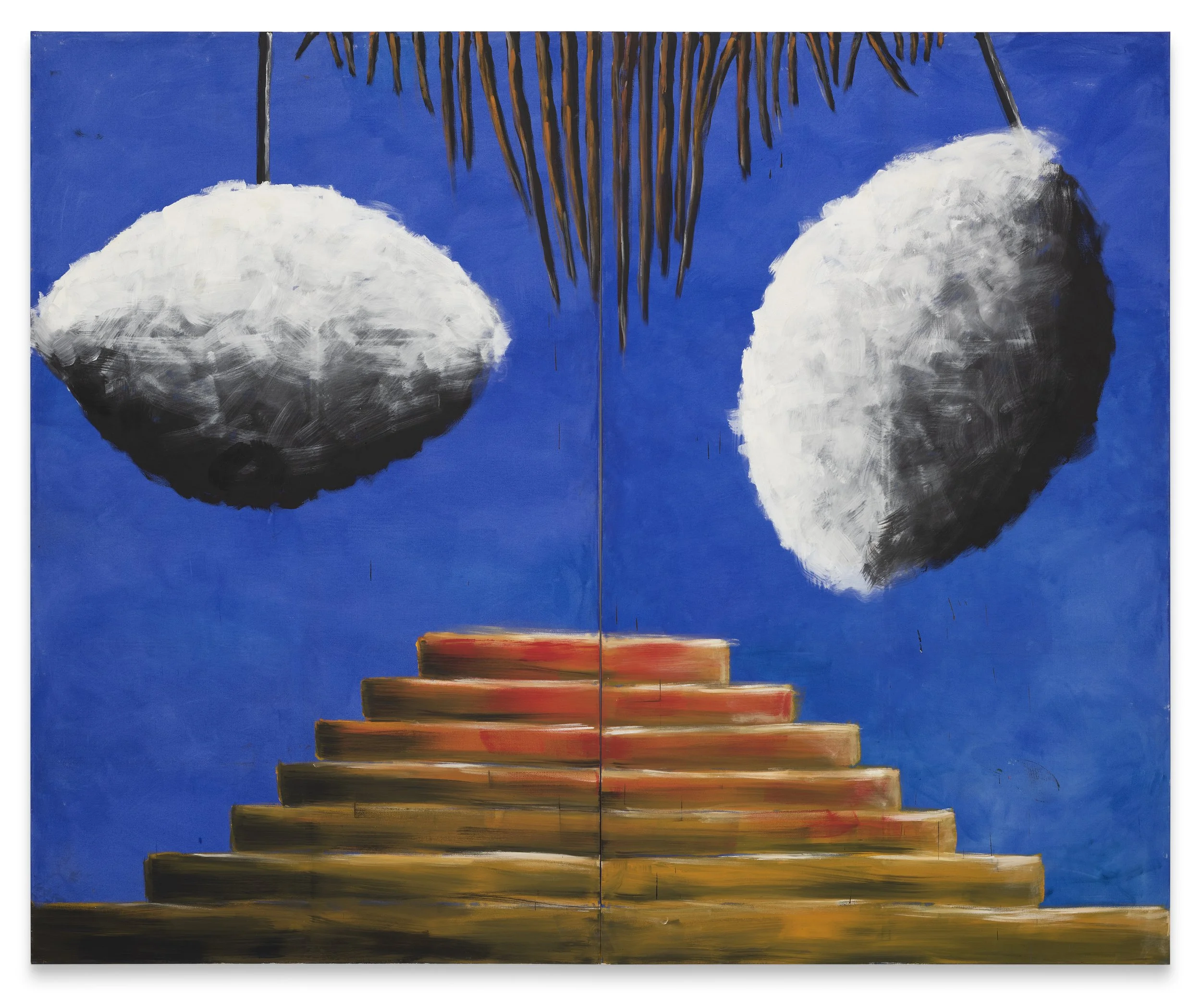
Untitled, 1982 Acrylic on nettle cloth 270 × 330 cm (2 parts) | 106 1/4 × 130 inches (2 parts) MSPM ASC 14632 Copyright Andreas Schulze / VG Bild-Kunst, Bonn Courtesy the artist and Sprüth Magers Photo: Ingo Kniest
KUPPER: Were you both sort of underdogs, or maybe outside of this scene, which seemed very masculine at the time? I mean, you originally wanted to only show women artists.
SPRÜTH: This was my idea. But as I mentioned, I didn’t do it from the very start. It was a very male-dominated atmosphere. So I thought, I will shock them a bit later. But I must say, the first visitor when I opened my gallery with Andreas’ show was Michael Werner. We are still friends to this day. For me, his gallery is one of the most important ones in Germany.
SCHULZE: And we didn’t have dealers like Marian Goodman.
SPRÜTH: No, we didn’t have these female figures and dealers like there were in New York at that time.
SCHULZE: At that time, I didn’t know what an underdog was. I was just starting as an artist and simply wanted to do my artistic stuff. That was the only thing that interested me—and certainly not the art market, which was only just developing at that time into the form we know today.
SPRÜTH: Sometimes your timing is just luck, but there are also these particular moments where you feel that it makes sense to do something. And I felt this very strongly. So after Andreas, my second show was Rosemarie Trockel, and the third was Fischli Weiss, and then George Condo came also in 1983.
Untitled (mie), 2017 Acrylic on nettle cloth 200 × 160 cm | 78 3/4 × 63 inches MSPM ASC 31045 Copyright Andreas Schulze / VG Bild-Kunst, Bonn Courtesy the artist and Sprüth Magers Photo: Jochen Arentzen
KUPPER: Did it feel like your paintings were in the realm of these other painters who were getting a lot of attention? Did you feel like you had a provocative edge?
SCHULZE: Yes, provocative, but also against the so-called provocative.
SPRÜTH: He has a very specific way of speaking, which is the same as how he paints. There is a specific humor which is reflected in his titles—a lightness, but also a strong precision.
SCHULZE: The successful painters at that time—for example, the ones from Mülheimer Freiheit—already had their style. I found it very gestural. And I said, “I have to do it differently. I have to be more tidy.”
SPRÜTH: And your formats in those days were different. Your scale was always four meters divided in two panels.
SCHULZE: Yes, for practical reasons. Each panel was two by two meters for transport.
SPRÜTH: Another thing that was interesting from the beginning is the perspective in your paintings, which is sometimes strange and not based in reality. So, there was always the question: Why does he do this? Dokoupil thought it had to do with your eyes.
SCHULZE: Yes, because since birth, I have only 10% vision in my left eye.
SPRÜTH: That was the assumption. Why is he doing this strange perspective?
SCHULZE: Perspective and the volume also.
KUPPER: Is there no peripheral vision?
SCHULZE: It is difficult to explain. With my left eye, I can’t see three-dimensionally; it is rather flat. The right eye is compensating.
SPRÜTH: That was Dokoupil’s explanation for why Andreas started to do these incredible special interventions.
Untitled (Garden), 2016 Acrylic on nettle cloth 170 × 580 cm (2 parts) | 67 × 228 3/8 inches (2 parts) MSPM ASC 28499 Copyright Andreas Schulze / VG Bild-Kunst, Bonn Courtesy the artist and Sprüth Magers Photo: Timo Ohler
KUPPER: You two have known each other for over forty years now; what have you learned about each other in that time?
SCHULZE: Continuity and collaboration.
SPRÜTH: I have never known any artists who are as inventive with their images as Andreas. And this is still true today, forty years later. His style is very recognizable, and it’s always full of subtle content. It is humorous, but in the end, it gets to the point. There is a special Surrealism in his paintings which attracts people to them. I can see it also in the works of your students. They take a certain aspect of this flat, surrealist style from you, and maybe also from Domenico Gnoli.
SCHULZE: Maybe theirs is more flat because they have good eyes.
SPRÜTH: But Andreas’ paintings always have a very unique balance. Despite their lightness, they also have something disturbing, something dark. Strange combinations that you don’t get elsewhere. I always thought that even if you don’t like his paintings, you still recognize that they are very unique, very authentic.
KUPPER: How has the freedom to work on a larger scale and interact with the gallery over the past forty years changed or helped you evolve your work?
SCHULZE: It helped a lot to do what I wanted. This was always my focus. There are a lot of artists who have two or three big galleries. I didn’t think so much about what else I could do, who else I might work with.
SPRÜTH: It was not strategic the way it is today with many artists, especially Americans, in the art market.
SCHULZE: The market didn’t play a role at that time. Today, younger artists spend a lot of time thinking, How much does this artist cost in that gallery?
SPRÜTH: Yes, exactly, how to promote yourself. Today there’s an extreme question of strategy. It is about promoting your background and having the right combination of galleries.
KUPPER: You weren’t part of any particular group either. Do you think your work developed its own language and remained unique because of that?
SCHULZE: Yes. Today, you might see ten young artists who are around the same age, and their work is very similar. For me, it’s always important to not do something you can compare to somebody else. I always wanted to narrow myself down, in a positive way. All of these trends go away and come back.
SPRÜTH: Exactly. This is who you are from then to today. You have your own style, and it has a strong authenticity. In the early days, I thought it was quite outstanding because, in a way, in painting everything had been said already. But there are always moments where somebody can go one step further. Andreas is that kind of painter. Your style was always your own invention.
SCHULZE: But there are, of course, a lot of artists, designers, architects and musicians who have a big impact on me.
SPRÜTH: That’s true. There’s still a lot of reference. You are not living only in your own world.
KUPPER: There seems to be a lot of psychologically similar wavelengths that people were on between the New York Pictures Generation and what you were doing, because reappropriation was a major theme. It was a period when people were trying to think about how to make art differently. There was a lot of talk about painting being dead, and pop being dead. So a lot of artists that you were interested in started to think about how they could reference the past while also making something on their own, which makes your connection to them really interesting.
SPRÜTH: It’s true. I never thought about that, but it’s the same approach. There are a lot of references in Andreas’ paintings. Maybe that painting (points to a painting) is of a liverwurst, but aesthetically and formally there are so many references.
Untitled (Her), 2026 Acrylic on nettle cloth 90 × 120 cm | 35 3/8 × 47 1/4 inches MSPM ASC 65703 Copyright Andreas Schulze / VG Bild-Kunst, Bonn Courtesy the artist and Sprüth Magers Photo: Mareike Tocha
SCHULZE: It is like a good food painting by Gnoli.
KUPPER: I read something once where your work was described like Pee-wee’s Playhouse if it were done by Sigmar Polke. It was a really funny combination of ’80s references from both Germany and the US.
SCHULZE: What is it?
KUPPER: It was a very surrealistic television show that was made for kids but very much appreciated by adults. It was designed by Gary Panter, Wayne White, and Rick Heitzman, who were these punk artists of the era. I brought it up because the ’80s was an interesting time when people were thinking about the past, but also thinking about reappropriation and their place in art history, and maybe a relationship to post-war German painters and artists.
SPRÜTH: When I started this gallery, I said: “I don’t really want to have a gallery, but if I do it, I have to be precise.” It has to have a certain necessity in which artist you choose. That there is a moment in their work which goes beyond what was there already.
KUPPER: It’s interesting that you both find yourself here in Los Angeles for this exhibition; that you skipped New York to open a space here.
SPRÜTH: And the first show we did with Andreas in LA in 2017 was Traffic Jam, with all the cars.
SCHULZE: Close to the car museum.
Andreas Schulze Traffic Jam Installation view, Sprüth Magers, Los Angeles, November 15–December 23, 2016 Copyright Andreas Schulze / VG Bild-Kunst, Bonn Courtesy the artist and Sprüth Magers Photo: Robert Wedemeyer
KUPPER: George Condo described your work like a chair for your eyes to sit on. Do you agree?
SCHULZE: A chair for the eyes? Yes, it’s good to rest the eyes.
KUPPER: Can you talk about the furniture in your work? Metaphorically, but also literally?
SCHULZE: I am interested in our daily life, and I paint the things that surround me. Sometimes they are realistically painted, and sometimes they are just pure forms. This is the advantage of painting. You can mix things that are not connected in reality, which brings in a tension between the familiar and the unfamiliar.
SPRÜTH: You were also an early collector of old furniture that years later got very fashionable. What did you collect in the beginning?
SCHULZE: I can’t remember. It was something from the flea market. But the first new furniture that I bought was from the Memphis School [Milan]. Those were the first pieces I bought from more-or-less my generation.
SPRÜTH: The first time I saw Memphis was because you bought an Ettore Sottsass mirror. I think you probably like it because of the shape. It was formally close to you, and it fit well.
SCHULZE: I cannot say why. I also collect ceramics from the flea market. A lot of things from the 1920s that came from a porcelain factory in East Germany. They are decorative cake plates, called Spritzdekor. They remind me of fine art. They are like Expressionist paintings. And on the left, there’s a painting of mine that fits well with them.
Untitled (Without rhyme or reason 1), 2014 Acrylic on nettle cloth 180 × 100 cm | 70 7/8 × 39 3/8 inches MSPM ASC 23668 Copyright Andreas Schulze / VG Bild-Kunst, Bonn Courtesy the artist and Sprüth Magers Photo: Jochen Arentzen
KUPPER: It fits perfectly.
SCHULZE: It’s because this is a special spray technique from the time. There was a machine to do it. You need a hard edge, and then it diffuses like an airbrush.
KUPPER: What came first? Did your love of painting furniture make you want to collect it? Or did having the furniture around make you want to paint it?
SPRÜTH: It was parallel.
SCHULZE: But it had no direct connection. I was collecting furniture, and I was painting it. What I have done, however, is sometimes create three-dimensional versions of elements from my paintings. For example, a cabinet reminiscent of a Judd sculpture, as well as a sculpture that resembles the voluminous forms in my paintings. The latter was recently on display at my solo show in Dijon.
SPRÜTH: Yes, at the Consortium last year, and now you had your show at ICA Miami, and in June you will have your Cake show at our gallery in New York.
SCHULZE: That’s true. So first I did my paintings, and then somebody told me Baselitz, the painter, is doing now wooden sculptures. And I thought, maybe, I can do also a sculpture. And the result is the one from Dijon.
SPRÜTH: You call it Wurst [sausage]?
SCHULZE: That’s what some people call it, but it is not my term. The main idea was not a sausage. The origin of this form was a humoristic cartoon of a human being in a full plaster cast laying in a hospital bed after a ski accident. Only the eyes, mouth, and nose were visible. I was drawn to this absurd figure and at the same time its abstract form. Since then, I really like this form. It is a form that is a body, it has a certain sculptural and spatial physicality.
KUPPER: Where do you think that humor came from? Were you born with it?
SCHULZE: Who can say?
SPRÜTH: There’s someone from the US who compared him to this German comedian, Heinz Ehrhard from the 1950s, 1960s on TV, who is known for his subtle wordplay. Andreas even looks like him. But you can also say that Andreas’ work expresses a typical subtle German humor, even though Germans are not supposed to be funny.
KUPPER: Obviously, Germans can be very funny.
SPRÜTH: Yes, and in his paintings he has a very subtle humor combined with joy and lightness. First, when you look at them, they look kind of strange, and you don’t understand, but the more you get into them, all the aspects of German books, German characters, German comforts appear all mixed with general references to art history.
SCHULZE: The explosive comforts. (laughs)
KUPPER: We are living in an age when people are making images instantly with AI. How does your work fit into that realm of instant image-making?
SCHULZE: I am not against AI and the digital world, but it is not my world. The positive thing is that you get a lot of information. But I don’t want to have all this information. I don’t need this overload. In the past, you only had art magazines where you could learn about exhibitions on view, and even that was too much information for me.
KUPPER: Are you still excited about new images or do you think we should slow down?
SCHULZE: Of course, I want new images. I don’t want to paint always the same.
SPRÜTH: From my point of view, this has always been his strength. If I look back forty years ago, and then at his work today, his inventive mind is incredible. Today, sometimes artists think they have to change their style in order to be interesting, but Andreas stays within his world, his style, his cosmos, and still it’s always something new. It’s very …
SCHULZE: Narrow-minded. (laughs)
SPRÜTH: No, not at all!
Monika Sprüth and Andreas Schulze, Cologne, 1983 Photo: Wilhelm Schürmann
Andreas Schulze’s Cake is on view through July 31 @ Sprüth Magers 22 East 80th Street, 2nd Floor New York