Sinister Sights: An Interview with Gabriella Marina Gonzalez

Gabriella Marina Gonzalez's accessory collections are exuberantly sadomasochistic and by turns contradictorily flocculent on account of her cosmic balance of mixing knit and leather. Gonzalez, who is based in London, is onto her fourth collection, entitled Sinister Sights in Synthetic Moonlight, for her eponymous, made to order label.  Pas Un Autre asked Gabriella Marina Gonzalez a few questions about her new collection and whether we should be prepared for some kind of apocalypse.

Can you tell me a little bit about your new collection Sinister Sights in Synthetic Moonlight?

A/W11 'Sinister Sight in Synthetic Moonlight' was inspired by what I imagined the hallucinatory aspect of having sound provoked synesthesia could be like and the video accompanying it  by Sean Wild on my website was meant to  give a visual  experience of it. * Editors note: sound provoked synesthesia is a neurological phenomenon in which certain sounds trigger color and simple shapes that arise, move around, and then fade when the sound stimulus ends.

Your leather harnesses and masks almost look like armor, is there something we should be worried about?

I don't think I'm the only person who can feel a battle approaching. I think there are thousands of people out there just like me who are preparing for a universal change.

Theres a quote in your bio that says you are trying to "set an example against wasteful mass production and relieve.....'the identity fraud that high street brands convince the insecure to consume." Can you elaborate on that?

Yes, I think there is an element of consumerism that is based on wanting 'things' to bring worldly comforts and ease an insecurity about a lack of identity and a need to fit in to something to feel safe. Its a form of brain wash and I think is very dangerous. As a designer I am ultimately creating an item to be consumed so it is very tricky but I'm not pro missing anyone any untruth. I only want people who feel drawn to the work for untarnished reasons to be interested in it. Not because of celebrity endorsement and things of the like. This is why I make everything by hand because It makes me feel useful, like I am providing an art form to people.

Whats one thing you've never told anyone before?

I have no filter. I tell anyone anything I am feeling even if it couldn't possibly wash with them or they think I have a screw loose because there is nothing more pure than true honesty.

Where do you draw inspiration?

On a sheet of paper.

Do you have a favorite quote, motto?

Yes I think one has to trust their instinct–not push it aside.

In what kind of world or landscape would everyone be walking around in your designs?

I don't consider my work a fantasy, I think its very much a reality as it is based upon my truth. Everyone is walking around in my designs because everything is everything and we are all one energy and consciousness. We are just a little out of touch right now.

Whats next for Gabriella Marina Gonzalez?

I guess we have to have patience till the next chapter of the story.

Visit Gabriella Marina Gonzalez's website to see more of the collection and more.....www.gabriellamarinagonzalez.com

Text by Oliver Maxwell Kupper for Pas Un Autre

Not Taking the Piss: An Interview with The Rodnik Band

Lets tap into the strange and brilliant mind of Philip Colbert–designer and founder of The Rodnik Band. Marketed as an "ironic pop band," Colbert has built a bridge between art and fashion, à la Yves Saint Laurent's Mondrian dress or Peggy Guggenheim's Calder earrings. The Rodnik's Band's latest collection, "Venus in Sequins," which saw its debut at London Fashion week, is a tongue in cheek, satirical exploration of some of the most iconic works of art  sartorially adapted into incredibly intricate wearable sculptures. At face value, Colbert's designs are comical and verge on the absurd, but on a deeper, subatomic level they are definitive statements that respond to the basic foundations of the business of making art and fashion. And as if to validate, or maybe offer whiffs of irony, Colbert's wearable art has been getting the approving nod from industry giants such Ana Wintour to Karl Lagerfeld.  Ironic because Colbert is seemingly lampooning the lavish ridiculousness of fashion, especially couture, that designers like Lagerfeld have helped define.  

After studying philosophy and art history from St. Andrews University, Colbert went into the business of selling Russian scarves and in 2005 founded the Rodnik Band with no formal fashion training.  After six years of chopping his axe as a designer in the cut throat arena of mainstream fashion, with his collections showing around the world and carried by the best retailers, Colbert was seeking more meaning–in essence "....to create a more meaningful approach to fashion. [And] was less interested in the trend of fashion for fashion sake, the smoke and mirrors style of trend based fashion, which is repetitive, cyclical, and often devoid of meaning."  As we were still curious, Pas Un Autre asked Philip a few questions about art, pop culture, fashion, and The Rodnik Band.

The Rodnik Band is not presented as a traditional fashion label, but as a band. Why is that?

I present the label as a Band, because I was inspired to break the mould and present fashion in a new way. I was inspired by the cross over between fashion and music, and wanted to create a new cross over concept.

Can you tell me a little about your current collection, Venus in Sequins?

I wanted my artwork dresses to sparkle so they are made using intense sequin embroidery, which takes over three weeks of hand work per dress. I wanted to created wearable POP art with requisite hand crafted detail. They are a hybrid product, they stand in no mans land between the two established genres of art and fashion. I see them as a step in establishing a new conception of clothing as wearable art. I was inspired to create clothing with clear artistic expression. I found good past examples of this concept in the Ballet Rus, where Picasso and De Chirico designed costumes which are unquestionably great artworks, and take their painting styles into a different and exciting dimension. The graphical style of the dresses are unique as I create my own artwork interpretations of each inspiration (such as the soup can) and create lino block print to simplify and recreate the image by my own hand, allowing mistakes and giving the work my visual identity. The Naive black lines create a more satirical rendition on the idea and add a sense of humor. Sequin work is then added on top of the print artwork to make it sparkle. I use mostly silk, such as Duchess Satins and Georgette's, and Cashmere as a base. Then hand sew the sequin work on top.

On your website you say that you are inspired by Marcel Duchamp and Pop Art. Andy Warhol said in an interview once that "Pop art is about liking things." Its fairly vague, but what do you think he meant by that?

I was interested in the way POP art communicates, unlike many art forms it it relevant and accessible to people from all walks of life, it draws inspiration from the culture we live in, and is a very strong form of visual communication, it is essentially very democratic and connected with peoples lives. Similarly I think Warhols quote may have meant that it is a positive form of artistic expression.

"I feel the industry takes itself to seriously

and is in danger of missing the creative spirit

that makes it a higher art form

with expression."

If Marcel Duchamp were alive today what would he think of art in the 21st century?

If Duchamp were alive today, he would probably start painting like like the old masters, I remember a quote, which goes something like, "those that created Religion would be the same people who tear it down".

Pop Art is a reaction to current popular culture or the zeitgeist.  The Rodnik Band borrows from a lot of zeitgeists of yesteryear.  Is The Rodnik band a response or a statement? Or both?

The Rodnik Band is both a response and a statement. I feel the industry takes itself to seriously and is in danger of missing the creative spirit that makes it a higher art form with expression. I like the idea of breaking the conventional mould.

How does one stand out in a world where every one is trying to stand out? Is too much individuality bad for art?

To much of anything can be bad, I don't think we have to worry about to much individuality for art, the majority of people will always follow the crowd.

You studied philosophy originally.  What brought you to fashion?

I came into fashion in the spirit of unexpected adventure, and i always was inspired by that, it was never something i would have expected myself to work in. I have tried to create a direction and way of working that inspires me. I like the quote from Oscar Wilde, "We Should all be either a work of Art, or wear a work of art".

Whats next for The Rodnik Band?

New wearable artwork collection which is aimed at further developing the concept, a diffusion line to take Rodnik to spirit to more people, and more songs of course .

You can find pieces from the Venus in Sequins collection for sale here or visit www.therodnikband.com

Text by Oliver Maxwell Kupper for Pas Un Autre

An Interview with Jesse Ruins From Tokyo

jesse_ruins_tokyo

Who is Jesse Ruins? No one seems to know. But, does it matter? Three brilliant songs have been released slowly over the past six months–Dream Analysis, Inner Ambient, and Sofija–each one just as good as the last.  While we don't know what Jesse Ruins looks like-we do know Jesse Ruins is from Tokyo and has put out a collaboration record on Cuz Me Pain records.  In regards to the mystery–Jesse Ruins maintains "that [he or she] is not doing this intentionally." There are no plans for a record release, but it seems as if a great record is tantalizingly just out of reach–perchance the next great buzz album of 2011, or maybe even 2012. And so we wait and fall right into Jesse Ruin's web. Despite the mystery Jesse Ruins was nice enough to answer a few of Pas Un Autre's questions.

You go to some lengths to remain mysterious, anonymous even - why?

Well, I'm not doing this intentionally, but I'm just trying to remove unnecessary information.

Will you ever divulge your identity - or will you be anonymous forever?

It will come out when it's the right time. I even don't know when it's going to be.

Do you have an album coming out?

I want to release it, but there isn't any specific plan yet (label and stuff like that) at the moment.

All anyone seems to know is that you are from Japan - true or false?

It's true, I'm living in Tokyo.

How would you describe your music?

I cannot describe it in words, so I do that through my music. I think it's really up to each listener how he/she feels about it.

Keep updated on Jesse Ruinshere

Text by Oliver Maxwell Kupper for Pas Un Autre
Colorless Murder: An Interview with Aoi Kotsuhiroi

Aoi Kotsuhiroi, who has released the new chapter of her Exotic Regrets collection, entitled Colorless Murder & Silent Wolf -  Aoi sends Pas Un Autre a message each time a new collection or chapter is release - is nothing short of stunningly beautiful.  Her collections indeed recall a mystic, other worldly plane.  Infused with breaths of haikus, lyricism, poetry - oft times human hair, bone, and leather - her pieces are certainly beyond simple accessories - body accessories could explain it better, but it is much more. And because Aoi Kotsuhiroi is mysterious herself, a name or a categorization is even harder to attain. Aoi Kotsuhiroi was kind of enough to answer a few of Autre's question regarding the new chapter.

You just released a new chapter of your new collection entitled Colorless Murder and Silent Wolf. Can you tell me about the new collection?

The chapter Two of Exotic Regrets continues this 'relationship' that has begun in the chapter one... A number of characters find their place in the chapter two. Signs indicate that something happened or is going to happen... The images write a waiting, an in-between, in the middle of somewhere...

Each one of your collections, it seems, tells a story and you release each collection by chapters - the first chapter of the new collection Exotic Regrets was released a few months ago - just recently you released a new chapter. What is the concept behind releasing the collections like that? Is it for the anticipation?

There is no 'concept', no 'calculation'... Just affect and subject. I'm in the moment.

I also see a lot of poetry infused in the identity of the collections - are you a poet?

Yes, it's like breathing.

Can you tell me your poetic influences, inspirations and who is your favorite poet? Do have a favorite stanza?

I do not want to do any 'list', I find it boring and a bit simplistic perhaps...I like that has no "name", lost, which belongs to nobody, that we can not lock up or put in a category or a style. I have a short native american song in my mind:

"I walk in the sky I go with a bird "

And then:

"The clouds change"

You use some way out there materials; namely, human hair, horn (for the heels), and bone. There is actually something quite tribal about it. How did you get into those materials?

The materials are a language, they are a story...With them, in silence, and dialogue, a relationship is going and take shape...

In terms of fashion, who or what are come of your fashion influences?

I do not watch fashion, it bores me ... The influences are 'crutches', I walk alone by doing my own mistakes which are mine ...

Whats next for Aoi Kotsuhiroi?

The chapter three is on the road...


See Aoi Kotsuhiroi's designs here. Text by Oliver Maxwell Kupper. 

The Ubiquity of Tattoos: An Interview with Cris Cleen

The ubiquitous proliferation of tattoos in today’s mainstream culture has peeled away all but every layer from the archaic notion that tattoos are taboo. Tattoos, let’s face it, have become commercialized. But if you dig your hands through the pile, you’ll find a new tattoo niche that harks back to the good ol’ days. A time of pre-world war industrial bliss…where hands were busy and sweat glistened proudly. It was a time when things weren’t necessarily easy, but you got the work done and didn’t quite worry about the unending mystery of the ever expanding universe. It was an era where tattoos were an earned folk art tradition. For sailors, long odysseys into uncharted hemispheres granted coveted sparrows, like badges, and crudely drawn women with seductive eyes are scrawled three layers deep into flesh to memorialize debauched, forgotten nights in remote tropical isles. Today, there is a new band of misfit tattooists keeping this tradition beautifully alive. Last Monday I got a chance to sit down to talk with tattooist Cris Cleen.

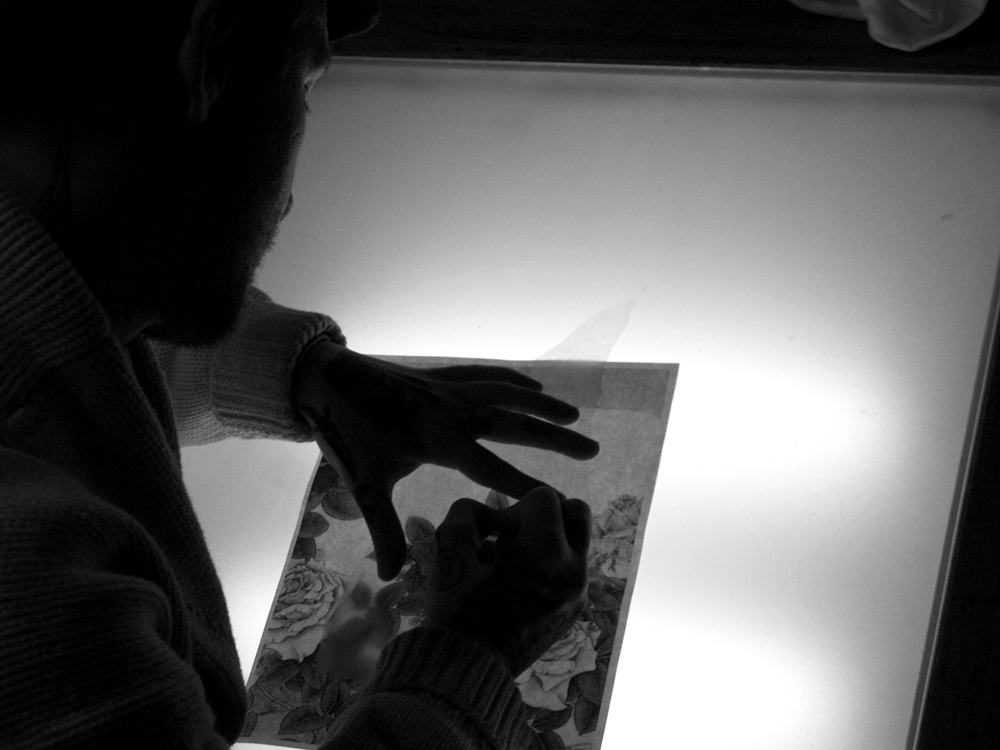
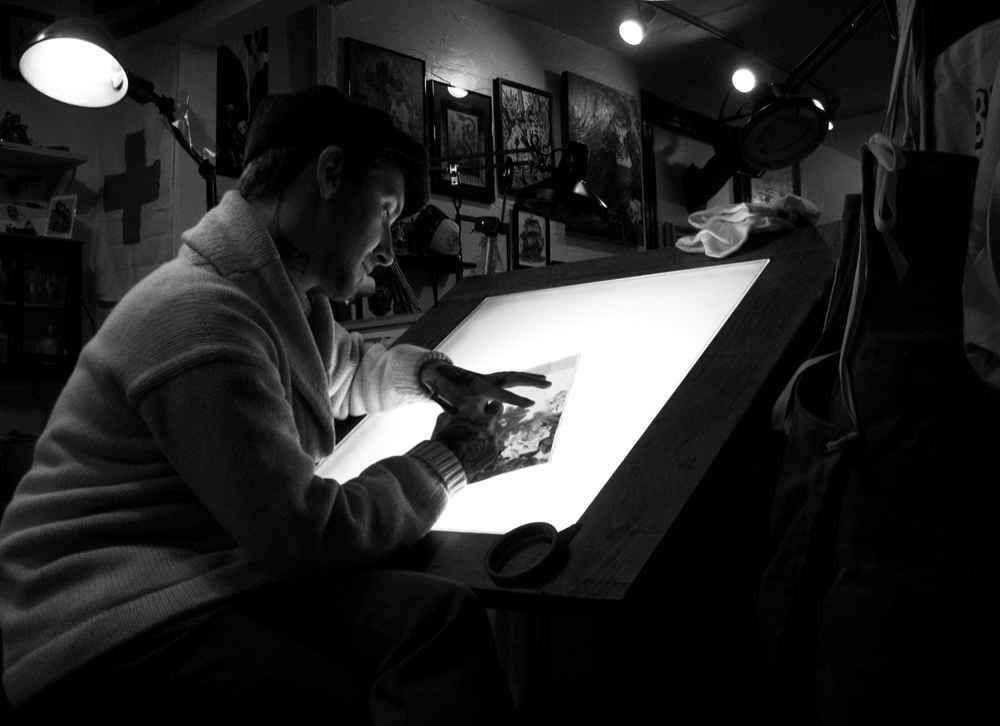
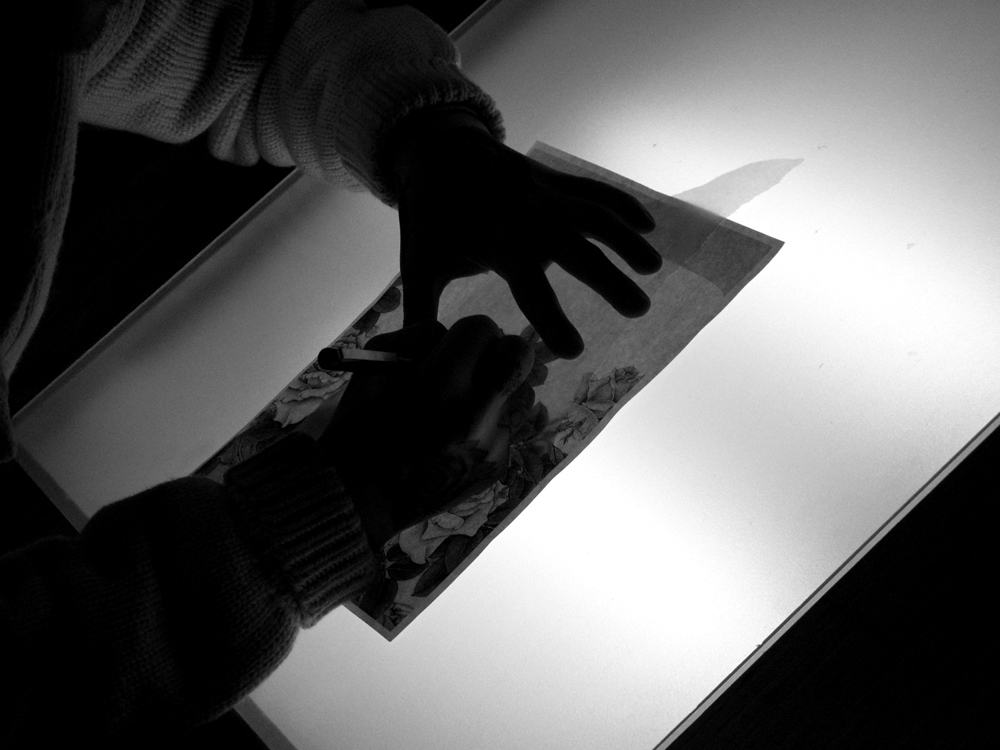
When I got to Idle Hands Tattoo, in the Lower Haight neighborhood of San Francisco, he was hunched over an angled draftsman table sketching intently. Like an author of a novel would give a name that alludes to a character'sphysicality or persona, Cris Cleen was....well...very clean and well dressed – dapper even. His style of dress is a throwback to a distant, nostalgic era. It’s the era you see in black and white photographs of 1930s street hoodlums, bootleggers, and dust bowl wanderers. I should mention though, that Cleen is far from a Luddite, even though I could smell small whiffs of Ned Ludd. I learned that Cleen has “three computers and an iphone.” Cleen also recognizes the disadvantages of that era: “lights caused fires and people threw their trash out the window.” But there is still a soupcon of romantization of an earlier era, which seems not only nostalgic, but also appreciative of the bygone ethos of the American Dream. Even the brief story he told about himself, his brother and their mother moving out west from Iowa to California seemed very Steinbeck. But all this simply added to the splendorous aesthetic and personality of his tattoos: folksy, like patchwork quilts.

Cleen has never been to art school and never wanted to be an artist. Even now he doesn’t consider himself an artist: “I like to come up with ideas and put things together… I’d rather have a good idea than a good drawing.” At one point Cleen wanted to become a cop – a revelation that illustrates the merit of his character – something about cops having “the guts to defend something.” And Cris Cleen certainly is protecting something: his integrity. Cleen is not a people pleaser and has never had a problem speaking his mind: “I don't want to be suicidal when I'm 30 because I've been a people pleaser all my life.” Whilst most kids “were fucking off and spending their parents money” Cleen, in his early 20s, had a career – he started tattooing right after he turned 19. Cleen doesn’t really know what drew him to the world of tattoos, he had “no frame of reference,” but admits that after seeing flash art for the first time he became fixated. Cleen mentioned that something about the random smattering of images, the “dichotomy of a skull and a rose next to each other,” sold him right away. You could say that tattoos were Cris Cleen’s calling.

Cris Cleen appreciates the “folk sensibility” of tattoo art and theorizes that the commercialization of tattoos has made them too polished, and that “over stylization is dead.” Cleen likes to stick to stuff “that’s always going to be beautiful…like roses and girls.” In that sense, Cleen is a constant pursuer of timelessness. He sees tattoos like permanent jewelry…adornment, not defamation of the flesh. Cleen stays up late into the night working on his drawings for his clients. He doesn’t try to appeal to the “tattoo collector,” but to the “every man” who simply wants a beautiful tattoo. And Cleen doesn't like that the tattoo world overplays the working class persona. Cris Cleen is not a working class hero. Cleen considers himself more a part of an elite trade of craftsmen more than anything. Which brings us back to the new niche aesthetic of the misfit tattooist: here in the second decade of the 21st century there is a full on revolt against some of the most common iniquities in the annals of tattoo history, like tribal tattoos and Geiger inspired machinery. Cleen mentioned some of his influences, which date back to the turn and early 20th century, from whence he culls a lot of his inspiration, like Saturday Evening Post and pre-Norman Rockwell illustrator J.C. Landecker and Norman Lindsey, the Australian artist who was ostracized for the overtly sexual nature of his art, and for living with more than one woman. For Cleen, in art, there is a certain power and lust. What is male desire? The countenances of the woman depicted in Cleen’s tattoos all have an underworld quality…. as if they live in a dark velvet room in a constant state of indecency…disrobed…. sprawled out and ravaged.

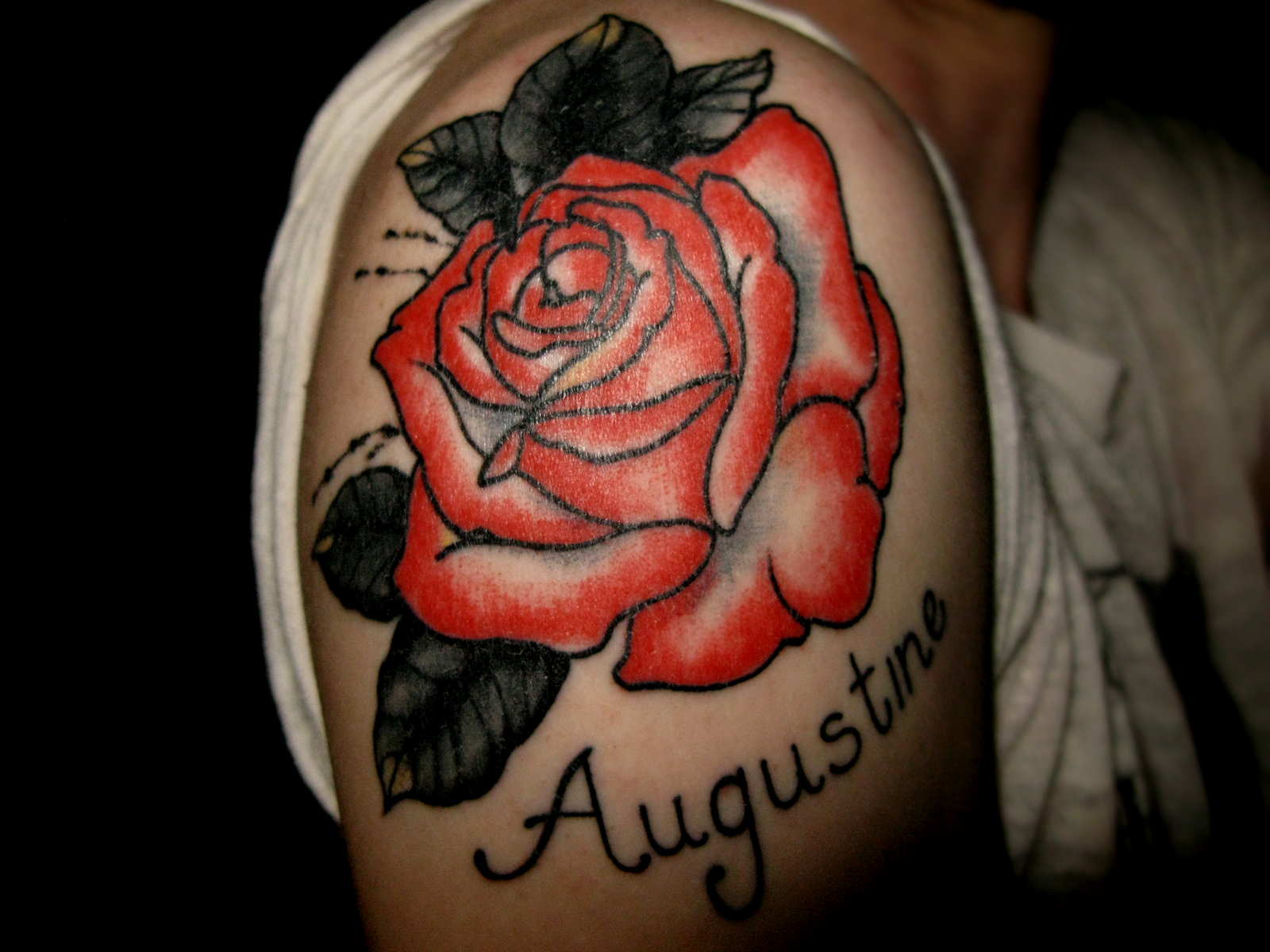
Last Monday was my sister’s 25th birthday. Cris Cleen and I, after a weeklong email thread that stretched into twenty or so messages, decided upon simple design: a simple rose. When I got to the shop I asked him to put my sister’s name below the rose and he obliged. The tattoo came out beautifully. Cris Cleen’s tattoos are like precious permanent keepsakes…


Cris Cleen will be tattooing New York at Saved Tattoo during the month of March and back at Idle Hands Tattoo in San Francisco after that.  Text & Images by Oliver Maxwell Kupper.

cris_cleen_tattoo_5_oliver_kupper_maxwell