
text by Maisie McDermid
Two symbolic colors make up the Ukrainian flag—a band of yellow below, representing a field of sunflowers, and a band of sky blue above, as hovering hope. Black Sunflowers is about yellow flowers going black, dreamers faced with clouded skies, yet still holding on.
The American director, James Marcus Haney, No Cameras Allowed, 2014, and Ukrainian cinematographer, Misha Lubarsky, spent nearly four years filming in Kyiv, alongside Volodymyr Yatsenko and his local team at Limelite. The film, executive produced by three-time Academy Award winner Sean Penn, who is a staunch advocate for Ukraine, is commencing its festival run after recently taking home First Runner-Up for the People’s Choice Documentary Award at its TIFF world premiere.
Marked by moments of adrenaline and stillness, the film follows the everyday lives of several young Ukrainians living in Kyiv, including car drifters, a combat medic, ravers, and a nature turned combat photographer. The protagonists speak to Marcus, and, very directly, to the audience about the ongoing, surrounding presence of war in Ukraine, and how they each find ways to feel alive.
Haney, who does not speak Ukrainian, worked with his team to create what he calls “live translation hacks” during interviews. With a subject set-up on a lavalier microphone, the translator disappears into a nearby closet, bathroom, or outdoor area, speaking what is being spoken into Haney’s ears. People don’t like hearing back what they have already said, Haney explained, and it stalls emotional communication. “If they’re saying something profound, it takes a whole extra beat for me to understand and react. At that point, they’re already moving on in their head to something else,” Haney shared in an interview last weekend. With this strategy, the piercing lines from the film flow. Each one, sharply specific and beautifully raw.
Within 97 minutes, ten stories seamlessly intertwine. “Depth versus breadth” became the opposing poles of the editing process. “We as humans don’t have the bandwidth to empathize with multiple people at once deeply. You know, empathy takes a lot of energy, and we’re asking the audience to empathize with ten different people they’ve never met. That’s a huge ask.” Yet, the quality of dialogue and the rhythm of the film—up for air, then back underground in a thudding rave—enables closeness, a total presence, and a continuous state of curiosity.
Moments after an interviewee closes their eyes and cries, the film cuts to Anya, throwing her straight blonde hair back-and-forth in between loose smiles at K41, Kyiv’s iconic underground techno club. Scenes later, laid out by a stream, she writes in her journal, “Will we ever smile again?” Cut to Vania, a soldier who has experienced one of 93,566 amputations since the war started, waving his prosthetic leg out of a car drifting at its highest speed down a nighttime street in Kyiv. All the while, Fred Again’s signature sound pulses, accompanied by Brian Eno’s ambient thuds and Koloah’s immersive, almost-cinematic soundscapes.
“It is heart and throat the whole time,” Haney said, on drifting. “You know when you go on an adult roller coaster for the first time as a kid or a teen, that feeling. But at least on the roller coaster, you know you're going to get off of it… You can’t just shoot that from the side of the road and get that feeling. You have to be there with them, and, you know, the only place to handhold the camera is in the passenger seat.” Haney brings you inside of this war—inside a car with soldiers, speeding off the adrenaline from the frontlines, inside the intimacy at home, inside the feelings.
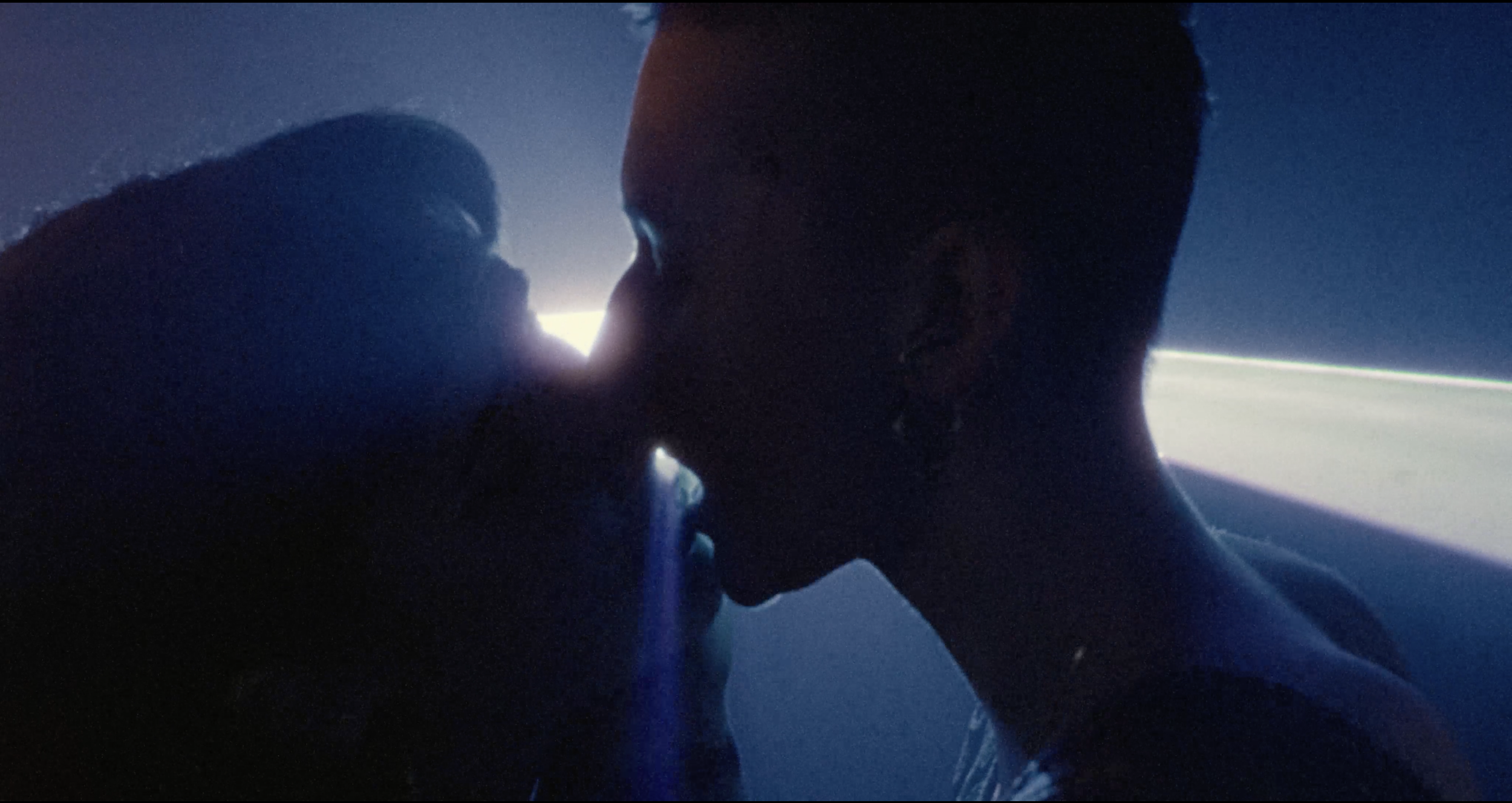
“On the front line,” Haney said, where there were no translators, “I just had to guess, hoping that the camera was in the right place.” This guessing manifests as lingering, the camera staying moments after an important line has been spoken. You witness not only how a boy in his early twenties reacts to a bomb that lands yards away from their outpost, but also, how he sits, how he breathes, the moment after the shock.
“I’m not eternal,” the combat photographer, Nikoletta says, after photographing dead Russian soldiers in body bags. Slava, a soldier who also lost a leg, believes that “Even if we win the war, it still won't feel like a victory. The flower of the nation has died.” In one final scene, Nikoletta walks amongst a sea of sunflowers withered and turned away from the sun.
Black Sunflowers proves how general news coverage informs, but details haunt. Yet what if, in haunting, there is hope? One family, seated for dinner, points up at their daily acts of happiness, written on a board attached to the wall. “Start each day with a smile,” reads the first line.
Haney, who is now planning a tour of the film in Ukraine, wants this film in front of audiences that don’t normally reach for documentaries. “The intention is for people around the world to ask themselves that same question: If their country was invaded, who in the film would they be?”