
Volta Collective’s Loneliness Triptych Questions the Source of Our Unsettling Discomfort with Solitude @ New Theater in Hollywood

text by Summer Bowie
photographs by Roman Koval

As feelings of isolation grow increasingly profound in our society, it seems logical that we would bifurcate our psyche in an effort to keep ourselves company. Julian Jaynes, an American psychologist, proposed that the human race began with what he called a bicameral mentality, where our inner monologue was believed to be the voice of external gods making commands. There was no self-reflection, no ability to perform executive ego functions, such as deliberate mind-wandering and conscious introspection. British philologist Arthur William Hope Adkins believed that ancient Greek civilization developed ego-centered psychology as an adaptation to living in city-states. Could it be possible that the development of those city-states into supermetropolises infinitely connected by social media might effectively bend the arc of our psychological universe back toward bicameralism? Might Narcissus look so deeply in the mirror that he would eventually forget its existence?

Volta Collective’s Loneliness Triptych comprises three acts and an epilogue, directed and choreographed by Mamie Green, with a live, original score by Dylan Fujioka. When the house doors open, the stage is occupied by a rotating, black office chair, a folding chair, a small area rug, and an inflatable mattress propped against the wall. The first act, titled “Doppelganger,” begins with two women played by Bella Allen and Anne Kim. They are dressed identically in white tanks and black pants. One lies down on the rug so that the other can roll her up like a fresh corpse. Our narrator, Raven Scott, watches from above, the twin dancers serving as stand-ins for her allegory’s rotating cast of characters. She walks down the stairs to a mysteriously ambient symphony of bells, strings, and keys recounting her experience with cinema escapism—a coping mechanism for loneliness so firmly tied to the 20th century that you could almost feel nostalgic for it. She speculates on whether movies might actually be able to watch us back and celebrates the cyclical nature of time captured on reels of celluloid. The dancers start this act as a duet while our narrator tells their story. By the end, our narrator becomes integrated into the dance, the divide between subject and objects dissolves, forming endless constellations of triplets.

From the red velvet seats of the movie theater, we’re thrust into the 21st century with “Camgirl,” the second act, written by Lily Lady and played by themself and Mandolin Burns. Sonically, it feels as though we’re in a yoga studio and our heroes aren’t dressed identically, but their shared vibe is equal parts casual and sexy. They walk toward each other from opposite corners of the stage and meet in the center with the inflatable mattress. Lady rolls like a log across the mattress, mirroring the opening of the first act with the rug. Our camgirl doesn’t need a camera. Its existence is as inherent as the audience they can scarcely see behind the stage lights. In Ways of Seeing, John Berger wrote: “​​A woman must continually watch herself. She is almost continually accompanied by her own image of herself. Whilst she is walking across a room or whilst she is weeping at the death of her father, she can scarcely avoid envisaging herself walking or weeping.” Lady claims that they’ll do anything to avoid pain as their alter ego supports them through endless bouts of self-pity. The two embrace from either side of the mattress, and move together as a trio that is only two-thirds human. The mattress slowly deflates until the two melt into an embrace on the floor. The lights go red and the music gets industrial. Our dancers skip together across the stage; Burn fires on all cylinders in a solo dance that ends with her wrapping the deflated mattress around her body like a dress while Lady watches and contemplates a “form of introspection that ceases to be disaffected and self-indulgent.”

Act three, “The Kid,” eschews the text, pulling us into a pure movement experience with the office chair performed by Ryan Green and Ryley Polak. Practically indistinguishable in size and shape, they form a twisted counterbalance on the chair as it spins slowly centerstage. I’m reminded of how difficult it is to truly carry the full weight of oneself—to be solely responsible for the consequences of one’s existence. They are like the opposing forces of the id and superego, constantly keeping one another in check. The inertia of their movement echoes the chaotic percussion of dissonant, grungy drums and electronic glitching. Supporting one another through inversions and barrelling leaps through the air, their dance is an endless chain reaction of ever-impressive acrobatics. Suddenly, they are bathed in an ethereal overhead spotlight, and their spinning turns to melting. They’re like cogs propelling one another with teeth turning on opposite planes. Unlike the previous acts, their ending feels quietly triumphant.

The epilogue is populated by all of the dancers at once. The New Theater stage can hardly contain all seven of them, and yet each feels just as lonely as ever. Our cast is a mix of trained dancers and actors who know how to move. However, they don’t feel mismatched as mirrors. Their talents are perfectly complementary and masterfully executed. Green’s trademark, multidisciplinary approach to theater has found its most subtle balance in Loneliness Triptych. Her players embody their characters while allowing the text, music, and choreography to inform their lived experiences. They film themselves as they vape and exchange props to a remix of Justin Timberlake’s “Cry Me a River,” a turn-of-the-century ballad about refusing to forgive. We’re left to wonder if the source of our loneliness isn’t simply a product of our elective, disaffected self-indulgence. If we do not, indeed, prefer it.

Notes of Tragedy: A Review of Volta Collective's "MILK" @ the Institute for Art and Olfaction


text by Summer Bowie

A smell of youth, sensuality, and otherness welcomes the audience into Volta Collective’s MILK, a multisensorial dance performance staged in collaboration with the Institute for Art and Olfaction. This is the scent of young Medea as defined by Saskia Wilson-Brown, the institute’s founder and executive director. Dominated by notes of winter spices, citrus, light florals, grape and fig, this inviting fragrance distributed through the audience on tester strips carries the sweet and piquant promise of juvenescence that our protagonist takes with her as she falls passionately in love with Man. No longer Jason, as his character is known in the classic Euripidean tragedy, but simply Man, as modernized by Alexis Okeowo, a staff writer at the New Yorker, essayist, and PEN/Open Book award-winning writer. In Okeowo’s reprisal, Medea and Man meet “kind of on the internet, kind of in person,” the way most of us meet our lovers. Man is described by notes of fresh sweat, muscled body, leather, ship’s wood, and ocean. He is the unsympathetic son of a political family defined by its proclivity toward nepotism, yet his reluctantly dutiful approach toward carrying the torch makes him a keen object of affection for Medea, the ambitious daughter of a garbageman.

The dancers embody these characters almost as vessels being fluidly possessed by multiple individuals over time, exchanging personages with one another in the same fashion that a zoomer might perform opposing subcultures from one day to the next. Their movement is scored by the nostalgic melodies of harpist Melissa Achten made timeless by the timpani, organ flutes, and vocal synth employed by sound architect Nicolas Snyder. They preen itchily, embrace indulgently, and shrink obsequiously at times, followed by displays of proud exhibitionism that sublimate into moments of performative submission. These anxious, amoebic qualities feel familiar in their contemporariness; an uncanny valley of gesture and sonic sensation.

In their early stage of courtship, Medea finds herself struggling to step into a feminine identity that she can both perform successfully and connect to authentically. She has grown accustomed to “competing for the love of men, using her weapons of not-too-intimidating intelligence and charm to win their devotion,” which leads her to feeling like she is “wearing FEMininity like a kind of drag.” The dancers wear their characters in kind. They become all-consumed by the fullness of feeling so many emotions simultaneously, falling into states of frenetic mania that are tempered by brief, unexpected periods of static calm. These mercurial waves bely Medea’s occupational transition from upwardly mobile wife to doting mother in the shadows. She accedes her attempts at manifesting Man’s agency internally and settles for the proxy of power incarnate via the rearing of his two sons. He is inclined to take on his mayoral campaign independently while Medea stands high on a wooden table, emptying a pitcher of milk into her son’s open, waiting mouth. It’s in this moment when my acquaintance with feeling makes me uneasy in its perpetual, abiding nature.

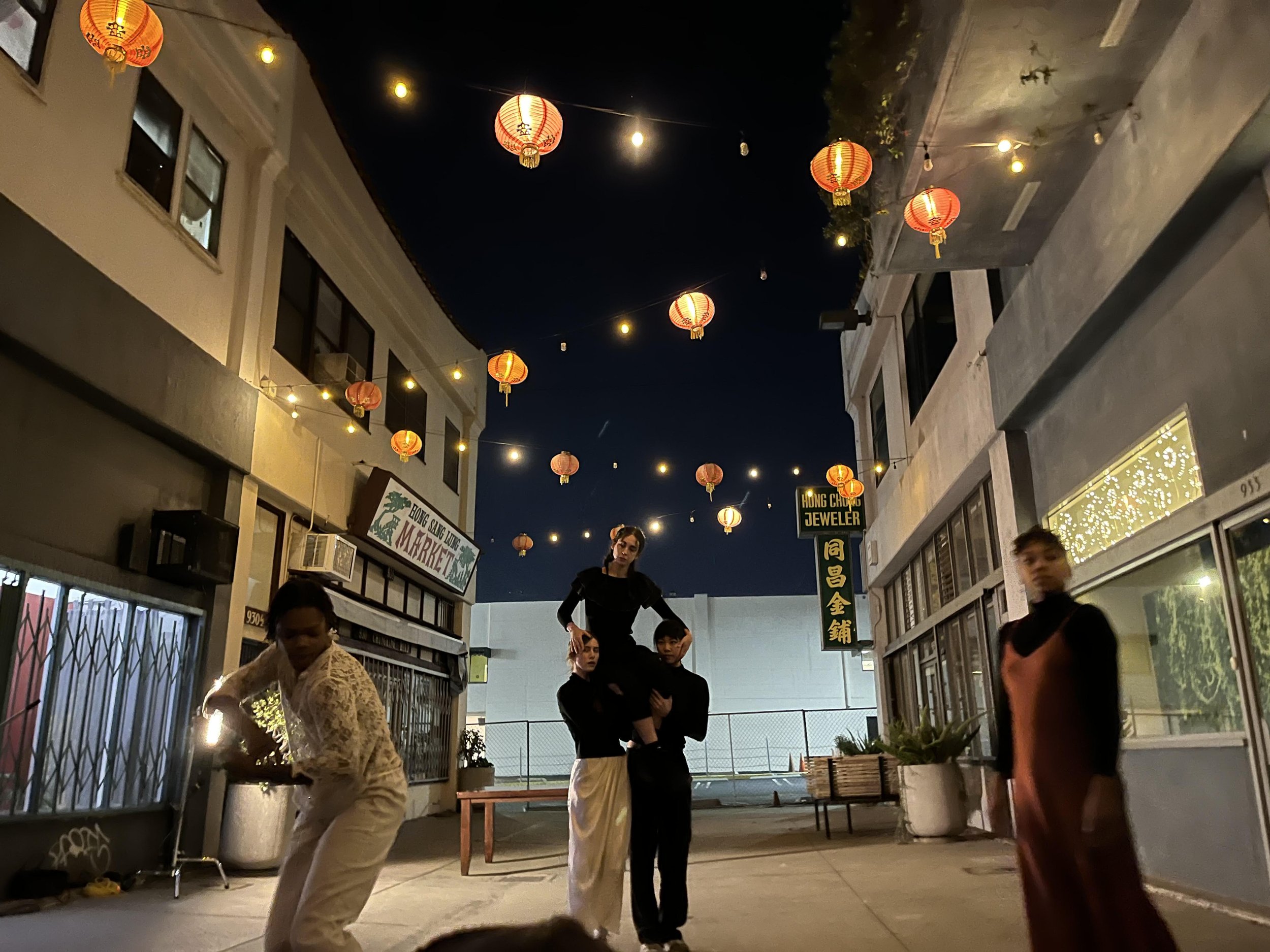
A street with lamps criss-crossed above the dancers in movement. Two peoplew stand up in front while two other carry a dancer on their heads.

Photograph by Volta Collective

Man loses his election and seeks comfort in the arms of another woman who comes to bear another of his children. Medea unravels the way so many of her generation do, dissolving into the doom scroll of his social media, subsisting on Hot Pockets, and watching the Real Housewives while contemplating all the ways that she was “prettier and smarter than all of those embarrassing women,” and how “they all had more power.” Her ire is characterized by a perfume of winter spices, citrus, unwashed body, earth, blood, and burning fire. The dancers perform duets that feel like the competing psyche of a dual personality. They push each other’s heads and bite each other’s hands. They carry each other twisted and inverted, memetically gesture toward an invisible bow pulled taught with potential, fall into splits, and weave themselves into surprising systems of support. They orbit chaotically like an electron cloud around a still nucleus where what appears to be a central ego played by Okeowo is carried front and center. Our narrator recites their final verse wherein Medea ultimately decides to burn down the house where Man, his pregnant mistress, and her two sons are sleeping. As in the original tragedy, Medea flees and decides to start a new life elsewhere, “she was going to BE Man in her next story, she was going to rebrand.” And there we are, left with a parting bouquet that conjures the scent of the innocents: sweet bread, warm skin, blood, and of course, milk.

My lasting reflections are multifold and complicated. The scope of this experience felt so much bigger than what could be encompassed by a 30-minute performance on the pedestrian pavement of Chung King Road. It felt like something that exacted the attention of a full-length work on a proscenium stage. A duration and location worthy of the masterful choreography directed by Mamie Green and Megan Paradowski could breathe more life into the exigence of the tragedy. Performed and choreographed in collaboration with the accompanying dancers: Keilan Stafford, Marirosa Crawford, Claire You, and Madi Tanguay, I left feeling like each one of them packed their talent into a container that begged to be expanded. 

It also gave rise to thoughts on social systems scientist, futurist, and cultural historian, Riane Eisler’s cultural transformation theory. Among its many claims, this theory proposes that patriarchy, or dominator society, is not so enduring a form of social organization as it seems; that humans lived in partnership societies for millennia that weren’t defined by the rule of one gender class over another. She suggests that the role of many Greek tragedies was to redefine traditions of matrilineage (the idea that children belong first to their mothers and are named respectively) into a new era of patrilineage. Although, many treat Euripides’ Medea with a more feminist reading than other Greek tragedies due to her “getting away with the crime,” I would venture to guess those are the same people who saw a feminist bent in Emerald Fennell’s Promising Young Woman, a film where, Cassandra (another tragic Greek heroine) played by Carey Mulligan, exacts revenge on all men who cross her path. In her book Anxiety veiled: Euripides and the traffic in women, Nancy S. Rabinowitz states that the reason why Medea “turns her anger at her husband into violence against her children” is because “we are the heirs of mythology handed down not by the Medeas of the past but by the Jasons.” We are wont to sympathize with her over Jason in the first act only to be punished for our naivety in the last. The underlying thesis in all of these tragedies almost invariably serves us with the warning that women are not to be trusted with the full agency that is rightfully entitled to men. As a play that was initially received tepidly by Greek audiences, it’s intriguing that it has received more modern adaptations than almost any other. My sincere hope for Medea, as she will likely live on in the current and future zeitgeists, is that she might one day abscond with her two sons that she suckled with her two breasts and ensure that they are known by her last name, whatever it may be.

A bunch of models laying close or on top of each other with blood dripping from the leg of a woman standing above everyone. Others drinking and spilling around a bunch of fruit and flowers.

Photograph by Anna Tse