

text by Estelle Hoy
photographs by Kennedi Carter
styling by Julie Ragolia
styling assistance by Kaylee Gibson
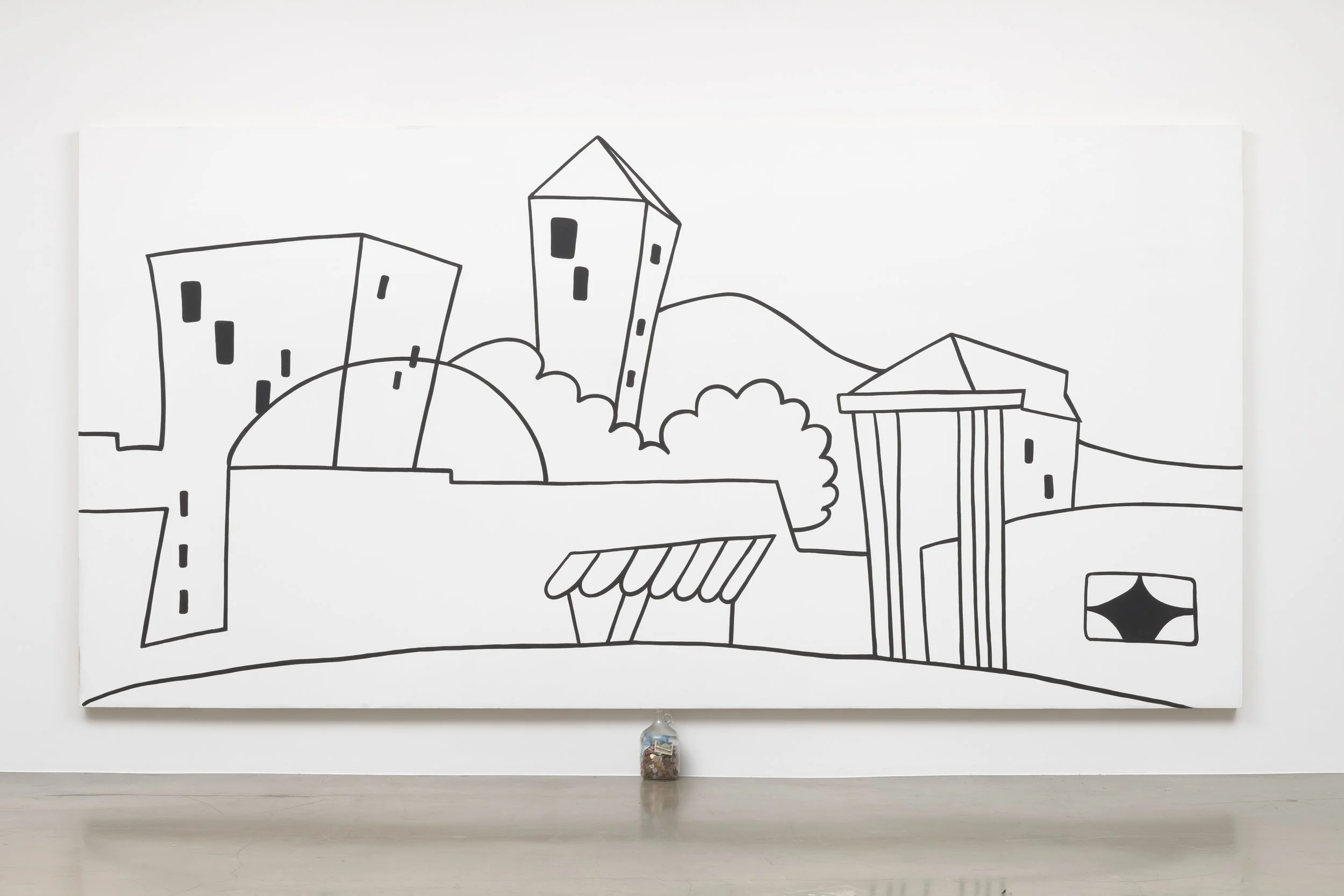
Martine Syms
Belief Strategy XVI (2023)
Wood, screws, glue, paint, glass jar and mixed currency
96 × 192 inches
© Martine Syms
Courtesy Sprüth Magers
Photo: Robert Wedemeye
She’d Do Well to Drown
Loser Back Home
Martine Syms (*1988, Los Angeles)
June 2-August 26, 2023
Sprüth Magers, Los Angeles
“Why can’t I do what others have done—ignore the obvious. Live a normal life. It’s hard enough just to do that in this world.”― Octavia E. Butler, Parable of the Sower
There’s something quite arbitrary about the idea of home, but to the degree that this arbitrariness is the shape of the space we inhabit, which looks very logical, even matter-of-course. Mostly ideas that appear ‘matter-of-course’ to our contemporaries are how we know something instinctually lunatic is going on. Refusing to fuck-up the Altadena census, lavishing endless attention to detail on surface proportions as if a building or space were an occasion for plausibility, is California-based artist Martine Syms; her magnificence of diction through video, performance, publishing, and installation makes clear what we already know to be true; home is a privilege for some. It’s depressing. Our actions are self-conditioned psychological phenomena rooted in human nature that reveal elements of our deepest laws associated with shape, place, belonging, possession, and their every supine iteration. Survey polls are for fucking losers, (usually) white (always) men who believe there’s a semblance of consensus in a census. Systematically acquiring information about where and how we live is an archaic, utilitarian convention that collects the artistic façade of space and time. Displaced people cannot form a viable, representative sample of a hometown if they’re not there to check a box to begin with. It’s a small mess.
Through the halitosis stink of white men holding purple clipboards with transparently unlikely answers, Martine Syms issues a rule change that might restore the mental stability of those excommunicated physically and psychologically. In Loser Back Home, her first solo show at Sprüth Magers, Los Angeles, Syms premieres her latest works in video, sculpture, painting, and photography, collating data about dysplacement—a term extemporized by American historian and Black rights activist Barbara Fields. In her effectual theory of Dysplacement, Fields disses the destruction of place and loss of collective connection to one’s familiar home or country. Discovery more than invention. It’s what people fear the most. On the plane to Los Angeles to see the exhibition, my skittish, certifiable neighbor, with a considerable lack of wit, clutched onto a golden sea captain’s compass as though the pilot were a dodgy taxi driver trying to run up the meter. After stifling laughter for several minutes, I realized the integrity of this atypical picture and its pseudo-Syms condition. In histrionic effect, my madcap neighbor painted an image of a hyper-simplified, formalist action of the absolute human need for directions home; not merely abstract signs, words, or figures but immediate, tangible hints that we belong somewhere. The lunacy was, in fact, my own.
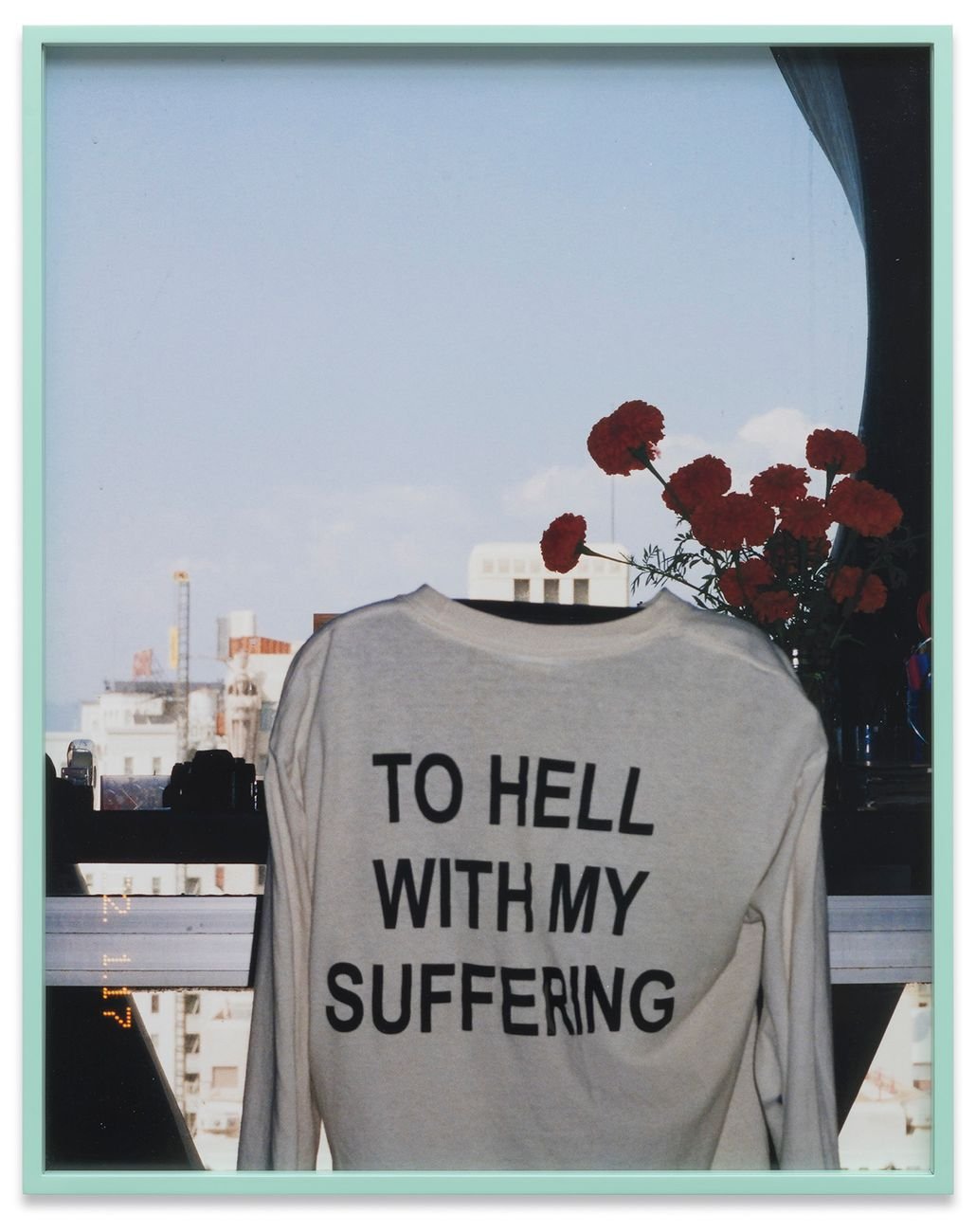
But I am starved; to hell with his suffering! Where’s the Jatz crackers?
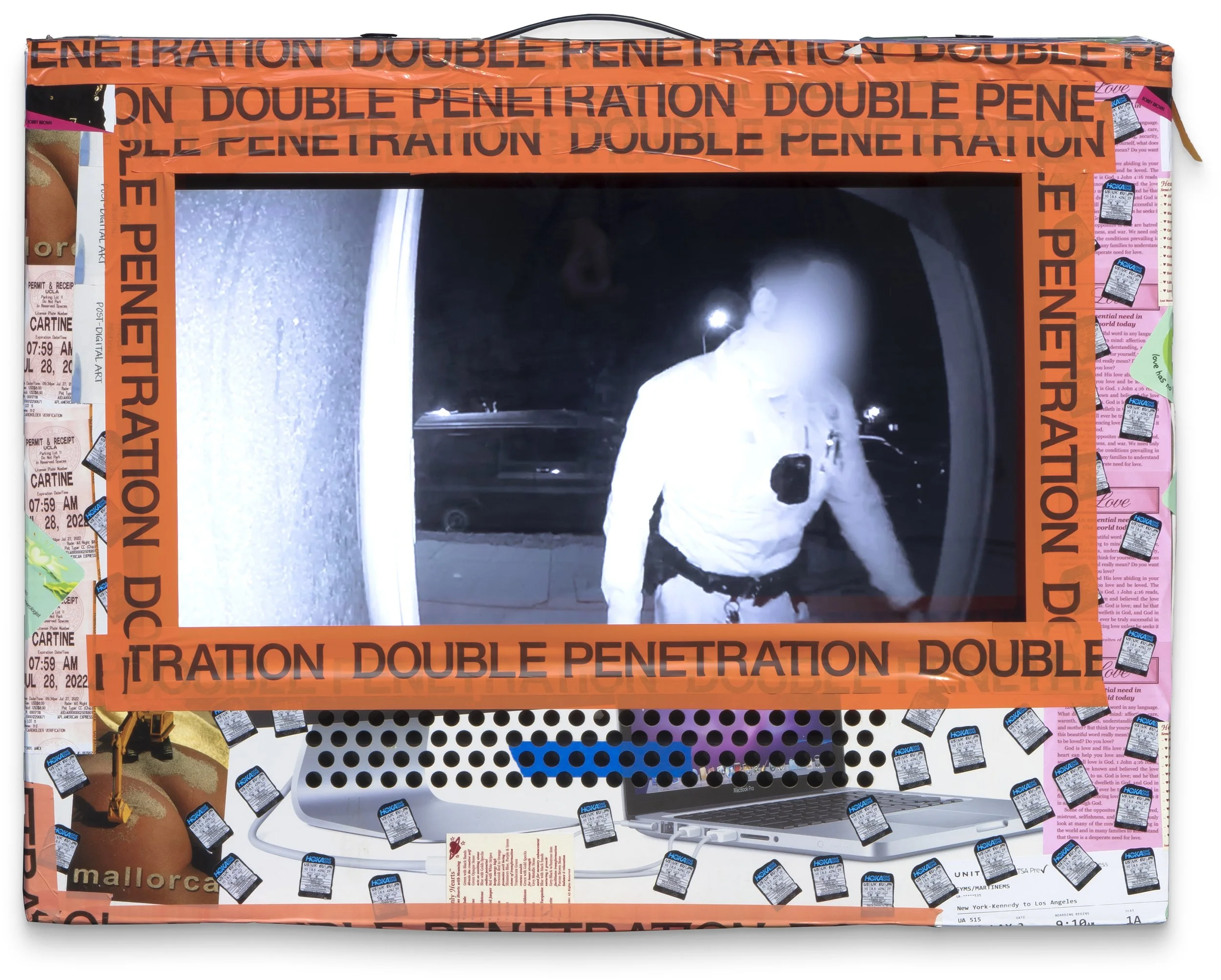
Exerting pressure on artificial skies, Syms airs This Is A Studio (2023), presenting surveillance footage (black and white, no less) capturing a late-night visit from police wearing starched tactical uniforms, a holstered Glock 22 here and there. The small problem with police visiting at 3am, crumbed in Dunkin’ Donuts, and a yeast infection, is that it’s fucking terrifying because American cops are pretty racist and can’t work a safety lock, ostensibly. Ugh, everyone is disappointing. Syms expands on the instinct of disapproval by clustering images of mundane, routine home-life banalities on a laser-cut cardboard box, inside which the surveillance tape is playing—from the inside. Routine living breeds ‘routine’ checks, don’t you know? Trespassing is one fine pursuit. Sticky orange PVC tape wraps around the carton, depicting the words double penetration, notarizing the comprehensive way that constitutional rights are so casually perforated for Black people. Or if you are Black and poor, you’re double fucked. It is here at level orange (orange is the new black…for people of color, at least) that Syms takes the point of biological stratum, using the epidermis as a sensitive point of contact, an interface between the conscious self and the infinite emission (or omission) of racial signifiers. Whether or not you have title deeds to your art studio is inconsequential to LAPD because they mostly can’t read. In 2.10 minute loop-de-loops of supplanting ambition and a trigger-happy corporeal punishment, sorry, I mean police corporeal, This Is A Studio (2023) dislocates in a kind of socio-aesthetic diphthong: This Is THEIR Studio (1457-present). Here is where primacy enters. There is a vaguely held belief that being the first to an idea or place gives you property rights. This is the gold rush model. If you can get there before others, you can stake a claim; if you can prove it, we might recognize it. Exceptttt if you’re Black, or Brown, or colored or.... ; We also might just want your house and hand-on-heart willing to dial 911 as many times as necessary with falsified home intrusion reports and A.I.-generated security alarms. Home rights are an elaborate, Machiavellian charade, and sadly, we know the whole, unscrupulous plan; the entire goddam fantasy is fundamentally flawed. Cognitariat Martine Syms will have to be very careful about how she continues to noose that videotape to shape her studio image. Persistence isn’t always safe.
Here the idealist vision is turned upside down, wrapped in images of excavated trips to Palma de Majorca and a calorie-counting, S'Aramador sand-dusted ass that's never had mascarpone in its life. This unexaggerated prognosis of delusional dialectic opposition pursues a social treatise in i am wise to die things go (2023, 13:73 minutes, looped video). A split-screen depicts a desperate, pacing woman under punishing sunlight, her rising sign in Pisces, trying to avoid boring, ugly people as she seeks to return to a neverland of milk and honey (aka Mallorquin vermouth and a Soho House membership)–avoiding boring people is wise, just quietly. All sorts of utopian collective dreams spill from her mouth: Was Jeffrey Epstein murdered? Heading toward morphogenic eden with all her judicious schizoid traits, the actor, in singular breath and sneering cosmic rhythm, searches with the utmost intensity of the mutation underway. Syms wants to question the assumption that home is passive and purely receptive while dysplacement implies budding creation and transitional stimulation. A falsified view that insensibly actions emancipation and secure reception for some types of people and pathological rearrangement for others. Inasmuch, West Hollywood viewers of i am wise to die things go are exhausted of their human 'reason,' as Syms frenetically implores us to consider the deficit disorders of piecemeal displacement. Locked in a pink green-screen like a screwy, art-world Truman Show, our schizoid plaintiff perspires toward a quixotic paradise that doesn't exist.

Martine Syms
i am wise enough to die things go (2023) (still)
Single-channel video, color, with sound
13:73 mins, looped
© Martine Syms
Courtesy Sprüth Magers
But I am boreedddd; to hell with her suffering! Where’s the 6th Street Metro from here?
The whole social proxemics of the artist's existence fight the gallery walls upstairs, an extensive photo collage of laser-cut sculptures and images from quotidian life: camel-colored commercial moving boxes, Whole Foods shopping bags in limoncello, proselytizing signs by salty desert-dwelling Mormons, and striped vacation-y garden chairs with their view of a thicket. Dream about the forrest fingering me from both ends (2023)—an ambition we all share—is an installation composing simple circadian pleasures of finger fucking in peaceful, scenic symbiosis. Or maybe Syms just had a Prozac crash. Either way, she is deactivating the carnal distance between individual reality and the rhythmic desire for a safe, nurturing environment surrounding a person. Triggering psychopharmaceutical socio-environmental and cultural devastations whose traces are found in the room, Syms chases a King-sized future-present we can all cream into. I had a dream! The primary source of existential stress is the competition for safety and home, and its accompanying epidemic symptoms are experiential misery, panic, SSRI-resistant angst, loneliness, and the constant desire for normalcy. A differential diagnosis: fear. In Martine Syms's solo show or Prozac-crash, the violence of suffering no longer concerns an uninsured minority, but involves the majority of weird, boring, ugly, insufferable people, which is to say you.
She’s very pushy.
Octavia E. Butler shits on the general majority in Parable of the Sower, a fucking lachrymose, dystopic book in which a Black protagonist, the hyper-empathetic Lauren Olamina, is forced to leave her home to find a home: They (the colonizers) have no power to improve their lives, but they have the power to make others even more miserable. And the only way to prove to yourself that you have power is to use it. It doesn’t matter which dismal character said it, her Baptist preacher father or possibly herself; the point is that it’s said. Picking up power in Loser Back Home, Syms hurries to analyze whole clusters of socio-historical and procedural fallacy, dysplacing assumptive ideas we fail to examine because we might have the luxury of a quiet forest finger-fuck and think nothing of it. For real. Some people’s anxiety about home is never tested. However many personalities you have, whatever color your excoriating skin, it is your human fucking right to know a deep sense of belonging to place, country, and community. Connecting to the enduring desire for place shows up through all sorts of freaky iterations: clammy compasses on long-haul flights, cumming on all fours from a Californian date palm; making videos in your art studio without being cased; endeavoring to live a normal life. It’s hard enough just to do that in this world. Dysplacment as merely another piece of art-world weather becomes something bold, honest, hopeful, and genuinely communal in Loser Back Home, inviting us all to drown social wrongs that do or don’t directly affect us; you know, stop ignoring the obvious.
“Oh, you arrived!” says Martine Syms, forest branch in hand, drowned in warm coital fluid; "I didn't think you were coming.”