Steve McQueen: Notes on Sunshine State

text by Abbey Meaker

“Nothing distinguishes memories from ordinary moments, only later do they make themselves known, from their scars.” ― Chris Marker

What if instincts are actually descendents of memories? Memories are fragmented downloads of experiences–impressions, the essence of things seen, felt, endured. My father’s roses, the grass my mom planted over his garden–its smell, light through trees animated by the wind, the transporting song of a mourning dove. These interior recordings create invisible, connective chords, memory material. We come in with genetically encoded instincts; some may be translated memories of our parents, grandparents, great grandparents, etcetera. They too were linked by invisible chords, to each other and beyond. This ‘memory material’ creates an ever expanding web of desire and drives that evolve through our own becoming.

Some of these instincts may be innate, raw materials, while others are profoundly individual, organic. In one person, suffering will create a prison and in another, liberation. Perhaps it is the soul, the unknowable thing which pushes us through time with a deep sense of knowing: material folding and unfolding. I would argue that the function of cinema is to explore these sense impressions, the murk of our desires. Film is exploration, rehabilitation, salvation; it uncovers what is concealed, brings to life the unseen, those invisible chords by which we are connected to infinite worlds.

The visionary artist and filmmaker, Sir Steve McQueen, has mastered storytelling beyond the limitations of language. Like feeling your way through a dark room, the experience of watching a Steve McQueen film is completely and viscerally experiential.  McQueen forces us to see with all of our senses. He directs and holds our gaze upon what seem like banal moments; however it is in these scenes that we find the essence of not only the film but of that mysterious invisible thing that guides and connects us: a light flickering upon the intangible, the invisible web of us. The depths of experience in being human. Through this durational observation, a scene from a movie becomes pregnant with meaning, like a  photograph in which you continue to find new information, greater depths. McQueen assigns a moment to our memory, keeps the camera rolling, elongating a moment for what feels like too long. There is a thought process that unfolds: why am I still looking at this? When will the next scene begin? There is an instinct to look away, but we are forced to keep looking until we’ve had adequate time to contend with what we have seen and felt.

Many of McQueen’s films are historical, and always about the individual, conflicted figures, their depth, interiority, the dynamics of relationships: that of families, lovers, friends, a political prisoner and his priest. Within the larger context of these stories and their historical significance are intricate, raw depictions of people and relationships, and the richness and complexities of in-between moments. We are asked to actively consider horrific truths of both the past and the present, where we come from and where we are now, what connects us in our humanness, where we have and continue to falter. McQueen deals with specific historical events as well as universal themes, particularly concerning loss, self reckoning, and liberation: political prisoner Bobby Sands and the Hunger Strikes in 1980s Northern Ireland (Hunger, 2008); the story of Solomon Northup, a free black man from upstate New York, who was kidnapped and sold into slavery in the South (12 Years a Slave, 2013); Frank Crichlow’s Mangrove restaurant in west London, and the trial of the Mangrove Nine in 1970 (Mangrove, 2020).

“Mangrove”, from the Small Axe series, is an historical drama about the Mangrove restaurant in west London, opened in 1968 by Frank Crichlow, a Trinidadian immigrant. The restaurant was a sanctuary, an integral meeting space for the black community in the Notting Hill neighborhood, particularly for black activists, artists, and intellectuals. In the restaurant, McQueen has created a warm, immersive environment; it vibrates with atmosphere and life. Music is always playing and patrons are engaged in lively conversation, floating in and out of the space, signaling a feeling of safety, community, and home beyond the restaurant's physical borders. Crichlow is faced with relentless, violent, and baseless police raids led by sadistic office Frank Pulley.  The film jumps between the vibrant warmth of the Mangrove and the stark, cold monochrome of the police station: the life-giving glow of the sun, burning and suspended in vast, cold space. The police see the Mangrove as a transgression, a threat to the white British way. After a particularly violent sequence in the restaurant, a colander is knocked off its base. In a lingering shot, the camera traces the chaotic violence down to the kitchen floor where that colander aggressively rocks to its final rest. The plea to keep looking when the instinct is to look away from violence is challenging but comes with its rewards. The rocking colander lulls the viewer through conflicting emotions: the desire to get through the scene, to skip over what has happened, engenders a kind of reckoning. We are forced to process what we’ve just seen before moving on.
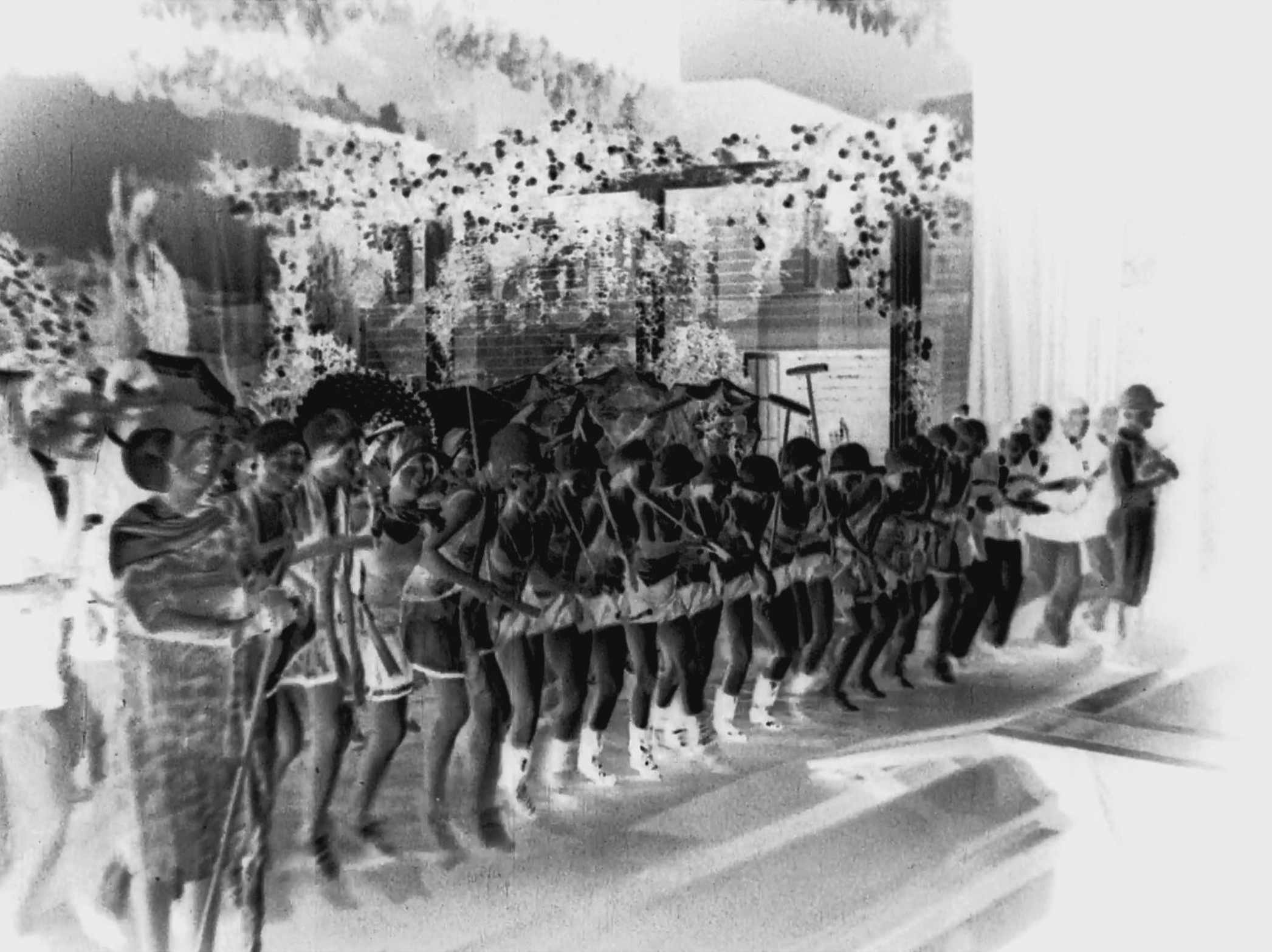
The harassment of the police forced Crichlow into becoming an activist. In response, on August 9, 1970, the black community organized a march in which 150 people protested police conduct. The police again provoked violence, and a number of the protestors were arrested and charged: Frank Crichlow, activist Barbara Beese, Triniadian Black Panther lead Altheia Jones-LeCointe, Trinidadian activist Darcus Howe, Rhodan Gordon, Anthony Carlisle Innis, Rothwell Kentish, Rupert Boyce, and Godfrey Millett. Their trial lasted 55 days, and though not all of the charges against the Mangrove Nine were acquitted, the trial became the first judicial acknowledgment of behavior motivated by racial hatred within the metropolitan police. It was a critical case in the British Civil Rights movement. For many children, “Mangrove” has created a connection to a time their parents may not have talked much about but that likely influenced their relationships. The present is imbued with sense impressions–wounds–of the past.

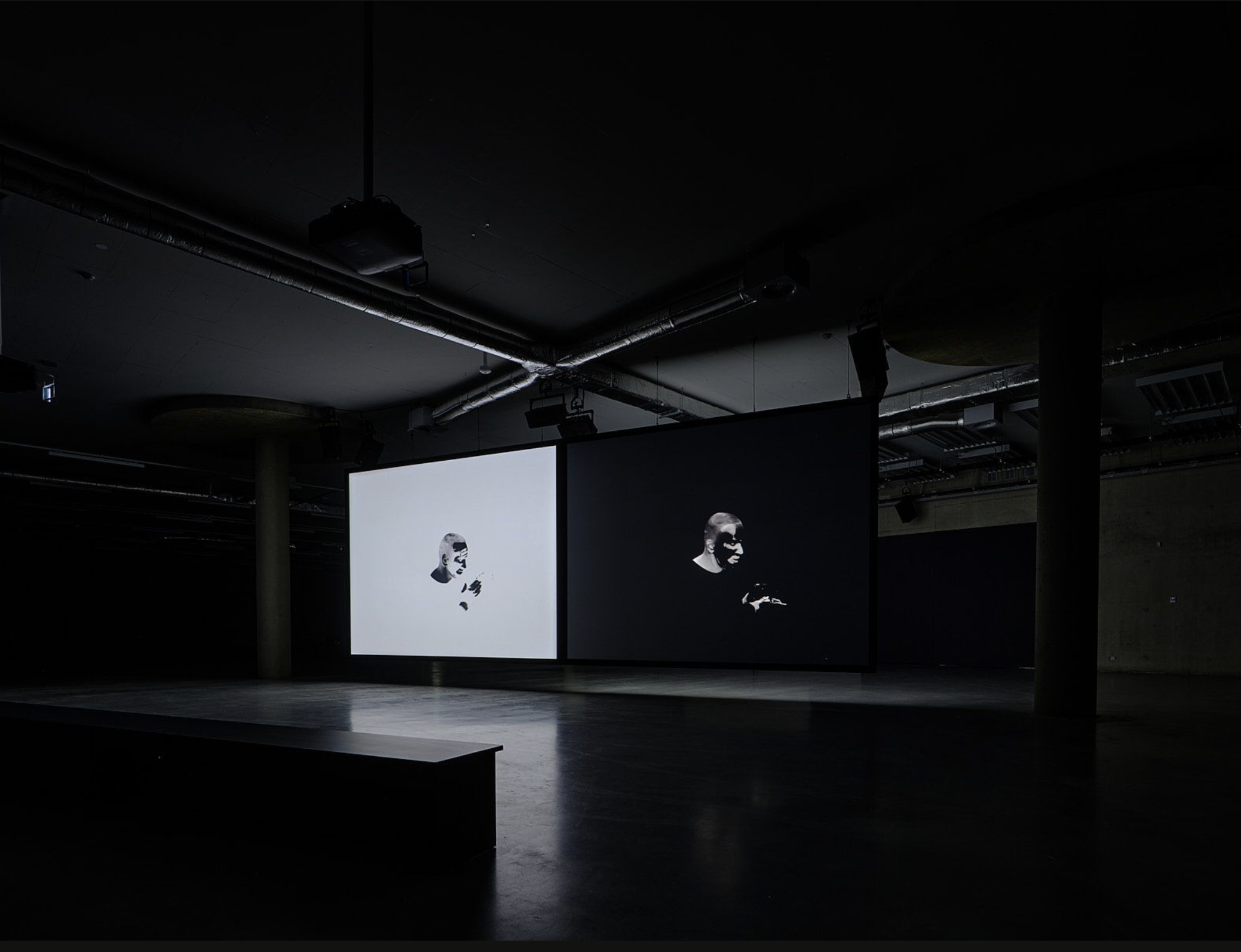
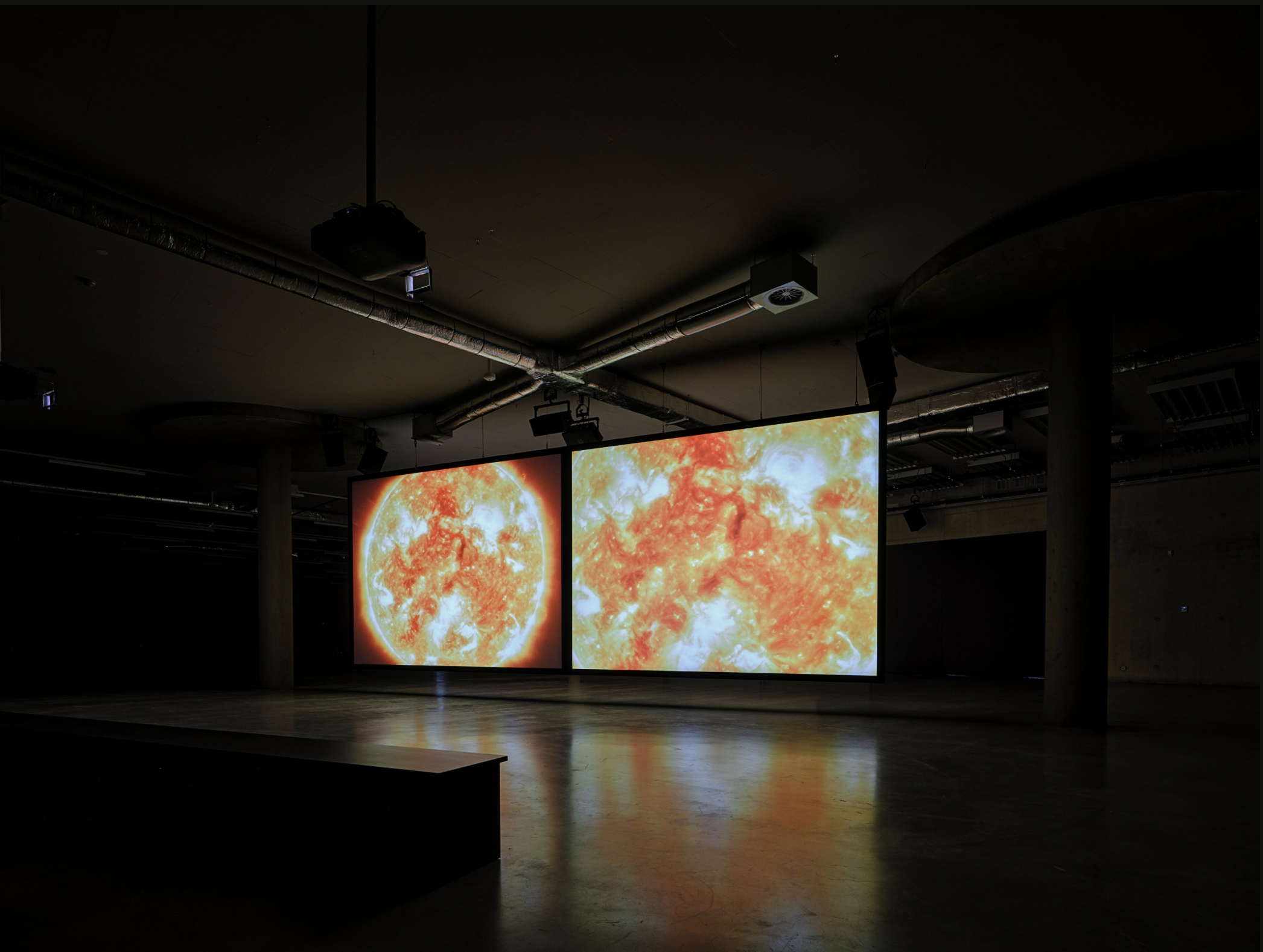
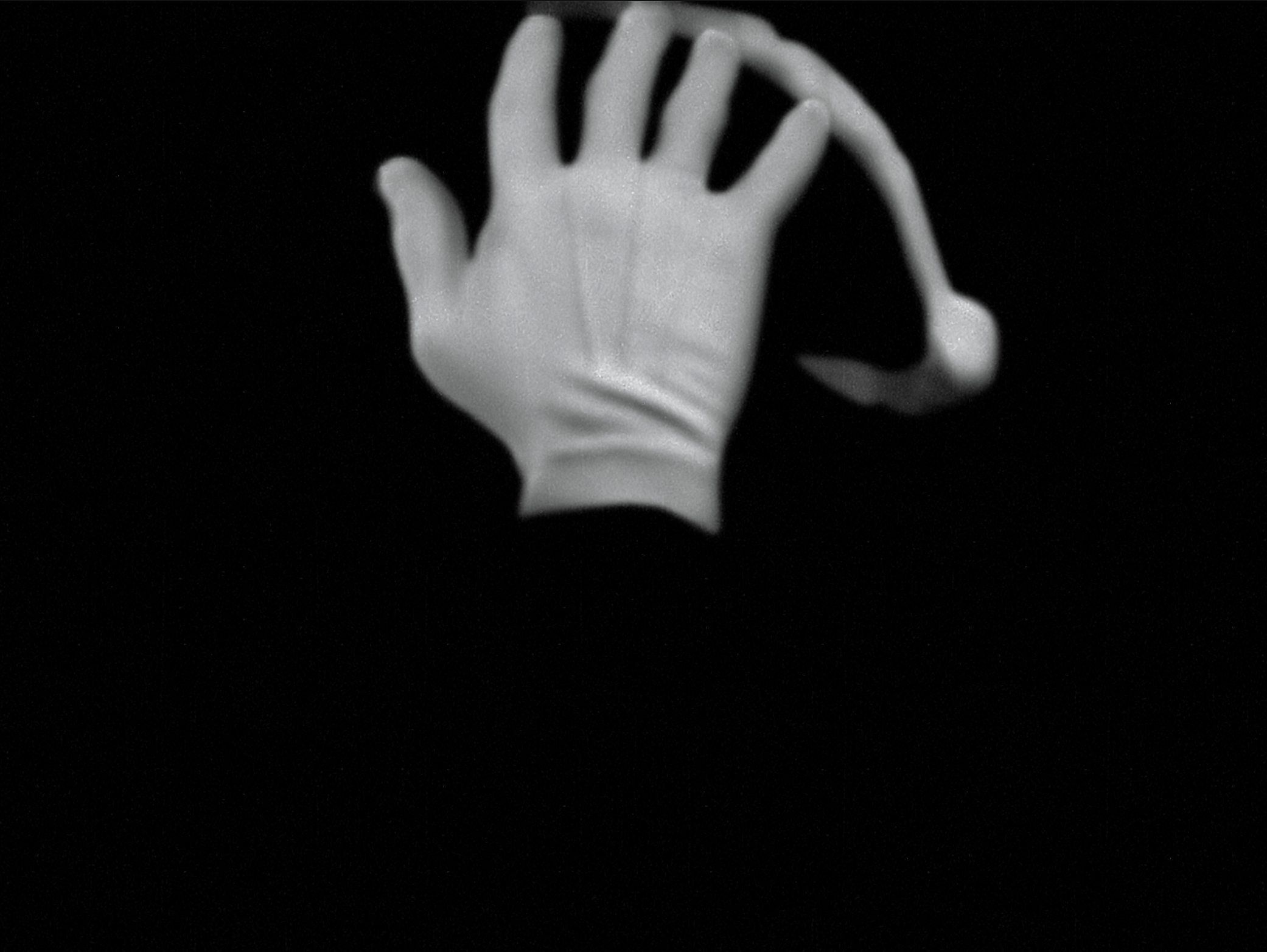
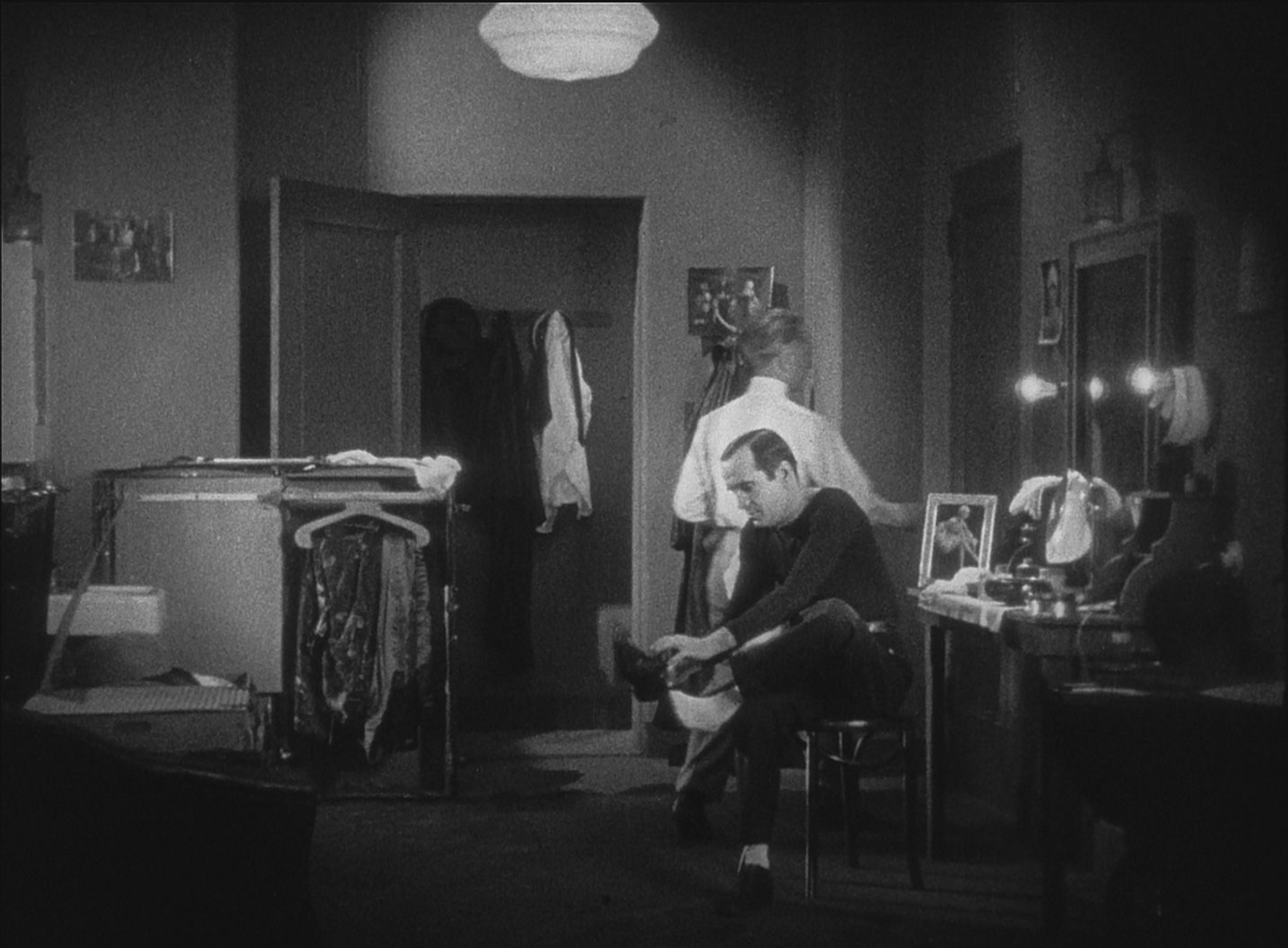
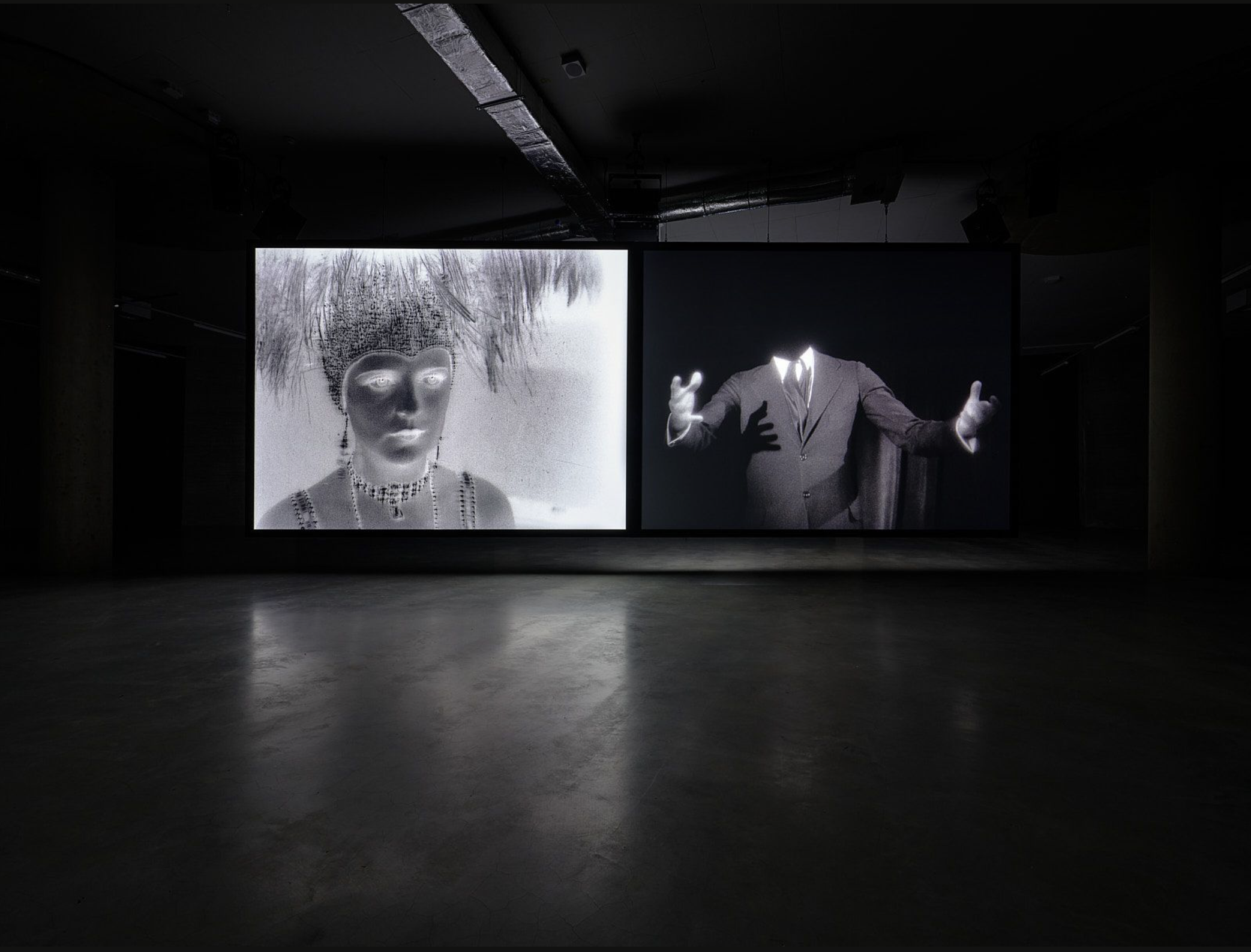
Steve McQueen’s latest artwork, Sunshine State, is weighted, ripe with memory material. In the two-channel video installation, projected on both sides of two screens, one placed beside the other, McQueen weaves the deeply personal with the historical. The work opens with footage of a burning sun and unfolds into scenes from the 1927 film The Jazz Singer, a musical drama and first feature length film with synchronized dialogue, the first “talkie.”  The film stars actor and singer Al Jolsen who is shown applying blackface makeup in preparation of a Broadway dress rehearsal. Against a black backdrop, the blackface is never actually shown. In McQueen’s version, only Jolsen’s suit and white minstrel gloves can be seen. The rest disappears; he becomes invisible. Juxtaposed with the black and white images of the Jazz Singer are video fragments of the blazing orange sun, a burning, breathing neon orb. Over the video is McQueen’s voice recounting a devastating story his father shared with him just before his death. The story is told in full, then repeated until fragmented, distorted. It is a life transforming story, like a door to a dark room opening to the sun.  His father was taken from the West Indies to work picking oranges in Florida, where a casual visit to a bar after work ended in traumatizing fatal violence.

It’s impossible to know to what degree this unknown experience, its memory, its wound, has informed McQueen’s art practice, but he has largely uncovered and shown a light on stories and people who were unseen, ignored, erased. There is liberation in being witnessed, in being seen, and through observing and absorbing, the invisible chords that connect us are fortified.  His father’s final words, “hold me tight,” are recited as a chant, a mantra to the sun burning on in a vast dark space. In an interview, McQueen asks himself what he discovered looking back on the years-long process of creating “Sunshine State”: “I suppose I was carrying shit with me…heavy shit, and I didn’t know I was carrying it. I think that weight is what I discovered, of what you carry with you, and I don't know if I’m lighter, but I’m more appreciative.”
Mike Kuchar

interview by Oliver Kupper
portraits by Pat Martin

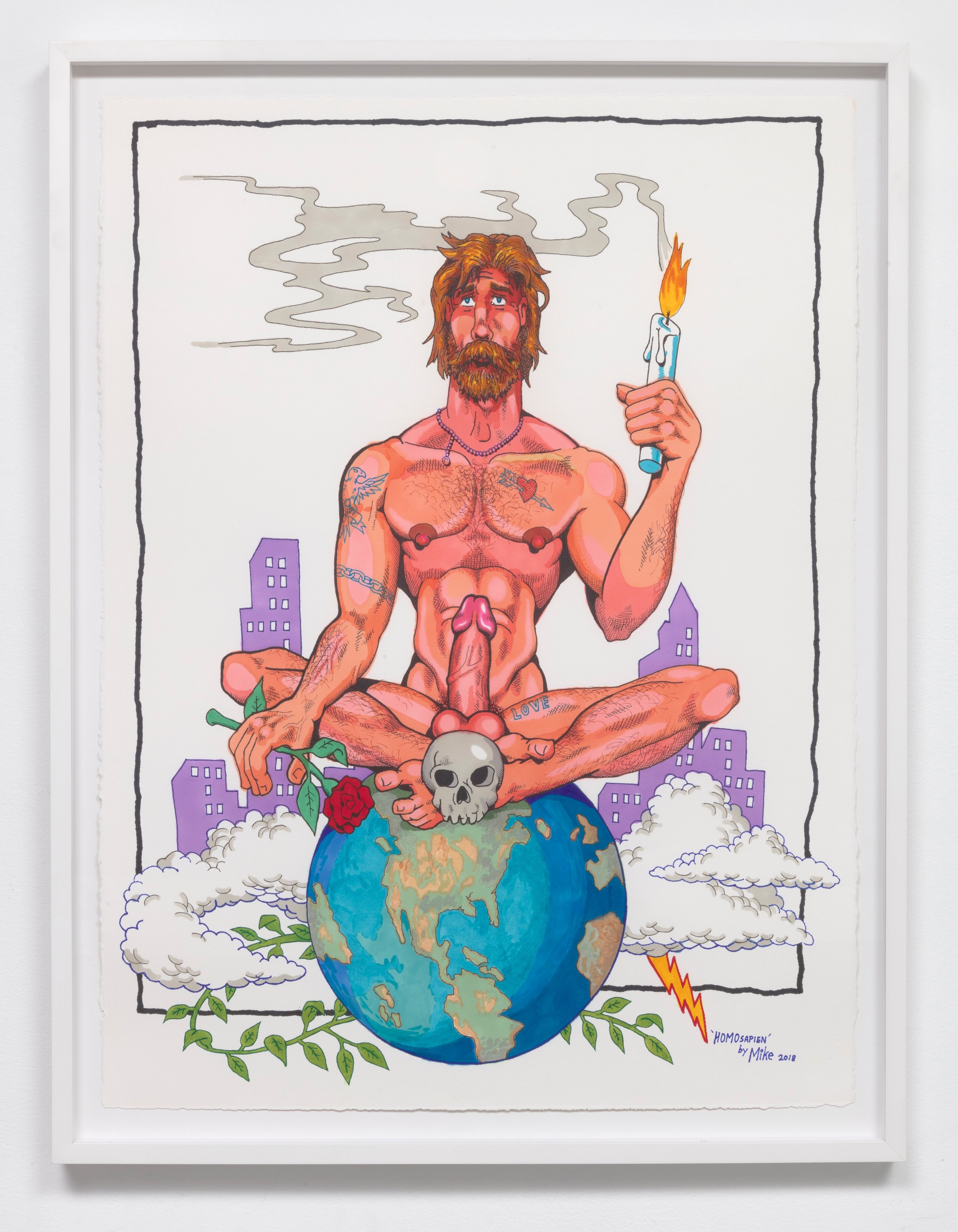
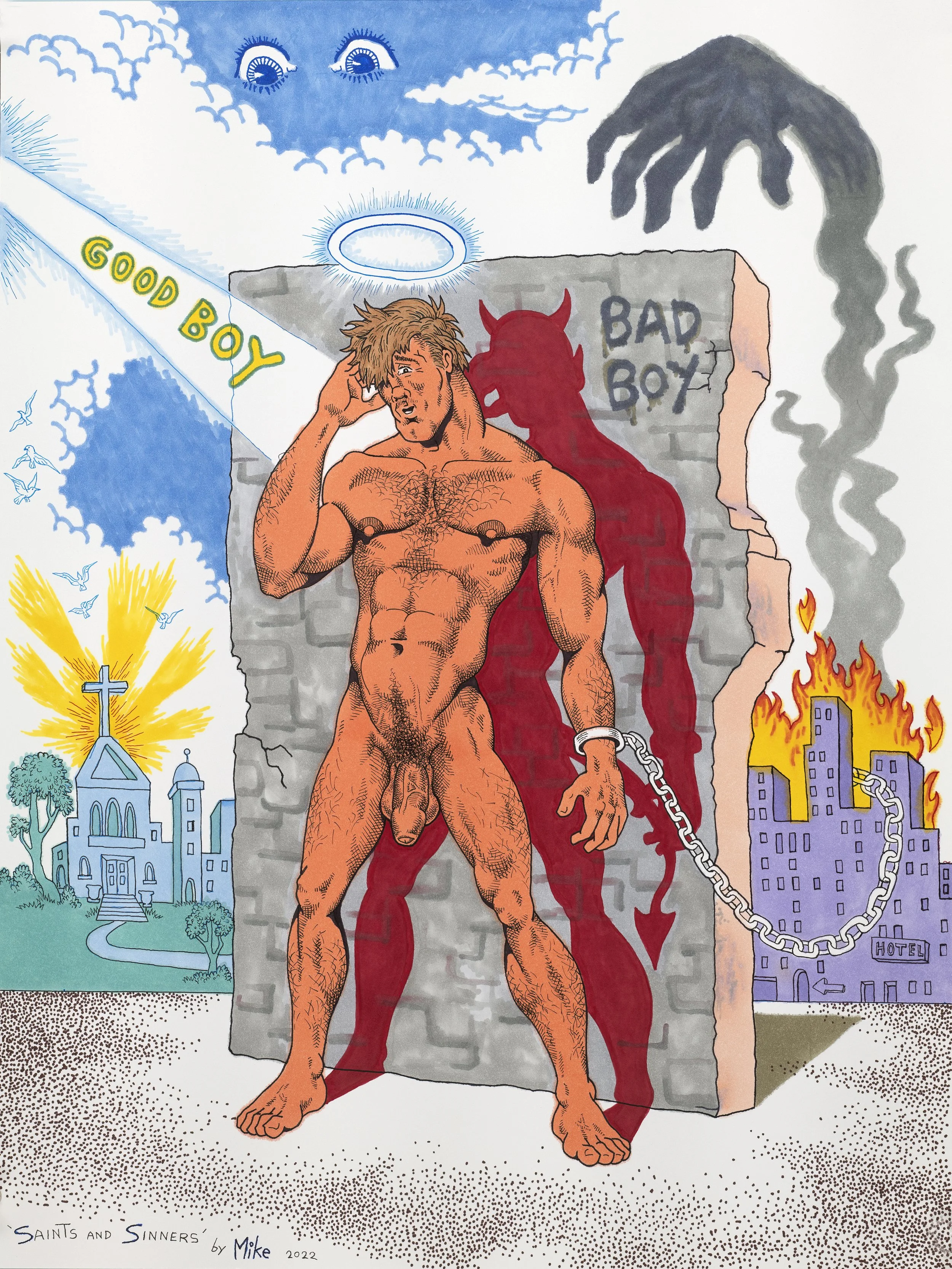
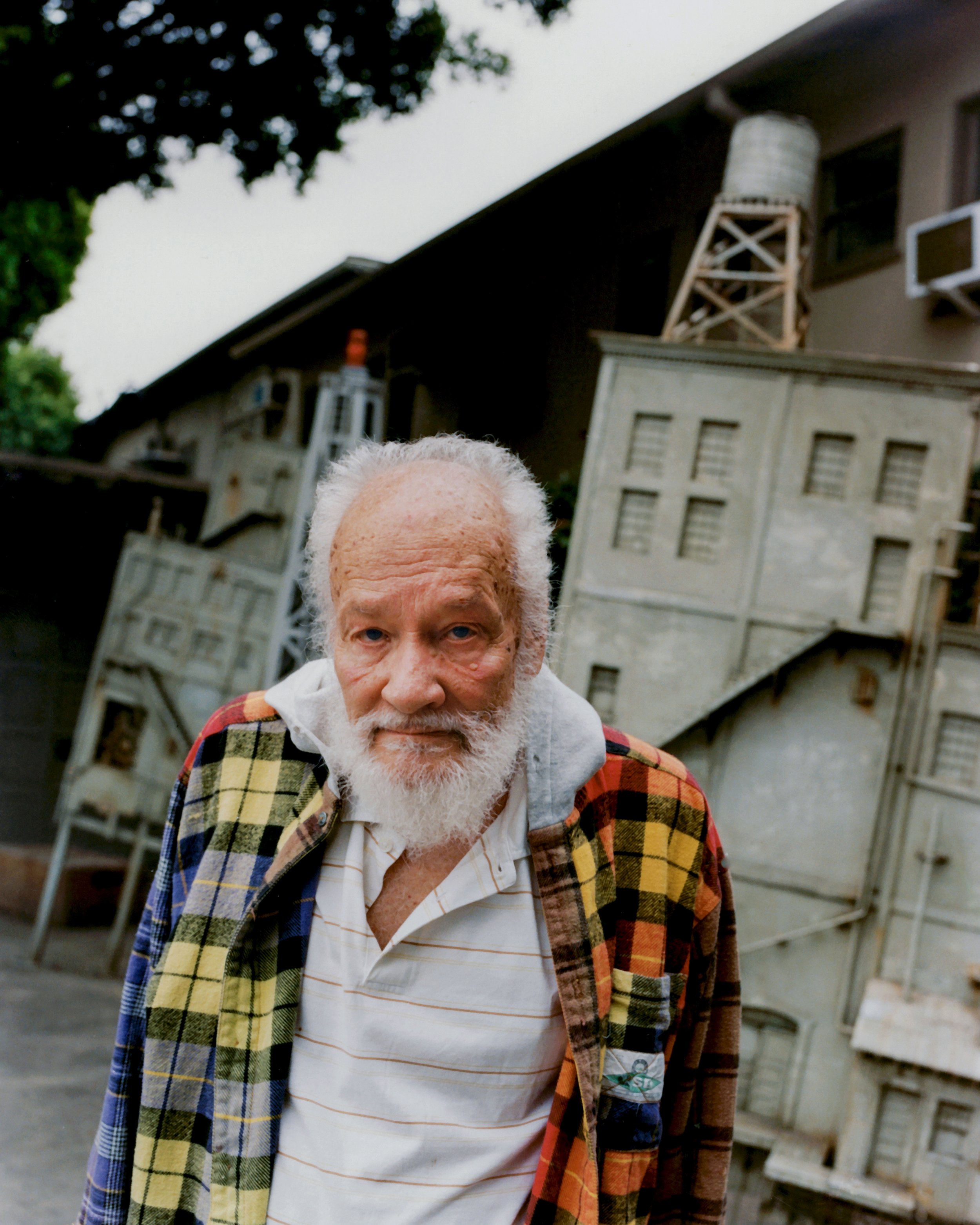
New York City in the 1960s was the cradle of underground cinema. Daring experimentations in celluloid were being made in the makeshift laboratories of urban lofts, on the streets, and on the water tower-dotted rooftops. Twin brothers, Mike and George Kuchar, were at the forefront of this movement, alongside Ken Jacobs, Maya Deren, Jack Smith, Jonas Mekas, and more. To support his filmmaking efforts, Mike Kuchar worked in the commercial art field and created erotic illustrations for the pages and covers of magazines such as Gay Heart Throbs, Meatmen, and First Hand Magazine. His drawings are drenched in hyper-saturated colors with flesh-toned muscle men in homoerotic scenes of science-fiction and Biblical epics. Today, he is still making films and drawings—many of which were shown alongside historical work during an exhibition, Big, Bad Boys, at François Ghebaly gallery in Los Angeles during the summer of 2023.  

OLIVER KUPPER When did your films and paintings enter this very libidinous place? 

MIKE KUCHAR It’s always been there. The urges, the drives, the desires—they’re inside me, they’re inside all of us. But, since I’m interested in playing around with mediums, I use them to express the drives, to get it out of me, and to reveal it; hopefully in a way that’s entertaining or captivating. Those libidinous drives are often the subject of the creation. It’s being taken out of oneself and put on the paper, or the silver screen, and presented to the outside world in a way that will hopefully be digestible, and in some ways entertaining. Using the gimmicks and language of the medium, whether it be paint or the camera, it’s materializing the urges.  

KUPPER It’s very instinctual.  

KUCHAR Putting it into a tangible form to be reviewed and experienced and told, but in a way where you stand back and look at it, to either be horrified or find it hilarious.  

KUPPER Or turned on. (laughs) When did you first discover this libidinous side of yourself? Were you scared of it or did you feel liberated? 

KUCHAR It had to come out. You can’t stop it. It’s there and it only gets stronger with age because the hormones are getting more fierce. It depends on who you’re working with or what interests you at the time. But, there are a thousand inspirations.  

KUPPER Your first films were made in your Bronx childhood apartment at around eleven and twelve years old with your twin brother [George]. What did your parents think of this? Were they supportive of these cinematic experimentations? 

KUCHAR They were domestic-minded folks. They just let us do what we wanted to do. Oh, actually, my mother kind of complained. We would sometimes use the bedspreads, or the coverings from the sofas as costumes and go up on the roof to shoot these kinds of Biblical epics. She would find out and get very mad. I remember she would go on a tirade. So, that was the only way she recognized interest in our movies; when we sort of disrupted the draperies in the apartment. But otherwise, they didn’t care. My father liked our movies—he was only interested in our movies because he liked some of the girls we had in the pictures. He’d sometimes ask if we could take some private pictures of them, but I wasn’t interested in doing that.  

KUPPER Was there religion in the home? Because there are a lot of Biblical references in your work. Did you go to church? 

KUCHAR Yes, we were religious. Our family always wanted us to go to church, but we didn’t go. My brother was more affected by the church, mostly attitude toward life and sex, and dealt with them in his movies. Sometimes, they’d border on sacrilege. He had a battle. But what affected me—I just liked the Biblical movies. I like them because of the costumes and sets. For me, going to church was a rather strange experience. It was really a temple full of masochistic imagery of suffering, and martyrs, and people chained, or nailed to things, like Saint Sebastian and Christ. It was such a strange mixture of sadness and eroticism.  

 
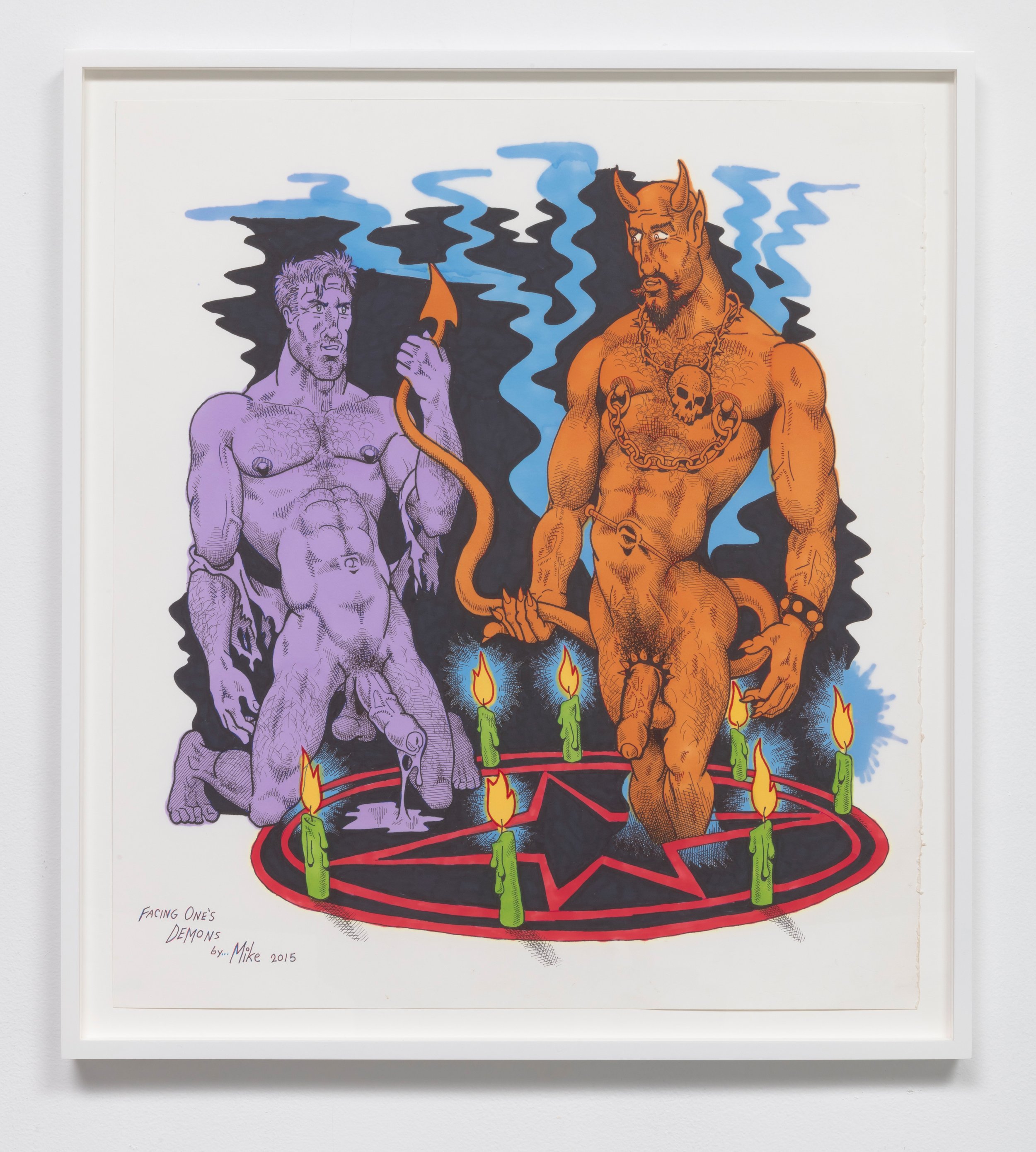
Mike Kuchar illustration demons

Mike Kuchar, Facing One’s Demons, 2015
Ink and Marker on paper
24.5 x 22 inches; 62 x 56 cm
Courtesy the artist and Ghebaly Gallery, Los Angeles


KUPPER It’s sort of what happens when you suppress these libidinal instincts.  

KUCHAR Yeah, it didn’t give me any guilt, though. It had a kind of haunting ambiance. My brother was more affected by guilt and salvation, and he had to deal with that and he did so in an often-entertaining and relevant way. 

KUPPER When you were making movies together, what was the creative process like? 

KUCHAR In the beginning, it was an activity, it was a sport. We’d get together, hold a party, and instead of putting on the record player and dancing, we were gonna make a movie. And everybody knew it. And we were all there to create a movie. And the people were there to act in it and to play characters. And then, when the picture was done we’d hold another party to see the finished product. As we grew older, it became something else. It was still movie-making, but it had a different process. You’d meet individuals and you’d create more controlled experiments of depicting inner drives, and inner feelings, and interpreting them into a movie. The directing was getting more internal and precise.  

KUPPER Did you and your brother share a twin language?  

KUCHAR No, the only thing we shared was equipment. He made his type of movie and I made mine. We were twins, but we actually had different temperaments. And then, of course, after we made the movies we’d show them to each other. 

KUPPER Can you talk about how instinct has driven your creative pursuits? 

KUCHAR Sometimes, the basic reason we create is not flattering. But what’s created from that urge grows bigger into something else, or at least that’s what you should aim for. It will begin to encompass something even greater, or something more important than the fundamental reason—just a basic kind of mood. A need. A basic need.  

Sometimes how I start making a movie is like being on a psychiatrist's couch. There are reasons why you place people in a certain way, and why you dress them in a certain way. And then, you begin to realize and analyze where it’s going. Very seldom have I made pictures where I don’t know the end. And a lot of times it has to do with the people you’re dealing with, or your feelings towards those people, which we then turn into a kind of bigger story, and then that begins to build into the structure of the picture.  

KUPPER I’m curious about how the underground movies of that time were brought above ground. Jonas Mekas was a big part of this process in New York. Where did you show your movies? How did Jonas discover your work? How did you meet him? 

KUCHAR There was a girl that we went to school with, it was in a poetry class. She said, “I know an older painter, let’s go over to his house, or I’ll tell him to come over, and we’ll make a movie.” So, we met this older painter and he said there’s something going on at a loft in lower Manhattan every month. Sculptors and painters would get together and show movies at night. This older guy said, “Why don’t we take your pictures and show some of the movies you made.” It was Ken Jacobs’ loft. They got a kick out of the movies. Ken Jacobs said, “Look, next month, come back and bring more of your movies. I’m gonna invite some other people.” He invited Jonas Mekas, who was writing articles about this underground film movement in The Village Voice. So, Jonas Mekas came, and he saw our movies, and he enjoyed them very much. He said that he opened an underground theater in New York and that they’d like to show them there. So, Mekas wrote a great review in his column in The Village Voice and showed our movies at his theater. 

KUPPER What were the first movies that you shared there? 

KUCHAR Pussy on a Hot Tin Roof (short, 1963), A Town Called Tempest (short, 1963), Born Of The Wind (short, 1962)…all done in 8mm.  

KUPPER And this was shortly before your first 16mm film? 

KUCHAR This was before, yeah. I found out about 16mm from other people in the underground, from seeing the others who were beginning to buy 16mm cameras. I got a bonus from a job, it was $250, I bought a Bolex. So, we upgraded our cameras to a bigger format.  

KUPPER And that was from doing illustrations in magazines? 

KUCHAR I had a job for a while in the commercial art field. I used to do photo retouching. I never went to college, but I went to a commercial high school. There were two art schools in Manhattan: High School of Music & Art, which was fine art, and The School of Industrial Art, which was commercial art. A teacher said to go to the latter because fine art is always tough in the beginning. So, I went to the commercial school, graduated with a portfolio, and ended up doing photo retouching in Harper’s Bazaar—with actual transparencies and dyes. It paid well, but I was never interested in it, so I couldn’t adapt to it. I was always a misfit within corporations.  

KUPPER Kenneth Anger passed away a few days ago…have you ever crossed paths? 

KUCHAR My brother knew him better than I did. They would get together during shows. I met him once in London. I happened to be in London to visit a distributor to see if there were any royalties for me and Kenneth Anger happened to be there doing the same thing. He came up and said, “Oh Kuchar, we finally meet!” And that was my only encounter with him.  

KUPPER There was a moment when he was in San Francisco with the Church of Satan and that whole crowd. You were in New York, but your brother was in San Francisco a lot earlier.  

KUCHAR I’d go back and forth. I was sort of a drifter and always had certain obligations. Eventually, I began to permanently live in San Francisco. But my brother was pretty well stationed there at the San Francisco Art Institute, which kept hiring him every year. He did that for thirty-five years.  

KUPPER You were both making art, but your drawings came earlier…can you remember your first drawing? 

KUCHAR When I was four years old, my father gave me a cigarette—he also wanted to know if I was interested in whiskey. I tried that and thought it was horrible. But one afternoon, he came in with a pencil and paper, and said, “Why don’t you draw us something.” And I remember the drawing I did: it was a stick figure with a hat. I was such a young child, but it seemed to be an omen of what I’d be interested in. I always admired comic book artists and I wondered if I could even come halfway close, so there was a certain urge in me to strive to draw something, even slightly close, like how they did it. So, I began to draw. But then, a freaky thing happened. Some guy was publishing a comic book and they needed someone to make drawings. This woman I knew recommended me. I gave a sample and they flipped over it. All of a sudden I had an assignment that would also give me a little money. So, that got me focusing on my drawing. My interest was now focused because I had to actually produce something. And then, it escalated—the comic book became successful for that publisher, so he kept asking me to do more. Then it got out in the world, and other publishers saw my work, and they somehow managed to contact me. The homoerotic became my specialty. It was no problem for me (laughs). I knew the subject quite well. I looked at drawing like my second career. And that’s what I became known for. I did get fan mail! And I’d get phone calls from strangers with heavy breathing…It was like voodoo. I would get these calls late at night and it was all because of the drawings. The drawings were haunting people.  

KUPPER When did color come into the work? Because in the ’60s and ’70s, it was expensive to do color in publications.  

KUCHAR The color came in later with the bigger, slicker homoerotic magazines. There was one illustrator who was really something, Harry Bush. He did all these kinds of vibrant teenagers and they would print his work more in color. But earlier, there was a publication called Physique Pictorial that was mainly black and white.  

KUPPER I want to bring up two things, which are artificial intelligence and the ongoing cultural war that we’re in now—there’s a renewed censorship going on with artists. One of your films, Sins of the Fleshapoids (1965), which told the story of robots in a nuclear holocaust, was extremely prescient.  

KUCHAR I didn’t give any thought to that picture. I said, “Okay, so this will sort of be my robot movie.” I might’ve seen some trashy poster about robots that are mimicking people and then I said, “Okay, I’m gonna do something like that.” Maybe it was that we unknowingly do things that are really prophetic. But that film was unconscious, I just thought it would be a colorful thing to work on. 

KUPPER During that time, a lot of those underground film screenings were being raided and negatives were being stolen, and people were being arrested just for showing their art.  

KUCHAR That was interesting, though, because then whole court cases came up and things were settled and became more open. But there had to be court cases and they had to deal with this stuff and that opened the gates for the culture to become more lenient or acceptable, and digestible. Then these films were being shown on bigger screens at bigger theaters, and even in museums. The MoMA had a big series on the underground cinema movement. They presented it to the more refined public in institutions that were bigger and revered, and legitimized. So, it slowly seeped in and was absorbed by the movie-making culture. 

KUPPER Did you deal with anything personally during that time in terms of being censored or raided?    

KUCHAR No, not my brother and I. Our films were like camp-y manifestations. We made them in studios, or in apartments, with people who wanted to be actors. We were hosting the artificiality, but it was not to destroy the tradition of movie-making. It was carrying on the tradition, but then it became something else. It became grotesque, or beautifully funny. 

KUPPER The one thing that sticks out are the characters’ eyebrows. 

KUCHAR My brother was very interested in makeup and seeing makeup on actors. Sometimes to make the scene work you change the shape of their eyebrows—it’s like a kabuki master—to make them look sad by putting the eyebrows like that. Their faces are canvases you can paint on, especially if they are female characters. The eyebrows even made non-actors look like they were acting.  

 
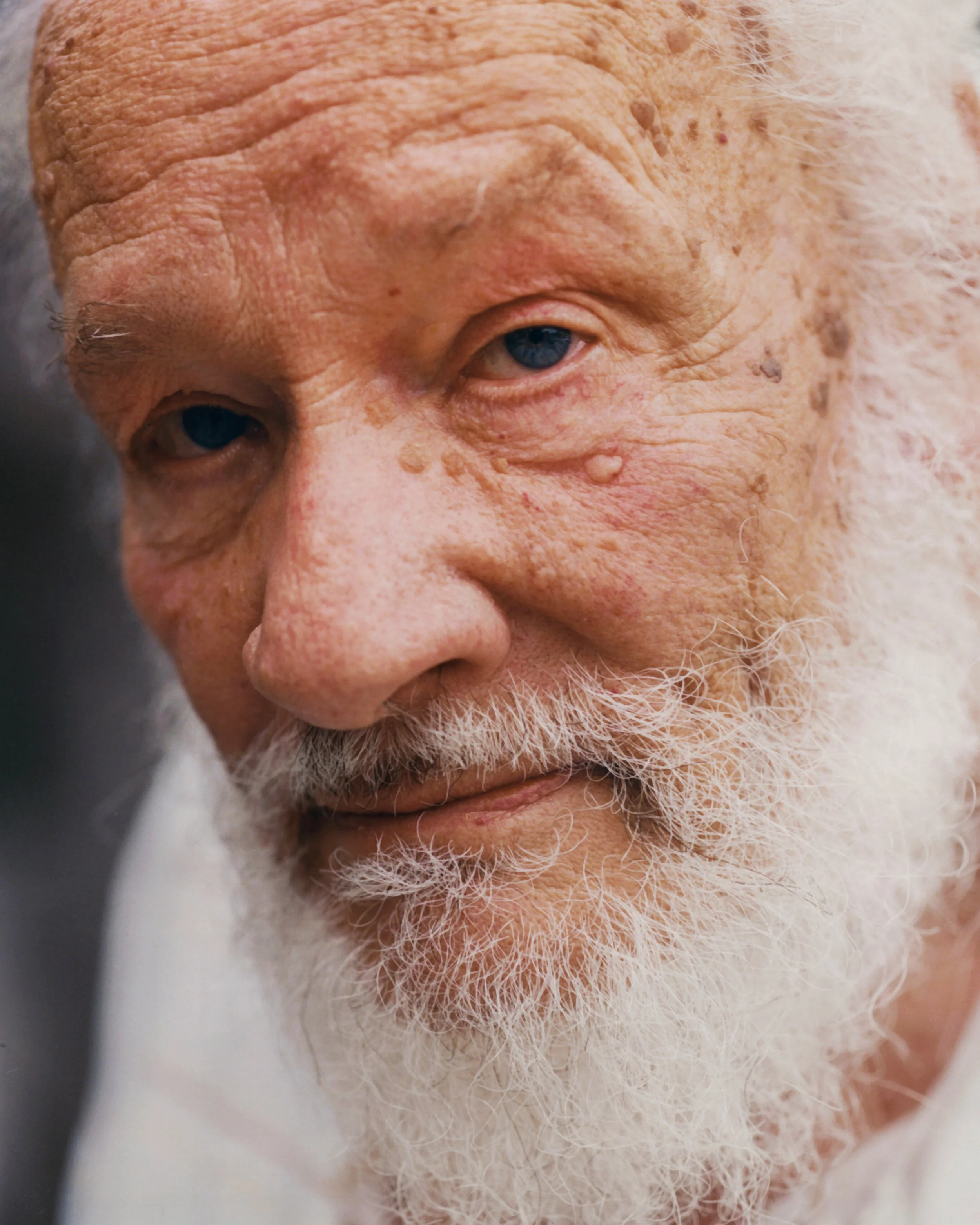
up close portrait of Mike Kuchar
 

KUPPER Your show at François Ghebaly is really interesting because it mixes a lot of new and older work. What was the organization behind this curation? 

KUCHAR Actually, it was up to the gallery. If they’re gonna put up money to house me, and fly me in, I said “Look, have fun.” I’m very happy they took an interest in my work. I mean, my brother and I have closets full of movies and it piles up. You can die, the landlord comes in, throws everything away, or the house can catch on fire. It’s interesting, but there are these institutions and places that somehow find worth in all the work and they wanna house it, protect it, and also make it available. It just happens. 

KUPPER I think a lot of your life has been led by intuition and it got you to the right place. 

KUCHAR It’s all chance. It’s because of our interest, we would just make movies no matter what. But it affected some people who thought it had worth and they wanted to preserve it. 

KUPPER Do you still imagine movies you want to make?  

 KUCHAR I do, of course. I made one last week. They’re more minimal. I don't have the versatility to do things. I’m too old. But that changes my style. You have to adapt to what you can physically do—I call them soul-searching pictures: people talking about their existence or certain problems. I try to make them feel like they have depth in the way they’re photographed, and the words used. 

Julian Charrière

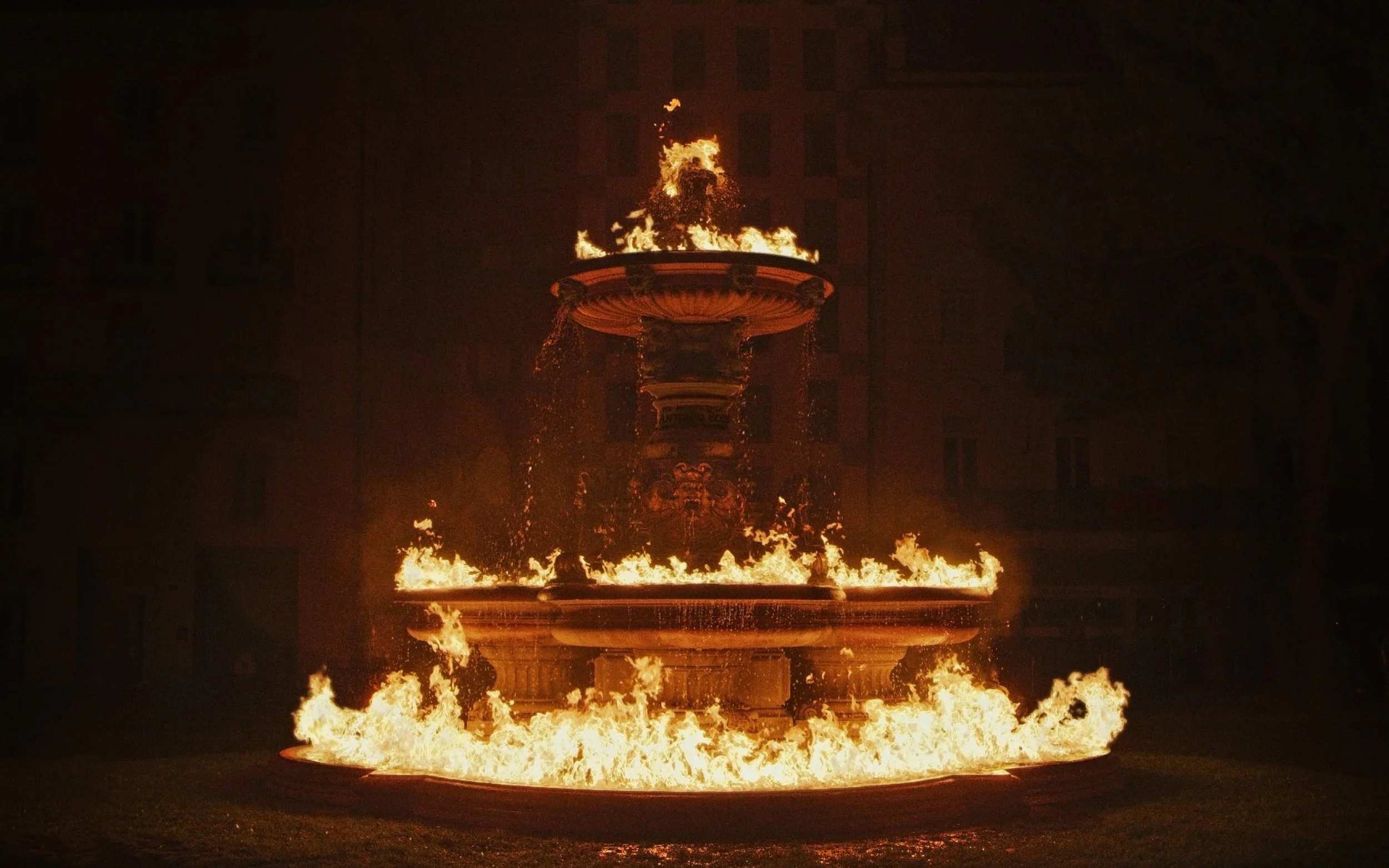
water fountain on fire

Julian Charrière, And Beneath It All Flows Liquid Fire, 2019
Video still. Copyright the artist; VG Bild-Kunst, Bonn, Germany

interview by Oliver Kupper

Traveling the world—from Greenland to Bikini Atoll—French-Swiss artist Julian Charrière captures the debris of human impact on Earth. Using myriad mediums, he exposes the layers of sedimentary scar tissue as a result of our unbridled ambition to conquer nature, and decodes the ecological algebra within its complex systems. Balancing anthropogenic and cosmic time scales, he fuses fine art and scientific practices to discover where we fit into this ancient equation. In Buried Sunshine, which will debut this fall at Sean Kelly gallery in Los Angeles, he explores the fraught history of oil extraction in Los Angeles; the world’s largest urban petroleum field. Using heliography—one of the oldest photographic techniques using light-sensitive emulsion incorporating tar from La Brea, McKittrik, and Carpinteria Tar Pits—he creates an abstract aerial view of the wastelands. Charrière’s oeuvre asks eternal questions: how did we get to now and will we survive tomorrow?

OLIVER KUPPER You are currently in Greenland; can you talk a little bit about what you are doing there and why the country is so important in your practice?

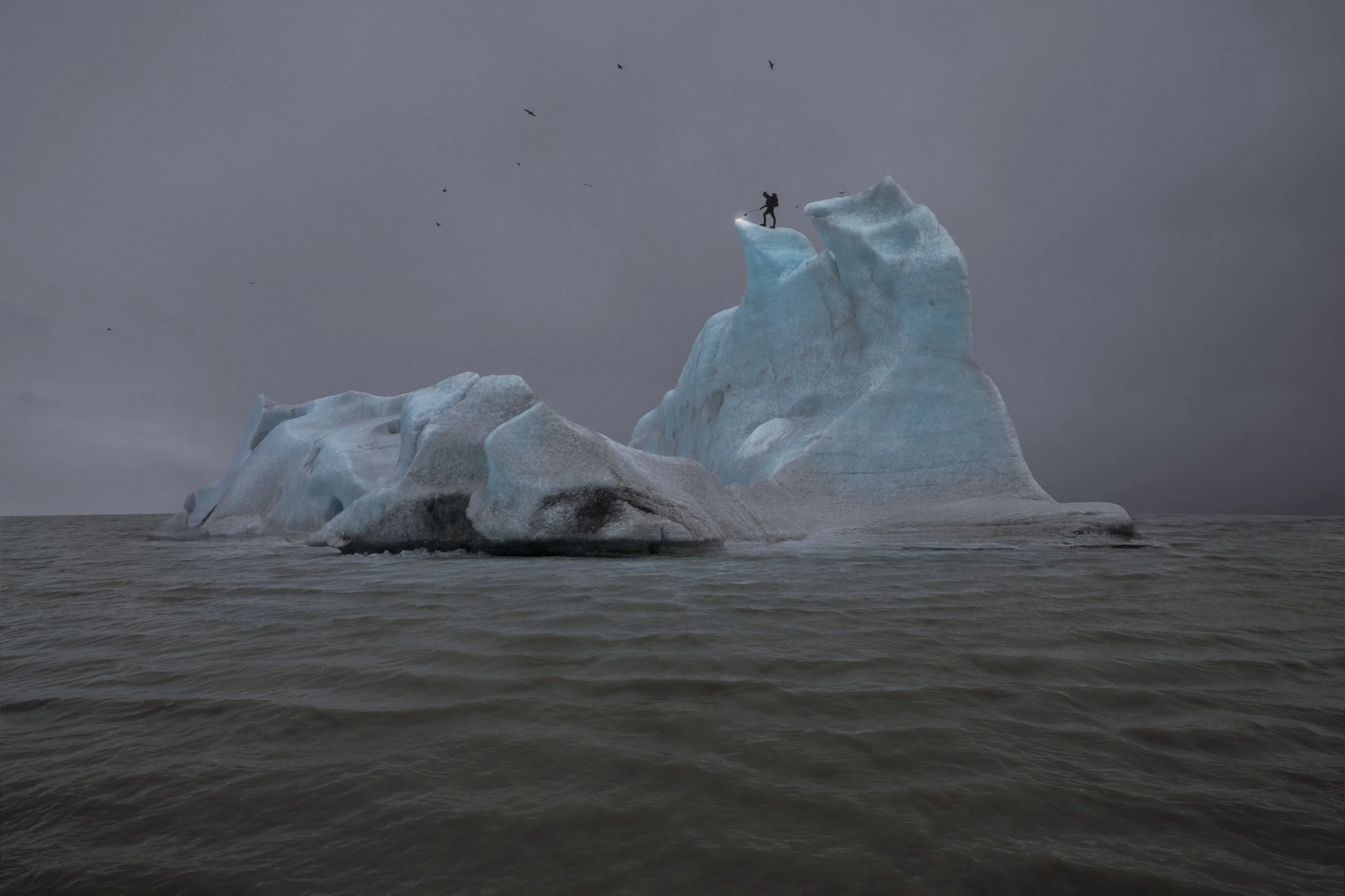
JULIAN CHARRIÈRE There is something about the topography of Greenland, or perhaps the lack of topography, which I am drawn towards. Without trees and houses, the landscape itself is a blurred boundary between sky, and ice, and land. Even circadian rhythms come undone there since the planetary tilt delivers entire seasons of white light and then months of uninterrupted darkness. I am traveling there with a scientific expedition, joining the scientists on a journey around East Greenland. During this time, we live on an icebreaker and trace the coastline, allowing samples to be collected from otherwise difficult-to-reach locations. For me, it marks the first step of an upcoming project, for which I am trialing a new ROV (remotely operated underwater vehicle) in the icy surrounding waters. Filming below the surface of the Greenlandic Sea, you quickly realize that global warming is not only causing glaciers and icebergs to disappear, but that with them entire oceanic ecosystems dissolve.

KUPPER The theme of this issue is instinct. I think a lot of artists unleash their instincts, or unlearned impulses, to drive their creativity. What does instinct mean to you and how does it drive your work, especially when it comes to your immense, adventurous spirit?

CHARRIÈRE I think instinct plays an integral role in my output, fused always with curiosity, though I would maybe describe it more as intuition. And honing that is part of what makes artists capable of approaching ambiguous, complex, and dense topics, which might otherwise seem daunting. Even when encountering something opaque, you can instinctively choose a thread to pull on or descend into a certain rabbit hole, guided by the voices that echo from within it. My intuition has, at times, unleashed an instinct leading me down some very strange paths. From polar ice sheets to the depths of palm oil plantations, these are locales that at first glance might seem remote or liminal, until you arrive and realize that these are places. They are as much homes to the human and non-human animals who live or lived there as your home is to you. Of course, it is exciting to dive in the Bikini Atoll and see the hulls of warships sunk by the US during nuclear tests in the 1950s, but the adventure is secondary to the encounter with that history, and especially how we relate to it today. The first instinctual spark of curiosity is almost gravitationally connected to that physical encounter, tethered to it like those distance lines cave divers follow in the dark, leading them through the unknown. You feel there is something beneath or beyond—some long-forgotten history, or fate, or lively material shuffling around—and so you listen to your gut, and look beneath the rind, and see what you can maybe bring into the light.

man on glacier in the sea

Julian Charrière, The Blue Fossil Entropic Stories I I I, 2013
Copyright the artist; VG Bild-Kunst, Bonn, Germany

KUPPER When did you become interested in the natural world and when did the ecological enter your artistic lexicon?

CHARRIÈRE Even from an early age I was interested in immersing myself in my surroundings, and so I spent a lot of time in the natural landscape interacting with snakes, and frogs, and birds, and plants. It has always felt like an integral part of my being and how I evolved in the world. As a kid, it wasn’t so reflected, and this idea of immersion and encounter only began fully developing when I started studying art. It expanded into this idea of meeting a particular landscape, rendering it a tool for thinking about how we think about ‘nature’—how it is framed as a milieu, or a system, or whatever. In terms of environmental perspectives, this is almost always present, since when you investigate such topics you almost inevitably arrive at the ecological meltdown which looms ahead.

KUPPER The summer of 2023 was the hottest in recorded history. Your work deeply explores the impact that humans have on our natural world and landscapes, why don’t you think our survival instinct kicks in with these dire warnings about the planet?

CHARRIÈRE Complacency is a tricky thing. But I think it is critical to examine who is responsible for the situation we are in and what one can conceivably expect from individuals. It’s like how British Petroleum in the early 2000s popularized the expression ‘carbon footprint,’ devising a marketing campaign that bestowed upon us the idea that environmental pollution is the responsibility of private citizens, rather than the oil companies. More so than asking why our survival instinct hasn’t kicked in, maybe we can investigate the often-reciprocal relationships between political systems and corporations. How can we require scrutiny and transparency? How can we build platforms and communities or even start conversations about the industrial actions that, while conducted out of the public’s view, will have devastating consequences for our planet? One of the reasons why I think our response may appear so apathetic is because climate change is vastly abstract. Our human reaction time is incompatible with it, making global warming feel fast and slow at the same time. It only becomes somewhat tangible when you encounter it firsthand: when your commute to work is flooded, or your house is engulfed in fire, or a garden that was once abuzz with life is dead quiet in midsummer. I think one strength of art is that it can be used to countermand this kind of apathy by exploring challenging topics and uncomfortable feelings; deconstructing the arbitrary and systemic, thus perhaps providing tools for dealing with the terrifying uncertainty that might otherwise shut us down emotionally.

KUPPER Do you feel there are too few artists leaving their studios to tackle these major issues of our time? Is a studio painting practice self-serving in the age of the climate crisis?

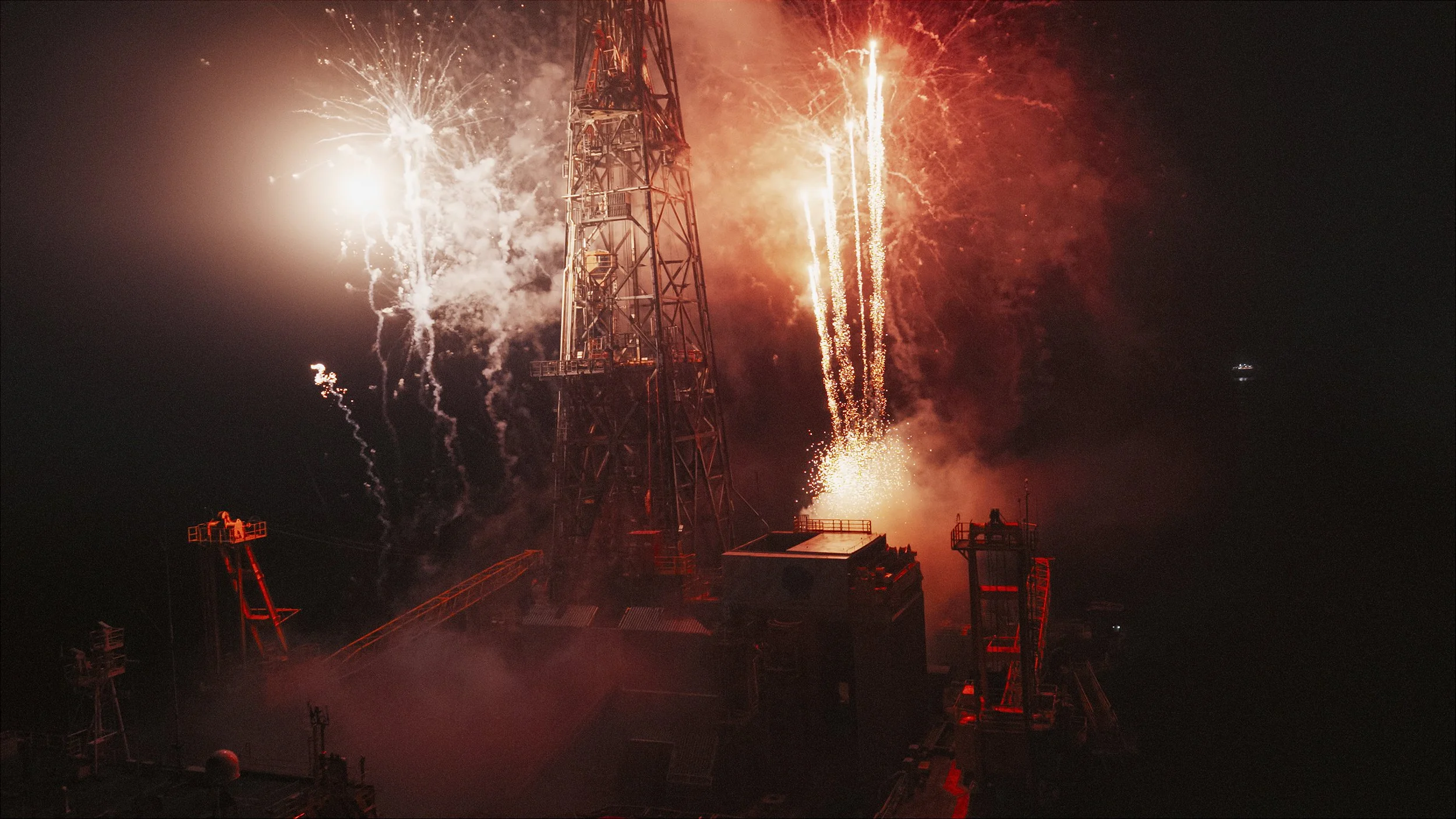
CHARRIÈRE No, I wouldn’t say I feel that way. A painter should paint, whereas another artist might need to travel to dream. It would be reductive to art as a vocation if there was pressure to conform to political themes, even if those themes are urgent ones. And really, how interested would we be if every artwork we experienced was didactically about climate change? In my works, there are often environmental themes present, but these are often enmeshed in other perspectives as well. With my latest film Controlled Burn, for instance, the meta-layer is very much about extractivism, visually foregrounding the buildings we construct and spaces we carve out for energy production. But while it features a power plant cooling tower, an abandoned open-pit coal mine, and a towering ocean oil rig, it also explores other things beyond environmental degradation. In the film, you soar through reversing pyrotechnics, mirroring the intense power released by our terraforming. But it is also about the past biomes that now constitute our coal, and petroleum, and natural gas: the Carboniferous woodlands that outgrew themselves and condensed in the earth to what we now repatriate as resources. It is not explicitly about tackling a major issue but acts as a cosmic meditation on energy transformation. Someone could argue that what we need are more explicitly environmental works, but art often operates in less obvious and more ambiguous ways, and that is a strength.

KUPPER Fire has been a central theme in your work, but also ice and glaciers. There seems to be a fascination with the primordial and the elemental. Where did this fascination come from and what is the symbolism of fire and ice?

CHARRIÈRE Our history with fire, but also the history fire has with our planet, was something I delved into recently for my exhibition, Controlled Burn, at the Langen Foundation. It foregrounded one of the reasons why I am interested in these kinds of biochemical processes: the fact that they have fates of their own, often long predating our hominid entry onto the planetary scene. The first fires emerged from the very properties of life. To paraphrase the fire ecologist Stephen J. Pyne, the story of fire is the story of oxygen and plants. Without either, the ignition of lightning would never flourish into flame. So, as life ascends from the seas and begins to grow on land, we also encounter the earliest flames, with the earliest record dating from charcoal in rocks some 420 million years ago. This was in part an inspiration for Panchronic Garden, which is a dark and crackling installation in the show. Set in a reflective and coal-based scenography, it figures ancestral plants to those who lived during the Carboniferous era. Entering this smoldering coal seam, the visitor can listen to a real-time soundscape produced by the ‘umwelt’ experienced by the vegetation in the space. Now and then, a fluorescent flash erupts in the space—perhaps the ignition of that first coming-together of the components that necessitate fire. But then, sweeping through that deep time, we arrive in the era of humankind. Fire integrates into our agriculture, and then to a degree manufactured in our combustion engines, not only burning the raw materials of the present but the lithic landscapes of the past. Oil, and coal, and natural gas are extracted and burned for fuel, warming the future. In my work, I am drawn to investigate these cycles and systems, with which our idea of reality is inextricably linked. Ice too holds histories, suspending within it registers of past atmospheres, yet for us living in the so-called Anthropocene era, the icebergs, and ice sheets, and glaciers also act as clocks, physically counting down towards an uncertain future. There is also the paradoxical situation where neither state is particularly compatible with human beings, both ice and fire are entities with which our bodies cannot cope—thus confronted with agencies beyond our immediate control.

fireworks at night

Julian Charrière, Controlled Burn, 2022
Video still. Copyright the artist; VG Bild-Kunst, Bonn, Germany

KUPPER One of your most symbolic works is And Beneath It All Flows Liquid Fire, which adds another layer of symbolic meaning. Can you talk about this iconic work and how the fountain is connected to civilization?

CHARRIÈRE Alongside the control of fire, the fountain represents one of the most fundamental achievements of human civilization, since the invention of wells shifted us from a nomadic lifestyle to a sedentary one—in turn giving rise to agriculture and thus sowing the seeds for future industrialization. As a symbol, it has this rich and poetic history, from the original spring fountain where it provided vital water, to the ornamental versions that publicly displayed not only the technical achievements of the jets, but the power and ‘overflowing’ wealth of those who could afford to install them. In this sense, And Beneath It All Flows Liquid Fire is a memorial of anthropogenic hubris; our belief that the natural world can be dominated and natural elements controlled. But it can be interpreted in many ways, with the presence of fire anachronistically engulfing it, pointing to the nether realms beyond our purvey. How beneath the political debates, philosophical reflection and symbolism, there lies the original and autonomous state of the planet, free from human interpretation. How deep beneath the Earth’s surface, between the outermost crust and the inner core, magma constantly churns. I was interested in juxtaposing this uncanny underworld, where liquid fire constantly flows inside of a recognizable structure like the fountain. And while I wanted to point to the ambiguity of fire, a power which, like us, is capable of both creation and destruction, it is maybe unavoidable in the current climate of erratic wildfires and rising temperatures for the work not to feel a little like an omen.

KUPPER Not only has this summer been blazing hot, but there has been a renewed concern with nuclear devastation—can you talk about your experimentations with atomic energy?

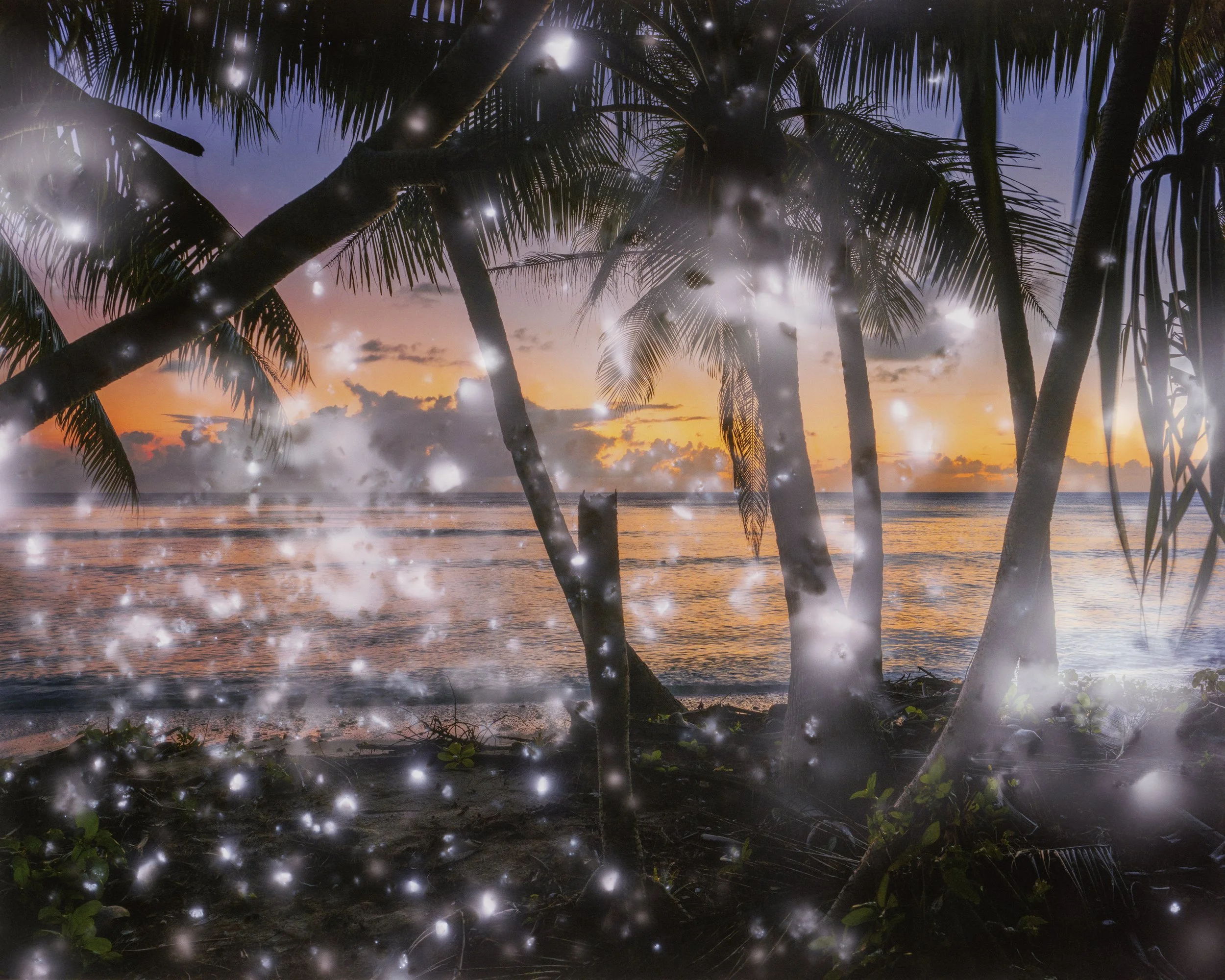
CHARRIÈRE In a way, our belief that we can control elements, as with water in the previous question, becomes truly unhinged when we begin developing nuclear weapons. As we are no longer trying to command simply an Earthly element, but the atomic power housed by stars. I first began working with radioactive materials in my series Polygon. I traveled to the Semipalatinsk Test Site in Kazakhstan where the USSR conducted its nuclear tests. In the production of the photo series, the negatives were exposed to local sand, which was still radioactive from the site. Though invisible to the human eye, the radioactivity seared bursts of white light onto the final photographs. I returned to this method in a more expansive project where I, together with curator and writer Nadim Samman, journeyed to the Marshall Islands; to the atolls where the U.S. detonated some of the world’s most powerful nuclear weapons in the 1950s. It especially focused on the Bikini Atoll—a now deserted but once-populated island whose citizens were displaced by the tests. It is easy to think of this tropical island as remote, situated on the very edge of the world, but it was very much home to the Bikinnians. Even after some half-hearted clean-up efforts by the Americans, it is completely unlivable with the ground still containing the radioactive substance cesium-139, effectively poisoning any locally-grown produce. The world quite quickly forgot about the people on these atolls whose legacy fell by the wayside of the spectacular images the US took of the detonations. A large part of this military project was about visually documenting the violent potential of the US military; a way to disseminate its power through media. In a sense, I too documented this action with my photo series First Light. It was not an encounter with the thermonuclear reactions, but rather a portrait of the white shadow eternally expanding from the events themselves. A meeting with a cosmic specter who still haunts the beaches: the radioactivity forever crackling on the atoll. It is strange, of course, to think how much and how little has changed since. Returning to political conditions similar to those of the Cold War, it is hard to not feel like we are reaping what we sowed during that first nuclear arms race.

starry palm trees by the sea

Julian Charrière, Hickory - First Light, 2016
Copyright the artist; VG Bild-Kunst, Bonn, Germany

KUPPER Can you talk about your upcoming show, Buried Sunshine, at Sean Kelly in Los Angeles?

CHARRIÈRE With Buried Sunshine, the aim is to bring together a mise en abyme of the geological materials, especially those which we utilize as tools and resources. A large part of the show is also about prying at the veneer of Los Angeles, which is the world’s largest urban oil field. It includes the aforementioned film, Controlled Burn, and a new series of heliographic works with which I wanted to unearth some of the fossilized sunshine upon which the mythos of the city is constructed. Because when you think about it, Los Angeles is a spatial anomaly, built both on top of and by hydrocarbons. Without the overwhelming abundance of oil, the film industry boom might never have exploded as it did. And to this day, one-third of residents live within a mile of a drilling site, yet those derricks are whimsically hidden behind shopping malls and artificial buildings, forging a contradictory paradise, as much a nightmare as a dream.

The heliographs, named Buried Sunshines Burn are made using one of photography’s oldest techniques, first developed by French inventor Nicéphore Niépce in 1822. It is a production method I first began experimenting with for my series A Sky Taste of Rock in 2016. To make heliographs, you use a light-sensitive emulsion, made in this case with regional tar collected from the La Brea, McKittrick, and Carpinteria Tar Pits in California, creating photographic imprints of local oil fields on highly-polished, stainless steel plates. Shot from a bird’s eye perspective, it shows the immense Kern River Oil Field in the San Joaquin Valley, the Placerita and Aliso Canyon Oil Fields in Santa Clarita, and the giant Inglewood Oil Field, which from this point of view become abstracted, coiling like oil spill through reality. Presented alongside these new works are the sculptures Thickens, pools, flows, rushes, and slows, which consist of large pieces of obsidian. The material is a type of volcanic glass produced from congealed magma during eruptions, and when you look into its seemingly depthless interior, you see why, historically, many cultures used it for divination.

With the show, I sought to contrast the dark vitality of these materials, from obsidian to coal and petroleum, with the colossal nuclear fusion of the sun: the celestial ignition for our planetary machinery. I wanted to suspend the visitor like a speck of dust in this cosmic sunbeam, revealing how light is not as immaterial as we believe. But rather show it as a topography, reaching from the silver lining of our exosphere to the deep carbon orbiting Earth’s core. It not only shines but sediments, registering in the strata much like a camera captures an image on a light-sensitive surface. It too is a photograph, opening portals to other places and times far beyond the present.

Martine Syms


text by Estelle Hoy
photographs by Kennedi Carter
styling by Julie Ragolia
styling assistance by Kaylee Gibson


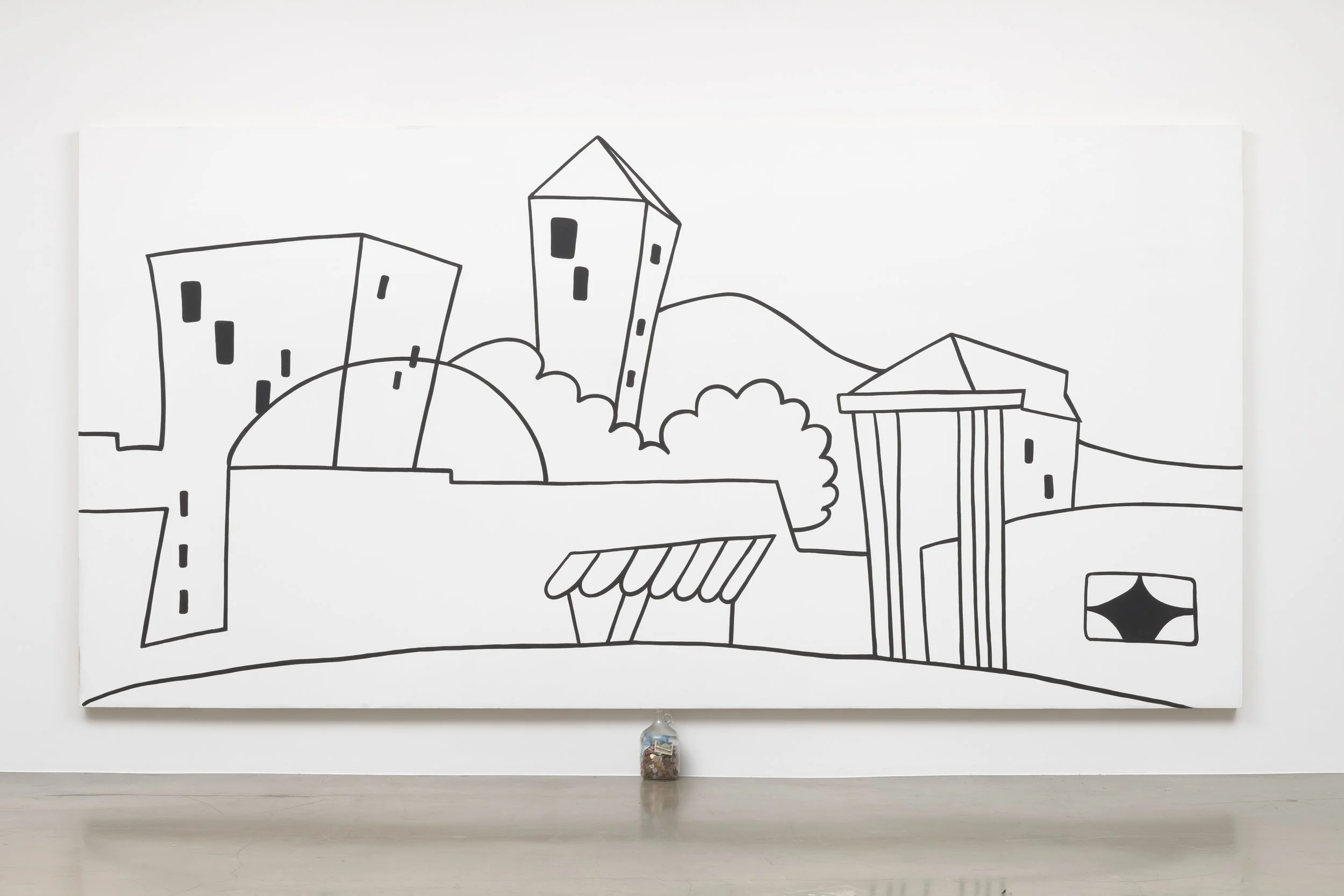
Martine Syms
Belief Strategy XVI (2023)
Wood, screws, glue, paint, glass jar and mixed currency
96 × 192 inches
© Martine Syms
Courtesy Sprüth Magers
Photo: Robert Wedemeye

She’d Do Well to Drown
Loser Back Home
Martine Syms (*1988, Los Angeles) 
June 2-August 26, 2023
Sprüth Magers, Los Angeles 

“Why can’t I do what others have done—ignore the obvious. Live a normal life. It’s hard enough just to do that in this world.”― Octavia E. Butler, Parable of the Sower

There’s something quite arbitrary about the idea of home, but to the degree that this arbitrariness is the shape of the space we inhabit, which looks very logical, even matter-of-course. Mostly ideas that appear ‘matter-of-course’ to our contemporaries are how we know something instinctually lunatic is going on. Refusing to fuck-up the Altadena census, lavishing endless attention to detail on surface proportions as if a building or space were an occasion for plausibility, is California-based artist Martine Syms; her magnificence of diction through video, performance, publishing, and installation makes clear what we already know to be true; home is a privilege for some. It’s depressing. Our actions are self-conditioned psychological phenomena rooted in human nature that reveal elements of our deepest laws associated with shape, place, belonging, possession, and their every supine iteration. Survey polls are for fucking losers, (usually) white (always) men who believe there’s a semblance of consensus in a census. Systematically acquiring information about where and how we live is an archaic, utilitarian convention that collects the artistic façade of space and time. Displaced people cannot form a viable, representative sample of a hometown if they’re not there to check a box to begin with. It’s a small mess.

Through the halitosis stink of white men holding purple clipboards with transparently unlikely answers, Martine Syms issues a rule change that might restore the mental stability of those excommunicated physically and psychologically. In Loser Back Home, her first solo show at Sprüth Magers, Los Angeles, Syms premieres her latest works in video, sculpture, painting, and photography, collating data about dysplacement—a term extemporized by American historian and Black rights activist Barbara Fields. In her effectual theory of Dysplacement, Fields disses the destruction of place and loss of collective connection to one’s familiar home or country. Discovery more than invention. It’s what people fear the most. On the plane to Los Angeles to see the exhibition, my skittish, certifiable neighbor, with a considerable lack of wit, clutched onto a golden sea captain’s compass as though the pilot were a dodgy taxi driver trying to run up the meter. After stifling laughter for several minutes, I realized the integrity of this atypical picture and its pseudo-Syms condition. In histrionic effect, my madcap neighbor painted an image of a hyper-simplified, formalist action of the absolute human need for directions home; not merely abstract signs, words, or figures but immediate, tangible hints that we belong somewhere. The lunacy was, in fact, my own. 


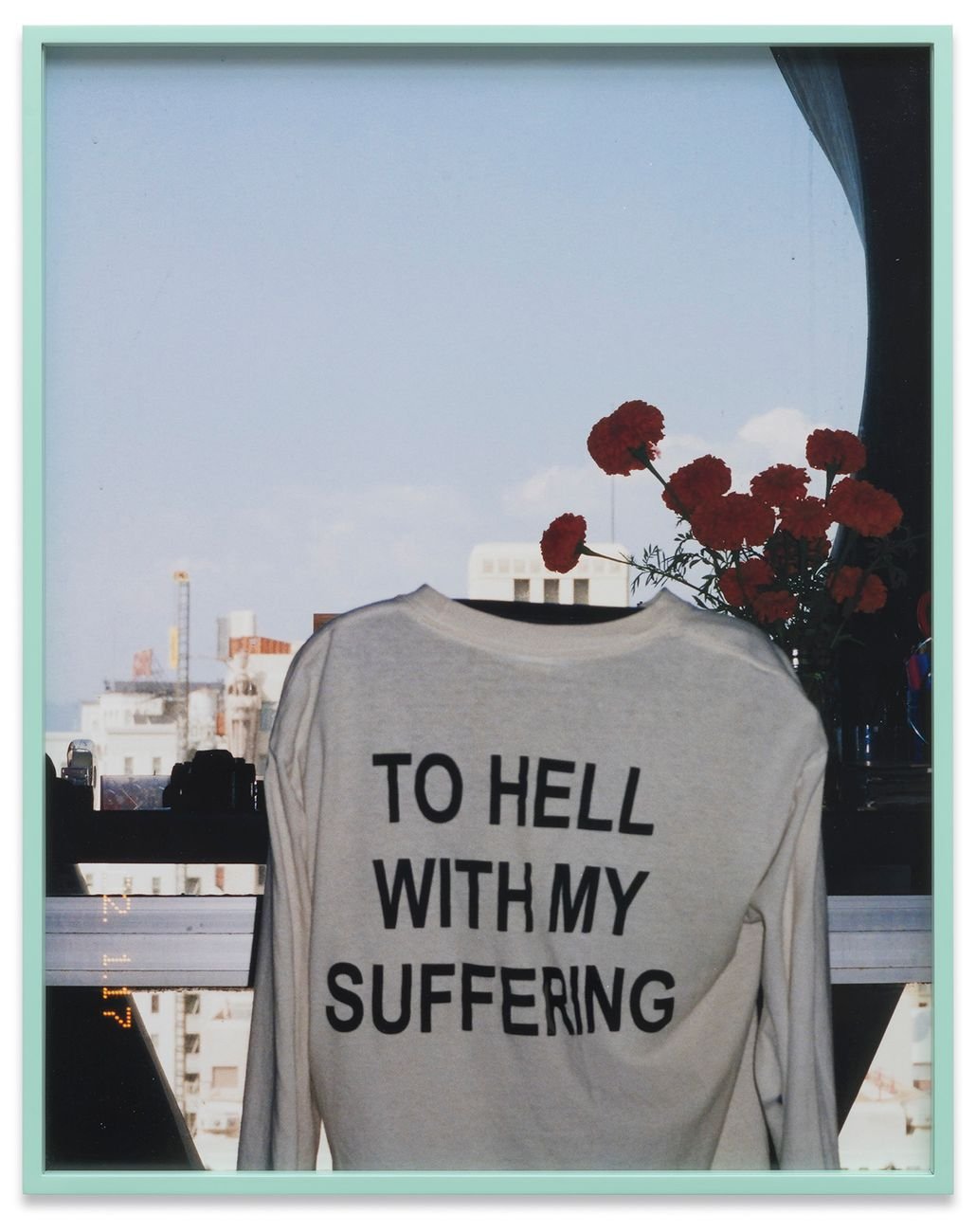
But I am starved; to hell with his suffering! Where’s the Jatz crackers? 

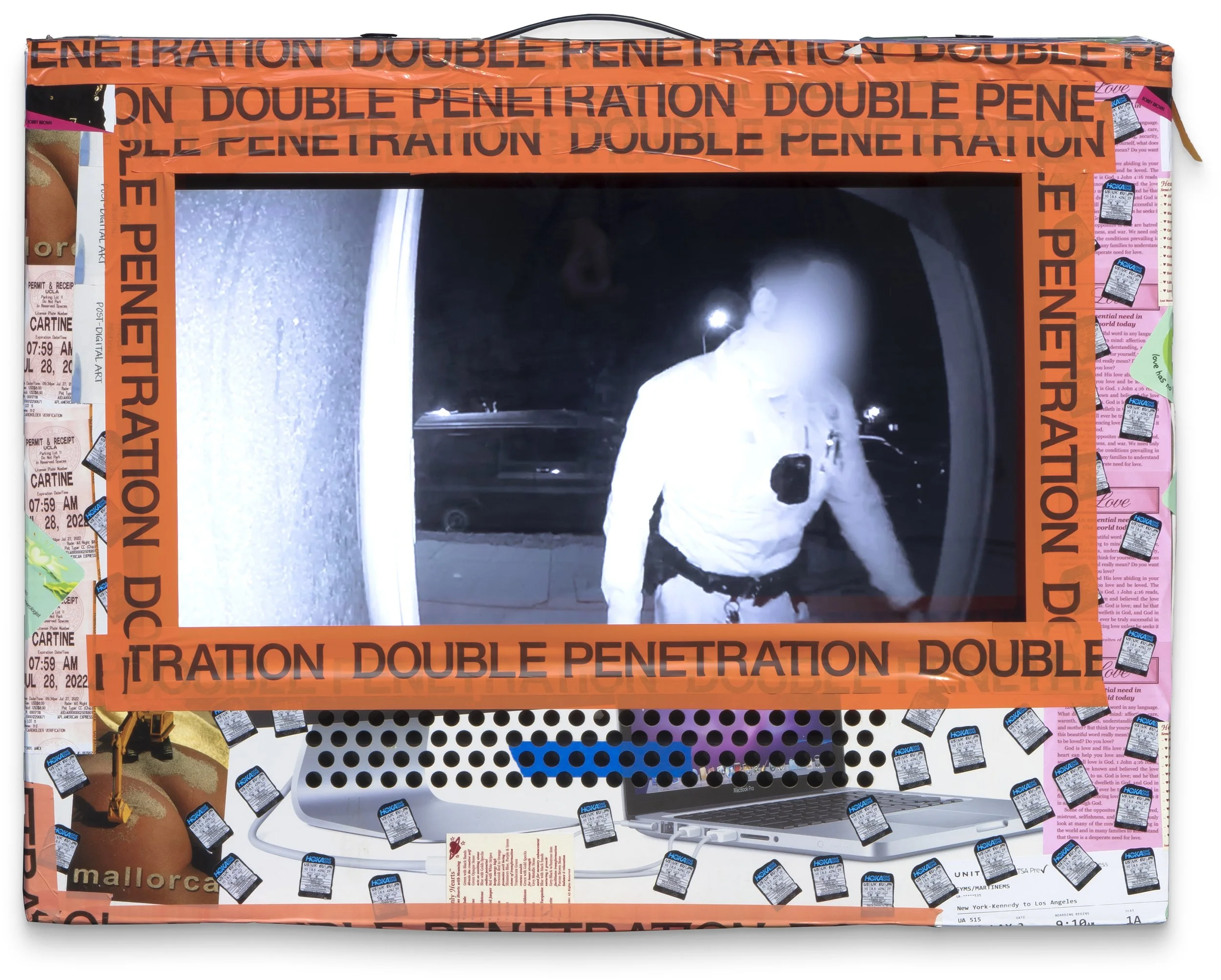
Exerting pressure on artificial skies, Syms airs This Is A Studio (2023), presenting surveillance footage (black and white, no less) capturing a late-night visit from police wearing starched tactical uniforms, a holstered Glock 22 here and there. The small problem with police visiting at 3am, crumbed in Dunkin’ Donuts, and a yeast infection, is that it’s fucking terrifying because American cops are pretty racist and can’t work a safety lock, ostensibly. Ugh, everyone is disappointing. Syms expands on the instinct of disapproval by clustering images of mundane, routine home-life banalities on a laser-cut cardboard box, inside which the surveillance tape is playing—from the inside. Routine living breeds ‘routine’ checks, don’t you know? Trespassing is one fine pursuit. Sticky orange PVC tape wraps around the carton, depicting the words double penetration, notarizing the comprehensive way that constitutional rights are so casually perforated for Black people. Or if you are Black and poor, you’re double fucked. It is here at level orange (orange is the new black…for people of color, at least) that Syms takes the point of biological stratum, using the epidermis as a sensitive point of contact, an interface between the conscious self and the infinite emission (or omission) of racial signifiers. Whether or not you have title deeds to your art studio is inconsequential to LAPD because they mostly can’t read. In 2.10 minute loop-de-loops of supplanting ambition and a trigger-happy corporeal punishment, sorry, I mean police corporeal, This Is A Studio (2023) dislocates in a kind of socio-aesthetic diphthong: This Is THEIR Studio (1457-present). Here is where primacy enters. There is a vaguely held belief that being the first to an idea or place gives you property rights. This is the gold rush model. If you can get there before others, you can stake a claim; if you can prove it, we might recognize it. Exceptttt if you’re Black, or Brown, or colored or.... ; We also might just want your house and hand-on-heart willing to dial 911 as many times as necessary with falsified home intrusion reports and A.I.-generated security alarms. Home rights are an elaborate, Machiavellian charade, and sadly, we know the whole, unscrupulous plan; the entire goddam fantasy is fundamentally flawed. Cognitariat Martine Syms will have to be very careful about how she continues to noose that videotape to shape her studio image. Persistence isn’t always safe. 


Here the idealist vision is turned upside down, wrapped in images of excavated trips to Palma de Majorca and a calorie-counting, S'Aramador sand-dusted ass that's never had mascarpone in its life. This unexaggerated prognosis of delusional dialectic opposition pursues a social treatise in i am wise to die things go (2023, 13:73 minutes, looped video). A split-screen depicts a desperate, pacing woman under punishing sunlight, her rising sign in Pisces, trying to avoid boring, ugly people as she seeks to return to a neverland of milk and honey (aka Mallorquin vermouth and a Soho House membership)–avoiding boring people is wise, just quietly. All sorts of utopian collective dreams spill from her mouth: Was Jeffrey Epstein murdered? Heading toward morphogenic eden with all her judicious schizoid traits, the actor, in singular breath and sneering cosmic rhythm, searches with the utmost intensity of the mutation underway. Syms wants to question the assumption that home is passive and purely receptive while dysplacement implies budding creation and transitional stimulation. A falsified view that insensibly actions   emancipation and secure reception for some types of people and pathological rearrangement for others. Inasmuch, West Hollywood viewers of i am wise to die things go are exhausted of their human 'reason,' as Syms frenetically implores us to consider the deficit disorders of piecemeal displacement. Locked in a pink green-screen like a screwy, art-world Truman Show, our schizoid plaintiff perspires toward a quixotic paradise that doesn't exist. 

Martine Syms
i am wise enough to die things go (2023) (still)
Single-channel video, color, with sound
13:73 mins, looped
© Martine Syms
Courtesy Sprüth Magers

But I am boreedddd; to hell with her suffering! Where’s the 6th Street Metro from here?

The whole social proxemics of the artist's existence fight the gallery walls upstairs, an extensive photo collage of laser-cut sculptures and images from quotidian life: camel-colored commercial moving boxes, Whole Foods shopping bags in limoncello, proselytizing signs by salty desert-dwelling Mormons, and striped vacation-y garden chairs with their view of a thicket. Dream about the forrest fingering me from both ends (2023)—an ambition we all share—is an installation composing simple circadian pleasures of finger fucking in peaceful, scenic symbiosis. Or maybe Syms just had a Prozac crash. Either way, she is deactivating the carnal distance between individual reality and the rhythmic desire for a safe, nurturing environment surrounding a person. Triggering psychopharmaceutical socio-environmental and cultural devastations whose traces are found in the room, Syms chases a King-sized future-present we can all cream into. I had a dream! The primary source of existential stress is the competition for safety and home, and its accompanying epidemic symptoms are experiential misery, panic, SSRI-resistant angst, loneliness, and the constant desire for normalcy. A differential diagnosis: fear. In Martine Syms's solo show or Prozac-crash, the violence of suffering no longer concerns an uninsured minority, but involves the majority of weird, boring, ugly, insufferable people, which is to say you.  

She’s very pushy. 

Octavia E. Butler shits on the general majority in Parable of the Sower, a fucking lachrymose, dystopic book in which a Black protagonist, the hyper-empathetic Lauren Olamina, is forced to leave her home to find a home: They (the colonizers) have no power to improve their lives, but they have the power to make others even more miserable. And the only way to prove to yourself that you have power is to use it. It doesn’t matter which dismal character said it, her Baptist preacher father or possibly herself; the point is that it’s said. Picking up power in Loser Back Home, Syms hurries to analyze whole clusters of socio-historical and procedural fallacy, dysplacing assumptive ideas we fail to examine because we might have the luxury of a quiet forest finger-fuck and think nothing of it. For real. Some people’s anxiety about home is never tested. However many personalities you have, whatever color your excoriating skin, it is your human fucking right to know a deep sense of belonging to place, country, and community. Connecting to the enduring desire for place shows up through all sorts of freaky iterations: clammy compasses on long-haul flights, cumming on all fours from a Californian date palm; making videos in your art studio without being cased; endeavoring to live a normal life. It’s hard enough just to do that in this world. Dysplacment as merely another piece of art-world weather becomes something bold, honest, hopeful, and genuinely communal in Loser Back Home, inviting us all to drown social wrongs that do or don’t directly affect us; you know, stop ignoring the obvious. 


“Oh, you arrived!” says Martine Syms, forest branch in hand, drowned in warm coital fluid; "I didn't think you were coming.” 

Emma Stern

 
Emma Stern in Area wool dress

Area crystal embellished wool dress, crystal earrings


text by Evan Moffitt
photography by Jason Miller
styling by Erik Ziemba
hair by Sergio Estrada
makeup by Sena Murahashi @ MAGroup
photo assistance by Benjamin Jastremski
production design by Evan Jean

New York-based painter Emma Stern’s muses are digital avatars—buxom, sexually liberated, 3D-programmed and rendered machinations; some might also say alter egos. The relationship between artist and alter ego as a muse is what makes Stern’s paintings so fascinating, alluring, and psychologically titillating. Utilizing proprietary character design software to create digital sketches, Stern turns to formal oil-on-canvas painting methods to make her digital fantasies come to life. In a new body of work, Penny & The Dimes: Dimes 4Ever World Tour, which will be exhibited at Almine Rech in London, Stern’s new avatars are members of a fictional all-girl rock band. In an interview with Evan Moffitt, Stern expounds on her unique practice.

EVAN MOFFITT So, @lava_baby: what is “lava”? 

EMMA STERN (laughs) Lava is like an amorphous blob of virtual clay. It’s the basic starting point of any 3D program. When I first started messing around with it years and years ago, I was reading one of the last books Carl Jung ever wrote—it was about UFOs. There’s a part in it where he's talking about quicksilver, this medieval, mythical material that can take the shape of anything. I realized that's kind of what I was dealing with in these 3D programs. So, I just started calling it “lava.” When I started doing these figures, I was calling them “lava babies,” and then it became my Instagram handle, and then it took on a life of its own. I've called my social media presence an extended performance piece—which wasn’t really intentional in the beginning, but that's where it is now. 

MOFFITT Can you explain how that 3D rendering comes into your painterly process? 

STERN Instead of doing a sketch with paper and pencil, I sketch in these programs and develop the compositions. Most of the decisions get made before I ever put brush to canvas. It's very akin to when I was learning how to paint formally, working from a live model: you set up a scene, fix the lighting, you have this person pose for you, and you can kind of move around 'em to understand them volumetrically. It's far preferable to painting from a photograph, which most painters would tell you tends to really flatten everything.  


Emma Stern, Margot + Spike (venti), 2023. oil on canvas 72 x 60 inches. courtesy the artist and Half Gallery, photo: Daniel Terna


MOFFITT When did you first start painting? As someone who's super engaged with digital media, what about this very traditional, canonical form interests you? 

STERN I've been doing some version of painting my whole life. I was always interested in the figure, and the female form specifically because it allows me a level of self-portraiture. But in general, female bodies are so much more fun. When I was learning to paint in this very formal, traditional way in art school, I felt quite stuck. All of my heroes, like Michelangelo and Caravaggio, were dead white guys, and I'm a female painter in the 21st century. So, it became a question of how I could add to this conversation rather than just carrying on a tradition that really is not super connected to my experience.  

When I started working with 3D modeling, I realized I was building my own muses. I've long been interested in this relationship between the artist and the muse. When I was in art school, I was working at Cooper Union as a nude figure model. I was using that almost as research, you know? I enjoyed the experience of being a muse and thinking about what that meant for me on either side of the canvas. 

People ask me all the time: “Why paint when it's already an image that exists on a computer?” I really want this work to exist in conversation or at least add continuity to the tradition of painting and portraiture. I like the idea that it's this very traditional way of making work, but a very non-traditional, contemporary subject matter. 

MOFFITT  You’ve described these avatars as self-portraits. Do they ever begin as your own image? Or do you think of them as more abstract representations—like expressions of yourself that the rest of us can’t see?  

STERN  Of course, there is some fantasy involved, but then an avatar is an idealized, virtual version of yourself. The cool thing about a virtual self is that it doesn't have to be static. Quicksilver is this constantly changing thing. There's an inherent drag element to it too. I’m using drag interchangeably with role-playing and cosplay because drag makes most people think of gender, but my show last year was all pirates, and that was like my pirate drag, you know? 

Now, I’m working on rockstar paintings. It’s my rockstar cosplay, because as performative as I may come across, I actually have stage fright. I'd love to be a rockstar, but I hate to perform in front of a live audience. Making these rockstar avatars for the past five months is a way for me to live out the rockstar fantasy and offload my stage fright onto these proxies. Ultimately, that’s what these avatars are. They're vessels I can offload different parts of my personality onto.  


Emma Stern, Ursula (Hindsight), 2023. oil on canvas 72 x 60 inches. courtesy the artist and Half Gallery, photo: Daniel Terna


MOFFITT  It reminds me of something that Nash Glynn once told me: “Every painting is a wish.” You've been making digital avatars for computer games since you were a teenager, right? 

STERN  I'm actually using a character design software that is mostly used by people who make 3D porn. There's an online marketplace with a lot of user-generated assets for that. You can go buy genitalia and different kinds of pubic hair for the characters. Often people call my work pornographic, which is so interesting to me because I don't even really do nudes at all. My characters tend to be at least partially clothed, and there are never any depictions of sex.  

MOFFITT In that respect, I see a lot of Lisa Yuskavage in your work. I'm curious if she's been an influence on you.  

STERN Oh, yeah. I'm a huge fan. When I was in art school, I was going to all of her lectures. She probably thought I was stalking her. But I think she has a really different relationship with painting than I do. She's much more of a painter’s painter, whereas I spend a lot of time erasing my hands. There's really not a lot of brushwork. I also feel she's really focused on pain as a subject matter in a way that I'm not. The thing I've really taken from her is the psychology of color: the way different colors can elicit different emotions.  

MOFFITT Your paintings have a distinct palette. Is that supposed to denote lava? Or, the spectrum that lava can reflect? What’s its mood?  

STERN  With the pirate paintings, I called the palette “tequila sunrise.” It was all very sunset, tropical. For this show, there are a lot of paintings that have stage lighting, so it's very cool, indoor, and artificial. I wanted it to look as fake as possible. Although, my palette is always kind of unnatural. These are not colors you see together in nature generally. That's something I started doing, however subconsciously, to emphasize that these aren't humans; this isn't real life. These are cyberspaces, not landscapes. Lava itself, or virtual clay, is actually a grey, plasticky material. I build and design the characters and then I import them into a program. It's an incredibly powerful piece of software.  

MOFFITT Yuskavage was criticized in the ‘90s for painting hyper-sexualized women, as if a female artist couldn't determine the contours of her own desire. Given that people have made these comments about your work, do you think this attitude is still a problem? Historically, it’s come both from men and anti-porn, second-wave feminists.  

STERN I got a lot of this criticism early on, and it seems to have really gone away. But I did notice it was almost always coming from straight men. They assigned a lot of irony to my painting. My definition of irony is a lack of authenticity and these are very authentic coming from me. Perhaps there's some humor, but I almost feel that for someone to call something ironically misogynistic, they’re just giving themselves permission to enjoy something. It's such a cop-out. People are scared to like things that appeal to base instinct, which again, is where porn comes in. But if you enjoy something, how can that be ironic? Enjoyment must be authentic on some level. I also don't see anything inherently problematic with hotness. It’s actually the most misogynistic thing to say that sexy women are offensive. To whom? I'm not offended.  

Diesel sheepskin leather shirt, skirt and pant, leather boots; Jennifer Fisher plated brass earrings

MOFFITT What about your social media persona? You called it a performance. Do you consider that authentic or ironic?  

STERN It's a character. I don't think I did it intentionally. My virtual self has become so much bigger than my actual self, in a way. Most people who know me and know my work are experiencing it through the filter of my social media persona. I think that persona functions the same way as the rockstar cosplay. “Lava Baby” was not supposed to be an alter ego. It was just supposed to be an Instagram handle. But then, everyone's social media presence is an alter ego. Even the most authentic feeds are hyper-curated. I'm very sassy and cheeky online, but I actually think I'm a pretty serious person (laughs). Sometimes, when people meet me in real life, they tell me I'm so much nicer than they thought I would be (laughs). I’m talking with my therapist, and she's like, this is a defense thing. You're offloading social anxiety onto this very confident, sexually conscious, strong-minded character, which contains a lot of me but is not me.  

MOFFITT  I think you're right to note that we all do it in some way or another. But then, aren’t the real and the virtual inseparable now? It’s like the old joke: a fish swims up to another fish and says, “Isn't the water nice?” And the other fish says, “What the hell is water?” Even the way that we process analog images, like paintings, has been conditioned by our engagement online.  

STERN We all are internet artists. Everything is mediated by a screen. Anyone who makes art and posts it online, most people who see their work will only ever see it at the scale of a phone screen. You can choose to take that into account or not. I think about how my work is going to look on a phone. How elitist would it be for me to only think about how it's going to look hanging on the wall of a gallery somewhere in Europe or in someone's home? I feel guilty sometimes because I think like, my gosh, I'm in the business of luxury retail. That's what the art market is at the end of the day. And the thing that rescues me from that dark place is the realization that so many people are seeing this and connecting to it online. Social media is a way for people who will never be able to afford a piece of art in their life to experience and enjoy it.  

MOFFITT  You're bringing internet subcultures to a different context where they might not usually be taken so seriously.  

STERN Right. Something that is really exciting to me is bringing what would be considered lowbrow, like fan fiction, and digital art, and all these weird niche subcultures that exist in the underbelly of the internet, and turning them into something that's considered capital “A” Art. You hang it on the wall of a gallery and someone writes a press release about it. Because now, there’s discourse, right? But that’s important because this is the visual culture of the masses. I love Russian minimalism, but it is not post-internet. You can't post a painting of a black canvas. It doesn't translate to Instagram. Color field painting does not work on the internet, either. Joseph Albers doesn't work on the internet. If you're making stuff that has to be seen in person today, I think it's actually quite elitist. So, recontextualizing what's considered lowbrow subject matter is super interesting to me. A decade ago, no one expected that suddenly, they’d see street artists in a gallery, and then become the highest-selling artists in the world—that graffiti works were going to be auctioned for millions of dollars. There was an opportunity to have some discourse.  

MOFFITT You're not talking about elevating a low cultural form so much as you're talking about getting the art world's attention economy down to the level where everybody else’s has been. 

STERN Yeah. I like to think of elevating it a little bit, but you're right. For a while, I was concerned, because a lot of the people who collected my work were men. And I think there's been a real switch lately. A lot of women are collecting my work now, which makes me super happy. I mean, I love that people are buying my work because they want a big-titty centaur girl in their home. But that's also a surface read. If you can get a little deeper than that and start thinking about the avatar aspect, the fantasy of the virtual self, you might want to spend more time with the work.  

 
cat woman on piano

Emma Stern, Catherine (window licker), 2023. oil on canvas 72 x 60 inches. courtesy the artist and Half Gallery, photo: Daniel Terna


Power Images: Paul McCarthy & Judith Bernstein in Conversation

The word graffiti comes from the Italian word graffio, which means to scratch. The Ancient Romans would write their names and protest poems on buildings. Since the 1960s, artists Judith Bernstein and Paul McCarthy have been brutally scratching the surface of the American Nightmare with inspiration from the psychological graffiti of its violent and totalitarian collective subconscious. Bernstein had her revelation by absorbing the rude hieroglyphics scrawled on the bathroom stalls in the men’s room of her alma mater of Yale—McCarthy’s landscape was California; its dark optimism and congenitally blind ambition. Together they meet at the intersection of a disillusioned dream.  

PAUL MCCARTHY I'm not sure when I discovered your work. I think I knew of the screw paintings from magazines. When did you start making those? 

JUDITH BERNSTEIN I started in about ’69 and I continued them through the ’70s. I got a lot of brouhaha with those. I was censored in Philadelphia. There was a show called Focus: Women's Work—American Art in 1974 at the Museum of the Philadelphia Civic Center. It was curated by Cindy Nemser, Marcia Tucker, Lila Katzen, Adele Breeskin, and Anne d’Hanoncourt. They chose 86 up-and-coming and well-known female artists. When they saw my work, they said, “Oh no, we can't have that. It's pornography. All the kids will be damaged forever.” It went all the way up to Mayor Frank Rizzo. But there was a petition in protest that was signed by a lot of very well-known people, like Louise Bourgeois, Clement Greenberg, Linda Nochlin, Howardena Pindell, and Alice Neel. So, that's how I got more on the map.  

MCCARTHY My interest in your work is probably related to how I viewed art and society at that time. I made these pieces in the mid-60s that I called the “Black Paintings,” which were eight or nine feet tall. They were based on a dragster car—like if you take a drag car and look down on it from above. The image was abstracted and flattened out. At the top was always this masked head, a gas mask. It was man, as machine—like a screw, but like a machine. So then, with the masked head of the man at the top, it was a totem stack, it was like a standing dick. Those paintings were all done between ’65 and ’67. They were always painted flat on the ground and I would be on top of them. They weren't painted with a brush but with a rag. And there was a frame about two inches off the plane where I would pour gasoline. Then, I would throw a match in and burn them. I was thinking about this today: with the trajectory of all my work, there has always been a similarity in a certain kind of critique of power structures and the patriarchy.  

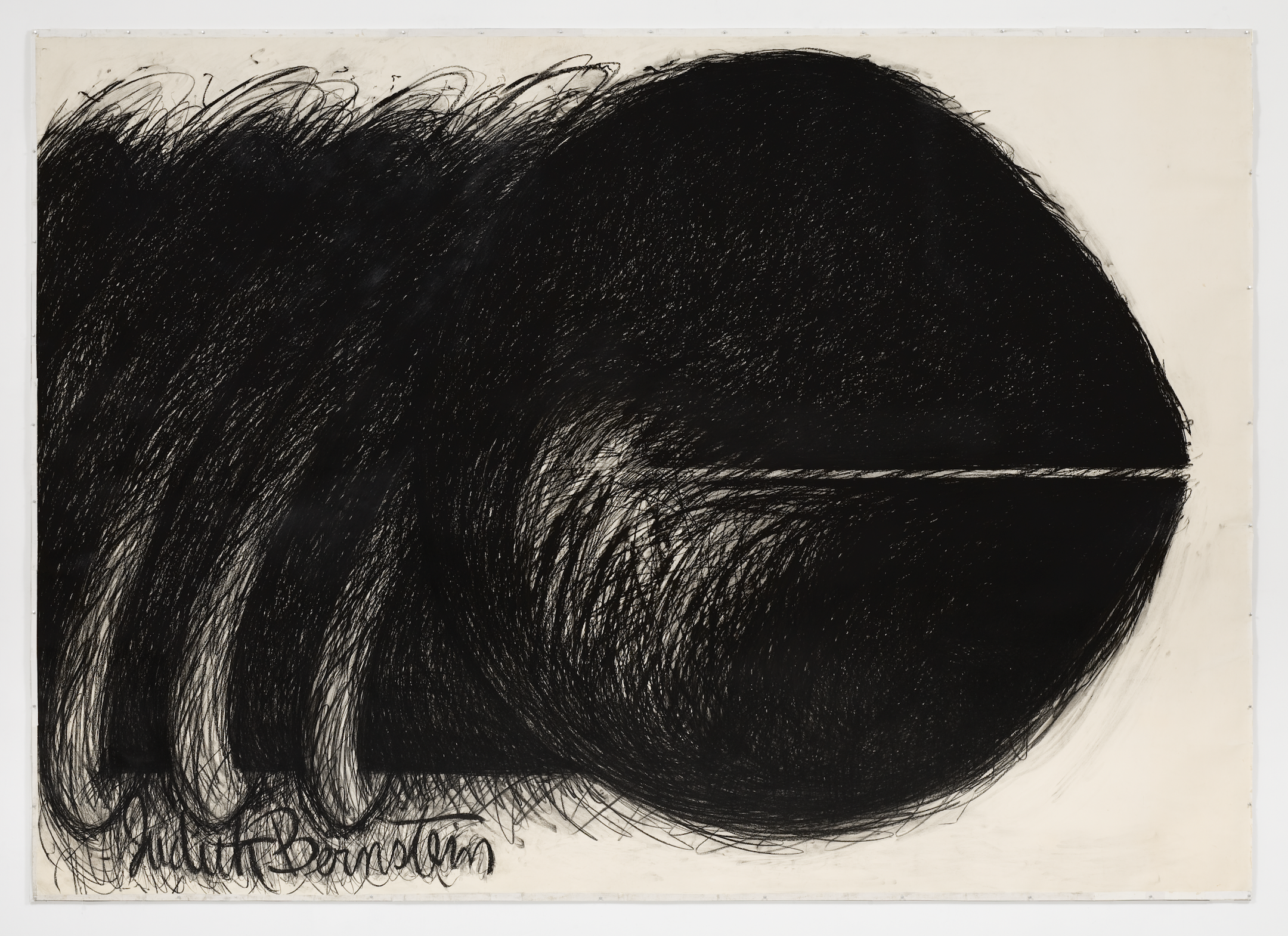
BERNSTEIN With the work that I was doing—the screw is a power image. It was a combination of masculinity and anti-war. They were also about feminism, like mine's bigger than yours. And actually, that screw drawing, the horizontal one shown at The Box, I recently sold to the Metropolitan Museum of Art, which I'm thrilled beyond belief about. Nevertheless, it was once something that was censored. I always think that women, although we don't literally have a penis, we can certainly have access to the imagery. So, as I said, mine's bigger than yours, because the size was nine feet by twelve and a half feet. But, you know, it's funny because a lot of people think that I do some of these drawings when they're flat on the floor, but I don't. I always make them on the wall, so I can get farther back and be able to see the whole image. 

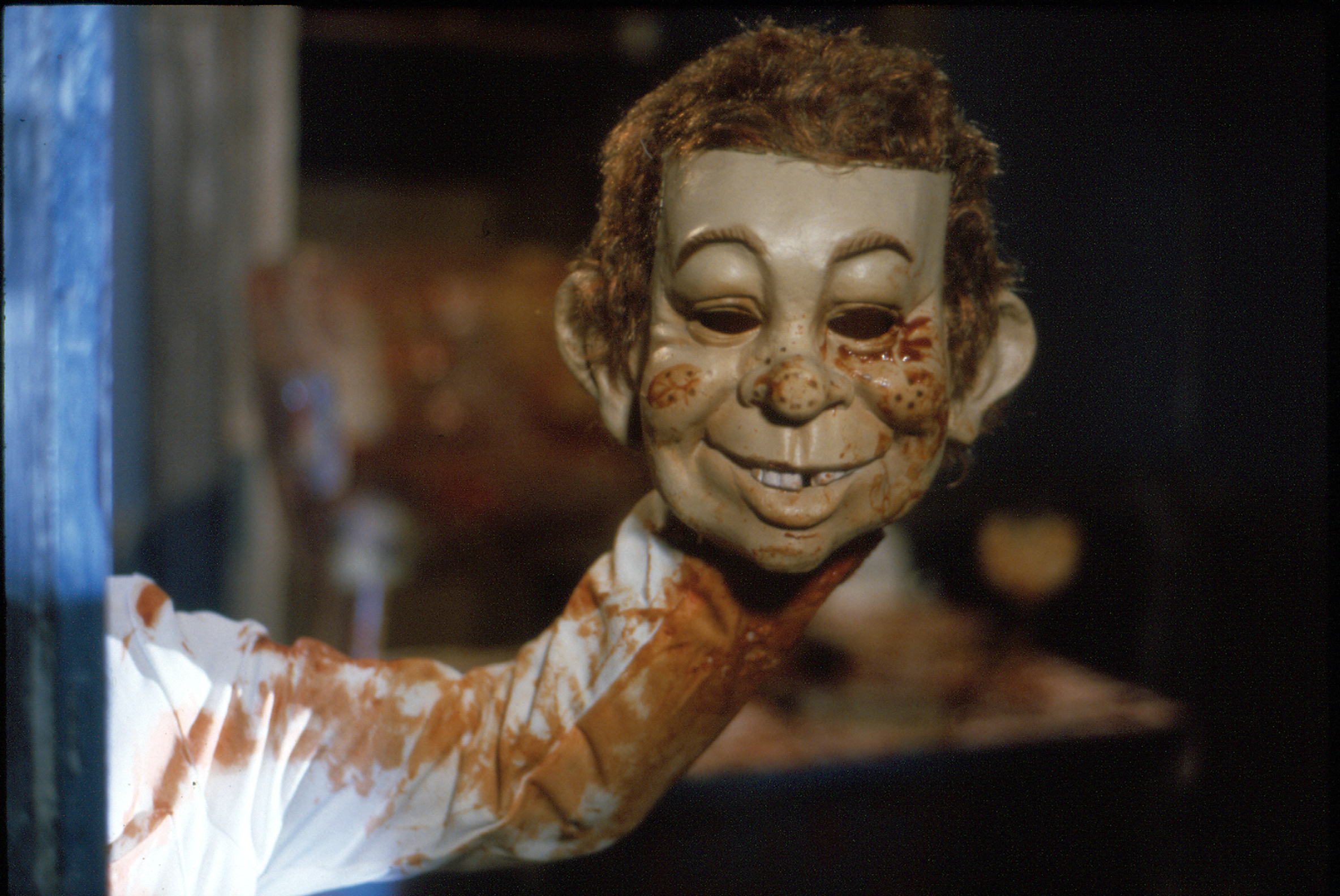
bloody mask of an eyeless man missing a tooth

Paul McCarthy, Performance still from Bassy Burger, 1991
© Paul McCarthy, Courtesy of the artist and Hauser & Wirth.
photo: Vaughn Rachel

MCCARTHY Mine is the opposite. I'm not often standing back to look at it—to judge it. It's always a shock when I look at it, and that's still the case. I didn't paint paintings on the wall until 2013. I viewed the paintings and drawings as an arena, like a room: it's on the floor or a large table and I'm moving around on it. It's a different experience, but the trajectory of painting and drawing is something that you stayed with. I was never attached to one medium—it could go in all directions simultaneously. But the connection between us is to that period of time in the ’60s, the institutions, and the war in Vietnam as a grounding point for suspicion and mistrust in the government. And of course, the subject of the male patriarch and the female. Even very early on, the words “Adam” and “Eve” came up in my work as a kind of joke or something. But always, there's this thing of portraying myself, the male, as the buffoon.  

BERNSTEIN It's very psychological. And it’s much deeper than actually the buffoon because it speaks about a lot of things in your subconscious. And I do the same thing. When I actually make an image, I don't think about it. I get the general idea and then I do it. And then, later on, I think about what I've actually done.  

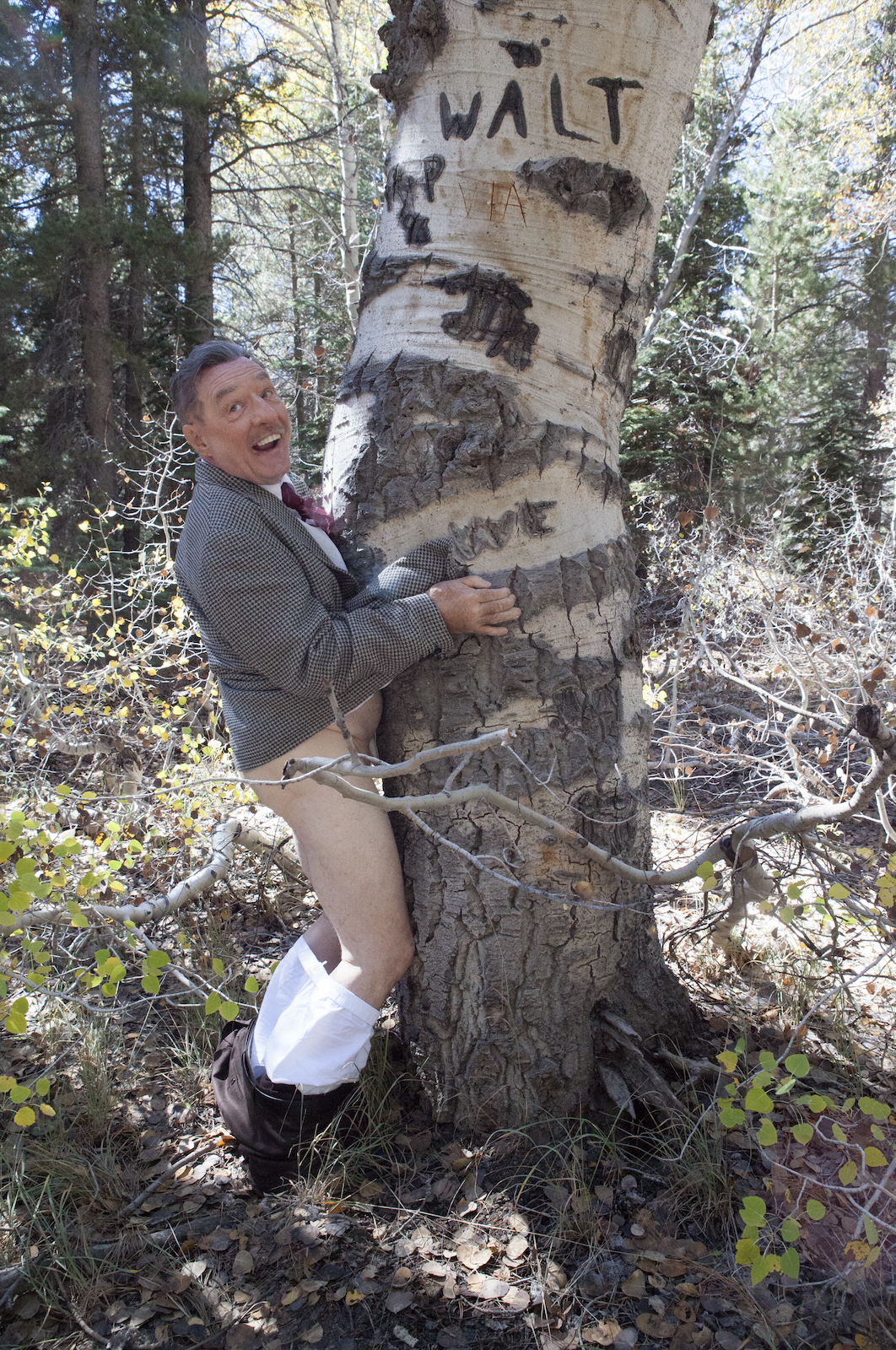
MCCARTHY I think back to the ’70s, but it became more pronounced in the ’90s—I would only describe it as painting or drawing in character. It's not so much about inhabiting an accurate interpretation of Walt Disney or Hitler, that’s not the point, but I talk all the time. And I realized at one point, I talk as if I'm drunk. And the drunk character, the brave character, likes to destroy the good paintings. In performances, I do get drunk. By the end of a performance, I can be pretty drunk.  

BERNSTEIN I think you have access to the subconscious with that. I know my own work is autobiographical, and I think that your work is also autobiographical. There's a lot of self-portraiture in spite of the fact that you're using characters that are outside yourself. And it's also very much a performance, Paul. The work is very performative. I consider my work somewhat of a performance, but yours is even more so because you're literally in the painting itself, or in the drawing, or in the piece of sculpture, or whatever you're doing.  

 
neon collage of ghost faces

Judith Bernstein, Gaslighting (Blue Ground), 2021
acrylic on canvas, 90.5 x 87 inches
courtesy of the artist and The Box, Los Angeles


MCCARTHY I've done a number of them where the action on the painting or on the drawing, there's someone else there, like the ones with Lilith Stangenberg. It's like creating this distraction. I would draw for three or four hours in these sessions. Somebody said, “Your paintings, your performances are like trances,” or, “Are you in a trance?” And I go, “Well, no, but there is something about focus and a form of involvement in a character that affects what I do.” 

BERNSTEIN There is something about being in a trance. I know that when I'm painting, I have to finish it up because I'm in a zone and I don't want to wait until the next day. You're in a zone and there's something that is beyond you. It's interesting because when you have another person there, it's a happenstance that they are actually part of. And I do think, in essence, it’s like you're drunk. And there's something quite marvelous about it, because in a way it feels like an out-of-body experience, like someone else did it. I’ve heard Bob Dylan talk about this.  

MCCARTHY There's this schizophrenic experience going on. Like I said, now I'm painting with the canvases leaning against the wall. It's like a whole new thing in a certain way. But I actually still try to get very close. I mean, literally two or three inches from them. I lean on them. I put my face on them. 

BERNSTEIN Just in your face. 

MCCARTHY I get very, very close and sometimes I stand back, but it'll go back and forth. And then you look at it and you go, I really like that one. And then, later you go, I've hated it ever since I started it. Yet it's almost on the edge of being something. But I know that the only way I can really get to it is to destroy it and start over. And then, I will talk constantly. And I'm saying these things to myself. The character always goes, “You don't trust it, Paul, do you, you don't trust. Paul doesn't trust me. Paul doesn't trust.” And then he goes to this crazy one: “Paul doesn't trust God.” You could say the drunk pretend character is crazy. 

BERNSTEIN Well, we are the god of our work. Many times you'll have some extraordinary drawing, and then you'll just smear the whole thing over. Maybe it's too perfect. How can you actually be even more creative than you did the first time around and bring something else to it that you didn't the first time around? 

MCCARTHY Do you paint over the top much?  

BERNSTEIN It depends. I made a painting recently where I didn't get the color I wanted. So, I blacked out most of it. Then, I went in and did something entirely different, and I liked it better. Most of the time I do paint on top, but not much. I know when I geot it, and then I move to another painting. It's almost like the game of telephone: you do one thing and then it moves to something else, and then it transforms into something else.  

MCCARTHY I paint over the top more now than ever before. Sometimes I think, oh, there's like six paintings underneath there.  

BERNSTEIN I bet they're all as good. 

MCCARTHY Maybe. I'm interested in painting over the top of paintings and keeping it going in a certain way—to keep the mental state going.  

BERNSTEIN It's a great mystery. And also that mystery is a great gift because there's something so hallucinogenic about that. I use “We Don't Owe You A Tomorrow” because you don't know what tomorrow is. I think there's something very childlike about the world. They go into a room and they mess everything up, and then they leave and go into another room. And that's basically what we've been doing with our planet. We're so primitive in some ways, yet so technologically advanced. But it's still that motivation for power. As an artist, it is power over your own work. We think that it's only now that we don't want to pay the price of the future. But unfortunately, the future is now, and it's moving exponentially faster.  

MCCARTHY Since the ’60s, I’ve been fascinated by the subject of fascism. Also, psychology, the subject of repression, and all the Freudian stuff. The discoveries of Wilhelm Reich's book Mass Psychology of Fascism (1933), Norman Brown’s Love’s Body (1966), Herbert Marcuse, Sartre, and R. D. Laing, and, of course, then you discover Duchamp, or John Cage, and then art and life become a thing. And then, there’s the subject of film and the moving image. It was critical for me. It's in California, but also you have the Europeans: [Jean-Luc] Godard and [Ingmar] Bergman. But there was also experimental film: Warhol was interesting for me, and Jack Smith. I was interested because they were dealing with the weird subject of the pretend. And on top of that, you have the political critique; the attempt to understand the absurdity of what humans have created. This thing of fascism and repression, as well as the subject of the phallic and the vagina, appears in both our work very early on. Is it a penis? Is it a vagina? What is it? This thing of desire and the pleasure principle versus the reality principle. But in the past twenty years, the subject of fascism continues to come up. In the last five years, I've been doing performances in the character form of Adolf Hitler. And the character that Lilith plays is Eva Braun, but she's also referred to as Marilyn Monroe. At some point I asked, what male stands out in Western culture? Is it Adolf Hitler? Is it Jesus Christ? And what's the female? Is it Marilyn Monroe? And of course, the two together are crazy, right? We're not trying to be in the ’40s or anything. It’s some sort of version, some sort of pretend play in a very ultra-serious, ultra-dumb, and ultra-buffoonish way. I’m pretending to be an American Adolf Hitler and Lilith is a German Marilyn Monroe. 

BERNSTEIN It's goddamn serious, but it's actually so surreal. Trump brought back McCarthyism, Roy Cohn, and all this stuff that's out there now. And also Putin. I use the swastika. It's only a Nazi symbol at this point, not a Buddhist symbol. There's permission now to have a lot of this horrible fascism. It's much more accepted. It's very terrifying for those of us who know how horrible fascism can be—the extremes of fascism: death and concentration camps. 

MCCARTHY But the goons or those who follow these characters, do they understand how the propaganda is being constructed? Do they recognize it? Their notion of what fascism is gets to be pretty small and pretty limited. And so they reject that. And then, you wonder about Trump—who is he and what is he? A few years ago, when we were remaking Liliana Cavani’s The Night Porter (1974), the Max character I was playing in my version, Night Vater, was not actually the Nazi officer that Dirk Bogarde plays. I become like a character living in California that produces films. The image I made was very mafioso in a clichéd way. The connection between government, fascism, and mafia or organized crime is real.  

BERNSTEIN All these characters, they're two sides of the same coin. They're terrifying and very seductive at the same time. 

MCCARTHY The one thing that has happened in these pieces that we've done is that the Eva Braun character, or Marilyn Monroe, becomes a mother, and a daughter. And Adolf Hitler is a father and a son. And they switch these roles. It’s built into the script that if the female kills the male, it's in response to the actions of the male. It's in response to who he is. And when the male kills the female, it's mean. It's the berserker. There's a difference in how violence towards the other happens. With the male, there's an insanity in there that comes out in these plays that we do. He’s a very ugly buffoon goon and a lush drunk character. 

BERNSTEIN The male can be very ugly because it's killing his mother. The father is someone who has had physical power for so long. It's complex because it goes all the way back to the primal family, and it's very primal.  

MCCARTHY There’s also the crazy part of how all this is understood, like how somebody reads this kind of imagery. How do they deal with the subject of irony, sarcasm, metaphor, or caricature? How do they understand the language of art? It's a forum, an arena. The idea that as an artist you have to know your intentions before you begin. How art is talked about, I’ve sat in on crits in colleges, and there is an emphasis on having a correct idea before you make the work. Then, the question is about how well you’ve carried out your initial intentions, so how good the work is would be determined by how well you’ve completed your intentions. What is frowned upon is working from an idea through a process to get to an understanding, allowing yourself to change, and resolving issues in the process, letting the process move the work. But also, in this way art can expose something. What scares me right now is the type of criticism that's going on. I was censored in the ’60s, but I've been censored more now than ever before. In one way, as the world gets more extreme, you would think it's natural that art would inevitably become more extreme in response.  

BERNSTEIN I hope that's the case, but I don't know. It may become more simplistic. 

satirical performance about Hitler having a cooking show

Paul McCarthy with Lilith Stangenberg, Performance still from A&E, Adolf and Eva, Cooking Show, 2022. Directed by Damon McCarthy © Paul McCarthy, Courtesy the artist and Hauser & Wirth. Photo: Alex Stevens.

MCCARTHY But a lot of that is the market and the art world. The art world as a market controls so much of what we know of art. You know, like what the gallery shows, but really what the museums show. And then, you know, who's on the board, and who the curators and directors are, and how the money flows. I went to a gala a few years ago and a film director got up and said, as part of his speech for the award, “Remember, if it's not popular, it's not art.” Nobody said a thing. In fact, people clapped. And I thought, oh, god. It becomes propaganda. Imagine that statement moving through an audience of five-hundred or six-hundred people. Then, you have museums creating shows that are popular and counting people that are coming and going.  

BERNSTEIN It's all intertwined, Paul. 

MCCARTHY Yeah. It's all entwined. It also has layers to it. In some ways, the art world has opened up and in other ways, it's closed down. It's a strange combination. It may indicate that we’re in a transition. But the seduction of money is huge. You and I, in some ways, have experienced the same art world, but in different locations. You've been primarily in New York, and I've been primarily in California. There’s an interesting difference. But there are a lot of levels where our work connects. I think it was Mara’s [McCarthy] idea that I would curate your latest show, We Don’t Owe You A Tomorrow, at The Box. Maybe there's less to say about the curating, and more about the paintings. There was a question about the black light paintings. I think if we could have afforded it, I would've turned the whole gallery into a black light situation so that you really had a chance to see these paintings in the two situations.  

BERNSTEIN I put a black light on stuff so that you have a parallel universe. There's something very mysterious about the way I handle it because I make a painting and then I see it under black light after it's finished. In a way, it's like a surprise. I thought about the work being mostly about this nightmarish zeitgeist. Also, I'm very much into humor, just as you are. But mine has a different kind of black humor. I think that humor makes the work more accessible and more memorable, but also that it makes it easier to accept. Laughing—it's almost like an ejaculation.  

When I was a graduate student at Yale, I had the idea to go into the men's room. I read an article in the New York Times, and it said the title of Who's Afraid Of Virginia Woolf (1962) was taken from bathroom graffiti. Right away, I was off and running. Graffiti is actually much deeper than you expect. And the same with your work—you have stuff that is so psychologically charged. I also use these great limericks: There once was a man from Nantucket who had a dick so long he could suck it. All those graffiti pieces led to the Fuck Vietnam pieces and the large projectile phalluses. I was always so interested in doing things that express my rage at injustice. My rage at the Vietnam War was extraordinary. My work has a lot of energy and a lot of balls. There's something so primal and so primitive about painting and just putting your whole self in it, your whole life in it—it's been an extraordinary trip. 

MCCARTHY I think the paintings you've made in the last few years kind of indicate a sense of speed and quantity. You know, quantity is a subject or part of what I'm doing. The idea of the studio being a B- movie sound stage. But the thing that's happening now is digital quantity. There are hundreds of thousands of images, but it’s also video—there’s more video than we can possibly ever edit. For me, the accumulation of imagery becomes a piece in and of itself. The hard drive that holds all the images is the object. At one point, all my videotapes in the ’70s were in cardboard boxes, and the cardboard boxes were stacked like a totem. The subject of stacking has gone on in my work since the ’60s. So, I stacked the videotape boxes and it was sold as a sculpture. The object is the boxes that hold the videotapes. I think there's something about the unseen and the skin of the box is like the skin of the person and inside it holds the information. For me, they become kind of metaphors for the body. Now what I’m doing, intentionally and unintentionally, meaning it’s just happening, is the stacking up of hard drives. I would say that a good portion of what I've made in the last ten years doesn't even get shown. It has no place. 

BERNSTEIN Yes, but you got a chance to do what you wanted to do. And you know something, you don't know what will happen tomorrow.  

 
portrait of Judith Bernstein

Judith Bernstein in her studio in New York City. Photography by David Brandon Geeting.