
interview by Oliver Kupper
photographs by Olivia Lopez
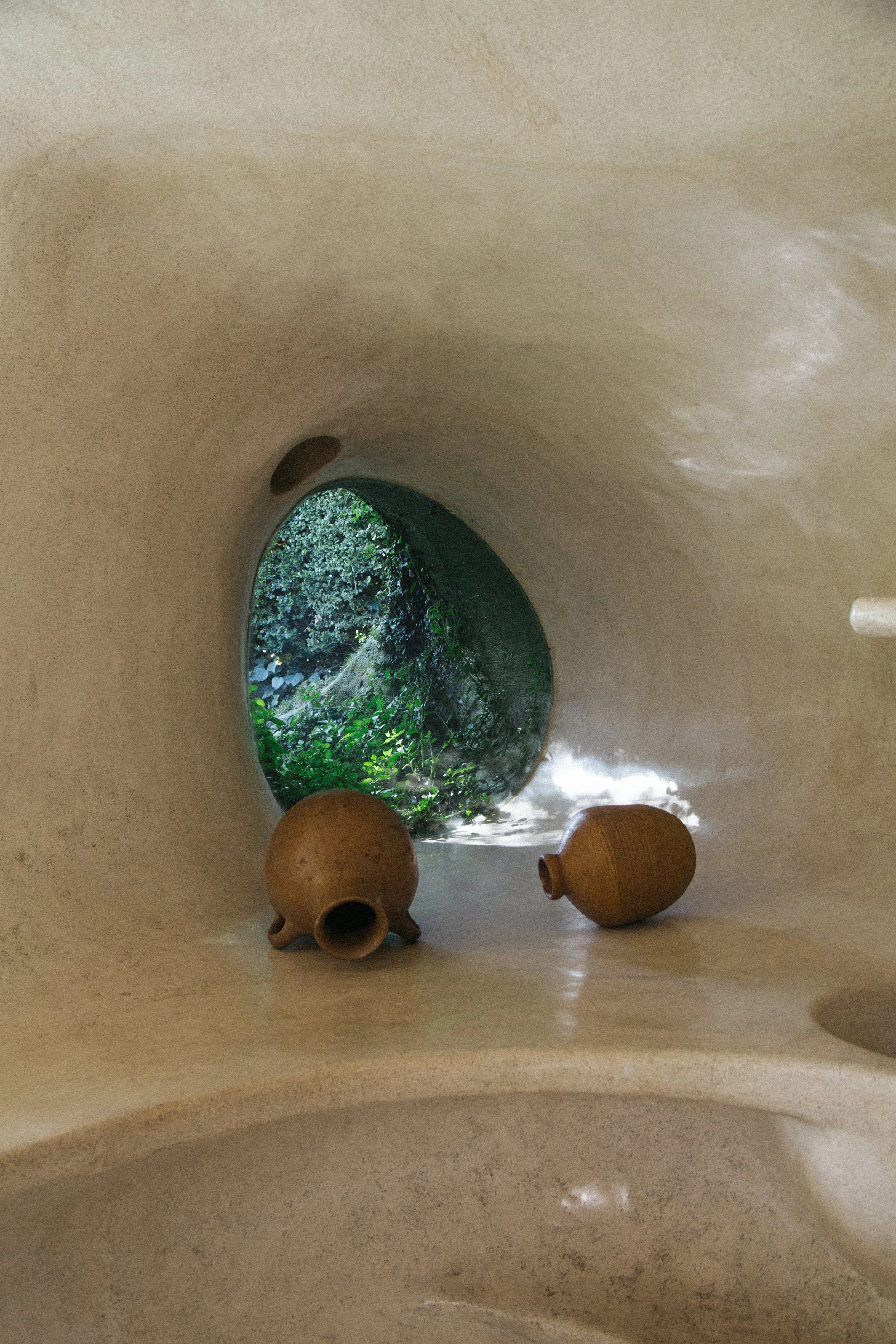
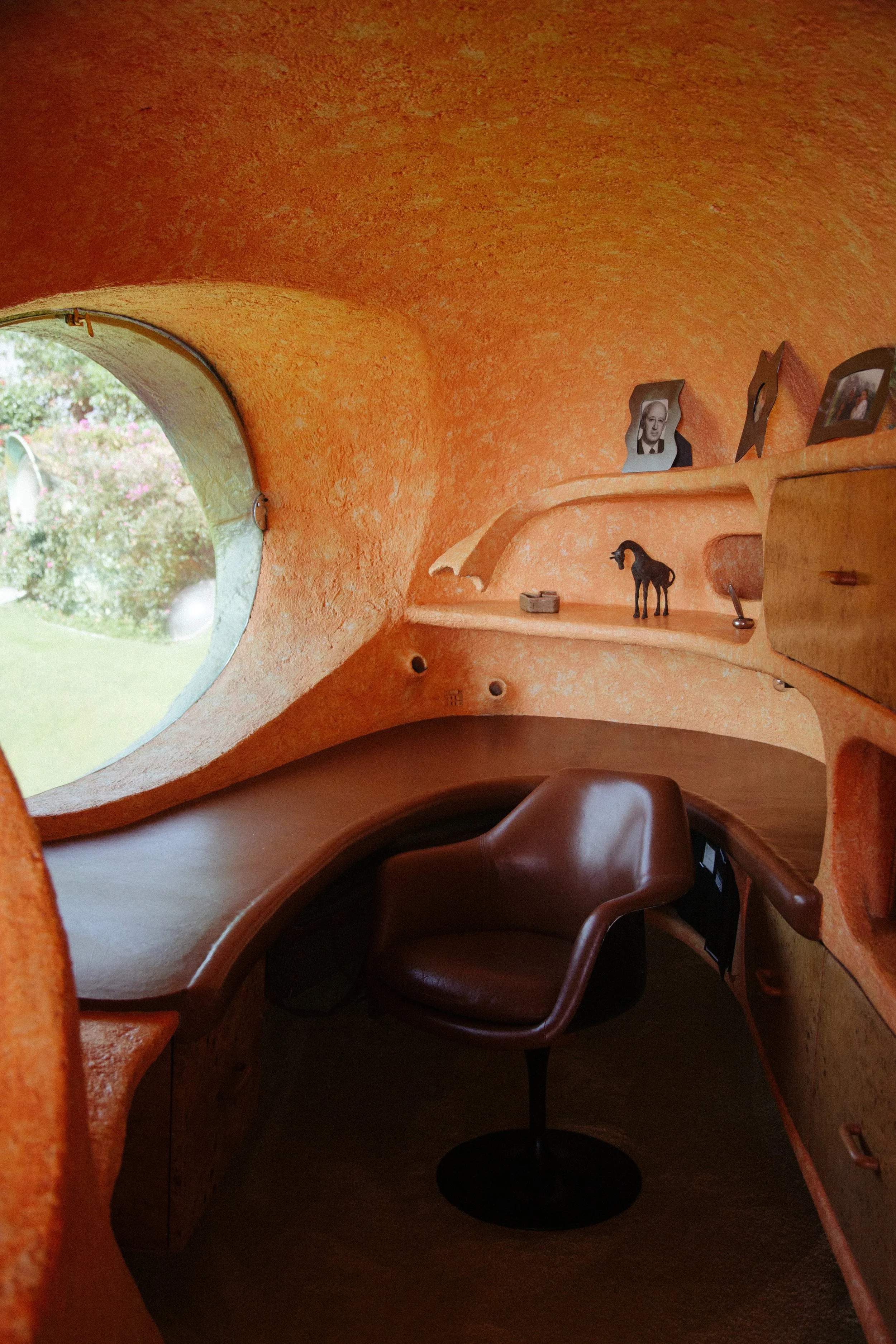
Casa Orgánica is a romantic elegy to living in harmony with the natural world and natural forms. Built by Mexican architect Javier Senosiain Aguilar in 1985, the house is located in Naucalpan de Juarez, a stone’s throw from Mexico City. Senosiain’s architectural philosophy was to build a home that more closely resembled the habitats of animals and prehistoric humans: a cave, a womb, a snail’s shell, an igloo. Sinuous earth-tone tunnels lead to different living chambers, giving the feeling of entering the earth. From the exterior, the domicile is barely visible through layers of grass, trees, shrubs and flowers, which, by evopotranspiration, produce oxygen, reject pollution and filter dust and carbon dioxide creating a unique microclimate. The house and workof Senosiain was recently featured in a landmark exhibition at The Noguchi Museum, entitledIn Praise of Caves, which was organized by Ricardo Suárez Haro and curated by Dakin Hart. Alongside projects by Mexican architect Carlos Lazo, Mathias Goeritz, Juan O’Gorman, the exhibition was a metaphor for reexamining how we live on planet Earth.
OLIVER KUPPER: We should start with the connection between utopia and organicarchitecture.
DAKIN HART: One of the interesting things about organic architecture for me, is that tosome extent, it offers a path back to Eden. It suggests an entirely alternative family treeof development—of the idea of how we live on the planet—that could have departedfrom the one that we’ve ended up on very early in human history. So,it’s nice to thinkabout following it backwards the way that Javier does in his scholarship, and if you thinkabout utopia as an umbrella category for a way of living that we might recapture, onethat has different characteristics and a different value set, that seems really interestingto me.
JAVIER SENOSIAIN: In the case of organic architecture, I believe that utopia could be a reality.
OK: The exhibition catalog goes back to the original cave dwellings, which is the prehistoric idea of organic architecture.
DH: Every time modern architecture has tried to address the idea of utopia, it runs into such trouble because the version of abstraction that it leans on is mathematical. And that doesn’t really have to do with life, it has to do with a kind of purenotion of what lifecould be or should be. Maybe it’s fundamentally religious or spiritual too, which is also highly problematic, because it gives it this messianic quality. Organic architecture potentially offers a salve to that.
NATALIA SENOSIAIN: Modern architecture involves a lot of technology. When you think of sci-fi movies, it’s all about technology and not really about humans.
DH: Right. The closer we can get to stainless steel, the better everything will be is sort of the premise of modern, International Style, architecture. Javier, what kind of utopia do you think organic architecture could build in contrast to something like the Corbusian notion of utopia, which is total uniformity, total cleanliness, total purity.
JS: We are in a very difficult world situation now, mostly because of climate change, and to solve really big issues, we need big solutions. Corbusier used to say that the house is a “machine for living.” That statement doesn’t really apply anymore, it would be better if we thought of the house as the nature of living. Maybe going back to our origins can take us closer to utopia, even if it sounds weird.
OK: I’m curious about how the exhibition came to be, how it was curated based on Javier’s work, and why the Noguchi Museum?
DH: Ricardo Haro was thinking about this lineage of organic architecture that Javier has invested so much of his life and career in, in terms of scholarship and practice. And I think he just intuitively recognized that this group of artists could work really well at theNoguchi Museum. So, Ricardo just sent us an email out of the blue in 2018, and part of what we do with these exhibitions at the Noguchi Museum is we try to treat the museum like nature. We treat it like a park or a natural environment. So, we started trying to put together a structure that could work at the museum, and this was a perfect opportunityto show a different side of it. We're always trying to split the Noguchi beam into different aspects, or peel the onion. I had never even heard of the term ‘organic architecture’ before Ricardo wrote, and while it’s not an ‘ism’ that’s currently in art history textbooks, it may well be in the near future because there’s obviously a strong seedbed of interest, which our exhibition proved. I think it maybe the most popular show that we've done in the last ten years. The response to it was just extraordinary, and really worldwide too. It was exciting to have hundreds of young architects and architecture students coming to see the show. We don't know how exactly it's going to ripple out, but young architects want different solutions. They’re not satisfied with the status quo, and here is a serious body of work that's well rooted in history, and cultural traditions, and a landscape, andbuilding traditions, and it's still current. It's being taught and practiced by somebody incredibly inspiring. I think it has a real chance to offer an important counterpoint to what most people are learning in architecture school, and when they come out into their own practices or go to a big firm, they're still expected to do whatever it is they choose to do.
OK: Javier, when did you first start developing your scholarship around organic architecture?
JS: When I give a lecture, I start by showing the students a couple of projects I did whenI was at the university, which already had some resemblance to organic architecture. I was very lucky because I had Matías Goeritz as my teacher. At a school where all of the other teachers were very rigid, he was very abstract and he would let us do very free work. When I went to do my social service in a small village, I proposed a sports and cultural center with square shapes and then realized that I could start working with more freedom. That was when I started thinking about curves and realizing that curved spaces are far more human. I started doing research on the natural shape of a human being. This is one of the features of my architecture—the continuity and the space.When you walk through the space, you can see the continuity and the flow. So, organic architecture has a lot of that.
DH: The difference between that and someone like Frank Gehry, who's a contemporary of Javier’s, or Zaha Hadid, a generation behind, is that Javier’s architecture is organic from the inside out. It's based on organic models, and it's developed in a craft methodology that emphasizes the connection between the eyes, the hands and the brain. From the outside, those other structures look organic in that they’re not strictly quadratic anymore, but that's just an expression of technology. They demonstrate what modeling programs were gradually able to accomplish over time as they pushed the technology, but that form of abstraction isn’t anymore inherently organic than square buildings. Javier is starting from a completely different premise that isn't CAD models, or what a manufacturer can do. He’s using thousand-year-old technology to approach building as an expression of our innate, human instinct, as opposed to just putting the latest processor through its paces in coordination with modern manufacturing. I just read that article about the Lucas Museum of Narrative Art, and all of its delays in LA. A lot of them have to do with the complexity of fabricating those fiber panels that cover the whole thing because every one of them is unique throughout the entire structure. It's one of those examples of trying to push beyond what modern manufacturing can do. It looks like a spaceship, or a fish, but it’s not really organic, even though it's not rectilinear.
OK: Casa Orgánica truly is a masterpiece example of contemporary organic architecture. Can we talk about that?
RICARDO SUÁREZ HARO: Natalia grew up in it, and it seems utopian when you visit it. I can only imagine the type of brain connections it forms to grow up in that house, as opposed to the one that I grew up in, which was a California tract house.
NS: It was my normalcy. But, when my friends used to come visit, I could see their reactions—the way they loved the house and instantly wanted to play and everything. Now that I'm grown up, I can see the impact that it has. My father always says that he wanted to create a more humane architecture, and now I believe that he accomplished it because all types of people want to go visit the house. You can be an engineer or a mathematician and still find it remarkable. But, I believe that I did grow up with a different mindset, just because of living in that house. Once, when my sister was in kindergarten, the assignment was to draw your house. So, she (laughs) just painted grass and round windows, and the teacher was confused. She called the school psychologist, and then the psychologist decided to talk to my mother, and my mother was like “Oh no, it's just that my husband is an architect and he does this really different type of architecture.” And the psychologist said, “Oh, maybe I should be speaking to your husband.” (laughs)
OK: So, where did the idea for the house come from? I've read so many different things about where the ideas came from around its shape.
JS: The idea was to take into account the physical aspects, environmental aspects, cultural aspects, and the necessities of the human being. It was part of an investigation in which I took all these aspects into account, while putting aside the very rigid aspects that are taught in university. The idea is sort of like a peanut, but in some interviews it has been misunderstood. I had the concept and the philosophy of the spaces that were needed to live, and there are two spaces: one is the day space, which is much more social, and then the night space, which is more intimate. The zoning was like a peanut because there were two spaces, but it was sort of shapeless. We adapted that peanut into the shape of the house, taking into account the topography of the land, and there was a big eucalyptus tree that was in the middle, so the house surrounded the tree.There was a lot of stone on that land, so originally the idea was that the walls were made out of stone, and the roof was made out of wood, but I didn’t like it because there was no continuity in the material. That’s when I came up with this constructive method of ferrocement. It’s a very noble constructive system that can allow you to buildpractically any shape and respect that continuity.
DH: Javier gave this beautiful talk at the opening of the exhibition about the CasaOrgánica and the way that once we leave the womb, we end up living and dying in aseries of boxes. If you think about it, it's a form of torture, to go from the womb into a shipping container. And that’s essentially what modern architecture is; just a series of hard, square spaces. The whole philosophy of organic architecture offers an alternative to that regime, and that's where the humanity comes from. The Casa Orgánica is a nest.It's the most enveloping and natural form. When I walked through, I couldn’t help thinking about what it would have been like to grow up in those bedrooms, the way that using the faucet is like starting and stopping a stream. It really is like living in a forest glen. It's the ultimate fort. All kids try to achieve that by building forts out of pillows and blankets, but at seven you don't have the resources to do what Javier accomplished with the Casa Orgánica. It’s the most sophisticated version of what we all want as children.
OK: So, how do we protect organic architecture, especially when we're so obsessedwith putting people in these boxes? Of course, the Casa Cueva [built by JuanO’Gorman] was tragically ruined, but also, how do we cement its importance in thehistory books and in scholarship?
JS: I believe they're very isolated examples of organic architecture. O’Gorman's house and Carlos Lazo's house were made in the ‘50s. Now, with the climate crisis and with people being much more conscious about the planet, these houses could be more affordable than regular housing. They're also much more resilient in certain climates, and in response to natural disasters, like earthquakes. So, they could possibly become more commercial in the way that they're built.
NS: When I lived in the Casa Orgánica, I remember my friends really enjoying the house and telling their parents, “Can we live in a house like this, please!” And the parents would be like “Okay, yeah, it's interesting, but I would never live in a place like this.” I believe that the generations are changing, so people will look more for these types of experiences.
RH: What’s interesting about exhibiting organic architecture in museums is that inatypical painting exhibition, the audience is passive, and they only contemplate whateverthey're looking at. But when you see these kinds of shows, you realize that we can all be active players in our own homes. Just moving the furniture from one side toanother,you can see if you feel better, if you gain more natural light, if it makes more sense. Wecan start interacting and see how we feel, and that's something very organic as well.
DH: That's really what Noguchi's work is about—empirical intelligence—trying to train us to think better through our bodies, to think better physically. We've all been taught that the use of language is the highest expression of intelligence, but it's just one expression of intelligence. There are many others, and we would all be better served if we had more empirical literacy. The neat thing about organic architecture is that it's one discipline for doing that, and if you live with it, it formats your brain differently. You have different expectations, which leaves you open to different solutions. The NoguchiMuseum is trying to do just that; to open up a universe of other solutions. And organic architecture is an extraordinary example of that, one that's incredibly important to society.