Mindy Seu interviewed by Lara Schoorl

interview by Lara Schoorl

For over three years. designer and technologist Mindy Seu has been gathering online activism and net art from the 1990s onwards. Commissioned by Rhizome in 2020, the growing collection of text and imagery forms the always-in-progress web database Cyberfeminism Index. By way of a “submit” button, anyone can contribute to the project making both the creation and outcome accessible to everyone. In 2023, the Index was translated to print by Inventory Press and includes over 700 short entries with scholarly texts on the hacktivist utopias of the internet’s nascent years.

LARA SCHOOL: Do you think it is possible to invent a new type of cyber-utopia outside of the surveillant, capitalist, algorithmic framework?

MINDY SEU: During the Cyberfeminism Index panel at the New Museum with E. Jane, Tega Brain, Prema Murthy, and McKenzie Wark, we tried to trace the evolution of what's happened from the early ‘90s until now. This idea of the utopic internet was very palpable in the ‘90s because it was the first introduction to this new technology that promised global connectivity, the ability to be everywhere all the time with those that were not in close physical proximity. However, people quickly began to realize that, while the internet did afford these new potentials, it was also very much guided by the infrastructure that the internet was created on, which was born from the military industrial complex. This ultimately shapes the platforms we use now and the behaviors that these platforms perpetuate: things like surveillance, censorship, and data extraction. In my essay, The Metaverse is a Contested Territory for Pioneer Works, my good friend and Cyberfeminism Index collaborator Melanie Hoff describes what pushes people to imagine is the need to imagine: a survival mechanism to find release from the the pressures of your current reality. Some examples of this were given throughout the panel. E. Jane talked about the liberatory potentials of bespoke and local experimental music communities. Tega Brain talked about projects that consider the materiality of the internet and the physical implications of these seemingly ephemeral networks that we use. There are definitely potentials for how we can begin to think of not necessarily a utopia, but broader views of how the internet might be able to serve more people rather than the smaller minority.

SCHOOL: It seems as though the internet is almost showing us that this need to imagine is universal. Even if the status quo might work for some-arguably it does not work perfectly for any person— the internet has made visible the failures, corruptions, shortcomings, and discriminations of and within all kinds of systems. Perhaps free imagination is not fully possible on the internet itself now, or not as was anticipated, but it has made visible the need for imagination and change across the globe and all demographic groups.

SEU: Absolutely. And as you are saying, in some ways the internet did al low more people to publish these kinds of narratives online without the gatekeeping of more “legitimate” institutions.

SCHOOL: Typically, things are now translated from print to on-line, but you did the inverse. What are your thoughts behind turning the online archive into a book? Something that continues to morph organically through submissions into a more or less fixed, prescribed format?

SEU: Because my background is in graphic design, I have always believed that print and web are very complementary. In Richard Bolt, Muriel Cooper, and Nicholas Negroponte's Books with Pages 1978 proposal to the National Science Foundation, they describe how soft copies are seen as ephemeral and dynamic whereas hard copies are seen as immutable, permanent, or more reputable because of how academia valorizes printed volumes. But, with my website collaborator Angeline Meitzler, we tried to flip this hierarchy. The book, while it did come after the website, acts like a snapshot or a document of the website's mutation, whereas the website acts an ever-growing, collective, living index, to grow in perpetuity. Even since we (my book collaborators Laura Coombs and Lily Healey) froze the website's contents to create the manuscript for the book, the online database has already received 300 more submissions. The book functions as a call to action for the website to continue gathering ideas of cyberfeminism’s mutation moving forward. That said, with my publisher Inventory Press, we made sure the book was included in the Library of Congress. When creating these revisionist histories, grassroots information activism must contend with the perceived legitimacy of forever institutions by penetrating it, hacking it.

SCHOOL: Thinking about physical versus online spaces, where do you think safety and accessibility of both people, information and/ or archives, like the Cyberfeminism Index, are better achieved, online or in print? Or does a hybrid environment foster these more widely?

SEU: Generally, especially with people who resonate with cyberfeminism, there is an appreciation for complexity. It is never the binary of this is better than that, but rather seeing the pros and cons of both media and how elements of both can be used to achieve the community’s goals. For example, with print, you do have these connotations of legitimacy, but we also see the rise of sneakernets, which are physical transfers of digital media rather than using online networks as a way to avoid different methods of surveillance. With the web, there is the ability to have a dynamically changing environment that updates over time. The co-existence of print and web allows both to grow.

SCHOOL: I keep returning to the word “hybrid” when thinking about the future. I recognize it in so many of the entries in the Index: William Gibson’s cyber-space, Donna Haraway’s cyborg, E. Jane’s anecdote about us needing air to breathe, Ada Lovelace and Jacquard’s loom, and more. How do you consider a hybrid on-line-physical point of view?

SEU: It makes sense why people think the internet is ephemeral and acces-sible; we have these computers in our pockets that have become extensions of our bodies. It is harder to see the physical infrastructures that make this thing possible: fiber optic cables running along the ocean floor, or the rare earth minerals that make up our phones, typically mined in Latin America in places that have very few or non-existent labor laws. Even after our devices die, they are very hard to recycle so they end up in e-waste graveyards in Guiyu, China where people break apart the phones to sell different parts, and the remainder is burned, leading to a very cancerous environment for those who live there. expand on these ideas in a forthcoming essay called “The Internet Exists on Planet Earth,” commissioned by Geoff Han for Source Type and Tai Kwun Contemporary that attempts to unpack the materialism of the internet. For one of the people who coined cyberfeminism, Sadie Plant, materialism is a huge component of her seminal book Zeroes and Ones (1997). In it, she gives a retelling of techno-history, redefines what technology actually includes, and details the ecosystem in which technology lives.

SCHOORE: Do you think it is possible to be completely inclusive, even if attempted? Is it more conceivable for utopia to be actually plural: utopias? Or, are they indeed meant to literally exist nowhere?

SEU: Generally, universalisms cannot exist. The utopias that are evangelized do not account for the many different perspectives and demographics that true equity requires. Rather than thinking of utopia as a space, we can think of utopia as principles. There are principles that could be embedded in our current landscape to benefit the masses, such as file sharing, basic income, open borders. Lately, I have been thinking about scalability. A couple of years ago, I co-organized an exhibition at A.I.R. Gallery with Roxana Fabius and Patricia Hernandez called the Scalability Project, whose title was borrowed from Anna L. Tsing’s Mushroom at the End of the World [2015]. Scalability was also a tenant of this year's Transmediale in Germany. Scalability implies a smooth, seamless, hyper-efficient growth pattern, but the breaking points it reveals inevitably create conditions for change. Legacy Russell writes that the glitch is the correction to the machine. Instead of the glitch as an error, it is an amend-ment, a reexamination of the problem. Another activist and scholar, adrienne maree brown, and her collaborator Walidah Imarisha, introduce the concept of fractalism, the creation of principles for a small local community that can grow as a spiral, with clear mutations at different levels in order to bring in more and more people. It is this idea of constant evolution rather than seamless scalability. We’re embracing glitchiness, bumpiness, and the errant.

SCHOOL: I know the project does not aim to define cyberfeminism, but do you have a particular understanding of the word “cyber”?

SEU: I think about “cyber” in the context of how it has been used in history and through its etymology. The prefix “cyber” first emerged in Norbert Weiner’s cybernetics in the ‘40s. In simplistic terms, it proposed the idea that you are impacting the system just as it is impacting you. It’s all about feedback. Then, cyber appeared in cyberspace in William Gibson’s Neuromancer [1984]. This sci-fi novel was important because it predicted the sensory networked online landscapes that we are very much talking about today. But Gibson's Neuromancer was also shaped by the white male gaze, with fembots and cyberbabes and depictions of women with assistant or robotic-like roles. He also created a very oriental landscape that is devoid of actual Asian figures. When cyber was then fixed to “feminism” to create “cyberfeminism” by VNS Matrix and Sadie Plant in the 1990s, it felt like a provocation for feminists, marginalized communities, or women to reshape what cyberspace could be.
Pippa Garner interviewed by Hans Ulrich Obrist

interview by Hans Ulrich Obrist


From the auto body to the human body, artist Pippa garner is one of the most pioneering artists of our time. Serving first as a combat artist during the Vietnam War, Garner’s radical practice took on the form of absurdist automotive sculptures and utopian inventions. A backwards car, an umbrella with real palm fronds, a half suit, satirized our lust for objects and teetered on the edge of fine art and commercialism. Even Garner’s own sex change, transitioning from man to woman, become a materialistic invention, her sexual organs equal to the raw material sent down the factory assembly line; body and thing becoming one and the same part of capitalism’s bioindustrial complex.

HANS ULRICH OBRIST: I wanted to ask you how it all began. How did you come to art or how did art come to you? Was it an epiphany or a gradual process?

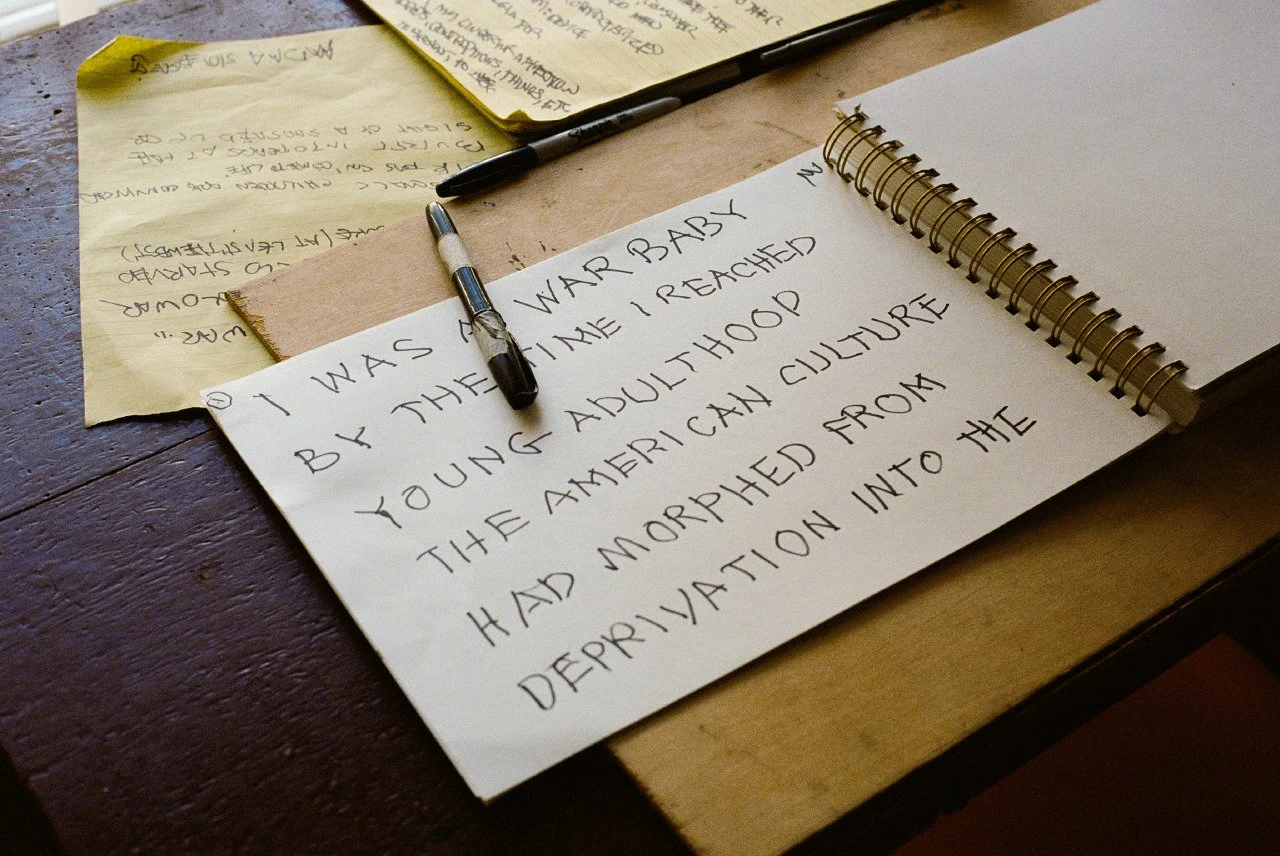
PIPPA GARNER: Well, I was a misfit to begin with. It seems like the growth process can be enhanced by the situation you're in. I was a war baby. I was born in ‘42, and I still have a few memories of what life was like during that time. Everybody knew somebody that was in the Army. Even a small child can get a sense of what it feels like to have the world be at war. I didn't pick the time I came to life on Earth. The war years were a time of deprivation. And this is a country of extravagance—it was based on independence and outlaw thinking. And all of a sudden, the whole thing was thrown away because of the war. But living was good for me then because I went through adolescence just as consumerism was really born. The assembly line technology that had preceded World War II was advanced by war needs, so there were all these companies suddenly producing the fastest, best things they possibly could, from airplanes to shoes. Advertising was born out of that because they had to convince people they needed things they didn't realize they needed. Suddenly all these stores were flooded with consumer goods. Things that nobody could imagine: chrome blenders, waffle irons, ovens, and lawnmowers. And I was fascinated with that, particularly automobiles, because the cars that I grew up with all had very distinct faces—the eyes, the mouth, the nose. You could recognize whether it was a Studebaker or a Ford. They had a certain character and I felt like there was life there. It goes back to another childhood thing of wanting to bring things to life. I think all children go through that with their stuffed animals. They get off of it pretty quickly, but I never quite overcame that. Clear into my puberty and beyond, I still felt that cars were living. If I’d see a bad crash where the face of the car was all smashed, I’d burst into tears. I found that it was a useful tool as an artist because a lot of the stuff that I was making was a kind of consumerism.  

HANS ULRICH OBRIST: You were in the Vietnam War with the US Army as a combat artist. Can you tell us a little bit about that experience? It also brought you to photography because you got these state-of-the-art cameras from Japan and started to take personal photographs, which became important for your later magazine work.

PIPPA GARNER: I was drafted in college. I used up several student deferments. Finally, they sent me the notice. So, I was sent to train as an unassigned infantryman in Vietnam, having no idea what I was going to be doing. I went over on a big plane full of people who were going to be assigned to different units. Once I got there, I thought, gee, I wonder if there's something that might have to do with my art background. I did some research and sure enough, one of the divisions, the 25th Infantry, is the only division with a Combat Art Team (CAT). A group of people who had some art background were given an itinerary to go out with different units and document with drawings, pictures, and writing. The camera thing was interesting because the military store on the base had all this expensive Japanese camera equipment, very cheap. And I got a really nice Nikon camera for nothing and trained myself to use it. A lot of times things were going so fast that you couldn't really hold the image long enough to document it, so that's when photography became very much a part of my life.

HANS ULRICH OBRIST: Then you studied transportation design at the ArtCenter College of Design in Los Angeles, an extremely well known institute. You had one of the first major epiphanies in 1969. You presented your student project, which was a half car, half human. Can you tell me and our readers about the epiphany that led to Kar-Mann (Half Human Half Car). And also how people reacted to it?

PIPPA GARNER: There was a Volkswagen sports car in the '60s called the Karmann Ghia. It was considered a very sophisticated sports car during that time and that’s why I modified the spelling and called the sculpture Kar-Mann. I started going to art school fairly early. I went to the ArtCenter College of Design, which at that time was called Art Center School and it was in Hollywood. My father, who was in charge of things, saw that my interests were leaning toward art. To him, that was bohemian and something he didn't like. He was a businessman and wanted me to go into business. And so he tried to direct my art to car design because I was so interested in cars. He did a lot of research and found out that the school where all the car designers were trained was this Art Center School in Los Angeles. So I went out there in 1961 and found myself alienated because all the other students there wore suits and loved cars in a much different way than I did. I cherished [cars] in a way that was sort of comical. I thought some of them were really funny and stupid looking, so I felt pushed into a satirical corner. So, I quit that school and went to the Cleveland Institute of Art in Ohio, which is a wonderful fine art school, and I started doing a lot of life drawings. I fell in love with life drawing. To study the form, you have to understand it from the inside out or else it doesn't look lifelike. But I got quite good at it. So, eventually I went back to the Art Center. I still had the design classes, but they had life drawing work. And so, I began doing tons of life drawing and sculpting the human form. It just fascinated me. But the idea of making this half car, half man, was something that I did as a sketch. There was a wonderful teacher that encouraged out-of-the-box thinking a bit more, and when I showed him the sketches he said, “Why don't you make that?” So, I figured out the proportions—I wanted the human part to be about the size of a small male figure, and then I found a toy car and was able to integrate that using styrofoam to make the basic sculpture. And then, I covered it with resin to make the surface hard and did all the detailing. I was making fun of cars.

HANS ULRICH OBRIST: I've just written the book Ever Gaia [Isolarii, 2023] with James Lovelock, who invented the Gaia Hypothesis with Lynn Margulis. He was a serial inventor. In a similar way, you are a serial inventor. You created all these objects between design and non-design, and then images of these objects were published in magazines, like Esquire, Rolling Stone, and Playboy. It's interesting that you then decided to go beyond the art world. I've always been very interested in that. Can you talk a little bit about how you bring these objects to a bigger audience, through magazines, but also appearances on talk shows?

PIPPA GARNER: When I was doing all that work in the ’70s, ’80s, and ’90s, there was a real barrier between fine art and commercial art. If your work occurred in magazines, it was low grade. No matter what it was. It was degraded by the fact that it was published. And I reversed that in my mind. I thought, well, gee, that's not right. Here's an opportunity to have things out there reaching thousands of thousands of people as opposed to an art gallery. I love the idea of having as much exposure as possible. Even though I've had close friends that were recognized fine artists, and in a bunch of the galleries—I never really cared much about it. I did have a couple of gallery shows here and there, but mainly the thing that fascinated me was the fact that I could reach people clear across the country, and sometimes beyond, with these images. I didn't have much money during those years, but I always got enough out of the magazines.

HANS ULRICH OBRIST: And of course, one of your key inventions, which is so famous today, is the backwards car from 1973. It’s also interesting because it was a different time in magazines—when they paid for these extraordinary realities to happen. Can you talk a little bit about the epiphany of the backwards car and how it then drove on the Golden Gate Bridge in San Francisco?

PIPPA GARNER: There was a period in all the major American car companies after World War II when they started having these really huge design departments. They used a lot of references to jet planes. The Cadillacs in the ’50s were huge, and they looked like they were moving even when they were standing still, which is called directional design. After my half car, half man, I started seeing cars in a context that had nothing to do with their purpose. The Cadillac particularly fascinated me because of the huge fins. And I had a good friend that was a designer who worked for Charles Eames in the early ’70s. He and I would go roaming around sometimes on our bicycles. One time, we went by this used car lot and there was a ‘59 Cadillac, and it just popped into my head, what if that thing was going backwards? It was just devastatingly funny and that convinced me that in some form it had to happen. So, I started sketching and figuring out how to do it, and I made a nice presentation. Esquire Magazine in New York responded and said, “Oh my God, we have to do this. How much do you want? How long will it take? We’re going to send a photographer to take pictures of the process.” But it couldn't be a Cadillac, because you couldn't see over the fins. So, I started looking in the papers until I found the car I wanted: a 1959 Chevy, two door sedan, six cylinder, no power steering or power brakes. I wanted a drive train as simple as possible so it would be easier to reconnect. It had fins, but the fins were flat, so they didn't obstruct your vision. And so I did the whole thing myself in a little garage space. Now, it was a matter of, how do I lift this thing up, turn it around, and set it back down on the frame? I didn't have access to any sophisticated technology to do it, so I got everybody I knew and we had a little party when I finally got everything cut away. Once everyone got a little bit high from the alcohol, I said, “Okay, folks, everybody around this car, shoulder to shoulder. When I give the command, I want you to lift the car up, and then walk it back, turn it around, bring it forward, and set it down again.” I thought it was going to be too heavy, but fortunately they didn't have any trouble. Once it was set back down, there was the backwards car. One day it was ready to try out and that was it, we went out and drove it around the San Francisco coast.

HANS ULRICH OBRIST: The other day, I visited Judy Chicago, and of course she worked with car elements. There was also John Chamberlain. And during the same era, there was also Ant Farm, the architecture collective with whom you actually collaborated. And Nancy Reese was a big influence on you, because she made you realize that you can identify yourself as an artist. Can you talk a little bit about this?

PIPPA GARNER: Well, that was an interesting evolution, especially when you think back on it from the Information Age. Now, everything is shrunk down to nothing. There's no presence. Even cars look almost identical. You can't tell one from the other. The only way you can tell the difference between a Mercedes and a Kia is by getting close enough to look at the logo. Other than that, they're identical. They all get the same input. They use CAD design. So, that whole era really stands out. Everything was so unique. There was such an emphasis on trying to make things attract attention and to design things that make people say, gee, I gotta have that.


HANS ULRICH OBRIST: In 1995, you did this great project where you tried to get a custom license plate that said “sex change”—spelled SXCHNGE. But the authorities at the Department of Motor Vehicles turned it down, so you resubmitted with HE2SHE and it was accepted.

PIPPA GARNER: For me, the sex change thing was a material act. I never had a sense of being born in the wrong body as one of the expressions that they use goes, or had the trauma of being treated badly because of my sexual feelings. I never thought of any of this until I had already lived in my thirties as a male. And then suddenly, I ran out of interest in the assembly line products that I was so fascinated with. Even with cars, I felt like I had done as much as I could do. So I thought, there's gotta be something new, something else. And that was just about the time that changing your gender worked its way into the culture. The first example was, of course, Christine Jorgensen, way back in the ‘50s. But it wasn’t until the ‘80s when terms like transsexual started to be used. Leading up to that was the whole gay revolution. When I was growing up, you couldn't be gay. It was the most horrible, evil thing that could happen to a person. Gay culture was completely concealed. So coming out of these cultural biases became a real issue. And the human body—flesh and blood—fascinated me because I could still be using existing objects and juxtaposing them, but at the same time, making it fresh again. So, I looked at myself in the mirror and thought, you know, I'm just at an appliance, like that radio over there, or the car sitting outside. The body that I was assigned to, I didn't pick it. I didn't say I want to be white, middle class, and heterosexual. So, if I am nothing more than another appliance, why not have some fun with it? Why not play with it and alter it in a comical way? Finally, that escalated into my deciding to go through with the surgery, which I went to Brussels for in 1993. I had what they call a vaginoplasty. Now, part of me is European [laughs]. I came back from that and thought, this is great, Im in my forties, I've had a penis for all these years, and now I have a vagina. What an amazing thing—I live in an age when you can do that. You could go and pay somebody some money and say, “Here, I want to have my genitals turned the other way around.” And they said, “Fine, here's the bed.” (laughs) I was fascinated with the fact that I could do that with my body. It gave me a sense of control and a sense of a whole new area that I could explore. Meanwhile, the culture was changing and becoming more open. It's still not good, but it's much better than it was. I was kind of a pioneer with that perhaps.  

HANS ULRICH OBRIST: There's this amazing conversation, which you did with Hayden Dunham, about the struggle of being inside bodies. You say that because the advertisements and consumerism in the background in your life were always very gender oriented, you were forcing yourself to become more masculine. And at a certain moment, you decided not to conform anymore. It’s so pioneering. Can you talk a little bit about that?

PIPPA GARNER: Everything is structured in the culture to try and keep people in a comfort zone. Unfortunately, that doesn't fit everyone. But how do you deal with that? How do you let people be what they want to be and still have a sense of the culture being unified and functional? Again, all these things are just a point of evolution. Things keep changing and moving forward, and they always will. I think about my life being one frame of an endless film—just my little thing, and then it goes to the next frame. And that goes on into the distance forever. I think that my perceptions of gender were very materialistic. I’m a consumer and this is what I do with my body. It was no different than someone putting on makeup, or somebody going to a gym, taking steroids, and building this huge body that doesn't have any purpose at all except for looks. I didn’t have anyone that was going to suffer for it. If I had a family, it might've been different, but probably not. At this point, I was single. I had nobody to be responsible for, except to keep things moving forward. I don't want my life to ever get stagnant, to start losing its rhythm. And that's what I'm fighting now, because at this age, how do I maintain that? It's very hard for seniors to keep one of the things that I think is essential for life and that is sexuality. Everything for me represents the lifespan—from baby to aged person. Whether it's called puberty, adolescence, middle age, old age, I feel the need to incorporate that thinking in my work to keep that sense of life going, and the most obvious way is by maintaining sexuality. If I don't have any sex drives, all of it goes flat. I take estrogen and testosterone so that I can keep an endocrine system that's young and still is attractive and wants to be attracted, even at 81. That’s one of the real essential parts of my inspiration. If I lose that, I don't have any ideas. It's funny because hospitals are all divided into these clinics. Because I’m a veteran, I've got this ten-story VA hospital building at my disposal and there are clinics for everything but sensuality.  So, they’re really missing the point of trying to make people want to stay alive.

HANS ULRICH OBRIST: In this conversation with Dunham, you say that you see the body as a toy or a pet that you can play with. You can change the shape of it. You're an inside and an outside.

PIPPA GARNER: Well, that's it right there. That keeps things interesting and keeps a sort of question mark floating in the air over everything. So, you're not quite sure what will happen, you know, maybe it will be a drastic failure, or maybe a revelation.

HANS ULRICH OBRIST: We know a great deal about architects' unrealized projects because they publish them. But we know very little about artists' unrealized projects. I wanted to ask you if you have any unrealized projects, dream projects, which are either censored or too big to be realized, or too expensive to be realized?

PIPPA GARNER: Well, it's funny, because I always do. The problem is—and this is fairly recent—I was diagnosed with leukemia that was ostensibly from my time in Vietnam. I was there for thirteen months in the mid-60s. They were spraying Agent Orange, a defoliant, which turned out to be extremely toxic. I actually went on several of the missions with one of the planes that was spraying it, and there were no masks or anything. It stayed dormant until only a couple years ago, when all of a sudden, it caused pneumonia, which put me on life support for over six days. I was unconscious and I was in the hospital for a month in intensive care. Life support is terrible because it causes you to melt basically, mentally and physically. I've never gone through anything like that. All of a sudden, I found myself like a baby. I was able to go back home, but I still haven't fully recovered from that. I don't think I have the will. So, that's one of the problems. Now, I have this obstacle in my thought process because I'm constantly thinking, am I going to have some more time or not? You can be very isolated in Long Beach. Most of my friends are in Hollywood. So, I spend a lot of time alone, and I'm not good at that. I need to have back and forth. But I'm on the rules of the hospital. They did a five-hour infusion, which was a good thing. I'm lucky to have somehow survived to this point. I did something today with this young woman from the gallery who helped me take some pictures. It was a little thing I do for every April Fool's Day, which is my holy day. And so that was something that represents my thought process. I didn't have that two weeks ago. Then, all of a sudden, there it was. The same little mechanism back there was working. One thing that will be interesting is when we get autonomous cars. I want to live long enough to see that—something tangible. Something that affects my life that I feel stimulation from. Maybe I’ll just have one final burst left and then I drop dead. Or maybe not. I might be able to spread it out.

Not Casa Orgánica: Javier Senosiain & Dakin Hart in Conversation

interview by Oliver Kupper
photographs by Olivia Lopez

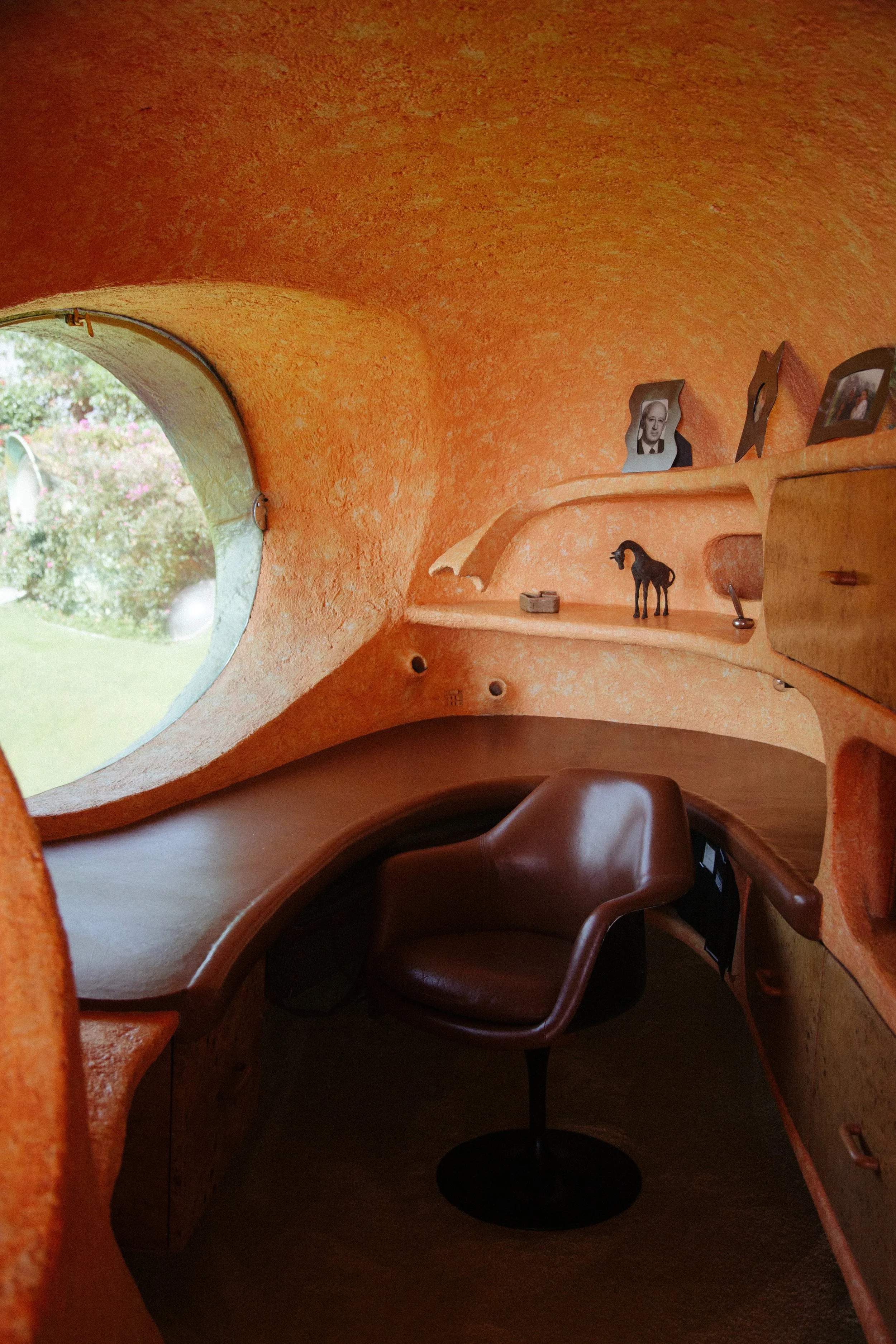
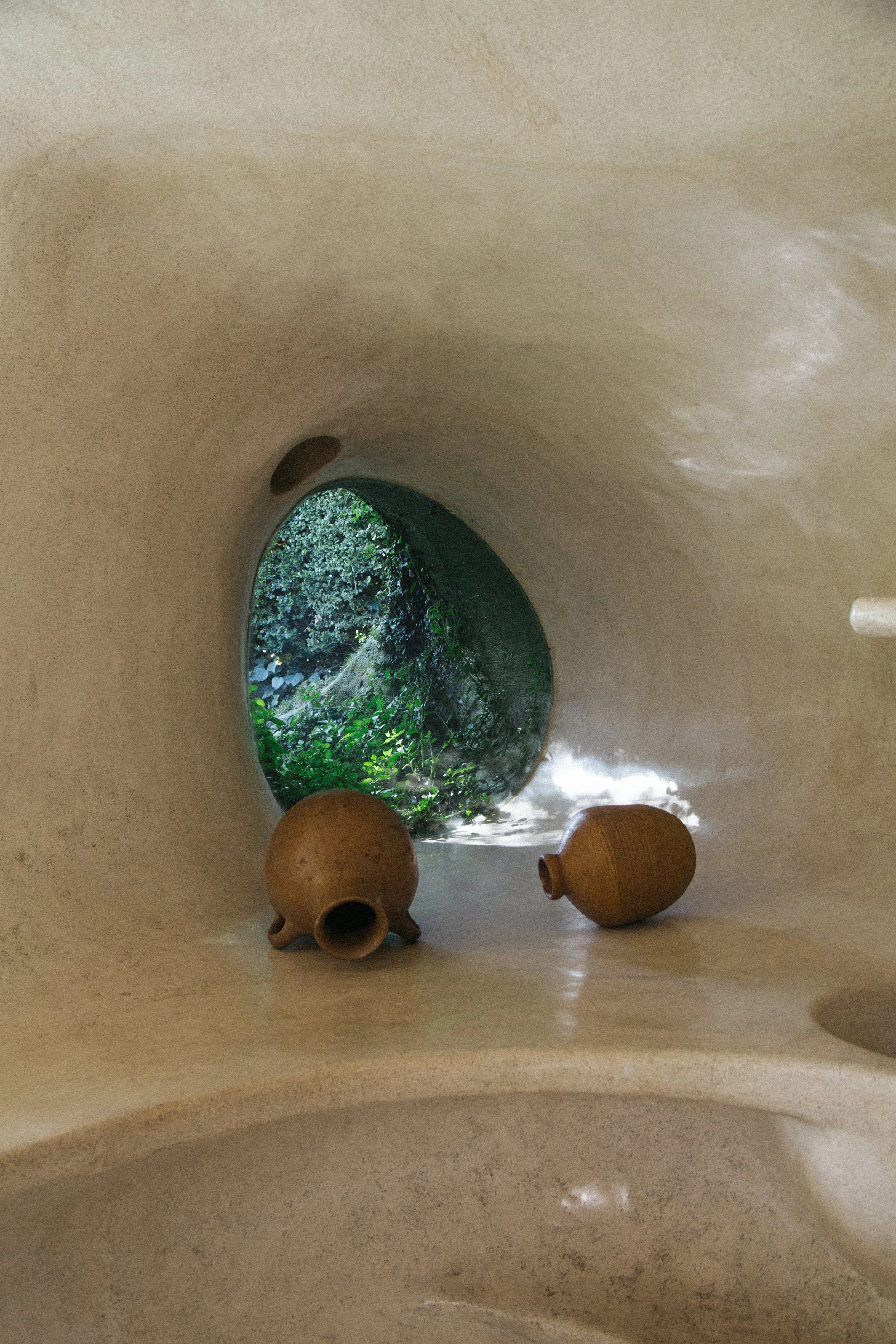
Casa Orgánica is a romantic elegy to living in harmony with the natural world and natural forms. Built by Mexican architect Javier Senosiain Aguilar in 1985, the house is located in Naucalpan de Juarez, a stone’s throw from Mexico City. Senosiain’s architectural philosophy was to build a home that more closely resembled the habitats of animals and prehistoric humans: a cave, a womb, a snail’s shell, an igloo. Sinuous earth-tone tunnels lead to different living chambers, giving the feeling of entering the earth. From the exterior, the domicile is barely visible through layers of grass, trees, shrubs and flowers, which, by evopotranspiration, produce oxygen, reject pollution and filter dust and carbon dioxide creating a unique microclimate. The house and workof Senosiain was recently featured in a landmark exhibition at The Noguchi Museum, entitledIn Praise of Caves, which was organized by Ricardo Suárez Haro and curated by Dakin Hart. Alongside projects by Mexican architect Carlos Lazo, Mathias Goeritz, Juan O’Gorman, the exhibition was a metaphor for reexamining how we live on planet Earth.

OLIVER KUPPER: We should start with the connection between utopia and organicarchitecture.

DAKIN HART: One of the interesting things about organic architecture for me, is that tosome extent, it offers a path back to Eden. It suggests an entirely alternative family treeof development—of the idea of how we live on the planet—that could have departedfrom the one that we’ve ended up on very early in human history. So,it’s nice to thinkabout following it backwards the way that Javier does in his scholarship, and if you thinkabout utopia as an umbrella category for a way of living that we might recapture, onethat has different characteristics and a different value set, that seems really interestingto me.

JAVIER SENOSIAIN: In the case of organic architecture, I believe that utopia could be a reality.

OK: The exhibition catalog goes back to the original cave dwellings, which is the prehistoric idea of organic architecture.

DH: Every time modern architecture has tried to address the idea of utopia, it runs into such trouble because the version of abstraction that it leans on is mathematical. And that doesn’t really have to do with life, it has to do with a kind of purenotion of what lifecould be or should be. Maybe it’s fundamentally religious or spiritual too, which is also highly problematic, because it gives it this messianic quality. Organic architecture potentially offers a salve to that.

NATALIA SENOSIAIN: Modern architecture involves a lot of technology. When you think of sci-fi movies, it’s all about technology and not really about humans.

DH: Right. The closer we can get to stainless steel, the better everything will be is sort of the premise of modern, International Style, architecture. Javier, what kind of utopia do you think organic architecture could build in contrast to something like the Corbusian notion of utopia, which is total uniformity, total cleanliness, total purity.

JS: We are in a very difficult world situation now, mostly because of climate change, and to solve really big issues, we need big solutions. Corbusier used to say that the house is a “machine for living.” That statement doesn’t really apply anymore, it would be better if we thought of the house as the nature of living. Maybe going back to our origins can take us closer to utopia, even if it sounds weird.

OK: I’m curious about how the exhibition came to be, how it was curated based on Javier’s work, and why the Noguchi Museum?

DH: Ricardo Haro was thinking about this lineage of organic architecture that Javier has invested so much of his life and career in, in terms of scholarship and practice. And I think he just intuitively recognized that this group of artists could work really well at theNoguchi Museum. So, Ricardo just sent us an email out of the blue in 2018, and part of what we do with these exhibitions at the Noguchi Museum is we try to treat the museum like nature. We treat it like a park or a natural environment. So, we started trying to put together a structure that could work at the museum, and this was a perfect opportunityto show a different side of it. We're always trying to split the Noguchi beam into different aspects, or peel the onion. I had never even heard of the term ‘organic architecture’ before Ricardo wrote, and while it’s not an ‘ism’ that’s currently in art history textbooks, it may well be in the near future because there’s obviously a strong seedbed of interest, which our exhibition proved. I think it maybe the most popular show that we've done in the last ten years. The response to it was just extraordinary, and really worldwide too. It was exciting to have hundreds of young architects and architecture students coming to see the show. We don't know how exactly it's going to ripple out, but young architects want different solutions. They’re not satisfied with the status quo, and here is a serious body of work that's well rooted in history, and cultural traditions, and a landscape, andbuilding traditions, and it's still current. It's being taught and practiced by somebody incredibly inspiring. I think it has a real chance to offer an important counterpoint to what most people are learning in architecture school, and when they come out into their own practices or go to a big firm, they're still expected to do whatever it is they choose to do.

OK: Javier, when did you first start developing your scholarship around organic architecture?

JS: When I give a lecture, I start by showing the students a couple of projects I did whenI was at the university, which already had some resemblance to organic architecture. I was very lucky because I had Matías Goeritz as my teacher. At a school where all of the other teachers were very rigid, he was very abstract and he would let us do very free work. When I went to do my social service in a small village, I proposed a sports and cultural center with square shapes and then realized that I could start working with more freedom. That was when I started thinking about curves and realizing that curved spaces are far more human. I started doing research on the natural shape of a human being. This is one of the features of my architecture—the continuity and the space.When you walk through the space, you can see the continuity and the flow. So, organic architecture has a lot of that.

DH: The difference between that and someone like Frank Gehry, who's a contemporary of Javier’s, or Zaha Hadid, a generation behind, is that Javier’s architecture is organic from the inside out. It's based on organic models, and it's developed in a craft methodology that emphasizes the connection between the eyes, the hands and the brain. From the outside, those other structures look organic in that they’re not strictly quadratic anymore, but that's just an expression of technology. They demonstrate what modeling programs were gradually able to accomplish over time as they pushed the technology, but that form of abstraction isn’t anymore inherently organic than square buildings. Javier is starting from a completely different premise that isn't CAD models, or what a manufacturer can do. He’s using thousand-year-old technology to approach building as an expression of our innate, human instinct, as opposed to just putting the latest processor through its paces in coordination with modern manufacturing. I just read that article about the Lucas Museum of Narrative Art, and all of its delays in LA. A lot of them have to do with the complexity of fabricating those fiber panels that cover the whole thing because every one of them is unique throughout the entire structure. It's one of those examples of trying to push beyond what modern manufacturing can do. It looks like a spaceship, or a fish, but it’s not really organic, even though it's not rectilinear.

OK: Casa Orgánica truly is a masterpiece example of contemporary organic architecture. Can we talk about that?

RICARDO SUÁREZ HARO: Natalia grew up in it, and it seems utopian when you visit it. I can only imagine the type of brain connections it forms to grow up in that house, as opposed to the one that I grew up in, which was a California tract house.

NS: It was my normalcy. But, when my friends used to come visit, I could see their reactions—the way they loved the house and instantly wanted to play and everything. Now that I'm grown up, I can see the impact that it has. My father always says that he wanted to create a more humane architecture, and now I believe that he accomplished it because all types of people want to go visit the house. You can be an engineer or a mathematician and still find it remarkable. But, I believe that I did grow up with a different mindset, just because of living in that house. Once, when my sister was in kindergarten, the assignment was to draw your house. So, she (laughs) just painted grass and round windows, and the teacher was confused. She called the school psychologist, and then the psychologist decided to talk to my mother, and my mother was like “Oh no, it's just that my husband is an architect and he does this really different type of architecture.” And the psychologist said, “Oh, maybe I should be speaking to your husband.” (laughs)

OK: So, where did the idea for the house come from? I've read so many different things about where the ideas came from around its shape.

JS: The idea was to take into account the physical aspects, environmental aspects, cultural aspects, and the necessities of the human being. It was part of an investigation in which I took all these aspects into account, while putting aside the very rigid aspects that are taught in university. The idea is sort of like a peanut, but in some interviews it has been misunderstood. I had the concept and the philosophy of the spaces that were needed to live, and there are two spaces: one is the day space, which is much more social, and then the night space, which is more intimate. The zoning was like a peanut because there were two spaces, but it was sort of shapeless. We adapted that peanut into the shape of the house, taking into account the topography of the land, and there was a big eucalyptus tree that was in the middle, so the house surrounded the tree.There was a lot of stone on that land, so originally the idea was that the walls were made out of stone, and the roof was made out of wood, but I didn’t like it because there was no continuity in the material. That’s when I came up with this constructive method of ferrocement. It’s a very noble constructive system that can allow you to buildpractically any shape and respect that continuity.

DH: Javier gave this beautiful talk at the opening of the exhibition about the CasaOrgánica and the way that once we leave the womb, we end up living and dying in aseries of boxes. If you think about it, it's a form of torture, to go from the womb into a shipping container. And that’s essentially what modern architecture is; just a series of hard, square spaces. The whole philosophy of organic architecture offers an alternative to that regime, and that's where the humanity comes from. The Casa Orgánica is a nest.It's the most enveloping and natural form. When I walked through, I couldn’t help thinking about what it would have been like to grow up in those bedrooms, the way that using the faucet is like starting and stopping a stream. It really is like living in a forest glen. It's the ultimate fort. All kids try to achieve that by building forts out of pillows and blankets, but at seven you don't have the resources to do what Javier accomplished with the Casa Orgánica. It’s the most sophisticated version of what we all want as children.

OK: So, how do we protect organic architecture, especially when we're so obsessedwith putting people in these boxes? Of course, the Casa Cueva [built by JuanO’Gorman] was tragically ruined, but also, how do we cement its importance in thehistory books and in scholarship?

JS: I believe they're very isolated examples of organic architecture. O’Gorman's house and Carlos Lazo's house were made in the ‘50s. Now, with the climate crisis and with people being much more conscious about the planet, these houses could be more affordable than regular housing. They're also much more resilient in certain climates, and in response to natural disasters, like earthquakes. So, they could possibly become more commercial in the way that they're built.

NS: When I lived in the Casa Orgánica, I remember my friends really enjoying the house and telling their parents, “Can we live in a house like this, please!” And the parents would be like “Okay, yeah, it's interesting, but I would never live in a place like this.” I believe that the generations are changing, so people will look more for these types of experiences.

RH: What’s interesting about exhibiting organic architecture in museums is that inatypical painting exhibition, the audience is passive, and they only contemplate whateverthey're looking at. But when you see these kinds of shows, you realize that we can all be active players in our own homes. Just moving the furniture from one side toanother,you can see if you feel better, if you gain more natural light, if it makes more sense. Wecan start interacting and see how we feel, and that's something very organic as well.

DH: That's really what Noguchi's work is about—empirical intelligence—trying to train us to think better through our bodies, to think better physically. We've all been taught that the use of language is the highest expression of intelligence, but it's just one expression of intelligence. There are many others, and we would all be better served if we had more empirical literacy. The neat thing about organic architecture is that it's one discipline for doing that, and if you live with it, it formats your brain differently. You have different expectations, which leaves you open to different solutions. The NoguchiMuseum is trying to do just that; to open up a universe of other solutions. And organic architecture is an extraordinary example of that, one that's incredibly important to society.

Ant Farm: An Interview Of Chip Lord

Cadillac Ranchby Ant Farm (Lord, Marquez, Michels) under construction, June 19th, 1974.Amarillo, Texas. Courtesy Chip Lord

interview by Oliver Kupper

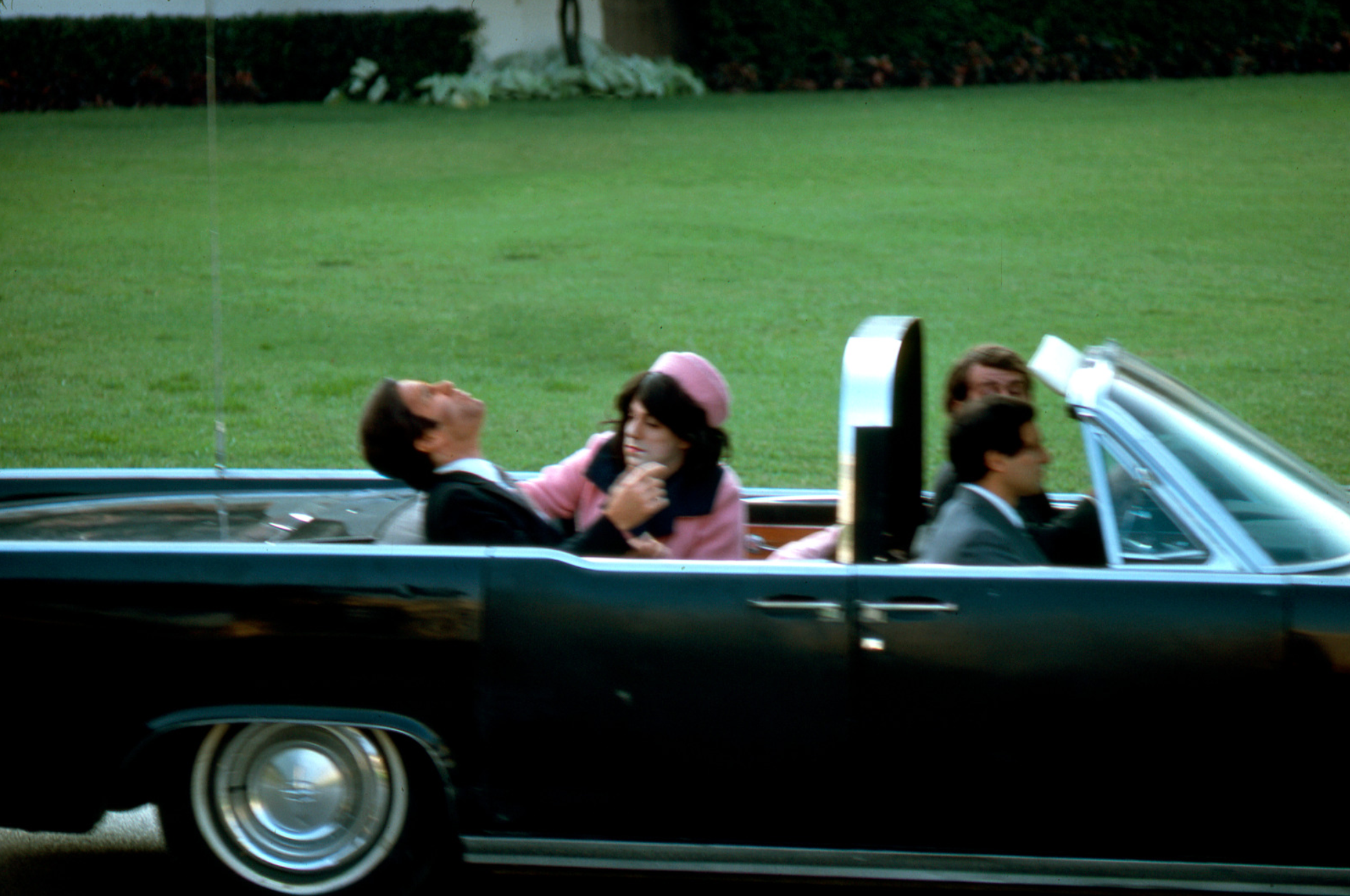
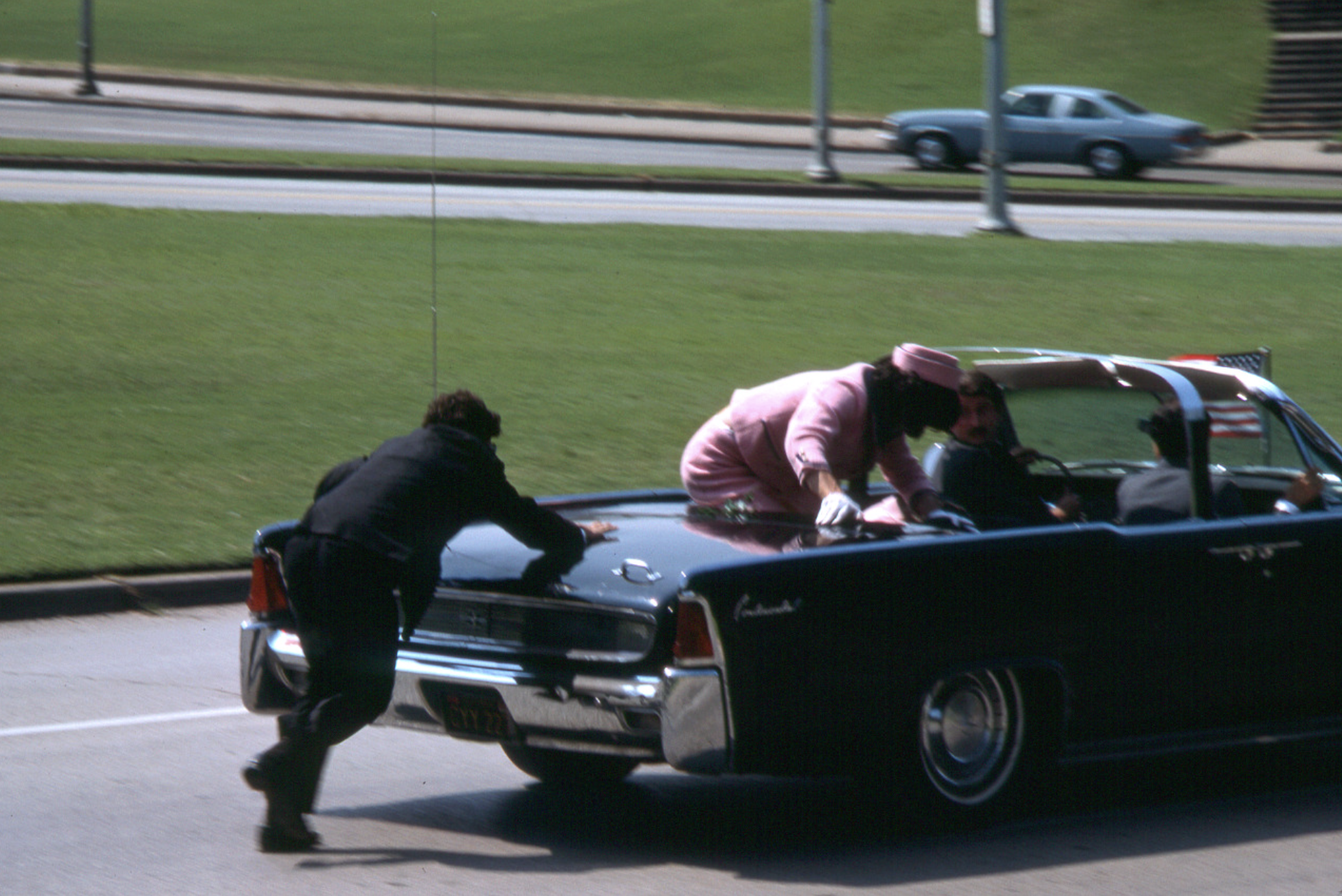
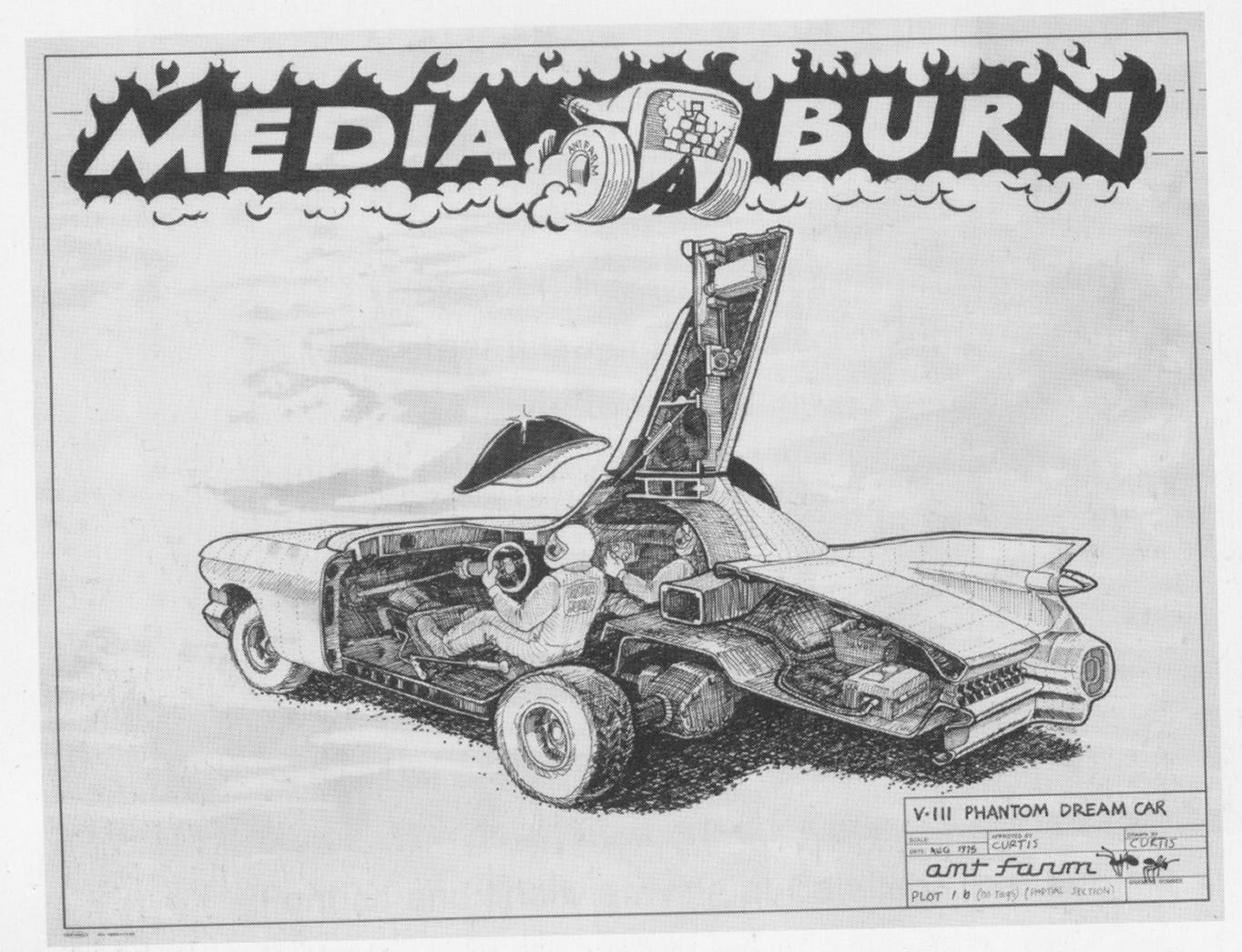
In 1975, Ant Farm—the techno-utopian multidisciplinary architecture collective founded in San Francisco by Chip Lord and Doug Michels (joined later by Hudson Marquez and Curtis Schreier)—launched a customized 1959 Cadillac, renamed the Phantom Dream Car, at full speed into a wall of flaming television sets. Media Burn was an excoriation of Post-War American popular culture, mythos, and the consumerist imagination, particularly our obsession with broadcast media. This singularly powerful act came to exemplify Ant Farm’s irreverent architectural examinations, where the blueprint was the message itself. Armed with portable videotape cameras, Ant Farm turned the gaze back on those wielding the power in a time when America was entering its mirror stage, and millions of young people were realizing the country’s intrinsic hypocrisies and instincts for violence. From its inception in 1968 to its dissolution in 1978—from the last flickering embers of the hippie love fests to the early days of disco—Ant Farm experimented with alternative modes of living with detailed cookbooks for building inflatable shelters and a Truck Stop Network for flower children searching other flower children out on the open road. Ant Farm also buried Cadillacs in the Texas sand, reenacted John F. Kennedy’s assassination, and they had plans for an embassy where humans could communicate with dolphins. In the end, a fire at their studio was a symbolic curtain closing for the underground collective whose prophetic visions of the future can be witnessed today in a digital epoch of surveillance capitalism, artificial intelligence and the twenty-four hour news cycle. 

OLIVER KUPPER: I want to start off with talking about the day you kidnapped Buckminster Fuller. I think it says a lot about your generation’s fascination with his mode of utopian thinking, and it set the tone for the radical, utopian antics of Ant Farm.

CHIP LORD: The kidnapping? Well, Doug Michels [co-founder of Ant Farm] and I were teaching at the University of Houston. It was the spring semester of 1969. I don’t think Ant Farm was at all well-known at that point in time. We heard that Buckminster Fuller was coming to speak to the engineering school at the U of H, so Doug basically called Fuller’s office and said, “We’ll be coming to pick you up, and this is what we look like.” And then, he called the engineering school and said, “I’m calling from Buckminster Fuller’s office, and he won’t need a ride in from the airport.” (laughs) And so that’s what we did. We met the plane, and I think we were fumbling in my turquoise Mercury Comet. And we drove him to the campus of St. Thomas University, where there was the machine show exhibition [The Machine as Seen at the End of the Mechanical Age]. And in the machine show was the Dymaxion car [1933]. At that point, he said, “Oh, I don’t want to see it, that was a bad episode.” (laughs) But we took him in anyway, and when he did see it, he was very excited. The front seat cushion, the back part had fallen, and he reached in to make a little correction, and of course, a guard came over and said, “You can’t touch the art.” And that was about it. But then, we took him over to U of H and delivered him to the engineering school.

KUPPER: Obviously, his thinking about the world was hugely inspirational, but what was it about Buckminster Fuller? Where did you learn about his ideas?

LORD: For me, it was through Whole Earth Catalog. Every issue, for several years, began by publishing something by Buckminster Fuller. I didn’t really have that personal connection to specific ideas until I started reading Whole Earth Catalog, which was a graduate education. Because a degree in architecture is not really an intellectual degree. It’s an art degree, basically, and there was no theory introduced into architecture during the 1960s.

KUPPER: What brought you to architecture?

LORD: As a high school kid, I was more interested in customizing cars and hot-rodding, but for my parents, that would not lead to a career. I also liked walking around in houses that were under construction in my neighborhood in St Petersburg, Florida. Especially when the walls had gone up, but they weren't solid yet, they were just the studs and you could walk through walls. Out of that experience, I thought, well, maybe architecture would satisfy both the creative instincts I have toward cars and yet, its a more professional career. I mean, that decision was made kind of at the last minute, so I went to Tulane. For an undergraduate architecture degree, you start right as a frosh, embedded in a culture that’s based around drawing and the studio, which was exciting at the time. But later, I realized I didn’t really get that much of a broad education out of going to college.

“There was a lot behind what we were doing as Ant Farm that came from the knowledge that there was a much bigger community exploring alternatives.

KUPPER You were also at the forefront of witnessing the post-war boom of the American economy—car culture, and the suburbs—which must have been fascinating.

LORD: When I was eleven, we moved from a small town in Connecticut to St. Petersburg Florida, and that was a huge transition. It was not really a subdivision, it wasn’t Levittown, but a nice, small development. Not really knowing it at the time, I was embedded in the world of advertising around the automobile in the mid-1950s, the tail fin era.

KUPPER: Politically, right around the time you started Ant Farm—the late 1960s—Kennedy was dead, modernism was proving its failures, pollution, Manson, Vietnam. There’s a lot going on. What was the ultimate epiphany that turned the youth to this kind of radicalism and distrust of the system? Can you talk a little about the sociopolitical miasma that was happening during that time? 

LORD: On a personal level, of course, it was the Vietnam War; how to make a personal choice. I really didn’t want to go. I actually was in the Navy Reserve program. I was a year behind in school, and it was the only way I could finish without being drafted and losing my college deferment. But once I had graduated, more than ever, I didn't want to be drafted. So, I went to the Halprin Workshops in San Francisco in the beginning of July 1968. It was a thirty-day workshop for architects and dancers, which is a great combination, of course (laughs). There was a third leader of the Halprin Workshops in addition to Larry and Anna [Halprin], a psychologist named Dr. Paul Baum. Eventually, he wrote me a letter that got me out of going to Vietnam. But it was only a little bit later within Ant Farm where I think we started to react or create works that were reflecting some of the craziness of living through that moment.

KUPPER That craziness definitely seems like it forced Ant Farm to think about this utopian impulse, that you needed to create a better world.

LORD: Or to add to the world in some way. I mean, the Eternal Frame [1975] was a pretty strange idea, to reenact the Kennedy assassination. But you know, there was this huge interest in literature around it and all the swirling conspiracy theories. And at the same time, that decade in the seventies was such a utopian moment in the art world, and all these additional mediums were being explored. One of them was performance art, and another was video art, and they kind of came together in the Eternal Frame. Maybe there was a truth in actually reenacting it, going to Dallas and being in that place, and recreating the image of the assassination. And it was frightening, actually, to be there, to do that.

KUPPER: Marshall McLuhan also had a big influence on Ant Farm and the idea of the “medium is the message” and the “global village.” Using technology was an example of this utopian thinking as well. How did his ideas influence you? 

LORD: I was a student when his book The Medium Is the Massage: An Inventory of Effects [1967] had just come out. And what was interesting was that it was a collaboration with a graphic designer, Quentin Fiore. It was actually reprints of things McLuhan had written as text and more theoretical analysis about the ‘global village.’ But in The Medium Is the Massage, it was put into a visual form, and I think that really influenced me. I never saw him lecture either, but the way images were used to amplify his ideas about the global village, it was so different from the discipline of architecture. At the same time, the realization that architecture was this kind of privileged, elitist profession, that you had to have clients, and the clients had to have the money for whatever they wanted to build. So, for my generation, graduating in 1968, so many people wanted to avoid going and doing the typical architectural career.

Clean Air Podperformance by Ant Farm, U.C. Berkeley, Sproul Plaza, Earth Day, 1970(Andy Shapiro and Kelly Gloger pictured) courtesy Chip Lord

KUPPER: What was Ant Farm’s interpretation of the global village? How would you define it?

LORD: I guess as the collectivity that existed in the counterculture, because there was a lot behind what we were doing as Ant Farm that came from the knowledge that there was a much bigger community exploring alternatives. Whether it was going back to the land, living in communes, co-housing, so many different ways to reject the existing set of expectations. I think that gave us the strength to keep going, to keep experimenting, and producing the work that we did.

KUPPER: One of the most incredible works that encapsulates those ideas was Electronic Oasis [1969], and also your idea of an ‘enviro-image future.’ Because it was way ahead of anybody’s time. Can you talk about the enviro-image future?

LORD: The idea that a computer could generate environments and put you in places was part of hoping to make another psychedelic experience, without drugs, without taking LSD. It just seemed obvious that it was going to happen. It’s only now really happening with AI. There was, of course, the enviro-man, who was connected to a computer, and sitting next to him was enviro-woman, and this was just a visual stunt that was done while we were teaching at the University of Houston. But that project was about simply creating that image in order to show that it might be possible. Most of our presentational form was through the slide show and that also came from architecture. It’s a very good way to contrast and to create a narrative between the images.

KUPPER: And then there was the Truck Stop Network [1970], which is really interesting. 

LORD:  A lot of people at the time were either building campers on a pickup truck, or modifying the Volkswagen bus. And there was this idea within the counterculture of nomadics. So, we were conceptually and architecturally combining the idea of the truck stops that already existed as a network across the US, and making them countercultural truck stops. You would stay for a few days or a week, plug in, and each truck stop had services built in that would make it more of a community. There's access to computers, there’s daycare, there's all of the social community structures.

KUPPER: Another work that had to do with cars was Cadillac Ranch [1974], which came a little later. It was installed around the time of the oil crisis, I don’t know if that had anything to do with it?

LORD: Well it did, absolutely. It was 1973 when that actual embargo from the OAPEC (Organization of Arab Petroleum Exporting Countries) countries happened. You had to wait to get gas in California, to fill up. And so, Cadillac Ranch was conceived at that moment. It was easy to be very aware of the social hierarchy attached to the Cadillac. General Motors, Ford, and Chrysler all had multiple makes and the idea for General Motors is you might, as a young man, buy a Chevrolet and be loyal to GM, then move to Pontiac, move to Oldsmobile, Buick, and then finally in your fifties, making a good salary, you would achieve Cadillac status. The funniest thing was, we realized that our fathers, none of them ever made it to Cadillac. The furthest they made it was Oldsmobile. So, you could say we were realizing the final two steps of the social hierarchy by making Cadillac Ranch, but also putting these gas guzzlers in the ground. 

KUPPER One of Ant Farm’s most iconic works that used a Cadillac was Media Burn [1975], because it wasa combination of two things, which were Kennedy and America’s fascination with television and cars. Can you talk a little bit about where that piece came from?

LORD: When we traveled in the Media Van, we went to the East Coast and met the publishers of Radical Software. There was an identifiable idea that there should be an alternative to the three major television networks, and it may be possible with portable video, which had just come out. The Sony Portapak was designed for education, schools, and businesses for producing training tapes. But artists and community activists immediately started using it as an alternative form of television and that was kind of solidified in “Guerrilla Television,” which was an issue of Radical Software. The editor, Michael Shamberg, had asked Ant Farm to design it. So, we did. We were engaged in the idea of alternative media and alternative architecture, and that became part of the idea of Media Burn. The idea was to create an image that would be powerful in its own right, but would also attack the monolith of broadcast television, which seemed to have a hold over the American public through advertising and image control. Seeing the car crash through that tower of televisions would be symbolic of an attack on that monolith. It was as simple as that. It took two years to realize that one image, and in that time of the planning, other meanings expanded out of it, and it ended up being a huge community effort. But we had to have a speaker, a politician, hopefully. And that is where the conceptualization of using a Kennedy impersonator as a speaker at Media Burn came in, and it was just a short jump to “Well, if we’ve got Kennedy, we might as well reenact his assassination.” And that was Eternal Frame

KUPPER: That also connects to a little bit of your personal work later with Abscam [1981], the recreation of surveillance footage; a statement on the power of these images of Kennedy’s assassination. Nobody, at that point, had ever really seen anything like that before. It really speaks to our voyeurism and thirst for seeing this kind of violence.

LORD: And also, taking control of it too, because it was such powerful imagery that made the viewer almost powerless in the face of it. So, could we take control of it in some way?

KUPPER: In 1978, your studio burned down. Why was that the official end of Ant Farm?

LORD: Well, at this point in time, Ant Farm had become a three-person partnership, Doug Michels, myself, and Curtis Schreier. Doug Michels wanted to move to Australia to develop the Dolphin Embassy. Curtis and I were not interested in moving to Australia. There was a woman involved and Doug wanted to go back to see her. I think in '76, there was a period of time when he was not present, and the studio space had become kind of just Curtis and me showing up, but it felt empty and people would often knock on the door asking, “Is this the Ant Farm?” (laughs) We would give them the little tours, but it had become almost a museum of itself in a way. It was over as a working partnership, and then the fire was a symbolic ending and almost exactly ten years after the founding, in 1968. So, that seemed appropriate, to have such a spectacular ending.

KUPPER After Ant Farm disbanded, how do you think your utopian thinking changed? I mean, there’s that incredible piece you did called American Utopia [2020]. Do you think that your view of the system became more cynical after Ant Farm?

LORD: There was certainly a cynicism within Ant Farm, I must say (laughs). No, for me, it was like, Well now how am I going to make a living? It was a different era, the counterculture wasn’t dominant. A lot of people in counterculture had opened businesses, natural food businesses, and other things. Not everyone, some people had successfully lived off of the land, but everybody had to confront, “how do you make a living, how do you survive?” I tried different things, like freelance photographer, and writer, having a contact at New West magazine, but you know, that was never going to pay the bills. So, I thought maybe teaching was going to be a collaborative venture, which was an aspect of Ant Farm. So, I applied for a job at UC San Diego in the visual arts department. The irony was that the work of Ant Farm was my credential, and there weren’t that many art departments where it would actually be effective (laughs).

KUPPER: What do you think now, post-pandemic in this weird political climate we’re in—what would Ant Farm be exploring now? 

LORD: (laughs) It’s funny because that question was also asked at the end of a lecture, and I turned it on the room full of students. I said, “It’s really up to you, the next generation, to make that utopian gesture.” So, I don’t really have a good answer to that, except that now I’m not such an optimist. I think that after the Ant Farm exhibition, which was at the Berkeley Art Museum in 2004, I traveled to a few places. When I came back to make videos afterward, Elizabeth Kolbert’s book had just been published, the Sixth Extinction [2014], and I realized that we’re in the process of creating this extinction of our own species with climate change. So, I created several works in video about that, which had to do with the rising sea levels. One is called Miami Beach Elegy [2017], you know Miami Beach maybe isn’t going to exist by the end of this century. Another one is New York Underwater [2014], and that was preceded by a Hurricane Sandy, which flooded so much of Manhattan. So, I’m trying to shift my love of cars into loving trees. 

KUPPER: You mentioned that you’re not so much of an optimist anymore, but do you think utopian thinking is still important?

LORD: You know, I’ll have to think about that question. I guess yeah, of course it is, but maybe utopian thinking is shifting now. I love this book, To Speak for the Trees [2021], by Diana Beresford-Kroeger. As a child, she was orphaned and went to live with her uncle in Ireland for the summer, and the people of that community decided to teach her Celtic knowledge. She had this intense learning experience about plants and other species, which led her to becoming a professor with a specialty in botany. So, that’s now utopian: understanding indigenous people, and indigenous ways, and the integration with other species we share the planet with. That’s so utopian now, because it’s so different from the mindset we’ve lived with throughout the 20th century. The Dolphin Embassy is one the most popular projects by Ant Farm. Again, it was simply a very symbolic idea, and we didn’t have the personnel, or the budget, or the power to find the scientists, and work with them, to make Dolphin Embassy a reality. It was a utopian idea, to focus on trying to communicate with another species.

Barbara Stauffacher Solomon

interview by Oliver Kupper


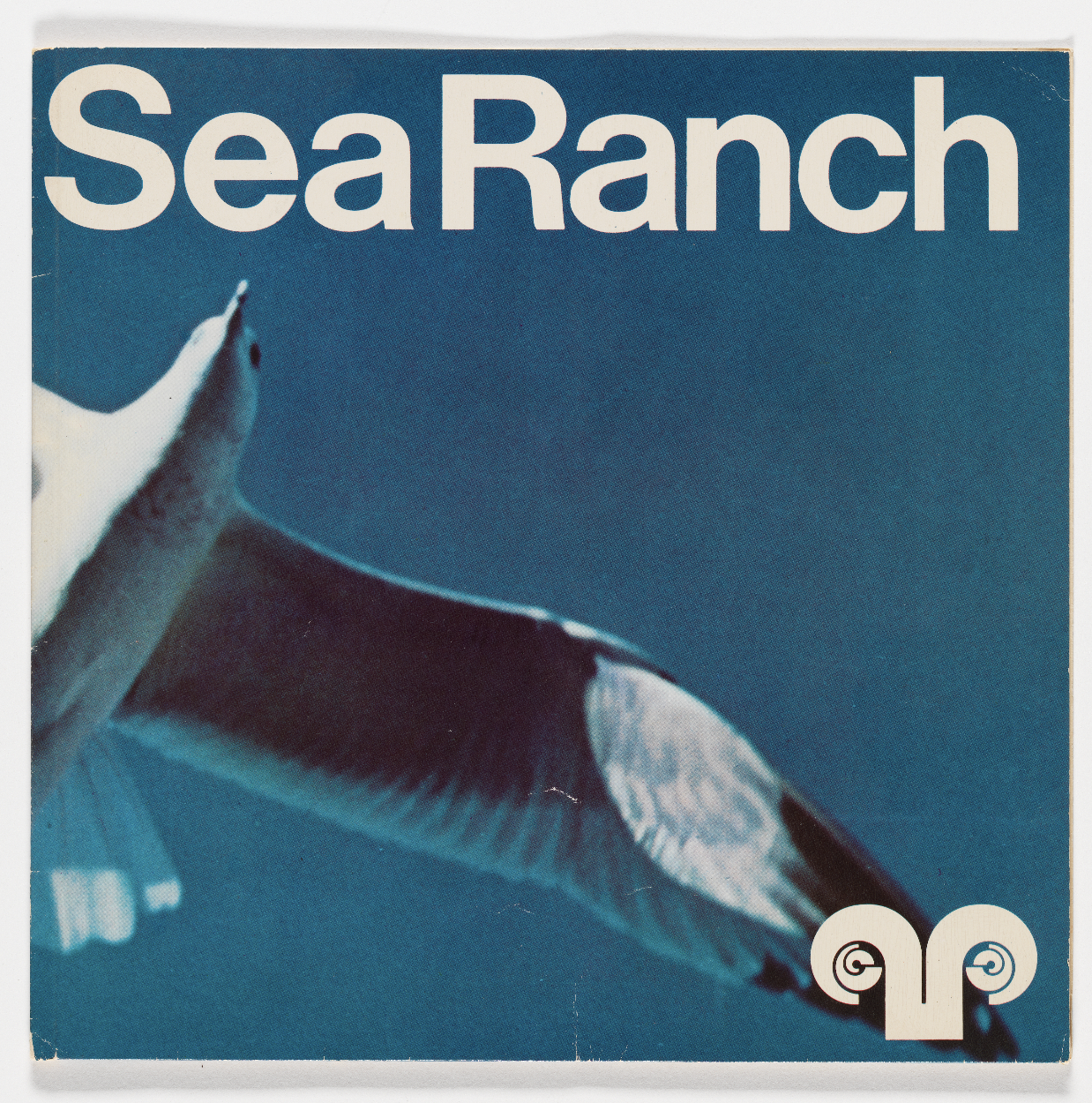
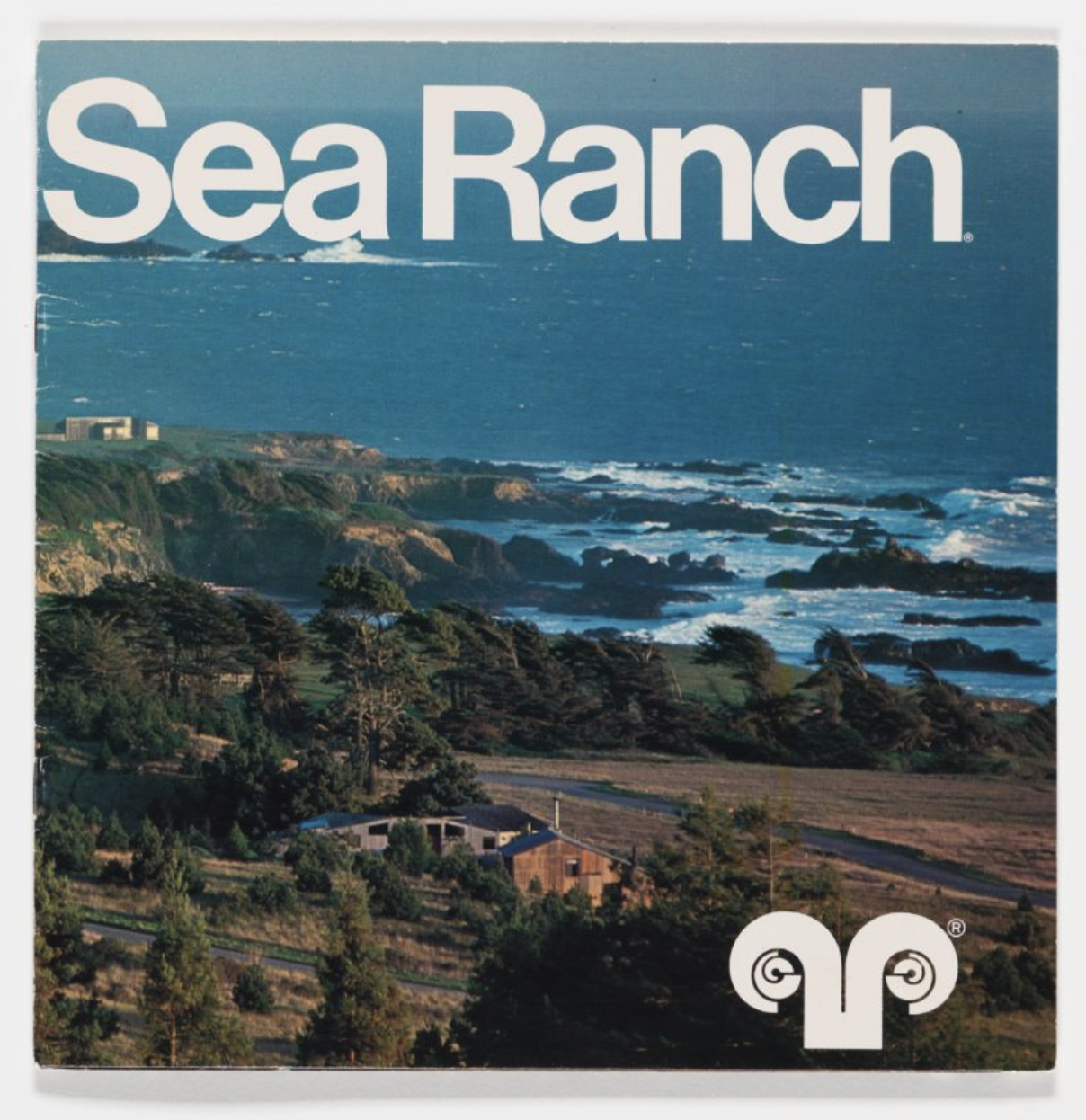
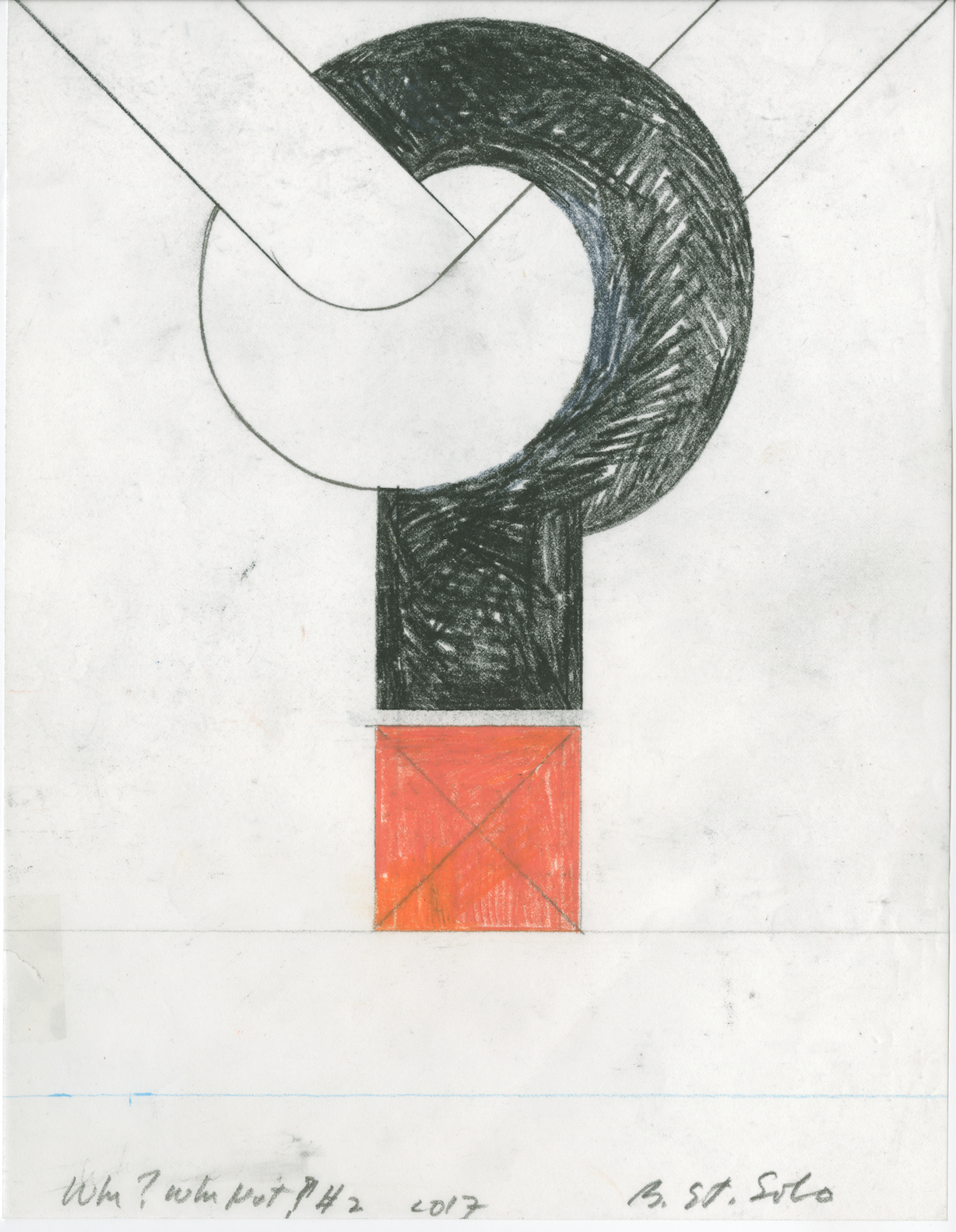
Barbara “Bobbie” Stauffacher Solomon, now ninety-five years old, studied graphic design in Switzerland under the legendary Armin Hofmann in the late 1950s. Her most famous project, the graphic identity for Sea Ranch, a planned community imagined by architects Al Boeke and Lawrence Halprin on the Sonoma Coast, was a blend of Swiss Style and California Modernism, an amalgam of irreverent hippie cool and clean straight lines in oversized texts and symbols called ‘supergraphics.’ The logo depicted two sea-shells that formed a ram’s head. When the idealism of the ‘60s and ‘70s died down, Sea Ranch lost its utopian ethos, but still remains a relic of what could have been. Solomon, however, is more prolific than ever.  

OLIVER KUPPER: Right now you are working on some new supergraphics for the San Francisco Museum of Modern Art.  

BARBARA STAUFFACHER SOLOMON: Yes. I'm doing absolutely enormous “OKs” with stripes. We're going to make it so visually nuts. It's like choreography, where you get everybody to walk in one direction with the design.  

KUPPER: Like the old dance step footprints that would be painted on the floor.  

SOLOMON: Yeah, kind of like that! Only it'll be on the ceiling. “OKs” will lead you to the Mario Botta building. So, people will go through the “OKs,” which is where the information and tickets desk is, but then they get into this kind of maze of stripes.  

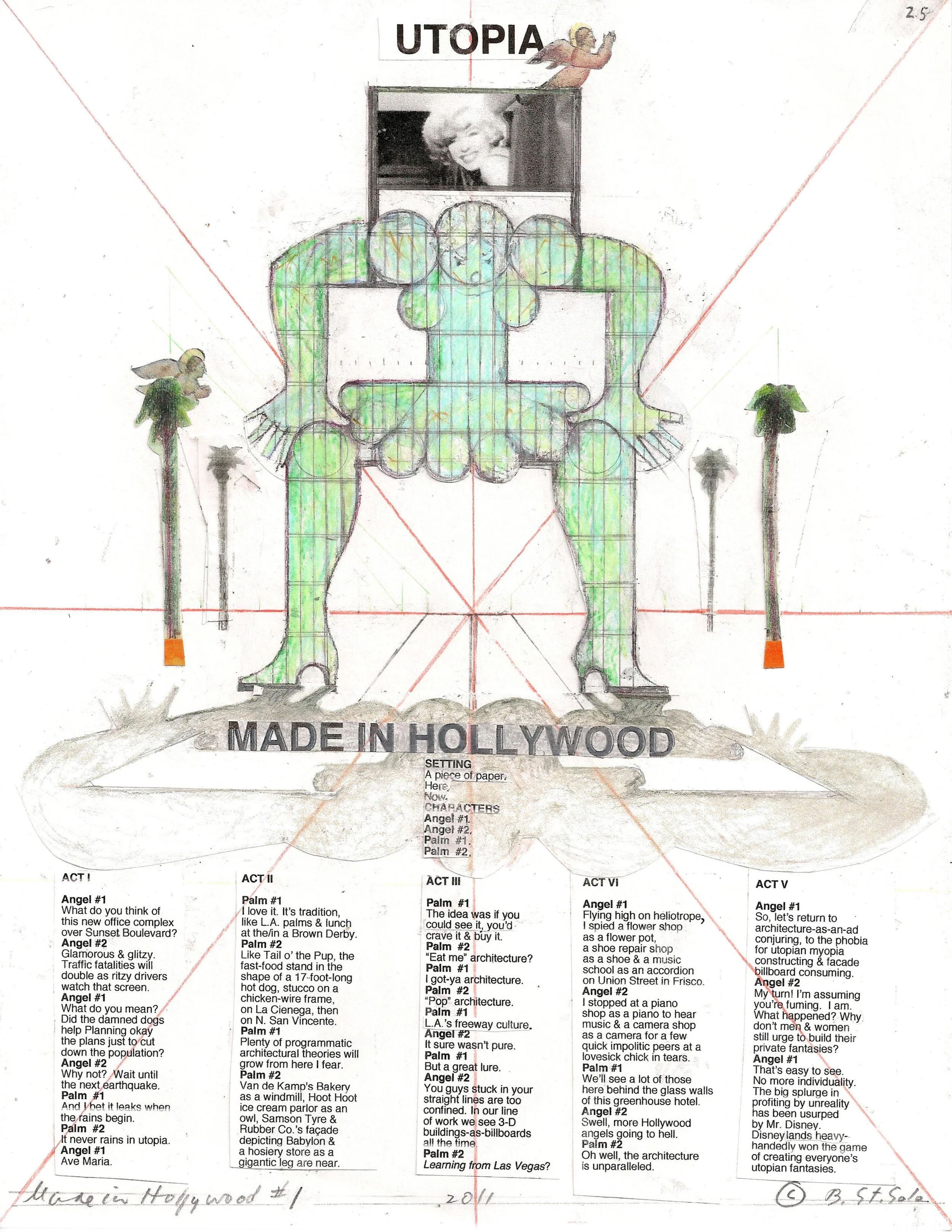
KUPPER: You have also been working on a series of books, like UTOPIA MYOPIA (2013), which has a page that is a five-act play set in Hollywood, between angels and palm trees.  

SOLOMON: That one section is totally illiterate. I never went back and cleaned it up, or I just gave up and decided nobody's ever going to read this, the type is too small. But you did!  

KUPPER: I dissected it immediately, because the lore of Hollywood attracts me. Did you spend time in Hollywood?  

SOLOMON: I've been down there a lot—with my first husband who was a movie maker, Frank Stauffacher. All the screenwriters loved him. That’s how I knew George Stevens and Frank [Capra], who was an angel! My husband, who had a brain tumor, started fading after he presented one of his movies. We went out for a drink, and my husband passed out. Capra, a strong little Italian man, just picked my husband up and carried him to the car. I mean, he's a mensch. We knew them towards the end when Frank was dying, and we were quite a scene. I was this beautiful little chick, and he was handsomer than the movie stars.  

KUPPER: That was the golden age of Hollywood.  

SOLOMON: They made the American Dream. For Capra, it was the American Dream to get out of Italy and the mess there and live in Hollywood. And make these democratic movies, teaching everybody to be good little democrats.  


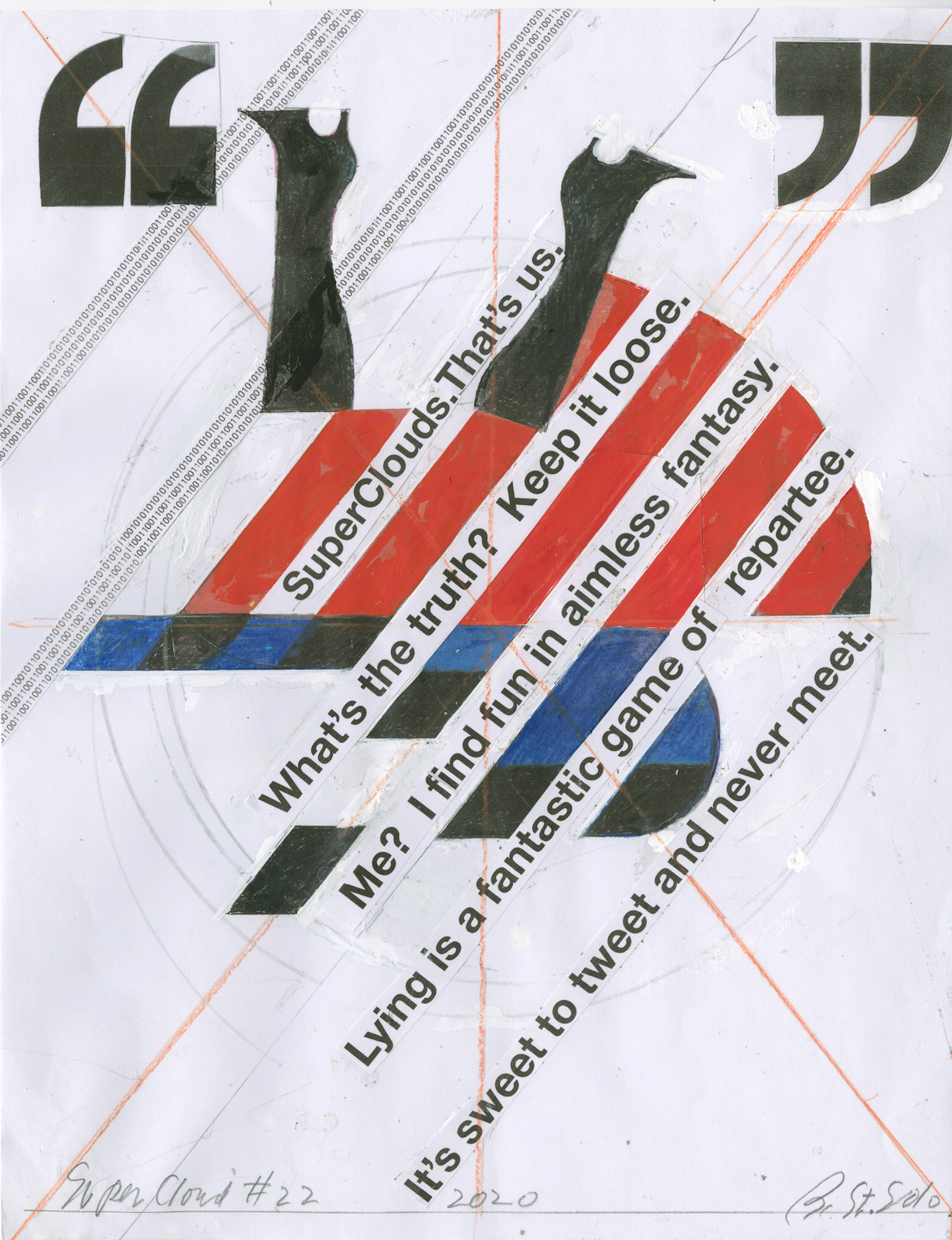
Barbara Stauffacher Solomon, Supercloud 22, 2020
Mixed media: Pigment print collage, gouache, ink, graphite,
colored pencil, white-out, cellophane tape, rubber cement, paper
8.5 X 11 in. (27.9 x 21.6 cm)
Courtesy the artist and Von Bartha


KUPPER: Did you ever meet Man Ray and what was he like when you met him?  

SOLOMON: Oh, he was sweet. He never said anything. He only talked about money. He was always short of cash. He always wanted to sell a drawing or a painting. He always wanted to have the next show because he needed money. We had dinner at their house one night, and Julie Man Ray was teaching me how to make risotto in the little kitchen. Think of yourself out on the corner of Hollywood and Vine and just walk about six houses south, and that was where they lived. That was in 1948. We went down and saw them on our honeymoon. And we took a walk around the block to look for the sites of where all the novels had been written. I was very young. I was sixteen when I first met Frank [Stauffacher]. He was fifteen years older than I was. He was fancy, and he knew all the surrealists. 

KUPPER: Where did you stay when you were in Los Angeles in 1948?  

SOLOMON: I would always stay with Lee Mullican and Luchita Hurtado. All the men were madly in love with her. She was so good at being charming, and she was just marvelous. She had been my best friend since I was about 16. I mean, she would tell me what to do, and I would do whatever she said. We were very close. They had a glass porch on the front of their house with a little cot in it. It was about three-feet wide. That was my bed.  

KUPPER: Wow, that’s an amazing memory of Luchita Hurtado.  

SOLOMON: I didn't even know she had her own last name. She was either Luchita Paalen or Luchita Mullican. She had so many husbands and names. And as long as the men with their egos were alive, they were the painters, and she was the one who cooked dinner. She never really let herself paint until she was a widow and had time. She always knew she could, I think, deep down. And the minute that Lee died, she started doing it, and then she was immediately very successful.  

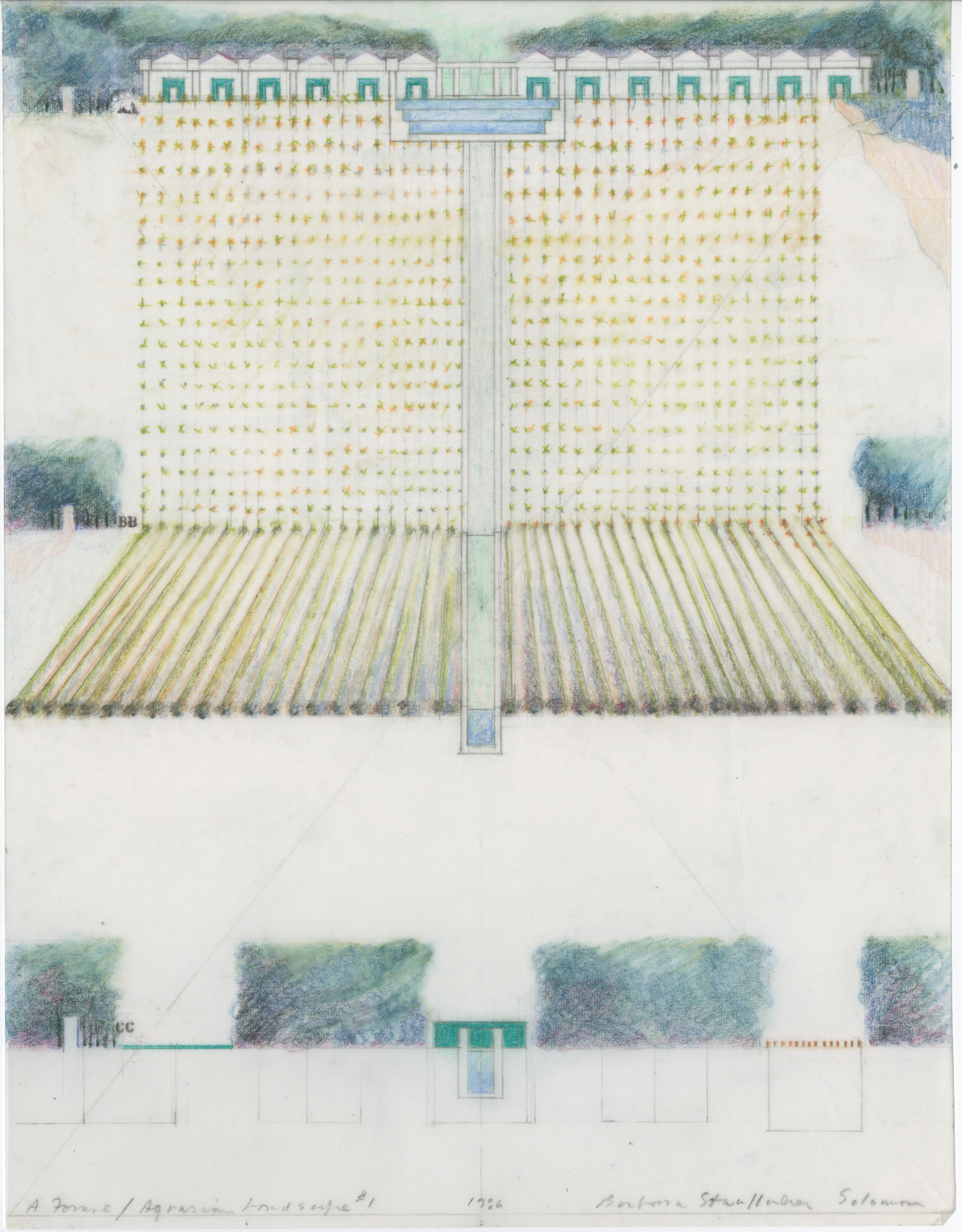
KUPPER: I wanted to talk about your thesis book, Green Architecture and the Agrarian Garden [1981]. Why is the union of architecture and landscape so important? 

SOLOMON: It's everything. They are two sides of one wall. First, the architect destroys all the trees and builds his precious little house. And then the landscape architect comes back and puts the trees and nature back. The world is all one big landscape. Inside the house and outside—they're all one thing in a way. They're extensions of each other. But in the architecture department, they hate each other. Architects think the landscape architects are the stupid ones who didn't have enough brains to be architects. And the landscape architects think the architects are the shits that are tearing down the trees.  

KUPPER: Well, a lot of architects are building now with more organic architecture in mind, where the landscape is more seamless with the architecture.  

SOLOMON: Well, the landscape architects have won. The landscape architects are going to save the world because otherwise, it's gonna get too hot, and everybody's just going to burn up.  

KUPPER: When did you start becoming interested in green architecture?  

SOLOMON: Somebody in art school once said, “Never use green. It's a very hard color to deal with, and never put empty space in the middle of your painting.” So I did both, actually. I have hundreds of those goddamn green architecture drawings. The ones with square trees that look like buildings. I just visually like green rectangles and want to make the world look that way. I was born in San Francisco and I lived all my childhood in the Marina District where there's the Marina Green. Every night with my mother, we'd walk around the Marina Green. And the grid of San Francisco has all these green squares where there are parks scattered around. At a certain point, the tops of the hills were just too difficult to build on, so they made them into parks. Little rectangles on top of almost every hill. 

KUPPER: San Francisco is such a beautiful, green city. And the surrounding areas like Marin. The utopian ethos has been so strong in California. Why do you think that is? And what does utopia mean to you as an architect?  

SOLOMON: All architects think they're building utopia. Even if it's just a gas station, they think it's utopia. 

I just think California is—I mean, open your golden gates! Since we found gold here, they assumed California is utopia. Californians have that feeling about California. That's why I came back. I could have lived in Europe. California is just an extension of people's bodies. 

KUPPER: Where do you think your rebellious spirit came from?  

SOLOMON: I don't know. My father was a lawyer, and he told me there's no such thing as god or the president of the United States. Don't have respect for any of those things. So, there's no reality. There's nobody you believe in and listen to. It's all absurd. My mother was like that too. She was a pianist. She was a rich girl that was no longer rich and loved walking among the redwood trees. She thought god was in the redwood trees.  

KUPPER: Can you tell me about Sea Ranch, and your contribution with the Supergraphics. When did the Swiss Style start to merge with the California Modernism?  

SOLOMON: When my husband died in 1955, I went to Basel, Switzerland to learn how to make money and how to be a designer instead of just a painter. I came back with all this training in me when they handed me Sea Ranch in 1962. Al Boeke and Lawrence Halprin, two of the architects, wanted Sea Ranch to be like the French new towns. Also, Lawrence had been raised on a kibbutz in Israel. First, he gave me an office that was in the same building as his firm. When they told me to do Sea Ranch, I designed it the way I had been trained under Armin Hoffman at the Kunstgewerbeschule in Basel. I had no idea what I was doing until I did it, I have to admit. But I was such a modernist. I went up there in a truck with the two sign painters. Everything had to be straight lines because they were sign painters and could only do letter forms. So my vocabulary consisted of what a sign painter could do. I started with that big blue wave on the west side of the building. The wave went up the shed roof, and then it came down, turned green on the other side. We only had black and white, vermilion and ultramarine blue, and I think one small can of yellow—primary colors. It was kind of like De Stijl. I was best friends with all the architects until I got all the press. Charles Moore never spoke to me again because I got in Life magazine and forgot to tell them he was the architect.  

KUPPER: So, who did they hope would live in Sea Ranch? Was it supposed to be for artists, for intellectuals?  

SOLOMON: No, Al was very square. I mean, it was supposed to be just plain old nice people. They weren't supposed to be intellectuals. And it certainly wasn't supposed to be second homes for the rich. That happened when they started making it so you could save on taxes with your second home. And that's when everybody was buying second homes up there. And they hired a couple of salesmen to come in and take over selling off the land. All of a sudden, it wasn’t about a nice town with a church and a school.  

KUPPER: Sea Ranch is really an example of an almost failed utopia.  

SOLOMON: It really is. It's very successful if you're rich. A lot of people from Los Angeles are coming up and buying property. Now it's all diamonds up there and the richest, trickiest people. 

KUPPER: Do you think design can be dangerous, especially if you are designing for a dangerous philosophy? 

SOLOMON: Of course, but that's what design is: it's the bullshit on top. It's making things look good.  

KUPPER: That's a good answer. I wanted to ask you if there is any connection to your time as a dancer and graphic design? 

SOLOMON: Every once in a while, it used to feel like it. When I used to work with the crew, and when you stretched your body big and long or got on the floor, I felt like I was making the same moves I made as a dancer. You're kind of moving with the paint with your arms stretched out. And you know, where I feel like a dancer again is when I’m at the SFMOMA making these stripes that'll make people walk from the entrance and up the stairs. They’ll wonder, now what am I supposed to do? And now, I'm going to give them big red stripes to have something to do. I’m choreographing them with art.  

KUPPER: Looking back on your career, what's the one thing that's been most misunderstood about you as an artist?  

SOLOMON: Well, nobody remembers that I was a widow with a child, and I needed money. The whole damn thing has been to support myself and my child. My husband, who died, his family just dumped me because my daughter has cerebral palsy. They were scared I'd ask for money. Then my second husband dumped me because he was young and cute. I aged, and he seemed to not. And I always had to support myself. I had two daughters, and I have a granddaughter. It was like, "Grandma is painting some supergraphics. I guess we can have oysters tonight!” If Frank hadn't died, I would have been a painter. And if I hadn't gone to Switzerland, I probably would have painted big color fields.  

KUPPER: Well, I'd say you came out on top.  

SOLOMON: Look, I was talented. I mean, when I had those two big rooms in the Sea Ranch to do, I was lucky, I got Charles [Moore] and Bill ​​[Turnbull’s] architecture. The walls had beautiful shapes, and I just followed the shapes and played with the shapes, and thank god it came out right. It's just dumb luck if it really works.  

KUPPER: Do you have any advice for people who might be reading this and thinking about building a better word; their own utopia? 

SOLOMON: I remember when I was teaching at Harvard, I asked the students, "What is art?" The answer: "It's nothing; just learn to see, and you'll learn that everything is art." The problem is that people look, but they don't see. If you look and see, the whole damn thing is certainly art.