interview by Oliver Kupper
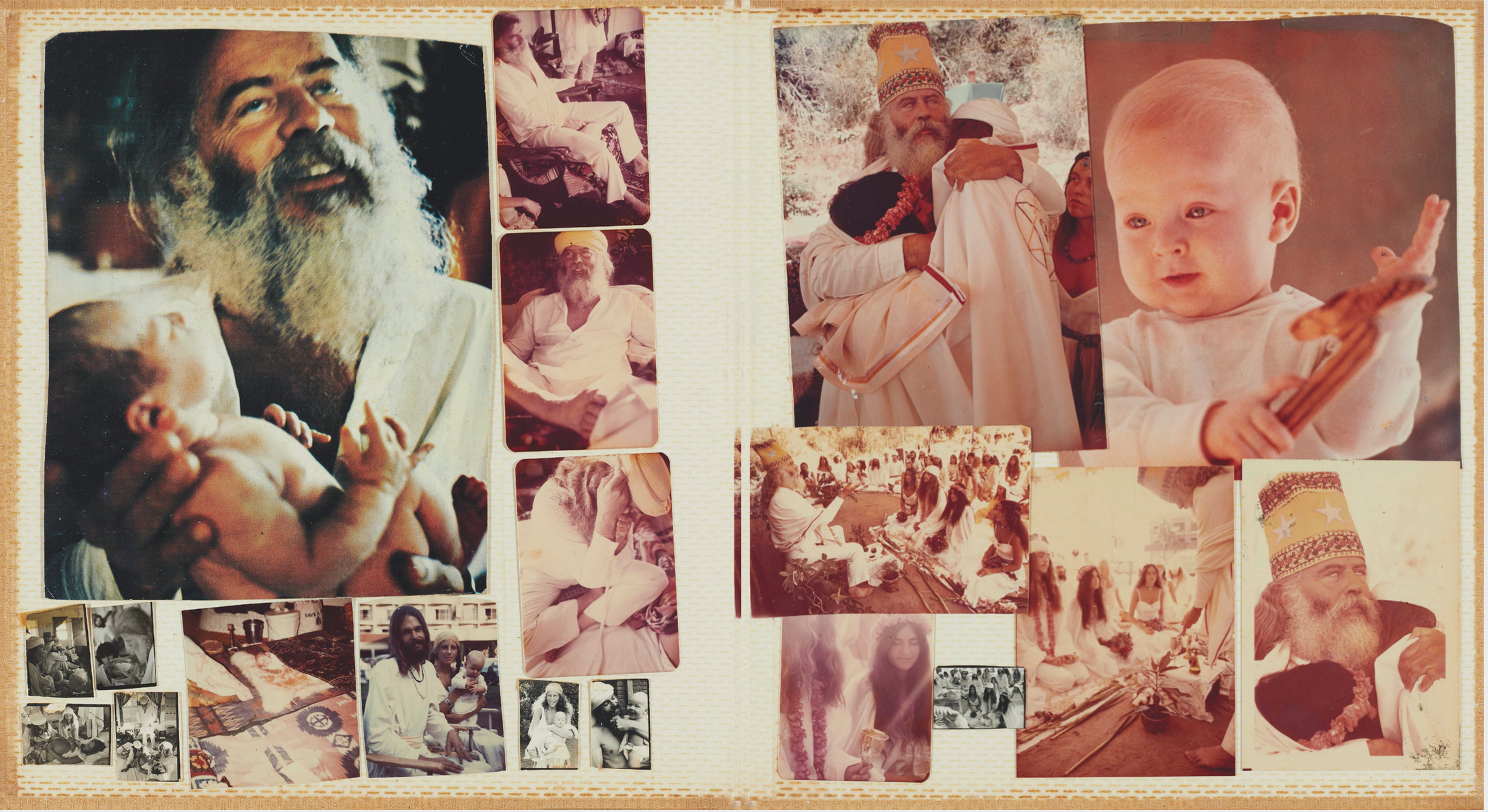
photography by The Source Family Scrapbook
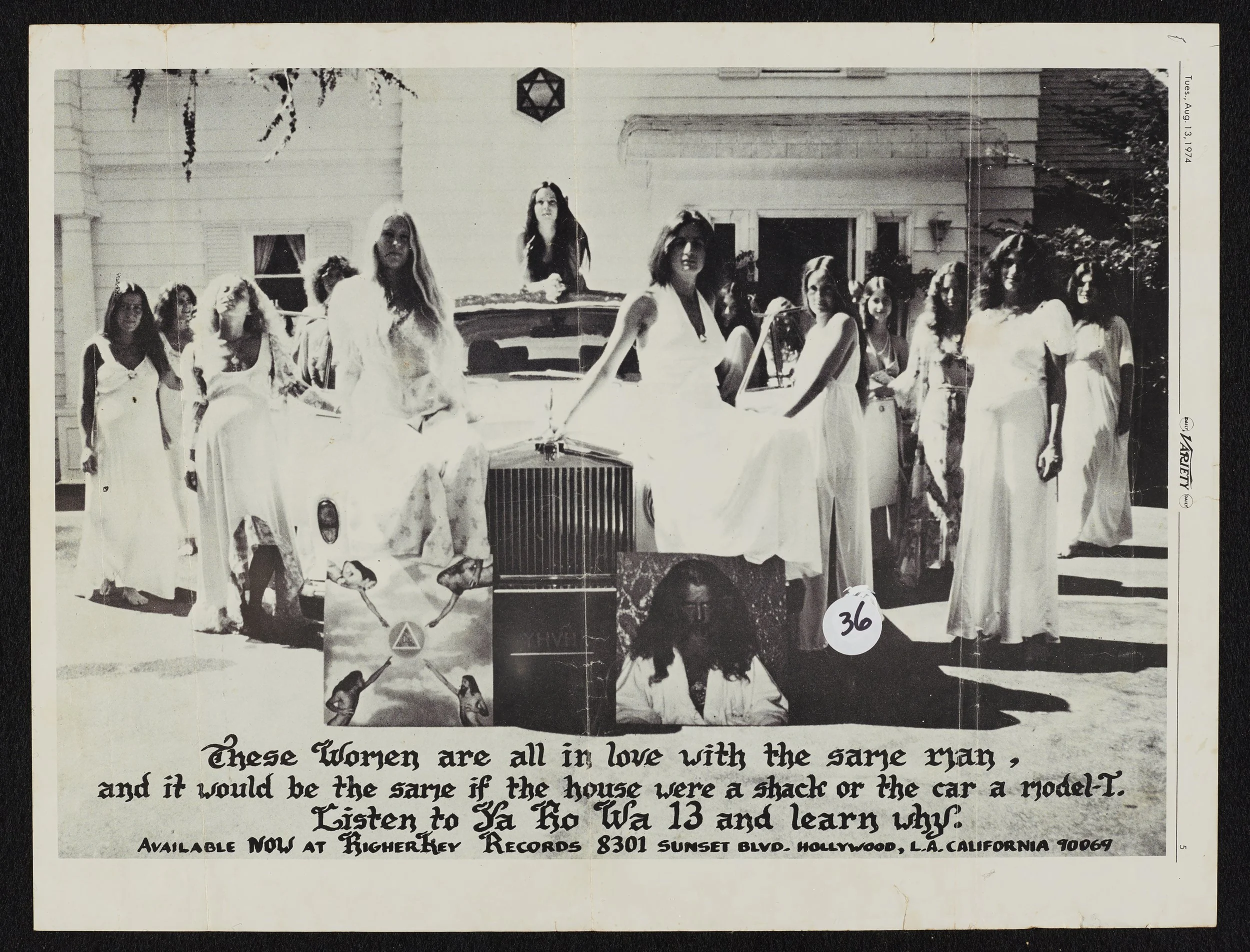
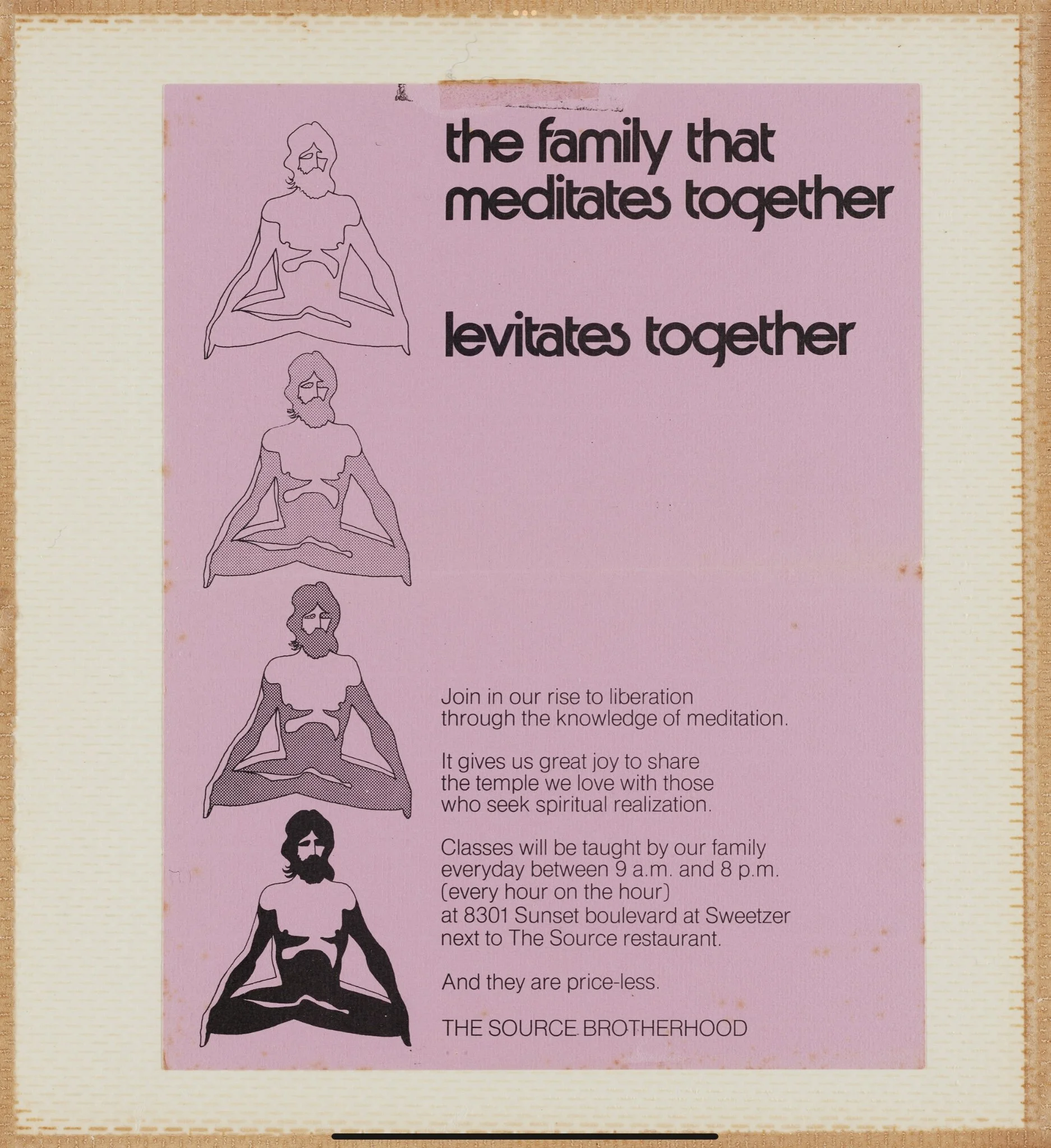
The Source Family was a spiritual commune founded in the Hollywood Hills by James Edward Baker, otherwise known as Father Yod or Ya Ho Wha. A blend of Eastern mysticism and Western esotericism, the family was supported by The Source Restaurant on the Sunset Strip, which was one of the first vegetarian restaurants in Los Angeles. Isis Aquarian, or Charlene Peters, a former socialite and beauty queen became one of Yod’s fourteen wives and the commune’s de facto archivist. Together with curator, filmmaker, and scholar of spiritual communities, Jodi Willie, they have released a new monograph, FAMILY: The Source Family Scrapbook, published by Sacred Bones.
OLIVER KUPPER: Isis, where are you based right now?
ISIS AQUARIAN: Hawaii. I love it. It’s my soul home. But LA is my heart home. By the way, I really appreciate the topics you are covering in this issue.
KUPPER: I feel like people are thinking about building a better world again and thinking about utopia. There’s a new utopian urge.
AQUARIAN: I remember Father Yod saying it would be our children’s children to carry it forth. We were the foundation, the pioneers.
KUPPER: I want to start with the intro to the scrapbook. It’s so interesting and brilliant, that exploration into the dynamics of the Source Family. In it, there’s this Buckminster Fuller quote: “You never change things by fighting the existing reality. To change things, you need to make the existing model obsolete.” Why do you think there was such an overwhelming global urge toward this utopian way of life in the late ‘60s and ‘70s?
AQUARIAN: My very simple understanding of it is that we all made commitments before incarnating. And when the timing is right, you get encoded, for lack of a better word. You step into that commitment you agreed to, so it was a no-brainer for many of us. Without even analyzing it, we stepped into that new paradigm. When I met Father Yod, he was still Jim Baker, and we drifted apart at first. Then, we met again when I stepped into the Source. When I saw him again, he looked like Moses and that was it. I never questioned it, I never turned around, and I’m still working within that paradigm with him.
JODI WILLE: Looking at history, things come in cycles. Studying the astrology of the time, it’s pretty wild to see how these cyclical energies come through the world and manifest in different ways at different times. They’re always different, but they have these similar threads. In the late ‘60s, you had these very dissatisfied people. You had the Vietnam War, which was affecting young people more than we could possibly imagine, and you had industrialized food and medicine reaching this high-profit breaking point. A lot of people were fed up with the food that they were eating and the drugs they were getting, and wanted to explore other pathways. Jim Baker had a lot of experience in that zone when it was very unpopular. Astrologically, they break these shifts down into 20-year periods, but then there are also these 100-year periods, and of course, you’ve got Pluto going into Aquarius again. So, Los Angeles was filled with people like Father Yod who helped to give birth to The Source.
KUPPER: Isis, you were a beauty queen way before joining the Family. Can you talk a little bit about your life before?
AQUARIAN: I think socialite is a better title. I was a complete socialite and I was a model too. My dad was Chief of Documentations for the Air Force, so I grew up pretty entitled. I grew up being archived and photographed, which wasn’t an issue with me. I moved to DC and worked for a senator and then I was a socialite out of the house at night in Washington under President Johnson. So, there was a whole elite circle that I was a part of. In the ‘50s, people were drinking, becoming alcoholics, and everything that came with that. And then, I moved to New York and slid into a whole other socialite scene with Warhol and Salvador Dalí, and I was dating one of the heirs to Smirnoff’s Vodka for a short period. Then, I started hearing about the hippies and flower children, and everything that was happening in LA. New York was just a dark zone. LA seemed very light and bright, and I was so pulled to it. I went, “I want to wear flowers in my hair, I want the sunshine, I want to drop out.” When I moved to LA, I very quickly walked into the Old World [Restaurant] and met Jim Baker and his wife Dora.
KUPPER: Jodi, how did you discover or learn about the Source Family?
WILLE: I went over to visit a friend one day—this was 1999—and he said, “I have this box and you’ve gotta see it.” It was this big 12-by-12-inch black box with this man who had a white beard and hair, and a bunch of small people collaged onto his belly area. At the top of the box it just said, “God And Hair—Yahowha Collection.” It was a complete collection of all the Source Family records that they turned into a CD box set. I was just blown away by it. I had been studying and researching occultic intentional community groups for many years at that point and there really wasn’t anything on the internet about the Source Family. Five years later, my then-husband, Adam Parfrey, came home with a student film that he’d found at Amoeba Music and it was about The Source Family. I was just like, “Oh my gosh, I have to find these people.” (laughs) So, I went online and it just so happened that there was a website that Isis had created. I wrote to the email address and asked her if they’d ever considered doing a book. Isis wrote me back right away and said, “My brother, Electricity, and I have been working for seven years on a book and we just finished it.” That conversation led to me coming out to Hawaii to go through the archives with her—this massive collection of photographs and documents, and putting together the first Source Family book, The Source: The Untold Story of Father Yod, YaHoWha 13, which also led to the documentary years later.
KUPPER: Isis, when you joined The Source, what did your birth family think of this new family? And what was the dialogue between them and you during this time?
AQUARIAN: Well, they were used to me being off the grid. I was the uncontrollable, dark horse. Between DC and New York, there were plenty of energies that shocked them. Also, my dad was in the CIA. So, he had a good handle on DC. He checked in on me a lot and found out what was going on with me in New York and LA. But no, they weren’t happy about it at all. How would you understand what was going on at that time if you weren’t in it, there’s just no way. And my dad was quite controlling to begin with. But my mom was fine with it. She loved Father Yod, by the way. She said, “I know where you are. You’re clean, you’re being fed, it’s safe.”
KUPPER: These utopian movements at that time, for some strange reason, really became the number one enemy of the CIA.
AQUARIAN: I know, we had helicopters flying over the house, we had men in black suits that we caught spying on us.
KUPPER: And Jim Baker sort of had a reputation before becoming Father Yod. He had this outlaw persona, which is very American.
AQUARIAN: Yeah, extremely. He was, and he loved that part of himself.
KUPPER: What brought him to this new spiritual movement? Was it something about his upbringing? Because he was older and came from a different generation.
AQUARIAN: He was searching his whole life, and he had a habit of just leaving every situation when it reached a level that wasn’t giving him what he needed anymore. He knew when he was done with a certain part of his life. And unfortunately, he didn’t handle it very well with the people around him. He would just take off and leave. Always leaving a trail of women—wives and kids. Because he was just moving on. He was on his journey and he was going full speed. He had Hollywood and he was on the start of his journey toward a spiritual path. Dora, his wife, was younger than him. She was a French girl. She smoked a lot of marijuana and that influenced him. She turned him on to the music, and it really was the music of the time that got to him. It struck his soul. He eventually got into that groove and he dropped out himself. Then, he met Yogi Bhajan, which got him into yoga, meditation, and the spiritual path. He wanted to merge the Western and Eastern vibration, and the yogis didn’t like that. They were stuck in a 3,000-year lineage. And so, that’s what he did. He opened The Source [restaurant].
KUPPER: The Source Family had a lot of alternative views about love and sex. This was at the height of the sexual revolution. Why was it such an important part of this new utopian model of thinking?
AQUARIAN: Because we made everything sacred. We smoked marijuana, but we called it the sacred herb. We only did it once each day for morning meditation, a spiritual process. We took our sex and it became what they call tantric. Most people now are aware of what tantric sex is. It's sacred sex, and usually the man doesn't use his seed unless he wants to have a child. He’s in control. It’s not lust. Our food was also sacred. We gave people an alternative to see everything in a different way.

WILLE: Teenagers during the sexual revolution were sexualized at a very young age. It’s a very unpopular thing to discuss now, but the reality was, from what I heard, there were a lot of underage women in the Source, and they were among the most highly sexualized of the women in the Family. For all of them, the women and the men, it was a very different kind of sexuality. It’s almost hard to imagine. It was not just like a free love, free-floating sexuality, it was a spiritual discipline.
AQUARIAN: There were no orgies. Father Yod had fourteen wives, but we had our one- on-one time with him. Everybody got what they needed. The young girls that came into the Family—we had a couple of young guys too—they came in from the street for a place to crash. Nobody came in as a virgin, except one guy that I know (laughs). And when most of those young girls came in, their parents at least knew where they were and that they were safe.
KUPPER: It’s interesting because the sexual revolution is such a big part of the utopian model that started to develop in the ‘60s, but sex seems so retro to kids today. When they hear that Father Yod had fourteen wives, I’m sure they immediately think of these big orgies.
AQUARIAN: (Laughs) First of all, not many people could have pulled it off. Dude, you better be able to handle it. You better be able to have yourself in control on all levels to begin with, or it’s going to be a shit mess. And it wasn’t. The women were sisters before we were his wives. We knew each other inside and out, and we liked each other, which made a difference. It’s not like we were all thrown together and didn’t even know what the crap was going on. And he didn’t separate us, we were in this together.
KUPPER: There’s a lot of misconstruction between the words ‘cult’ and ‘commune.’ What is the line between the two?
AQUARIAN: After Charles Manson, they associated the word ‘cult’ with him and that’s what stuck. That was the downfall of the whole thing, but a cult is just culture.
WILLE: The word cult didn’t really become weaponized by the corporate media until the ‘70s. Back in the 1930s, there was a rash of love cults that the tabloid magazines would write about. And there were new religious movements—that’s what most of the scholars call them these days. They’re basically just nascent religions. Of course, there are cults with leaders that actually do control people’s minds (laughs). All the way back to Pythagoras, you could call him one of the first cult leaders. Oftentimes, these groups are led by people who question things. They’re creating a group because they’re unhappy with the status quo, because they feel alienated by the larger society, and a number of these groups rise up when a society is in decline. They’re often seen as a threat to those who want people to stay in their boxes, who want consumers to keep buying things (laughs), to do as they’re shown on television.
KUPPER: It’s interesting how fearful the Judeo-Christian capitalist enterprise really is of these groups. Why is that fear so important and why has it been so effective, because a lot of these groups have fallen apart?
WILLE: Well, a lot of them have, but a lot of them haven’t. We know about a handful of them—the worst of the worst. We know about the groups who have murdered people, who have committed mass suicide, who have done horrible things. But there are literally thousands of these groups that exist now. They exist across the world and they’ve existed forever. Those are the ones you don’t hear about because they don’t murder anybody. The Source Family disappeared and nobody even remembered it until we put the first book out.
KUPPER: It also takes a lot of privilege to drop out. A lot of these groups are white and middle class, but the Source Family seems relatively diverse. Can you talk about that diversity and why so many other communes come from predominantly white, middle class families?
WILLE: For a lot of people, it does take a certain amount of privilege, and coming from a white, middle class family gives you the leeway to experiment, and explore. Although, I think it’s important to note that in the late ‘60s and early ‘70s, the economy was really challenged. There were a lot of people who were struggling financially. Timothy Miller claimed that one of the main reasons these groups lived together was because it made sense economically. They pooled their resources and that’s something that’s happened throughout human history.
KUPPER: The blending of Eastern mysticism with Western esotericism was a big part of these communes. What do you think was so magnetizing about this amalgamation?
WILLE: Manly P. Hall wrote about Western magickal tradition in Secret Teachings of All Ages [1928], which was a foundational book for the Source Family. Jim Baker was an avid student of Manly P. Hall for many years before he formed the Source Family, so he had this foundation in Western mysticism and magick. Then he met Yogi Bhajan, and immersed himself in that too. He also had some personal issues he was really working on, and one of those issues was that he was an itinerant philanderer. So, he became celibate for a while, and celibacy really suited him. After a while, he started seeing the limitations of celibacy. At the same time that Jim Baker got to know Yogi Bhajan very well, he started learning about Yogi Bhajan’s hypocrisies and corruption. So, he had less respect for that ascetic, Eastern mystical way of life. Yogi Bhajan had all these mistresses that he was hiding in the closet, and what really fascinated me when I was learning about Jim Baker and the Family was how he folded in some of the best tech— this incredible breathwork, the chanting, and then brought in Western magick.
AQUARIAN: What he realized was that part of him was what he called his animal man. And to me, Jim Baker became the ultimate animal man. But then, when he started switching over with the Yogi to his spiritual evolutionary process, he had to deal with his godhood. There was his animal man and his higher spirit. This meant controlling all parts of his life: what you eat, what you think, what you say, what you create, and your sexual practices. And that’s where tantra came in, which he took to heal that animal part of his being and became the spiritual godhead within his sexual practices. He had fourteen wives because he had threads with all of us. He had karmic issues for payback. He said, “My wives in this incarnation are either because I owe them or we need to heal something, end something, or as a gift to them for completion of a very beautiful past lifetime.”
WILLE: A lot of materialist cynics think there’s a con man who’s drunk on power, so he starts a group that he can do this to. But, what I and other scholars have found with these groups is that they are led by people who have skills. They’ve got interdimensional skills (laughs), psychic abilities, they’re intuitive, and they have a high ability for that. That’s why the Source Family attracted a lot of people who are also intuitive and psychic, like Isis.
All of a sudden, you have a father figure who actually understands your internal experience, which is one that most people don’t know anything about, unless you can feel or see energy, see auras, and a number of people do. Another incredible thing I’ve discovered by researching and getting to know these groups is that when you have people who are focused on the same practices together, meditating, setting magical intentions, doing these chants, it becomes this incubator. It’s not only a social and cultural incubator, but it’s a spiritual incubator. They’re just clearing all of the clutter of (laughs) the materialist death culture in these situations. That’s why they stay a long time, even though the situations are really messy and dangerous. What do you think about that, Isis?
AQUARIAN: Well, he tried to disperse us three times. He said, “I’m done. I’ve given you everything I know. It’s time for you to go out on your own path.” And we tried three times, but he really took us on his journey, and in the process of that, he told us everything. I know everything about Jim Baker, Father Yod, the darkest, most embarrassing, horrible things you can imagine, like robbing banks. He held nothing back. He processed what we call his “river of life” by orally giving us the history of his timelines. He gave us everything about him, which taught us how to do it with ourselves.
WILLE: We didn’t capture it in the first book, or the film, but we mentioned it in this new scrapbook. During morning meditation, Father Yod would look back on his life with brutal honesty and even a sense of humility. Years ago, Omni Aquarian told me at one of the morning meditations, Father Yod said when one of his early wives, Elaine, was divorcing him, she very gently told him that throughout their marriage, she’d never had a single orgasm, and he had no idea. He didn’t even know what a female orgasm was because most men didn’t at that time. He continued to tell the Family how he learned about female sexuality, which was through his best friend Gus, who was a butch lesbian. She was also running a harem of twelve of the most elite prostitutes in Los Angeles at that time, and they were all madly in love with her. So, Jim Baker learned about how to give an orgasm through Gus. Father Yod would often say that the only constant in the universe was change, right Isis? And he was always changing everything up in the Family.
AQUARIAN: Daily. It was an ideology, and you had to really step up if you wanted to move with him, which happened on the day he left his body. We didn’t know until that morning he was going hang-gliding. Nobody knew. He just got up right in the middle of our morning meditation and he said, “Do you have the kite ready? Let’s go hang- gliding.” If you weren’t in two seconds following him, you were going to be left behind.
KUPPER: So, what would be your advice to young people who might want to make the existing model obsolete, and is the utopian urge still important or relevant?
AQUARIAN: It is still important, and nothing has to be obsolete. That whole thing in the ‘60s and ‘70s with the Source Family was a foundation. It was part of being the pioneers, something this generation can now take, make it better, continue with it, and do it in their way for this era. There’s so much from that time that they need now, just like we took from things that happened in the 1920s and 1940s, going back to the 1800s. We were taking stuff and incorporating it. People are going to know what to do, just like we knew what to do in the ‘60s and ‘70s.
WILLE: I’d like to say one thing that I learned from several Source Family members over the years, which they considered one of the most valuable lessons that Father Yod taught them, and that was to be fearless. They learned to be fearless because they had to encounter so many intense situations over and over again. There were extreme risks that they took, and to me, that seems as good as any guidance that I could get from anyone.
AQUARIAN: Being fearless is a warrior’s mentality. We were spiritual warriors.