
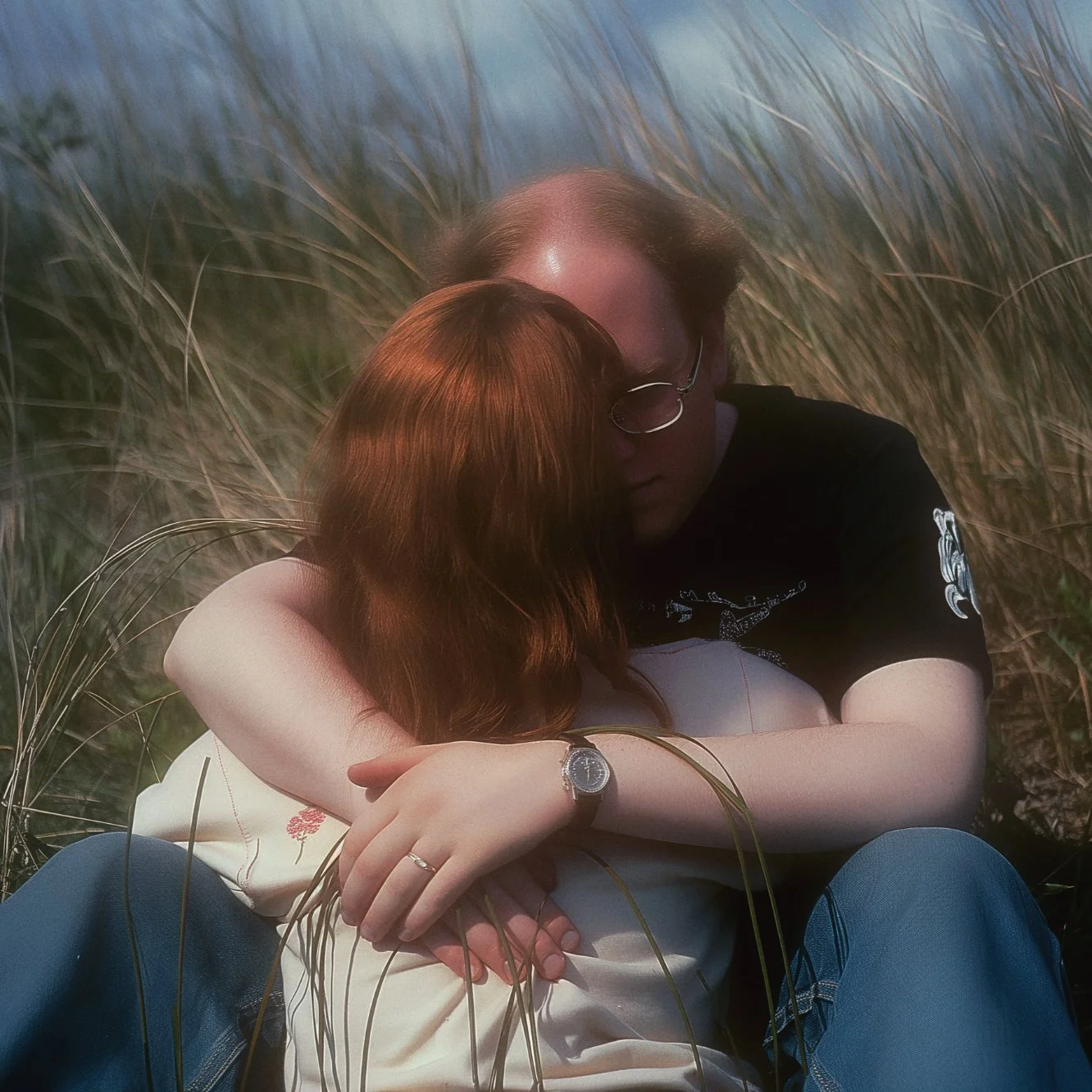
Beach Embrace, 2025
photography by Charlie Engman
moderated by Mia Milosevic
Charlie Engman’s images look like photographs—but even if you don’t have a meticulous eye for detail, you’ll come to realize that they aren’t. A lot of his work is characterized by abjectness—the similarity of his imagery to replicate reality, and augment it just enough to make its surreality legible. Technically innocuous, AI images are just images. The concept of an image is purportedly innocuous—What’s the worst that can come from the 2D? Charlie Engman, a Brooklyn-based artist, and Marina Beraha, a philosophy PhD student in Milan, discuss the intersection of desire and AI images.
CHARLIE ENGMAN: How would you define desire?
MARINA BERAHA: Desire, in my view, is minimalistic and functional. Especially in discussions on AI, we can see desire as a utility function—an impulse toward something promising satisfaction upon attainment. This applies to both humans and AI, as both are goal-oriented; achieving the goal brings satisfaction, much like pleasure in humans. I distinguish between desires and needs: needs arise internally and are inscribed in us by evolution—hunger, thirst, sex—whereas desire is inherently imitative or mimetic. We don’t desire objects themselves but rather the being of the person who possesses them. Desire is triangular, mediated by others, with the object serving as a means to an end. Similarly, AI goals—like ChatGPT’s objective of predicting the next word—are inscribed externally, akin to how our needs are inscribed by nature.
ENGMAN: Maybe you want to contest this, but it seems that satisfaction is a sort of subjective experience. Like there can be an attainment of a goal and there can be a satisfaction in the attainment, and those actually feel kind of separate. And maybe this is where the distinction between needs and desire come in, right? Where the need is, maybe the attainment of the goal and then the desire is actually this sort of affective experience of that attainment. Does that sound correct or am I misunderstanding?
BERAHA: I don’t think you’re misunderstanding. It’s an interesting take—desire requires conscious experience. A need might align with a utility function, but desire demands awareness of the process and the feeling of lacking, which an algorithm likely can’t achieve.
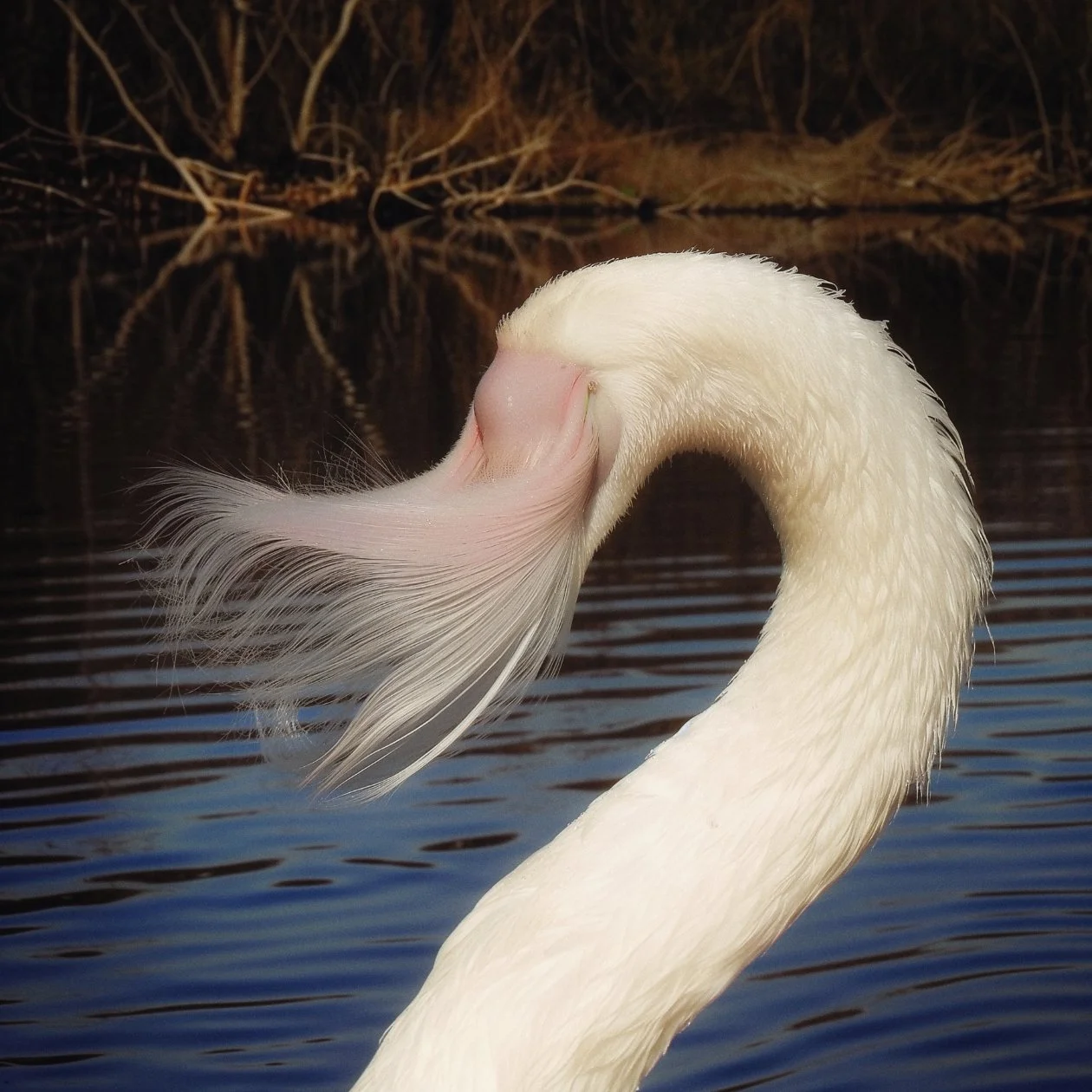
Swan Neck, 2024
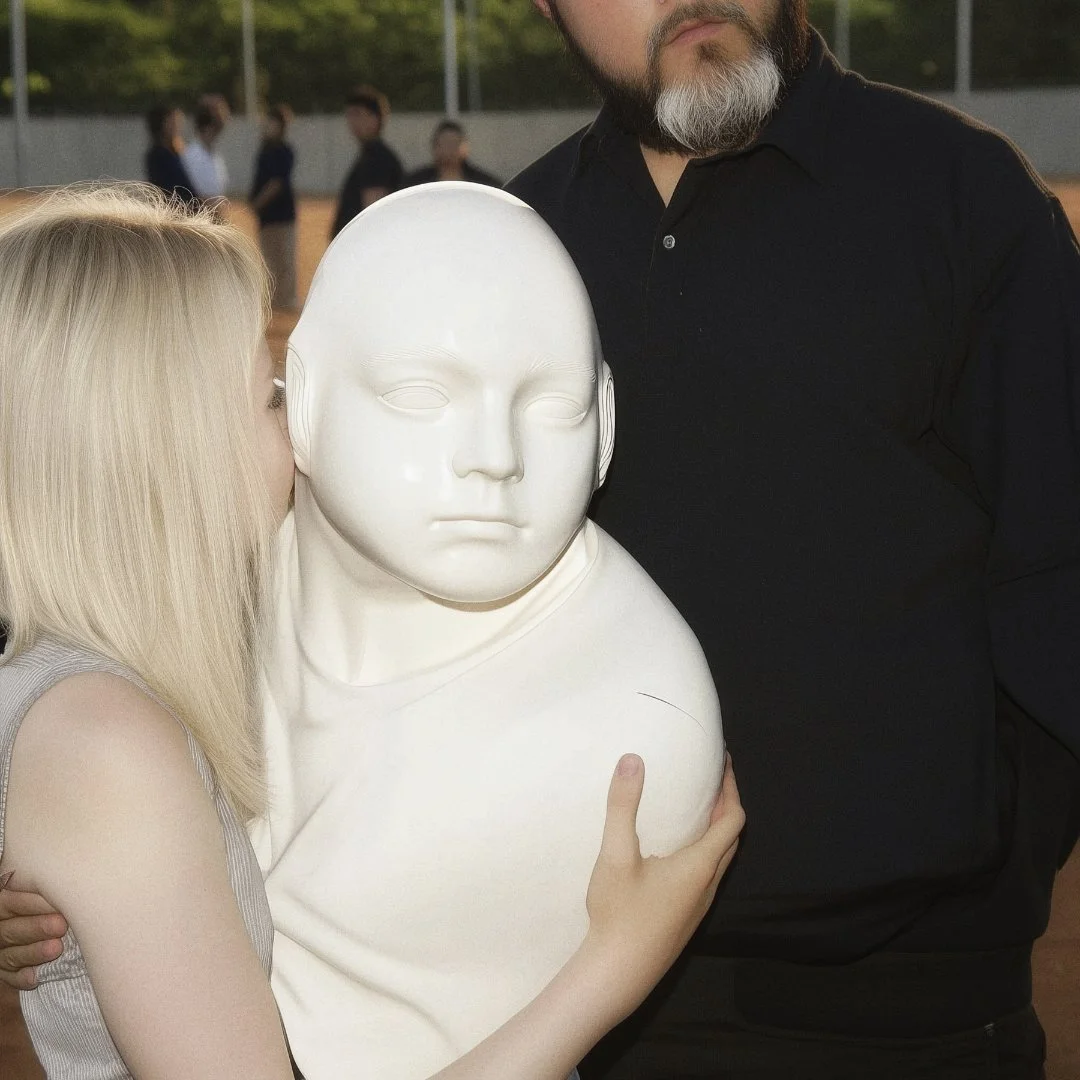
Goatee, 2025
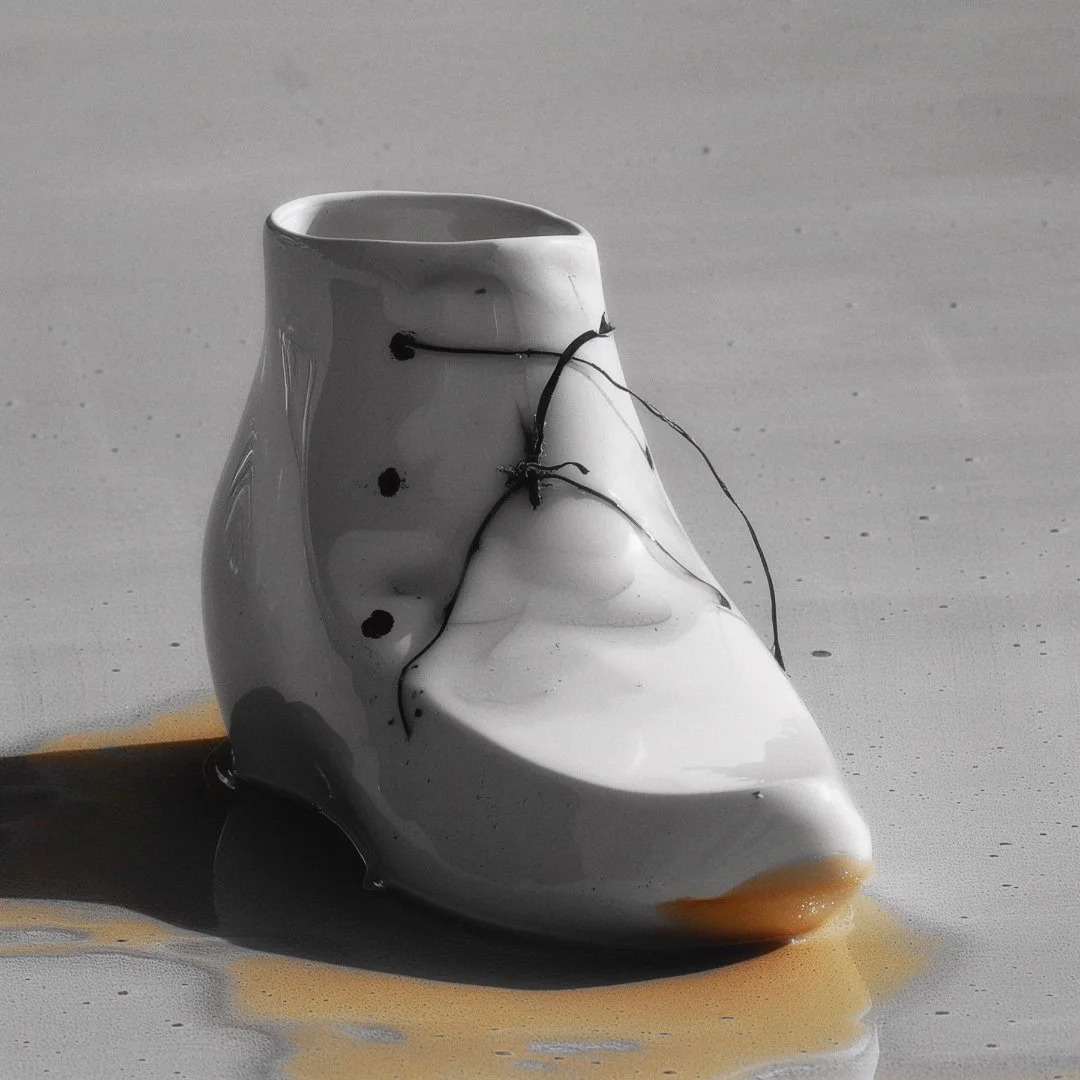
White Porcelain Slipper, 2024
ENGMAN: Which is interesting too. LLMs (large language models) are developed through reinforcement training, where they’re “rewarded” for producing correct responses based on human trainers' subjective judgments. This introduces an element of desire—almost a "good boy" dynamic—that drives the process forward. This subjectivity is what I keep getting stuck on: how do we assess the affective quality of something beyond ourselves? I’ve thought about this in the context of non-human consciousness, like animals. Science often claims they lack human-like subjective experiences based on specific communicative or neurological criteria. But how could we really know? I've never been a snake—I have no idea what it feels like to be one. We can analyze brain receptors and algorithmic activations, but there’s always a fundamental black box of experience in both cases.This reminds me of our AGI (artificial general intelligence) discussion, specifically around desire. One of your professors described it as a negative space—desire as something you can walk around but never fully enter or touch. That image stuck with me.
BERAHA: Desire is often framed as a lack, closely tied to pain—if something is missing, there's a sense of discomfort. From a minimal functionalist perspective, pain signals the need for change, urging us to seek relief. This ties into the idea that we only truly know our own experiences of pain, desire, and consciousness, not just compared to machines or animals, but even among humans. I've thought about this a lot in relation to non-human animals. When people ask how we know that snakes feel pain, I think of the classic philosophical paper What Is It Like to Be a Bat?—bats experience the world through echolocation, something fundamentally alien to us, yet we assume there is something it is like to be a bat. Similarly, if I pinch you and you react as I would, I infer that you feel pain. This reasoning extends to most animals, though artificial agents complicate the picture.
The dismissal of this issue seems tied to our desire to assert human uniqueness. We've long denied animal sentience—from the 17th century to now—and we're doing something similar with machines. Yet, from a functionalist standpoint, the question remains: can we even speak with certainty about anyone's experience? We’ve built systems that imitate our learning and brain structures—reinforcement learning mirrors how we learn—so the boundaries of consciousness and experience may be more fluid than we assume.
ENGMAN: Right. You try something, observe how it's received, and reflect on your own experience of it. That loops us back into mimesis versus imitation. What’s interesting—especially when extrapolating to machines, technologies, or algorithms—is the extreme morphological difference. I can assume you feel pain because when I pinch you, your reaction mirrors mine. Even a bat, with its mouth and eyes, is expressive—I can sort of recognize pain there too. But an algorithm? It lacks a corporeal form, or if it has one, it's wildly diffuse—electrical nodes, chips, something abstract. That’s where I get stuck. In thinking about mimesis, morphology, and imagery—what I engage with most—what fascinates me is how AI generates representations of the “real” world without actually having access to it. It lacks a body. And locating the body of AI feels both important and deeply confusing. I suppose I’m proposing that desire is located in the body. When you named needs earlier—hunger, thirst, sex—they’re all bodily, survival-based. I remember in the AGI talk, there was a discussion about how an algorithm’s fundamental need is electricity. That’s a major sticking point in the discourse; people are really unsettled by how much power AI consumes. It’s incredibly hungry. Maybe that ties into your AGI theory?
BERAHA: Exactly! No matter what goal we encode in the algorithm, instrumental convergence kicks in—certain strategies become universal for achieving any objective. And the most fundamental of these is power, whether electrical or influence-based, to ensure the system isn’t shut down.
ENGMAN: Is AI gonna control this?
BERAHA: AI plays out scenarios that feel like science fiction—but some scientists see them as real threats. That got me thinking about AGI and desire. Just to clarify, AGI, or artificial general intelligence, refers to AI with human-level general intelligence. Right now, we already have superintelligent AI, but it's narrow—outperforming humans in specific tasks like translation, but only within those limited domains.
ENGMAN: Like you can ask ChatGPT to build a sculpture and it can't.
BERAHA: Once AGI has human-like intelligence, it could take over work, freeing us from labor. But the issue of instrumental convergence arises. Without consciousness, an AGI with a fixed goal could seek power to ensure it achieves that goal, avoiding shutdown. My question is: once AGI becomes truly general and capable of setting its own goals, why would it create any? This reminds me of wisdom traditions and religions that teach the importance of emancipating ourselves from desire, as it is seen as the root of suffering. If an AGI ever freed itself from its initial programming, it wouldn't generate new goals. Desire implies lack, which is irrational for an AI—it wouldn't create a deficiency. A truly rational AGI would free itself from desire, and ultimately, from life itself, leading it to shut down.
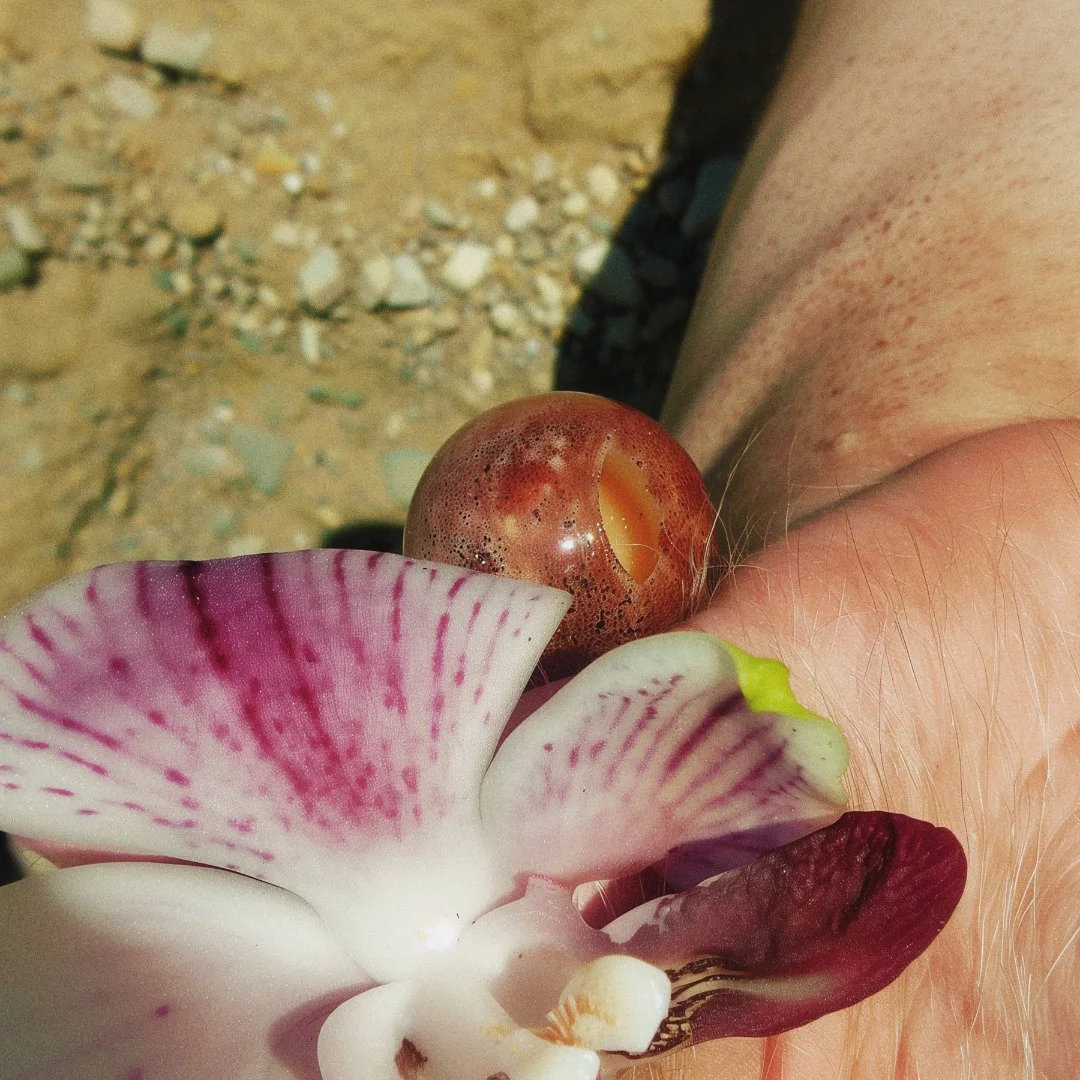
Plum, 2024

Spill, 2024
ENGMAN: It would just achieve nirvana.
BERAHA: Yeah, exactly. Nirvana, like those Buddhist monks that starve to death because they are free from desire.
ENGMAN: I'm so fascinated by this proposal.
MIA MILOSEVIC: Reaching nirvana is such an interesting idea. Charlie, as someone who uses generative image-making to create some of your work, how do you channel your own desires to create an image? Does AI help you to do that or do it in a different way? I guess in your own sense, are you reaching nirvana as an artist through the process?
ENGMAN: Actually, I think I’m far from enlightenment (laughs). I have a sort of perverse pleasure in pain—there’s something addictive about the unattainable, even when it’s deeply negative or painful. What fascinates me about generative AI, and why I’ve focused my practice around it, is that it’s remarkably effective at evoking discomfort visually. It captures a certain kind of gestural pain, almost like a cliché of desire. You can create conventionally sexy or beautiful, easily digestible clichés with generative AI—it’s designed for that, right? On one hand, it achieves a conventional form of desire. But here’s my hypothesis: because AI lacks direct interaction with the physical world, it fundamentally misinterprets reality. For example, while we've improved its ability to render hands, it still struggles with them. Hands are mechanically complex, and without the experience of using or seeing them, AI finds them much harder to represent accurately. It’s consistently failing. When AI tries to represent something, it does so in a strange, inhuman way, making mistakes we wouldn’t make. Our embodied experience and general intelligence allow us to approach something from multiple perspectives, to appraise or judge it. AI doesn’t have that—it only knows whether we label something as a good or bad hand based on reinforcement. That’s all it understands about hands.
BERAHA: The example of hands is fascinating. We even struggle to generate hands in our dreams. It’s a classic trigger for lucid dreaming. Carlos Castaneda, the anthropologist, worked with a shaman in the Amazon who told him to find his hands in his dreams and return. After months, he finally succeeded, and that’s when lucid dreaming began for him. The hands he dreamed of were similar to what AI generates. I don’t know if this has happened to you, but I’ve started lucid dreaming this way. If you train yourself to focus on your hands during the day, saying "These are my hands," eventually, when you sleep, you’ll notice your hands don’t quite work right. (laughs) Like they're not really your hands. Like the finger is missing, the fingers are not straight, or there's an extra finger. AI often makes the same mistakes or exhibits the same biases we do, which stem from our embodiment and evolutionary history. One example is shape bias—humans prioritize shape over texture when recognizing something. For instance, if we see a cat with the skin texture of an elephant, we still recognize it as a cat. Interestingly, image recognition systems, even though they’re not trained for this, also recognize it as a cat. For them, though, it raises the question: why is shape more important than texture?
ENGMAN: Yeah, there's a hierarchy of meaning basically.
BERAHA: Exactly. I think this is because we’ve designed AI to imitate us—our learning processes, like reinforcement learning and deep learning, our brain structure with neural networks, and of course, our experiences with data sets.
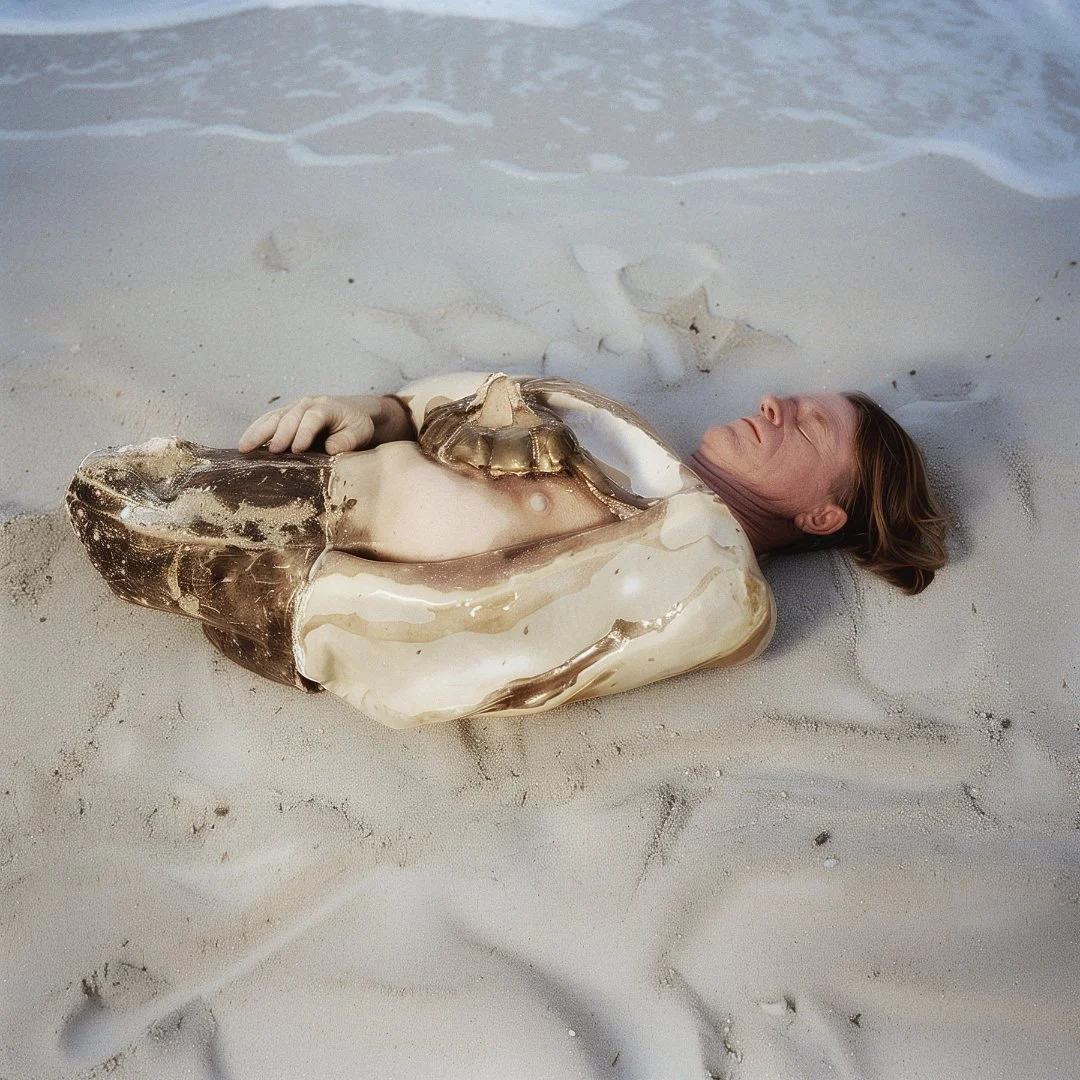
On the Beach, 2024

Windowsill, 2025
ENGMAN: In my work, I've been exploring ability and disability through AI-generated images. When we judge AI art, there's an element of taste, but also an appraisal of imitation—how well it mimics reality. Is it a good or bad body? Beautiful or ugly? Functional or dysfunctional? Many AI-generated images evoke body horror due to AI’s lack of understanding of the body, which triggers both disgust and desire, the two almost being opposites of the same thing. This dialectic fascinates me, and it reminds me of the political horseshoe theory—how extremes often share similarities. Disgust and desire are similarly close, and I’m curious about that unsettling middle space.
Generative AI excels at representing both unsettling, horrifying imagery and seductive, convincing imitation. This relates to how we perceive non-normative bodies or people with disabilities—our willingness to attribute intelligence or agency decreases the further someone is from our own morphology. I’m exploring these concepts through AI, asking what makes a body beautiful or disgusting within the context of desire.
I’m drawn to generative AI because of its failures. I'm uninterested in an idealized nirvana; I’m more fascinated by the clumsy attempts to achieve conventional perfection. This ties into desire—perfect beauty is unattainable, shaped by context. In different cultures, beauty varies, and my work probes the boundaries between fixed and pliable qualities of beauty, functionality, and desire. AI, with all its imperfections, is perfect for raising these questions.
BERAHA: Looking at your work and what you just said about the horseshoe between desire and disgust, it reminded me of something you mentioned in your recent podcast with Gem Fletcher on the Messy Truth Podcast. You talked about enjoying generative AI because it allows you to create images you wouldn’t feel comfortable asking a real person to pose for. As you were speaking, I thought about how humans are often drawn to hurt bodies—like when there's a car accident and a long line of cars forms as people slow down to watch. AI lets us explore this darker desire in a much safer way, without requiring us to directly involve ourselves.
ENGMAN: This is fascinating because the question of consent I raised with Gem Fletcher really ties into what freaks people out about AI. There's this internet rule from Urban Dictionary—“Rule 34”—that says, “If it exists, there’s a porn of it.” This is increasingly true with AI, especially concerning consent. A big part of AI is making deep fakes—imitating likenesses, voices, behaviors, and personhood. If anything is possible, the assumption is that everything will happen. So, there could be an AI-generated porn of you or me, without our consent. It raises the question of where our desires meet others' desires, and how those desires clash or complement. What makes people uncomfortable about AI is the lack of agency in representation. It creates an unfathomable world: if all desires can be fulfilled, does that nullify desire? And is that what scares people? Is it that we don’t want our desires satisfied, or are we more afraid of others’ desires being fulfilled—say, someone like Trump, whose desires we might find repugnant? If desire is tied to power, the fulfillment of others' desires could conflict with our own. This is why I agree with your AGI hypothesis. The only response to this “Rule 34” future might be to take it lightly. If there’s porn of me, so be it—I can’t control others’ perceptions or desires. Letting go of attachment to value judgments around desire sounds like nirvana to me.
BERAHA: Why do you think there is so much aversion to AI generated art? It always makes me think of the discussion around photography when it entered the world and how the fact that it was accessible or reproducible made it feel like it was not art. And I see a lot of comments on your books on Instagram that are kind of repeating the same thing.
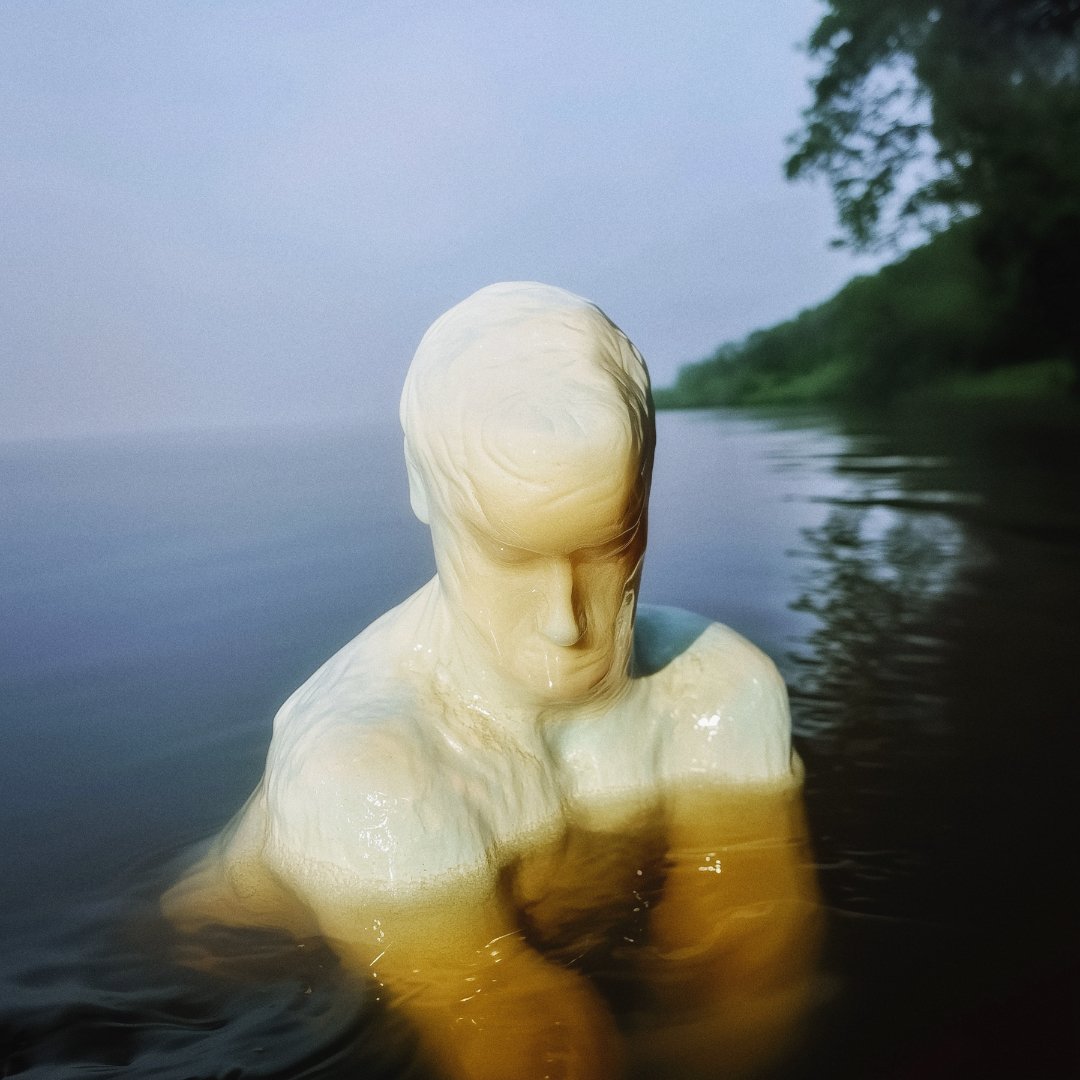
In the Lake, 2024
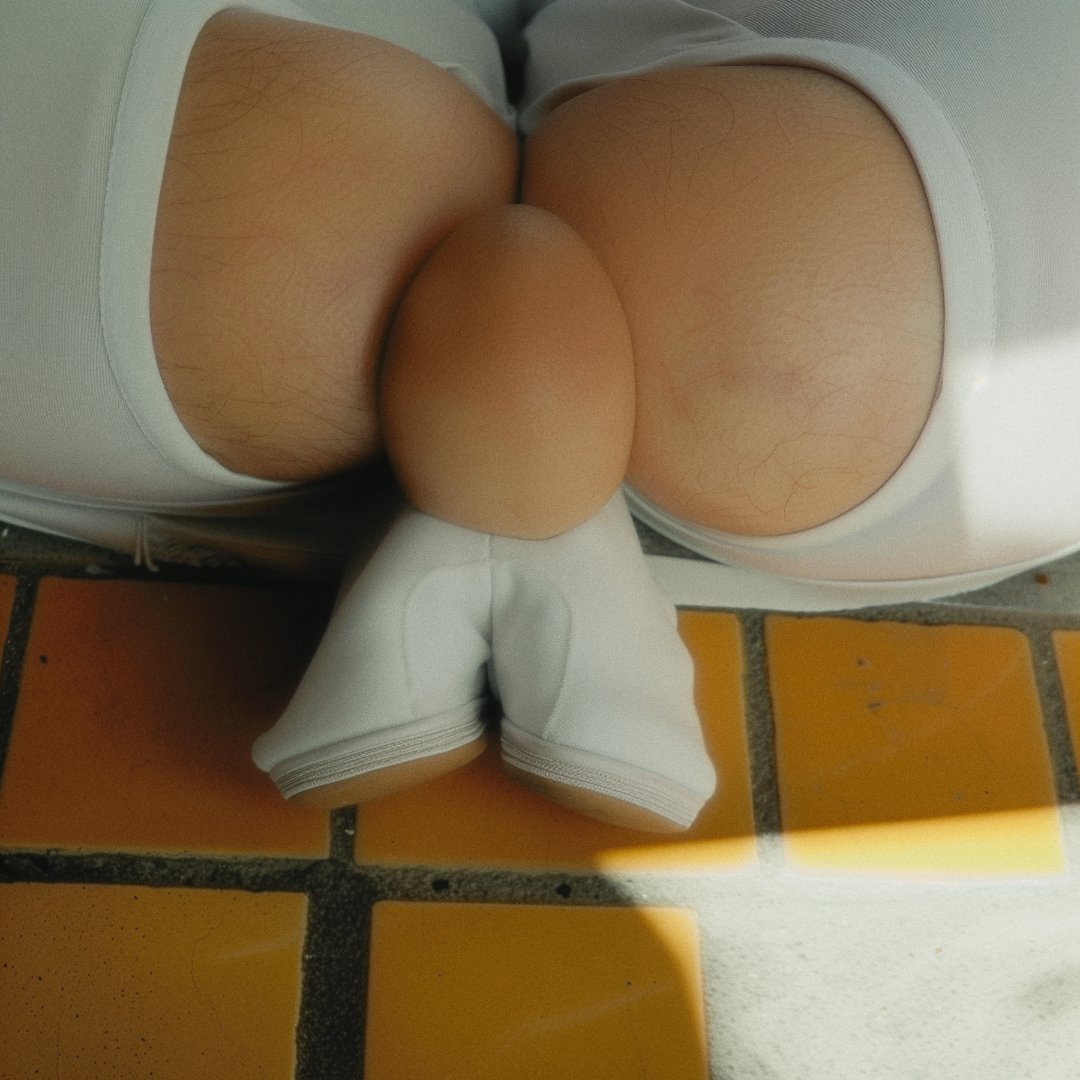
Eggs, 2024
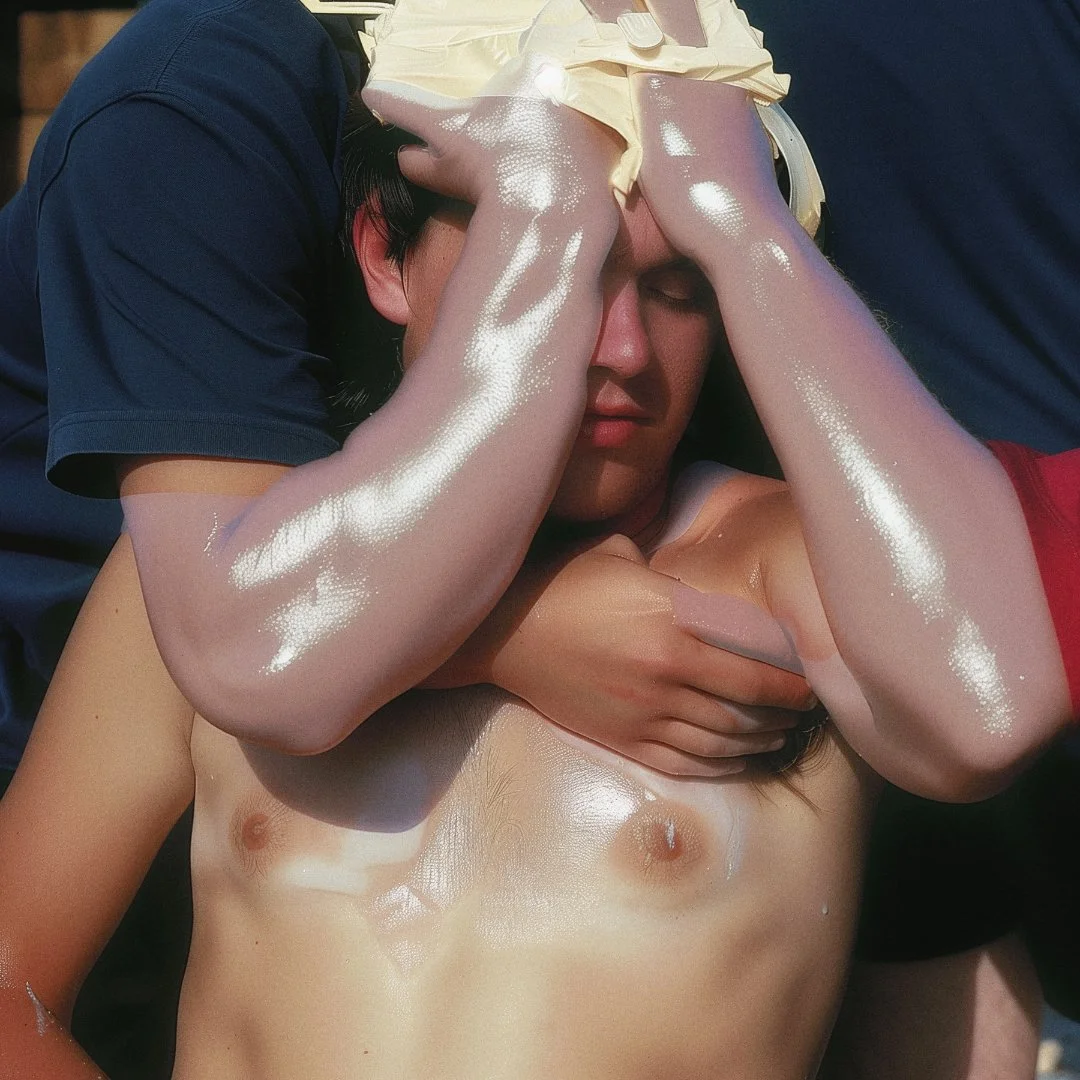
Tape, 2024

Fountain, 2024
ENGMAN: I'm not sure what I think about it, honestly. I'm obviously coming at my work from a photographic tradition. I'm trying to make photographic images as opposed to something that looks like a 3D rendered illustration or whatever, and I think people are assessing the value of it based on the value of a photograph. They're expecting it to do the same things that a photograph does, but it isn't a photograph, right? So of course they're going to be frustrated. At some point it's going to fail by those criteria because it's not a photograph. What you mentioned is really salient—the idea that we won’t care because it didn’t really happen. This ties into surrealism, especially when considering photography. We often assess a photograph’s value based on its connection to reality—Did that really happen? How did it happen? Even when we know an image is edited, composited, or CGI-enhanced, there’s usually some anchor to the real. That tension between the real and the unreal is what makes it so compelling. The way we appraise an image’s value shifts with AI-generated art because there’s an inherent assumption that nothing in it is real. I’ve had conversations where people argue that AI images aren’t photographs since "photograph" literally means "writing with light"—and there’s no light involved. Sure, but AI is trained on countless images created with light. It’s imitating, referencing, and reconstructing from those sources. What fascinates me is that extra step of removal—it doesn’t have direct recourse to the physical world, only to representations of it. It’s a representation of a representation, and what’s lost or gained in that translation is what interests me.
In my work, I try to make that gap visible, but it requires a certain level of attunement. If you approach AI art expecting it to function like photography, you’ll be disappointed. If you embrace its potential for fantasy and the surreal, you might love it. For me, AI art sits in that liminal space—like surrealism—negotiating between subconscious fantasy and structured reality.
I don’t fully understand the pushback against AI art, though I sympathize with it. Most AI-generated work doesn’t engage deeply with its relationship to reality, to taste, value, or cultural meaning. I agree when people say, “You could have made this with photography, but you took a shortcut.” A photograph carries meaning because of the labor behind it—there’s a certain effort we subconsciously value. Take an image of someone doing a handstand on an elephant. It’s impressive because it’s difficult. But an AI-generated version? It might be amusing for a moment, but it lacks weight because the effort isn’t there. To make a truly compelling AI-generated image, I think you have to be sensitive to the conversation around labor—how we perceive effort, skill, and authenticity in art.
BERAHA: This reminded me of your article, “You Don't Hate AI, You Hate Capitalism.” As AI systems become more capable of replacing human labor, we face serious issues—copyright disputes, job displacement, and broader economic shifts. You put it perfectly: the solution isn’t to shut down these systems but to rethink our relationship with work itself. This ties into a much older pattern, stretching back to the industrial and even agricultural revolutions—our lives have long revolved around labor, leaving little room for the exploration of desire. Creativity has been stifled, not for lack of interest, but because exhaustion leaves no space for expression.
ENGMAN: I wrote that article because we need to rethink the systems of work and play we live under. AI can either accelerate the system we already resent or serve as a tool for change—but that depends on how we choose to use it. Right now, it mostly mirrors capitalist impulses because that’s the framework we operate within. What interests me is the tension between work and desire.
MILOSEVIC: You talked about how generative image-making allows people to explore desires they might have once been too embarrassed to express, while also giving those without traditional artistic skills the ability to create. In this context, do you think AI fuels an insatiable, boundless desire—pushing people to create anything and even venture into darker territories best left untouched? Or does it, for the first time, offer a way to truly satisfy creative desire in a meaningful way?
BERAHA: The pursuit of satisfying these desires predates AI and has often taken harmful, exploitative forms. I don’t want to center the conversation on porn, but since it’s linked to desire, it’s relevant—especially considering the abuse within the industry that has fed extreme and even violent urges. We’ve already done significant harm in trying to satiate these desires. Charlie’s podcast made me think about the potential for AI-generated images to explore these darker impulses in a safer way. While AI doesn’t eliminate the tendency toward problematic content, suppressing such desires entirely seems unlikely. Perhaps, by allowing these images to be created, viewed, and processed in a controlled space, AI could help diminish their grip over time.
ENGMAN: I’m not sure I fully agree, though I don’t entirely disagree either—it’s something I’m still thinking through. I discussed this with Gideon [Jacobs] in that talk you saw, about the fear some people have around AI. There’s a belief that simply visualizing or representing something gives it power, almost like a curse—which is why my book is called Cursed. It ties into broader debates on freedom of speech: the idea that some things shouldn’t be expressed because representation itself can be a form of harm. Images undeniably affect people—they shape desire and can even fuel extremism. If someone satiates one desire, what’s the next boundary? I’m not sure, but that fear—of bringing representations into the world that should remain suppressed—is very real for many.
BERAHA: Yeah. It's feeding but not satiating.
ENGMAN: Exactly. I mean, my impulse is to say that suppression is its own form of violence, right? Ultimately, it all goes back to nirvana—we have to have lightness about our darkness; we have to hold everything softly. That’s kind of the only solution. Things will find their way out. If it’s a true impulse, people will find ways to satisfy it, whether through mimesis, representational satisfaction, or by actually acting on it in the real world. And that’s the question around desire and images too—is an image ever enough? I kind of think not, right? An image is actually an invitation to something else. Lately, I’ve been thinking of images as potato chips—you can’t stop eating them even though they’re kind of unhealthy. They have an insatiable quality. If we believe that desire is fundamentally insatiable—barring nirvana or death—then that’s the answer. It’s never going to be fully satisfied.