Growing up near the Appalachian Mountains in his home state of North Carolina, New York-based fashion designer Charles Elliot Harbison was disconnected from the glitz, grunge, and all things in-between of New York fashion. Nevertheless, he still managed to find his way to aesthetics. Though it might seem surprising to the average New York cool kid, Harbison learned about style at the church. “There was propriety in it,” he says. “There was personal exhibition. There was worship. It was never thoughtless. I remember white shirts, blue blazer, bowtie, some suede bucks. That’s when I became acquainted with style.”
New York Fashion Week has solidified its position as the most commercial of all the Fashion Week’s. But as New York commerciality has reached its apex, a crop of young radical designers have emerged displaying awareness of contemporary art and pop culture and shining light back on American fashion: Eckhaus-Latta, Moses Gauntlett Cheng, Vejas, and Harbison.
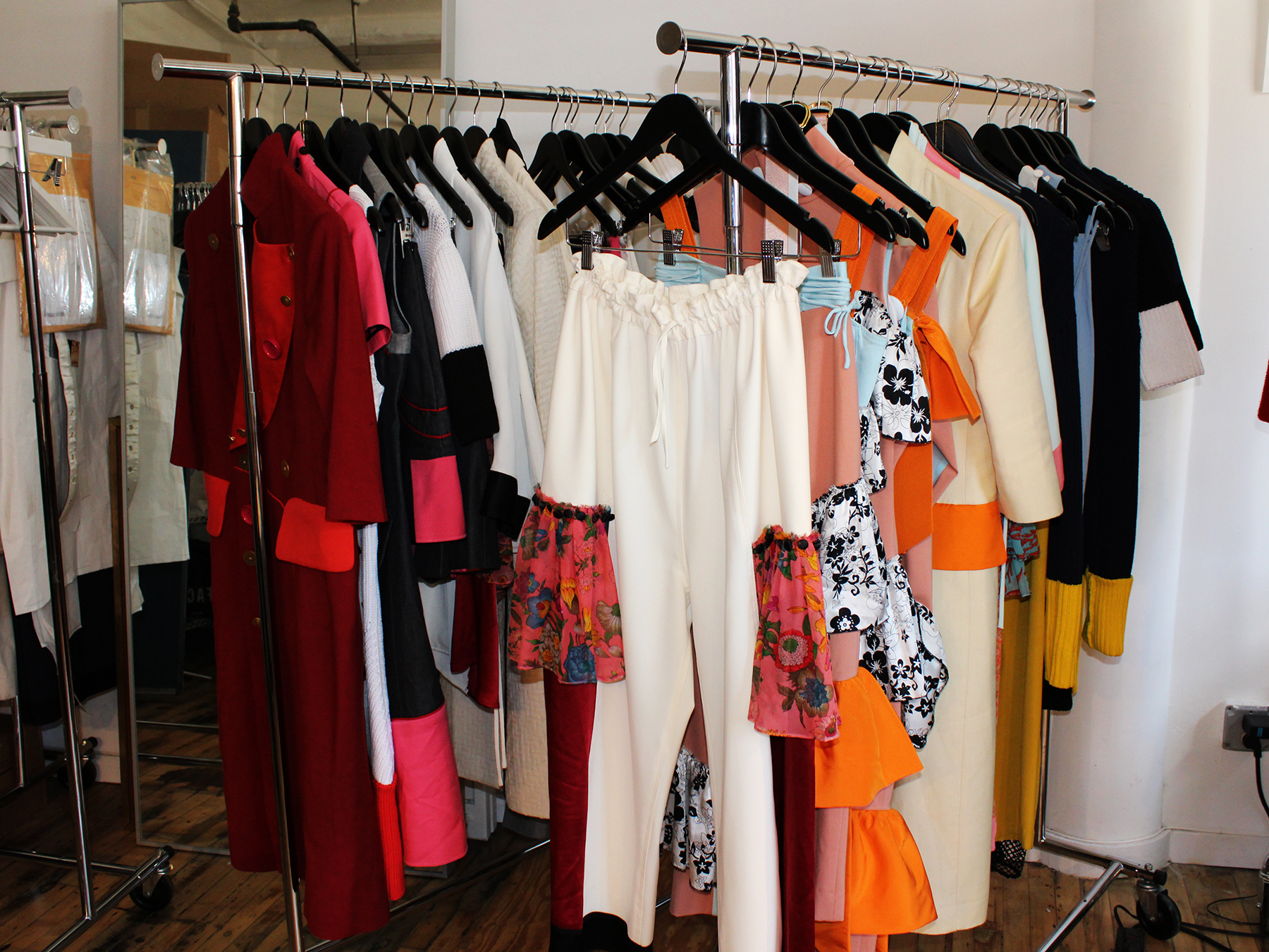
But Harbison still stands out as something of a renegade even amongst this crop of wildly exciting fashion design talent. Though Harbison comes from a fine art background, having studied fine arts and painting at North Carolina State, he does not shy away from things traditionally “chic,” inspired by the luxurious approach to sportswear his mother employed when he was a child. He has leaned towards the subversive since he started his brand three years ago, employing a gender-neutral approach to his garments far before the industry jumped on the trend. But even with that, it’s not hard to imagine Park Avenue women loving to wear his modernist, color-blocked, and astoundingly beautiful clothes, allowing him a customer far wider in demographics that some of his contemporaries could ever conceive of reaching. “I don’t think [subversiveness] has to be relegated to just casual wear or crude construction,” says Harbison. “I want to do it through the filter of elegance, expense, and aspiration.”
Harbison also has some serious fashion education. Having learned about textiles and fabrics in Central Asia, studied fashion as a post-grad at Parsons, and worked for Michael Kors, Billy Reid, and Luca Luca, he has a leg up on his contemporaries with flat-out knowledge over the construction of garments. How would you describe those garments? This writer would say, “subtly striking.” They aren’t unwearable pieces of clothing architecture or tattered to shreds in the name of art. Harbison creates a form-flattering silhouette and then applies blocks of vibrant color to make the statement. They are the types of clothes that you find yourself staring at without realizing it. “Color, texture, embellishment, contrast, valence, proportion,” says Harbison. “I just wanted to be true to that when I started Harbison.”
He also has the ability to tell stories without grandiose displays of conceptual creation. Everything that Harbison presents in his shows, he sells. Much like Dries Van Noten, or even Yves Saint Laurent (minus the couture), he adheres to the tenets of ready-to-wear. And yet, he still conveys strong and discernible ideas. Patti Smith is the brand’s muse, and Harbison has also told stories centered around Erykah Badu, Aaliyah, and Nica Rothschild. The strong and cultured women that breathe in his garments has attracted the attention of Beyoncé, who wore custom Harbison to Kanye’s Yeezy Season 1 presentation (and Solangé wore the same in Paris some weeks later) and brought massive attention to the brand. “What the muse does is allow me to work them into my stories,” says Harbison.
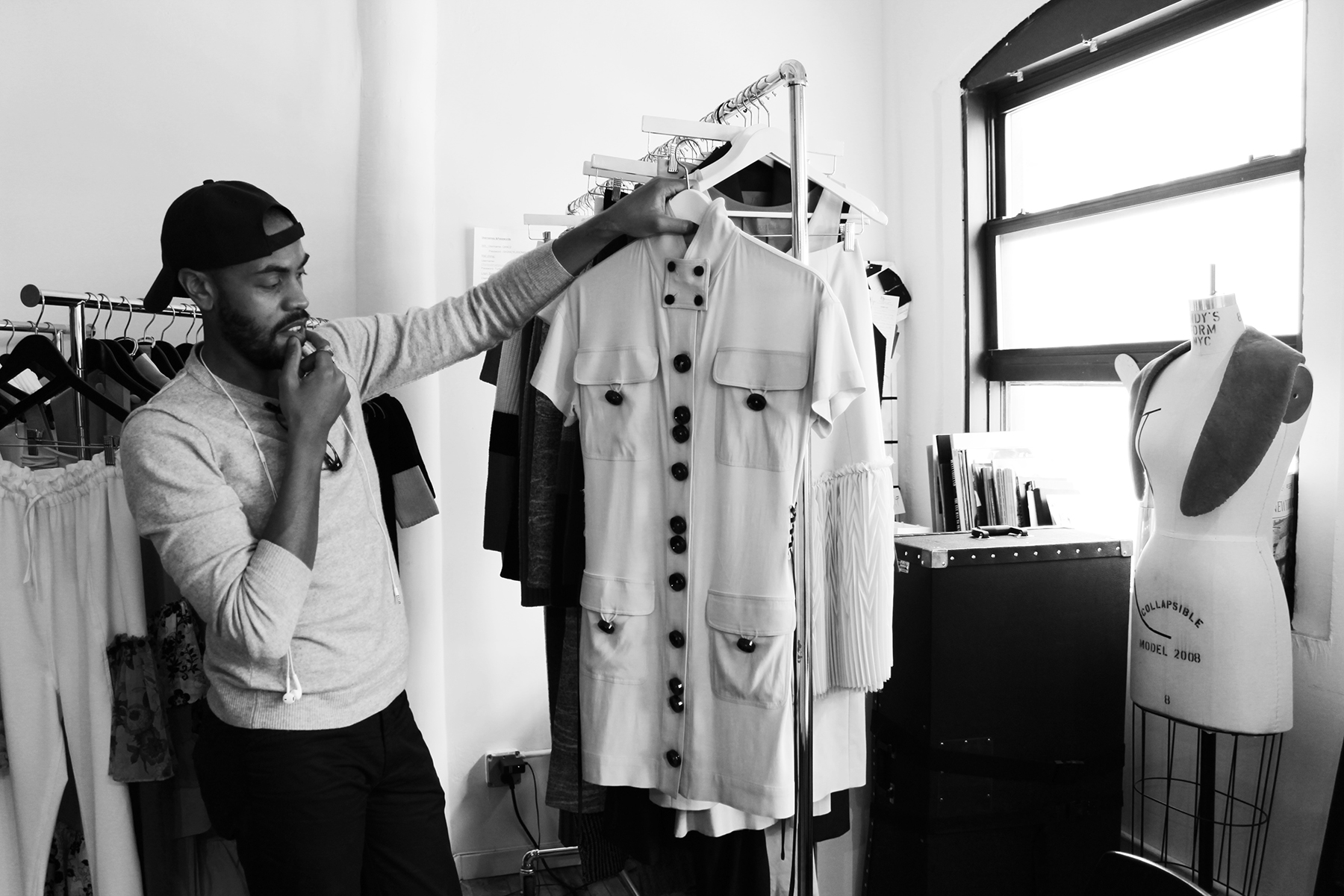
When I meet Harbison in his small, clothes-filled office near Manhattan’s City Hall, he is in great spirits despite a busy morning. Though his brand sat out the last NYFW, he is still moving forward. His next collection will be the first “gender-neutral” collection where the clothes are cut in ways to fit a man and a woman’s body. He laughs a lot, and has an ease in explaining his ideas that is absent in a lot of creatives. We spoke at length about his history and the direction of the brand.
LEHRER: Are you still religious now?
HARBISON: I have a spiritual practice. I go to church in Harlem. It feeds me culturally as well as spiritually. It’s nice to have this whisper of my early life an hour away. [I live] in Bushwick. Every Sunday, I get to be around black people from the South.
LEHRER: Does it ever rub you the wrong way that something you’ve been doing for a while, gender-neutral collections, is now a trend and being done by like, Burberry?
HARBISON: It completely bothers me. When I launched [the brand] in 2013 it was inconceivable for the buyer to understand a man in a womenswear lookbook. They couldn’t understand seeing one coat on her and the same coat on him. From a market point of view, this is a women’s collection. But the cuts are neutral. This is how my friends and I live. When I was at Michael Kors, I would wear women’s samples as a dude. I never felt like my masculinity was compromised. Of course, I’m queer, but I saw straight guys and girls doing the same thing. By and large, America is slow to this idea. You have Selfridges with their gender-neutral merchandising.
LEHRER: They had a gender-neutral section in their store. Like, Hood by Air and J.W. Anderson.
HARBISON: Fully. You have Gucci putting dudes in pussy bow blouses. You have Jayden Smith as the face of Louis Vuitton womenswear. I feel like a lot of that gets filtered through novelty, comedy, and trend. But for me, it’s just a way of dressing that makes sense. I want to do it from a slick point of view. It makes me a better designer and marketer.
LEHRER: A lot of brands will throw dudes in a women’s lookbook or a show for a statement. You’re thinking about it in terms of the products.
HARBISON: The pant cut, we fit on a guy and a girl. The tunic cut, we do it in a way that works well on him, but it gives her tailoring options if she wants to do something more waisted. The transformability of the clothes allows them to become whatever you want them to become. It’s not just a visual statement. The shit feels good. There are a lot of clothes that are “exclusively for women,” but even that’s not true. Like, dude, it’s your life. If he wants to wear a dress, I don’t care. I just want to make cool ass shit that makes people happy.
LEHRER: Do you feel like buyers are starting to have a bigger say in what the collection is?
HARBISON: Store buyers, often, now see themselves as the end-all-be-all. It removes a lot of the excitement from the shopping and dressing process. What if someone had done that to McQueen? What if someone had done that to Galliano?
LEHRER: I shudder to think of the buyer telling Alexander McQueen what to do.
HARBISON: In the beginning, McQueen and Galliano were making crude but interesting stuff. There were problems with construction, but there was an idea there, and it was supported by the industry. It wasn’t until they got money that you saw their actual genius. Their processes were supported.
LEHRER: Color is a big part of your collections. Your brand came out three years ago, and at the time, the big predominant thing was street goth, ninja goth. Were you put off by the excessive use of black?
HARBISON: No, not put off. But I did want to offer something different. I design through the filter of art and modernism. The beginning of my arts education was in fine arts and painting. I love fine arts first.
LEHRER: When did you decide to transition from art to fashion?
HARBISON: In undergrad, I ended up weaving seventeen yards of this beautiful fabric. For me, it was like speaking to my Native American heritage. It didn’t feel right to wrap it on a canvas. So I thought to make some garments. That moment in undergrad, my junior year, was when I decided to figure this shit out.
LEHRER: You went to central Asia to study textiles. What did you learn over there?
HARBISON: I studied in Turkmenistan in undergrad – indigenous fabric construction. When I graduated, an opportunity came up to go back to the region for a year. I hadn’t found a job, so I thought, why not? I wanted to understand more about myself. There was so much mystery around that area. It’s an area that no one has really claimed. It’s former Soviet territory, but the population is South Asian, and they look East Asian in language and food. It’s influenced by the Middle East. It was also my first time out of the country, and it was the best decision I made. Fell in love with the fabrics. Spent time with students in their villages, and saw how they lived so casually amongst beautiful things.
LEHRER: And then you started working so you went to Parsons for some post-grad work, and then went to work?
HARBISON: I cut my teeth at Michael Kors Collection.
LEHRER: Your designs are much more radical than Michael Kors. What did you learn from him?
HARBISON: I learned so much: quality, detail, fabric, merchandising, selling, and how to dress people. Michael knows his way around client connection in a really amazing way. There’s an approach to his fashion that is really respectful of the genre. Though I approach novelty and art, I wanted [my clothes] to be rooted in shapes that are classic. I don’t make a lot of conceptual pieces. I love sportswear, so being with Michael was the best place for me.
LEHRER: You said you started your own brand by accident. What was that accident?
HARBISON: I burnt out. I was at Billy Reid and walked away. I started traveling. I had an Eat Pray Love experience. It was awesome. I read Patti Smith’s Just Kids, and that changed my life. She and Robert [Mapplethorpe] were the muses for my first capsule. I came back to New York from St. Croix. I had an interview at some collection, and when I walked in I thought, “I’ll be damned if I can do that.” Fashion week was coming up, and I didn’t want to skip a season. So I just made my own samples and shot some thing myself. Those images fell in the hands of Mark Holgate at Vogue and Virginie Smith. They said, “Do you want this to be a thing? We’ll feature you.” It’s been a hella crazy ride since.
LEHRER: I want to ask you about Patti Smith. You said she was the brand’s muse. What is it about her that you find so inspiring? Aside from, well, everything.
HARBISON: Beside everything she’s ever done? Patti walks this modern line of femininity, which I think is amazing. In her relationship with Robert, she was the stronger entity. He was the more fragile of the two. The relationship was beautiful and modern in that way. I find Patti’s lack of self-consciousness aspirational. She and Robert were vehemently sure of what they wanted in New York. That reminded me to take the risk. I was also able to touch this late ‘60s world that I love. In my mind, I feel I would have really done well in that time period touching on the modernist artists that I love.
LEHRER: You’ve done collections based on Sade, Aaliyah, Erykah Badu. Do you always design with a specific woman in mind?
HARBISON: For example, last spring I imagined Erykah Badu singing in a Zen garden carrying a Bryce Marden painting. This story allowed me to imagine seemingly contradicting things and bring them together. That’s a challenge that I like. I want to offer things you’ve never seen before.
LEHRER: New York has gotten known of being the most commercial of the fashion weeks, but there is a whole crop of designers and brands coming on the scene who are making innovative things. Why do you think this is happening now? Has the commercialization hit a tipping point that is being rebelled against?
HARBISON: Completely. You see the evidence in the industry itself. The commerciality is no longer commercial.
LEHRER: The biggest brands are all struggling too.
HARBISON: Exactly. For younger designers, there’s no desire to make something you already see in the world. Design based on replication doesn’t feel responsible. Also, with a global market, we’re comparing ourselves to everything around the world, even things that aren’t “high fashion.” Everything becomes a reference point. Everything influences what we find fresh, new, artful, and relevant.
LEHRER: You said you don’t want to be Ralph Lauren overnight. Would you ever want to be that big?
HARBISON: Yeah. [Laughs.] I love designing things. I feel like I have a dialogue for cars, homes, architecture. I love aesthetics. I would love to have the opportunity to configure aesthetics in different areas. As far as how big Ralph is, that is something that I think I’m still grappling with. For me, what is most valuable is having a lot of product for people to opt into. I want a lot of product in the world.
LEHRER: You sat out this fashion week. People talk about the speed of the industry – Raf leaving Dior, etc. Is that something you struggle with or not?
HARBISON: Yeah. The speed of the industry has brought me to my knees before. I think it can compromise design integrity. For me, skipping out this show season, I needed it from the business standpoint. I needed to figure out how to approach these marketing events in a way that’s more thoughtful of the business revenue. How do I give all these eyes access to the collection? You can opt out of [the traditional fashion schedule]. You don’t have to make four collections a year. You can make one. You can do this thing however you want to do it. That’s why I have so much respect for Raf and him walking away [from Dior]. It no longer worked for him, and that’s wonderful.
LEHRER: He’s supposed to be this radical, punk designer. Dior was weighing on him for a number of years. It was like he said, “Fuck that.”
HARBISON: Exactly. To be happy. How modern is that?
LEHRER: Did you have designers or artists that you looked up to when you first got into this?
HARBISON: Yeah, Dries [Van Noten] and Azzedine [Alaia].
LEHRER: I was thinking about Dries when you were saying everything comes down to product. Dries has a way of telling a story only using pieces that he will sell on the racks. That’s definitely what I see with you.
HARBISON: Thank you. That’s the goal. Dries has created a world that’s wholly his. His client base is totally devoted. My favorite pieces to wear are all Dries. I want to make that the case for Harbison. “I’m always going to go back to Harbison because it makes me happy.” I want my customers to say that
Visit Charles Harbison's website to see current collections. Text, interview and photographs by Adam Lehrer. Follow Autre on Instagram: @AUTREMAGAZINE