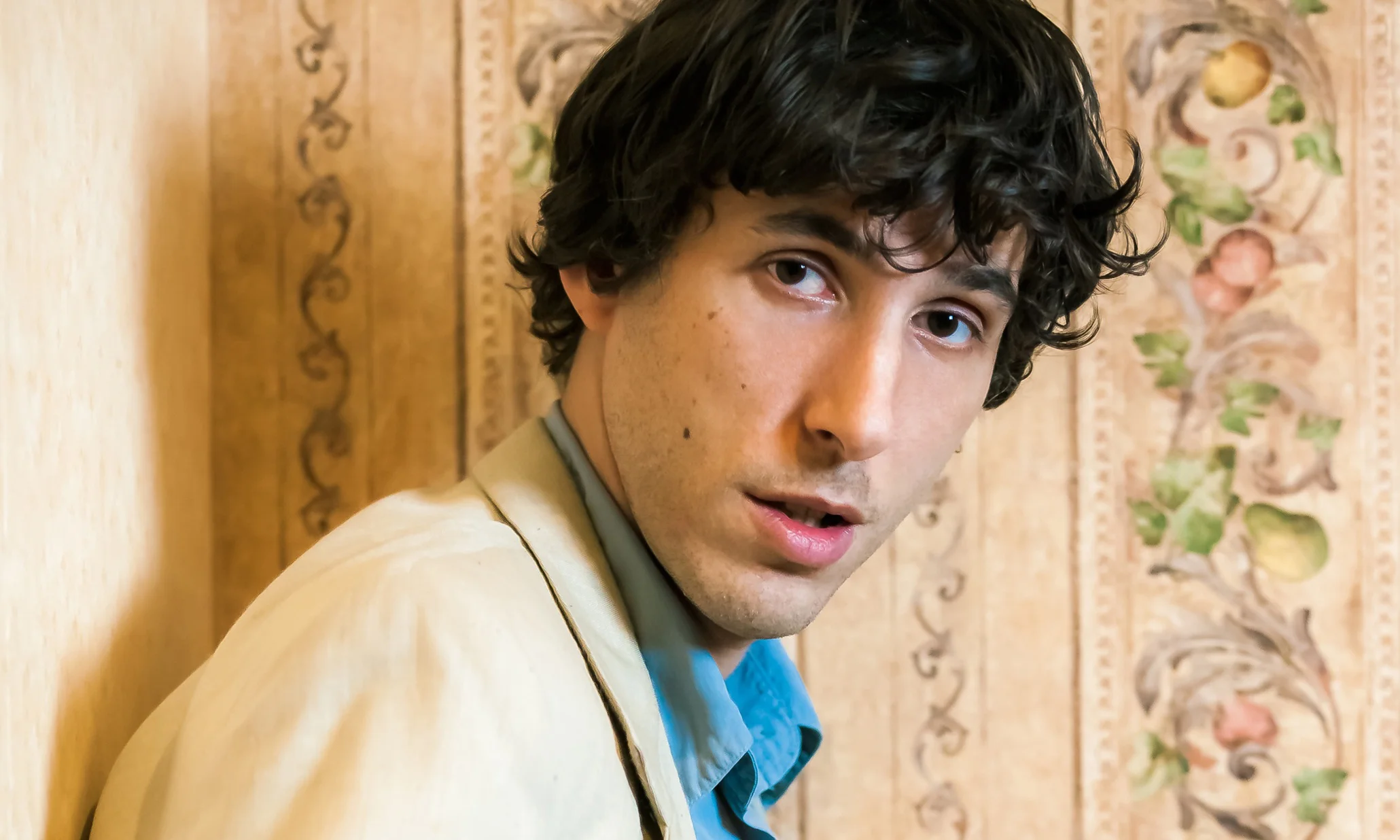
Nearly ten years ago, Donald Cumming, the snarled-lip founder and front man of The Virgins, sang about stuck-up rich girls and other superficial fancies of youth and abandon. But that was a different time; downtown New York was grittier, cheaper, and less gentrified. Cumming grew up listening to old records above his father’s liquor store in Tribeca. Now, however, Cumming finds his inspiration a little farther uptown, where a piece of Old New York still exists. This shift of interests is not only indicative of a changing city, but is also symbolic of Cumming’s maturation as an artist. This evolution is also evident in Cumming’s astonishing debut solo album entitled Out Calls Only, released this month on the Washington Square Music label. Tinged with the same poetic, literary textures and existential questions of past musical efforts, the singer’s distinctive drawling voice harkens Jonathan Richman or Richard Hell on klonopin, Out Calls Only is heartbreaking, introspective, and incredibly raw. It is also boozy and beautiful, seemingly bathed in a warm, romantic red glow. From start to finish, the intimate album alludes to the self-assuredness of an artist who has learned from past mistakes and has a found a stage that is all his own. Autre had a chance to speak with Cummings over the phone from his apartment in New York – I could hear him dragging on a cigarette between questions with the sound of the city in the background, like a sweet symphony of chaos. In the following interview, Cumming talks about his time in The Virgins, an ever-evolving New York City, and his new solo musical journey.
Oliver Kupper: When did you first discover music? Was there a revelatory moment, or anything specific that you can describe?
Donald Cumming: I remember listening to the records my mother used to play when I was a kid. She played Springsteen and Linda Ronstadt. I was always aware of it and listening to the lyrics. I would misinterpret or put the words together in nonsense ways. But music was always playing. And I was always singing songs—the different songs you sing in school with the whole class. I was always really engaged with music.
OK: Your music has a literary edge to it, a literary layer. Are there influences of this nature in your work?
DC: I don’t know about direct influences, but I do read a lot. It depends on the material. I like a lot of American literature—particularly poetry, but also novels. I like Dos Passos. I like Mailer. As far as poetry, I love Franz Wright. I love Robert Lowell. There’s pretty much a wide spectrum.
OK: You grew up in downtown New York. How do you think New York has affected your work? Do you think there’s a major influence?
DC: Being from here and growing up here, obviously, most of my life experience happens here. So that has a big effect on things that I end up making. But as I get older, I think the influence is less. I’m not really engaged with the city the way I was as a teenager. I’m not really out running around like I used to be. I don’t really have the same kind of social life that I had when I was young. The city has also changed a lot. As far as being downtown, it’s unrecognizable. It doesn’t feel like a place that I have any emotional connection to beyond walking around and thinking about the past, or remembering people that aren’t here. It’s not an optimistic place for me. But when I go uptown—particularly on the Upper West Side or Central Park, that kind of area—still feels like New York. It hasn’t been demolished and rebuilt fifteen times in the last twenty years. That feels like a new place for me. I mean, obviously, I would go up there as a kid and as a teenager, but it didn’t interest me in the same way. Now, I feel like that might be the area that I find inspiring.
OK: Do you think that comes from age, too?
DC: It’s probably a combination of age and the way the city has changed. I feel more comfortable up there because it reminds me of the New York that I was around growing up. It hasn’t really changed that much, so it feels like it’s still this place that’s familiar. On the other hand, getting older, I have a different lifestyle. There are museums up there; you can go see Swan Lake on the weekend. That’s something that I enjoy a lot more as an adult.
OK: Do you think that change in New York also contributed to the disbandment of your band, The Virgins?
DC: It’s not something that I was ever thinking about when we were doing it. But yeah, definitely. The Virgins, when I started, I was at a very different place in my life. It was that mid-period—the city was half the way I remembered it and half this thing that was changing radically. Still, my peers were all around. We were making our way in the world, so maybe it felt like we were participating in the changes. Whereas, now, all my friends have scattered. The ones who are around are working. The city that I see when I open my window is like a college dormitory that I have no relationship to. For me, the second line-up of the Virgins comprised of all my friends. It was just them and me. We were working in the East Village, and we did hang out and go around. But at that point, they were younger. They were engaged with the downtown more than me. I was married, and that was not in that zone as much. So I think it changed the way we worked—at least the way I worked.
"....For me, it’s having freedom to do whatever I want. Obviously, I enjoy that. There’s also the fact that the songs have the freedom they didn’t have when I was in a band. There was always the pressure to have everybody be able to participate and have as much fun as possible."
OK: Your new record, which I’ve been listening to a lot lately, it’s really good— it has a sort of loungey, introspective vibe. How would you describe the new record?
DC: Out of anything I’ve made, this is probably the most personal album. Every song is something that came out of an experience. Not a remote experience that was then filtered through an additive or semi-informing a perspective, but directly. While I was making the record, I was going through some things that came out in the songs and were very much a part of the record. So it’s about this period in my life that is already over. But it felt, while I was doing it, really visceral. It was completely linked to what was happening. I’ve never done that before, not consciously. For me, I think it’s the best thing I’ve made. I don’t know if that’s because it’s so connected to me personally, or if it’s just because I have a better idea of what I’m doing. We’re not fighting now [laughs]. But I think it’s the best thing I’ve made, and I’m happy about it.
OK: It does seem really tinged with heartbreak and personal experiences. What is your lyric-writing process? Do you have a specific practice?
DC: Basically, I write a song, and I keep it. I had some experiences early on in which I would make these demos, and I would really put everything into them. And then, I would come to find out that, for whatever reason, the label would want me to re-record it. It could sound more high fidelity—whatever the reason. You end up chasing that demo and never quite nailing it the way you did. Something I learned from that experience was just to not work hard on demos. I write a full song—I write the lyrics and the melodies, and I either play it on a piano or a guitar. But as far as recording, I’m not making multi-tracking or making revisions. I record the song with one take.
OK: Is that different than what you did in the past?
DC: In the past, in the second versions, I would take that tape to the band. We would practice it or play it live a few times, whatever. But for this album, there was no band. What I had instead was different friends who were booked to record with me, and I would bring the tape into the studio. Everyone would hear the song that day, we’d play it, and we’d start tracking almost immediately—as soon as everybody was confident with the changes. That spontaneous energy made it onto this record. It’s something I’ve wanted to capture for a long time, and I think it’s the direction I want to go in. That’s what I’m aiming to do—record these experiences that can’t be repeated. Find moments that are special, and preserve them. That was the process for this record. And even this record, at times, things started to flow maybe too much. I’d like to catch some more off-the-cuff stuff in the future.
OK: So there’s more? You’re going to continue on the solo trajectory?
DC: Oh, of course. I’m definitely not going back to being in a band. For me, it’s having freedom to do whatever I want. Obviously, I enjoy that. There’s also the fact that the songs have the freedom they didn’t have when I was in a band. There was always the pressure to have everybody be able to participate and have as much fun as possible. When you’re in a band, you want to play a loud fucking show, you want to have an upbeat song with a lot of energy. You’re thinking about all these other things when you’re writing. As a solo artist, the song can be whatever it wants to be. If I write a song, and the song makes sense as a piano song with me singing quietly, I can put that right on the record. I don’t have to worry about if it’s going to work with a guitar solo, or if it needs to have a faster pace or something. That gives the songs more freedom to be what they’re supposed to be. It makes them stronger.
Listen to our favorite track from Out Calls Only below. You can find Donald Cumming's "Out Calls Only" in multiple formats here. Text and interview by Oliver Maxwell Kupper. FOLLOW AUTRE ON INSTAGRAM: @AUTREMAGAZINE