
text by Arlo Kremen
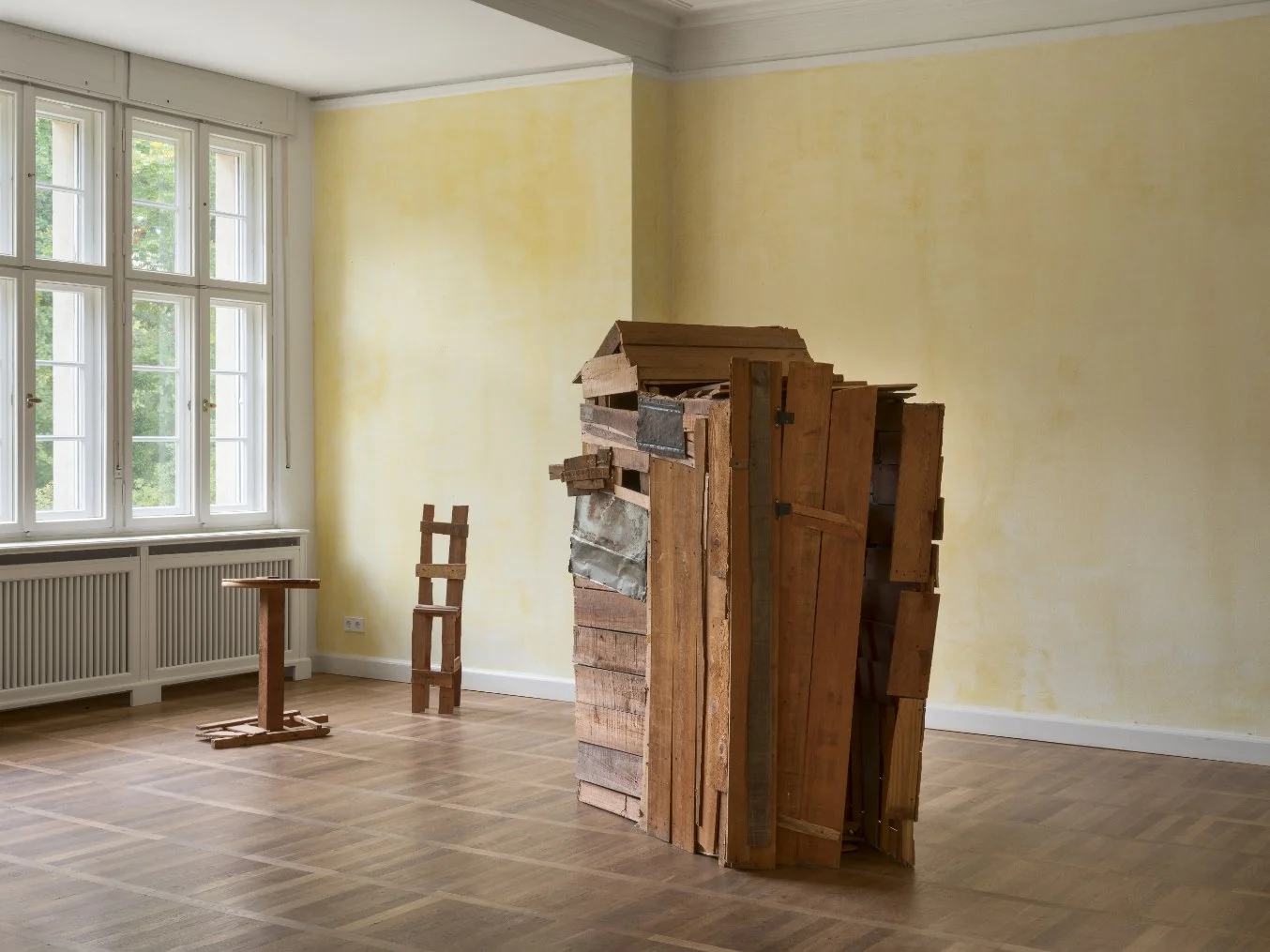
Standing a block away from the last stop of the U3 at Krumme Lanke, Haus am Waldsee, a beautiful residence turned art museum, sits by the Zehlendorf quarter’s local lake, or Waldsee. Haus am Waldsee is the only property on the lake where all visitors are free to access the water, a facet of the institution deeply in line with the ethos of the late Beverly Buchanan’s work. For her “shack” works, Buchanan regularly trespassed onto the grounds of these structures of Southern American vernacular architecture for photos and inspiration, coming face to face with many upset, disgruntled, and irritated homeowners, but also new friends. In this regular practice, she met Ms. Mary Lou Fulcron, a woman who had built her house and lived alone. In an excerpt of the artist’s writing, Buchanan shares how she helped carry logs for Ms. Fulcron, and her challenge of ingratiating herself with an isolated black woman in Georgia, a challenge that had become a regular exercise for the artist. From her brief diary entry pinned up in the show, Ms. Fulcron meant a lot to Buchanan. A woman of endurance, who, when hospitalized, escaped back to her house on foot, ten miles away, scared something would happen to her home.
These are the stories Buchanan saw in every shack she came across, with many of these structures being somewhat-restyled slave cabins. She saw power, endurance, and survival in each and every one. When speaking to curators, Beatrice Hilke and Pia-Marie Remmers told another story of Buchanan entering a home at night without a roof. All she wrote about was how clear the stars were. She never came to a home with judgment, critique, or patronizing worry; she came to these homes as if they were art objects—monuments to those who live and have lived in them.
Beverly Buchanan
Three Families (A Memorial Piece with Scars) [with legend], 1989
Print on paper
10 x 23 cm
Courtesy of the Estate of Beverly Buchanan and Andrew Edlin Gallery
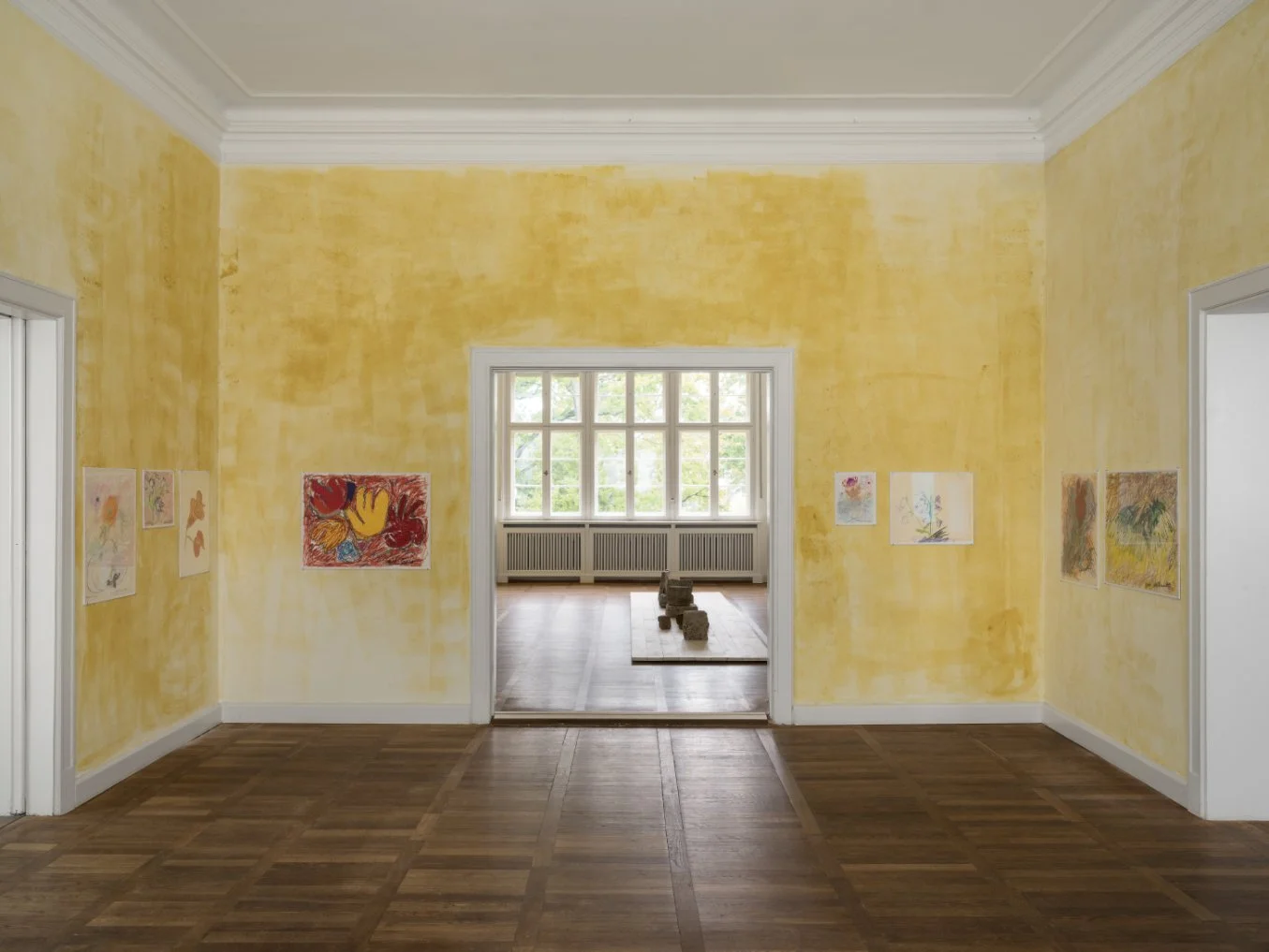
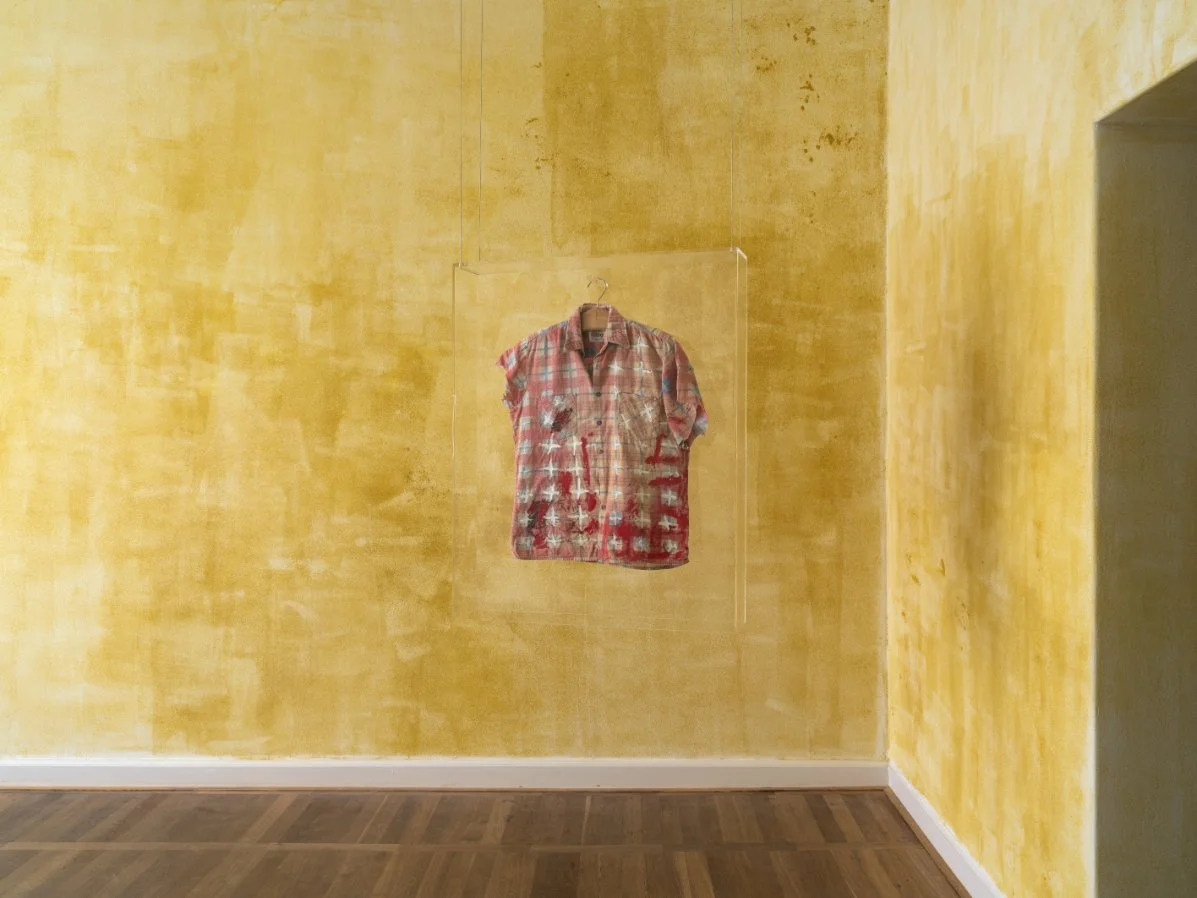
Ima-Abasi Okon made two accompanying works to the show. The first involved lockboxes outside the premises that take visitors to the lake and onto the private property around the museum. In these lockboxes are lube and organic materials. Lube is a substance to bring an object into a space where it does not belong. With its sexual connotations, the interaction between foreign object and intruded upon space can be procreative and pleasurable, referring to Buchanan’s trespassings and their paramount role in her practice. The other works Okon made were wall paintings covering every inch of wall with pollen. Titled Sex (2025), the walls are streaked yellow, bringing the materiality and smell of the outside inside. Here, Okon submits the walls to environmental degradation, a frequent technique of her more labor-intensive sculptural works. With a title like Sex, Okon also propounds this feature of her work as similarly pleasurable and procreative.
A common misconception of Buchanan’s oeuvre is that she is an outsider artist. However, the artist had been exhibited at A.I.R. gallery alongside contemporary and friend Ana Mendieta and started out as an abstract expressionist under the tutelage of Norman Lewis. Buchanan was trained as an insider. Her works are of the trends of her time, land art, conceptual art, and post-minimalism, but her works have a D.I.Y. inflection to them. Her shacks, alongside her other wooden construction pieces, are undeniably in conversation with the folk art of the South. According to Buchanan, she always “made things,” never really understanding her creations as art objects until later. She began her professional life in medicine, studying parasitology at Columbia University, which brought her to New York, where she eventually connected with the Art Students’ League.
Beverly Buchanan,
Lamar County, GA, 2003
Oil pastel on paper
56 x 76 cm
courtesy of the Estate of Beverly Buchanan and Andrew Edlin Gallery
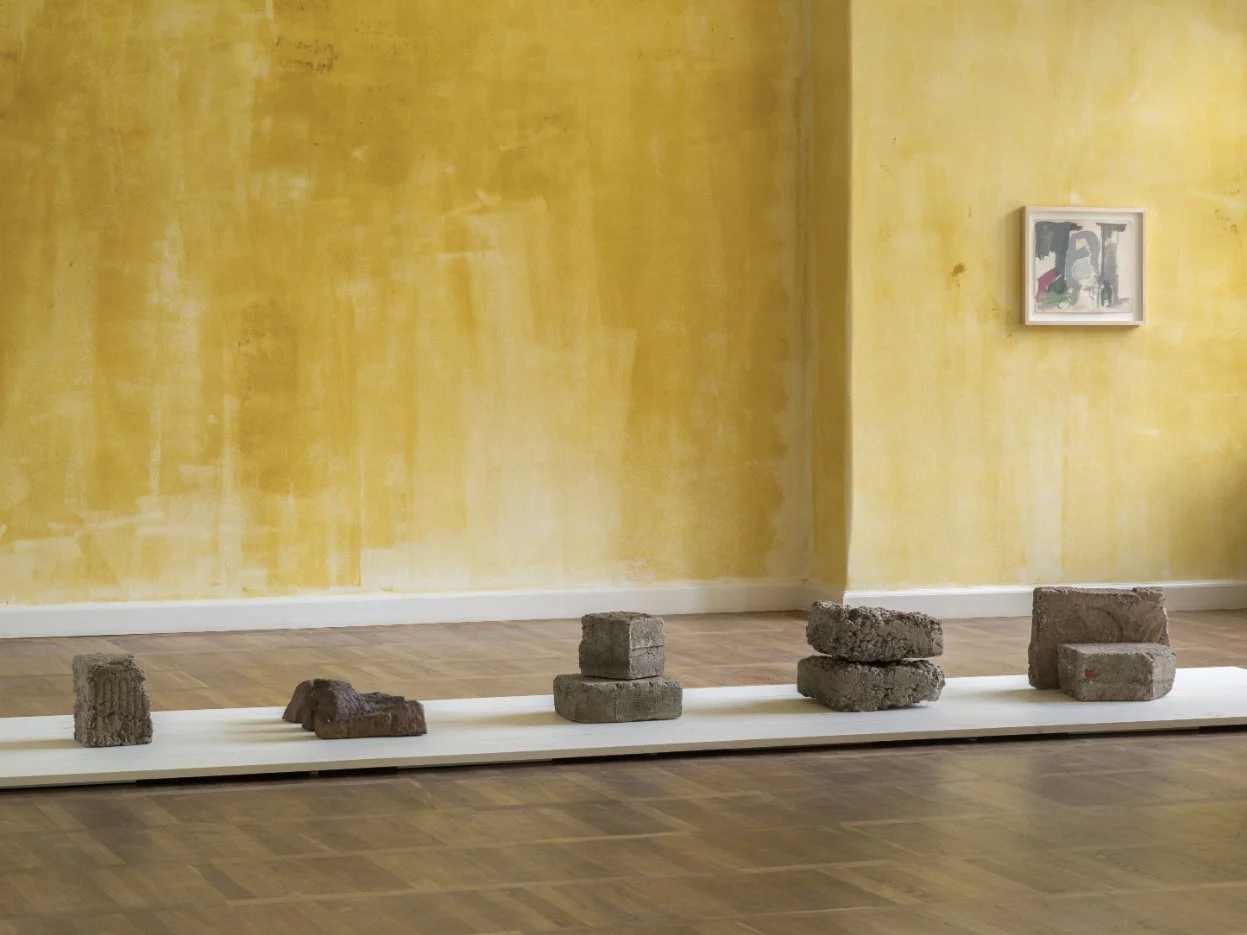
The artist suffered from several chronic illnesses, having stacks of medical bills to pay at any given time. To pay these bills, Buchanan sold many of her works for the exact prices of different bills, spreading her work across a plethora of private owners in and outside of Macon and Athens, Georgia. Hilke and Remmers, doing research in the state to prepare for this show, ventured into many homes only to find different Buchanan works on unassuming walls and tables. All of her flower works exhibited in the show came from these homes. The flowers were put together by Okon, offering a contrasting side to the artist, who, in adjoining rooms, has her still sculptural works. One such room includes her monumental frustula, cement sculptures whose molds she made from bricks and found materials like milk cartons. The frustula works, while many being of different cement mixtures, all have a timeless, enduring quality—shaped by time. The flowers, on the other hand, are electric. Quick, loose-colored scrawlings across paper build up a shape that could be called anything but still lives. Her shack pastels have an identical effect. Often exhibited with the shack sculptures, the curators made the decision to show the pastels on the second floor, overlooking the sculpture garden. By separating pastels from sculptures, both mediums could stand autonomously, the curators prevent the unfortunate hierarchy that tends to favor the shack sculptures as the more prominent representations.
Beverly Buchanan
Untitled, 1978—1980
Print on glossy paper
20 x 25 cm
Courtesy of the Estate of Beverly Buchanan and Andrew Edlin Gallery
Beverly Buchanan. Weathering took a very gentle, nuanced approach to the wide-ranging work of Beverly Buchanan, permitting her work to breathe and soak up the space as individual works and as series, while simultaneously forwarding the artist’s massive archive. Buchanan had a rigorous documentation process—photos, writings, poems, and drawings—spread by the stairwell on the second floor, situating her ephemera as a prime feature of her practice. Her archiving instinct became of sizable importance to her Marsh Ruins (1981). For this land piece on the coast of Georgia, Buchanan built a memorial to the enslaved people who, once landed on American soil, raced to the water and drowned as an act of return to their homes. Funded by the Guggenheim grant, Buchanan worked with a few other laborers to make tabby stones that blend into the swamp landscape, becoming nearly unrecognizable as human-made objects. Shown as a slideshow, the recording covers the correspondence between the artist and the Guggenheim, the work proceeds through the day-by-day photographic coverage with supplementary captions taken by the artist to prove the project was completed. Although not necessarily Marsh Ruins, the work shown is an artwork in its own right, turning bureaucratic processes into a creative act. Beverly Buchanan. Weathering showcases a nuanced approach to Buchanan’s work, all while giving visitors a glimpse into her mind to reveal a singular person who stretched her art into every corner of her life.
Beverly Buchanan. Weathering is on view through February 1st @ Haus am Waldsee, Berlin.