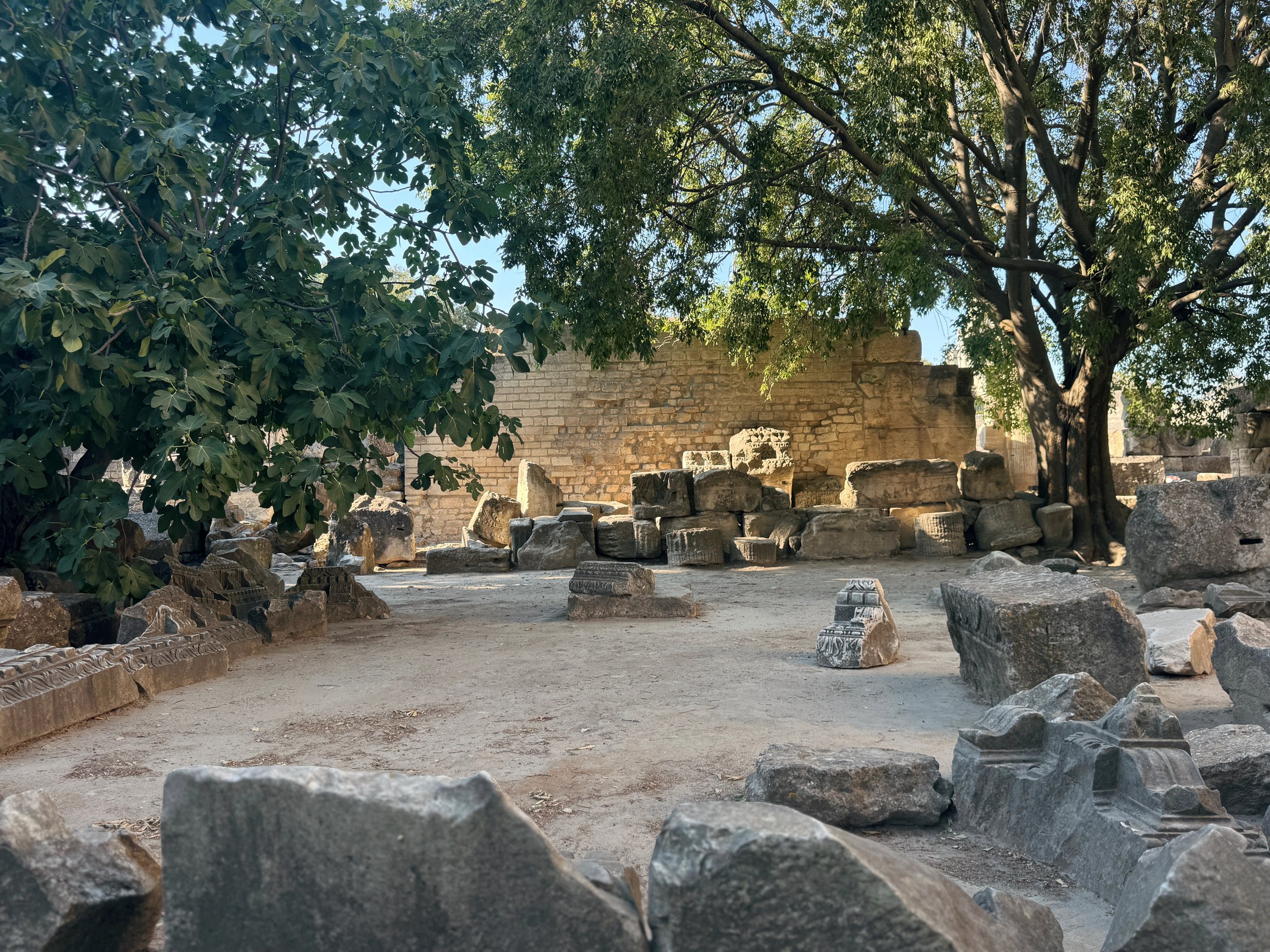
Eva and Franco Mattes, Half Cat, 2026. Installation view, Modèle animal: 200 ans de photographie, Rencontres d’Arles
text by Perry Shimon
A wash of cicadas in the canicule. I stand in the shadow of a Roman amphitheater in Arles, where I’ve arrived at the Rencontres de la Photographie to experience this most prestigious of international photography surveys. This year, a proposal I submitted on a twentieth-century Greek cabaret, founded by Giorgos Darzentas and Dorothy Moore, was presented as part of a celebratory event at the end of the opening week before moving to a gallery for the duration of the festival. My engagement with the organizing team has given me insight into this expansive event, and my interactions have been invariably gracious, attentive, and thoughtful, enlarging my appreciation for the effort that goes into a survey of this scale.
From the Giorgos Darzentas and Dorothy Moore Archive. Courtesy of SKETCH Gallery.
Along with the growth of the Rencontres, certainly bolstered by the formidable presence of the Gehry-fortified LUMA Foundation, there is an unmissable chorus of critics lamenting the changing spirit and increased presence of commercial galleries, exclusive events, and luxury brand partnerships. I am familiar with these dynamics, if less so with the challenges of producing something of this scale, and would offer that one of the Rencontres' many winning features—beyond its superabundance of visual art—is the fact that one can’t be too sure whether one would have had a better time at a collector dinner in a private villa or in the lively place with its vibrant and worldly community of photo enthusiasts. In fact, it is extremely difficult not to find oneself constantly marveling at images, learning about the world, and having pleasant conversations with interesting people. Provided, of course, you can find a bed and have enough time not to feel rushed and overwhelmed—an increasingly difficult and costly proposition.
Hu Weiyi, Erosion, 2021–ongoing. Film processed with the artist’s gastric acid, The Inner Darkroom, Rencontres d’Arles 2026.
Vigilance: Work Under Tension, installation view, Rencontres d’Arles 2026.
The scope of the survey this year is impressive and shows the extent to which artists and curators will go to offer something distinctive and unusual to the international audience. Chinese artist Hu Weiyi immersed exposed film rolls of natural landscapes in his own stomach acid, painfully extracted through his nose (as documented in the accompanying video), to make a "living chemical reactor" producing psychedelic prints enlarged to monumental scale. This work sat next to Vigilance, an exhibition celebrating industrial photography by the French electricity board, Électricité de France, and SODEL (Society for the Development of Electric Applications), commissioned for their titular magazine and featuring a delightfully high-modern photographic and design sensibility applied to workplace safety culture. These exhibits in the former SNCF train maintenance building-cum-gallery, adjacent to the Arles train station, are perhaps the first or last exhibitions visitors encounter, illustrating the festival's broad and colorful commitment to the capaciousness of the medium.
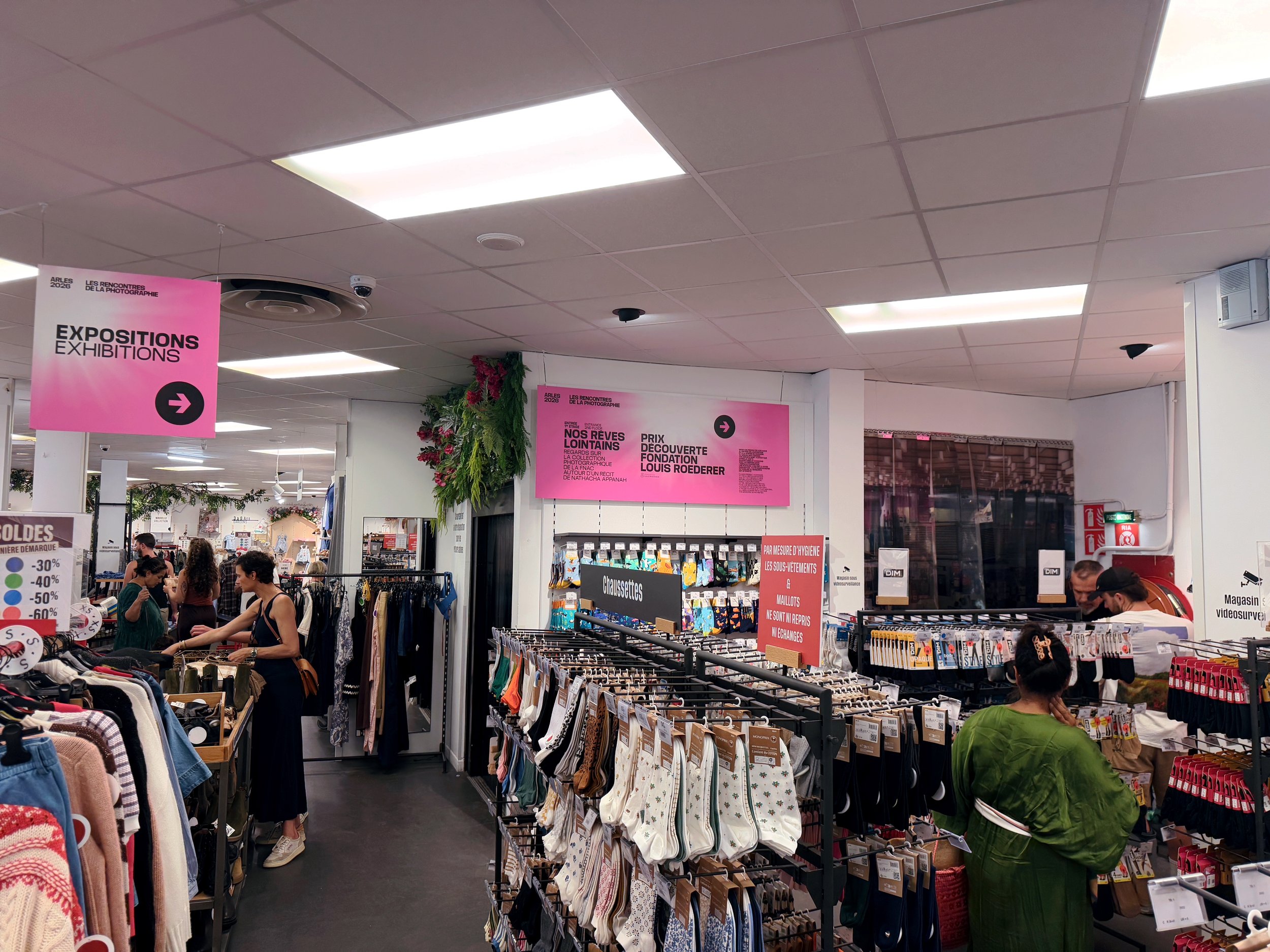
Nearby, on the second story of a bustling Monoprix department store, selections from the FNAC collection sit on view beside nominations for Le Prix Découverte de la Fondation Louis Roederer, including Jordan Beal's Polaroids of AI-generated images exploring the colonial histories of Martinique. I was amused to see art crowds walking through the Monoprix, getting distracted, browsing fast fashion, and buying GMO fruits.
Lech Wilczek, Simona Kossak with the raven Korasek, Modèle animal: 200 ans de photographie, Rencontres d’Arles.
This edition features many familiar genres and names: Harry Gruyaert’s bold color work, Martine Barrat’s European ethnography of the South Bronx, a range of unusual process-based works including notable presentations by Ming Smith and Meghann Riepenhoff, and large thematic surveys on broad subjects such as Ghana and animals. Some of the most lively sections for me were the selections of artist books, the book fair, and the Night of the Year, where some forty selected proposals were transformed into short videos that played during a celebratory performance before a selection moved into a nearby gallery. In the balmy evenings, crowds slowly trickled into a Roman amphitheater, where thoughtfully produced events engaging with photographic arts unfolded before keen and attentive audiences.
Pablo Saavedra de Decker presents the archive of his mother, photographer Marie-Laure de Decker, at the Théâtre Antique during Rencontres d’Arles 2026.
Throughout the festival, and particularly during the opening week, visitors proceed through a labyrinth of winding streets, churches, cloisters, museums, palaces, pavilions, and gardens, encountering the official selection, while nearly every available surface across the city is decorated with images. This offers a more interesting visual culture than the advertising and social media supersaturation to which we are accustomed, while remaining entangled with the logics and trends of the visual regime from which it emerges and against which it competes.
Verena Paravel, Delta, 2026. Film still detail, Cosmofonia, LUMA Arles.
Chatting with an arts administrator I met attending the concurrent Les Suds music festival, after Clémence Gabrielidis' Sapphic exploration rendered in reimagined rebetika—looping processed vocals and musical phrases in the crepuscular evening light at the Musée départemental Arles Antique—our conversation turned toward LUMA, which she conceded certainly commissioned impressive art but was perhaps more interested in what artists can do with more modest means. I had been expressing enthusiasm for Verena Paravel’s sensory documentary on the ecology of the Camargue, where she embedded herself with a range of scientific recording instruments deployed with extraordinary poetry. These themes were picked up by Pooya Abbasian, in a nearby exhibition at the Lee Ufan space, where a similar attention to the local ecology intersected with nearly extinct animist myths from the region that somehow survived Christianity’s anthrochauvinism.
Grégory Dargent performs Soleil d’Hiver combining oud, electronics, magnetic tape, and projections at the École nationale supérieure de la photographie, Les Suds à Arles, 2026.
The flourishing of summer festivals in the region was an inspiring reprieve from the austere and increasingly fascist cultural context of the States, with its small cadre of market actors. As the opening of the Rencontres cross-faded into the ebullient world music festival of Les Suds, I encountered Grégory Dargent, whom I had last seen performing a powerful personal work of photography and processed oud at Café Oto in London, and had the pleasure of hearing an evolved version at the local art college. Both Clémence and Grégory are extraordinary musicians, and I couldn’t, while enjoying their brilliant performances, shake a sadness that perhaps the neoliberal artist is one who travels alone and makes the work of a community by themselves, slowly accumulating loops that seem to both echo and determine the limits of a sociality receding quickly from this conception of music. Cyborg troubadours salvaging diminishing syncretic cultures, swallowed by technology, progress, efficiency.
Ecology—or perhaps ecology as a lens through which everything else was refracted—was the dominant theme of my visit. Most inescapable was the punishing, record-breaking canicule that settled over southern France, becoming the larger medium through which the many ecologically themed exhibitions were experienced.
Camille Henrot, In the Veins, 2026. Film still, LUMA Arles.
At LUMA, Camille Henrot’s In the Veins was among the strongest works on view, a masterful meditation on solastalgia, or the grief of living through ecological loss while raising a child, much of it unfolding within a gorgeous, spacious, light-filled Manhattan high-rise apartment. The film is tender, emotionally and stylistically precise, imagining childhood as a space still populated by abundant animals and livable ecosystems even as those things disappear. Yet it is also emblematic of where many of LUMA’s most ambitious exhibitions ultimately arrive. They lavishly render the affective dimensions of our contemporary condition while stopping short of naming the economic relations and political systems responsible for producing it, let alone orienting viewers toward any coherent alternative political horizon.
This hesitation may not be incidental. Like the pharmaceutical fortune that underwrites LUMA itself, the institution excels at managing the symptoms of crisis—cultivating reflection, care, and aesthetic intelligence—while remaining largely silent about the structures that generate the illness in the first place. The result is a cultural practice of extraordinary sophistication that often feels more committed to diagnosis than transformation, when it is not simply celebrating technological innovation, art-inflected amusement park rides, or immersive spectacles calibrated to the social media economy.
Philippe Parreno, Danny, 2026, LUMA Arles
Across the hall from Verena Paravel’s Delta, from her Cosmofonia series, Philippe Parreno’s Danny unfolded according to its own internal logic. Governed by an array of sensors and its eponymous artificial intelligence system, it read the space and its inhabitants, responding with videos, lights, images, prepared piano, sliding doors, and intermittent performances conceived by Tino Sehgal. The installation produced an algorithmic choreography, continuously determining the movements of bodies within the space. A friendly docent informed me that Danny was feeling “exceptionally generous and friendly” that day, and that the proceedings had something to do with cleansing one of my chakras. Moments later, one of the performers led me by the hand out of Danny’s sovereign installation and into the bright atrium housing Carsten Höller’s giant, infantilizing slide, overseen by two spectacularly bored-looking art workers.
Clément Cogitore, Memory Palace, 2026, LUMA Arles
Perhaps my favorite work of the Rencontres, or at least a work I revisited several times, was a film by Clément Cogitore called Memory Palace, made from anonymous vernacular home movies that accompanied a polyphonically performed passage of compiled and sometimes modified texts expounding on memory and history. It was an ambitious work—a protest even, against the “angels of oblivion,” of brutal history concerned only with power, and an imploring call for a “requiem for peace.” The work amassed poetic and philosophical fragments in a distinctly Enlightenment register, still saturated with Christianity, performing a God’s-eye perspective on the great sweep of European history. Lines like “When I say we, I mean everything that lives,” and “It took him seven days to make, not one more… I would have taken a day or two more,” accumulated with the force of a sermon over sensitively selected scenes from amateur family movies, lightly augmented with AI. The blend is fascinating: grandiose and prophetic pronouncements alongside extraordinary sensitivity to quotidian imagery overlooked by history.
Clément Cogitore, Ferdinandea, l’île éphémère, 2026, Mucem, Marseille
I curiously continued on to visit Cogitore’s contemporaneous exhibition in Marseille at MUCEM, a thoughtful exploration of a volcanic island that emerged suddenly from the Mediterranean in the first half of the nineteenth century, briefly igniting scientific speculation and geopolitical turmoil before disappearing again into the sea. It had Cogitore’s now familiar style of rangy bricolage, voice and image, plural openness to various and emerging media forms, a writer’s steady hand, temporal promiscuity, and an abundance of poetic, philosophical, and ethical open questions. It was a bit challenging for me to focus on the broad scope of speculative geopolitical stakes, myself recently emerging from the Mediterranean and surrounded by the ebullient Marseille crowds.
DIE ZAUBERFLÖTE by Mozart, Stage direction and video: Clément Cogitore. Festival d’Aix-en-Provence 2026 © Jean-Louis Fernandez
I learned that the polymath Cogitore had also directed Mozart’s The Magic Flute for the coinciding performing arts festival in nearby Aix, which I attended as well. I again recognized Cogitore’s magpie aesthetics: vernacular and popular images presented with centrally placed subtitles—an interesting signature that unsettles the usual hierarchies of image and text. It was an ambiguous staging set in twentieth-century post-war Europe, with Sarastro as a blind man surrounded by a chorus of scientists in an opaque and fluorescently lit orthogonal scenography. It felt constrained by Schikaneder’s bizarre libretto, with subtitles in both English and French, Mozart’s rather over-caffeinated music, and the range of child and adult performers—that, at two hours and fifty minutes, starting at 9:30 p.m., and in the midst of a canicule, was all a bit much. It was kind of like watching the accelerating Western repertoire overheat, sweating festivalgoers aggressively fanning themselves in the outdoor amphitheater while the usual violence, tragedies, and other familiar preoccupations dressed themselves up in different outfits.
This Western repertoire, these tired, violent stories, are becoming almost unbearable for me. There is a dark, pathological fixation on tragedy running through so much of the inherited canon. Universal Pictures has just released Christopher Nolan’s The Odyssey. Look at the names: a director named after Christ restages another violent epic for a studio that calls itself Universal. Such extraordinary resources are deployed to maintain these ruinous stories.
I took my daughter, dreading the experience. When it was over, I wanted to console her, to prepare her for the thousand variations on these themes she will inevitably encounter, and to reassure her: this is not entertainment, my love. This is trauma. This is sickness. These are the stories and images of pathological violence that continue to dominate the cinemas of nations still capable of astonishing barbarity, greed, imperial ambition, and the terrorization of others. We keep returning to them as though they contain some indispensable truth about what it means to be human, mistaking repetition for universality.
After the initial thrill and spectacle of the photo festival began to fade, I felt a kind of dread coming over me. As if this prolific image world were some kind of necrophilic cult—a quantum one no less—in this palimpsestic city, troubling the stability of my subjectivity with glimpses of infinite collapsing superpositions, slivers of alternate worlds and recurring temporalities. At a certain point, I needed the plaza like water in the desert: its animation, smiling faces, running children, affectionate conversations, one elder gently touching the face of a friend, laughing together. The open markets, shimmering colors, the offerings simply representing themselves.
Of course, it’s more than a cult of the dead, this photo love; I know this. It’s a celebration of life, as I keep reminding myself, even if it comes with a sacrifice of the moment. It’s an education of sorts—for seeing and sharing, for occasioning these convenings.
We are in an interregnum, I hear—again? Still?—and technological determinism is the most decisive characteristic of this new hyper-mediated world. We’re awkwardly stumbling into this cyborg age, with human agency, animism, and ritual receding quickly. We surround ourselves with windows into what has been and what might be, still mirrors in the palimpsestic city, reflecting our myths and desires, affirmations and contestations, rendered in the technological parlance of our age of representational world-building: our image cosmos.
Each night, on my return to my host’s home, I walked through a narrow chemin where I invariably encountered a young man sitting in the pallid blue light of a computer screen, a faint, sickly sweet smell of vape smoke lingering in the air, and I wondered how much his image world shares a common ancestry with mine.
There is a passage in David Graeber and David Wengrow's The Dawn of Everything in which the authors observe that people have been moving over great distances since time immemorial to build temporary architectures for cultural exchange, and that the archaeological record suggests much of what they exchanged must have been social and ritual. I wonder, as I make my own seasonal pilgrimage to these busy confluences of ritualized aesthetics, what traditions I am helping to keep alive.