Hocketing the Apocalypse: LA Art Week 2026

Amanda Ross-Ho at Frieze

text and images by Perry Shimon

‘Not Frieze’ LA exclaims, as in the international powerhouse art fair that provokes the broad ecosystem response we’re now calling Los Angeles Art Week. There are 8 fairs this year, of which I will see half, and an incalculable range of offerings calibrated to the influx of international art energies.

The main draw appears to be the lively and decorated Los Angeles crowds, which clearly preoccupy the guests more than the wall art. The fairs, with their high-key lighting, tiers of exclusivity, and long rambling promenades, are an easy win for LA audiences who turn out en masse for the spectacle and remind us—with a high calculus of automobile logistics—how poorly suited Los Angeles is to easy and spontaneous social gathering.

Frieze

Earlier this millennium, waves of displaced and precarious artists decamped from NYC and moved to Los Angeles in search of softer climates and more affordable, larger workspaces. There was a momentary feeling of discovery and excitement that quickly gave way to the predictable surge in real estate prices and attendant gentrification patterns. I wonder today where the center of cultural gravity exists in North America—less for market figures, and more for artist scenes and spaces—and it remains an open question for me. I let myself be carried away by the week, and then beyond, and sit here now with my phone open, doing a kind of mnemonic forensics to reconstitute a vaguely coherent narration of the unfolding events.

The Hollywood Roosevelt Hotel

Yunji Park

Carlye Packer Gallery

Felix, the bungalowed poolside alternative art fair extended across several floors of the Hollywood Roosevelt Hotel, opened the proceedings and set an easy pace of socializing, art grazing, and scene clocking. Weaving in and out of modernist suites, I encountered notable presentations from Allesandro Teoldi with Marinaro Gallery and Erin Morris with EUROPA, beautiful and uncomplicated things producing pleasant feelings.

Julia Stoschek Collection at the Variety Arts Building

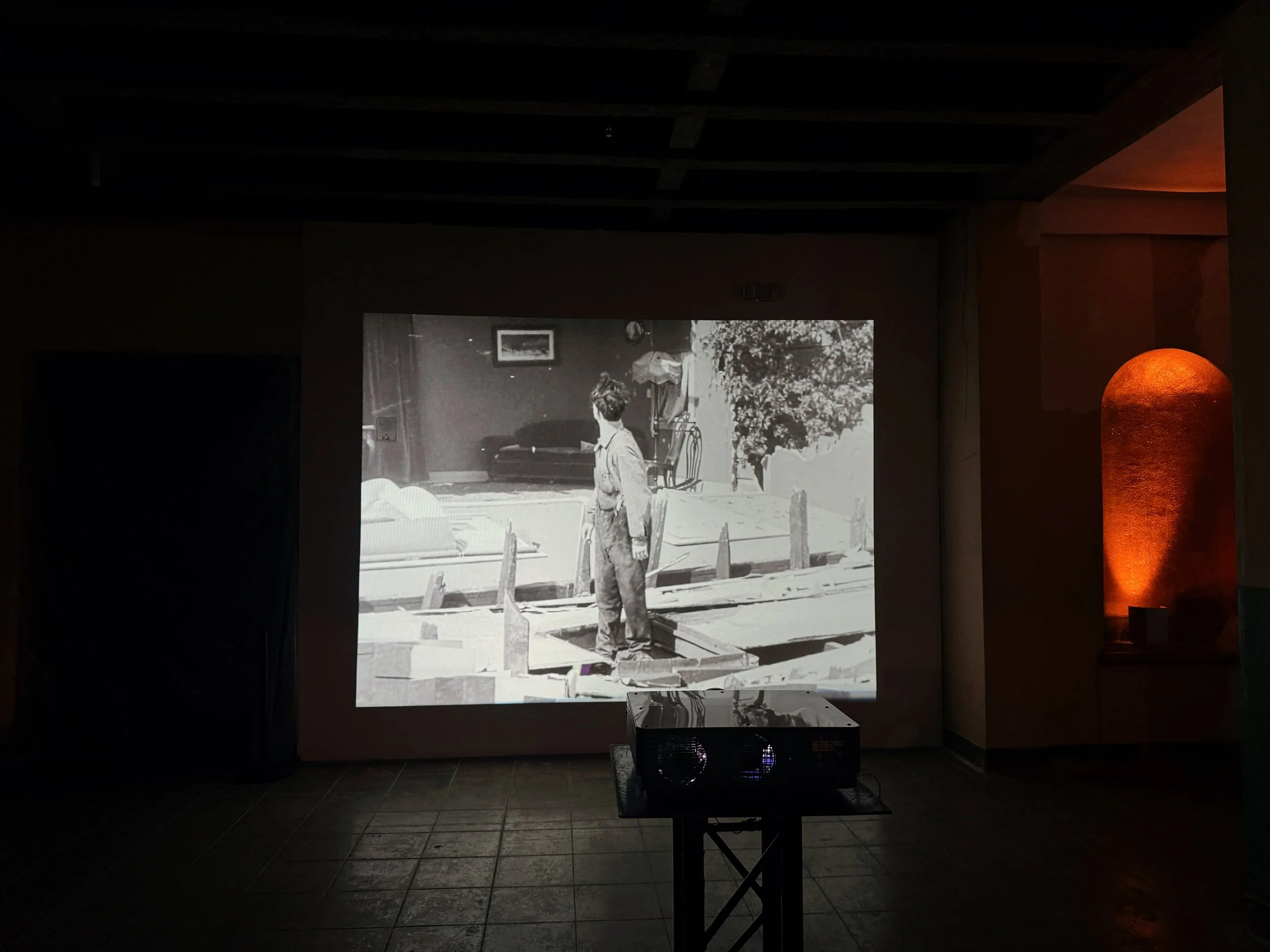
In the evening I went to what would be my first of three visits to the Julia Stoschek pop-up, who appeared to have fled the Berlin winter with a canonical collection of video art and installed what I heard billed as the largest such exhibition in US history, in the curious and dilapidated Variety Arts Building in the heart of downtown Los Angeles. The building has a fascinating history, initially constructed in the 1920s in a Renaissance Revival style to host the first women’s club in Los Angeles, with a grand auditorium for hosting performances and lectures, a library, galleries, and a banquet hall.
Buster Keaton

Cyprien Gaillard

Variety Arts Building

Anne Imhof

The knowledgeable docent at the entrance was offering historical overviews to the impromptu groups of guests gathered at the gratis popcorn counter. She informed us that after its life as a women’s club, the building became a vaudeville theater, underground punk club, rave spot, and then was bought by Justin Bieber’s megachurch, who brought it up to code and sold it during the pandemic. Fact-checking this oral history, I encountered the wonderful bigorangelandmarks.blogspot.com by local visual historian Floyd B. Bariscale, who documents historic buildings in LA, and encountered a lively comments section with contributions like:

Anonymous said...

MY NAME IS LONNIE HICKS. DURING THE YEAR 1980 I PROMOTED A VERY SUCCESSFUL DISCO IN THE BALLROOM ON THE FOURTH FLOOR ON THURSDAY NIGHTS ONLY. FOR TEN MONTHS I HOSTED PARTIES WITH SOME OF THE BIGGEST NAMES IN BLACK HOLLYWOOD .I TRIED VERY HARD TO ATTRACT A MIXED CROWD BUT IT NEVER SEEMED TO WORK OUT .SO WE WERE LABELED A BLACK CLUB. AT THAT TIME SEATING LEGAL ATTENDANCE IN THE ROOF GARDEN WAS 686 PEOPLE. MANY NIGHTS OUR ATTENDANCE EXCEEDED THAT FIGURE . THE ROOF GARDEN, IN MY OPINION IS ONE OF THE GREATEST BALLROOMS IN THE CITY. I FELL IN LOVE WITH IT FROM THE FIRST MOMENT I LAID EYES ON IT.I INTRODUCED MANY PEOPLE TO THE VENUE AND I USED ALMOST ALL THE BUILDING AT ONE TIME OR ANOTHER ; FROM THE THEATER, TO TIN PAN ALLEY, AND OF OFCOURSE " THE FABULOUS ROOF GARDEN". I WOULD LOVE ANOTHER SHOT AT PROMOTING THE ENTIRE BUILDING . I CAN BE REACHED FOR COMMENT OR INPUT ABOUT THE VARIETY ARTS CENTER AT 813-539-1965 OR AT TAMPASELESCT.COM

December 27, 2016 at 11:36 AM

LONNIE HICKS said...

HI, LONNIE HICKS AGAIN. I FORGOT TO MENTION THAT JAZZ GREAT AL JARREAU RECORDED A SONG ABOUT THE ROOF GARDEN BALLROOM TITLED, OF COURSE, "THE ROOF GARDEN .IT WAS RELEASED ON THE WARNER BROS. LABEL IN 1980 .BECAUSE THE ROOF GARDEN WAS DESIGNED BACK IN THE TWENTIES TO BE A BALLROOM DURING THE TIME IT WAS AS A DISCO IT WAS TOTALLY THE CLASSIEST ONE IN TOWN; WITH A CAPACITY MOST CLUBS COULDN'T COME NEAR.BOY, THOSE WERE THE DAYS !!!

December 28, 2016 at 9:47 AM

Our erudite popcorn docent was of the opinion this building should be converted into a long-term cultural center, and I agreed—keeping its rough-and-ready charm and availing itself to rotational curators doing seasonal evening programs of mixed-media art. And why not? How much tax money goes to subsidize sports arenas and Western imperialism instead?

Stoschek's collection contours the curious canon of ‘video art’, an imperfect category of moving-image art put into crisis—or at least into history—with the rise of mass visual culture in the age of smartphones and social media. If video art emerges no less as a space of visual experimentation outside the formal codes of Hollywood and corporate media than as a way to designate certain works of moving image as scarce and rarified, it all seems to be awash in the disorienting deluge of moving-image production that overwhelms the present. I couldn’t help wondering how this arbitrary and idiosyncratic canon of video art would be remembered at the cusp of a visual revolution.

Arthur Jafa

Robert Boyd

The forty-some-odd works on view across five floors were hard to neatly characterize—though violence, sex, and power were distinct leitmotifs. Robert Boyd’s four-channel Xanadu displayed a frenetic MTV-era montage of political icons, fundamentalist movements, doomsday cults, and escalating war over a pop score in the basement of the building, with an orbiting disco ball. A kind of Christian apopalyptic millenarianism that would be encountered again in Bruce Conner’s preceding Three Screen Ray on view at the Marciano Art Foundation, as well as in the infinite scroll of social media with its dizzying jump cuts of sex, violence, and pop music.

Bruce Conner at the Marciano Art Foundation

I encountered the sublime violence of Conner’s video works, monumentally installed and scored by Terry Riley, as a lilliputian war of American imperialism unfolded on my phone in streaming images, and I couldn’t wrest my eyes away—even driving down Sunset Blvd with its building-sized billboards advertising war films and luxury brands with deified and cosmetically sculpted celebrities. I began to feel as though art criticism has nothing to offer; nothing to elaborate on the unambiguous violence and horror of this country with its imperial realist aesthetic regime: coterminously streaming Al Jazeera and the US Dept. of War’s IG feeds as Tesla Cybertrucks surround me in front of Crypto.com Arena.

Outside of Frieze, on a manicured soccer pitch, a performance artist named Amanda Ross-Ho spent the duration of the fair rolling a giant inflatable earth, in an interpretive gesture I couldn’t help associating with planetary technocracy, geoengineering, and a global class of art elites for whom the world is theirs to play with recklessly like a children’s toy. Inside the fair was an incredible pageant of Los Angeles characters and a credible roster of collectible art.

At Marian Goodman, recently departed, Tacita Dean presented a collection of delicate chalk works, exquisitely beautiful and fragile drawings gathering chalk in gossamer gradations, collecting like weather and constellations, filigreed with fugitive fragments of poetry, salutations.

Nearby Wolfgang Tillmans shared his signature horizontalist, mood-board style of image-making neatly installed around the airy expanse of Regen Projects in Hollywood. A short looping video work in a back gallery, scored by Tillmans, circumnavigated a flowering wild carrot plant that seemed to contain the cosmos and announced the early Los Angeles spring: a teeming biodiversity region undeterred by automotive and anthropocentric impositions.

Wolfgang Tillmans

Wolfgang Tillmans

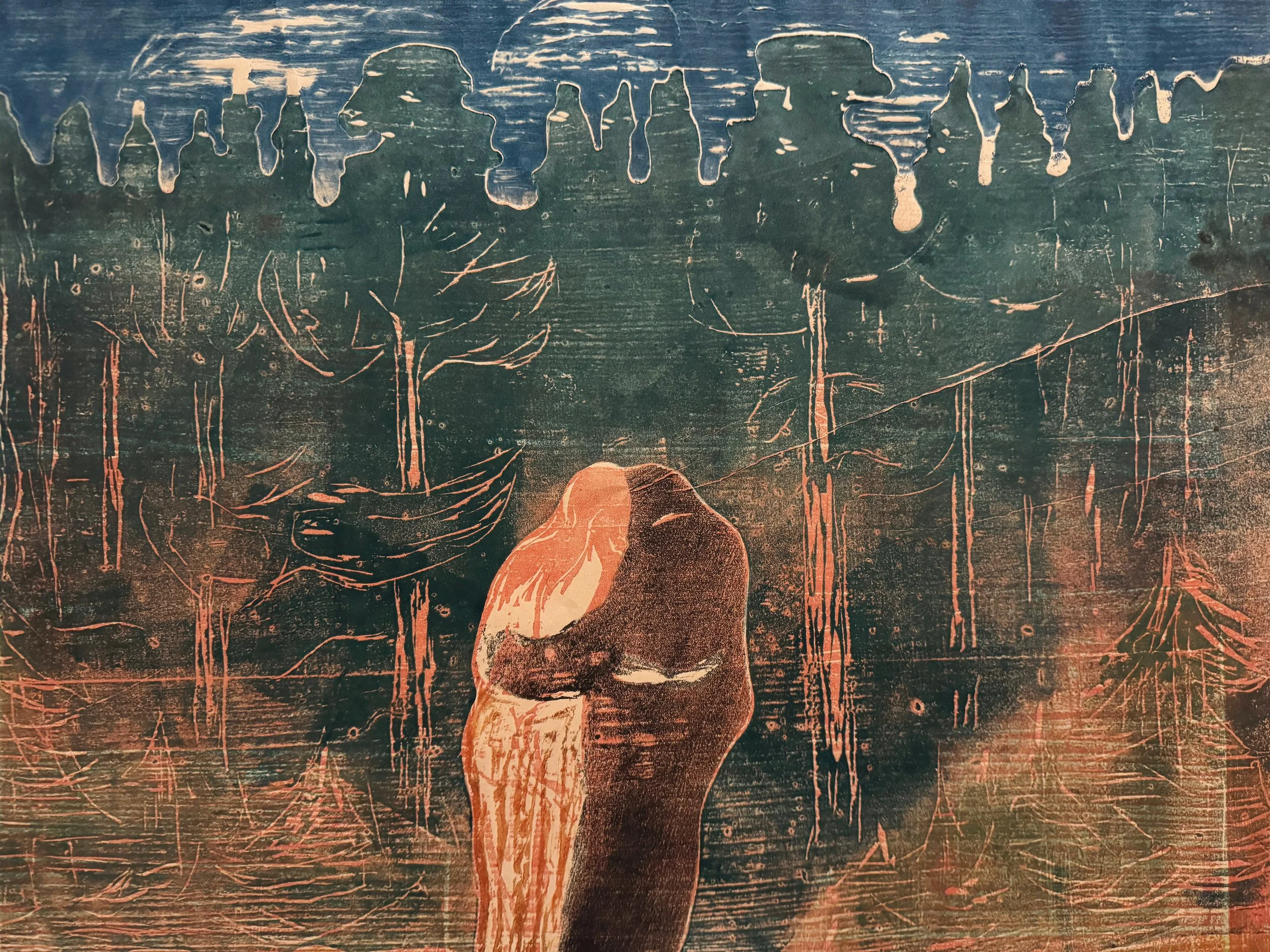
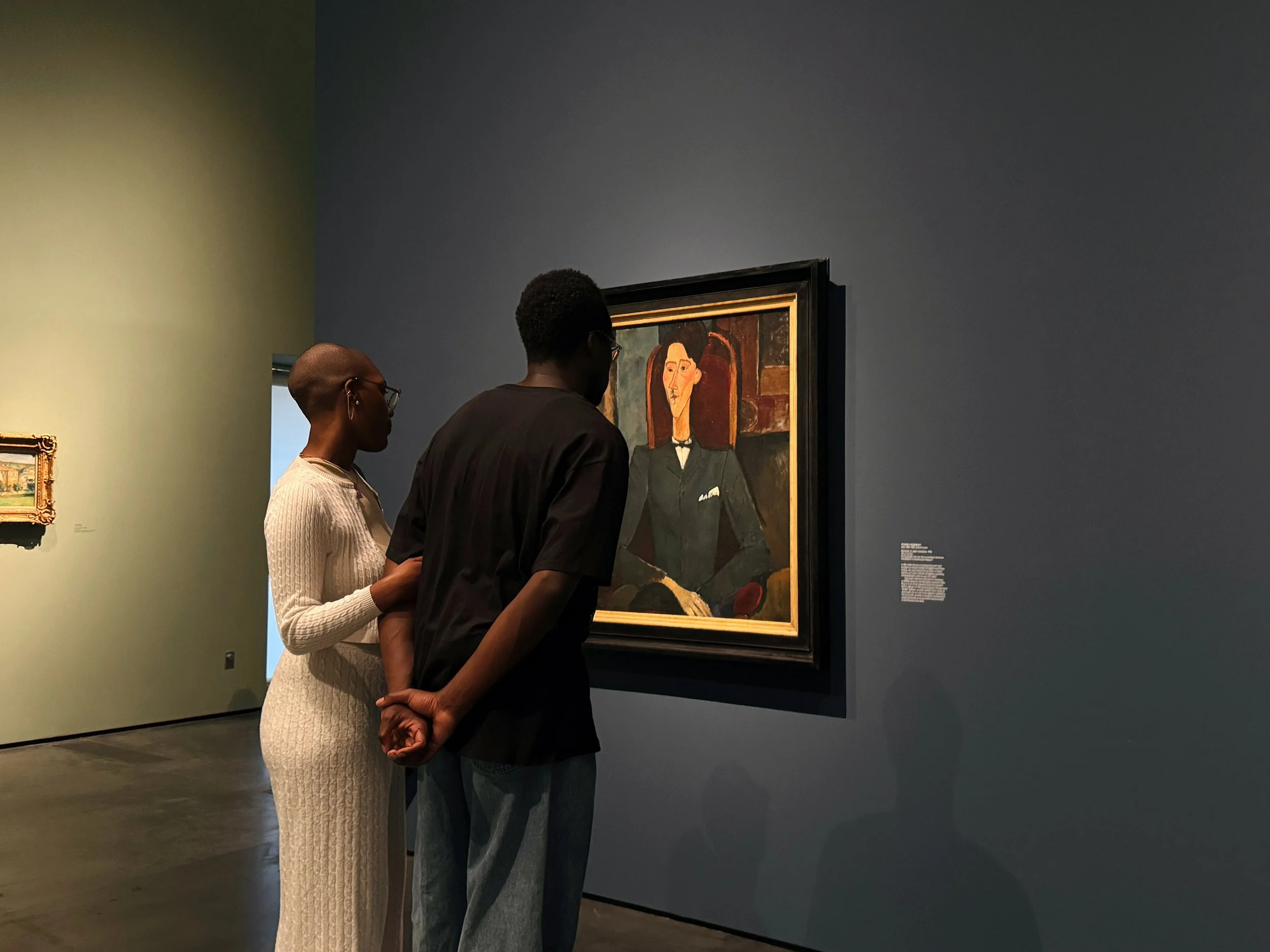
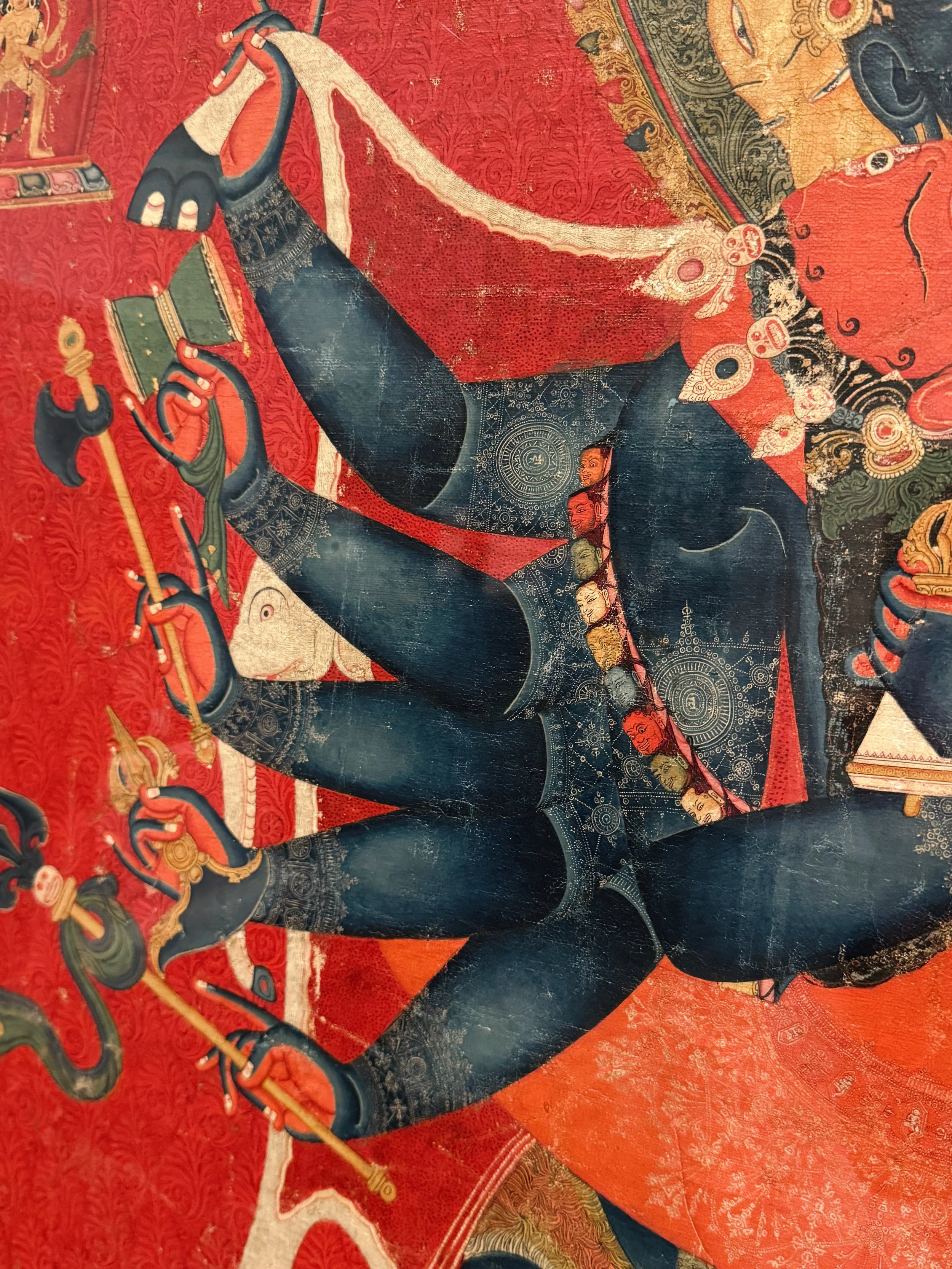
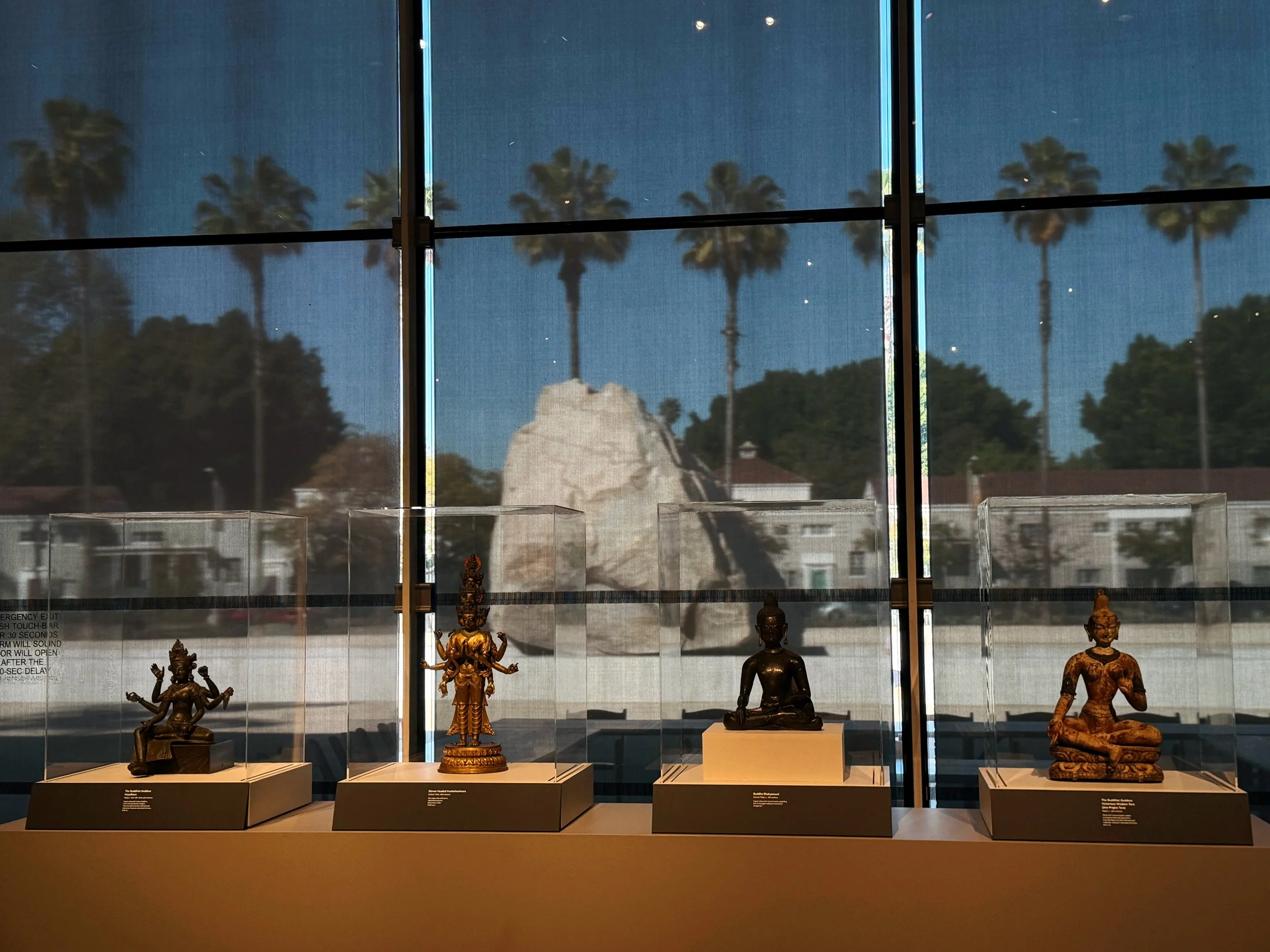
After all these small—and not-so-small—commercial offerings I ventured to LACMA to see some more historically rigorous and contextualized presentations. Walking past the open tar pits I came upon the sweeping modernist Geffen Galleries, still under construction, and traversing Wilshire with its grand curvilinear California modernist gestures. I spent some time with the Deep Cuts exhibition drawn from their impressive collection of block prints from around the world, and shows on Impressionism and Buddhist art, offering unexpected resonances and juxtapositions like a series of beatific Bodhisattvas perched in front of a symmetrical row of palms and Michael Heizer’s 340-ton granite megalith Levitated Mass

Edvard Munch

Modigliani

Detail of Chakrasamvara and Vajravarahi 15th century Tibet
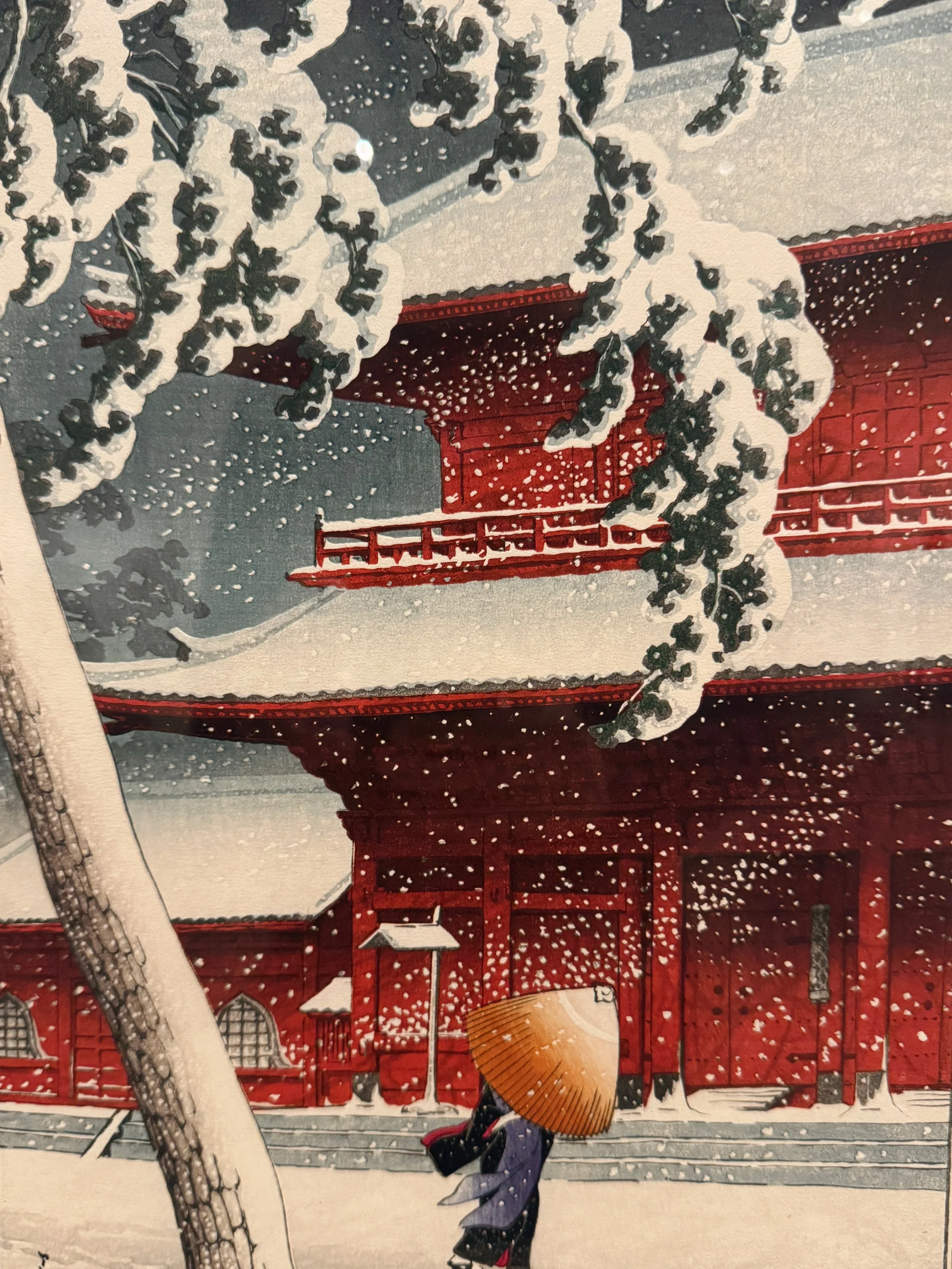
Kuwase Hasui
When making his 2000 debut Amores Perros, Alejandro G. Iñárritu left over a million feet of film on the cutting room floor. From this rejectamenta was assembled SUEÑO PERRO, a kinetic, smoke-filled cavern of multiple projections and cinematic machinery. The film assumes a quantum superposition as variations collapse in the ambulatory viewers, bathed and implicated in the recombining images. Its dually sculptural character: light extending materially through the haze and towering 35mm projectors like ouroboroi of flickering film, recursive and contingent.

A few blocks down along Wilshire were a trio of exhibitions housed in vacant properties owned by the same developer: a former Sizzler, an office building, and a 99¢ store—a kind of holy trinity of dystopian late-stage capitalism. The programming largely cleaved to each of the buildings' designated purposes. The Sizzler offered the kind of art popular in alternative art fairs: fast, unattractive, relatively inexpensive, and designed to produce simple palate-stimulating responses in its consumers. The office building offered a series of talks, panels, readings, PowerPoints, and other post-industrial forms of labor, slightly queered, Angelenosized, and performed in the drab and dispiriting cubicle and particle-board environs—picture attractive actors reading repulsive Paul McCarthy essays while guests sit uncomfortably in Great Recession-era office furniture. The 99¢ store offered a kind of anarchic, everyone’s-welcome free-for-all experience for maladapted objects and subjects, chaotic piles of capitalism’s overproduction and metabolic excretion.

I visited the Huntington for an early spring sakura and to see the beautiful tripartite Edmund de Waal exhibition 8 Directions of the Wind—after a line from a Bei Dao poem—rendering poetic stories of migration, diaspora, and exile with porcelain, poetry, marble, and burned oak. The installations and assembled libraries were interspersed across the flourishing springtime gardens and reflected quietly on quotidian ceramic practices inside the opulent architectures. Waal, descending from an aristocratic and oligarchical Jewish family persecuted by the Nazis, exhibiting the work in the sprawling pleasure grounds of a North American robber baron, produced an unusual setting for the reception of works informed by simple vernacular ceramic practices, or mingei; an uneasy migration between classes and cultural contexts that nonetheless rewarded close attention with the subtlety and poetry the works occasioned.

The impulse to escape into art as a palliative runs strong in horrifying times, and one finds little solace in the sun-soaked, hell-tinted, hypermediated LA art scene. Many conversations over the week centered on the elaborate social mechanisms of exclusion and affiliation that determine the social hierarchies governing the value of art in its institutional and financial inflections. These social rituals, in need of a dispassionate ethnography, eventuate in very idiosyncratic collections like the Stoschek and the all-night rituals of bacchanalian raves so popular with the same set. A student of both ancient Greece and the contemporary art world might notice the continuities between the mystery cults and the art world’s esoteric and largely inscrutable incantations, hedonistic dinners, and ecstatic late-night revelry.

At the former Masonic temple housing the Marciano Art Foundation, I attended a talk with the artist Una Szeemann, daughter of the late, storied Swiss super-curator Harald Szeemann, that centered on a collection of objects left with the estate when the Getty took his papers. Szeemann, a fascinating harbinger of an art world to come, was known for his indefatigable and idiosyncratic sprawling exhibitions anticipating our current vogue for superseding star curators and spectacularly scaled biennials. Una had curated a selection of minor objects, some taken from makeshift altars around her father’s southern Swiss Fabbrica Rosa estate, and presented them alongside thoughtful reflections from artists, curators, and anthropologists in a beautiful new library space generously featuring a browsable collection and modular furniture that rearranges to accommodate their public program. It had a kind of animist valence and invited speculation and meaning-making around these agential and talismanic objects.

Arriving at the Getty I encountered a descendant of Benjamin Franklin working at the gift shop and engaged in a rangey conversation about how the oil tycoon J. Paul Getty miserly installed pay phones in his home and about her practice of buying groceries for her colleagues’ undocumented relations who were afraid to leave the house on account of ICE raids. She was reading a book on the predominantly Black Sugar Hill neighborhood razed in the ’60s to install the I-10 freeway and went on to trace this kind of American racism back to George Washington, who, I learned from her, would rotate his slaves between Philadelphia and Virginia to avoid laws in the North granting them freedom after six consecutive months. I proceeded to a rather Manichaean-sounding special exhibition called Virtue and Vice: Allegory in European Drawing and found a suite of familiar and enduring ethical preoccupations. Describing the show later to a friend, I suggested they could have included a middle gallery—the size of the rest of the world.

Oh! If Only He Were Faithful to Me, Jean-Honoré Fragonard, 1770-75

Sitting in the Irwin Garden outside, I reflected on Jonathan Crary’s recently republished essay Robert Irwin and the Condition of Twilight, collected in the excellent Tricks of the Light, offering:

All of us within present-day technological culture inhabit a shifting mix of new and old perceptual modalities, of hybrid zones composed of Euclidean space and dimensionless experiences of electronic networks that often appear to be seamlessly connected. Thus even amid the fluctuating and unstable character of Irwin's work is a human subject who is still at least partially anchored within the enduring remnants of a Newtonian universe, even if these surviving components have been rendered contingent and spectral.

If the essay is astute in marking a shift into an increasingly indistinct virtual-experiential mode of seeing—if not being—and its attendant social parcellation, we are perhaps arriving at a time when these realms are no longer seen as dual and the visual takes on an agential role as it surveils and acts upon us, with increasing degrees of determinative automation.

Blinn and Lambert

At a new gallery in Chinatown, North Loop West, I saw a beautiful exhibition, another instance in a burgeoning—or perhaps continuing—Light and Space revival, from an artist collective Blinn and Lambert who darkened the gallery with large canvases covering the windows, with shapely apertures filtering warm light into the welcome cool calm of the gallery with the shifting sun. 35mm projectors set at 8:20-second (the time it takes light to reach Earth from the sun) and 60-minute intervals respectively threw cameraless pictures of light onto the walls creating a restorative and contemplative respite from the blazing sun and art-world velocities outside.

Meara O’Reilly and vocal ensemble

Solarc

Gathering a gift at the excellent Skylight Books, I chanced on a painful conversation between Maggie Nelson and Darcey Steinke about their respective surgery memoirs. I joined a new friend at the well-programmed 2220 Arts + Archives space for an evening of hocketing, or a staccato call-and-response vocal musical style popular in medieval Europe, central African vocal traditions, as well as corners of contemporary pop music, with LA composer Meara O’Reilly and her distinctly (and adorably) East Los Angeles-feeling vocal ensemble. The music felt fitting for an age of binary computational logic and stuttered along charismatically toward a higher-resolution but distinctly atomized kind of being-together somehow commensurate with our times. The following night we reconvened for the First Friday Flute Club gathering at the artisanal brewing new-music venue Solarc in Eagle Rock and enjoyed the company of a diverse cross-section of enthusiastic flutists sharing instruments, melodies, and fermented drinks.

Driving back to the Bay Area, the center of gravity for these new global technocratic shifts, I climbed the windswept arid pass, bracing my tiny 20th-century convertible against the Santa Anas, pushing it through the endless variable monocultures: grapes, cotton, citrus, almonds, houses. The absolute horror and putrefaction of the cow slaughter fields. A domestic dog split open on the side of the highway from a high-velocity impact with one of the innumerable trucks dwarfing me with their containers of terrible decisions and menacing spinning wheel-spikes.

La Simulación En La Lucha Por La Vida: Mexico City Art Week 2026

text and images by Perry Shimon

Over the ten years or so that I’ve been coming to Mexico City art week, it seems to have grown beyond what one can reasonably expect to see and make sense of. In the earlier editions, it felt as though there was a generous and loosely choreographed range of offerings that most guests largely experienced, and this provided a common frame that gave the proceedings a shared feeling of intimacy. The last several editions, however, have begun to produce that major-biennial feeling of anxious FOMO as events and invitations proliferate throughout the frenetic week. This feels a bit sad to me, as I used to regard my seasonal visits to Mexico as a balm to the usual anxious feelings related to trying to do too many things. I suppose this is largely a me problem—if a problem at all—and what I would like to offer in the following essay are some modest and affectionate reflections from a becoming-more-familiar tourist.

I arrived early enough to get settled in and have a limpia and a leisurely breakfast at the Zócalo. I love this limpia, or cleansing ritual, with all the sights and smells of the Indigenous healers beside the partially excavated Aztec ruins of the Templo Mayor, in the shadow of the grandiose Gothic Baroque Catholic church in the Plaza de la Constitución, on what was formerly known as Tenochtitlan on Lake Texcoco. The burning of rosemary, blaring conches, shimmering feathers—all a testament to an enduring Indigenous presence and culture. This beautiful ceremony activates the entire sensorium, plunging the participant into a sensual presence of deep attention, breath, and touch, while chimes and bellows dissolve you into a vibrational individuated state. Warm, herbaceous smoke fills the lungs, and cool, fragrant branches invigorate the body. I like to do this ritual upon arrival, just before departing, and sometimes after the ZsONAMACO preview.

PEANA Gallery

Patricia Conde Gallery

Material Monday, part of the generous extracurricular program organized by the Material fair, offered a coordinated set of bus routes around portions of the gallery circuit. It was a rather ambitious schedule, pretty much incommensurate with the slow social unfolding of each opening, and we made it to maybe half of the stops. A backdrop of largely forgettable paintings and libidinally charged, often BDSM-inflected objects and installations set the stage for the young and vibrant scene of international art crowds. A North American gallerist friend worried aloud about getting stopped at customs with some carry-on paintings that may not have been properly declared and informed me that last year the customs agents had Androids and slap-on-the-wrist fines, whereas this year it was iPhones, Apple Watches, Google Image searches, and an extra punitive zero.

I never quite got settled into yet another proliferating, ill-sized, generic Airbnb with IKEA-showroom furniture, faux-aged wall art, gratuitous Ganesh figurines, pallid lighting, cheap blunt knives, Amazon Basics plates, and an alphanumeric series of codes, lockboxes, and passwords. There’s a haze of pollution, undrinkable water, and structurally immiserated urban poor and rough sleepers, mostly left out of the otherwise extremely Instagrammable frame of the parts of Mexico City that art tourists, expats, remote workers, and hip affluent Mexicans have largely claimed—not necessarily in that order.

Inner Stage at Escuela del Ballet Folklórico

MASA Galería

There’s a kind of jouissance in playing spot-the-art-tourist, often found standing around in an ill-fitting, overly constructed, and colorful costume, looking transfixedly into their phone near some Michelin-rated eatery and largely oblivious to anything else happening around them. If sheer volume is any indication, someone at Michelin has fallen in love with Mexico City—or maybe someone from Mexico City has landed a senior position at Michelin—or someone has started bootlegging the Michelin signs. Whatever the case may be, you can’t go a block in Roma or Condesa without seeing a constellation of Michelin honorifics.

Enrique López Llamas at Salón ACME

The now oft-repeated synopsis holds mostly true: Maco is a tedious convention center filled with conservative art; Salón Acme is the most beautiful space and the most fun setting; and Material features the kind of art most resonant with the kinds of people who make these kinds of aesthetic judgments. This year, on account of Netflix buying out Material’s usual home on Reforma for an Immersive Stranger Things Experience, the fair moved to a soundstage in an adjacent neighborhood that responded with a smattering of anti-gentrification graffiti around the venue and entrance. Gentrification politics notwithstanding, the new location offered a welcome outdoor courtyard for convivial gathering between salon visits.

Material

Angela Maasalu at Tütar Gallery

Romeo Gomez Lopez

Sophie Jung at Copperfield

Tim Brawner at Management

While the deracinated, standardized, and financially motivated confines of an art fair hardly offer the context to meaningfully present and situate artists and their work, the pieces on view in this edition—and more generally among a generation of artists today—seem to illustrate some widely shared tendencies in a moment of post-industrial capitalism in the Global North. Broadly speaking, I would offer a sense of alienation from both production and meaning: deskilling, appropriation, and insular, memetic self-referentiality. I got the sense there was a kind of semiotic slippage or drift, vectorized in niche corners and chambers of the internet, devirtualizing in the gallery and congealing into ambivalent fragments of semiotic disintegration. This is, of course, not without moments of beauty, curiosity, humor, irony, and so on. I also found myself wondering whether the promise of relational aesthetics—with its de-fetishization of the art object and return to the ritual object or practice that reinstates social exchange—has somehow not been delivered in Mexico City art week. Several gallerist friends jokingly confessed they don’t mind losing money, really, because of how much they enjoy coming down and hanging out.

Taverna

Salón Acme

Salón Acme has gotten many things right, and its now overbearing success—with overflowing crowds and lines around the block—is perhaps a sign that the lessons learned there could be more broadly emulated and publicly supported. The grand, crumbling Porfirian architecture and courtyard, featuring a large open call of emerging artists, always offer thrills and diverse social energies across a range of convivial and aesthetic zones: restaurants and cafés, verandas and vistas for people-watching, libraries and bookshops, rooftop dancing, and art installed on nearly every surface in between. It invites the question: why don’t we have many more spaces like this, with this level of public programming? Why don’t municipalities support more projects like this? France offers some possible models, with venues like Friche la Belle de Mai in Marseille and 104 in Paris.

Tania Pérez Córdova at Travesia Cuatro

Graciela Iturbide at Fomento Cultural Banamex

Around the fairs, the Mexico City art ecosystem is on full display, offering a superabundance of institutional programming, satellites, events, artist-organized shows, performances, and historic architectures. Each addition seems to unearth and activate some overlooked or underexposed modernist architecture with art installations or contemporary design objects. This edition, I went to the Pedregal neighborhood to see the Casa Alonso Rebaque home designed by Félix Candela. Last year, I went to a performance at a Barragán estate inaugurated as a cultural institute, and the year before enjoyed beautiful tours of the Juan O’Gorman–designed home and studio of Nancarrow and the home and collection of Mexican architect Pedro Ramírez Vázquez.

I arrived early at the new crown jewel of Chapultepec Park, LagoAlgo, to see an exhibition by the London-based collective Troika, who converted the picturesque gallery into bands of RGB-tinted conceptual explorations of machine seeing and increasingly automated, algorithmically determined futures. Stills of eco-disaster captured on CCTV monitors—the collective noted there are 500 million of such cameras globally and growing—were meticulously painted at pixel resolution, while trembling plants sprouted from piles of silicon and salt around the gallery. A large monitor intersected the space with a CGI-rendered KUKA robot twirling a mane of virtual hair balletically atop a green-screened timelapse of climatological fluctuation. A haunting choral score stretched a lightly remixed line from a Rumi poem—“a drop in the ocean, the ocean in a drop”—into different permutations. Eva and Seb, two-thirds of Troika, shared that they were interested in the way certain animals, like dolphins and wolves, compress meaning into concentrated semiotic calls delivered across great time and space, and we considered what relation this might have to our packaged transmission of data through the internet. The conversation took a fascinating turn into the crystalline structures of modernity and a longue durée technological history of orthogonal logic. I believe Seb at one point suggested a kind of conspiracy of flint rocks, silicon, salt, and even mathematics in dominating the organic world—which, actually, makes a lot of sense to me. I found Troika’s work compelling for showing the similarities between art and science, as they are both largely lens-based partial epistemologies often co-engaged with metaphysical and ontological considerations and decidedly committed to our technological moment of massive planetary sensing: a moment that empirically demonstrates the severity of our polycrises, yet can only seem to find ways to profit from them, while the energetic costs of mounting planetary surveillance reinforce a downward ecological spiral.

Walking out of the gallery back into the grand architecture of the museum café and looking out onto a terraformed lake—what was once a natural lake—alongside a private tour of Northern collectors and art administrators that prompted my friend to mutter “Mar-a-LagoAlgo,” was a somewhat grim, if tastefully tisane-palliated, reminder of how unevenly these climatological experiences will be distributed in our unfolding future.

José Eduardo Barajas’s La Blanda Patria

I went downtown to see the large group show Columna Rota (Broken Column), curated by Francisco Berzunza around the theme of rejection, borrowing its title from Frida Kahlo’s 1944 self-portrait with an Ionic column in place of her spine, made during a period of surgery undertaken to overcome a debilitating physical injury. It was a bold curatorial gambit to foreground feelings of inadequacy in framing a rangy exhibition of some 150 loosely related international works. Many of the individual pieces overcame the curatorial determination on their own terms and complexity, and I found myself thinking over the coming days about the role of the curator in an art world of increasing bureaucracy and professionalization, and the restructuring of value toward those who control the vectors of circulation. I also found myself wondering what more structural concerns might be established and staked to link the disparate works on view.

Tamiji Kitagawa’s Two Donkeys

Araya Rasdjarmrearnsook’s Pray, Bless Us with Rice and Curry, Our Great Moon

Approaching the show, I felt small soap bubbles popping on my skin and learned they were made by Teresa Margolles using a solution employed to wash the dead in Oaxaca. We encounter José Eduardo Barajas’s La Blanda Patria, a mural installed in the ceiling before the start of the exhibition, and are then treated to a broad survey of works, with highlights including Tamiji Kitagawa’s Two Donkeys and Araya Rasdjarmrearnsook’s Pray, Bless Us with Rice and Curry, Our Great Moon—two works suggesting a more-than-human conception of rejection and overcoming. The show ended with a small comet study by José María Tranquilino Francisco de Jesús Velasco Gómez Obregón—or Velasco, as he is commonly known—whose work was contemporaneously enjoying a beautifully conceived retrospective at the nearby Kaluz Museum, housed in a restored and transformed viceregal hospice.

The Garden of Velasco at the Kaluz Museum draws from a collection compiled and acquired from the artist’s great-granddaughter and includes over 2,500 previously unseen paintings, notebooks, sketches, letters, manuscripts, books, and objects. The exhibition assembled from the archive is extraordinary in both selection and museography, and contours a brilliant polymath artist alive to his time in a critical, contemplative, self-reflexive, and ecological register. His journals, palette, and early experiments with photography provide beautiful insights. Taken in aggregate, the work rigorously engages a fraught modernist romantic regime emerging with its many internal conflicts and paradoxes, alongside enduring legacies of the construction, subordination, and instrumentalization of Nature.

UNAM’s MUAC galleries, ever a discursive force in the Latin American art context, offered a suite of compelling presentations, including an exhibition on Mexican collectives invited to the 10th Paris Young Artist Biennial in 1977 to show their aestheticized political work—perhaps a timely revisiting of this history in light of the recent documenta’s focus on the collective form—as well as the contradictions and tensions that emerge from exhibiting embedded, politically oriented collective practices within the European biennial format and the larger neoliberal context.

Los grupos y otras

Alongside Los grupos y otras, there were presentations of Marta Palau’s earthen textile, wooden, and ceramic works, and a large site-specific installation by Delcy Morelos, titled Womb Space, submerging the viewer in a chamber of fragrant earth. As surprising and pleasant as it was to encounter, I couldn’t help thinking of Jainism and how it might regard this work. Their sophistication of ecological awareness and ethics is so refined that they won’t harvest and eat allium vegetables so as not to disturb the microorganisms and surrounding insect life. It also evoked for me a kind of extractivism difficult to reconcile with the maternal invocations, and made me wonder about the labor and ecology of this presentation, as well as our implication in various forms of extractivism—for the purpose of making beautiful art installations, or mining the rare earth minerals needed for me to write and share this review.

Marta Palau

Delcy Morelos

The telluric theme ran through the Tamayo Museum, newly helmed by Andrea Torreblanca, who curated the gorgeous Archaic Futures exhibition in the downstairs galleries. The framing was both light and grand in its invocations of universals, archetypes, and cosmos, assembling, with high modernist elegance, a suite of recurrent natural motifs and sumptuous abstraction. In the airy atrium, now dedicated to relational art, appreciative visitors rested in a lattice of sweeping, undulating hammocks—a thoughtful and welcome reprieve from the art week’s velocities.

Archaic Futures

An artful highlight of the week, in the somewhat ironically named Arte Abierto space in a posh mall in Pedregal, was the painstaking, fragile, and menacing Temporal Advantage installation by Mauro Giaconi: a life-size ship made almost entirely from paper, graphite, and silicon, installed in a rooftop white-cube gallery. The impressive and beautiful work, compiled from thousands of sheets of paper—each skillfully rendered in graphite to evoke patinated metal—constructs a stalled, precarious, and ominous vessel filled with secrets, questions, and paradoxes. Upstairs, growing on the deck, was a garden made from machete blades; downstairs, a kind of galley kitchen with steaming pots resembling bomb equipment. One hidden real tin can sat on a shelf of paper ones, containing instructions for how to make a secret chamber in the base of a can to smuggle correspondence. A single book placed on the floor beneath a paper bunk bed was titled: La simulación en la lucha por la vida. 

Casa Wabi and Kurimanzutto offered case studies in beautiful architecture squandered on the presentation of overvalued individual artists. Meanwhile, the cheeky Purimanzutto popped up in a historic gay club and offered a lighthearted exercise in the radical subversion and reappropriation of a rigorously oppressive—if not contiguously gay—variation of Christianity, with campy, queered iconography and crucified Jesus disco balls adorning crowds of working-class local youth singing and dancing along to reggaeton anthems.

Guadalajara90210—whose 2019 Pabellón de las Escaleras 100-artist group show in an open-roofed building under construction in the Santa María neighborhood remains one of my greatest memories of Mexico City art weeks past—presented a sprawling forty-some-artist group show in their new space, alongside a solo presentation and a concentrated version of their last exhibition in a smaller gallery, combining small sculptures formerly stretched around the circumference of the gallery onto three shelves of densely wonderful works. Their plural, playful, social, and distinctly Mexican modernist approach to exhibition-making has made them beloved scene-makers in the flourishing Mexico City and Guadalajara milieus.

Joshua Merchan Rodriguez

Some of my favorite artistic interventions occurred at the infrastructural level. The dedicated public bus lanes that speed past gridlocked individual automobile traffic are a marvel of relational aesthetics. Parque México is a near-perfect and democratic achievement of social art that should be reproduced as widely as there are neighborhoods. Sitting in the central plaza, where every generation lingers and plays, and wandering the meandering paths filled with more-than-human life, I feel a sense of hope and contours of the otherwise.

Sunday dance group in the plaza

On my final night, I found my way to a deconsecrated church where the brilliant visual ethnomusicologist Vincent Moon had installed himself, with the help of local event producers Love Academy, for a twelve-hour durational live performance and mix of his thousands of music films produced around the world with ritual and devotional musicians. His approach felt shamanic and reverential, and I was moved to tears lying barefoot on the lushly carpeted and cushioned floor with an intergenerational audience enthralled by the sonorous beauty of our world’s diverse cultures and art forms. After the performance, Vincent stayed around, giving hugs and answering questions about his practice and equipment. He shared his humble thanks to the artists he has met and tenderly portrayed, and noted that all of his films are available for free for anyone to watch on his website.

The next morning, a final limpia and a return, fortified with beauty and ritual, to a dark and depraved, terrorizing Trumpian North America.