
Courtesy of Christopher Wool
text by Emma Grimes
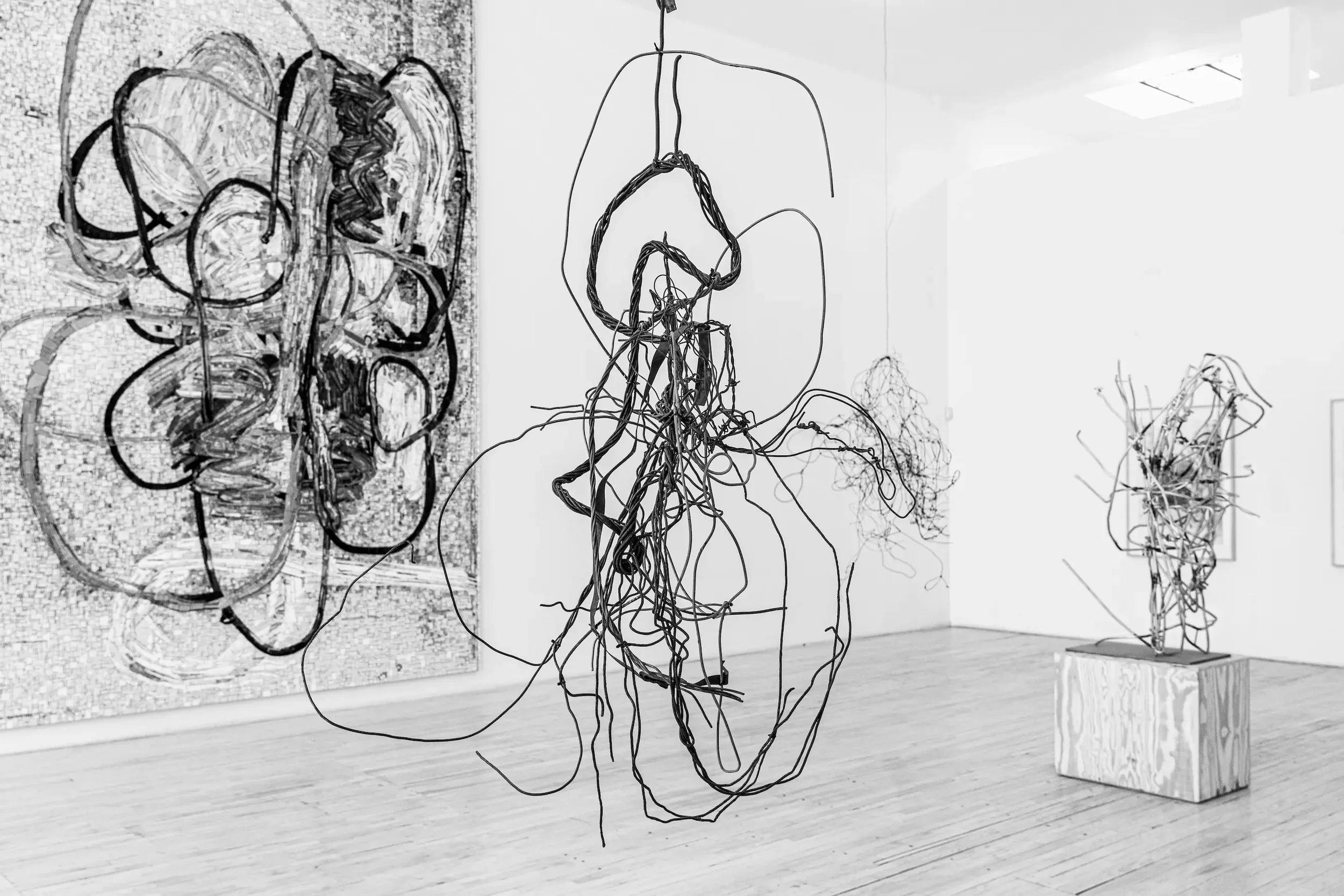
Walking into Christopher Wool’s See Stop Run exhibit in Marfa, you’re first confronted by a massive, spiderweb tangle of cast pipes. The sculpture sprawls across the center of the room without a clear point of origin: knotted and unruly. It feels like some kind of infrastructural system, rather than a single object, mirroring the subjects that fill Wool’s nearby photographs of old tires, scattered debris, and everything in between. To Wool, the natural world is inseparable from human waste.
The show spans four rooms across two neighboring buildings, holding a mix of sculptures, photographs taken locally in Marfa, and paintings.
When curator Anne Pontégnie first conceived of See Stop Run, she said that she wanted to get away from “the neutrality of contemporary art spaces, galleries, and institutions” and find somewhere in New York City—where the show originally ran—where the work “could interact with something other than a blank slate.” The show’s first iteration took place in an old, derelict office building in downtown Manhattan, and critics praised how the paintings and sculptures engaged with the space’s cracked floors, exposed wiring, and peeling surfaces, creating what a New York Times critic described as “visual rhymes.”
When the exhibition moved to Marfa in the spring of 2025 and took up space in the Brite Building, the presentation changed. It’s now in exactly the kind of pristine, white-walled space that Pontégnie wanted to avoid. Only one of the rooms contains the same wildness as the New York show, and this has the impact of lessening the dialogue between Wool’s work and its surroundings from shouts to whispers.
Courtesy of Christopher Wool
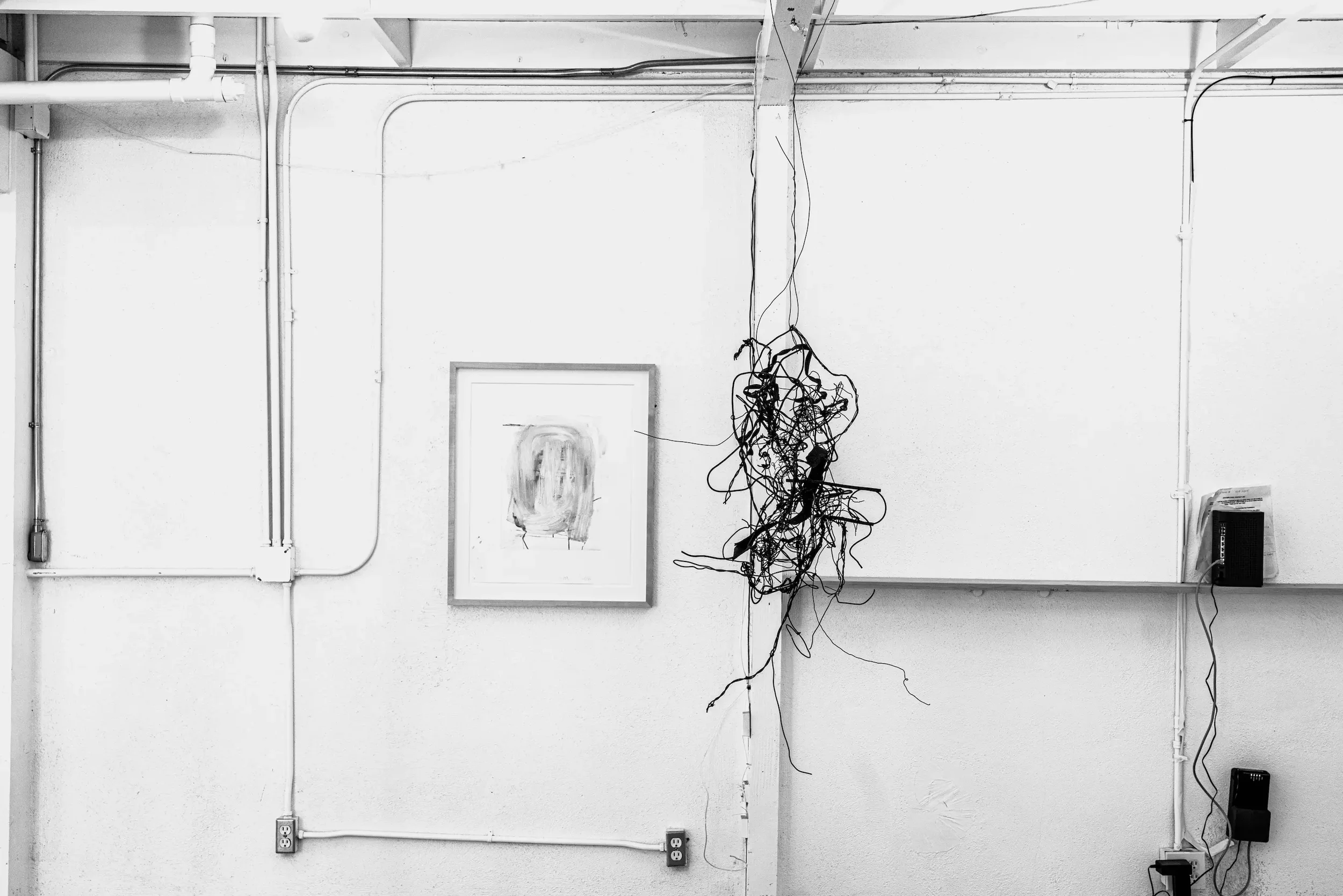
The exhibition here in Marfa is thoughtfully curated, but it doesn’t feel accurate to describe it as controlled chaos exactly, because what makes Wool’s work so compelling is how little it wants to be controlled. Most of the show does unfold in white gallery walls, but one room upstairs has a kitchenette, and another resembles the environment of the original New York show. Here, there are holes left behind by old nails and cracks in the floors. The wear and tear of the building—alongside the refrigerator and sink—feels as meaningful as the art itself because Wool’s work never seeks to dominate the space; it only asks to live in it.
One of the clearest examples is a wiry sculpture suspended from the ceiling, held by a black cord looped over a silver hook. It’s not immediately apparent where the artwork ends, and the means of display begins. Is the cord a part of the sculpture or just what’s holding it up? Wool seems to be testing the limits of his own work.
If a wire slipped loose or the floor cracked underfoot, or perhaps if one of his hanging sculptures fell to the ground, that wouldn’t change anything. It might even add something. And even though the Marfa iteration of See Stop Run offers less in terms of its setting, it ultimately delivers something even more compelling.
Courtesy of Christopher Wool
Courtesy of Christopher Wool
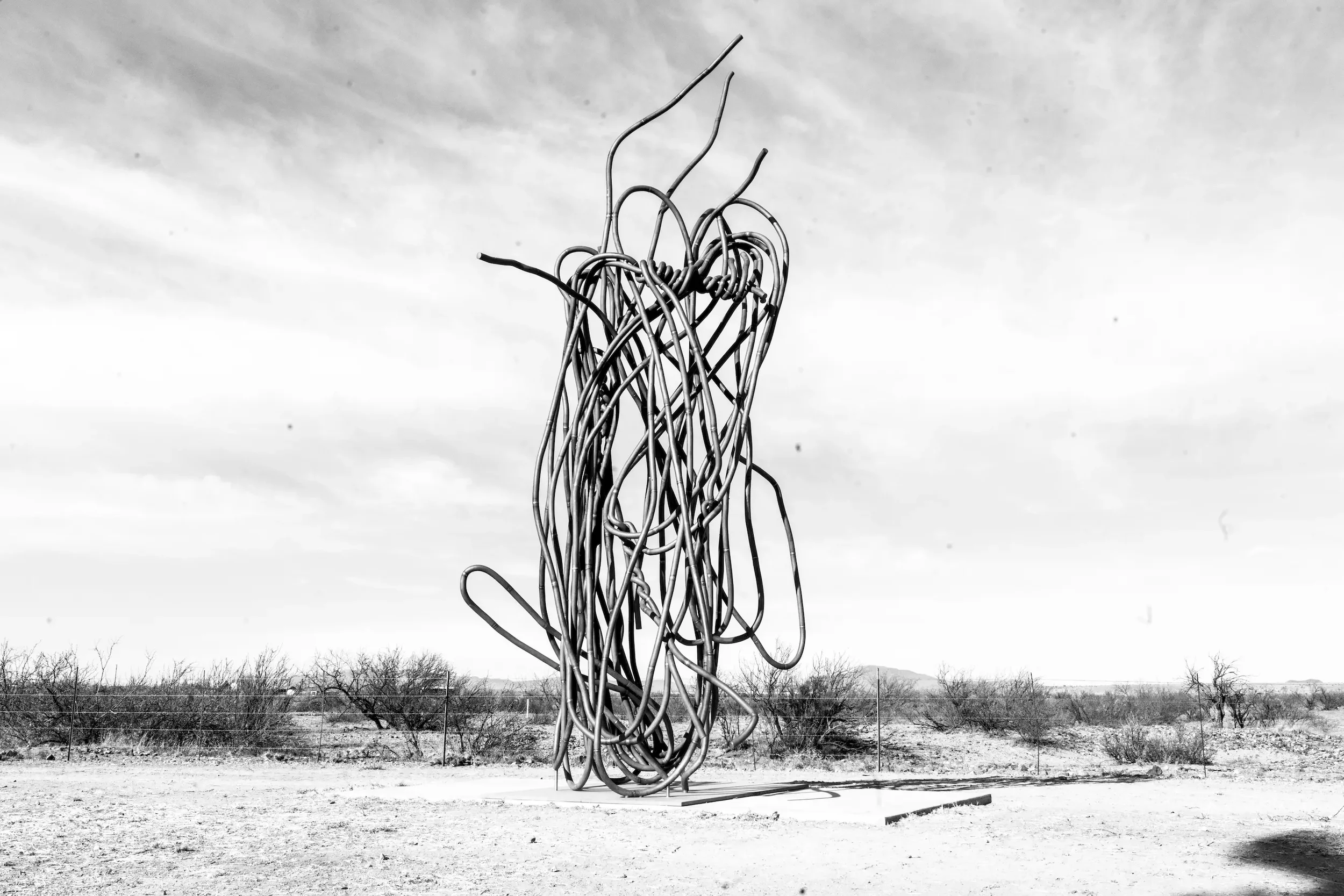
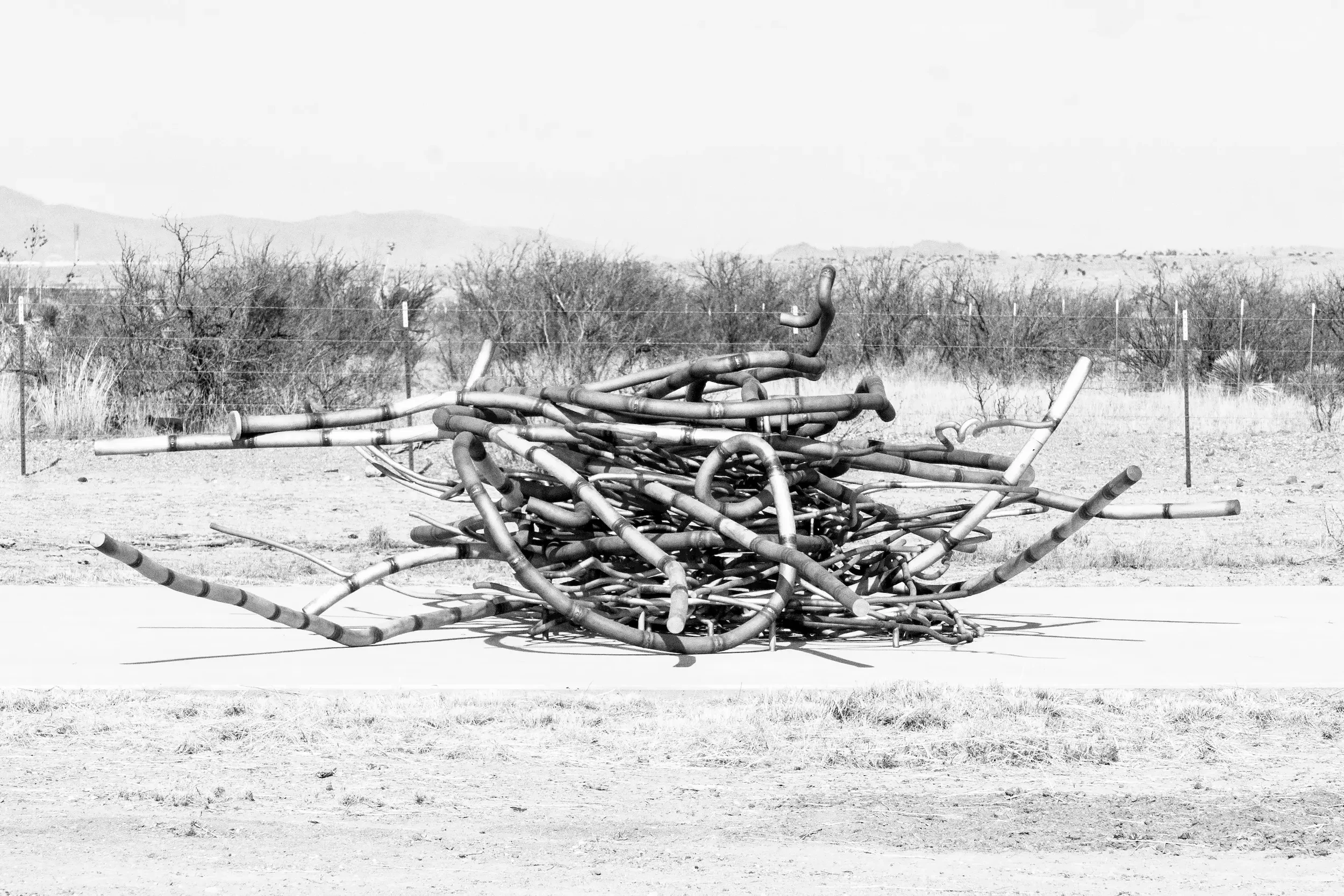
This comes in the form of three outdoor sculptures, which require a short drive to see, that feel like both the show’s natural conclusion and its highlight. Placed directly in the Chihuahuan desert, the works move forward from interacting with artificial space into dealing directly with the natural world as it is.
The steel forms resemble things already scattered across the landscape— tumbleweeds and tree roots and branches—but unlike the natural parallels, these ones don’t move or decay. Gazing at them, you can feel the human hands that meticulously crafted them. And meanwhile, the real desert continues its course all around them, indifferent. The sun rises and sets. The mountains stand tall.
In this way, Wool sets up a confrontation between two kinds of being: the natural world, which is alive precisely because it changes and dies, and his hand-crafted sculptures, which can endure only by refusing to be part of that cycle. Standing among these works as the wind forcefully blows and the Texas sun beams, you hover between these two modes of existence: the steel that combats mutability and the real, organic matter that changes, blows away, disappears.
See Stop Run is on view through Spring 2027 in the Brite Building, Marfa, Texas.