
text by Arlo Kremen
In the third year since the birth of the Nita Mukesh Ambani Cultural Centre (NMACC), the embryonic institution offers its space to realize filmmaker and artist Doug Aitken’s Indian debut. Under the Sun occupies three gallery spaces, disseminating the tripartite show equally among each floor. Considering the historic temporal division of past, present, and future, Aitken applies design, craft, and technology as a means to consider the ways in which the human condition has shifted as a result of technological innovation.
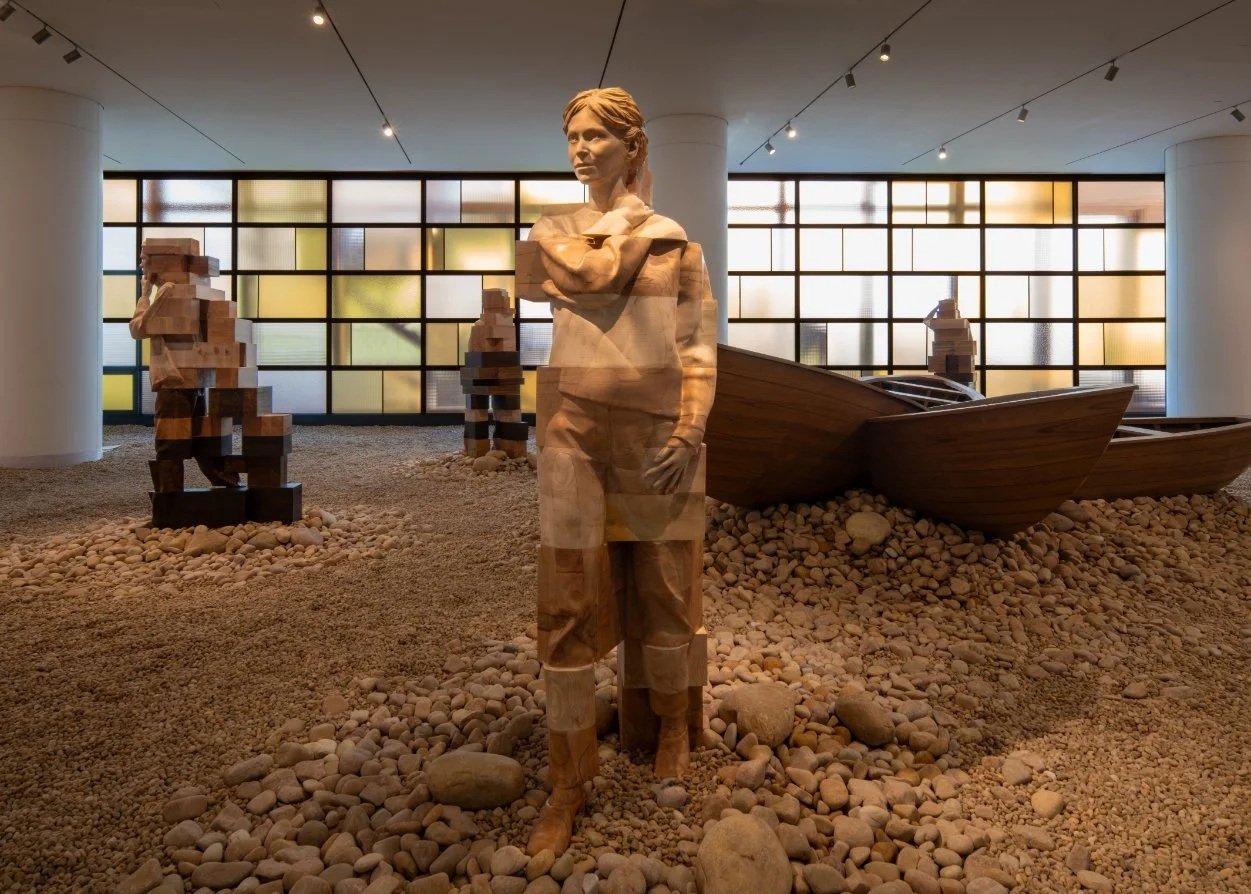
Past, the overarching title of the collection of works that make up this floor, is perhaps the most site-specific of any other floor. A collection of boats sit static aground, where instead of a frictive collision, they merge into one another into a Frankensteined structure. Rocks and pebbles flood the gallery’s floor, with the larger stones collected at the feet of those figures stretching their legs in a circular formation away from the derelict vessels. Sculpted out of reclaimed and raw Gujarat wood of variegated tones, human bodies emerge proportionally defined from pixel-like cubes of wood. Aitken’s use of machine milling and handiwork in the carving of these untitled and unidentifiable figures traces the development of ancient Indian wood carving into the modern age.
The walls hang textile works made by artisans across India who use embroidery and weaving techniques to imagine a selection of Indian rivers, as depicted in digital topographies, as being emblematic of meaning-suggestive hand signs. The works are dynamic, mixing blues with pinks and oranges in a bright clash. And by no mistake, the exhausting handcraft work required to make these works, each titled after the represented river, turns to the hand as the age-old mediator between idea and object, particular to the aforementioned rich history of Indian craft and design. To accomplish these works, Aitken’s studio collaborated with dozens of Indian artisans at Milaaya Embroidery House, bringing these generational techniques into the foray.


The second level, Present, turns to video work, projecting Aitken’s NEW ERA installation into a dark empty space of walls and mirrors. Centered on the history of the mobile phone and its inventor, Martin Cooper. By flitting between narratives of technological development and questions of humanity and personal identity, Aitken’s rightful juxtapositions of these two strains of thought define much of what it feels like to be alive in this current techne. The room is organized around three channels of video with mirrored panels. The mirrors open up the space with nearly endless halls of projections, leaving the viewer floating in an infinite space. Images of phones, roads, the ocean, telephone towers, and Martin Cooper's face and body move on and off the walls in a dance between past, present, and the yet-to-come future. Cooper’s voiceover stresses the existential importance of the cell phone, reminiscing on the site in which he made the very first public cell phone call on 6th Avenue in New York City, 1973. He reminisces, “I was lucky enough to make the very first public cell phone call in the world.” Bridging space from New York to Mumbai, Aitken stresses the global consequences of this act, bridging the two cities into the same technological globalist narrative.
Doug Aitken
NEW ERA, 2018
Video installation with three channels of video
Three projections, freestanding room, PVC projection screens, mirrors
Future features LIGHTFALL / OTHER WORLDS, commissioned, like Past, for this show. Suspended above a wooden floor, hundreds of vertical LED tubes shape an orb of light. Pushing in and out, visitors are invited to lie down under the orb to focus on feeling the shifting swells of light from above while soaking in a drone composition working in conjunction with the convulsing sphere. This orb is universal, denying spatial and temporal restrictions. Atom, primordial specimen, pagan deity, AI creation, and planet—LIGHTFALL / OTHER WORLDS offers a hypnotic grounding into, ironically, the present, where the present can be felt as the site in which the future is imagined and sculpted.
Doug Aitken
LIGHTFALL / OTHER WORLDS, 2025
Installation view at NMACC
Courtesy of the artist
Photograph by Dhrupad Shukla/Floating Home
The light reacts to sound in real time, changing its form depending on its surrounding environment. As such, the immediate reactive quality of the work necessitates its location in the present. The work’s relation to the future is merely implied, or perhaps its visual allusions to past conceptions of what the future might look like. LIGHTFALL / OTHER WORLDS feels quite of the present, using current technologies and trends, appearing rather similar to those artworks that care less for ideas and more for experiences, so often observed on Instagram explore pages. Although Aitken's installations pre-date, and likely inspired, this trend of experience-based art works, the mass commercial proliferation of these works might warrant a pivot in the use of spectacle in this fashion. For a work so concerned with the mixing of life forms into a single pulsing entity, it would be unfortunate for its spectacle to distract from the deeply meditative ask of the work: what makes something alive and how might the encroachment of digital landscapes onto reality shift these perceptions?
Doug Aitken’s UNDER THE SUN on view through February 22nd @ Nita Mukesh Ambani Cultural Centre, Mumbai.