
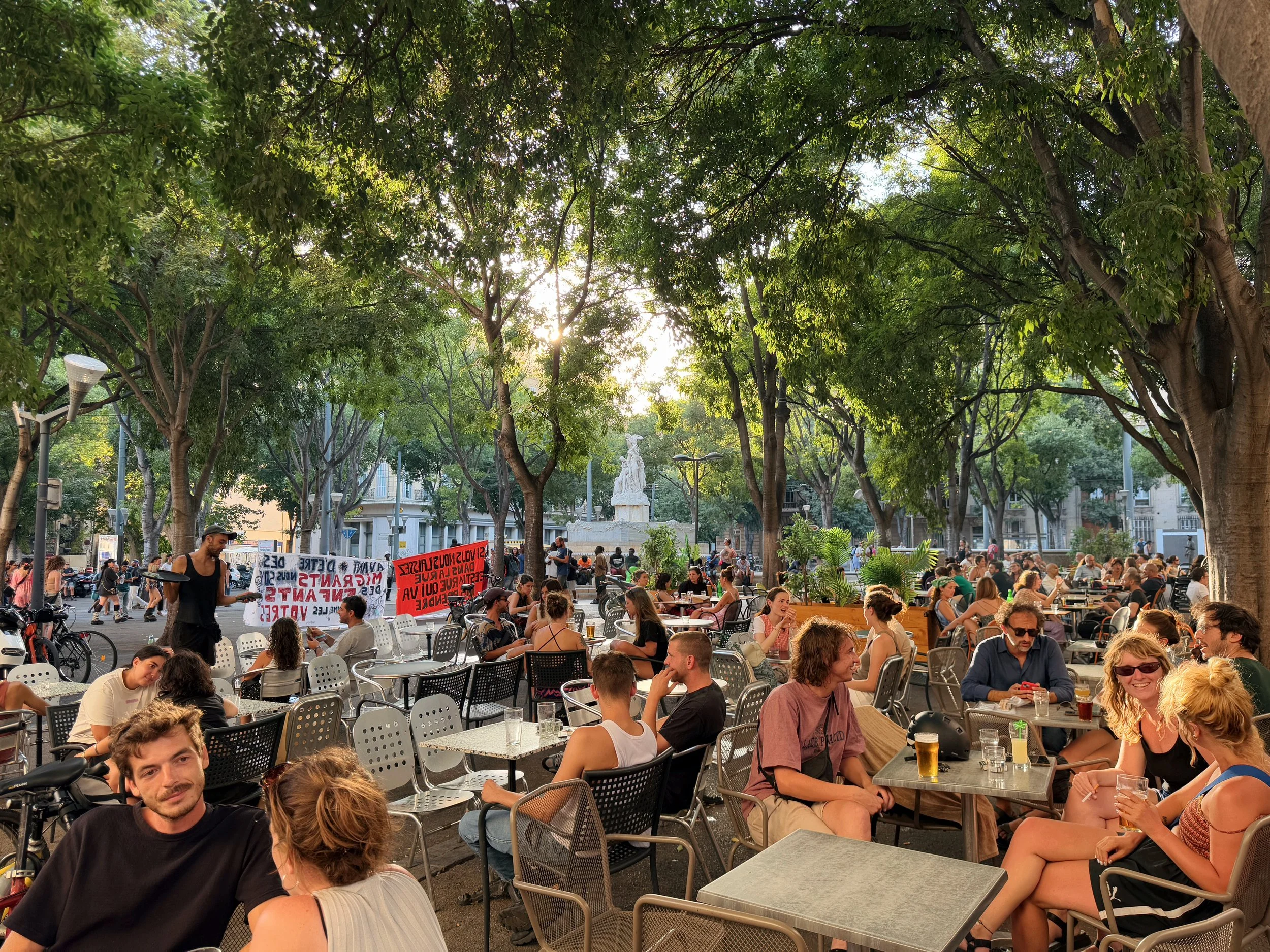
La Place
text by Perry Shimon
“…as long as the over-all structure of society does not favor the degradation of everyone into a compulsory voyeur.”
— Ivan Illich, Tools for Conviviality
The previous essays in this collection have sought to examine a conventional contemporary understanding of art that primarily reflects the dominant dynamics of power and finance in the age from which it emerges. Yet the capacity of art, as an evolving and contested category, is not exhausted by the tenets of neoliberal realism. Within the capaciousness of the category, there exist models for the otherwise.
In this penultimate chapter, I want to highlight a number of cultural infrastructures, institutions, and practices that offer inspiring alternatives to the possessive individualism and ever-increasing financialization of both art and life. A precondition for participation in these architectures of artful conviviality, however, is a more equitable distribution of self-determined time, alongside the conditions of social safety and care required to sustain it. The struggle for a more artful and beautiful world is inextricably bound to human and more-than-human emancipation from the ecological and social ruination produced by the destructive logics of endless growth and concentrated accumulation under capitalism.
Santo Domingo plaza Oaxaca, by ryan doyle via Unsplash
IAGO
Francisco Toledo’s Instituto de Artes Gráficas de Oaxaca (IAGO) remains an example particularly close to my heart of a small-scale, community-focused art space that is widely used and beloved. Founded in 1988 in an 18th-century building adjacent to the lively plaza in front of Santo Domingo Church, it was seeded by Toledo’s donation of tens of thousands of art books from his personal collection. These now form a public reference library beside a print studio, gallery, and bougainvillea-covered courtyard alive with birdsong and conviviality. I have many fond memories of reading there happily while listening to the quietly cheerful polyglot murmur, bird sounds, and diffuse sociality of the nearby plaza, with celebratory brass-band processions punctuating the rhythms of the day. Openings at IAGO are warm, gregarious, intergenerational affairs, free to all and accompanied by hearty food and music.
Eiko Ishibashi
Noise Research Union Residency
In 2008, Hamish Dunbar and Keiko Yamamoto opened Cafe Oto in a former paint factory in Dalston, East London. It has since become a beloved institution, both locally and internationally, with one of the most adventurous programs of music and performance anywhere, and it offers a space to artists experimenting beyond conventional tastes and established traditions. In the evenings, there are concerts, performances, screenings, lectures, symposia, and residencies, all realized in a large yet intimate room without a stage or backstage. By day, the venue functions almost as a community center, with a cafe, a modest menu, and thoughtfully curated selections of books and records for sale and reference. It sits on a quiet, leafy street with some outdoor seating and benefits from very little automobile traffic—a stark contrast to, and great respite from—the frenetic avenue just behind. I’ve had countless beautiful and inspiring evenings there, often arriving without even checking the calendar, collecting a fresh mint tea from the kind, artful, and friendly staff, and settling in for an extraordinary cultural evening. Afterward, the room hums with gratitude, conversation, and questions in a deeply convivial atmosphere.
Friche
At another scale, commensurate with the diverse and lively constituency of Marseille, La Friche de la Belle de Mai is a sprawling multi-venue cultural center built on the foundation of a former tobacco factory. It offers galleries, theaters, rooftop space for concerts, gardens, sports facilities, restaurants, cafes, a skatepark, a soccer pitch, a bookshop, artist studios, media production facilities, zones for street art, daycare services, farmers markets, and many other kinds of special events. The facilities also host the offices of some seventy or so cultural and nonprofit organizations. It is filled with joyful life, art, and conviviality, and offers programs and amenities that are inclusive and welcoming to everyone in Marseille.
Centquatre
In Paris, Centquatre—or 104—shares a similar spirit. Located in a former municipal funerary complex in the 19th arrondissement, it first became an informal gathering place for young people, often dancing, before eventually being built out (perhaps even a bit too much) into a vast cultural center with many amenities akin to those at Friche and a lively public program. Both venues provide free, hospitable spaces for sociality and art, without an overbearing commercial presence or the sociocidal imposition of automobiles. At the end of the twentieth century, Ivan Illich wrote in Tools for Conviviality: “The present world is divided into those who do not have enough and those who have more than enough, those who are pushed off the road by cars and those who drive them.” The automobile, and its domination of space at the expense of social and ecological life, remains a powerful example of anti-convivial technology, compounding the deeply uneven distribution of agential time and the impoverished conditions required for its meaningful use.
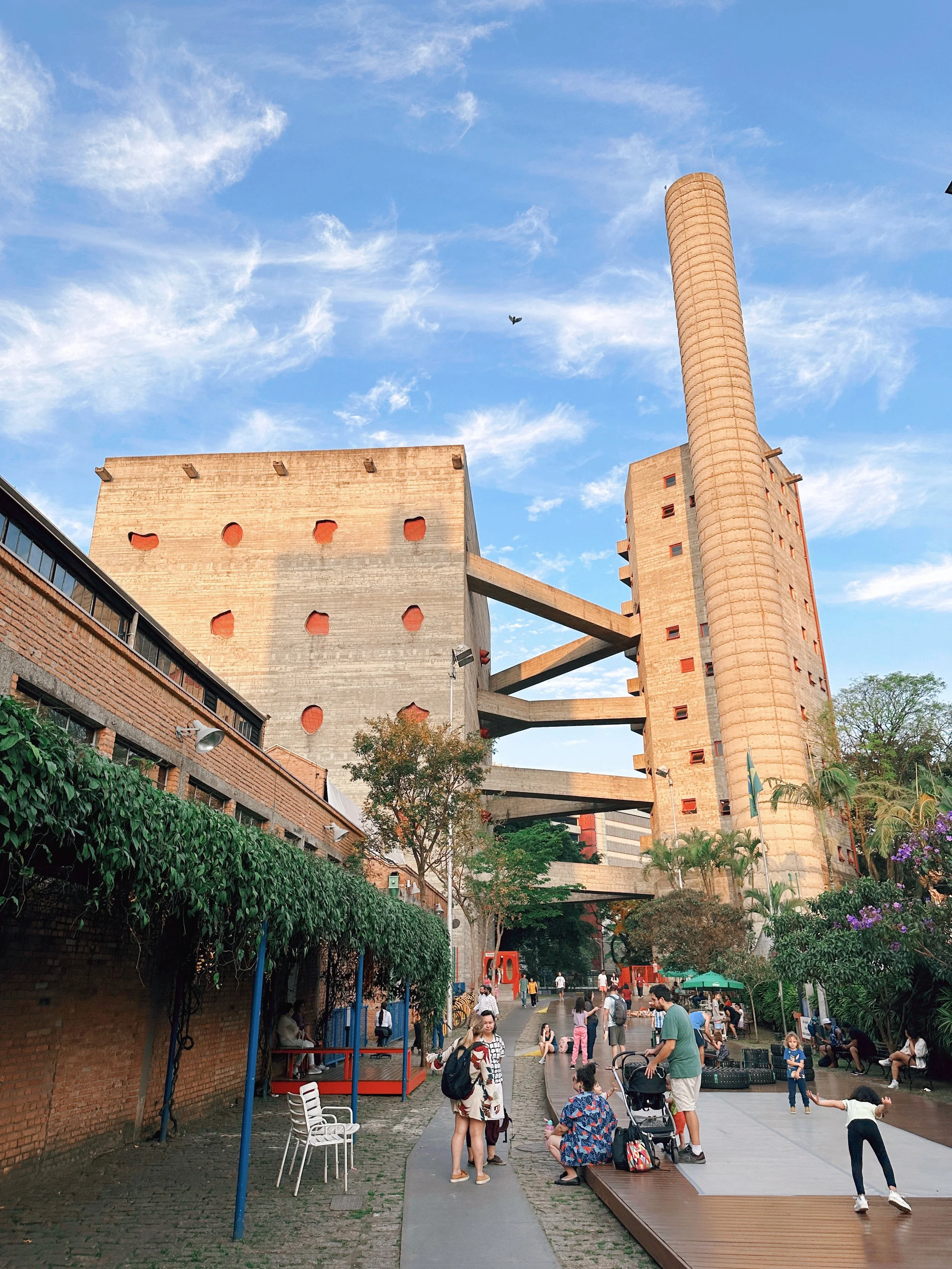
SESC Pompéia
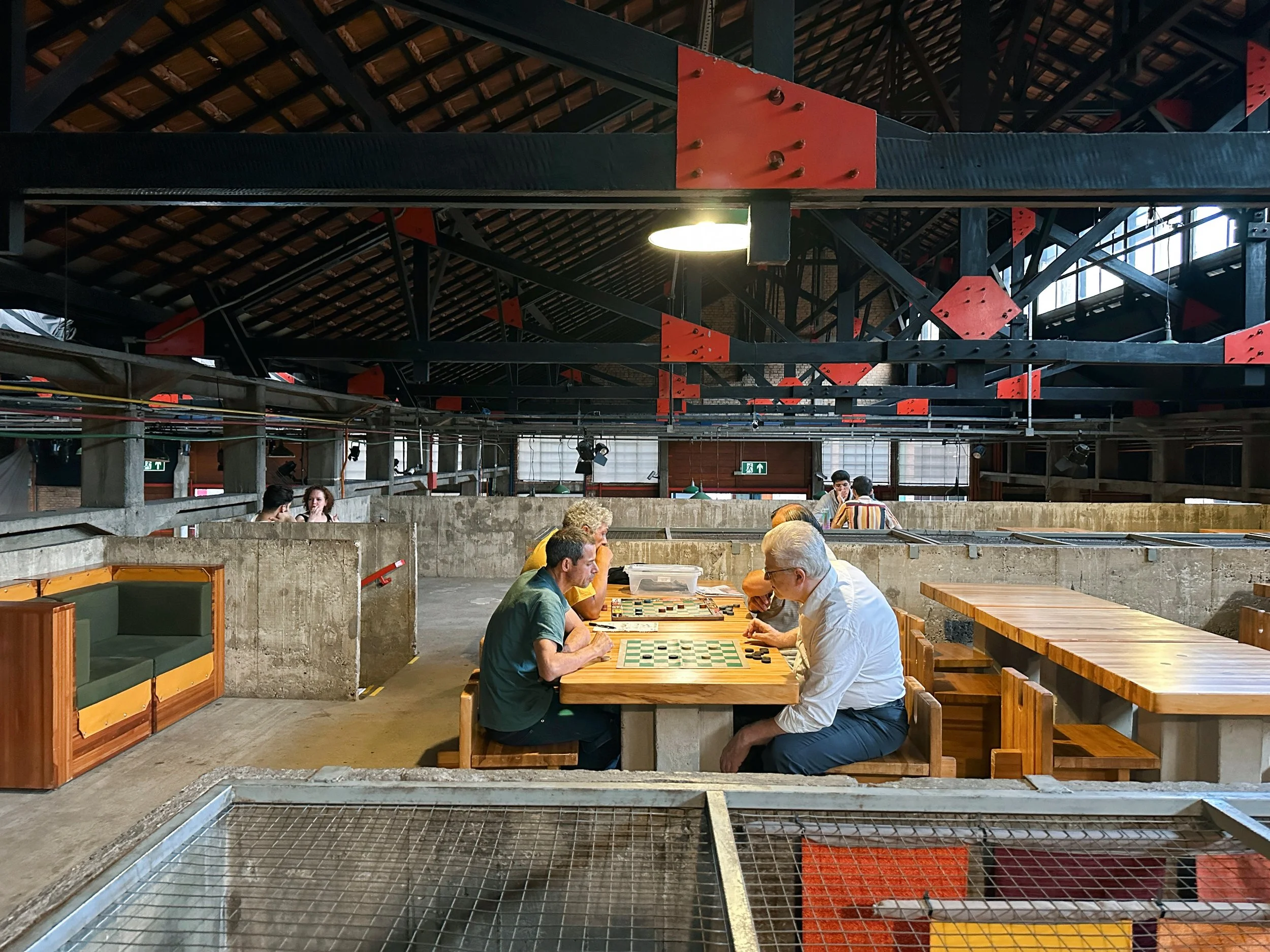
Brazil’s popular, nonprofit, tax-supported SESC programs offer another shining example of cultural infrastructure worthy of wider emulation. With regional variations across more than five hundred locations in all twenty-seven Brazilian states—far beyond the scope of this précis—I will mention only the iconic SESC Pompéia in São Paulo, housed in a former steel drum factory reimagined by the great architect Lina Bo Bardi as a multipurpose “leisure center” containing libraries, workshops, exhibition spaces, theaters, sports facilities, eateries, and a swimming pool. It is composed of many zones of enjoyment and cultivation, and is enthusiastically used and appreciated.
Minna no Mori
Minna no Mori (Everyone’s Forest) Media Cosmos, a municipally led civic and cultural project in Gifu City, is housed in a stunning building by Toyo Ito. Its sweeping organic wooden lattice structures, suggestive of mycelial forms, cast a warm, diffuse light over an expansive library, workshops, galleries, and spaces for education and cultural exchange. The space is filled with members of the community from every generation: learning, playing, reading, and working within a structure that clearly expresses profound respect for the people and values that animate it. When I asked the reference librarian about an artist I was researching, she kindly asked me to return at the end of my visit, at which point she presented me with a brimming folder of carefully compiled resources and suggestions for further inquiry.
More generally, Japan has one of the most sophisticated and robust cultural infrastructures I have ever encountered, combining more and less technologically complex forms and methods. In most places I visited, there were visitor information centers where all manner of cultural guidance was made freely available in a variety of languages. Warm, patient, upbeat, and hospitable guides generously offered advice and recommendations. A4 sheets announced imminent cultural happenings through beautiful graphic design and thoughtful presentation displays. This practice was common in significant cultural institutions of many scales, which in turn displayed resonant announcements for one another, connecting organizations in a mycelial web of aesthetic and social affinities. Online, robust and widely used platforms such as Tokyo Art Beat carry this spirit into the digital sphere.
Throughout the country, there is substantial regional and municipal support for recurrent seasonal art festivals that both celebrate local cultures and invite meaningful dialogue from abroad. These initiatives feel less determined by the market and its influence on a distinctly neoliberal form of biennial-making, which is more prevalent in the West. Many local art festivals honor their histories and earnestly invite cultural exchange with artists from abroad in a way that feels distinctly more open, playful, and inviting of participation.
The Eagle
I also felt, perhaps on account of the strong Shinto current still running through Japanese life, a reenchantment of quotidian aesthetic experience, along with a respect for the more recent past. I felt this acutely in jazz and classical kissas, or listening cafes, where people sit comfortably and quietly in an unusual kind of social space simply to hear beautiful recorded music played on excellent sound systems. My favorite kissa in Tokyo offered a small library of art and anthropology books and journals, and served a modest menu of simple pasta dishes in a cozy Japandi-feeling basement beneath a commercial corridor in Yotsuya. There was something akin to sacredness, and certainly deep satisfaction, in this contemplative being-together. It is not unlike the onsen and sento cultures where I found solemn peace and respite, especially from our hyper-technologized present and its tools, which, as Illich put it, “must inevitably increase regimentation, dependence, exploitation, or impotence, and rob not only the rich but also the poor of conviviality.” Spaces of respite and spaces of conviviality may well go hand in hand in providing models for how to be together outside the narrow, competitive, and antisocial relations of neoliberal exchange. Within Japan, and particularly in the countryside, I felt a sense of enchantment and gentle conviviality institutionalized in a way that feels profoundly absent from my life in Western metropoles. I was reminded of this daily by each, often simple, Shinto shrine encountered, inviting us into greater awareness of the quotidian and superabundant sacred.
It has been profoundly depressing to witness the early promise of the internet largely captured by insidious monopolistic corporations developing increasingly predatory, addictive, and antisocial practices for extracting profit and attention. Yet, in response, and much like the public library system before it, there exists a strong creative commons countermovement demonstrating an entirely different mode of organizing cultural production and life. Its protagonists operate at many scales: from the expansive and global Wikipedia, with its incalculable number of contributors and contributions to the knowledge commons, to more intimate organizations such as the Public Domain Review, dedicated to presenting curated selections of public-domain materials and generously contextualizing them for artists and researchers. Sound-sharing communities like Freesound and image-sharing communities like Unsplash have created vast audio and visual commons through which people can share, create, and collaborate, illustrating our better capacities for mutual aid. Beyond even the creative commons movement are shadow libraries such as Memory of the World, Libgen, and UbuWeb, which explicitly common and curate copyrighted materials considered of social and cultural value.
freesound.org
The questions of copyright and possessive individualism are complex, and I understand, to a degree, those positions advocating the fair remuneration of artists within neoliberal conditions. Unfortunately, however, I fear this line of thinking ultimately reinforces capitalist logics, narrows the range of beneficiaries, and fails to account for the collaborative and ecological contributors involved in anything that can meaningfully be called a work of art. Rather than devising ever-more-complicated technological and energy-intensive systems for administering artistic private property, it would be simpler and more socially beneficial to provide something like a universal or guaranteed income alongside a broad commoning of creative media and the redistribution of self-determined time needed for artful collaboration and exchange. The commoning of creativity I am describing already exists in impoverished form for most people making and sharing things today—writing, pictures, music, and so on—before the vast majority of value is extracted by a handful of monopolistic firms. How to enact a transition away from neoliberal realism within a geopolitical context of multipolar colonial power formations remains an open and urgent question, one illuminated by the precedents, axioms, and spirit of the models mentioned here.
Artists and organizers living under structurally disadvantaged conditions within the ruins of capitalism, and still seeking meaningful forms of gathering, have long experimented with alternative practices of sociality, art-making, and the sharing of knowledge. In a context poor in convivial cultural infrastructure, a few notable examples come to mind.
It was through my friend Gareth Evans that I became part of the London Walking Collective, a perambulatory, convivial, and welcoming gathering of friends and friends of friends, who meet to wander a given, often urban, environment with a playful Situationist spirit, together co-authoring a social essay unfolding through time and space. Sometimes a historian accompanies the walk to provide context, other times, a theoretical cosmologist reads Rumi above a buried river in the so-called Queen’s Wood. These hearty and edifying perambulations typically end in a public space of sociality, a pub or restaurant, where everyone is welcome, and laughter carries the group joyfully into the evening. Gareth, an inveterate and largely unaffiliated organizer of cultural events around London, often concludes the gatherings he facilitates with an open invitation to continue elsewhere nearby. This simple act of hospitality in cultural facilitation is among the most generous practices of conviviality I know.
Place Settings “Ascension” Photos by Noah Collier
Place Settings “Experiments in Space"
Los Angeles’ Place Settings, founded by Laura Nelson and Anya Ventura, makes use of Hollywood sets and other nontraditional locations to organize thoughtfully conceived, place-focused lectures on subjects ranging from shorelines to supply chains to lithium mines. Emerging from interests in third spaces, alternative pedagogies, and the undercommons, the project invites us to consider how impoverished architectures might be détourned or reimagined so that we may gather meaningfully and exchange knowledge under conditions of duress.
Each summer solstice in Oakland, California, within a stunning columbarium and mausoleum reimagined by Julia Morgan in a former transit center beside Olmsted’s Mountain View Cemetery, a day-long performance of new, classical, and experimental music takes place. Nearly a hundred musicians fill the labyrinthine architecture and gardens with porous sound. It is a joyful event I look forward to each year, skillfully conceived and organized by Sarah Cahill, featuring a beautiful ensemble of diverse musicians that score an experience encountered differently by every fortunate participant: a superabundance of sonorous conviviality resonating generously until the sun sets on the longest day of the year.
Otherwise is a series on neoliberal contemporary art and its unbounded remainders by Perry Shimon.
Otherwise VII: Coming Soon