text and images by Perry Shimon
It was hard to locate the disobedience in this year’s theme of disobedient images at this extremely pleasant festival, in the extremely charming UNESCO city of Arles, in the extremely agreeable Provence region. The works on view this year spanned the familiar preoccupations of affluent liberal audiences: conflicted zones, colonial histories, marginalized identities, and trauma narratives. It evokes a peculiar, perhaps Catholic, sequence of hedonism, sermonizing, and repentance. As though wandering through an artful overabundance in the palimpsestic old city, pausing for long leisurely meals on la place, must be atoned for by encounters with images of intense suffering and historical prejudice.
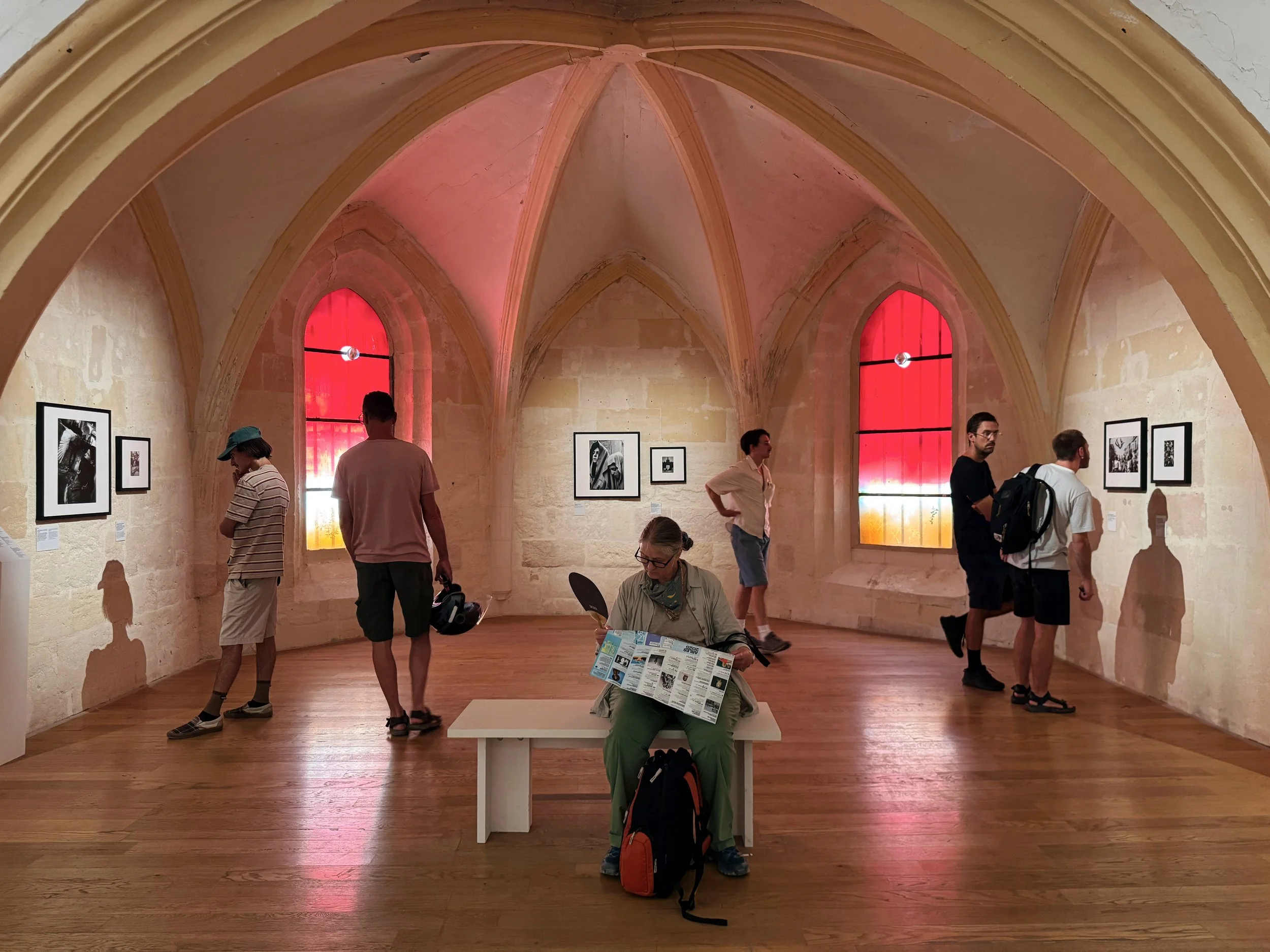
The opening week coincides with the Fête du Costume, where locals dressed in 17th-century finery perform elaborate processions around the city, simulating past rites into less-violent echoes of themselves; bullgames replacing bullfights. Such transformations invite broader comparisons. One could make a case for this as a cultural evolution: perhaps the collection and trophy-like display of images, many from formerly colonized and marginalized peoples, is a less violent enactment of the collection and domination of lives, labor, and time. Is this an incremental improvement, a continuum, a contestation, or a symbolic order? The answer may shift depending on one’s vantage.
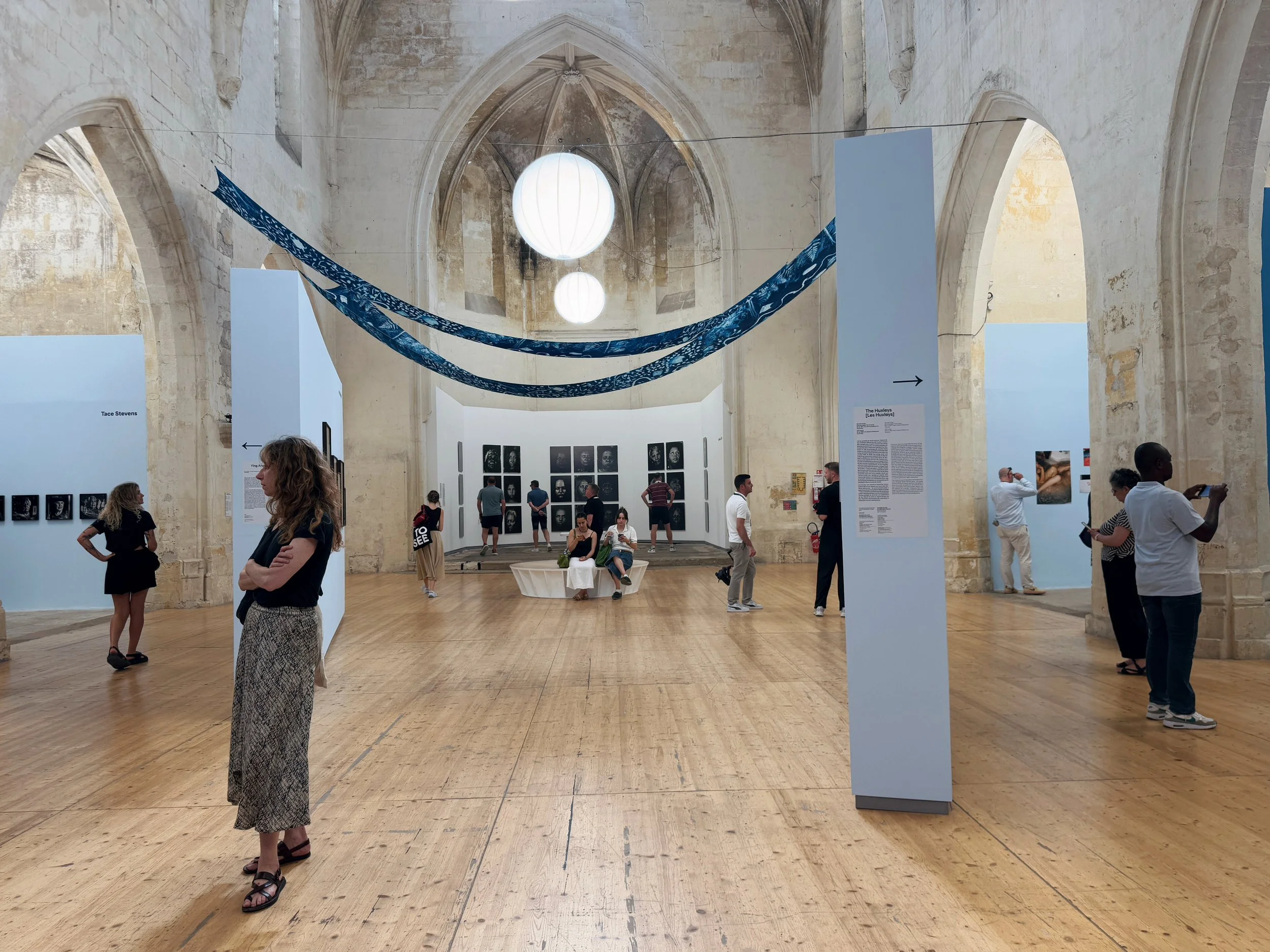
Adam Ferguson, Église Sainte-Anne
Arles has long been a seat of power: from the Celto-Ligurians, through Roman emperors, to today’s LUMA Foundation with its €150 million Gehry-designed castle and landscaped pleasure ground. The unpopular-with-the-locals architectural folly is a striking distillation of neoliberal values; the imperial and the cultural entangled through architecture, objects, history, and spectacle. Inside, exhibitions with titles like #metime, slide installations from Carsten Höller, and accounts of early industry-led collaborations between tech companies and avant-garde artists sit comfortably together: all an expression of a technocratic, individualistic, neoliberal worldview.
Wael Shawky, I am Hymns of the New Temples, LUMA
Ho Tzu Nyen, Hotel Aporia, LUMA
Also on at LUMA was Wael Shawky’s I Am Hymns of the New Temples, an immersive film installation of cosmological marionette theatre set in Pompeii, which filled La Grande Halle; and a significant retrospective of Singaporean artist Ho Tzu Nyen, offering a broad survey of his technologically situated engagements with Asian history, including a particularly haunting and fascinating work commissioned for the Aichi Triennial—Hotel Aporia—which explores wartime visual cultures and philosophical currents in Japan.
Lumière des Roses, Cloître Saint-Trophime
Some of the highlights of the photo fair this year included selections from Marion and Philippe Jacquier’s Lumière des Roses gallery in Grenoble, whose collection of anonymous, often amateur photography was installed in the cloister of Saint-Trophime. Within the austere, devotional architecture of the cloister, the effect was wondrous; small, strange pictures suggesting unknowable interiorities of past lives lived below the usual interests of history.
Retratistas do Morro, Croisière
The Retratistas do Morro presentation, subtitled João Mendes and Afonso Pimenta: Reflections from Serra Community, Belo Horizonte (1970–1990), offered selections from a massive archive focused on two key photographers who, over half a century, documented residents of the Serra community—one of Brazil’s largest favelas. The work resists exoticization, intimately contouring the kin and cultures of this supremely syncretic, culturally vibrant era. What emerges is a celebration of quotidian life, a revealing counterpoint to the structural violence imposed upon its subjects.
Diana Markosian, Father, Espace Monoprix
Diana Markosian’s Father was a complex, exquisite rendering of the Moscow-born artist’s reconnection with her estranged father, building on her earlier Santa Barbara project, which detailed her mother’s abrupt departure from post-Soviet Russia to marry a Californian farmer—taking both children and leaving the father behind in the middle of the night. In Father, the artist enlists her father, now living in Armenia, to participate in a staged reenactment of their reunion. The carefully lit, highly-stylized scenes stand in stark contrast to a vitrine filled with his actual, voluminous, and desperate correspondence: letters scrawled in Armenian to anyone he could think to contact in America, trying to locate his family. All above an open and bustling Monoprix grocery store.
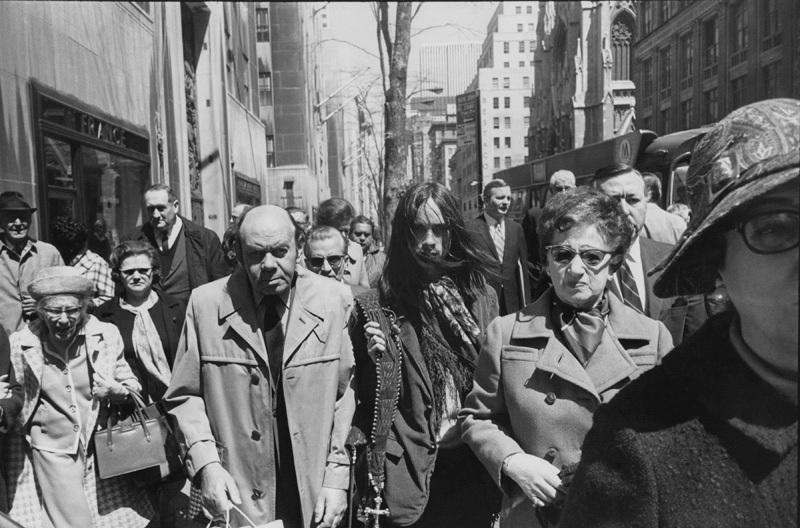
The Louis Stettner presentation in the Espace Van Gogh showcased the underrepresented work of a resolutely twentieth-century photographer. It carried an affirm-the-canon sensibility, offering more-or-less poignant takes on familiar humanist themes and modern alienation, with highlights throughout, particularly a somber series depicting New York train commuters.
Batia Suter, Octahydra, Cryptoportiques
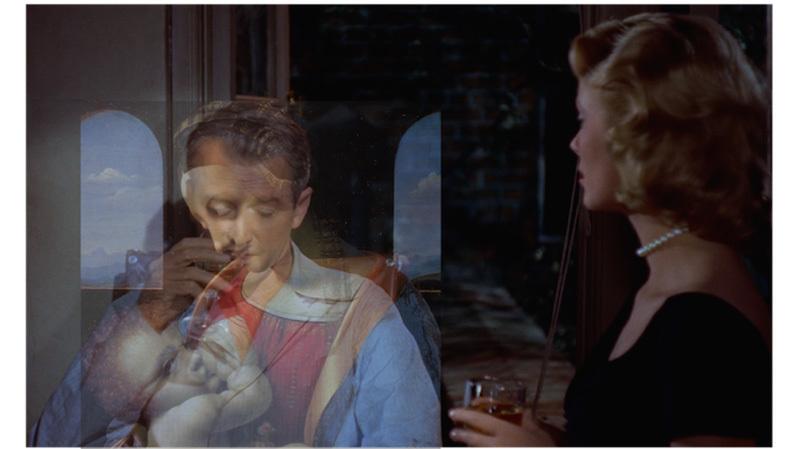
Batia Suter offered a hypnotic meditation on spatial resonance, projecting architectural affinities onto thin, overlapping muslins suspended within a 1st-century BCE Greco-Roman crypt. The work resisted explication, asking instead for a kind of intuitive attentiveness to form. For me it evoked underground server farms, circulating images, and a kind of visual associative learning and recombination characteristic of the age of AI. Nearby at LUMA foundation, the artist Tino Sehgal hung selections from their collection of photographs in a like fashion, determined by a surface-level visual similitude—inviting the question: after like is grouped with like, what remains outside of the data and dictates that determine them so?
Augustin Rebetez, Primitive Manifesto, Croisière
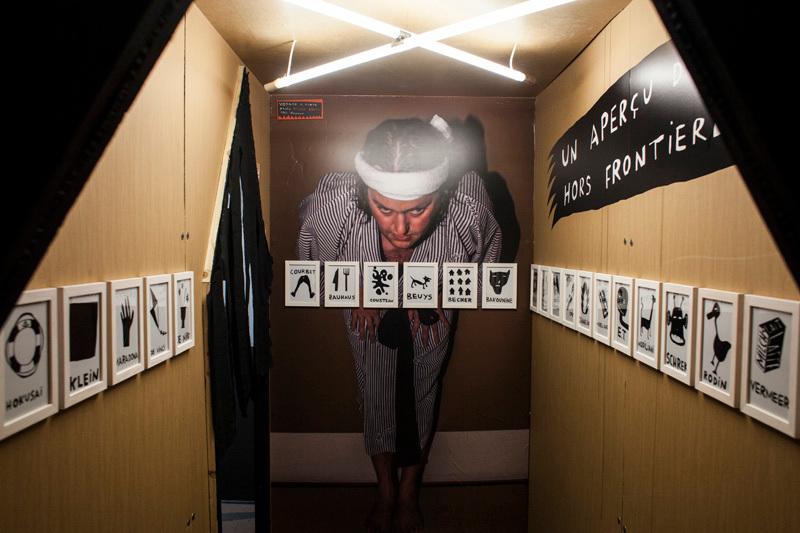
Augustin Rebetez’s Primitive Manifesto presented an unhinged, accelerationist, Rube Goldberg machine of anarchic play, mental illness, and attention economies, unfolding noisily through the Croisière. The cursed AI images and hyperbolic memes, produced at Trecartinesque velocities, were a humorous and upsetting break from the other more measured and polished official offerings.
Lisa Sorgini, Église Sainte-Anne
Lisa Sorgini’s sensitive and intimate family portraits shot during the ‘Black Summer’ immediately preceding the COVID lockdowns were a highlight from On Country: Photography From Australia in the Église Sainte-Anne; the beauty and terror of raising a family in troubling times. Letizia Battaglia’s Always In Search Of Life in the Saint-Martin du Méjan Chapel exhibited a powerful survey of the committed photographers' unsparing work, centered on midcentury Palermo; dark clouds of Christian passion and mafia violence tinged with quietly sublime silver linings.
Letizia Battaglia, Saint-Martin du Méjan Chapel
This Rencontres wasn’t so much disobedient as familiar, and that which was verging on disobedience felt more like a performance to please the structures of power and privileged audiences. The title suggests simply that art is subordinate, should know its place—and if it steps out of line, it can be easily controlled, domesticated, and put back to work in service of its owners. On the whole, though, Rencontres is a marvelous, superabundance of thoughtful and beautiful images in-and-around the official presentations. There are ample opportunities to revel and wonder together in the slow plazas, myriad exhibitions, Mediterranean light, and historically rich surroundings. À la prochaine.
Libraire Du Palais
Le Sauvage
Sophie