
William Eggleston
Untitled, 1972
Dye transfer print
© Eggleston Artistic Trust
Courtesy Eggleston Artistic Trust and David Zwirner
text by Sayori Radda
London’s October weather was as unpredictable as ever, but the mood inside Frieze was anything but subdued. Even on VIP day, the aisles were packed with collectors, curators and art-world professionals, moving between booths as galleries reported early sales. Despite the art market’s ongoing uncertainties, there was little sign of hesitation among the crowds at Regent’s Park. From October 14 to 18, Frieze London and Frieze Masters welcomed 95,000 visitors from 108 countries and regions, suggesting that London’s place on the international art calendar remains firmly intact.
Major galleries reported strong sales despite wider market uncertainty. David Zwirner placed works by Michaël Borremans ($1.5 million), Dana Schutz ($900,000) and Lisa Yuskavage ($450,000), while Hauser & Wirth sold an Avery Singer for $800,000. Thaddaeus Ropac reported sales of Martha Jungwirth (€560,000), Antony Gormley (£500,000) and Adrian Ghenie (€380,000). White Cube sold 11 works by Ilana Savdie, including two priced at $325,000 and $260,000, alongside a Gabriel Orozco for $300,000. Perrotin also reported sales of works by Izumi Kato for up to $250,000 each.
Beyond the major galleries, the fair’s curated sections offered a closer look at emerging talent and the galleries supporting them. Artist-to-Artist, which invites established artists to nominate fellow artists for solo presentations, saw Alice Amati and Goodman Gallery sell out their respective booths dedicated to Paul Robas and Unathi Mkonto. In Focus, a section supporting younger galleries and emerging artistic practices, a. SQUIRE, Gianni Manhattan, Harlesden High Street and Bukia Vakhania all reported sold-out presentations. Ehrlich Steinberg sold its entire presentation by Ella Fleck, winner of the 2026 Camden Art Centre Emerging Artist Award, to a European family collection for £14,000.
Paul Robas
Sleight of hands, 2026
Acrylic, oil and ink on linen
11 3/4 x 15 3/4 in
30 x 40 cm
The main Galleries section, meanwhile, brought together established international galleries presenting solo and group exhibitions of contemporary art. Union Pacific, a former Focus exhibitor that moved into the main section in 2023, sold out its booth featuring works by Niklas Asker, Apollinaria Broche, Sebastián Espejo, Aya Higuchi, Nour Jaouda and Oliver Osborne.
Institutional interest was equally notable, with representatives from a record 426 institutions across 51 countries and regions attending Frieze London and Frieze Masters. Among the acquisitions, the Whitworth in Manchester secured a work by Karimah Ashadu from Sadie Coles HQ through the Contemporary Art Society’s Collections Fund.
Taken together, the reported sales suggest continued demand for both established and emerging artists. Yet these figures, largely supplied by the galleries themselves, offer only a partial picture of the market. Sold-out booths and headline-making transactions do not necessarily translate into profitability, particularly when the rising costs of participating in international fairs are taken into account. Nor do they reveal much about the galleries that struggled to make sales. While Frieze’s commercial successes offer some reassurance, they should not be mistaken for evidence of a broader market recovery.
Beyond the sales figures, the quality of art on view was surprisingly high. Perhaps most impressively, even major blue-chip galleries moved beyond their usual blockbuster presentations, showcasing lesser-known pieces and drawings that revealed unexpected aspects of familiar artists’ practices. Often understated, these selections rewarded closer attention over immediate spectacle. White Cube (D21) exemplified this approach through an inventive curatorial arrangement that placed new paintings and works on paper by Ilana Savdie in dialogue with artists including Hans Bellmer, Louise Bourgeois, Alexander Calder, Salvador Dalí, Willem de Kooning, Marlene Dumas, Leonor Fini, Gustav Klimt, Maria Lassnig, Egon Schiele and Yves Tanguy.
Egon Schiele
Kniendes junges Mädchen, frontal - Torso, 1913
Watercolor over pencil on Simili-Japan
48.2 x 31.7 cm | 19 x 12 1/2 in.
© Egon Schiele. Photo © White Cube (David Westwood)
Gustav Klimt
Bekleidetes skelett nach rechts stehend (study for ‘Die Hoffnung I’, 1903/04), 1902
Pencil on paper
17 3/4 x 12 1/4 in. | (45 x 31 cm)
© Gustav Klimt. Photo © White Cube (Theo Christelis).
Leonor Fini
Leonor Fini Squelette c. 1965
Watercolor and ink on paper 43.5 × 28 cm | 17 1/8 × 11 in.
© DACS. Photo © White Cube (David Westwood)
Among the highlights were three rare works by pioneering artists: Schiele’s Kniendes junges Mädchen, frontal – Torso (1913), Klimt’s Bekleidetes Skelett nach rechts stehend (1902) and Fini’s Squelette (c. 1965). The inclusion of intimate drawings by Klimt and Schiele, two leading figures of Viennese modernism whose works are more commonly encountered in major museum collections and institutional exhibitions, was particularly noteworthy at a contemporary art fair. Displayed on industrial metal mesh panels reminiscent of densely packed museum storage racks, the selection spanned different artistic periods, from early twentieth-century modernism to Fini’s Surrealist explorations of the body. The unconventional presentation revealed distinct approaches to mortality, corporeality and psychological unease, establishing unexpected connections with Savdie’s contemporary paintings.
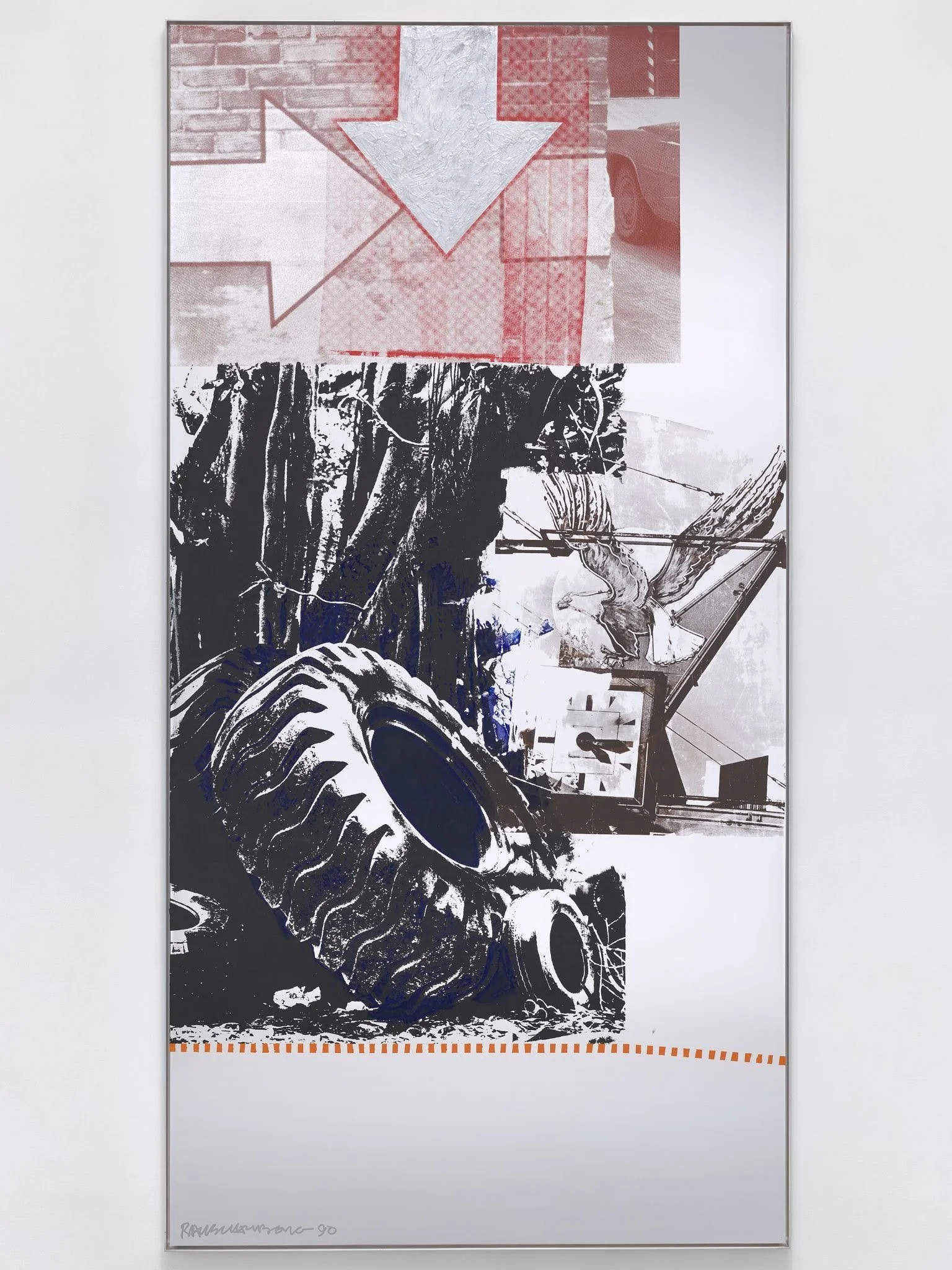
Robert Rauschenberg
Treadle / ROCI USA (Wax Fire Works), 1990
Source imagery for Treadle from the artist’s black and white photography
Courtesy of the Robert Rauschenberg Foundation
Thaddaeus Ropac (D22), meanwhile, showed Robert Rauschenberg’s Treadle / ROCI USA (Wax Fire Works) (1990), an unusual example of the artist’s later experimentation with metal painting, combining silkscreened and hand-painted imagery with pigmented wax on mirrored aluminum. Realized through an encaustic technique Rauschenberg called ‘fire-wax’, hot wax mixed with pigment was screen-printed onto the metal surface. Part of the work’s title, ROCI, refers to his Rauschenberg Overseas Culture Interchange project, named after his pet turtle, Rocky. The motifs in Treadle include the artist’s own black-and-white photographs, drawing on recognizably American imagery such as the bald eagle and other national symbols. One of just 20 metal paintings in the series, the piece offered a less familiar perspective on Rauschenberg’s practice and felt remarkably contemporary.
At Perrotin (C08), Sophie Calle’s (b. 1953, Paris, France) intimate mixed-media work Exquisite Pain, 88 Days Ago (1984–2003), part of her larger series of the same name, stood out for its intricate combination of photography and text on linen, arranged in two diptychs and framed in black wood. In the series, Calle explores personal and collective suffering through images and texts documenting the aftermath of a devastating breakup, which took place over the telephone in a hotel room. Gathering accounts of similarly shattering experiences from others, she places her own grief alongside theirs, turning shared experiences of suffering into a means of overcoming her heartbreak. The title itself suggests the possibility of transforming pain through its retelling.
Sophie Calle
Exquisite pain, 88 days ago, 1984 - 2003
Two colors photographs, two embroideries, flax, aluminium, wooden frames
Overall: 191.7 x 139 cm | 75 x 55 inches
Photo: Eva Herzog. © ADAGP, Paris, 2026
Courtesy of the artist and Perrotin.
Elsewhere at the fair, artists extended photography beyond the conventional print, integrating it into painting, sculpture and assemblage. At Galerie Poggi, Spanish artist Darío Villalba (1939–2018) combined photographic imagery with painterly interventions to examine bodily vulnerability and alienation. At Galeria Francisco Fino, Portuguese artist Vasco Araújo (b. 1975) mounted fragmented photographic sequences onto the metal and wooden chassis of an obsolete camera in Punctum #23 (2026), drawing attention to the passage of time and what remains unseen. At PM8 Gallery (B36), Palestinian-Irish artist Rosalind Nashashibi (b. 1973, London) explored desire and the gendered gaze in The Joins (2013), a series of handmade prints depicting men’s underwear and jeans, playfully reversing conventional associations between clothing, sexuality and the object of desire. Lithuanian artist Gediminas Akstinas (b. 1961), also represented by PM8, approached the relationship between photography and sculpture through minimalist shelf-like constructions, some supporting photographs and small objects. A recurring motif since the 1990s, these deceptively simple pieces introduce a subtle sense of humor by elevating the ordinary into something worthy of contemplation.
Rosalind Nashashibi
The Joins, 2013
Courtesy Rosalind Nashashibi and Galeria PM8/Francisco Sala
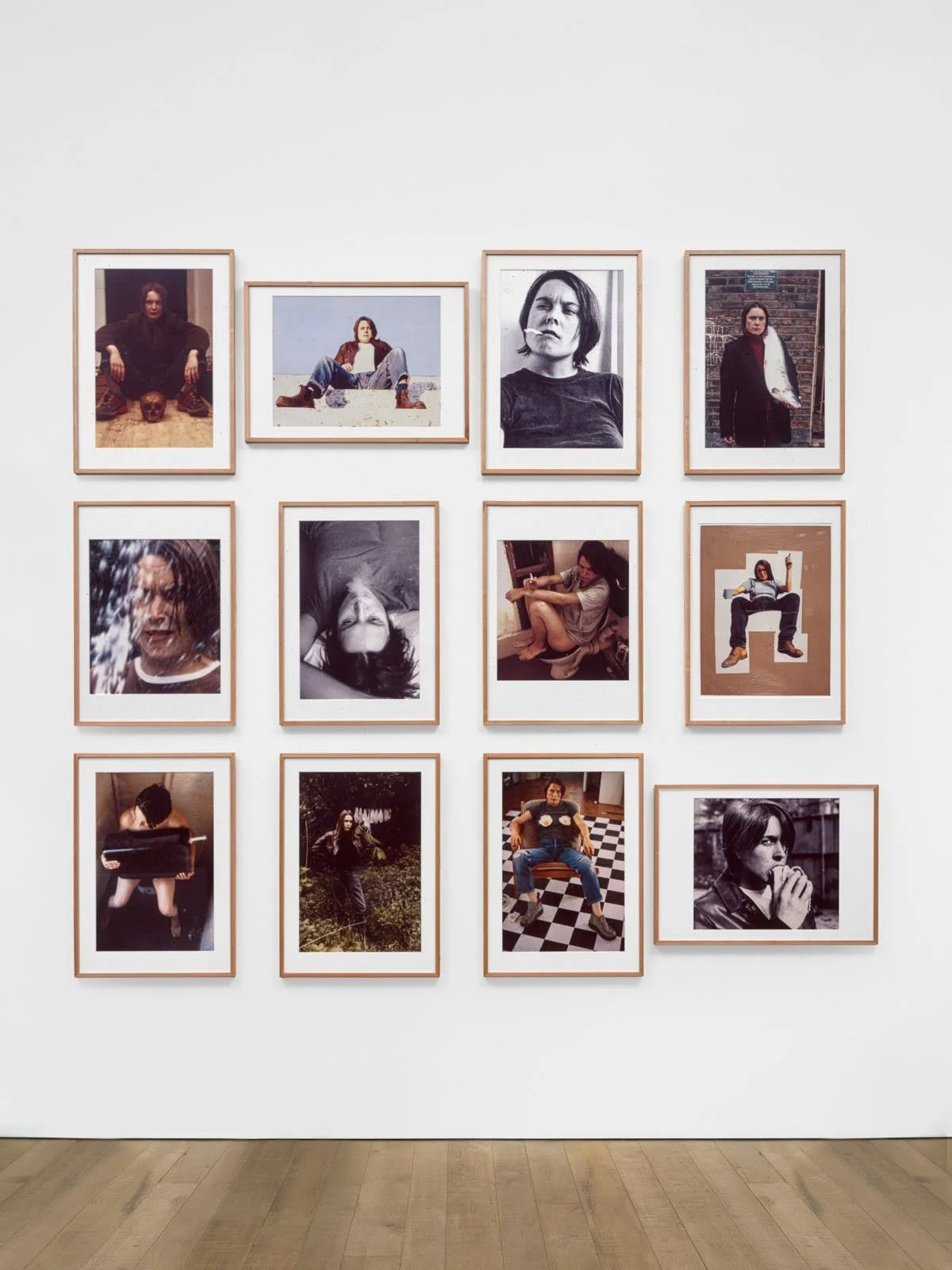
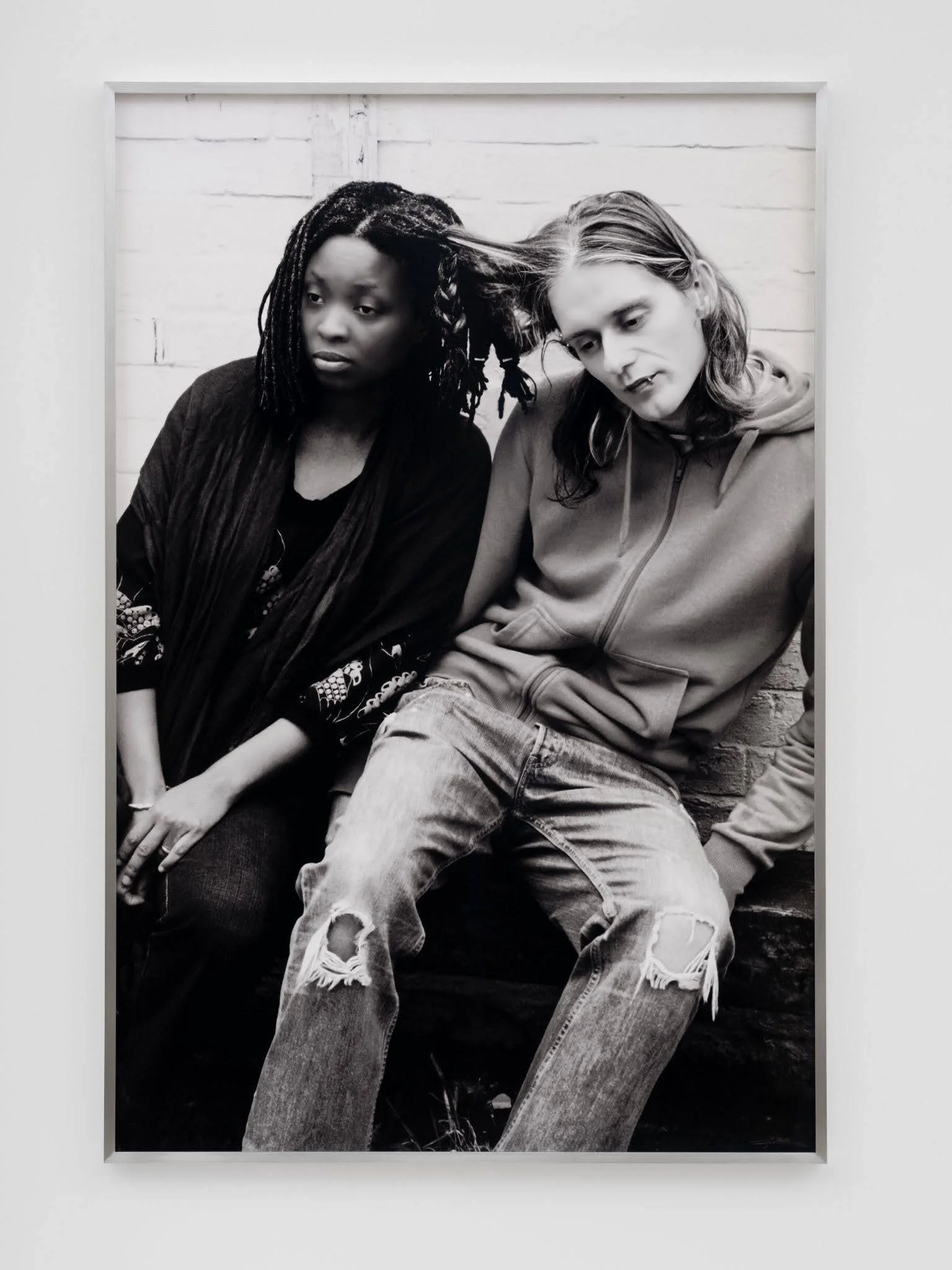
Hauser & Wirth and Sadie Coles HQ offered more direct approaches to photography through works by Sonia Boyce and Sarah Lucas, respectively, exploring questions of identity, gender and representation. Boyce’s Adjust (2006, printed 2026), a black-and-white pigment print on archival paper, depicts her black hair entwined with that of a young white man, bringing questions of racial identity, intimacy and interconnectedness into focus. At Sadie Coles HQ, a suite of Iris prints from Lucas’s Self Portraits 1990–1998 (1999) was hung in a tight cluster. Through irreverent, often confrontational imagery, Lucas challenges conventions of femininity and the female body.
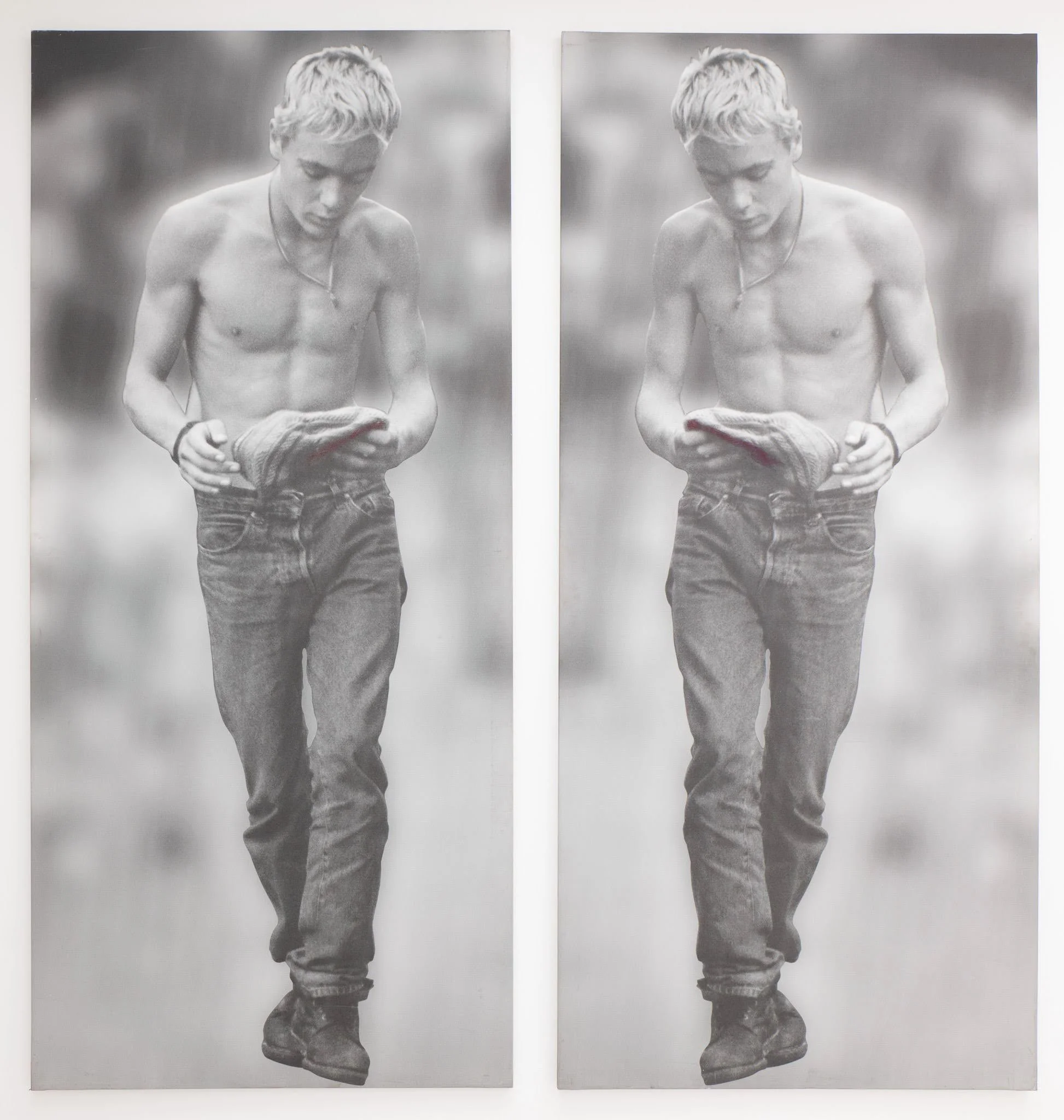
Among the fair’s other strong photographic presentations, David Zwirner (D15) showed works by William Eggleston (b. 1939, Memphis, Tennessee), the canonical American pioneer of color photography. In two untitled prints from the early 1970s, Eggleston elevates everyday scenes through unconventional compositions and saturated color. Both exemplify his use of dye-transfer printing, a technique that produces exceptionally rich, precisely controlled colors. In contrast, Steven Shearer (b. 1968, New Westminster, Canada) draws on European Romanticism and Symbolism in his oil paintings on linen, combining classical portraiture with imagery borrowed from heavy metal and underground youth culture. His often androgynous, introspective figures, as seen in PoCo Rococo (2025), recall the melancholic subjects of nineteenth-century painting, while their contemporary references raise questions of masculinity, alienation and identity.
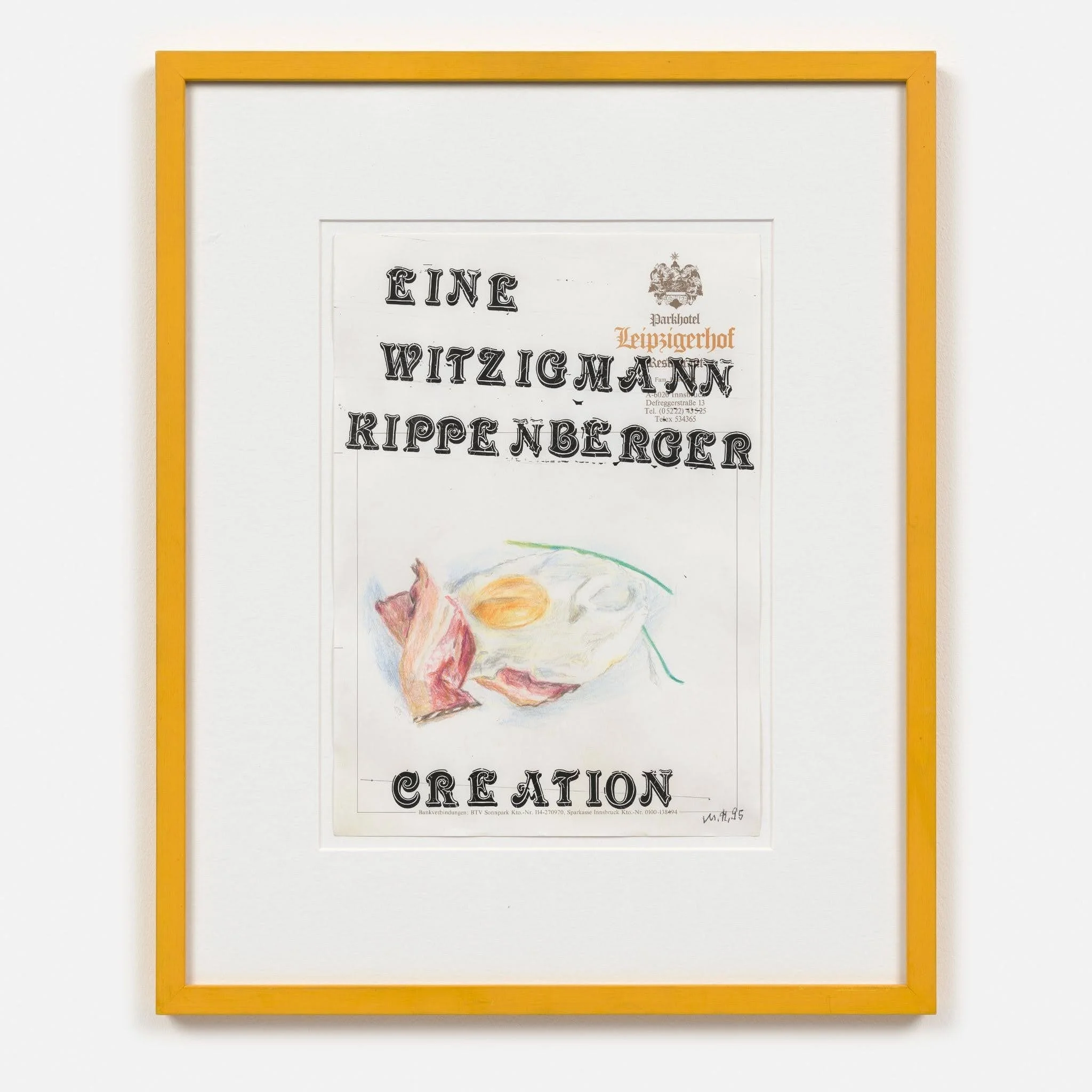
At Galerie Max Hetzler (B14), Martin Kippenberger’s (1953–1997) Untitled (Parkhotel Leipzigerhof) (1995) offered a characteristically irreverent take on artistic convention. Part of his extensive series of Hotel Drawings, begun in the 1980s, the work transforms hotel stationery into an unlikely artistic surface. Here, a loosely sketched breakfast of bacon and eggs sits beneath the hotel’s ornate lettering, combining the banal with the absurd. Inspired in part by the value attached to Picasso’s sketches on hotel stationery, Kippenberger used the series to question artistic prestige and the relationship between an artwork and its maker. The apparent spontaneity of these drawings, many of which were produced away from the hotels they reference, further complicates their seemingly autobiographical character.
Paula Rego
Get Out of Here You and Your Filth, 2013
© Estate of Paula Rego
Courtesy Estate of Paula Rego and Victoria Miro
At Victoria Miro (D12), Get Out of Here You and Your Filth (2013), executed in pastel on paper and aluminum by pioneering Portuguese artist Paula Rego (1935–2022), reflected the continued demand for her work, which was also prominently represented across several booths at Frieze Masters. Drawing on Portuguese literary traditions, the painting belongs to a series inspired by The Relic (1887), a novel by Eça de Queirós that satirizes religion and greed. The story follows Teodorico, who feigns devotion to secure his wealthy aunt’s inheritance. During a pilgrimage to the Holy Land, he searches for a relic to demonstrate his faith, only for a comic mix-up to result in a negligee being presented to his aunt instead. Rego’s characteristically unflinching satire leaves her reaction unresolved.
Elsewhere at Frieze London, contemporary painters explored increasingly ambiguous relationships between reality, memory and representation. At Carlos/Ishikawa (A17), Belgian artist Bendt Eyckermans (b. 1994) exhibited The burning (2026), a large-scale oil painting that draws on everyday encounters while unsettling conventional perspective through distorted figures, cinematic compositions and surreal details. In the Artist-to-Artist section, Vienna-based Romanian painter Paul Robas (b. 1989), invited by Louise Giovanelli and presented by Alice Amati (AA2), examined the instability of memory through fragmented, anonymous portraits. Working from digitally manipulated photographs, Robas combines oil, ink and encaustic to create blurred, layered figures that appear on the verge of dissolving. At The Modern Institute, Glasgow-based artist Lewis Miller (b. 1992) similarly introduced a sense of unease into familiar surroundings. In Studio with Jackets, an unoccupied interior becomes disconcerting through flattened shadows, uncertain scale and the suggestion of a recently departed presence.
Bendt Eyckermans
The burning, 2026
Oil on linen
199 x 165 x 2.5 cm78 3/8 x 65 x 1 in
©BendtEyckermans2026, courtesy the artistandCarlos/Ishikawa, London; and MendesWood DM.


