Joan Semmel
Sunlight, 1978
Oil on canvas, 60 x 96 in. (152.4 x 243.8 cm)
Courtesy of The Jewish Museum, New York
text by Emma Grimes
Uptown at the Jewish Museum, Joan Semmel: In the Flesh provides a survey of 16 works, spanning from 1971 to 2023, that tell the rich and compelling story of Semmel’s artistic evolution. And further downtown at Alexander Gray Associates, Continuities presents recent works, painted within the last two years, from the same pioneering artist. Together, these concurrent shows spark timely questions about womanhood, self-image, and transformation.
The Jewish Museum’s show begins with works from Semmel’s Erotic Series—from the early 1970s—that depict heterosexual couples having sex. In Flip-Flop Diptych (1971), the first painting shows a woman, rendered in a yellow-orange hue, straddling a reclined man. The second image, as the title suggests, flips their positions. Nearby, Erotic Yellow (1973) shows a couple laying down, intertwined. The woman’s body is painted in cherry pink; the man in dark, olive green. The bodies appear as if inserted onto the canvas from somewhere else, and the colorful backdrops can almost feel sterile. The scenes are recognizable and undoubtedly of real life, but they’re also luminously artificial and constructed, as if these figures are on a sound stage, posing.

Joan Semmel
Erotic Yellow, 1973
Oil on canvas, 72 x 72 in. (182.9 x 182.9 cm)
Courtesy of Alexander Gray Associates, New York
Semmel positions the woman as an equal partner. It is obvious, and might be taken for granted by young viewers today, that she has desire, is acting on that desire. What might resonate more for contemporary observers has less to do with Semmel’s representation of a reciprocal heterosexual dynamic, but more with how Semmel is shown to inhabit her own body. Given the recent resurgence and glorification of skinniness on social media, the proliferation of GLP-1s, and the normalization of plastic surgery, Semmel’s offering—that one can be at ease with one’s body, no modification needed—is perhaps more radical today than before.
Following these are Semmel’s self-portraits, also from the ‘70s. Each one is painted from the perspective of looking down. Due to the natural closeness between one’s own eye and body, the limbs and curves appear striking on the large canvasses. Works like Intimacy-Autonomy (1974) recall the spectacular, natural beauty of a Georgia O’Keefe landscape.
The positioning also forces you into her own subjectivity. It reminds me, perhaps bizarrely, of Joan Didion’s description of writing as a hostile act. When an interviewer asked her to expand on this, Didion said: “It's hostile in that you're trying to make somebody see something the way you see it, trying to impose your idea, your picture.”
Semmel’s self-portraits, in a similar vein, are coercing the viewer to see things from her angle. And while every work of art must come from an individual point of view, rarely does the coercion itself become visible. In her self-portraits though, she makes you see from her own gaze while also making that very effort evident.
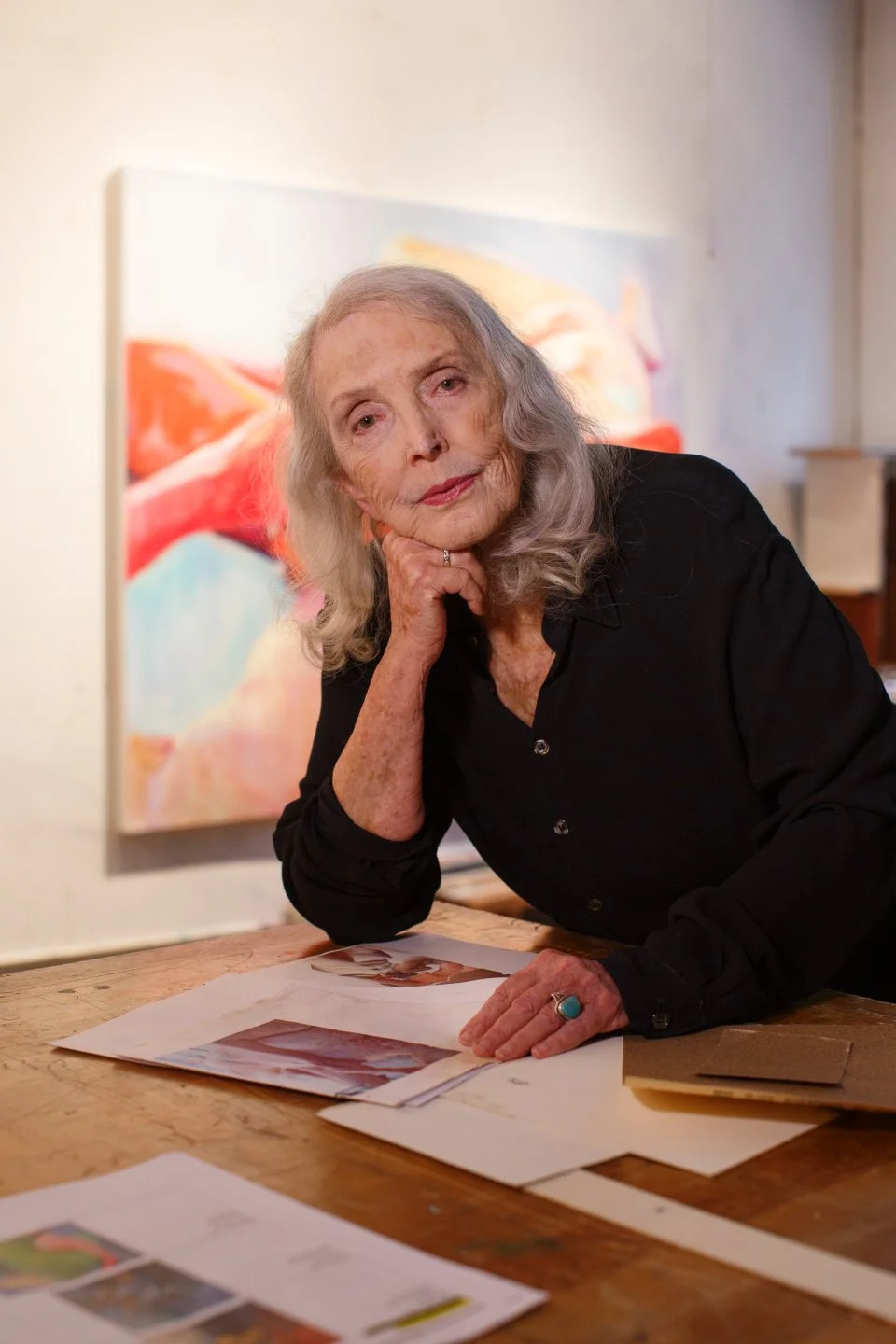
Joan Semmel’s Portrait: Joan Semmel, 2019.
Photo: Erica Lansner
In the middle of this show is a collection of other works from various artists and time periods that Semmel curated to be considered alongside her work. There are two pieces from Joyce Kozloff and Judith Bernstein respectively. There’s a sculpture from Hannah Wilke, Alice Neel’s portrait of Meyer Schapiro, Arnold Newman photographs of Louise Nevelson and Martha Graham, just to name a few. Then there are three curious variations of works referencing Adam and Eve: God’s Curse by James Jacques Joseph Tissot (1896-1902), Eve Eating the Forbidden Fruit and Handing it to Adam by Philip Galle (16th century), and Adam and Eve by Max Weber (1911-1916). There are too many to consider each in-depth, but they provide a fresh lens to consider Semmel’s work.
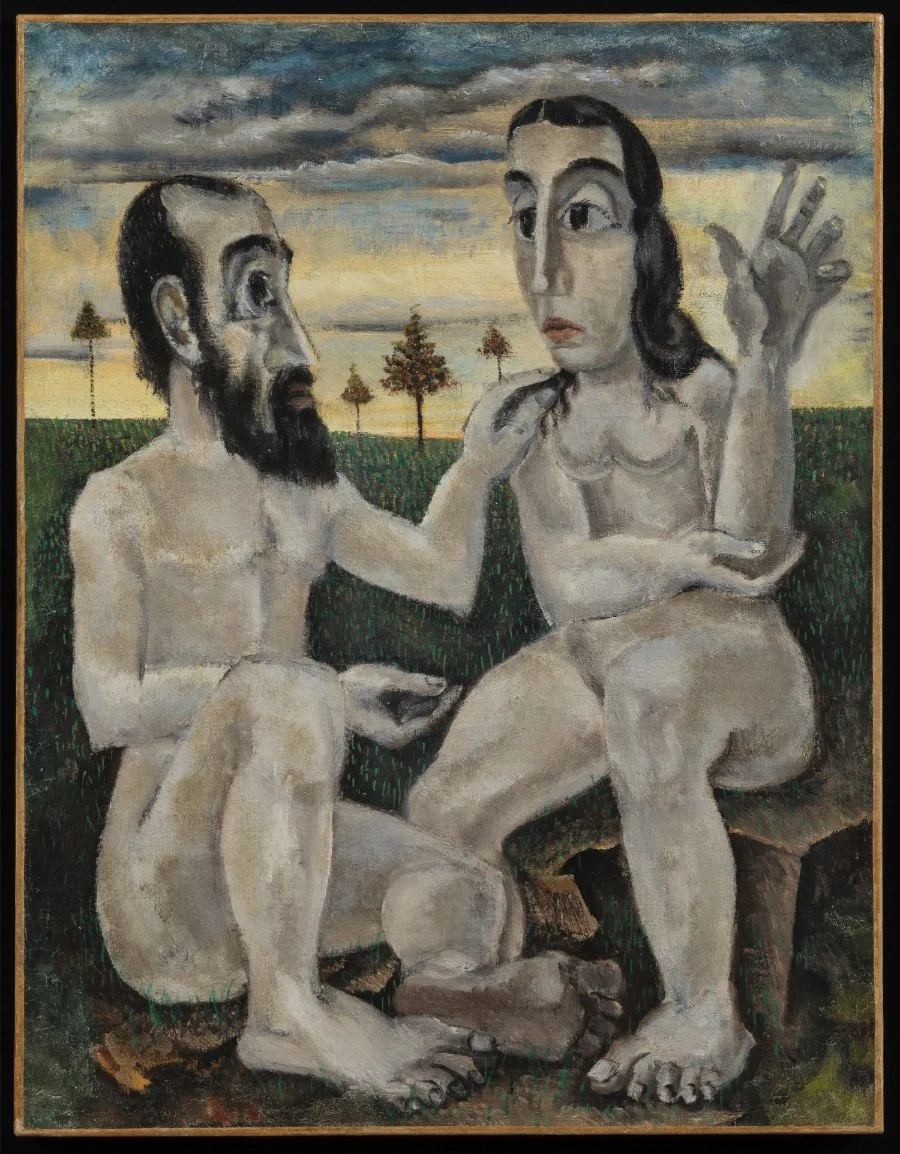
Max Weber
Adam and Eve, 1911–16
Oil on canvas, 22 x 17 in. (55.9 x 43.2 cm)
Courtesy of The Jewish Museum, New York, gift of Leonard and Phyllis Greenberg, 2014-26
The exhibit concludes with five nude self-portraits from this century, which is the subject of the entire show at Alexander Gray Associates. That exhibit, named Continuities, consists of around a dozen of these paintings, all made within the last two years.
Before entering the main exhibition room, one encounters a confrontational gaze from Semmel herself. In this self-portrait, she rests leisurely in a chair with her head tilted upwards faintly, as if she is asking something from you. The painting is titled Here I Am (2025). On second thought, it’s as though she is demanding something of you, specifically that you meet her gaze, that you look her in the eye before turning towards her body.
Among these paintings, one will quickly notice that Semmel seems to have moved on from that ambitious, subjective perspective found in her earlier works. There is a single painting, titled Shadow Heart (2024), that’s from her head looking down, except the one significant difference is that Semmel’s hand covers her lower stomach and groin. If what made her earlier nudes remarkable was their unabashed representations of the self and body—so forceful that they were transformed into imperatives to look (from her eyes) and acknowledge—then these works are tragic indications that one cannot hold onto such self-assurance forever.
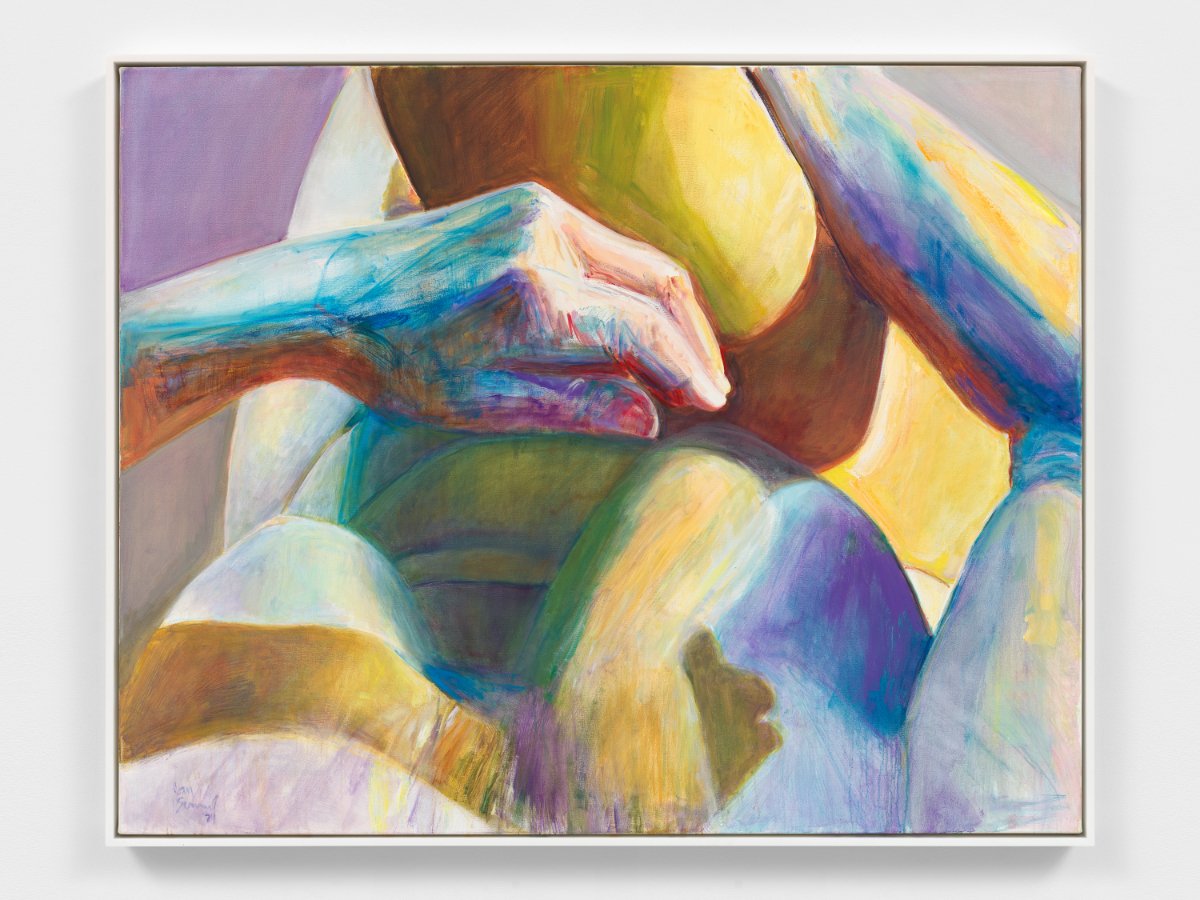
Joan Semmel
Shadowed Heart, 2024
Oil on canvas 48 x 60 in (121.9 x 152.4 cm)
Courtesy Alexander Gray Associates, NewYork; Xavier Hufkens, Brussels © 2026 Joan Semmel/Artists Rights Society (ARS), NewYork

Joan Semmel
Skin in the Game, 2019
Oil on canvas, 4 panels: each 96 x 72 in.
Courtesy of Alexander Gray Associates, New York
The language in some reviews of Semmel’s latest work is striking—well, striking, but not surprising. I mean the reviews that laud Semmel’s “courage” for revealing her 93-year-old body. “Shame is nowhere to be found,” one extolled. These reviews, needless to say, maintain the bottom-line idea that she should be—we’re expecting her to be—ashamed of her body. If nothing else, this is a curious assumption to make given her previous work.
That being said, there is something undeniably self-conscious about Semmel’s recent works. One can see this shift in a few ways. First, the gaze is made external. We are usually looking at her in these paintings, not with. Secondly, her body is not nearly as relaxed as before. She stands in front of a mirror, looking at herself. She is posing. She even covers up parts of her body in a few.
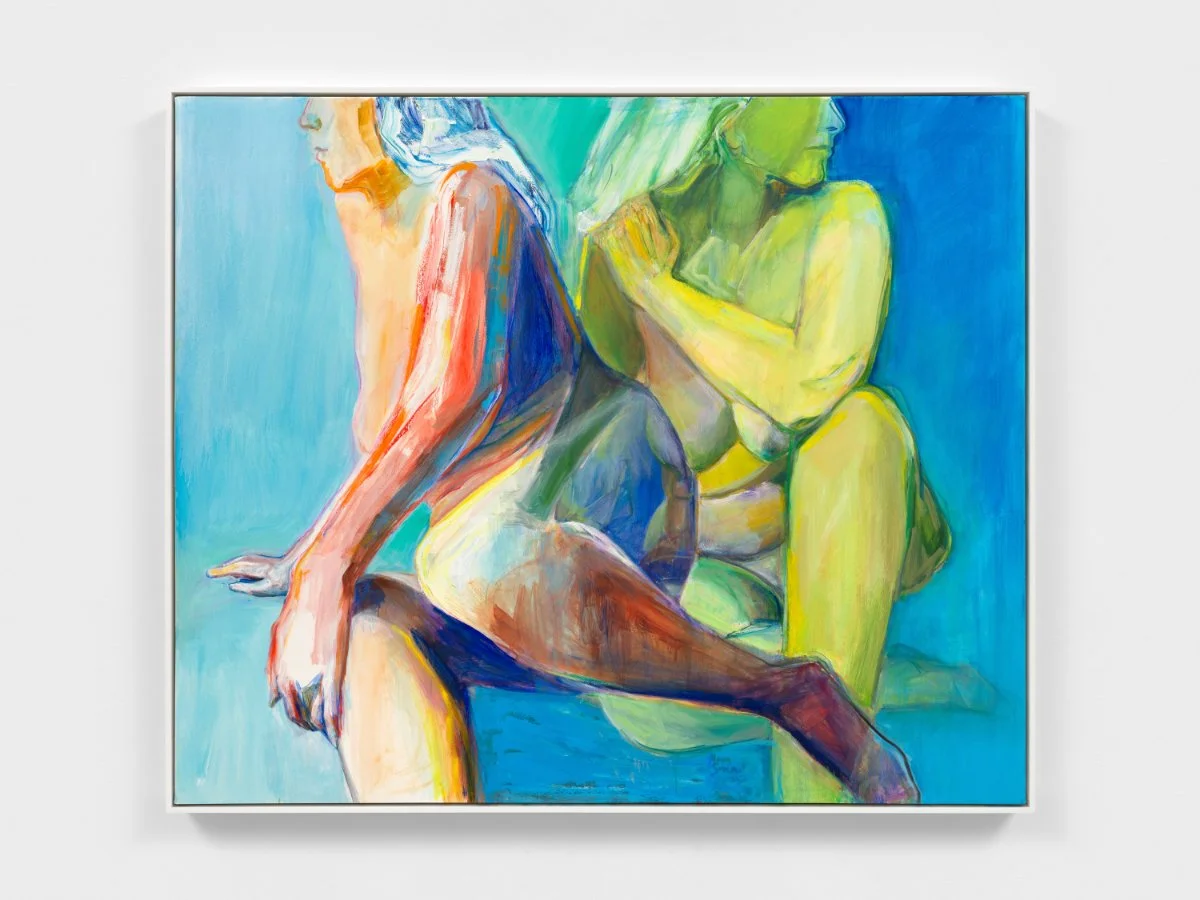
Joan Semmel
Blue Space, 2025
Oil on canvas 601/ 8x 721/8 in (152.7 x 183.2cm)
Courtesy Alexander Gray Associates, NewYork; Xavier Hufkens, Brussels © 2026 Joan Semmel/Artists Rights Society (ARS), NewYork
Compare any of these recent self-portraits at Alexander Gray with her earlier work. Take Sunlight (1978) as an example. In this work, she looks down on her soft pale body. A hand rests over her thigh, the other caresses the back of her foot. A finger on this hand presses down onto one of her toes, a subtle but meaningful detail that turns a body into a person with feelings, preferences, impulses. Her brown hair twirls over her left breast. The sunlit body sits on a white blanket. In the corner of the canvas’s left side are small splotches of grass, offering a narrative clue: she is outside—perhaps in a garden—appearing to enjoy the day’s warm sunlight. Wherever this person is, one also wants to be.
The painting, from a technical standpoint, is sublime (one does not want to look away), but what has always persisted for me, after one must look away, is this woman’s embodied presence. It is an attunement both with life outside and the life within. She is more than just unashamed of her body; she actually seems innocent of the knowledge that she ever had to be—like Eve, of course. And this mode of being cannot coexist with self-consciousness, and self-consciousness is precisely what worms its way into Semmel’s more recent self-portraits. Iris Marion-Young would describe this phenomenon as a woman seeing herself as another thing in the world, and therefore, she “remains rooted in immanence, is inhibited, and retains a distance from her body as transcending movement and from engagement in the world’s possibilities.” It is this distance that becomes present in these recent works where Semmel’s hands cover her face or where she watches herself mediated through the mirror reflection. What nevertheless remains astonishing is how Semmel—ever, yet alone for so long—created work unveiling her own body that simultaneously denied anyone the ability to turn her into an object. Where that sounds like a contradiction, it somehow never was.
This shift might provide an answer as to why Semmel chose multiple works depicting the story of Adam and Eve to be viewed alongside her exhibit. Tragically, one can’t stay in the garden forever.
Joan Semmel: In the Flesh is on view through May 31 at The Jewish Museum, 1109 Fifth Avenue, New York. Continuities is on view through May 30 at Alexander Gray Associates, 384 Broadway, New York.