
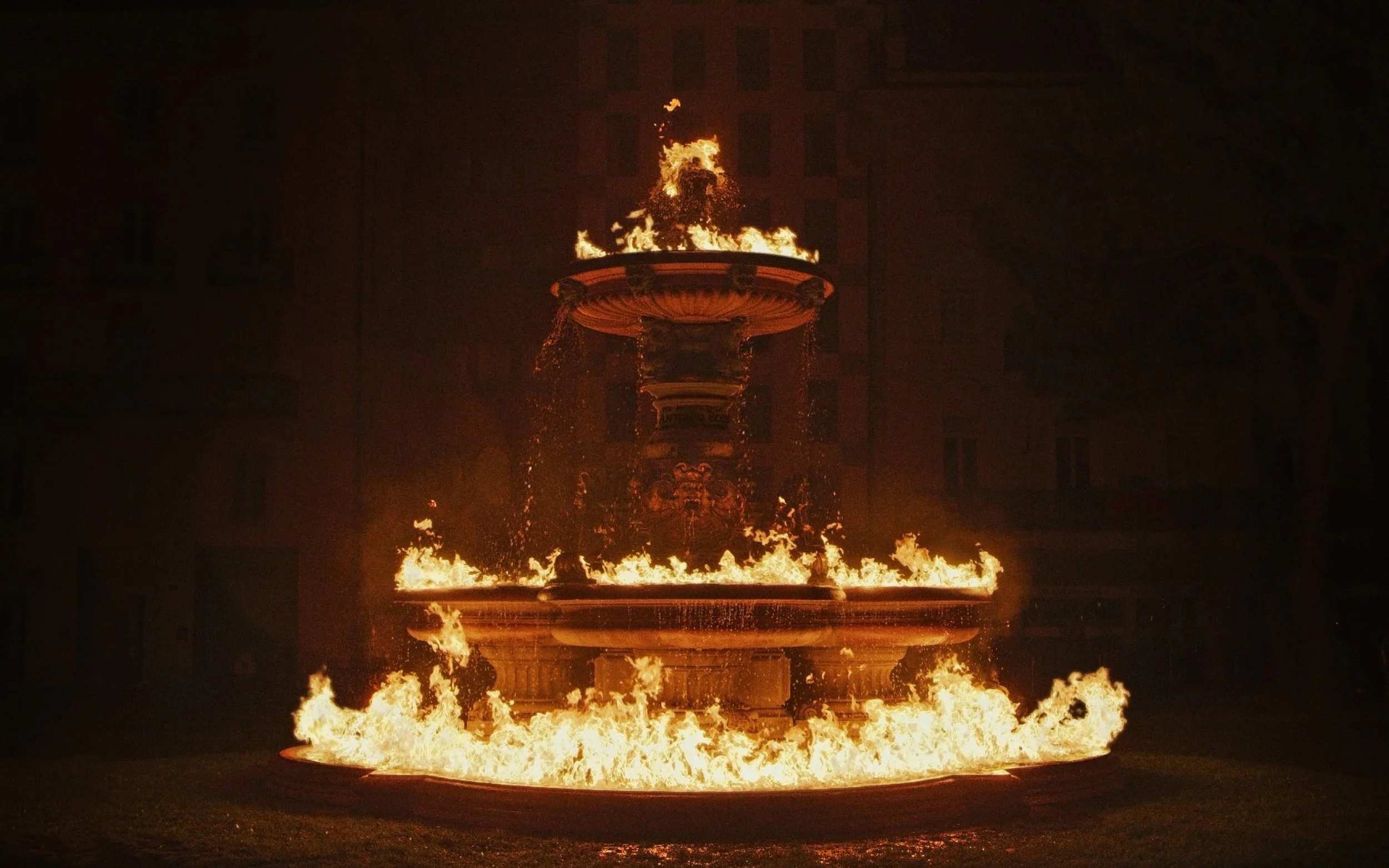
Julian Charrière, And Beneath It All Flows Liquid Fire, 2019
Video still. Copyright the artist; VG Bild-Kunst, Bonn, Germany
interview by Oliver Kupper
Traveling the world—from Greenland to Bikini Atoll—French-Swiss artist Julian Charrière captures the debris of human impact on Earth. Using myriad mediums, he exposes the layers of sedimentary scar tissue as a result of our unbridled ambition to conquer nature, and decodes the ecological algebra within its complex systems. Balancing anthropogenic and cosmic time scales, he fuses fine art and scientific practices to discover where we fit into this ancient equation. In Buried Sunshine, which will debut this fall at Sean Kelly gallery in Los Angeles, he explores the fraught history of oil extraction in Los Angeles; the world’s largest urban petroleum field. Using heliography—one of the oldest photographic techniques using light-sensitive emulsion incorporating tar from La Brea, McKittrik, and Carpinteria Tar Pits—he creates an abstract aerial view of the wastelands. Charrière’s oeuvre asks eternal questions: how did we get to now and will we survive tomorrow?
OLIVER KUPPER You are currently in Greenland; can you talk a little bit about what you are doing there and why the country is so important in your practice?
JULIAN CHARRIÈRE There is something about the topography of Greenland, or perhaps the lack of topography, which I am drawn towards. Without trees and houses, the landscape itself is a blurred boundary between sky, and ice, and land. Even circadian rhythms come undone there since the planetary tilt delivers entire seasons of white light and then months of uninterrupted darkness. I am traveling there with a scientific expedition, joining the scientists on a journey around East Greenland. During this time, we live on an icebreaker and trace the coastline, allowing samples to be collected from otherwise difficult-to-reach locations. For me, it marks the first step of an upcoming project, for which I am trialing a new ROV (remotely operated underwater vehicle) in the icy surrounding waters. Filming below the surface of the Greenlandic Sea, you quickly realize that global warming is not only causing glaciers and icebergs to disappear, but that with them entire oceanic ecosystems dissolve.
KUPPER The theme of this issue is instinct. I think a lot of artists unleash their instincts, or unlearned impulses, to drive their creativity. What does instinct mean to you and how does it drive your work, especially when it comes to your immense, adventurous spirit?
CHARRIÈRE I think instinct plays an integral role in my output, fused always with curiosity, though I would maybe describe it more as intuition. And honing that is part of what makes artists capable of approaching ambiguous, complex, and dense topics, which might otherwise seem daunting. Even when encountering something opaque, you can instinctively choose a thread to pull on or descend into a certain rabbit hole, guided by the voices that echo from within it. My intuition has, at times, unleashed an instinct leading me down some very strange paths. From polar ice sheets to the depths of palm oil plantations, these are locales that at first glance might seem remote or liminal, until you arrive and realize that these are places. They are as much homes to the human and non-human animals who live or lived there as your home is to you. Of course, it is exciting to dive in the Bikini Atoll and see the hulls of warships sunk by the US during nuclear tests in the 1950s, but the adventure is secondary to the encounter with that history, and especially how we relate to it today. The first instinctual spark of curiosity is almost gravitationally connected to that physical encounter, tethered to it like those distance lines cave divers follow in the dark, leading them through the unknown. You feel there is something beneath or beyond—some long-forgotten history, or fate, or lively material shuffling around—and so you listen to your gut, and look beneath the rind, and see what you can maybe bring into the light.
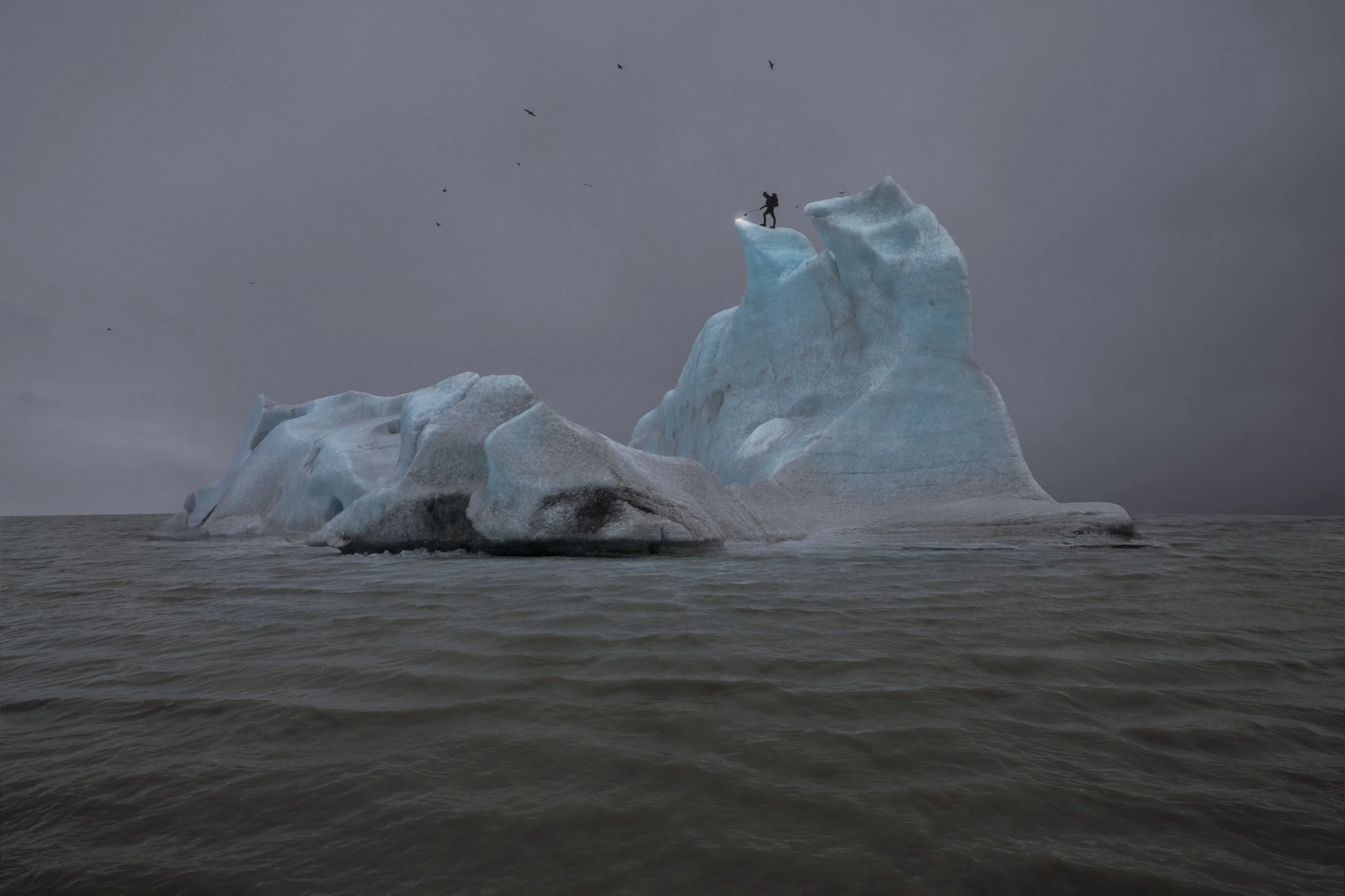
Julian Charrière, The Blue Fossil Entropic Stories I I I, 2013
Copyright the artist; VG Bild-Kunst, Bonn, Germany
KUPPER When did you become interested in the natural world and when did the ecological enter your artistic lexicon?
CHARRIÈRE Even from an early age I was interested in immersing myself in my surroundings, and so I spent a lot of time in the natural landscape interacting with snakes, and frogs, and birds, and plants. It has always felt like an integral part of my being and how I evolved in the world. As a kid, it wasn’t so reflected, and this idea of immersion and encounter only began fully developing when I started studying art. It expanded into this idea of meeting a particular landscape, rendering it a tool for thinking about how we think about ‘nature’—how it is framed as a milieu, or a system, or whatever. In terms of environmental perspectives, this is almost always present, since when you investigate such topics you almost inevitably arrive at the ecological meltdown which looms ahead.
KUPPER The summer of 2023 was the hottest in recorded history. Your work deeply explores the impact that humans have on our natural world and landscapes, why don’t you think our survival instinct kicks in with these dire warnings about the planet?
CHARRIÈRE Complacency is a tricky thing. But I think it is critical to examine who is responsible for the situation we are in and what one can conceivably expect from individuals. It’s like how British Petroleum in the early 2000s popularized the expression ‘carbon footprint,’ devising a marketing campaign that bestowed upon us the idea that environmental pollution is the responsibility of private citizens, rather than the oil companies. More so than asking why our survival instinct hasn’t kicked in, maybe we can investigate the often-reciprocal relationships between political systems and corporations. How can we require scrutiny and transparency? How can we build platforms and communities or even start conversations about the industrial actions that, while conducted out of the public’s view, will have devastating consequences for our planet? One of the reasons why I think our response may appear so apathetic is because climate change is vastly abstract. Our human reaction time is incompatible with it, making global warming feel fast and slow at the same time. It only becomes somewhat tangible when you encounter it firsthand: when your commute to work is flooded, or your house is engulfed in fire, or a garden that was once abuzz with life is dead quiet in midsummer. I think one strength of art is that it can be used to countermand this kind of apathy by exploring challenging topics and uncomfortable feelings; deconstructing the arbitrary and systemic, thus perhaps providing tools for dealing with the terrifying uncertainty that might otherwise shut us down emotionally.
KUPPER Do you feel there are too few artists leaving their studios to tackle these major issues of our time? Is a studio painting practice self-serving in the age of the climate crisis?
CHARRIÈRE No, I wouldn’t say I feel that way. A painter should paint, whereas another artist might need to travel to dream. It would be reductive to art as a vocation if there was pressure to conform to political themes, even if those themes are urgent ones. And really, how interested would we be if every artwork we experienced was didactically about climate change? In my works, there are often environmental themes present, but these are often enmeshed in other perspectives as well. With my latest film Controlled Burn, for instance, the meta-layer is very much about extractivism, visually foregrounding the buildings we construct and spaces we carve out for energy production. But while it features a power plant cooling tower, an abandoned open-pit coal mine, and a towering ocean oil rig, it also explores other things beyond environmental degradation. In the film, you soar through reversing pyrotechnics, mirroring the intense power released by our terraforming. But it is also about the past biomes that now constitute our coal, and petroleum, and natural gas: the Carboniferous woodlands that outgrew themselves and condensed in the earth to what we now repatriate as resources. It is not explicitly about tackling a major issue but acts as a cosmic meditation on energy transformation. Someone could argue that what we need are more explicitly environmental works, but art often operates in less obvious and more ambiguous ways, and that is a strength.
KUPPER Fire has been a central theme in your work, but also ice and glaciers. There seems to be a fascination with the primordial and the elemental. Where did this fascination come from and what is the symbolism of fire and ice?
CHARRIÈRE Our history with fire, but also the history fire has with our planet, was something I delved into recently for my exhibition, Controlled Burn, at the Langen Foundation. It foregrounded one of the reasons why I am interested in these kinds of biochemical processes: the fact that they have fates of their own, often long predating our hominid entry onto the planetary scene. The first fires emerged from the very properties of life. To paraphrase the fire ecologist Stephen J. Pyne, the story of fire is the story of oxygen and plants. Without either, the ignition of lightning would never flourish into flame. So, as life ascends from the seas and begins to grow on land, we also encounter the earliest flames, with the earliest record dating from charcoal in rocks some 420 million years ago. This was in part an inspiration for Panchronic Garden, which is a dark and crackling installation in the show. Set in a reflective and coal-based scenography, it figures ancestral plants to those who lived during the Carboniferous era. Entering this smoldering coal seam, the visitor can listen to a real-time soundscape produced by the ‘umwelt’ experienced by the vegetation in the space. Now and then, a fluorescent flash erupts in the space—perhaps the ignition of that first coming-together of the components that necessitate fire. But then, sweeping through that deep time, we arrive in the era of humankind. Fire integrates into our agriculture, and then to a degree manufactured in our combustion engines, not only burning the raw materials of the present but the lithic landscapes of the past. Oil, and coal, and natural gas are extracted and burned for fuel, warming the future. In my work, I am drawn to investigate these cycles and systems, with which our idea of reality is inextricably linked. Ice too holds histories, suspending within it registers of past atmospheres, yet for us living in the so-called Anthropocene era, the icebergs, and ice sheets, and glaciers also act as clocks, physically counting down towards an uncertain future. There is also the paradoxical situation where neither state is particularly compatible with human beings, both ice and fire are entities with which our bodies cannot cope—thus confronted with agencies beyond our immediate control.
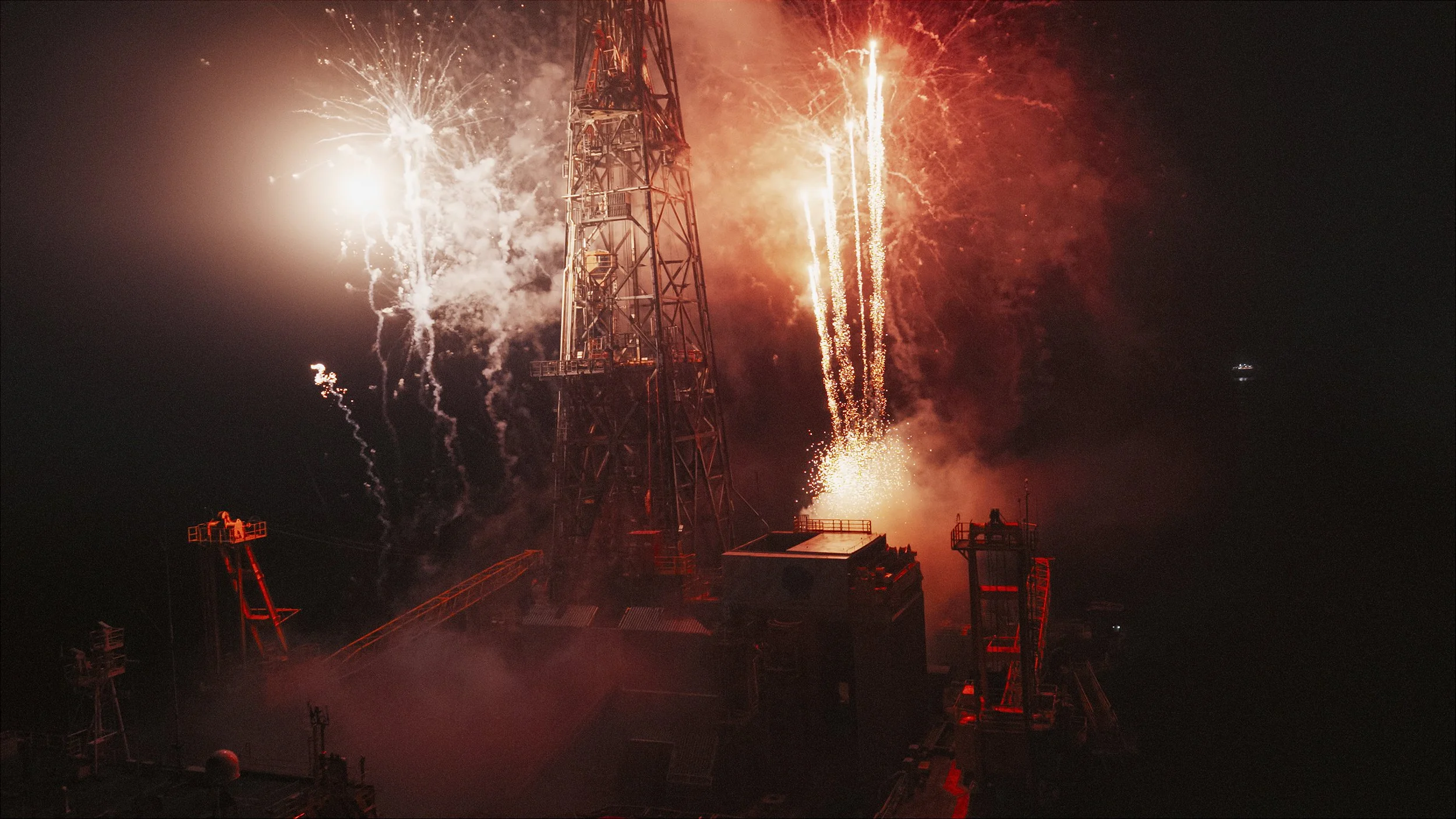
Julian Charrière, Controlled Burn, 2022
Video still. Copyright the artist; VG Bild-Kunst, Bonn, Germany
KUPPER One of your most symbolic works is And Beneath It All Flows Liquid Fire, which adds another layer of symbolic meaning. Can you talk about this iconic work and how the fountain is connected to civilization?
CHARRIÈRE Alongside the control of fire, the fountain represents one of the most fundamental achievements of human civilization, since the invention of wells shifted us from a nomadic lifestyle to a sedentary one—in turn giving rise to agriculture and thus sowing the seeds for future industrialization. As a symbol, it has this rich and poetic history, from the original spring fountain where it provided vital water, to the ornamental versions that publicly displayed not only the technical achievements of the jets, but the power and ‘overflowing’ wealth of those who could afford to install them. In this sense, And Beneath It All Flows Liquid Fire is a memorial of anthropogenic hubris; our belief that the natural world can be dominated and natural elements controlled. But it can be interpreted in many ways, with the presence of fire anachronistically engulfing it, pointing to the nether realms beyond our purvey. How beneath the political debates, philosophical reflection and symbolism, there lies the original and autonomous state of the planet, free from human interpretation. How deep beneath the Earth’s surface, between the outermost crust and the inner core, magma constantly churns. I was interested in juxtaposing this uncanny underworld, where liquid fire constantly flows inside of a recognizable structure like the fountain. And while I wanted to point to the ambiguity of fire, a power which, like us, is capable of both creation and destruction, it is maybe unavoidable in the current climate of erratic wildfires and rising temperatures for the work not to feel a little like an omen.
KUPPER Not only has this summer been blazing hot, but there has been a renewed concern with nuclear devastation—can you talk about your experimentations with atomic energy?
CHARRIÈRE In a way, our belief that we can control elements, as with water in the previous question, becomes truly unhinged when we begin developing nuclear weapons. As we are no longer trying to command simply an Earthly element, but the atomic power housed by stars. I first began working with radioactive materials in my series Polygon. I traveled to the Semipalatinsk Test Site in Kazakhstan where the USSR conducted its nuclear tests. In the production of the photo series, the negatives were exposed to local sand, which was still radioactive from the site. Though invisible to the human eye, the radioactivity seared bursts of white light onto the final photographs. I returned to this method in a more expansive project where I, together with curator and writer Nadim Samman, journeyed to the Marshall Islands; to the atolls where the U.S. detonated some of the world’s most powerful nuclear weapons in the 1950s. It especially focused on the Bikini Atoll—a now deserted but once-populated island whose citizens were displaced by the tests. It is easy to think of this tropical island as remote, situated on the very edge of the world, but it was very much home to the Bikinnians. Even after some half-hearted clean-up efforts by the Americans, it is completely unlivable with the ground still containing the radioactive substance cesium-139, effectively poisoning any locally-grown produce. The world quite quickly forgot about the people on these atolls whose legacy fell by the wayside of the spectacular images the US took of the detonations. A large part of this military project was about visually documenting the violent potential of the US military; a way to disseminate its power through media. In a sense, I too documented this action with my photo series First Light. It was not an encounter with the thermonuclear reactions, but rather a portrait of the white shadow eternally expanding from the events themselves. A meeting with a cosmic specter who still haunts the beaches: the radioactivity forever crackling on the atoll. It is strange, of course, to think how much and how little has changed since. Returning to political conditions similar to those of the Cold War, it is hard to not feel like we are reaping what we sowed during that first nuclear arms race.
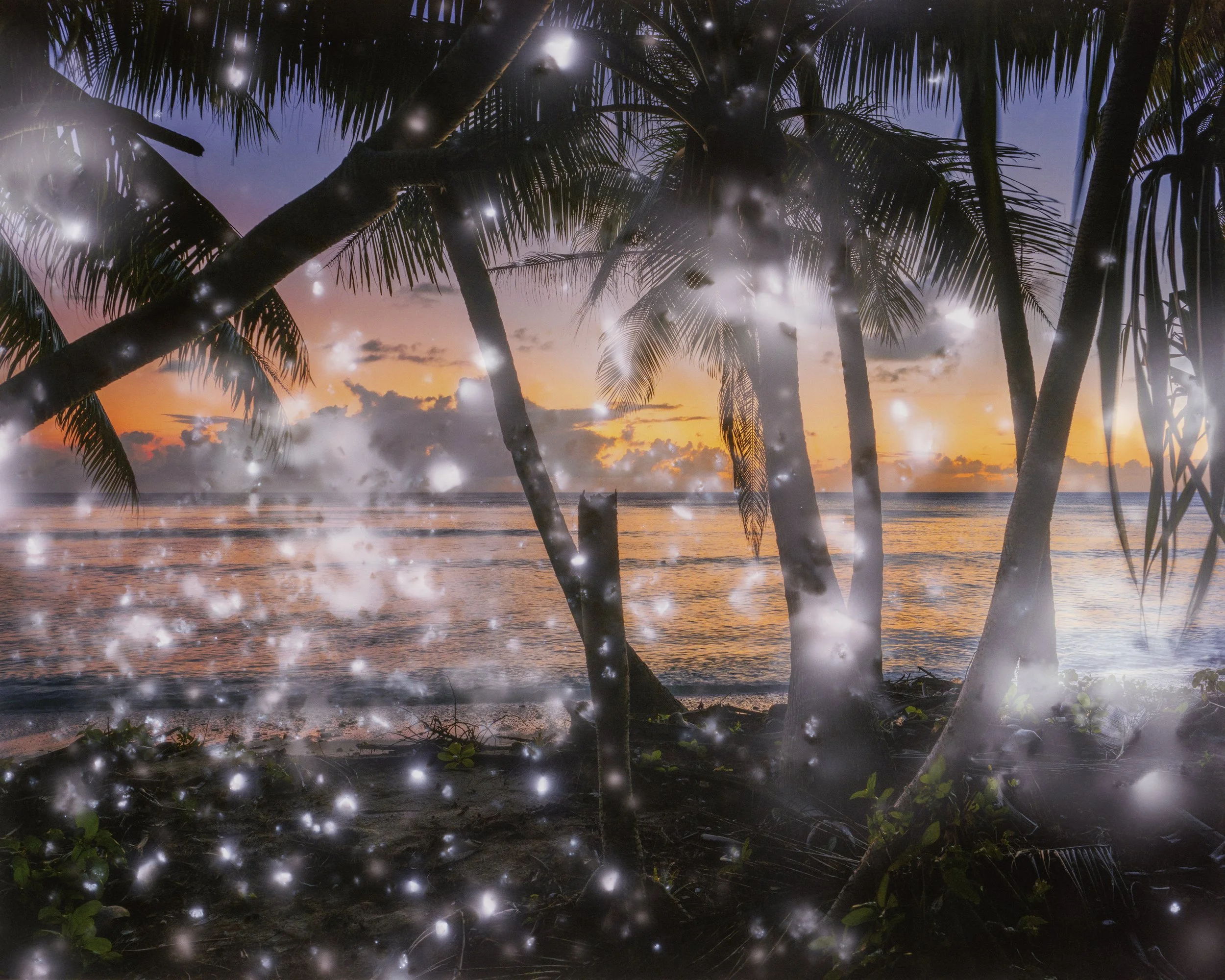
Julian Charrière, Hickory - First Light, 2016
Copyright the artist; VG Bild-Kunst, Bonn, Germany
KUPPER Can you talk about your upcoming show, Buried Sunshine, at Sean Kelly in Los Angeles?
CHARRIÈRE With Buried Sunshine, the aim is to bring together a mise en abyme of the geological materials, especially those which we utilize as tools and resources. A large part of the show is also about prying at the veneer of Los Angeles, which is the world’s largest urban oil field. It includes the aforementioned film, Controlled Burn, and a new series of heliographic works with which I wanted to unearth some of the fossilized sunshine upon which the mythos of the city is constructed. Because when you think about it, Los Angeles is a spatial anomaly, built both on top of and by hydrocarbons. Without the overwhelming abundance of oil, the film industry boom might never have exploded as it did. And to this day, one-third of residents live within a mile of a drilling site, yet those derricks are whimsically hidden behind shopping malls and artificial buildings, forging a contradictory paradise, as much a nightmare as a dream.
The heliographs, named Buried Sunshines Burn are made using one of photography’s oldest techniques, first developed by French inventor Nicéphore Niépce in 1822. It is a production method I first began experimenting with for my series A Sky Taste of Rock in 2016. To make heliographs, you use a light-sensitive emulsion, made in this case with regional tar collected from the La Brea, McKittrick, and Carpinteria Tar Pits in California, creating photographic imprints of local oil fields on highly-polished, stainless steel plates. Shot from a bird’s eye perspective, it shows the immense Kern River Oil Field in the San Joaquin Valley, the Placerita and Aliso Canyon Oil Fields in Santa Clarita, and the giant Inglewood Oil Field, which from this point of view become abstracted, coiling like oil spill through reality. Presented alongside these new works are the sculptures Thickens, pools, flows, rushes, and slows, which consist of large pieces of obsidian. The material is a type of volcanic glass produced from congealed magma during eruptions, and when you look into its seemingly depthless interior, you see why, historically, many cultures used it for divination.
With the show, I sought to contrast the dark vitality of these materials, from obsidian to coal and petroleum, with the colossal nuclear fusion of the sun: the celestial ignition for our planetary machinery. I wanted to suspend the visitor like a speck of dust in this cosmic sunbeam, revealing how light is not as immaterial as we believe. But rather show it as a topography, reaching from the silver lining of our exosphere to the deep carbon orbiting Earth’s core. It not only shines but sediments, registering in the strata much like a camera captures an image on a light-sensitive surface. It too is a photograph, opening portals to other places and times far beyond the present.