
The point is not of planning utopias; the point is about practicing them. And I think this is not a question of “should we do it or should we persist in the existing order? It’s a much more radical question, a matter of survival: the future will be utopian or there will be none.
– Slavoj Žižek
text by Abbey Meaker
Utopia is not a place; it’s a shooting star: it appears suddenly, in the eye of the mind, bright and mesmerizing, mysterious. It demands our full attention before vanishing. Utopia is not a place; it’s a moment in time, a note in tune. Utopia is a transgression. It is a question, a confrontation. It can only exist outside of our imaginations in small gestures. We can’t go there; we can’t live there, and the moment we try, the dream collapses. Utopia is not perfection; it’s freedom. In the tide of our experience on Earth, moments of utopia find us in the awareness of our interconnectedness, of acknowledging our finitude without being silenced by it. For a moment, it liberates us, and with the wind it goes.
There have been periods throughout history when the notion of utopia becomes part of the cultural zeitgeist, contemplated by artists, philosophers, and writers in the realm of an imagined paradise. Marie-Hélène Brousse opened her 2017 lecture entitled “Identities as Politics, Identification as Process, and Identity as Symptom” by arguing the fact that the dominant conception of identity is an ideal identity, whole and stable, unified and intentional (utopia). Contrary to such a view, Lacanian psychoanalysis posits that life is something which goes “à la dérive” (adrift). In other words, the idea of a unified identity is a lie, as the structure of the unconscious goes against the possibility of such a unity. The real utopia—cultivation of identity to oneself and the world around them—is one of quotidian practices. It is not an existence free of antagonisms. Our murky origins and inner workings have depth. From this dusky bloom we come with questions, compelled by curiosity and a need for connection. We follow that drive to dark places, and there we find a lighthouse, the artist. Artists are stewards of meaning, and as I consider experiential notions of utopia, I continually return to the work of Agnes Denes.
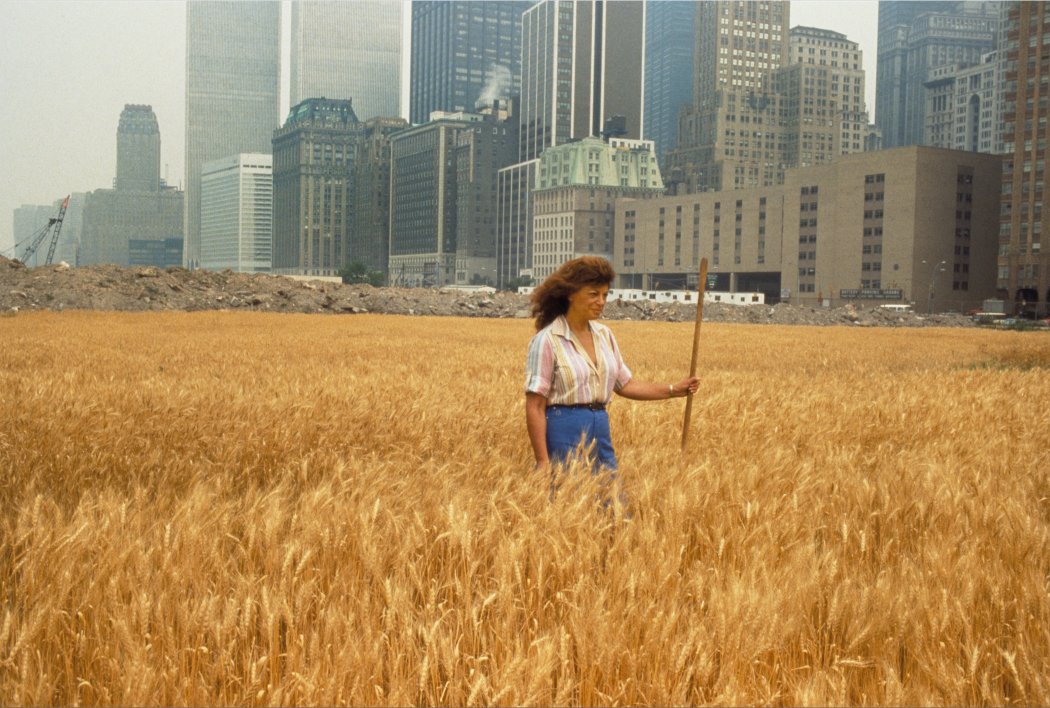
Utopia is an offering made by the hands of an artist. It is an act of creation. It is planting a wheat field on two acres in lower Manhattan as the artist Agnes Denes did in 1982. Wheatfield — A Confrontation, was sited on a landfill created when the World Trade Center was constructed in the late 1960s-early 1970s. This artwork was intentionally and aptly placed in the shadow of the towers, a stone’s throw from Wall Street with the Statue of Liberty in view. It yielded over one thousand pounds of healthy amber wheat, and in the months the wheat was maintained—on this property worth billions, representing some of the world’s greatest wealth—a compelling paradox was unearthed, a profound statement on the implications of global commerce, wealth disparity, and misplaced priorities on the culture and condition of the earth itself. Forty years later, this prescient work echoes with overwhelming urgency.
Agnes Denes, whose work has never been easy to categorize, is an artist who has continually engaged with the notion of utopia in tangible ways. Her practice, which investigates philosophy, science, linguistics, and history, is grounded in socio-political concepts and ecological concerns. Her work is motivated by a curiosity of the human mind, how we think, how we evolve, how time changes us, how previous generations inform current and future generations. Denes describes her entry into visual expression as an exit from the ivory tower of her studio into a world of concerns. For more than fifty years, Denes has used her work to call attention to and protest damaging systems of power, deteriorating values, and the ways in which our interests, choices, and problems interfere with and harm the whole of Earth’s ecosystems.
Her poetic eco-philosophical work Rice/Tree/Burial, first realized in 1968, began with a private ritual, a symbolic event and declaration of her commitment to the environment and human concerns, namely the ways in which one informs the other. Like chapters in a story, Denes began by planting rice. In the 1977 iteration of this work, the ritual was re-enacted and realized at full scale in Lewiston, New York. She planted a half-acre of rice in a field 150 feet above the Niagara Gorge. The site marked the birthplace of Niagara Falls between Canada and the US, twelve thousand years ago. Rice represented universal substance, that which brings forth and sustains life.
She chained together a series of trees in a sacred Native American forest. The chains symbolized connection, linkage in time and material, and our interference with natural processes. Reorienting these trees created, in a sense, a new ecosystem. Introducing new elements and materials, like a dam in a river, sets a cascading change into motion. The echo of interconnectedness sound.
The final chapter included the burial of a time capsule to be opened in one thousand years. It contained only the filmed responses to a series of philosophical questions that had traveled around the world, and a long letter the artist addressed "Dear Homo Futurus." The contents of the time capsule symbolized human intellect and evolution, clues as to the values of previous Earth generations.
Though conceptually rigorous, the acts involved in the rituals are everyday practices: hands in the soil, sowing seeds, burying the sacred, the symbolic, total absorption in the mundane. This work reminds us that ideas in the context of art can be more than flimsy imaginative notions, they can be used in the deconstructive remaking of the world. These gestures, the enactment of utopias, will bleed out, soaking our tightly interwoven fabric with new color and texture.
In my exchange with Agnes, she told me, and asked that I share with you, that we must turn around inside ourselves and look through a different window. To make sure we ask the right questions, questions that open the soul. The artist said she wanted to sit down with everyone reading this and start a conversation they would walk away from with a full heart, an open mind, and enough curiosity to kill a cat. I propose that we speak with Agnes, ourselves, each other, the past, the future, through a series of existential questions she buried in 1977:
1. What governs your actions? Do you think there is a force influencing what happens?
2. How do you feel about death?
3. What would you say the human purpose is?
4. What do you think will ultimately prove more important to humanity, science or love?
5. What is love?
6. What would perfect existence consist of?