
Антон Дмитриев / ehmitrich
text by Perry Shimon
The grid, in short, is a medium that operationalizes deixis. It allows us to link deictic procedures with chains of symbolic operations that have effects in the real. Hence the grid is not only part of a history of representation, or of a history of procedures facilitating the efficient manipulation of data, but also of “a history of the different modes by which, in our culture, human beings are made into subjects.”
- Bernhard Siegert
Music has no subject. It is neither the manifestation of an idea nor the illustration of a phenomenon. There is no musical heuristic. Music proves nothing. It refers to no dialectic of order and chaos, reveals no secret harmony of things, it does not render perceptible the mystery of mathematical relationships or the secret song of Nature. Nor does it call to God, nor does it corrupt the youth. It does far more than this.
- François J. Bonnet
The grid has long functioned as a top-down cultural technology for organizing space and subjects. Orthogonal planning emerged in the Indus Valley around 2500 BC, with cities like Mohenjo-daro and Harappa laid out along straight streets, and standardized architecture intersecting at right angles. In ancient Egypt, around 1895 BC, under the reign of King Senusret II, Kahun (or Lahun) a city was built in a similar fashion—tellingly—to house temporary laborers enlisted to construct a tributary pyramid. Similar spatial ordering appeared in early Chinese imperial planning, with examples like Chang’an in the Tang dynasty, where the city’s rectilinear layout was bound up with cosmological ideas of political authority and cosmic harmony. In Mesoamerica, around 100 BCE, Teotihuacan emerged as a gridded city covering more than twenty square kilometers, with standardized living compounds and monumental axial avenues.
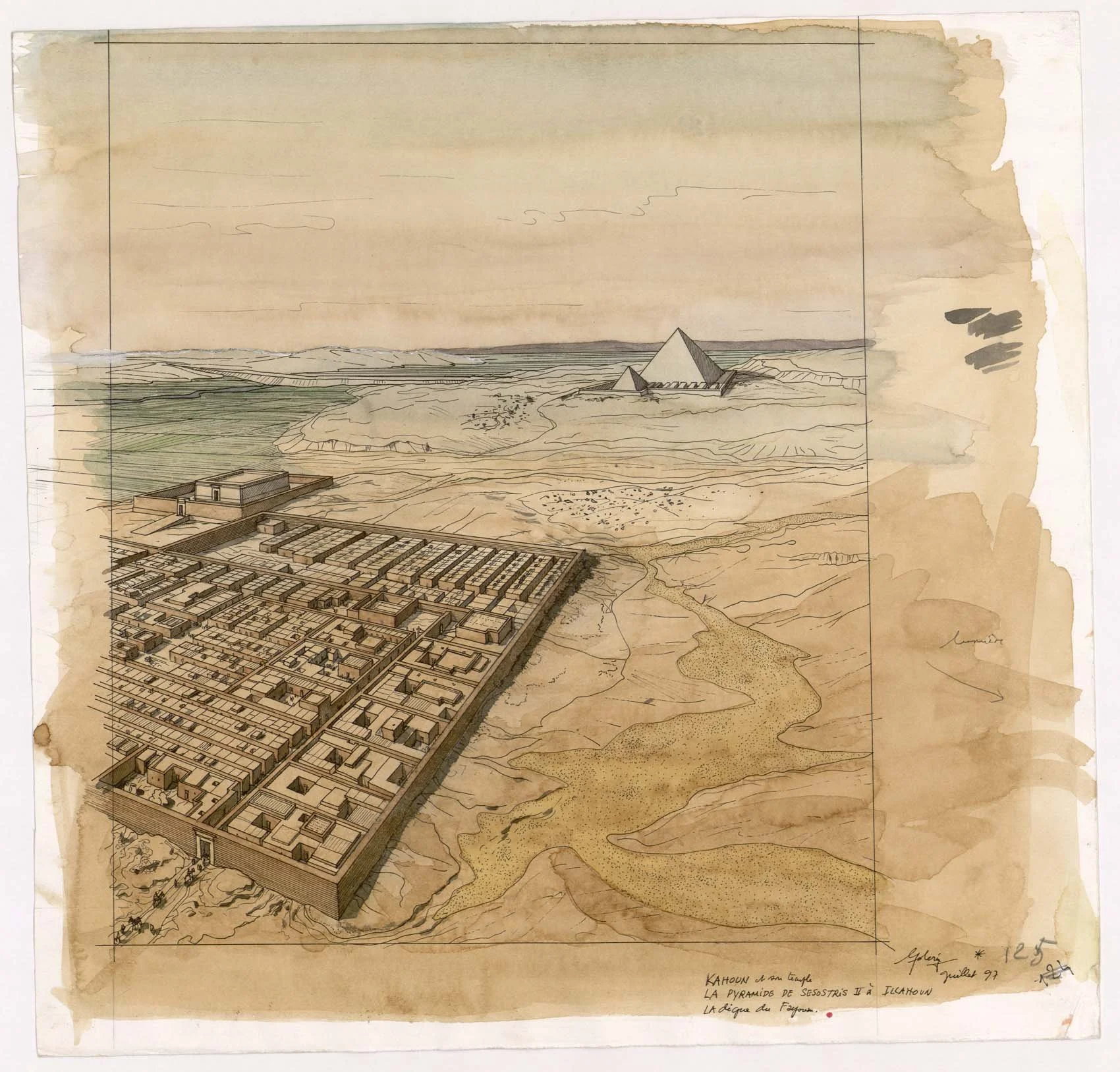
Watercolor by Jean-Claude Golvin
Excavations at Mohenjo-daro in 1924
While much about the social relations of these cultures remains speculative, these projects developed in ways that imply a tendency to organize space and bodies into governable units. They appear as coordinated, external attempts to control contingent and autonomous movements and agencies—or a system of rule that operationalizes deixis, in the words of Bernhard Siegert.
In the classical Mediterranean, the grid became an explicit instrument of imperial administration. Greek planners like Hippodamus of Miletus promoted orthogonal city plans that divided urban space into regular blocks, reenforcing ideals of order, productivity, and civic organization. The Romans extended this logic across their empire through surveying techniques that divided conquered land into standardized parcels for settlement and taxation. Cities like Timgad exemplify this approach with a rigid intersection of axes that imposed a legible structure on territory, allowing the imperial state to efficiently administer property and movement.
Timgad By Hamza-sia
During the early modern period European colonial powers applied the grid to remake landscapes across the Americas. Spanish colonial planning codes such as the Laws of the Indies mandated orthogonal town layouts centered on a plaza, replicating administrative order across distant territories. In North America, the grid reached an unprecedented scale with the Land Ordinance of 1785, which divided vast areas of land into square townships and mile-wide sections. Through this survey system, the continent was transformed into a vast cadastral grid, enabling land commodification, agricultural settlement, and speculative real estate markets.
Nelson Loverin’s version of the “Polish System” or “centograph” in Loverin’s Chart of Time (1882). via Public Domain Review
Western music theory as well developed a grid-like ordering. The emergence of equal temperament, associated with figures like Johann Sebastian Bach and his paragonal Well-Tempered Clavier, divided the octave into twelve evenly spaced intervals. This tuning system smoothed over the irregularities of natural harmonic relationships so that instruments could modulate freely between keys. While often celebrated for enabling harmonic flexibility, equal temperament strictly determined a form of acoustic standardization: the continuous spectrum of pitch discretized into a fixed grid of twelve tones per octave. Like the cadastral grid imposed on land, the tonal grid turns sonic space into a uniform field of interchangeable units.
Bach’s Well-Tempered Clavier
A similar process occurs in the organization of musical time. Western rhythmic notation, especially from the Renaissance onward, increasingly emphasized metrical regularity—bars, beats, and subdivisions that partition time into predictable intervals. The musical measure becomes analogous to a parcel of land within the larger temporal survey of a composition. Once time is divided this way, it becomes possible to coordinate large ensembles, synchronize performance, and eventually mechanize “musical” reproduction.
In the twentieth and twenty-first centuries this logic further intensified with the rise of electronic production tools. Digital audio workstations like Ableton Live and Logic Pro present music explicitly as a rectangular grid of time and pitch. Beats are subdivided into quantized increments and notes are snapped into place along vertical timelines. Quantization algorithms automatically correct deviations from the grid, pulling performances toward mathematically precise timing. The interface makes visible a conception of so-called music that is treated as a field of discrete coordinates where events can be standardized, reproduced, and transacted.
Ableton view
This digital grid is another reflection of the same epistemology governing contemporary spatial infrastructures. Just as planetary sensing systems such as the Global Positioning System (GPS) discretize the Earth into coordinates, digital music production discretizes sound into samples, beats, and MIDI events. The result is a sonic environment in which musical gestures become data points within a computational framework. Rhythm becomes a timing grid; pitch becomes a numbered scale, and each “musical” event becomes parcellated and recombinable information.
Seen from this perspective, the history of Western music can be understood as a gradual intensification of quantization and emplacement on the grid—the translation of continuous sonic phenomena into standardized units. The same cultural impulse that divides landscapes into parcels and cities into orthogonal streets also divides sound into notes, measures, and beats. In both cases, the grid becomes the cultural infrastructure in which the world is discretized and datafied, so as to be owned, manipulated, and controlled.
Siegert presciently pointed out in the beginning of the 21st century that:
The fusion of matrix grid and GPS has ensured the global presence of the operationalized deixis first conceived of in connection with the grid-and-register-shaped settlements of South America. Indeed, what better way to describe some of the basic aspects of our media culture than to point to the mutual translatability of cartographic grid, topographic grid, planning grid, and imaging grid? Linked with the convertibility of these diverse grids and with corresponding scaling techniques, grids—a formidable cultural technique—have become the basis of a mediatization of space from which hardly anything can escape.
NASA
The becoming-totalizing grid now surveyed by satellites and security cameras, in concert with the rectilinear self-surveilling smartphones now requisite for planetary citizenship renders everything and everyone on the planet susceptible to the spatial logics and social determination of the powers administrating them.
Cultural production today is nearly completely rendered within the logics of the grid, from the material form our cultural artifacts take to the institutions that house them, the server farms that store and disseminate our art, and the proliferating screens that reproduce them. Music, and specifically electronic music, provides a particularly clear illustration of these governing logics. The automobile factory with its increasingly automated modes of production was the historical backdrop from which techno emerged in the northern United States, with artists articulating the sonic and subjective fracturing experienced by the dissolution of both job security and artisan skills. Automatically looped musical samples featuring human voices and instruments reduced to mechanically-produced recurrences performed this sociotechnological transition. The increasing totality and smooth functioning of automation coarticulated itself coextensively with the gradual diminution of earlier human elements and melodies (traditions and rituals) and tends towards a kind of fully mechanical and quantized techno, snapped to a disciplining grid and endlessly cycling through highs and lows, as characteristic of both contemporary techno and capitalism.
Aleksandr Popov
The interpellated subject of this neoliberal music typically spins around alone, arms flailing, in a tight and narrow choreography of repetitive gestures, often taking pharmacological drugs to induce spikes of dopamine, serotonin, oxytocin, and other endorphin-like chemicals—that is, if they’re not simply standing and staring, subordinated, in front of the DJ with their phone recording. The power of these dynamics are not lost on preexisting power structures and strange syncretic blends have been emerging through these periods of transition. In late 2025, outside the 14th century St. Elisabeth Cathedral in Košice, Slovakia, a rave was organized as an evangelizing event and celebration of an archbishop’s birthday with a DJ priest and video blessing from Pope Leo XIV. The widely shared video on social media featured an elaborate laser light show spectacle to a rapt and roused crowd. In China today, both schools and factories have begun playing intense techno music to energize the students and laborers, while underground rave scenes are gaining in popularity for young employees who often work the “996” work week (9 a.m. to 9 p.m., 6 days a week). The idea of dancing alone to high BPM techno after a 996 work week seems to me to be yet another illustration of the internalization of the hegemonic values of power articulating themselves aesthetically in their time.
One might look at a DJ priest as a syncretic emergence of different forms of power and values, and just as easily look at critically acclaimed contemporary musicians to arrive at similar conclusions. Four Tet, Jamie xx, A.G. Cook, and Jacques Greene offer notable examples that contour these developments in power and music. Descending from traditions of well-tempered recurrent sonic architectures thoroughly emplaced on the grid, their music illustrates with extraordinary virtuosity a distinct spirit of neoliberalism, with its acceleration, volatility, dopaminergic calibration, and smooth quantized transactability. Their musical production is, of course, immediately at home on the grid, samples widely, incorporates diverse musical elements into its tumultuous cycles, and like much Christian music, tends towards a conjuring of transcendence and ecstasy.
Four Tet’s recent Only Human (MPH Remix) neatly scores this essay’s thesis, engridding what appears to be a chorus of one singing anxiously, before totally parcellating and recombining it into an exuberant posthuman hocketing of the hyperventilating remnants of alienated breath. Jamie xx’s recent remix of Robyn’s Dopamine is like a veritable dopamine releasing agent, and you can feel your brain flooding with chemicals at the drop. The lyrics are a looping “I know this is dopamine, but it feels so good to me.” A.G. Cook and his live performance are a baroque accelerationist hyperpop spectacle of light and chopped sound producing rapturous effects in his ecstatic audiences. Jacques Greene’s Believe opens squarely on the grid, with mechanical bleeps invoking a life-support machine, and builds through breathless chopped and looped vocal segments that intensify—booming until they bust—and then begin again, until they are seamlessly mixed into the next like articulation.
These Christian and liberal traditions of music have their critical practitioners who, with varying degrees of consciousness, interrogate and deconstruct these cultural techniques. Many jazz musicians of their day, like Elvin Jones or Milford Graves, seemed almost at war with the grid, playing in a fugitive relation to the imposing structures on life and art. It remains an open question how much this playing ahead of or behind the beat (the grid), and even beyond it, escapes the logics that determine its negation. I heard Fred Moten give a lecture in which he suggested the virtuosic drummer is a frantic attempt to reconstitute a lost polyrhythmic sociality after the deracinating horrors of the Middle Passage.
Today, artists like Burial and Oneohtrix Point Never seem to be operating in a similar embedded antagonistic tradition, knowingly provoking and deconstructing these orthogonal conventions and genealogies. Listening to Burial’s “Archangel” is like wandering the ruins of grid-based domination, getting lost in a graveyard, desperately trying to find one trustworthy person in the deterioration of sociality under capitalism, praying in the apocalypse, and then not transcending it. Oneohtrix Point Never’s “Lost But Never Alone (Forced Smile Edit)-Amazon Original” of 2020 is a pandemic-era dirge of impossible-to-locate nostalgia at the end of history, a sonic rendering of the deep anomie and a reactionary turn to what was never there, or at least its highly dubious, glitching and unstable, metastasizing and mutating simulcra. Love in the Time of Lexapro, the strained limits of the standard “I Only Have Eyes for You”, and “Sticky Drama” (as well as A.G. Cook’s remix of the same) offers apopalyptic deconstructions rendering the incommensurability of modern affects and postmodern hyperspace.
Hatis Noit video stills from Angelus Novus
The hypercultural artists of a post-internet age are upon us as well. While the twentieth century certainly had its many pleasurable syncretic modernisms, artists like Hatis Noit hailing from the remote Shiretoko in Hokkaido and now based in London, draw from a self-taught, largely YouTube-enabled exploration of Bulgarian and Gregorian chanting, operatic styles, Christian devotional music, Gagaku Japanese classical, and avant pop. She committed to music at sixteen while staying at a women’s temple in Nepal where she encountered a monk singing Buddhist chants alone. Her video for “Angelus Novus” shows a melting and shifting form, a kind of superfluid deictic subject, morphing and straining inside and against a becoming-virtual Euclidean space, while toggling divergent, diasporic musical styles and asemic whispering.
On social media, a new kind of hypercultural curator is emerging, piecing together and often scoring compilations of loosely authored, produced and distributed fragments of visual culture. There are echoes of ethnomusicology, though largely without the kind of rigorous analysis and historical situation the discipline is known for. There is a spectrum of contextualization ranging from musical and visual assemblist accounts like Dust-to-Digital which offers some light contextual information in their extraordinary and poetic round-ups of largely self-and-spectator-published musical ephemera; accounts like The Breeding Castle who revel in a hallucinatory hypercultural pastiche of libidinally-charged, often AI-generated, visual-musical production; as well as accounts like Error 404 who share a captivatingly curated variety of free-floating musical representations, which ostensibly promotes their own DJ practice and label. These unfolding histories of culture and power play out on the social media “grid” where echoes of anthropology, privatization, and extraction are ever present.
In his thoughtful clearing of a space for the “music to come” François J Bonnet offers:
The music to come can never be a space for performance or for the demonstration of prowess. The virtuosity of this or that musician, the mastery of a conductor, the extraordinary vocal abilities of a singer, bravura pieces and extraordinary performances of reputedly ‘difficult’ works—these are the distinctive elements that contribute to the dramatization and glorification of music. There is a strong tendency toward the supplementation of music with superlative elements, from the authoritarian figure of the conductor to the near deification of the superstar. These elements are peripheral to music, but they constitute a connective tissue that is so present, so powerful, that it even ends up affecting the music itself. Prowess, glorification, and hubris have become components of the musical vocabulary. The unavoidable consequence of this hybridization of music and vainglory is to shift the stakes of music toward stakes of power, either through the exercise of power itself or through its representation, which is itself always already a process of power.
Otherwise is a series on neoliberal contemporary art and its unbounded remainders by Perry Shimon.