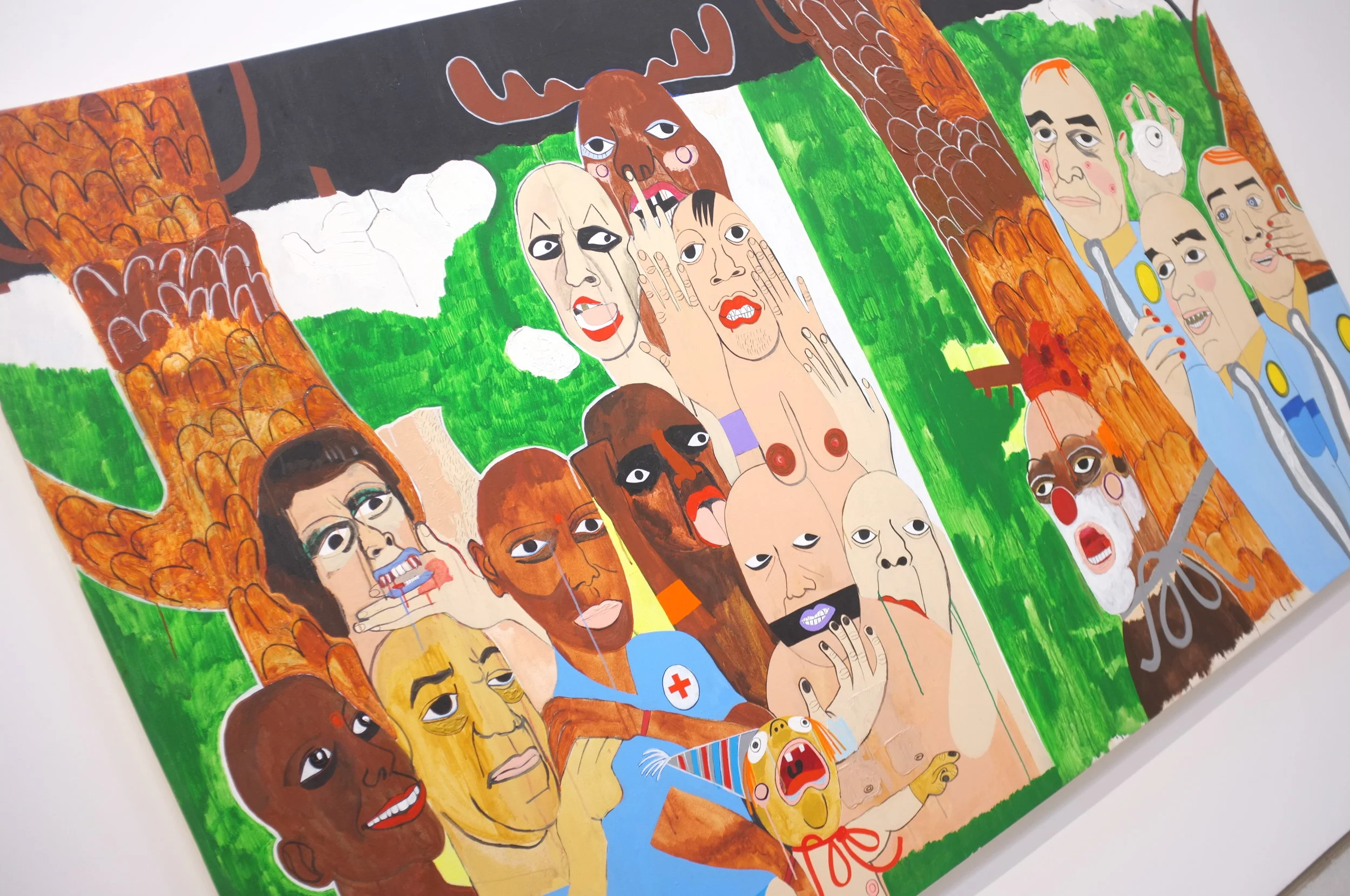
Vaginal Davisโ€™s Magnificent Product Chronicles Five Decades of Her Playful Defiance @ MoMA PS1

Magnificent Production by Vaginal Davis, MoMA PS1, 2025. Photo: Isabella Bernabeo.

text and photographs by Isabella Bernabeo

Magnificent Product marks Vaginal Davisโ€™s first major US institutional show, presenting art from her early Los Angeles projects to her more recent Berlin-based creations. Organized thematically instead of chronologically, the works take viewers on a journey filled with vivid colors, humor, and emotion.

Magnificent Production by Vaginal Davis, MoMA PS1, 2025. Photo: Isabella Bernabeo.

The exhibition begins in a light mint-green room titled Naked on my Ozgod: Fausthaus โ€“ Anal Deep Throat. This square room features green sheer curtains along every wall, with hundreds of photos from Davisโ€™s early Los Angeles years covering the walls behind the fabric. Visitors are invited to slowly peel away the fabric from the wall to get an intimate view into Davisโ€™s personal life before seducing them into the next room. This section is inspired by one of her first art exhibitions, originally held at the Pio Pico Library in Los Angeles. 

In the next space, HAG, Davis reconstructs her old Sunset Boulevard apartment in Los Angeles, the site where she produced many iconic zines, such as Shrimp, Yes, Ms. Davis, and Sucker. The dimly lit room glows pink and includes a walk-in box in the center. Inside, its walls display drawings and figurines of a womanโ€™s head, possibly self-portraits. The slanted floor creates a warped, unbalanced environment that meshes reality with fantasy, just like the work it supports. 

Magnificent Production by Vaginal Davis, MoMA PS1, 2025. Photo: Isabella Bernabeo.

Another engaging room in Davisโ€™s collection is HOFPFISTEREI, where visitors are encouraged to interact with her artwork. A table and four chairs occupy the roomโ€™s center, surrounded by piles of Davisโ€™s zines, writings, and creations. A photocopier stands nearby for visitors to print out copies to take home. 

Davis also utilizes a screening room, which resembles the Cinerama Dome movie theater that operated on Sunset Boulevard from 1963 until 2021. Here you can watch low-fi videos she created during the 1980s, showcasing her range of personas as an artist, queer activist, self-proclaimed โ€œBlacktress,โ€ and more. These recordings, much like the earlier photos, give visitors a detailed and in-depth view into Davisโ€™s life; theyโ€™re a testament to how interconnected her art is with her identity. 

Magnificent Production by Vaginal Davis, MoMA PS1, 2025. Photo: Isabella Bernabeo.

Another striking installment is from her Wicked Pavilion collection, displaying a reimagined version of Davisโ€™s teenage bedroom. However, instead of her in the rotating bed, a large phallic sculpture sits in the space. The room is completely pink, from the walls to the rug to the curtains. A miniature desk sits in the right corner, topped with two lamps, a pile of jewelry, and an array of colored nail polish, hinting that Davisโ€™s has relished dressing up as the showstopper she is since her youth. 

Along the ceiling, dozens of images are hung from a clothesline. These photos are of Davisโ€™s muses, such as actor Michael Pitt or actress Isabella Rossellini. While visitors take a look around the bedroom, they listen to a mix of the song, โ€œA Love Like Ours,โ€ from the 1944 film Two Girls and a Sailor, interviews that Davis herself conducted for LA Weekly in 1996, and a voice message from Davisโ€™s own secret admirer, creating a fully-immersive experience.   

Magnificent Production by Vaginal Davis, MoMA PS1, 2025. Photo: Isabella Bernabeo.

Across all of these works, Davisโ€™s playfulness and defiance shine through. Magnificent Product is a living experience that can be overwhelming at times, yet each room offers a sense of freedom. Davis commands her viewersโ€™ attentionโ€”and she intends it that way. 

Magnificent Product is on view through  March 2 @ MoMA PS1 22-25 Jackson Avenue, Long Island City, Queens

Bogotรก Rising: Notes on Resilience, Conviviality, and Experimental Art

San Felipe neighborhood skies

text & images by Perry Shimon

Colombiaโ€™s art scene is in the midst of a dynamic resurgence. After a prolonged lockdown that temporarily stalled the countryโ€™s cultural momentum, activity is ramping up again in anticipation of the fall season, anchored by Bogotรกโ€™s ARTBO fair, and two biennials in Bogotรก and Medellรญn. Despite longstanding infrastructural and political challenges, the country has maintained a vibrant landscape of artist-run spaces, project-based initiatives, and strong public engagement.

In this mountain-wreathed brick city with a breathtaking theater of clouds, I had the great pleasure of seeing and meeting much of Bogotรกโ€™s cultural ecosystem. In May of this year, I attended a curatorial intensive organized by Mahazabin Haque (All About Curating, Berlin) and The Art Dome (Miami / Bogotรก), which brought together artists, curators, and researchers, with warmth and conviviality, for a tightly packed itinerary of visits across studios, institutions, collections, archives, and impromptu social spaces. What emerged was a portrait of a cultural landscape with unique presence, community, improvisation, and resilience.

Telecom Building, student graduate show

One of the most memorable visits was to the dilapidated Telecom Towerโ€”a relic of privatization now reimagined as a vertical commons. After organizing a group exhibition in the building in 2024, Linda Pongutรก, William Contreras Alfonso, and Maria Leguรญzamo went on to occupy several floors, establishing studios, residencies, site-specific exhibitions, and performances. They also began developing an initiative to create a rotating museum showcasing works by the buildingโ€™s members. During our visit, one floor hosted a student show, several artists graciously welcomed us into their studios, and independent publisher David Medina was at work on a new book project. In the elevator, the partisan resistance anthem Bella Ciao played on loop.

Gloria Sebastiรกn Fierro Castro

Artist and teacher Ana Marรญa Montenegro gave a tour, describing a conceptual performance in which she was visiting each of Bogotรกโ€™s eighty notaries to have officially notarized a simple and rather philosophical promise: that she would be someone different tomorrow than she was today. Artist Juan Betancurth, who administers the artist residency program, gave an impromptu tour of his studio where he sculpturally assembles found objects into disquieting meditations on power, desire, and art. Nearby, Gloria Sebastiรกn Fierro Castro showed us their haunting textile and tar works, drawn from a family archive that traces their transition from rural life to running a gas stationโ€”a stark emblem of modernization in a sepia-toned desert landscape.

Curator Nicolรกs Gรณmez Echeverri at Museo de Arte Miguel Urrutia

The archive loomed large in other ways. At the Museo de Arte Miguel Urrutia, curator Nicolรกs Gรณmez Echeverri walked us through a collection tour that will soon be dismantled and rethought under his guidance. The planned rehanging will confront the colonial scaffolding of the existing display, seeking ways to integrate Colombiaโ€™s extensive institutional holdings into a narrative that accounts for omissions and regionalism. Among the exceptional paintings of Fรญdolo Alfonso Gonzรกlez Camargo, Obregรณn, and Cรกrdenas Arroyo, was a series of anonymous 18th-century convent funerary portraits: powerful images with uncertain authorship, quietly haunting and unsettling the canon.

Hadra Waheedโ€™s Hum in Doris Salcedoโ€™s counter-monument

At Fragmentos, artist Doris Salcedoโ€™s โ€œcounter-monumentโ€ to Colombiaโ€™s armed conflict, we walked across a geographic-feeling topography of thirty-seven tons of hand-hammered metal tiles made from weapons turned in after the FARC peace agreement. In the adjacent courtyard, a deteriorating colonial ruin serves as the setting for Hum, a multi-channel sound installation by Canadian artist Hadra Waheed, which gathers protest songs from across the world into a reflective, almost devotional field. 

Juan Cortรฉs Studio Visit

Memory was also the subject of a project we encountered in the studio of Juan Cortรฉs, who shared a recent collaboration initiated by the Colombian president: a digital map of โ€œhouses of memoryโ€โ€”community archives, cultural centers, and alternative institutions preserving regional histories. The ambitious and exemplary project is part oral history, part visual archive, part social cartography, and a model for a new possible infrastructure for collective memory.

Marรญa Adelaida Samper giving a tour of Gabriel Zeaโ€™s Mystic Capital at the Al Romero gallery

Elsewhere, in San Felipe, Gabriel Zeaโ€™s Mystic Capital, at the Al Romero House Gallery, staged capitalism as a religion. Tarot-inspired AI works illustrated symbolic systems of belief in the market, as well as its impoverished aims and overdetermined meanings. An accompanying video installation collaged cartoonish bull and bear imagery into frenetic and tumultuous booms and busts. Zeaโ€™s collective, Aliens, curated the show with Marรญa Adelaida Samper. It both estranged the givenness of our cosmologically proportioned faith in markets and situated it in a longue durรฉe continuum of numerology, mysticism, superstition, power, and grave consequences.

Tienda de Esperanza, San Felipe

Chuco Candela in Lavamoa Tumba

Tienda culture emerged as one of the more poetic and socially alive throughlines of the trip. These ubiquitous corner stores often moonlight as salons, exhibition spaces, and places of convivial gathering. Artist Chuco Candelaโ€™s intervention at Tienda de Esperanza turned an already beloved Macarena landmark into an exhibition space for his and his friendsโ€™ often meme-themed ceramics. Later, in San Felipe, his second location hosted a massive street party with fireworks for its opening. He later invited us to visit his most recent exhibition in his ongoing Lavamoa Tumba projectโ€”enormous, sprawling group shows in condemned buildings, this edition featuring 150 artists, and overflowing with energy, humor, and street-rooted practices.

Trepesitos fashion show at Odeon

After a fashion show by Trepesitos at the majestic theater-turned-exhibition space and artful community center Odeรณn, we ended the night in a tienda playing bolirana, a barroom sport that fuses pre-Columbian tradition with contemporary nightlife, popular with both Reggaeton and contemporary artists. It is perhaps to bowling what ping pong is to tennis and invites loud and playful sociality. Odeรณnโ€™s Tatiana Rais and Juan Sebastiรกn Pelรกez, formerly of the Miami Gallery and Carne Collective, began sharing insights about Colombiaโ€™s commitment to public art funding and the system of rotating independent art professionals who administer allocations for artist projects and spaces. While there is not a strong enough local market to support the many practicing artists, this type of public funding supports the scene to some extent and underwrites less commercially oriented works. 

Marรญa Morรกn at Cooperates

Charlie Mai exhibition and talk at Plural

We visited artist-run Cooperates studios and residency in Chapinero, anchored by the painter and teacher Marรญa Morรกn, and the communal Plural projectโ€”part art space, part kitchenโ€”where Chinese-American artist Charlie Mai was showing an installation with a series of performances reflecting on Chinese capital, North/South American labor, transportation infrastructure, and hybrid identity. We were sad to miss the closing party with a durational cowboy performance, Chinese dragon dancing, and DJ set by underground club hero DJ Bclip.

Josรฉ Darรญo Gutiรฉrrez at Espacio El Dorado

At Espacio El Dorado, Josรฉ Darรญo Gutiรฉrrez gave a highlights tour of his impressive collection of overlooked political Colombian art and their marginalization through Cold War-era collecting policies imposed by major Western foundations. During our visit, a young scholar from Buenos Aires working on a curatorial project about political photographers and left-wing conferences overheard the conversation and joined our group, offering a recently published dissertation called โ€œThe Cultural Cold War in Colombia: Oil and Washingtonโ€™s Policies for โ€˜Pacificationโ€™ of Art in Conspiratorial Timesโ€ by Christian Padilla Peรฑuela that Jose was coincidentally trying to place with a publisher. As we were leaving I noticed the young man and Jose in a deep thoughtful conversation, Jose generously retrieving books from his collection to give as gifts. 

Taller Arte Grรกfico

Subachoque

Perhaps the most moving experience of the trip was a pair of visits to Taller Arte Grรกfico and Sextante, founded by Luis รngel Parra and Marรญa Eugenia Niรฑo fifty years ago. They welcomed us warmly to their Bogotรก gallery and country atelier in Subachoque and let us marvel at the breathtaking collection amassed over a lifetime of artful collaboration. They described their printmaking and publishing practice as a โ€˜love storyโ€™ and shared how they met fifty years ago, moved in on that very same day, and have been together ever since. We learned a few days after our visit that sculptor Hugo Zapataโ€”a dear friend of theirs, whose works were on display in the galleryโ€”had passed away, making the visit a poignant and beautiful parting gift.

Subachoque

Hugo Zapata

There were countless other stops: Liz Caballeroโ€™s impressive three-story SKETCH Gallery, La Casitaโ€™s misleadingly named sprawling intergenerational and dialogic collection, Casa Hoffmannโ€™s austere kinetic and music themed program, NC-Arteโ€™s gorgeous design villa, Desborde Galleryโ€™s anarchic installation and performance works by Alfonso Aguas Negras, a tour of artist duo Eduard Moreno & Andrea Marรญn Garcรญa studio and upcoming works for the Medellรญn biennial, perhaps the worldโ€™s most significant pre-Columbian metalwork collection at the Oro Museum, and a very moving studio visit with the young Bogotรก-born-and-raised painter Angie Vega, whose extraordinarily skillful intimate portraits of her Tunjuelito neighborhood familiars had garnered her invitations to apprentice with master painters in Europe and Saint Petersburg. The lingering impressions from this vibrant and flourishing art ecosystem were its warm hospitality, generous sociality, and a sense of experimentation that felt neither reactionary nor utopic, rather present, responsive, and open.

SKETCH Gallery

Daniela Acosta Parsons and Danilo Roaโ€™s studio

Jeronimo Villa at La Casita

Angie Vega

Lia Garcรญa in her studio

Camilo Bojaca at Galerรญa El Museo

Miller Lagos in his studio

Studio of Andrea Marรญn Garcรญa & Eduard Moreno

Mauricio Gallego in his studio

.

Alfonso Aguas Negras at Desborde Galerรญa

Hugo Zapata at Sextante

Theatron

Cloud theater

Read An Interview on Fashion, Film, and the Erotics of Desire with Kate Biel & Kimberly Corday →

interview by Eva Megannety

In fashion, desire is often draped in fabric, but for Kate and Kimberly, it lives in motion. In their collaborative short Love Is Not All, the two artists trade runways for reels, channeling longing, beauty, and decay into a filmic fever dream. Against the backdrop of a world increasingly obsessed with speed and spectacle, their work feels like a deliberate pause - a place where emotion lingers, glances haunt, and the act of getting dressed becomes a cinematic ritual. As fashion continues to merge with entertainment, film has become the new frontier for designers looking to craft legacy, not just collections. For Kate and Kimberly, fashion isnโ€™t just about fabric and fit - itโ€™s about emotion, storytelling, and cinematic escapism. And through their lens, each frame becomes a love letter to the art of getting dressed. We spoke about the allure of the fashion film, the seduction of storytelling, and why, for them, desire can only be truly captured in movement.

Nina Chanel Abney's "Royal Flush" @ ICALA

Nina Chanel Abney: Royal Flush is the first solo museum exhibition of Chicago-born Nina Chanel Abney (b. 1982), and a ten-year survey of the artistโ€™s paintings, watercolors, and collages. Abney is at the forefront of a generation of artists that is unapologetically revitalizing narrative figurative painting, and as a skillful story-teller, she visually articulates the complex social dynamics of contemporary urban life. By engaging loaded topics and controversial issues with irreverence, humor, and lampooning satire, Abneyโ€™s works are both pointed contemporary genre scenes as well as scathing commentaries on social attitudes and inequities. Royal Flush will be on view through January 20, 2019 at ICALA 1717 E 7th St, Los Angeles. Photographs by Oliver Kupper