
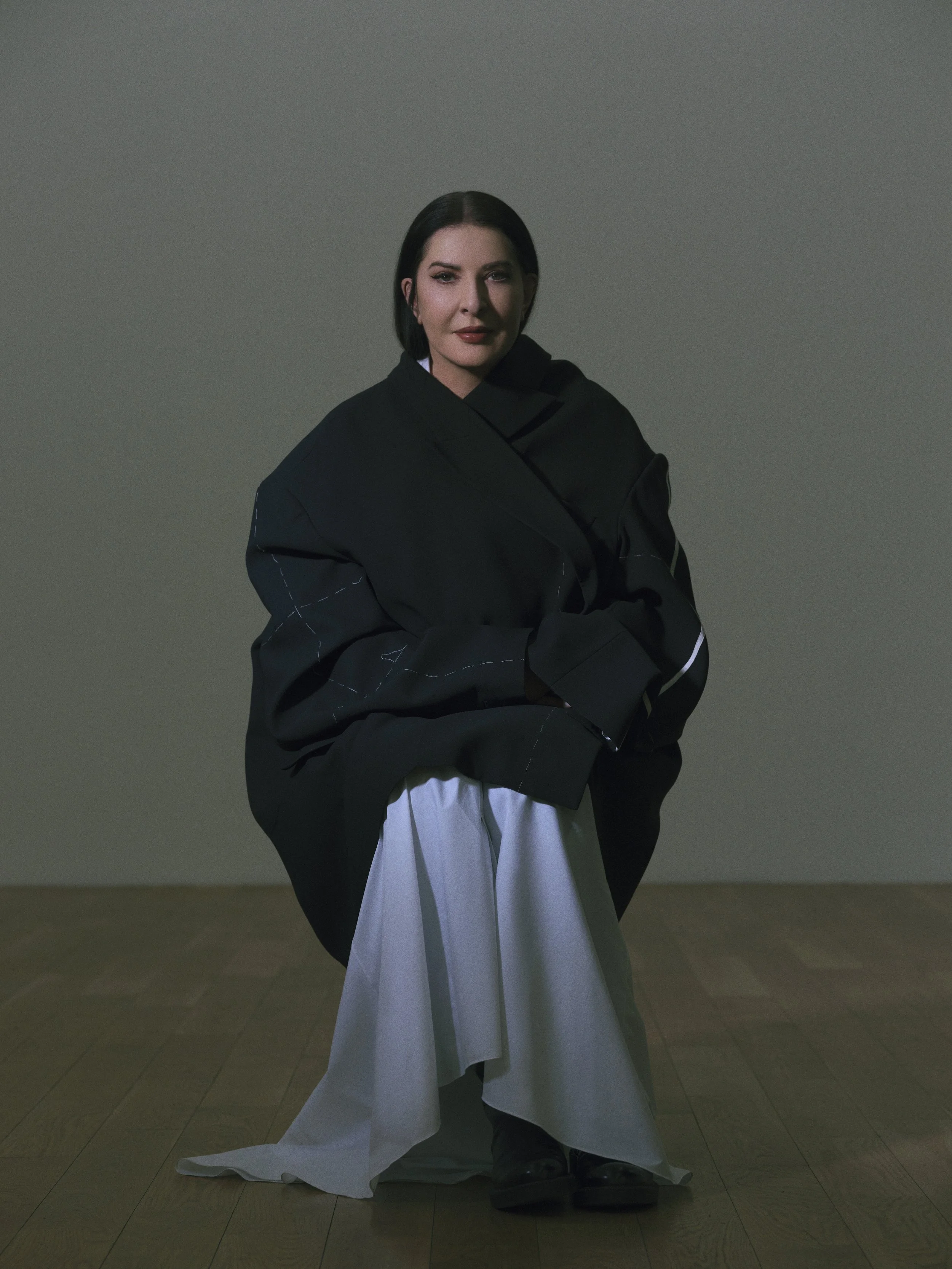
Peter Do oversized blazer coat and cotton wrapped blazer gown
Prada leather boots
interview by Miles Greenberg
photography by Justin French
styling by Julie Ragolia
Performance is a kind of collective action. It is one of the truest collaborative art forms. Since the 1970s, Marina Abramović’s main collaborator has been the audience to some of her most iconic, dangerous and breathtaking performances, which are often durational and test the limits of the human body. For Abramović, the artist is a universal vector for the experiencing of all things and all emotions. To protect her art form, she founded the Marina Abramović Institute, which regularly holds workshops, lectures, seminars and performances around the world. She was recently chosen for the Pina Bausch professorship in Essen, Germany, where she has been working with a multidisciplinary group of performance artists over the course of a year in preparation for their ten-day durational performance at the Museum Folkwang. Miles Greenberg was one of her performers in a six-day production, NO INTERMISSION, at Theater Carré in Holland that took place earlier this year. They caught up to talk about the transformative power of durational performance and the importance of freedom in one’s artistic process.
MILES GREENBERG: You came up as a young performance artist in Amsterdam. Can you talk about how the show we did together at Theater Carré reflected those years in its format?
MARINA ABRAMOVIĆ: You know, it was inspiring that the space where we did the performance is not a museum space, it’s not a kunsthalle, and it’s not the kind of space where you traditionally show art. This was a theater, and to actually break all of these rules that the theater imposes and create new rules—the playfulness was a very important part of the show. After doing this stuff for fifty years now, I’m so fed up with the rules, with the political correctness, and with all the shit that’s going on. Now, with a bit of nostalgia, I'm looking to futurists, to dadaists, to surrealists, to all these people with groups that actually created a history of art by playing. They weren’t afraid of mistakes. This is such an important situation where real, live art can happen, and also shit can happen, and both of those things are so exciting for me. We chose the artists but the artists were free to propose the things that fit them the best. Normally, if you have a show in a museum, you have to send the title of the performance, the duration, and what space it’s going to be in. All these regulations have to be followed, and then the work is made. I mean, who could have predicted that on the last day, the audience and the performers would jump into the canal, just like that (laughs). Normally, you don’t jump in the cold canal in Holland, apart from it being dirty, but never mind.
GREENBERG: I totally feel that. I think it resonated so much on a personal level when I went and participated. On the flip side, I had a museum show that I was working on back home in New York that was very regimented. Every single day I was having to deal with another tiny issue. There was so much preconception that it completely lost the spontaneity. It was great, but that process is so different. The performance we did in Holland, I had no idea what to expect, and that was such a palate cleanser—to be able to feel the immediacy of how the performance came to be. It’s an immediate art form. How does immediacy in that way—and the gratification of being able to create something and see it immediately with your body, with the audience’s body—how does that still play into your work and your practice today?
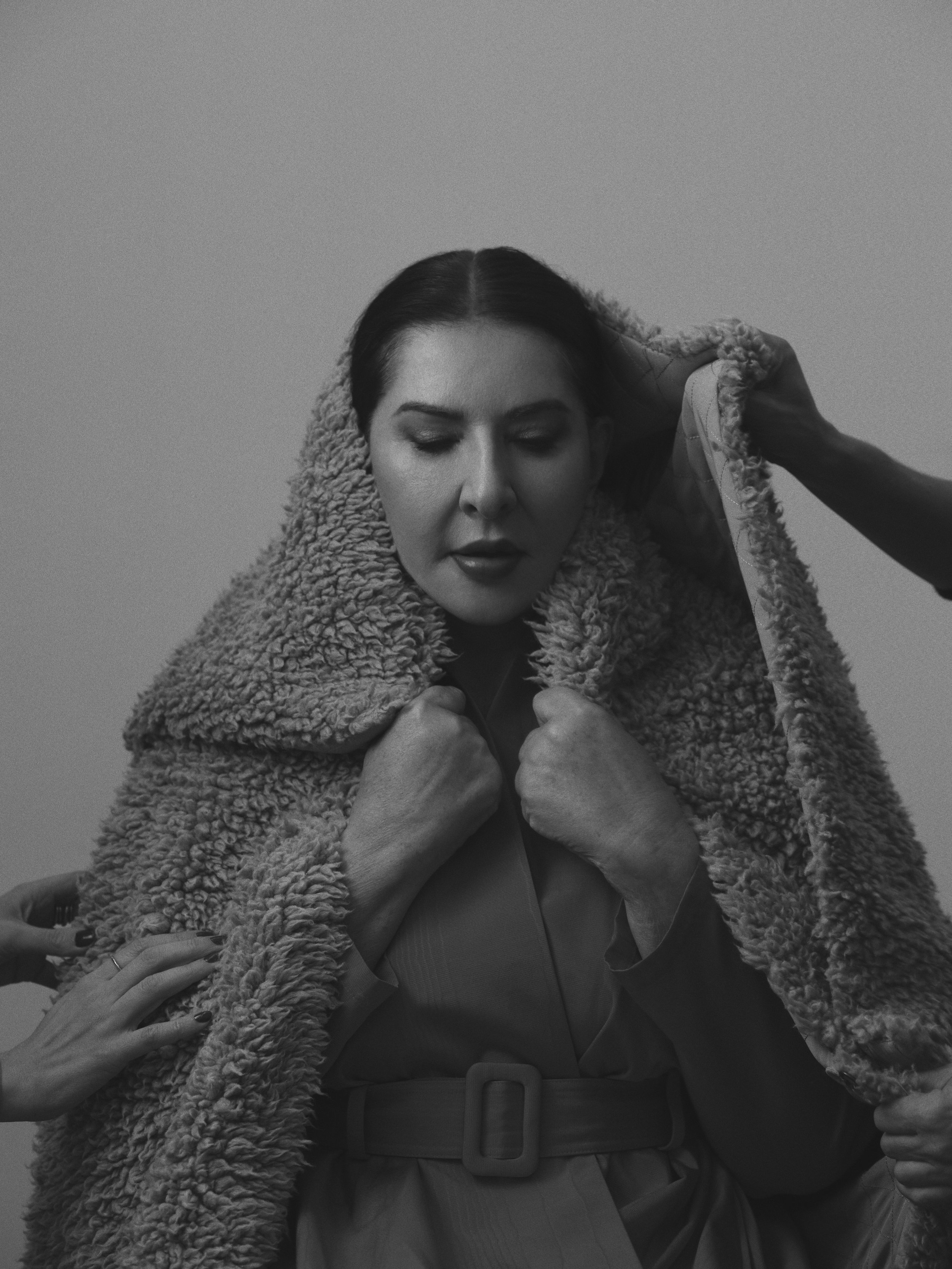
Marc Jacobs merino wool, baby alpaca and polyamide hooded cape
Gucci moiré smart coat
ABRAMOVIĆ: Jan Hoet was one of the very few great curators in art history, he was the director for documenta IX, and at the time, he took from Joseph Beuys' 350 secret potato recipes. So, every day we would have a new recipe and we hated potatoes. We wouldn’t get anything else, but he created this kind of family situation where you eat potatoes even though you hate them and you create art, because we all have to be in the same space with the same chemistry for this to happen. We need this feeling of freedom to create anything. It's from chaos that things actually happen, but you have to have that kind of vision.
Your project went through so many different phases. You were proposing one idea and then something else completely. What makes it great is when it's not just the artist who is doing experimental stuff, but the people who organize the performances need to have the same attitude. Did you feel the freedom to change the concept and everything else as you went along, even once you were in performance?
GREENBERG: Oh, things changed up until the last moment of the very last performance, absolutely. There were so many decisions that were made while making and while doing. The opportunity of having six days to feel it out with that audience every single day in a different way was great. Not everybody performed every single day. There were different versions and configurations, and everybody was working so much internally. For example, the way that Ying Mae walked through with her singing vase—it made the performance radically different from the day before.
ABRAMOVIĆ: When the public normally comes to a performance, they’re led into an auditorium, they take their seats as they’re used to. But then, they had one person, which was me, actually watch over them. And my watching was designed to turn them toward something they’re going to see, something that would be for a long duration, where they can just relax and take this as an experiment. I was trying to make this kind of dream for them, and after that, it strikes them that some can go to the left side, others to the right side, and some can go up. They were all free now to move around. But to start with a very simple exercise—let’s all breathe together twelve times—these simple exercises are so important to energetically connect everybody who would normally come to the theater not connected, and it works. So, the only structure was that one, and then everything else was so free, and whatever happens will happen.
GREENBERG: I love the way that you describe the difference between theater and performance. In theater, it's a fake knife and you’re seeing ketchup, whereas in performance, the knife is real and so is the blood. You like to bring people into the universe and prepare them to see something. I’m wondering how that differentiation exists in the audience’s body?
ABRAMOVIĆ: What we were doing at the Carré was so interesting because it was a mix of everything. There was a big performative team that was very theatrical, but also there was the Spanish guy who would really take a drug that would knock him down, and then he’s left to the public to take care of him. It was absolute exposure, vulnerability, and danger. This was real and you could immediately see how the public reacted emotionally on each day. Your work was extremely emotional too, it was dance, but you introduce this physicality of endless time, where you could come and see it in the ballroom and then you could have a full dinner, come back, and it's still there. It’s never-ending, that investment of time, of possible danger, it brings a lot of emotion to the public. The durational performance form is so unique because it has this transformative function. You’re not just doing it because you’re going through the process and changing yourself, you’re also changing the public. That’s the key. It was so interesting how every day more and more people came. They would invite their friends, and those friends would invite their friends because they couldn’t believe what was happening. At the end, it was this huge celebration and the audience was no longer looking at something, they were a part of something.
GREENBERG: Can you talk a little about teaching at Essen, the legacy of Pina Bausch and that crossing over with your performance work?
ABRAMOVIĆ: My love for Pina Bausch really dates back a long time. In the ’70s, she had an incredibly radical approach to dance, made some amazing pieces, and there’s hardly anyone left from the original company because everyone is so old, but the new group is still performing these pieces. Every time I see their work I’m in shock by how relevant, how contemporary, how incredibly important it is, and how many other choreographers take from her to create their own work. For her, dancing was everything. It was walking in the snow with bare feet, standing in the forest, smoking a cigarette—there was no limit to what dancing was. And also, working to the point of trance. I went to see The Rite of Spring, which I had already seen several versions of, but I wasn’t prepared for this one. They went to Uganda and they took thirty dancers from fourteen African countries, male and female. The moment they started to act, you’re elevated to this spiritual, shamanistic, energetic level where you hardly even notice you’re breathing. Unbelievable. It was so spectacular because they add their own culture to the dance, which she made space for. This was really something.
I stopped teaching a long time ago, but I got a phone call from Pina Bausch’s son and he said that when she died, she wanted to establish this academy in Essen where people from different disciplines could create a multidisciplinary group, and I was the first teacher who’d been asked. It would only be teaching for one year and we could propose different people. I got 150 proposals and I chose twenty-six people. These people are coming from from physical theater, from drama, not many from dance, a male opera singer who is a soprano, there are jazz vocalists, composers, and none of them have ever done anything durational in their own fields. So, we’re working together for this big event and they gave me half of the museum where they’re going to perform for ten days, six hours a day. More and more, I want to create new work that mixes performance and dance. The Pina Bausch approach to the physicality and the spirituality of dance really speaks to me the most.
GREENBERG: I’m curious about your group of students. What kind of work are they producing?
ABRAMOVIĆ: The way I’m teaching, I want to be just a conductor to their own ideas. I don’t want to push my ideas, so I don’t even talk to them about my work. They can look on Google, but I’m not giving it. They bring their own stories, problems, investigations, dramas, whatever they want to do. There’s one student, she’s working on physical theater and her biggest drama is feeling ignored in public but being too chicken. So now, she studies chickens. She went to several farms in Germany, she covered herself completely with feathers, and she’s going to do ten days, six hours a day, being a chicken. It’s perfectly done and I just give her space, time, and the facilities.
It was very funny also to tell them how to value their performance projects financially. Because they are students, they are not going to be paid. The school pays for the production, plus they get a museum show, TV show, catalogue—I mean, I’ve never seen such a thing in my life. But I said to them, “In real life, you have to be paid for what you do, so put the price.” Some of them put like 300 bucks and some like $10,000. Very interesting how they value their work. (laughs)
GREENBERG: You’re an extremely good teacher, because nobody ever teaches that.
ABRAMOVIĆ: You know, I never got paid for any performance in my entire life until The Artist is Present [2012], and they had to pay me because I performed for three months in the museum and I had to pay my mortgage. Tino Sehgal is a genius because he really found out how to sell a performance. Kiss [2003] was the first thing he ever sold and he sold it for $250,000. It’s an edition of five plus two artist proofs, and lots of museums bought it. Every museum has to pay for the piece plus the performers, but at the same time, you have to control who they are. I saw this piece performed really wonderfully, and then another time I saw two shitty guys who had no charisma, nothing. So, you have to set up rules for how the piece should be performed in the future.