Ariana Papademetropoulos: Cosmic Release


interview by Jeffrey Deitch
photographs by Max Farago

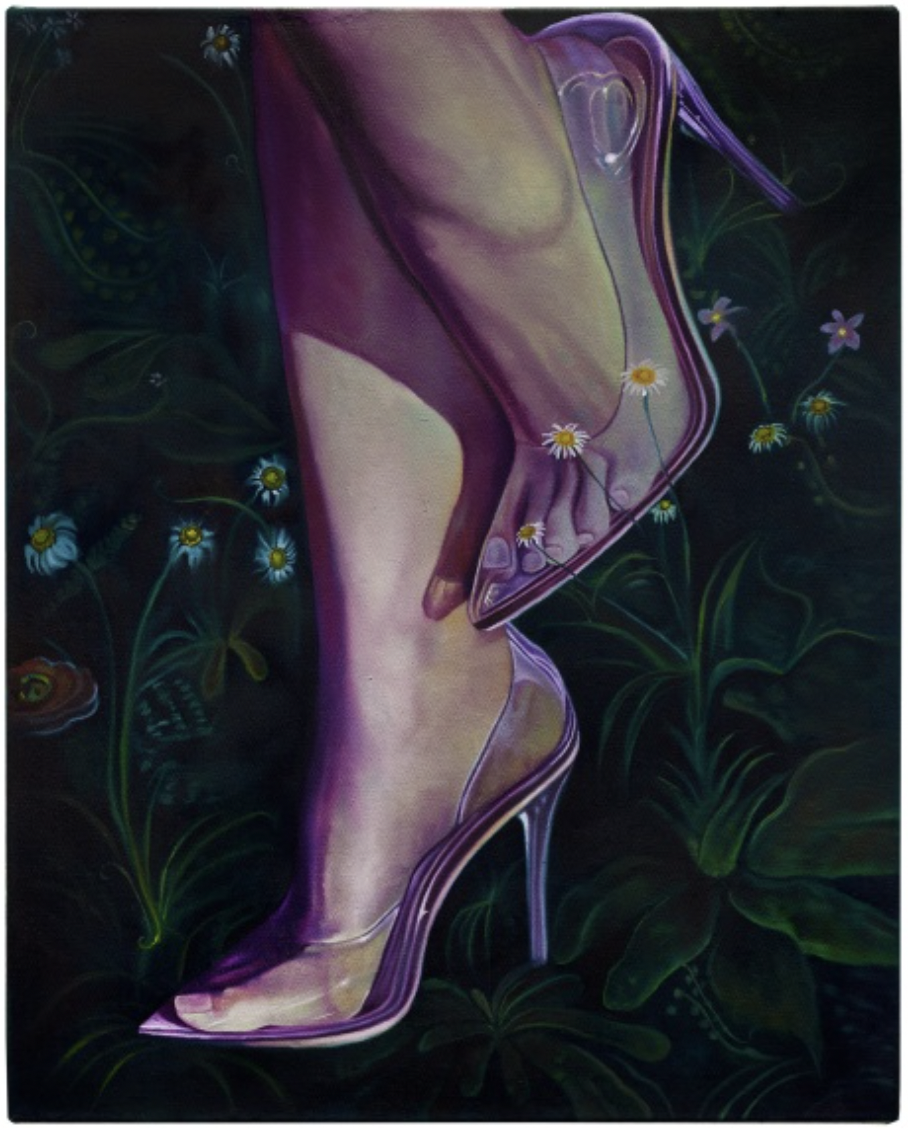
Ariana Papademetropoulos’ paintings are thresholds—portals into alternate utopian universes. Oneiric interiors are grand stables for a fantasy menagerie and translucent figures that haunt with languorous decadence where beds become symbols of sexuality and dreaming. Painting these distinct worlds since her early childhood, Papademetropoulos was inspired by the occultist environs of Southern California, particularly her hometown of Pasadena where rocket scientist Jack Parsons and Marjorie Cameron once held magickal rituals at his estate in the 1940s with a coterie of believers in the esoteric. Coming from a family of architects, Papademetropoulos uses Renaissance techniques to build a world that is uniquely her own.  

JEFFREY DEITCH: So, we're here in Mumbai, sitting in the lobby of the Oberoi Hotel. 

ARIANA PAPADEMETROPOULOS: Yes. We’re in a kind of utopian setting. 

JD: This is, yes. An artificial utopia. But let's transport ourselves back to Pasadena, California. 

AP: Okay, let's go.  

JD: I've always been impressed by how you were so rooted in Pasadena, Los Angeles, but somehow your artistic outlook is so international. Your work encompasses influences from Italian Renaissance, French Surrealism, and many other sources. But the key is your California background. You are California all the way through. A lot of the artists in Los Angeles, they come from someplace else. But you come from Los Angeles, you went to school in Los Angeles, you apprenticed with artists and that's where you work. So, let's talk about your background. You come from an artistic family. 

AP: I come from a family of architects on both sides, Green and Argentine, so although I was born in Los Angeles, I’ve always known a world outside of it. I suppose my interests are very influenced by both architecture and by my surroundings of Los Angeles, and so that follows through in all of the work. 

JD: I met you in a very organic process. That's how I like to meet artists. It’s not like I saw your art in a group show and contacted you, and you didn't send me an email with your images. 

AP: We met at the Autre dinner! We talked about Los Angeles history and that's how we connected. 

JD: That’s correct. We were seated next to each other at the Autre dinner at a hotel in Downtown Los Angeles.  

AP: And here we are doing an Autre interview. 

JD: I already knew a little bit about your work from some mutual friends. People said, “Oh, you have to see Ariana’s work. She's brilliant. She's such a great artist.” So, I was already intrigued. And then, I visited you in this storybook house in Pasadena. What a romantic place. It was kind of an outbuilding, like a stable, a barn, connected to a grand estate. It was a little bit shabby, which was perfect. And I went into your studio. There weren’t just paintings propped up and easels—it was a total work of art. A gesamtkunstwerk: book covers, astonishing objects, stools that have human legs coming out of them (laughs). It was an entire prosthetic world, and that's my favorite kind of artist. Where it's not someone who just makes a painting or a sculpture, it's an entire artistic universe that you created. And it seems that you were born into this artistic universe. I mentioned to your mother once how talented you are, and so young. And she said, “Oh, well, she's been doing this since she was six years old or earlier,” that you were born to be an artist. 

AP: I feel like it wasn't really a choice, it's just the way I've always been. But I think ever since a young age, I was highly sensitive to my surroundings and I figured out that the way I create a space affects my way of being. An architect creates a space and ideally it will affect the way that you behave in that space. Frank Lloyd Wright believed that the functionality of a space could enrich the life of whoever inhabits that space. In a way, it’s obvious, but I instinctively picked up on that ethos and knew that how I decorated my room would have an impact on my perception. 

JD: And most of your artworks are set in an interior. 

AP: Exactly. 

JD: There may be figures, there might be a fantasy animal, like a unicorn. But almost always set in an interior.  

AP: An empty room for me is like a portal to an imaginary realm. It always starts off of being basically bored in a house. That kind of suburban, empty room allows the fantasy to come through. It takes you to this middle world. 

JD: You're interested in volcanoes as well. 

AP: That's true. (laughs) I'm interested in archetypal subjects from fantasy, but I'm also interested in geological wonders and the natural beauty that exists on Earth. Volcanoes, crystals, waterfalls, flowers, geysers, bubbles, caves, you know, there is a lot of beauty everywhere if you look for it. Utopia does exist in some sense. It's just that we have to choose to see it.

JD: We've had a number of conversations about the special occult history of Pasadena. It’s a very unique place because on one side it's very Midwestern American, but on the other, it has attracted extraordinary people who enter into alternate realms. We talked a lot about Marjorie Cameron.  

AP: And Jack Parsons.  

DEITCH: I'm curious to hear how you learned about this as a child in Pasadena and how that alternate history of Pasadena has shaped you? 

AP: I've always been very drawn to esoteric subjects, including magick, Aleister Crowley, all that kind of stuff. And then, when I came upon Jack Parsons and Marjorie Cameron, I got very excited because it really is this crossover between all the things that I love, which is the occult, science, and art. But what's remarkable is that the mansion where I had my studio belonged to this woman named “The Silver Queen.” She inherited silver mines. Her husband died and she got married eight times—one was a prince in India. But I was convinced when I was working there—because it's very close to The Parsonage, which is where Jack Parsons lived—that she threw parties and that Jack Parsons attended. I imagined this whole scenario. And what's wild is that, one day, I went to the studio and it was transported to the 1930s. The house was often used for movie sets. They brought in all these orange trees and everyone was dressed in suits and hats. They were filming a show about Jack Parsons and my studio was The Parsonage in the TV show (laughs). I found the script and my mind was completely blown. That crossover between what's real and what's a fantasy is so present in Los Angeles. And speaking of utopias, Jack Parsons wanted to create his own version of utopia. The Parsonage was an 11-bedroom house where people from all walks of life had rooms and they performed sex magick. It was basically this place of free love and they believed that sex magick could take you to an alternate realm. L. Ron Hubbard lived there for a while. Also, professors at Caltech, bankers, and people like Marjorie Cameron.  

JD: It was a fascinating fusion of art, science, technology, the beginnings of space exploration. Religion was all there. Los Angeles art, for a long time from the perspective of New York City, was all about light and space and minimalism; high-tech materials. But there was always this undercurrent of homegrown surrealism; this utopianism. You mentioned Marjorie Cameron.  

AP: Yes, Aleister Crowley told Jack Parsons she was the Scarlet Woman, the woman that would move us out of a patriarchal society, the age of Osiris, into the age of Isis, the age of women.  

JD: It's fascinating that from the beginning you embrace that side of Los Angeles history in your art. 

AP: Los Angeles is a place that's built on myth. The idea of the city came long before Los Angeles was there. It has always had a history where fantasy becomes reality, and not just in Hollywood. And then, we created the concept. Beachwood Canyon had The Krotona Inn where the theosophists lived, which had very utopian architecture. There were the Nature Boys in the 1930s, who were like the first hippies—these Germans who moved to Laurel Canyon, and were vegan, and had long hair, and looked like they were from the ‘70s. The Native Americans say that Los Angeles has always had this magnetic quality to it that made people delusional. So, it's always this place of smoke and mirrors. Even hundreds of years ago, there was some type of energy that made things unclear. That opens possibilities for people to believe whatever they want to believe. That's what Scientologists believe—you create your reality and however you choose to live becomes the basis of your reality—which can be dangerous and idyllic. Growing up in LA, all of this has been embedded in my work.  

Ariana Papademetropoulos, Phases of Venus, 2022. Oil on canvas, 91 3/4 x 108 1/4 inches (223 x 275 cm); © Ariana Papademetropoulos; Photo by Argenis Apolinario; Courtesy the artist and Vito Schnabel Gallery

JD: We presented a fascinating exhibition project together called The Emerald Tablet. It was quite unique. I'm not sure any other artist has ever done anything like this. It encompassed a very impressive solo exhibition of your work with epic paintings. And then, in the other part of the gallery you curated an exhibition that articulated your unique aesthetic and it was a kind of fusion of what we've been talking about. This Los Angeles occult history with The Wizard of Oz, and that myth. You should talk a little bit about The Emerald Tablet and Unarius, who did a performance in front of the gallery as part of the opening.  

AP: L. Frank Baum [who wrote The Wizard Of Oz] was a theosophist. He named The Emerald City after The Emerald Tablet, which is an ancient alchemical text. The most famous line is “As above, so below.” I wanted to basically do an esoteric version of The Wizard of Oz. Instead of leading you to the Emerald City, it led to the Emerald Tablet, which is a place of collective unconsciousness. It's this place that all artists go to—a timeless universe. And that's why the green room had artists from the past hundred years. They all looked similar because they're all from this world some of these artists connected with. It's why the Mike Kelley piece looked so similar to the Agnes Pelton. The Jean-Marie Appriou piece looked like it was out of a Leonora Carrington painting. Everything was connected because it's this place that we can all enter into. Unarius believes there are these crystal cities on Mars, which was really similar to Mike Kelley's Kandor piece, which is where Superman was born. Unarius is a belief system, but they also functioned almost as a film studio because they made so many movies. They had their iconic bird release at the opening.  

JD: Unforgettable. They drove their spaceship up North Orange, parked in front of the gallery, and had their cosmic release. 

AP: I think perhaps Ruth, who started Unarius, was a performance artist without knowing it. She dressed as an Angel and flew down for her sermons suspended by a rope, surrounded by beautiful, young angel men. She lived out her dream. 

JD: And I love the way this exhibition tied together your work with that of this special Los Angeles history by Mike Kelley, Jim Shaw and artists from an earlier era, some connected to Los Angeles, and also artists like Leonora Carrington and Agnes Pelton. 

AP: Agnes Pelton is a big influence for me. She's very connected to that other realm, that collective unconscious that I'm always interested in, and theosophy is a religion that has been very inspiring to a lot of artists. Kandinsky was a theosophist. It's just a fusion of worlds that almost looks musical, and it comes from this idea of thought forms; where the best way to describe a feeling is not through words, but through pictures. I think that's what art is. It's not articulated, but you can feel it. Those were the ideas of Madame Blavatsky and Annie Besant.  

JD: So, you have an exceptional technique and you paint almost like a Renaissance master. I'm fascinated by the art education you gave yourself. You told me you were kicked out of about five high schools. Then, you attended CalArts where I'm sure you got very good artistic insights, but you didn't quite fit in. But then, you did something very interesting. You created an old-fashioned apprenticeship. You worked for Noah Davis. You worked for Jim Shaw and absorbed artistic techniques and approaches the old-fashioned way. 

AP: I think that's the best way of doing it, seeing how an artist operates in the world. Because, in a way, I do think art schools are a bit problematic. I can tell when an artist goes to CalArts. I can tell when an artist goes to Yale. You go to an art school with your own way of being and then you come out as a product of that school.  

JD: You didn't let CalArts do that to you. 

AP: I just don't think I could have. I don't have that personality. I've been interested in the same subject since I was ten years old. I am so through and through myself that I'm not successful at being anything but that. I think some of my favorite artists are self-taught because that is what being an artist is. It’s figuring out your own path. I mean, there’s a way of being a successful artist where you follow all the rules, but ultimately, you can also get there by doing it your own way. 


JD: Your perspective is also very international. Your name is Greek, but your mother is from Argentina. And you have a natural affinity for Italian culture—some of your wonderful paintings were painted in Rome, which suits you very well. Somehow, you're channeling the Renaissance in what you do—a sort of fusion of this unique California underground aesthetic and channeling Botticelli.  

AP: I definitely have my fantasy version of Italy. I first went there as an escape, but the longer I'm there, the easier it is to see the real-world version versus my Dolce Vita version. But I think Rome and Los Angeles are kind of similar in a way. And the churches of Rome are basically installation art. It’s all about trompe l'oeil. You don’t even know what you're looking at anymore. Is the sky really opening up to the heavens above? You go into those churches and you are overwhelmed by the beauty. It’s almost a religious experience because beauty is a portal to get you somewhere else. And I think that's something that I really strive for in my own work. I try to use beauty as a gateway to get to another thing. 

JD: I'm fascinated by your studio practice. You remind me of my friend Jean Michel Basquiat who was out all the time enjoying life in the clubs, yet astonishingly prolific. He obviously spent hours and hours in the studio. And so, unlike many artists, you have a very full and interesting life. Here we are in India, but your work is so demanding. It must be hours and hours in isolation doing this repetitive, exacting work. 

AP: I travel and I live my life, but I don’t think an artist is never not working. I get inspiration from seeing the physical world. For the show we are doing together on Nymphaeums, it will take a lot of research and visiting grottos. And then, I’ll go into my studio for a prolonged period of time and work out the ideas I’ve absorbed. The physical nature of the work does require a long time, but it's almost meditative, and I enjoy the peace. I’m either working or I'm exploring, but anything in between, I've just never learned how to do that. It's either I work really hard or I'm wanting to live life to the fullest. 

JD: So, a fascinating example of how you experience the world. You accompanied me some years back on a trip to Germany and you had read on the internet that there was some house built by a madman. It was the architecture of a schizophrenic and we were determined to see this house. When we encountered people in the art world and told them we were going to see this house, nobody else had heard about it. So, we rented a big Mercedes—I asked you to drive—and we saw this house. It was absolutely amazing. And that's typical of how you take in the world. I haven't seen the image of this house in your work yet, but something from this house is going to be there soon, I’m sure.  

AP: That trip was actually the first time you mentioned to me this idea of a gesamtkunstwerk, or a total work of art. I never knew that word existed. And you were saying to me that that's what I'm doing. There's the work that I make, but it's also an extension of the world that I live in. And I feel like that idea really resonated with me. Now that I have a word to describe this thing, it’s opened so many new possibilities, because I've always been a little bit afraid of being anything other than a painter. There are always magical, beautiful things if you look for them. And there are things that are out of this world, that are in this world. 
Mark Mahoney & Nan Goldin in Conversation

Photographs and interview by Nan Goldin

Photo assistance by Pat Martin


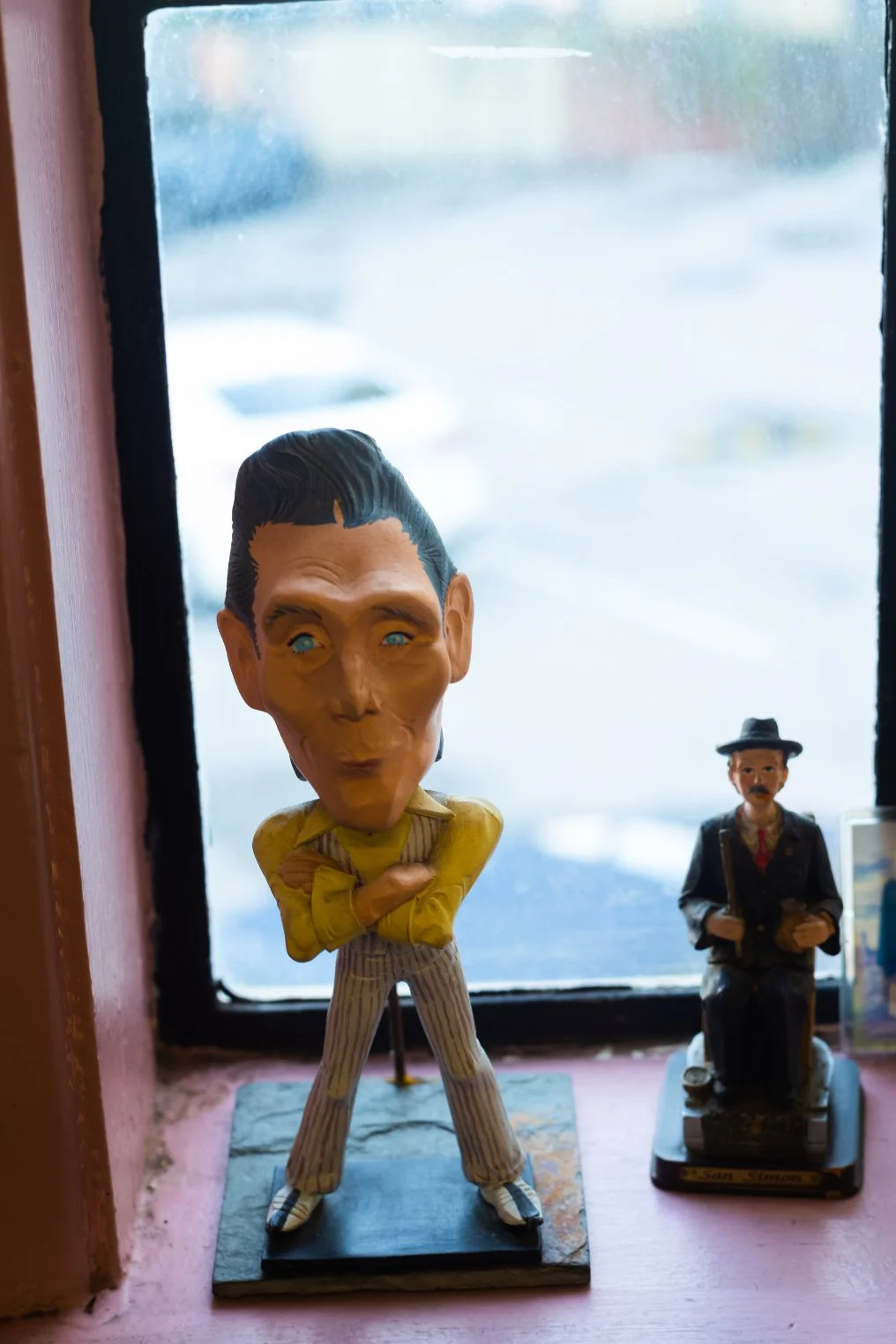
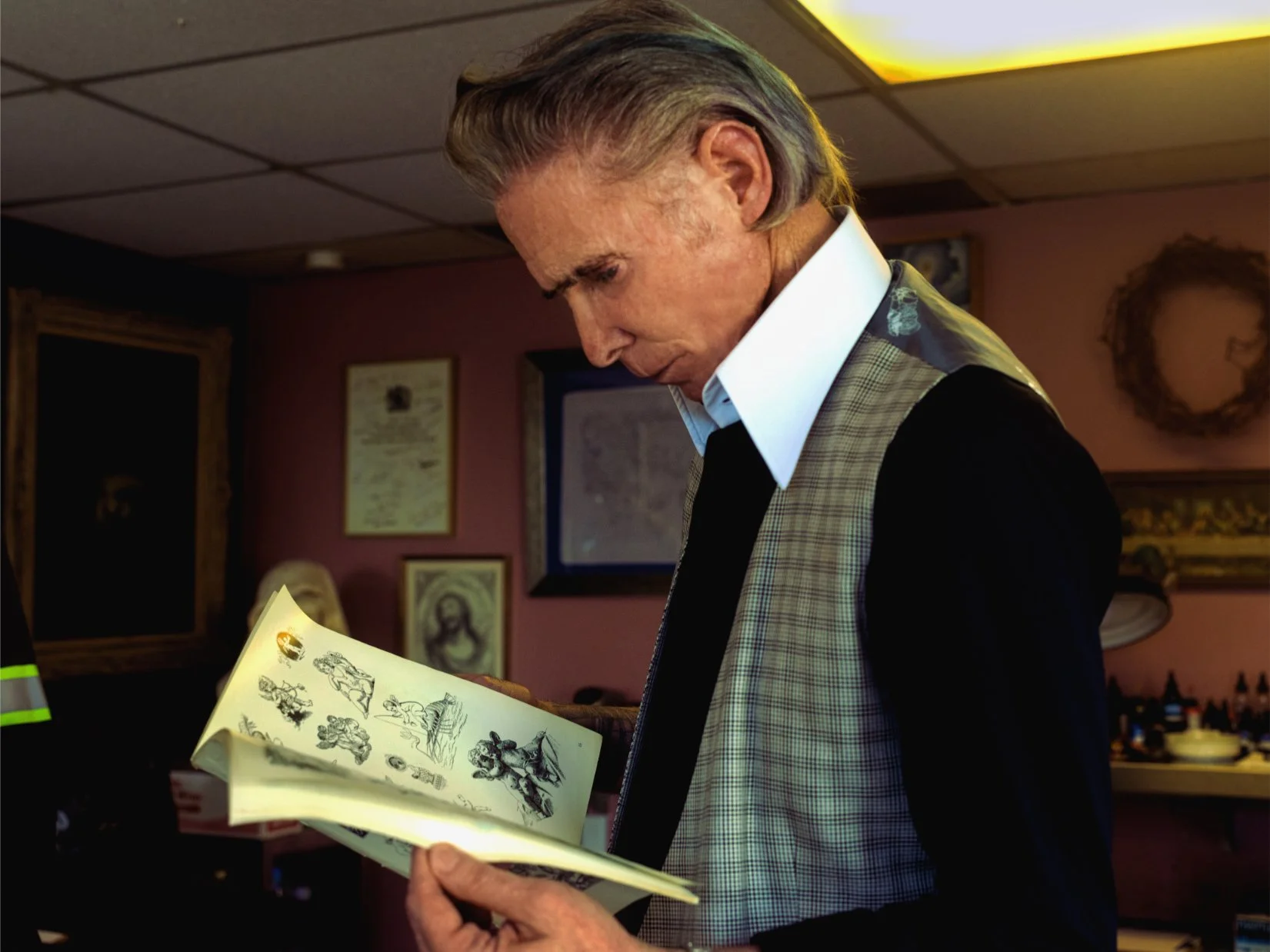
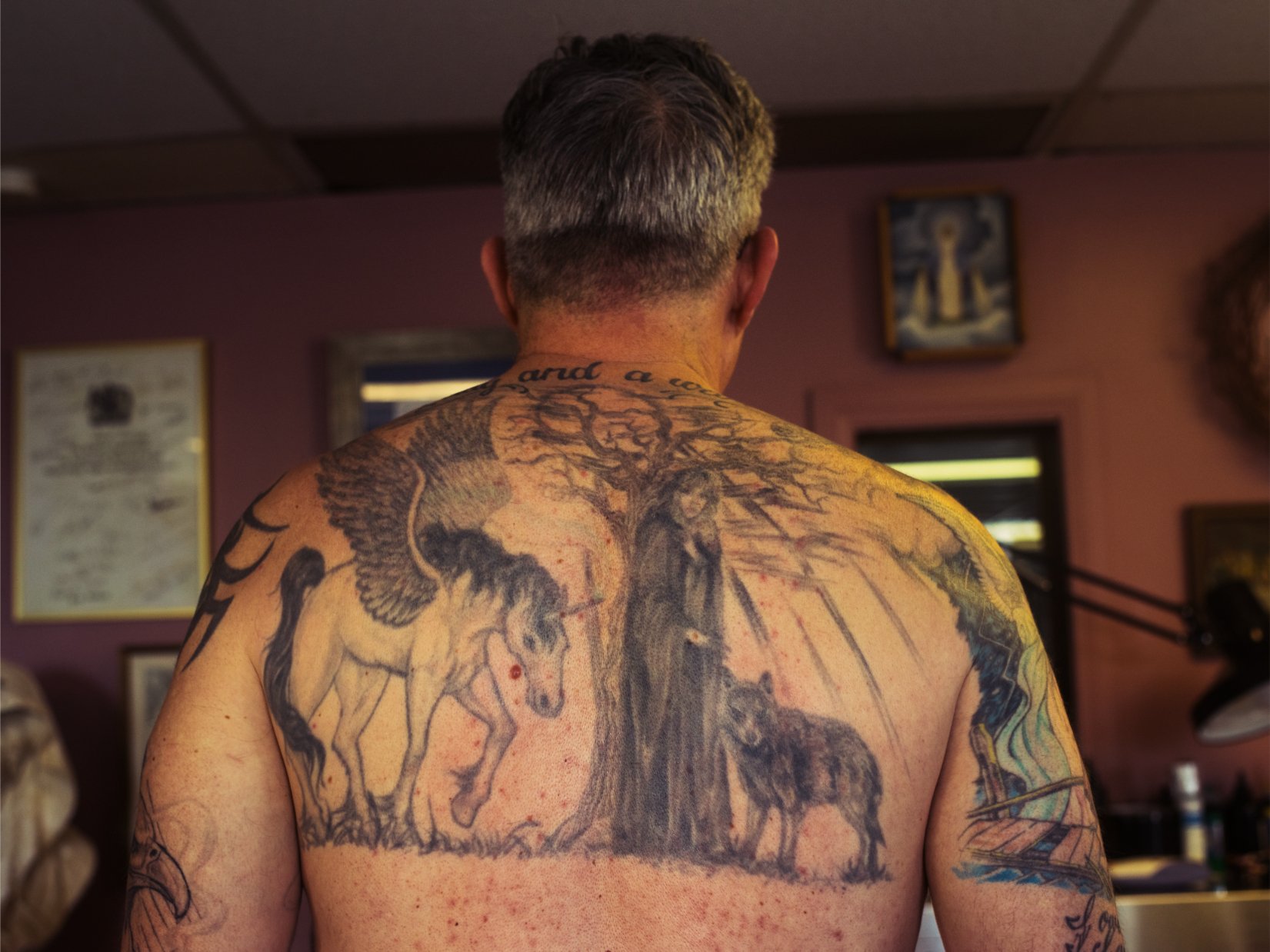
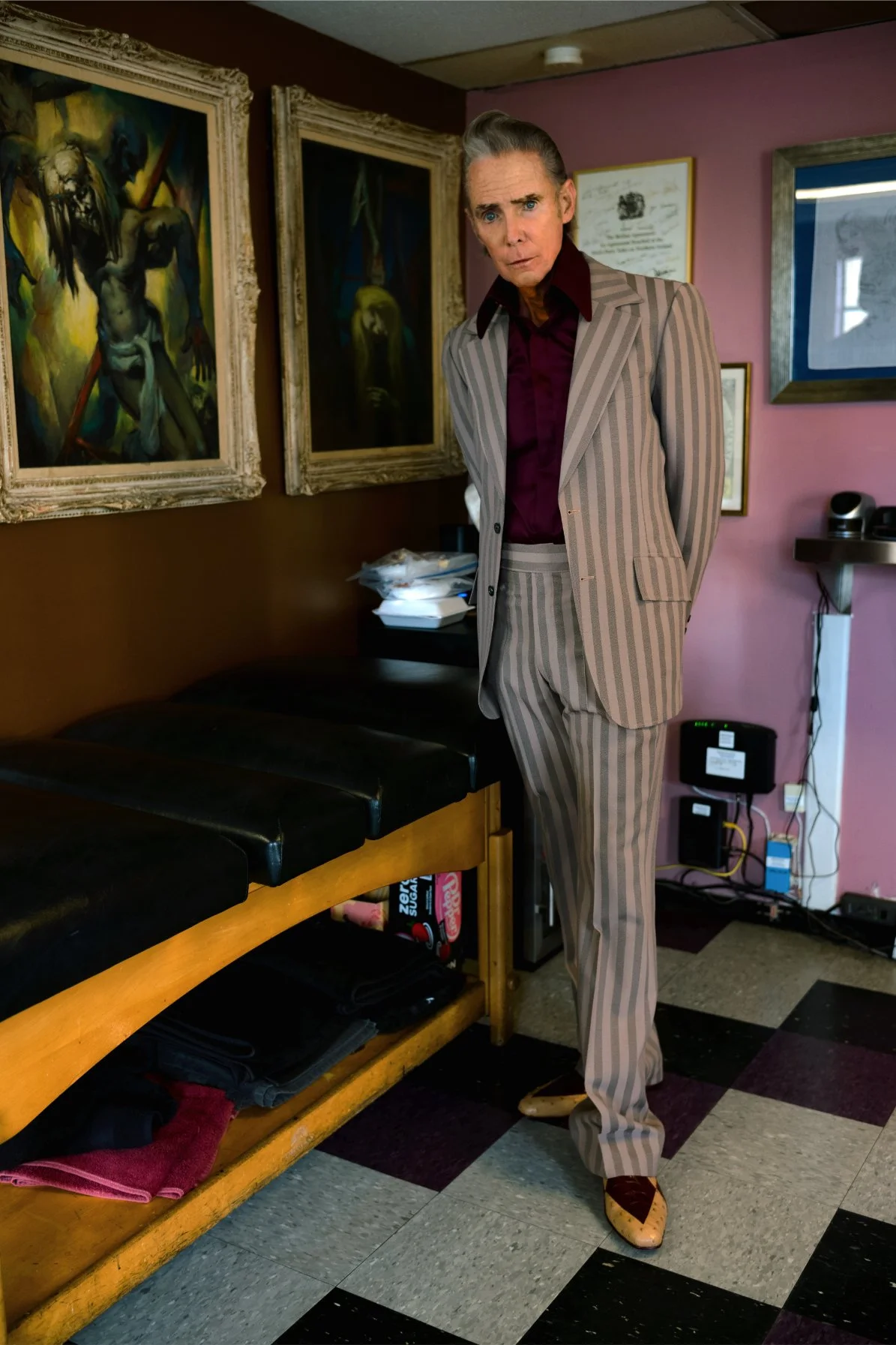
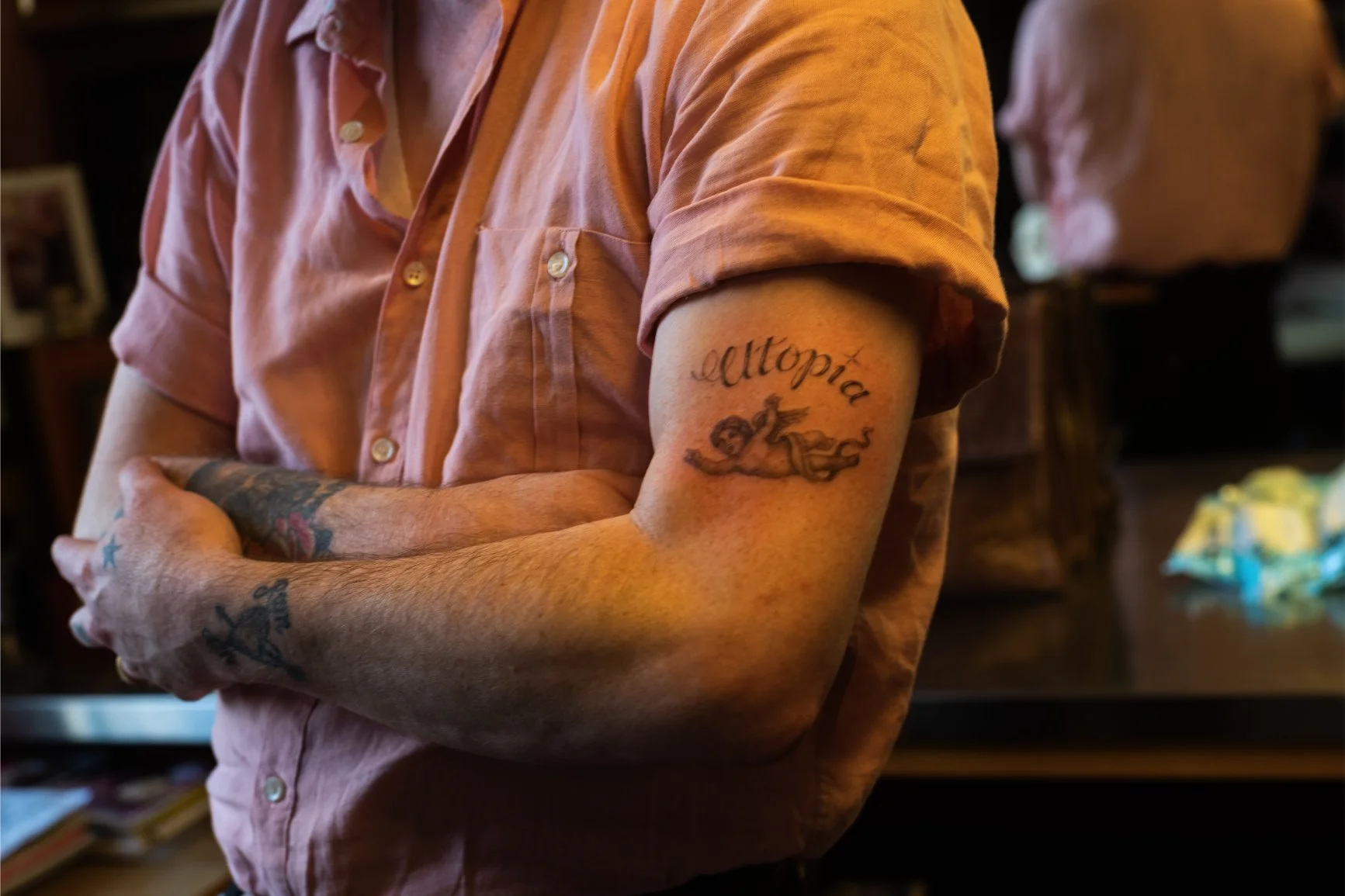
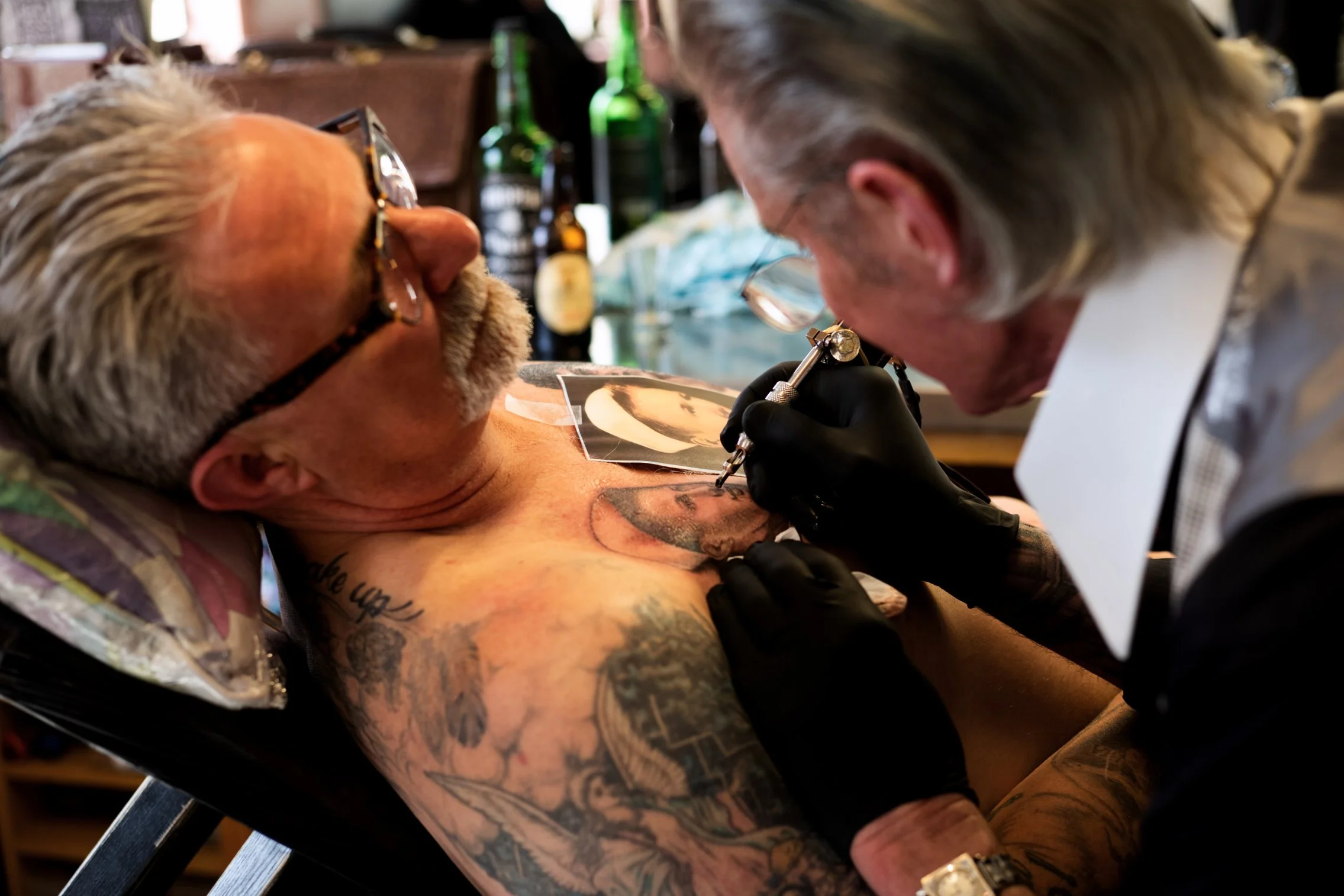
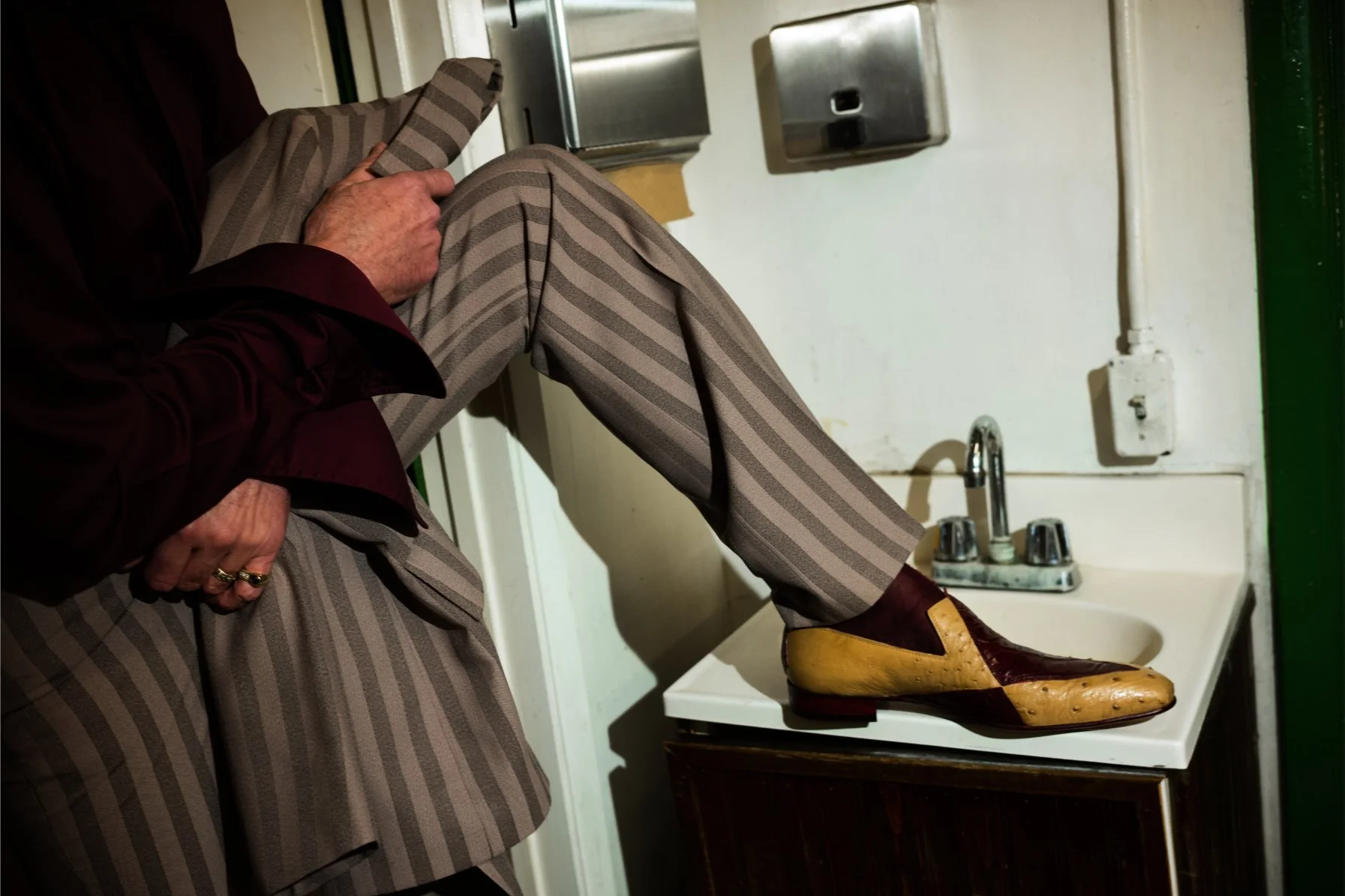
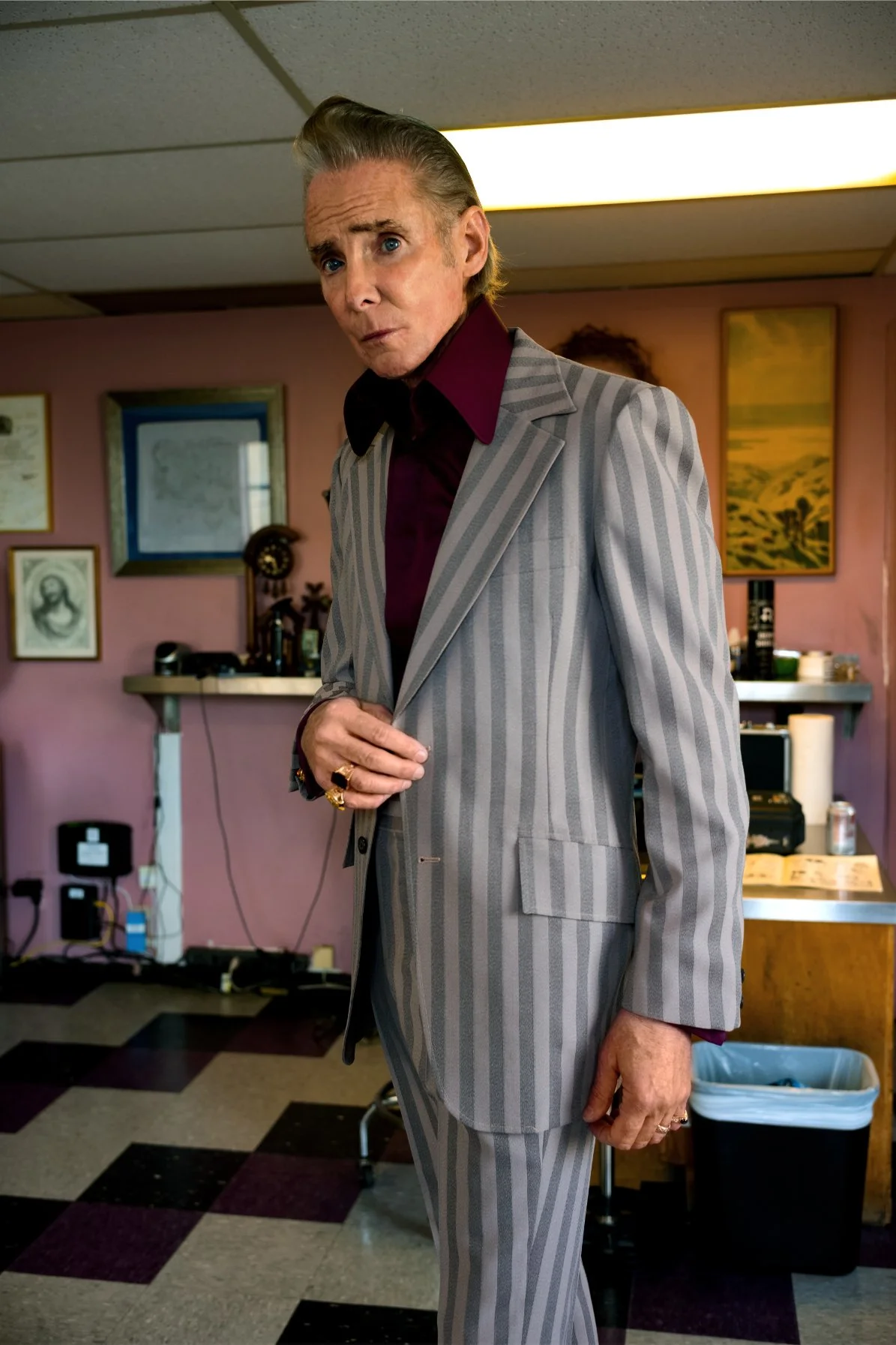
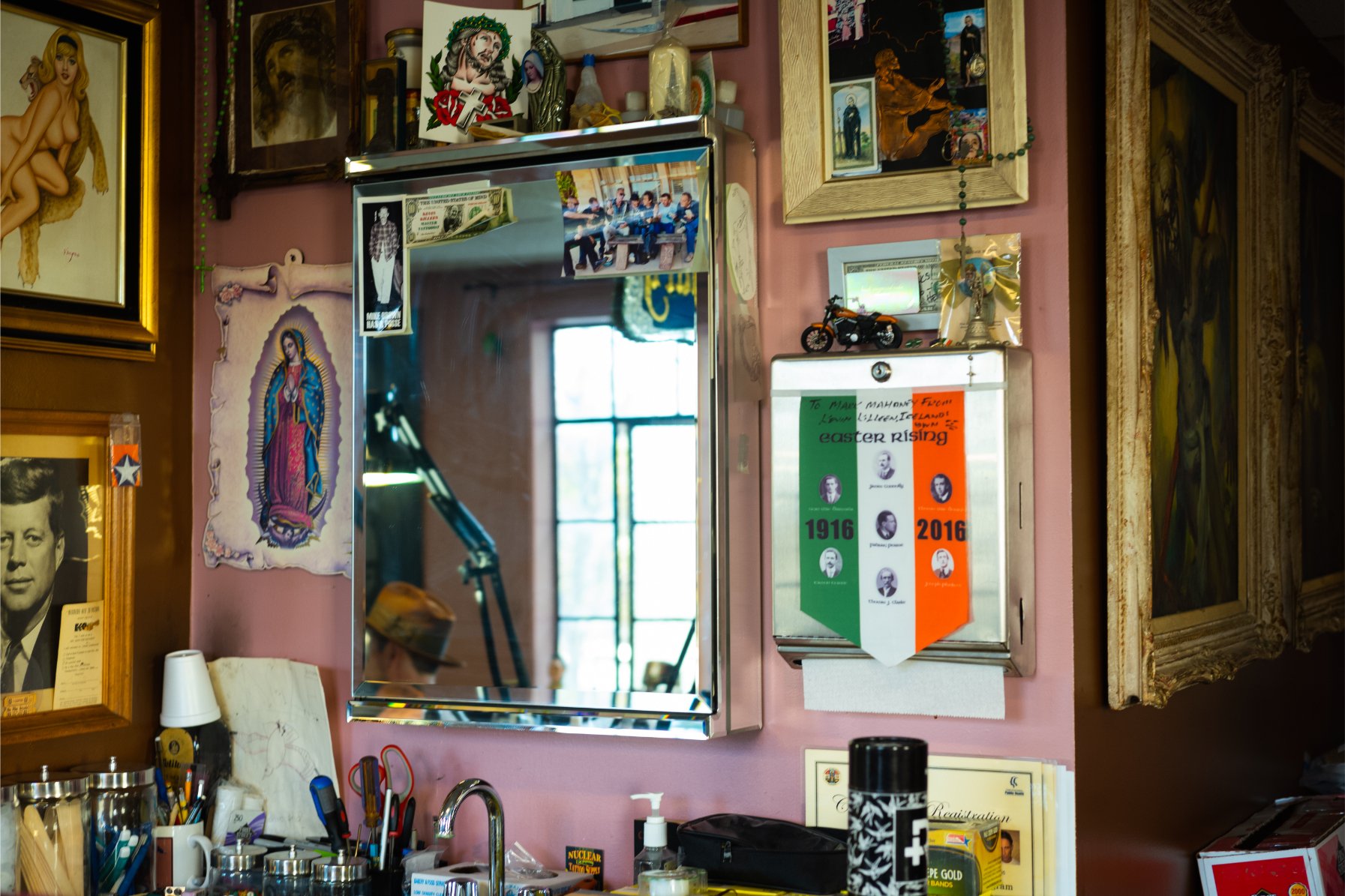
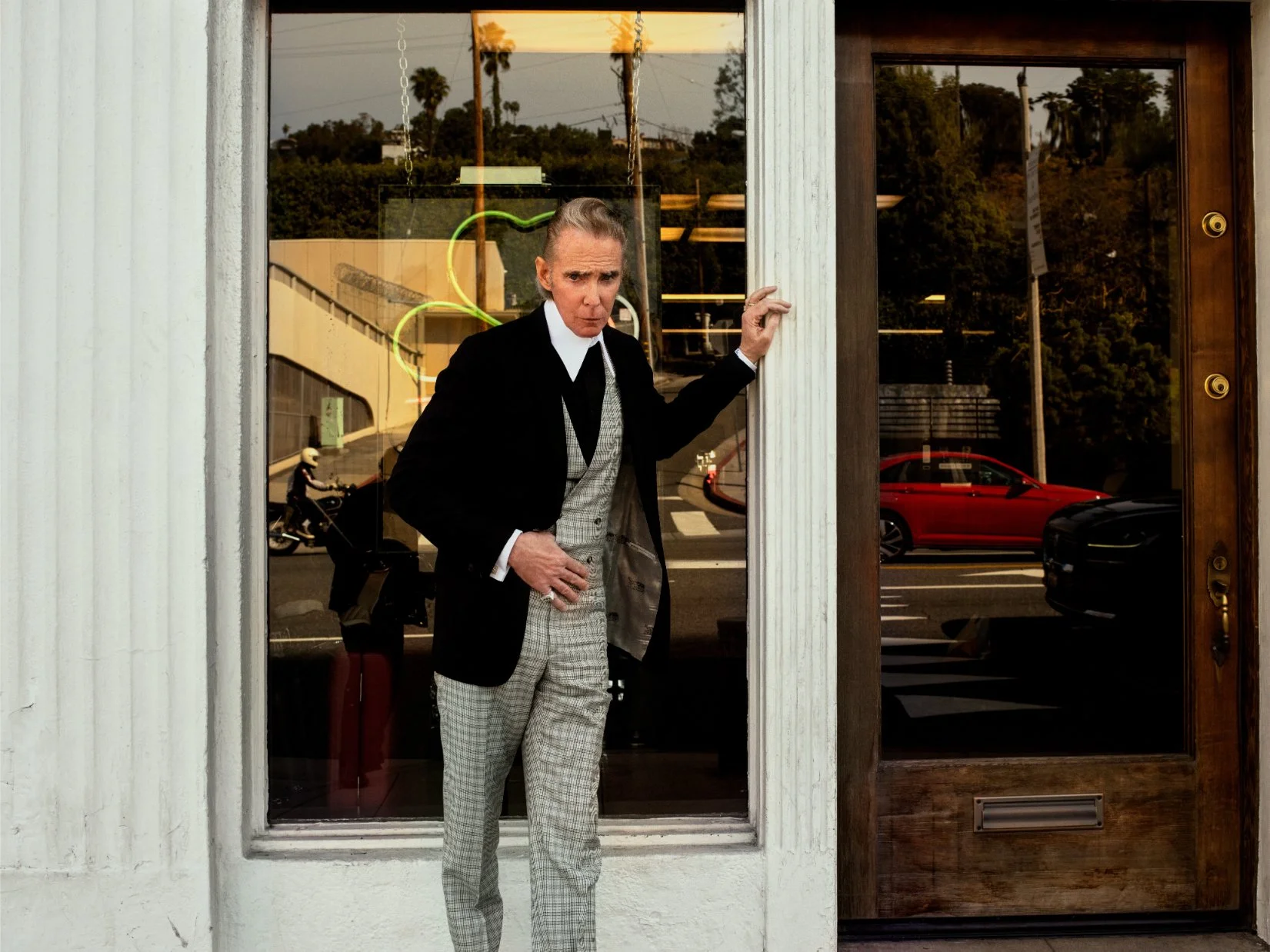
With the aura of a gritty, but warm benediction, legendary tattoo artist Mark Mahoney sounds and looks like a gangster angel that landed on the Sunset Strip. Priestly with high cheekbones, electric blue eyes, tailored suits, handmade Italian shoes, and a perfect pompadour, Mahoney’s shangri-la is Shamrock Social Club; one of the last true Irish tattoo parlors. Mahoney got his start tattooing the Hell’s Angels in Boston. Today, he is one of the world's most famous living tattoo artists. He was responsible for popularizing fine line tattooing, the black and grey style that originated within the Mexican gangs of East Los Angeles. Photographer and artist Nan Goldin met Mahoney in art school when they were just kids. Some of her earliest photographs are of the young tattoo artist: young, free, piercing skin with ink and riding around in cars. They have been friends for over forty years. Mahoney inked Goldin’s first tattoo. On a grey day in Los Angeles after the Oscars, where Goldin’s documentary All The Beauty & Bloodshed (2022) was nominated, she caught up with Mahoney for an intimate interview and a new document of portraits.


NAN GOLDIN: Did you learn anything in art school?

MARK MAHONEY: Zero. I just remember these two lesbian drawing teachers—they described themselves on the first day, one of them was like, “I like earth tones and natural fabrics." And I'm sitting there in shark skin and pointy-toed shoes and I'm like, fuck, we're off to bad start. And then, they asked us to draw flowers. So, I went home and drew, you know, flowers. And I come back and she's like, “No, I want you to draw how flowers smell, not how they look like.”

GOLDIN: So you came to only a few classes?

MAHONEY:  I came to only a few classes and then all the cool kids were going to New York. I went with you guys.

GOLDIN: You went earlier than me, with David [Armstrong] and Bruce I think. I came a year later. And Cookie [Mueller] and Sharon [Neisp] came around the same time.

MAHONEY: Yeah, yeah. Was it before you went?

It wasn't much before.

GOLDIN: Were you tattooing in New York? You didn't have a parlor, though, right? It was still illegal to tattoo.

MAHONEY: Yeah. I worked at people's houses. I worked in the Chelsea Hotel quite a few times. I'm going to tattoo you again at the new Chelsea when I do my residency, which I'm excited about. You are going to be the first person I tattoo.

GOLDIN: I love that idea.

MAHONEY: Returning to the scene of the crime.

GOLDIN: And so, when did you move to LA?

MAHONEY: 1980.

GOLDIN: What was the name of the guy who was doing fine line tattoos? Who moved to Hawaii.

MAHONEY: [Don] Ed Hardy

GOLDIN: What happened to him?

MAHONEY: You know, they made that ugly clothing line with his name, they licensed it. It was supposed to just be t-shirts, but they started making everything else. So, he had to sue the guy who licensed his name and he ended up getting a ton of money.

GOLDIN: Good. Did you work with him when you first came up?

MAHONEY: Yeah, I did. He changed the game.

GOLDIN: He was the first fine line tattooer.

MAHONEY: He encouraged it. He was more into color, but when they sold the shop where black and grey [tattooing] started, he bought it so that Freddy [Negrete], Jack [Rudy], and I would have a place to work.

GOLDIN: So good! Freddy's been with you all this time?

MAHONEY: On and off, you know. Freddy, how about that? A famous Mexican gangster tattooer. And then, when he wanted to get clean, he asked me to help him. And the only in I had was at this Jewish rehab, Beit T'Shuvah. A guy I tattoo was the intake manager. I'm like, “You gotta do me a favor, you gotta get Freddy in.” And he goes, “Mark, this is a Jewish rehab.” I'm like, “Don't worry, Freddy’s Jewish as a motherfucker. Let him in. Let him in.” (laughs) And you know, he finally broke down. And he did let him in. But, it turns out Freddy's mom was Jewish from when East LA was transitioning from a Jewish neighborhood to a Mexican neighborhood. So, his dad was a pachucos zoot suiter and his mom was a nice Jewish girl from East LA. He got totally into it. And he got Bar Mitzvahed.

GOLDIN: Now that's a beautiful story. But you know, it's against the Jewish religion to be tattooed. You can't go out of the world with anything that you didn't come in with or something.

MAHONEY: I think the jury is still out on that.

GOLDIN: I came to film the people at Beit T'Shuvah like four or five years ago.

MAHONEY: You did? That’s crazy. (laughs)

GOLDIN: Yeah. We were filming with a cameraman who was pure German. He had never probably met a Jew and he was going to the Passover Seder play—they did one of those. He had no idea what he was looking at. It defined corny.

MAHONEY: I think the rabbi is an ex-convict too.

GOLDIN: Yeah he was wild. Is the place still there?

MAHONEY: Yep. It actually helped a lot of people, man.

GOLDIN: A year and a half before Laura Poitras was on board as the director, when I first started this movie, we shot our own movie. But we couldn't get any money. Then Laura came on and we shot All the Beauty and the Bloodshed. But at the beginning of the movie, we were looking for radical approaches to sobriety.

KUPPER: How did you guys meet originally?

GOLDIN: We were at art school together. It was me and David and Mark and Kimberly and Bruce.

MAHONEY: We would drink beer and drive around in cars.

GOLDIN: That's what we did. We sat on suburban lawns, drank beer, and drove around in cars. Sometimes with the teachers. That was art school. And I lived with Mark’s sister for a while in Cambridge.

MAHONEY: It was great fun. You know, something I remember about living in New York, man, we'd go to three great gigs a night and then we'd go to the Mudd Club afterwards, but you could never say you were having a good time. You had to say, “Oh, I'm so depressed. It sucks.” (laughs) And in retrospect, we were having a ball. Right?

GOLDIN: No, we didn't have to say we were depressed. We just had to act like it.

MAHONEY: But I don't ever remember someone saying, “This is so much fun, ain’t this cool.” (laughs)

GOLDIN: It's true. I never thought of that (laughs). We missed our happy days.

MAHONEY: Yeah, right.

GOLDIN: Well, we’re picking up where we left off.

MAHONEY: That's a good line. We missed our happy days. I think it's absolutely true.

GOLDIN: We're having our happy days now.

MAHONEY: Right? I think that's why we're happy. Yeah. Happy enough. We’re cherishing in a way we didn't really then.


GOLDIN: So, did you come out to LA with Bruce?

MAHONEY: No, I came out with this girl from high school. We drove out and I went to the tattoo shop the first day and I asked them for a job and then they said, “Well bring someone down tomorrow and tattoo them. And if it works out good, we'll give you a job.” So, my friend who lived out here was in the Merchant Marines, he didn't have any tattoos. I told him, “You're getting a fucking tattoo.” So, I brought 'em down and I did a little tattoo on him and I got the job.

GOLDIN: Wow. The second day you were here. And were you living with Bruce?

MAHONEY: We lived together in San Pedro for a while, yeah. We had a cool house. It was crazy.

GOLDIN: Was David here too?

MAHONEY: Yeah, yeah. They came out together with the monkey, Joseph, who died en route. They went to a Pizza Hut in Mississippi and left him in the car with the windows rolled up.

GOLDIN: Oh, Jesus. Do you remember going to my parents' house?

MAHONEY: And the monkey got loose?

GOLDIN: Joseph escaped to the backyard and we had to call the zoo to come … no, the fire department. He wasn't coming back. And my parents were out of town and we were having too much fun in our house.

MAHONEY: Wild. I didn't think we would ever get ‘em out of that tree.

GOLDIN: I found a good picture. It's Bruce with the monkey.


KUPPER: Nan, can you talk about your first tattoo experience with Mark?

GOLDIN: Yeah, that was at Bruce's house on Elizabeth Street. There's pictures of it. I'm high as a kite. Happy as hell. Laying down on the bed with a beer in my hand. The first tattoo was a bleeding heart on my ankle.

MAHONEY: Yeah, like a sacred heart.

GOLDIN:  I collected sacred hearts.

MAHONEY: And the ankle sucks. It hurts.

GOLDIN: Yeah, it's not doing so well.

MAHONEY: We could redo it someday. Clean it up. You've earned that shit.

KUPPER: So Mark, how long were you in New York between Boston and Los Angeles?

MAHONEY: A few years. I went back and forth to Boston and worked on the Hell's Angels.

KUPPER: Tell me about that experience. Working with biker gangs.

MAHONEY: You know what, I look back on that now, those guys were so nice to me. I was so lucky. I think they were happy they didn't have to drive to Rhode Island and they liked that I could draw whatever they wanted on 'em, and I'd go to the clubhouse and have a ball. Yeah. That was wild. That was cool.

KUPPER: Did that experience inspire you to open your own social club?

MAHONEY: You know, when you’d go to tattoo shops in the old days, you'd go to Rhode Island and the guys were just mean, man. I remember asking a guy like this if there was a school for tattooing. And he said [imitating a growling voice], “Yeah, reform school.” There was this veil of secrecy around the tattoo world. It’s impenetrable. But I told myself that if I ever have a shop, you know, I want people to be nice to people. And that's why I call it the social club. It’s okay to socialize.

KUPPER: I feel like you've developed your own sort of countercultural shangri-la. Can you talk a little bit about that, and what your personal definition of utopia is?

MAHONEY: Well, I have been wanting to get Nan to move out here for a very long time because I know that the sunshine and California has been good for my mental health. You know what I mean? My mother had depression in that fuckin’ grey Boston weather. She said the Irish are given to the melancholy and I think that's true. But being in the sunshine, being in LA, it’s utopia to me. And I think Nan would thrive out here. I think she would be directing two movies a year and saying no to ten other ones.

GOLDIN: Jews are given to depression, too. There are two different kinds of guilt. Catholic guilt and Jewish guilt. I like Catholic guilt better than Jewish guilt. It’s more concrete and the imagery is beautiful. The Jewish guilt is endless.

MAHONEY: When you’re Catholic, you can go to confession and all your sins are forgiven.

GOLDIN: And if you’re Jewish you go to a Jewish psychiatrist and never get forgiven.

KUPPER: Nan, what's your personal definition of utopia?

GOLDIN: Utopia evades me. I'm a very dark person. My last show was called, This Will Not End Well. It's a major career retrospective, you know, being sixty-nine and saying, “this will not end well,” it says a lot. I mean, if I could, I would have my friends back. That would be utopian to me. All my friends and the way I feel now. The way I relate to people now with them alive as opposed to being young and an insecure person and all that. So, the way I feel now with them alive, that would be utopia.

MAHONEY: There’s that cherishing thing again. That’s really good.

GOLDIN: And maybe we'll meet them on the other side.

Marina Abramović


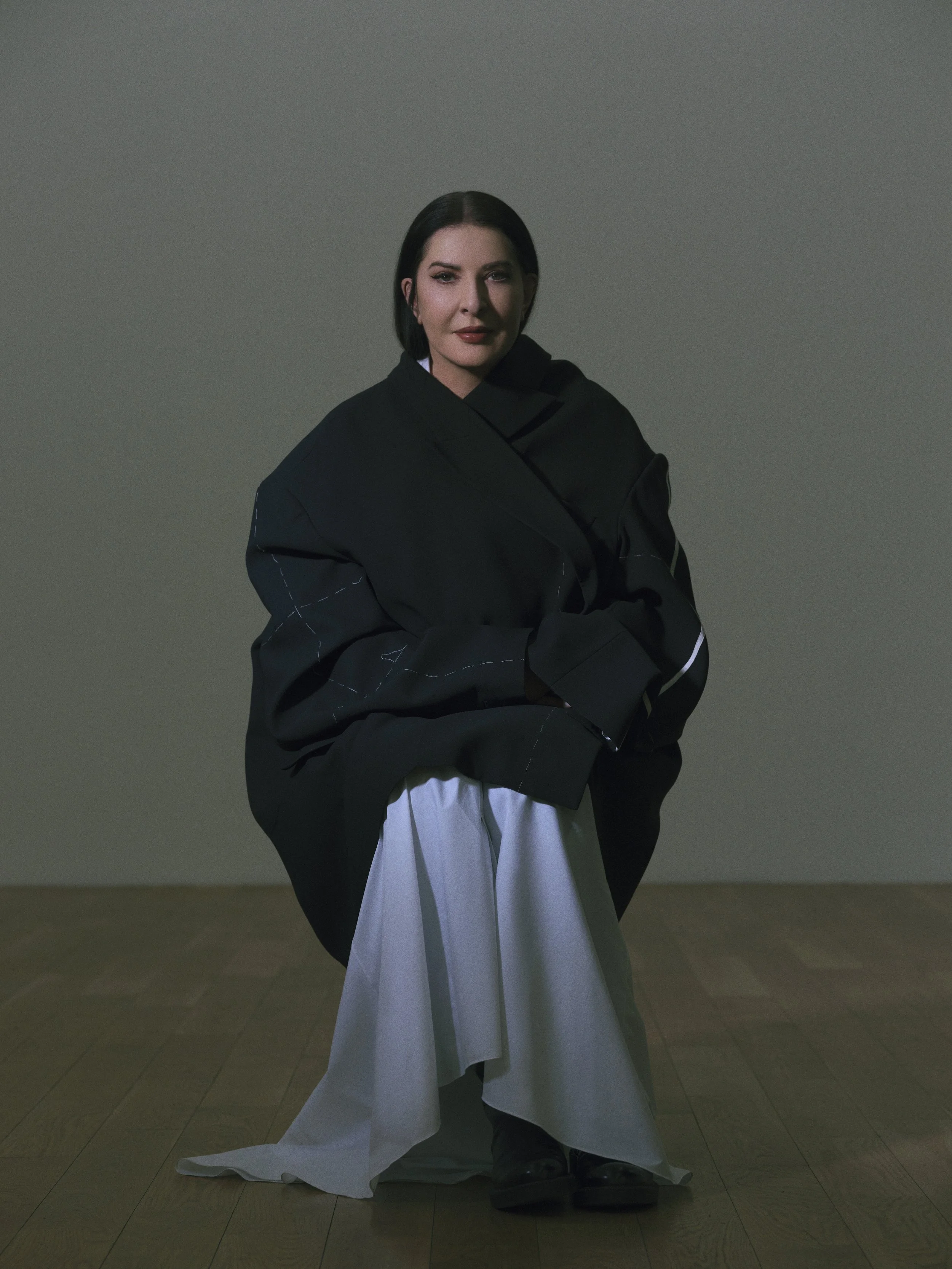
Peter Do oversized blazer coat and cotton wrapped blazer gown
Prada leather boots


interview by Miles Greenberg
photography by Justin French
styling by Julie Ragolia

Performance is a kind of collective action. It is one of the truest collaborative art forms. Since the 1970s, Marina Abramović’s main collaborator has been the audience to some of her most iconic, dangerous and breathtaking performances, which are often durational and test the limits of the human body. For Abramović, the artist is a universal vector for the experiencing of all things and all emotions. To protect her art form, she founded the Marina Abramović Institute, which regularly holds workshops, lectures, seminars and performances around the world. She was recently chosen for the Pina Bausch professorship in Essen, Germany, where she has been working with a multidisciplinary group of performance artists over the course of a year in preparation for their ten-day durational performance at the Museum Folkwang. Miles Greenberg was one of her performers in a six-day production, NO INTERMISSION, at Theater Carré in Holland that took place earlier this year. They caught up to talk about the transformative power of durational performance and the importance of freedom in one’s artistic process.

MILES GREENBERG: You came up as a young performance artist in Amsterdam. Can you talk about how the show we did together at Theater Carré reflected those years in its format?

MARINA ABRAMOVIĆ: You know, it was inspiring that the space where we did the performance is not a museum space, it’s not a kunsthalle, and it’s not the kind of space where you traditionally show art. This was a theater, and to actually break all of these rules that the theater imposes and create new rules—the playfulness was a very important part of the show. After doing this stuff for fifty years now, I’m so fed up with the rules, with the political correctness, and with all the shit that’s going on. Now, with a bit of nostalgia, I'm looking to futurists, to dadaists, to surrealists, to all these people with groups that actually created a history of art by playing. They weren’t afraid of mistakes. This is such an important situation where real, live art can happen, and also shit can happen, and both of those things are so exciting for me. We chose the artists but the artists were free to propose the things that fit them the best. Normally, if you have a show in a museum, you have to send the title of the performance, the duration, and what space it’s going to be in. All these regulations have to be followed, and then the work is made. I mean, who could have predicted that on the last day, the audience and the performers would jump into the canal, just like that (laughs). Normally, you don’t jump in the cold canal in Holland, apart from it being dirty, but never mind.

GREENBERG: I totally feel that. I think it resonated so much on a personal level when I went and participated. On the flip side, I had a museum show that I was working on back home in New York that was very regimented. Every single day I was having to deal with another tiny issue. There was so much preconception that it completely lost the spontaneity. It was great, but that process is so different. The performance we did in Holland, I had no idea what to expect, and that was such a palate cleanser—to be able to feel the immediacy of how the performance came to be. It’s an immediate art form. How does immediacy in that way—and the gratification of being able to create something and see it immediately with your body, with the audience’s body—how does that still play into your work and your practice today?


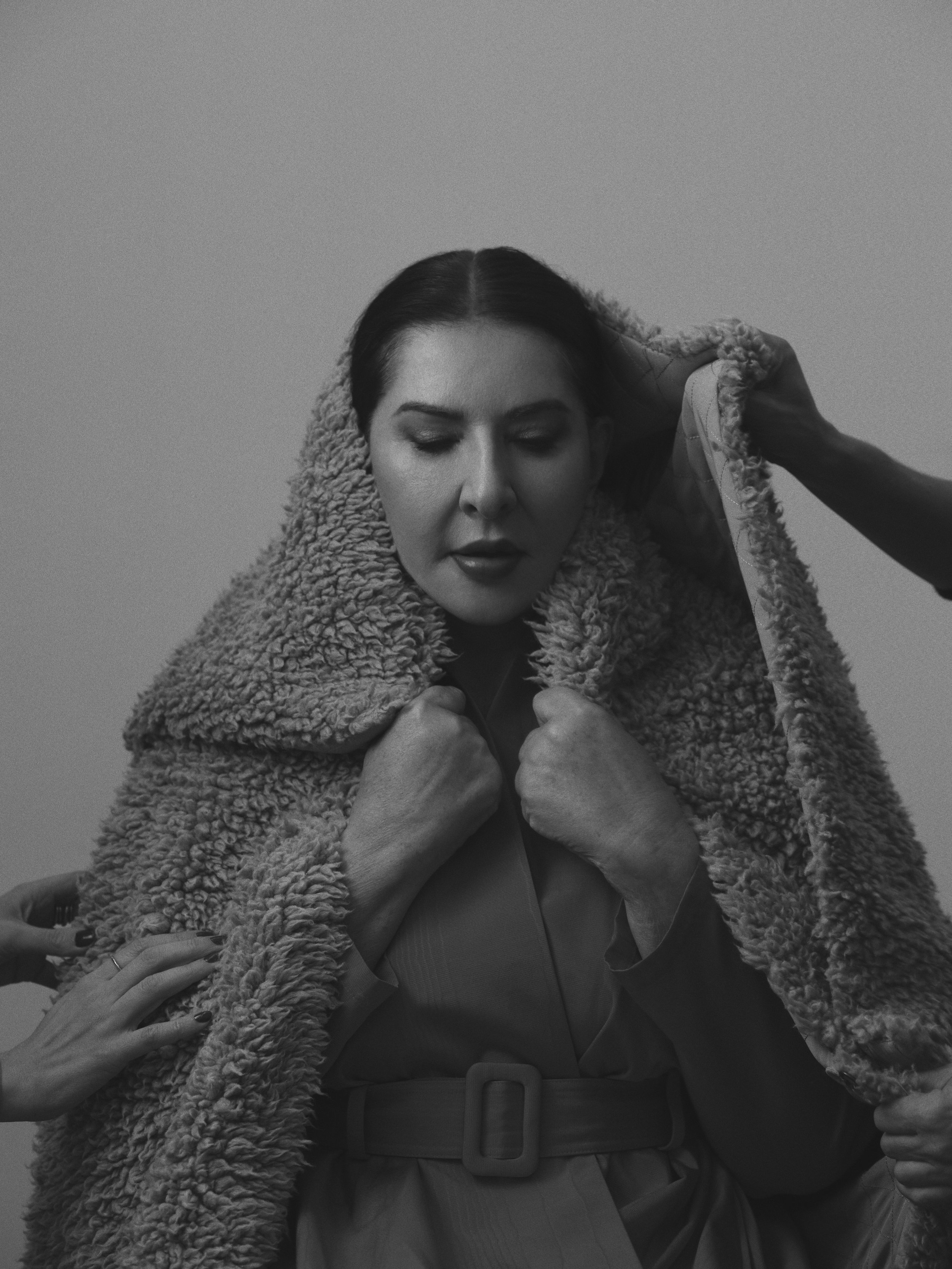
Marc Jacobs merino wool, baby alpaca and polyamide hooded cape
Gucci moiré smart coat


ABRAMOVIĆ: Jan Hoet was one of the very few great curators in art history, he was the director for documenta IX, and at the time, he took from Joseph Beuys' 350 secret potato recipes. So, every day we would have a new recipe and we hated potatoes. We wouldn’t get anything else, but he created this kind of family situation where you eat potatoes even though you hate them and you create art, because we all have to be in the same space with the same chemistry for this to happen. We need this feeling of freedom to create anything. It's from chaos that things actually happen, but you have to have that kind of vision.

Your project went through so many different phases. You were proposing one idea and then something else completely. What makes it great is when it's not just the artist who is doing experimental stuff, but the people who organize the performances need to have the same attitude. Did you feel the freedom to change the concept and everything else as you went along, even once you were in performance?

GREENBERG: Oh, things changed up until the last moment of the very last performance, absolutely. There were so many decisions that were made while making and while doing. The opportunity of having six days to feel it out with that audience every single day in a different way was great. Not everybody performed every single day. There were different versions and configurations, and everybody was working so much internally. For example, the way that Ying Mae walked through with her singing vase—it made the performance radically different from the day before.

ABRAMOVIĆ: When the public normally comes to a performance, they’re led into an auditorium, they take their seats as they’re used to. But then, they had one person, which was me, actually watch over them. And my watching was designed to turn them toward something they’re going to see, something that would be for a long duration, where they can just relax and take this as an experiment. I was trying to make this kind of dream for them, and after that, it strikes them that some can go to the left side, others to the right side, and some can go up. They were all free now to move around. But to start with a very simple exercise—let’s all breathe together twelve times—these simple exercises are so important to energetically connect everybody who would normally come to the theater not connected, and it works. So, the only structure was that one, and then everything else was so free, and whatever happens will happen.  

GREENBERG: I love the way that you describe the difference between theater and performance. In theater, it's a fake knife and you’re seeing ketchup, whereas in performance, the knife is real and so is the blood. You like to bring people into the universe and prepare them to see something. I’m wondering how that differentiation exists in the audience’s body?

ABRAMOVIĆ: What we were doing at the Carré was so interesting because it was a mix of everything. There was a big performative team that was very theatrical, but also there was the Spanish guy who would really take a drug that would knock him down, and then he’s left to the public to take care of him. It was absolute exposure, vulnerability, and danger. This was real and you could immediately see how the public reacted emotionally on each day. Your work was extremely emotional too, it was dance, but you introduce this physicality of endless time, where you could come and see it in the ballroom and then you could have a full dinner, come back, and it's still there. It’s never-ending, that investment of time, of possible danger, it brings a lot of emotion to the public. The durational performance form is so unique because it has this transformative function. You’re not just doing it because you’re going through the process and changing yourself, you’re also changing the public. That’s the key. It was so interesting how every day more and more people came. They would invite their friends, and those friends would invite their friends because they couldn’t believe what was happening. At the end, it was this huge celebration and the audience was no longer looking at something, they were a part of something.

GREENBERG: Can you talk a little about teaching at Essen, the legacy of Pina Bausch and that crossing over with your performance work?

ABRAMOVIĆ: My love for Pina Bausch really dates back a long time. In the ’70s, she had an incredibly radical approach to dance, made some amazing pieces, and there’s hardly anyone left from the original company because everyone is so old, but the new group is still performing these pieces. Every time I see their work I’m in shock by how relevant, how contemporary, how incredibly important it is, and how many other choreographers take from her to create their own work. For her, dancing was everything. It was walking in the snow with bare feet, standing in the forest, smoking a cigarette—there was no limit to what dancing was. And also, working to the point of trance. I went to see The Rite of Spring, which I had already seen several versions of, but I wasn’t prepared for this one. They went to Uganda and they took thirty dancers from fourteen African countries, male and female. The moment they started to act, you’re elevated to this spiritual, shamanistic, energetic level where you hardly even notice you’re breathing. Unbelievable. It was so spectacular because they add their own culture to the dance, which she made space for. This was really something.

I stopped teaching a long time ago, but I got a phone call from Pina Bausch’s son and he said that when she died, she wanted to establish this academy in Essen where people from different disciplines could create a multidisciplinary group, and I was the first teacher who’d been asked. It would only be teaching for one year and we could propose different people. I got 150 proposals and I chose twenty-six people. These people are coming from from physical theater, from drama, not many from dance, a male opera singer who is a soprano, there are jazz vocalists, composers, and none of them have ever done anything durational in their own fields. So, we’re working together for this big event and they gave me half of the museum where they’re going to perform for ten days, six hours a day. More and more, I want to create new work that mixes performance and dance. The Pina Bausch approach to the physicality and the spirituality of dance really speaks to me the most.

GREENBERG: I’m curious about your group of students. What kind of work are they producing?

ABRAMOVIĆ: The way I’m teaching, I want to be just a conductor to their own ideas. I don’t want to push my ideas, so I don’t even talk to them about my work. They can look on Google, but I’m not giving it. They bring their own stories, problems, investigations, dramas, whatever they want to do. There’s one student, she’s working on physical theater and her biggest drama is feeling ignored in public but being too chicken. So now, she studies chickens. She went to several farms in Germany, she covered herself completely with feathers, and she’s going to do ten days, six hours a day, being a chicken. It’s perfectly done and I just give her space, time, and the facilities.

It was very funny also to tell them how to value their performance projects financially. Because they are students, they are not going to be paid. The school pays for the production, plus they get a museum show, TV show, catalogue—I mean, I’ve never seen such a thing in my life. But I said to them, “In real life, you have to be paid for what you do, so put the price.” Some of them put like 300 bucks and some like $10,000. Very interesting how they value their work. (laughs)

GREENBERG: You’re an extremely good teacher, because nobody ever teaches that.

ABRAMOVIĆ: You know, I never got paid for any performance in my entire life until The Artist is Present [2012], and they had to pay me because I performed for three months in the museum and I had to pay my mortgage. Tino Sehgal is a genius because he really found out how to sell a performance. Kiss [2003] was the first thing he ever sold and he sold it for $250,000. It’s an edition of five plus two artist proofs, and lots of museums bought it. Every museum has to pay for the piece plus the performers, but at the same time, you have to control who they are. I saw this piece performed really wonderfully, and then another time I saw two shitty guys who had no charisma, nothing. So, you have to set up rules for how the piece should be performed in the future.