Marcella Zimmermann


interview by Kaitlin Phillips
photographs by Mike Vitelli

You can pass through many workplaces in New York City without coming across anyone completely suited to their career. Once you find such a person, it’s a quiet inspiration. People like to fight the notion that you are what you do—but in the cases where it’s true, I can’t think of a better scenario. Such is the situation with Marcella Zimmermann, founder and CEO of Digital Counsel. It’s not enough to say she works harder than everyone else. Though she is a workaholic, I think it was something subtler: there wasn’t a situation where she didn’t know what to do. This makes her aptly suited to her profession. Communications is a protean environment. What’s true one day is not true the next. This holds true in everything from the smallest detail (one editor will tell you they’d never cover such a story, while the person one cubicle over will assign it) to the largest (publicity isn’t magazines anymore). More importantly—because being able to do your job, while novel, shouldn’t be the highest bar—Marcella is one of those old school publicists, with the glamor and cultural relevance that it connotes. But I mean this literally, she was trained in the old world, and yet has chosen to pioneer a new lane in marketing. I can’t think of anyone more committed to leveraging new direct means of communicating with audiences, far beyond the printed word.

PHILLIPS: You didn’t go to college, you didn’t study communications, and you didn’t have a traditional route to a career. You do, however, know a lot of interesting people and have always been at the intersection of many cultural conversations. What were some of the first jobs that led to your work in PR, and how did this transition to Digital Counsel happen?

ZIMMERMANN: Thank you for asking because a lot of people don’t realize I’m out of the PR game! Okay, so how it all started: when I moved to New York after high school, I started my first agency, New York Art Department, where I was as much on Tumblr and Reddit as I was in the art world. I became obsessed with Nyan Cat, which I believed could be the next Hello Kitty. I cold-messaged the creator, pitched a group show at The Hole, and convinced artists like Tom Sachs and Virgil Abloh’s [streetwear label and music collective] Been Trill to reimagine it. The show got written up by The New York Times and became my first big client project. From there, I worked at VICE, where I launched Madonna’s first global digital art initiative “Art for Freedom” before moving into PR under one of New York’s most iconic publicists.

PHILLIPS: Nadine Johnson!

ZIMMERMANN: Yup! That role gave me a traditional crash course: pitching stories, managing red carpets, seating galas with sticky notes, planting items in Page Six. It was valuable training, but I realized my passion was working directly with artists and building experiences. So, I launched Foundations magazine with my best friend, the art dealer Sebastian Gladstone, profiling then “emerging” artists like Jamian Juliano-Villani and Jessi Reaves. Carly Mark from Puppets Puppets was an editor, too. In 2015, I helped start the PR firm Cultural Counsel. After nearly a decade there, I spun off Digital Counsel, the independent company I own and run today.

PHILLIPS: Communications is becoming a more niche-y, specialized field as traditional media platforms lose influence and non-traditional platforms expand. To meet this new world, you've rapidly expanded in a direction that I genuinely don't even totally understand. What's your lane? What are you doing that other people aren't doing?

ZIMMERMANN: Yes, the trad media game has been completely maimed. The real gatekeepers now are the platforms and algorithms, not editors. Artists, brands, and institutions don’t just need to get in the door anymore—they need to build trust and context directly with their audiences. That’s my lane.

The difference with Digital Counsel is that my team isn’t made up of communications majors or “social media managers”—we’re practicing artists, extremely online content creators, serious paid media experts, and hardcore engineers. I’m the only “traditional” communications person on staff!

We try to treat social media campaigns the same way a curator approaches exhibition wall-text. We start with core messaging: What is the idea? The thesis? Who’s the intended audience? Then we radiate outward—how does that message get adapted for a website, an Instagram Reel, a TikTok moment, a board report, an ad campaign?

PHILLIPS: So, you're bullish on the importance of being your own media?

ZIMMERMANN: Absolutely. In the future of culture, the competition isn’t just the gallery down the street—it’s the Kardashians, OnlyFans, Labubu, Netflix, AI slop cat videos. That’s the landscape. For the arts sector, it shouldn’t be about chasing a million views; it’s about building trust and having confidence that your voice and vision will find its audience through consistency.

The truth is, cutting through the noise is harder for the arts. Quick hits like when a museum’s plunky social media manager co-opts a meme-y trend like Girl Dinner, it might seem rewarding in the moment but there’s no lasting impact. And it’s cringe. What does last is the relationships you build with your audience. When people return to you because they trust your perspective, that’s the kind of sustained engagement that carries further than random short-term new followers, or a single headline, no matter how meaningful the coverage. That’s real influence.

PHILLIPS: How are you defining influence? Do you have a number in mind? I'll give a dumb example, there was a moment when having 200,000 Instagram followers mattered. It felt like those people were kind of famous, and now I think that number is a million.

ZIMMERMANN: I wish I could give you a number—like, “in 2025, you need 1.4 million followers”—but we all know that game is pretty hollow. You can have hundreds of thousands of followers and still be screaming into the void if nothing actually sticks. Visibility alone doesn’t equal influence.

And I don’t care much about likes or views anymore. The signals that matter are saves and shares. A save means something was valuable enough to hold onto; a share means it became part of someone else’s self-expression. That’s the level of connection we’re chasing—not vanity numbers, but work that people want to carry forward.

PHILLIPS: You’ve always gone back to the same sort of thing where you connect businesses and artists and art, seamlessly, with no effort. I’d love to get a clear picture of what you’re going to accomplish at your company, say, next week. What is going to happen from Monday to Friday?

ZIMMERMANN: Each weekday, my team and I make our way to the Lower East Side, where our studio is on the top floor of the former e-flux building. No two weeks look the same, but the rhythm is a balance: a lot of calls, a million decks, client meetings paired with crits, watching films, keeping an intense media diet, going to openings, and spending time in artists’ studios. That mix of structured work and cultural immersion is what keeps our practice both rigorous and alive to what’s happening around us.

Next week, for instance, we’re developing the annual plan for Hyundai Artlab’s channels, treating it the way a museum might plan an exhibition season: outlining themes, identifying new voices, mapping cultural touchpoints, and then translating those into video, editorial, advertising, web, and social. Meanwhile, I’ll be running around to the Independent and Armory Show. We’re also preparing the launch of Eva Foundation, a new arts space in Bucharest dedicated to women artists that we helped brand. And the release of the new Different Leaf magazine, which will be guest edited by the artist Nick Cave, who just had that great show at Jack Shainman. Just lots happening all the time!

PHILLIPS: I feel like it was really prescient and smart to found a digital-focused company. Was this a natural move skills-wise or was there a bit of a learning curve?


ZIMMERMANN: The move was natural in spirit, but it came with a real crash course. I had the soft skills from PR—intuition, relationships, timing—but suddenly had to master hard skills like paid media, analytics, and the language of engineers and technologists. With AI making many hard skills more accessible, soft skills will matter more than ever—but they can’t stand alone. Taste, empathy, cultural fluency, the ability to anticipate how a story will land—those are the qualities that make work feel alive rather than manufactured.

At the same time, instincts need structure. To make them actionable, you have to understand distribution—how media is bought, how algorithms surface content, how to measure impact. The future lies in the interplay: soft skills provide the “why” and “what,” hard skills ensure the “how” and “where.” Together they let ideas not just travel, but take root in culture.

PHILLIPS: Can you share any more about those numbers, those internal metrics for success today?

ZIMMERMANN: Platforms give you the obvious surface metrics—reach, impressions, likes, comments, follower counts. Those are important, but where we go deeper is in qualitative analysis. Every month, my team literally audits who the new followers are. We’ll click through, screenshot, and map them: is this a random bot, or is it a curator at a museum we’re into? Is it a peer foundation in the same city where a program just launched? Is it an artist or critic whose engagement signals cultural alignment? That kind of context is much more valuable than a vanity follower number.

PHILLIPS: Who do you think is doing a good job shaping the future of culture? When I started my business, I got some advice: Sit down and think about who your ideal client is, and work on pursuing them. So who are your ideal clients?

ZIMMERMANN: My ideal clients approach culture with rigor and openness— people that want to build a more interesting, compassionate future. Miuccia Prada and Fondazione Prada’s programs are a compass point for me. I’d love to help other luxury houses build their own digital versions of something similarly multidisciplinary and intellectual. I’m also watching what Yana Peel is doing at Chanel. I just saw her speak at the Aspen Ideas Festival about how she’s translating heritage into global cultural relevance.

But who are my dream clients? The 2028 Los Angeles Olympics. Or developing Claude’s arts program. Creating a tech conference for Gagosian Quarterly. Launching the Nike Arts Biennial, first online, then worldwide.

PHILLIPS: I think it’s cool you’re adjusting to the times. I’m still stuck in traditional PR. I really do find it glamorous.

ZIMMERMANN: For me, glamour always came with grit. I value the education I got in traditional PR—it was glamorous, yes, but it was also sticky notes at 2 AM, navigating egos, and late night marathons that shaped how I operate today. That old New York media world doesn’t exist anymore, and maybe people like you and me are the last generation who will actually remember it for what it was. Maybe that’s why we’re so good at breaking it down and repurposing it for now.

PHILLIPS: There’s just no trenches now. Like, they got rid of Vogue internships. There are so many workaholic stepping stones now that are just gone in New York, and I think it did change the kind of worker Gen Z is.

ZIMMERMANN: Totally. That absence has changed both the kind of worker you get and the kinds of dreams they bring to the table. But if the old system is gone, maybe that’s the opportunity—to invent something different, something better. A new kind of glamor.

Soft Gallery: Marta Minujín


Marta Minujín with her first mattress in her studio on Rue Delambre, Paris, 1963


interview by Hans Ulrich Obrist
photography by Ada Navarro Aguilera

In 1963, Marta Minujín invited Christo, Niki de Saint Phalle, and Jean Tinguely to an empty lot in Paris to set her artwork ablaze. This incendiary happening—a term coined by Allan Kaprow in 1959—marked a radical turning point in the Argentinian artist’s career. Today, with her first solo exhibition in Mexico City at Kurimanzutto, Minujín stands out as an artist able to see, hear, feel, and even taste the future: a future both soft and hard, sweet and self-possessed. Her most recognizable works include fluorescent mattress sculptures twisted into amorphous, seemingly impossible forms—love letters to intimacy, sex, and mortality. The first were made from discarded mattresses found outside hospitals. Even more political are her toppled monuments of phallocentric power, some covered in loaves of sweet bread, turning collapse into satire and protest. These horizontalized spires became pillars of anti-authoritarianism, critiques of capitalism, and monuments to soft power. Her technological happenings anticipated the future of mass communication. Utilizing satellites, phone lines, and closed-circuit television, Minujín forged connections that foreshadowed today’s world of constant contact. Spanning more than six decades, Minujín’s oeuvre is rooted in her belief that people should live in art, not just look at it.

“We wanted to destroy art—museums, galleries, everything.”


Marta Minujín inside Minuphone, 1967


HANS ULRICH OBRIST: This is your first exhibitionin Mexico, and it brings together recent works, but it's also the first timethat the El obelisco acostado (The obelisk lying down)—ahistoric piece—will be shown in Mexico. Can you tell us about this?

MARTA MINUJÍN: I made this piece in 1978 for the First Latin American Biennial in São Paulo. I got the idea to laydown all monuments—to change the idea that the world is vertical. The world is actually multidirectional. I don't like thinking that it's all straight. So, I invented the Statue Of Liberty lying down, the Eiffel Tower lying down. All monuments around the world, lying down. The first one I made was a full scale replica of Buenos Aires’s Obelisco, which is seventy-four meters long, but lying down. It was immersive—the people could walk in, there were televisions and Super 8 film projections. Since then, I have made many, many monuments lying down—including the James Joyce tower in Dublin lying down, covered in loaves of bread.

OBRIST: They somehow challenge the authoritarian narrative of publicly imposed representation. They are also anti-monuments?

MINUJÍN: I wouldn’t quite call them that. It has to do with the popular myths that the statues convey—they are national symbols. Like the Statue of Liberty, right now, as a symbol is technically sinking. It is totally lying down and the torch is extinguished. Before, the United States would welcome everyone, but now not so much. So, the statue has to be lying down and that will be my next project for the Venice Biennale next year. I am presenting this to the government for the Argentinian Pavilion, but I’m not sure if they are going to send me there. (laughs) I will do the Statue of Liberty lying down and then cover it with fake hamburgers. People will take one and change it for a real one at McDonalds locations all over the world.


Marta Minujín with El Obelisco acostado (The Obelisk lying down), Parque do Ibirapuera, São Paulo, Brazil, 1978


OBRIST: You’ve told me about the Obelisco de Pan Dulce and the Torre de Pan for James Joyce. Food is clearly an important aspect of your art—the idea of edible art. How did the concept of actually eating the artwork enter your practice?

MARTA MINUJÍN: The first edible artwork I created was the Venus de Milo made of cheese. I’ve always been fascinated by participatory art. The idea is similar to my early work, like La Menesunda: people engage directly, moving through the experience, eating, walking, and interacting. I want them to have moments they’ll never forget—like taking a bite from a Statue of Liberty made of hamburgers, or holding a slice of a bread-covered tower, or the Panettone Obelisk. I’ve made many edible monuments because I love for people to be active participants in my work, not just spectators.

OBRIST: You told me once that at ten years old, you suddenly knew you were an artist. Can you talk about this epiphany?

MARTA MINUJÍN: I knew I was an artist at five. I started making art when I was ten. I was a child that knew exactly what I wanted to do. I knew from the beginning. I'm very happy that I did it, but I suffered a lot because I've been very poor in New York, very poor in Argentina. But I got many grants. I received a Guggenheim Fellowship in 1966, so I could live on that.

OBRIST: Last year I saw the exhibition of your very early work at Kurimanzutto in New York. These pieces from the late 1950s emerge right at the moment when informalismo was a strong global force—in Europe, Latin America, even Asia. That’s also where your Catalogue Raisonné begins, with these first informal works. Alberto Greco was important to you then; he would point to a wall and say, “Look at this wonderful surface—I’ll sign it.” Already there was this shift in your attention, from painting an image to recognizing the wall itself as an object.

MARTA MINUJÍN: He was a very big influence on me. When I met him, I was sixteen. I was still in school, and I loved him so much as a friend. At the time, I was painting in a kind of surrealist style—I didn’t really know what I was doing. Then suddenly, I put the canvas on the floor and started working there. I made one painting that was inspired by Alberto Greco. I did many, many works—three or four a day. And then I destroyed almost all of them. Years later, we found some still in my studio; that’s why a few have reappeared now. After that, I began working with mattresses.

OBRIST: I'm very interested in this idea of the mattresses because the mattress works are continuing until today, and they're a very important aspect of your practice. What was the epiphany with the mattresses?

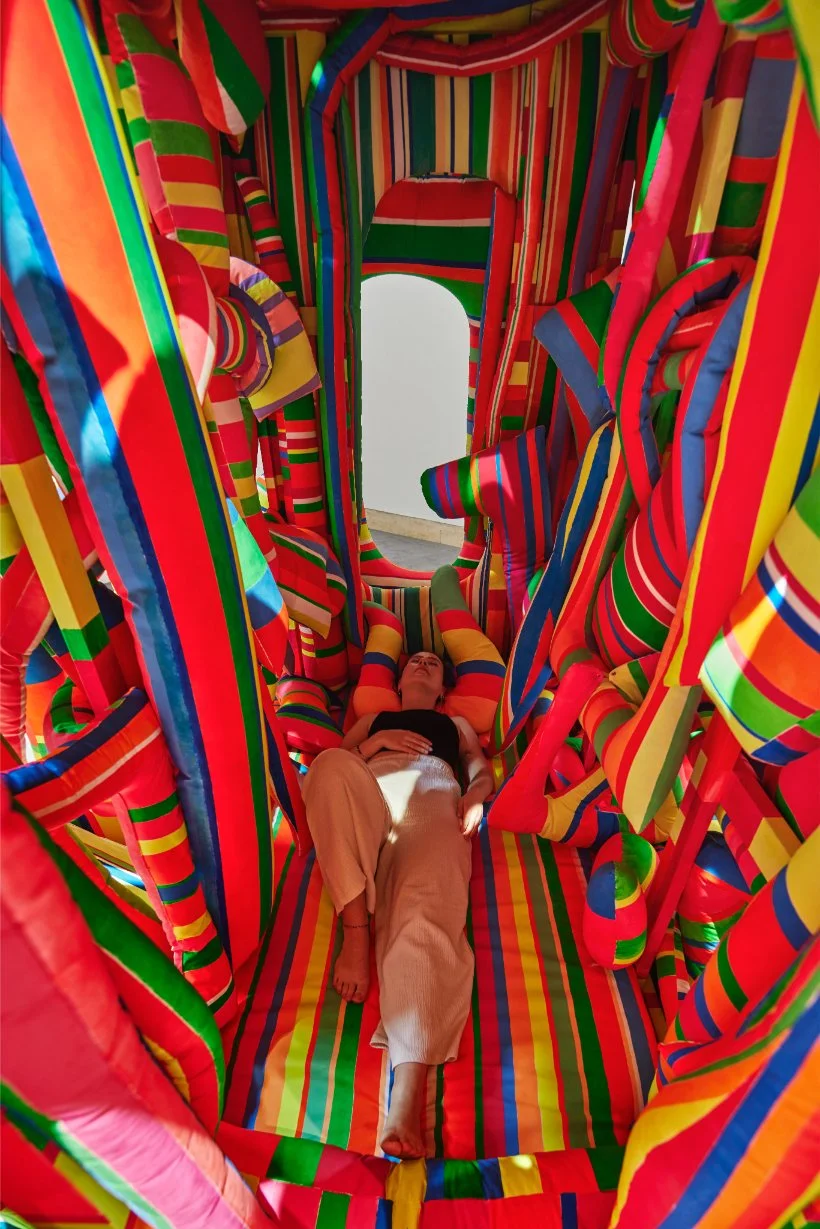
MARTA MINUJÍN: You are born, you make love, you give birth, you sleep, you die in a mattress. It's 50% of your life. And I needed a soft shape. So, I took the mattresses from my bed and glued them onto the canvas. Then I started adding cardboard boxes, mixing different materials with the mattresses. Little by little it grew. When I was living in Paris, I met Niki de Saint Phalle, and she said to me, “Why don’t you paint on the floor?” So, I painted the floor. That was it. I then visited a hospital and sourced some mattresses, which became some of my first mattress sculptures. After that, I abandoned painting objects—for maybe forty-five years. Instead, I focused on performances, happenings, and installations. Then, in 2014, I returned to the mattresses. Now I do both: some textile-based works—you probably saw one at Kurimanzutto—and, of course, the mattresses.

OBRIST: The mattresses also connect to your idea of the Soft Gallery, since softness was something you explored there as well. Can you talk about how you came to invent the Soft Gallery and what it meant for you?

MINUJÍN: This started in 1964 with a work called Roll Around In Bed and Live!, which you could actually go inside. I made it in Paris, because I was living in a place with no bathroom, no hot water, no heating. So, I built this house to protect myself. But I couldn’t sleep inside it—I just couldn’t. In the end, I destroyed it. After that, I made La Chambre d'Amour [The Chamber of Love] together with the Dutch artist Mark Brusse, who I was close to at the time. Then I went on to other projects. The last one from that Soft Gallery series was Erotics in Technicolor, for which I won the Di Tella Prize. With that prize I moved back to Paris and began working with technological art. I did many happenings with artists like Allan Kaprow and Wolf Vostell. In fact, in 2026, the Reina Sofía will present a major retrospective of my happenings and performances. That’s important, because I really began with happenings and performance in the mid-1960s. For example, in 1966 I did Three Country Happening using technology, and even earlier, in 1963, I staged La Destrucción [The Destruction], which was my very first happening.

“I built this house to protect myself. In the end, I destroyed it.”


Documentation of La Menesunda (Mayhem), Instituto Torcuato Di Tella, Buenos Aires, 1965

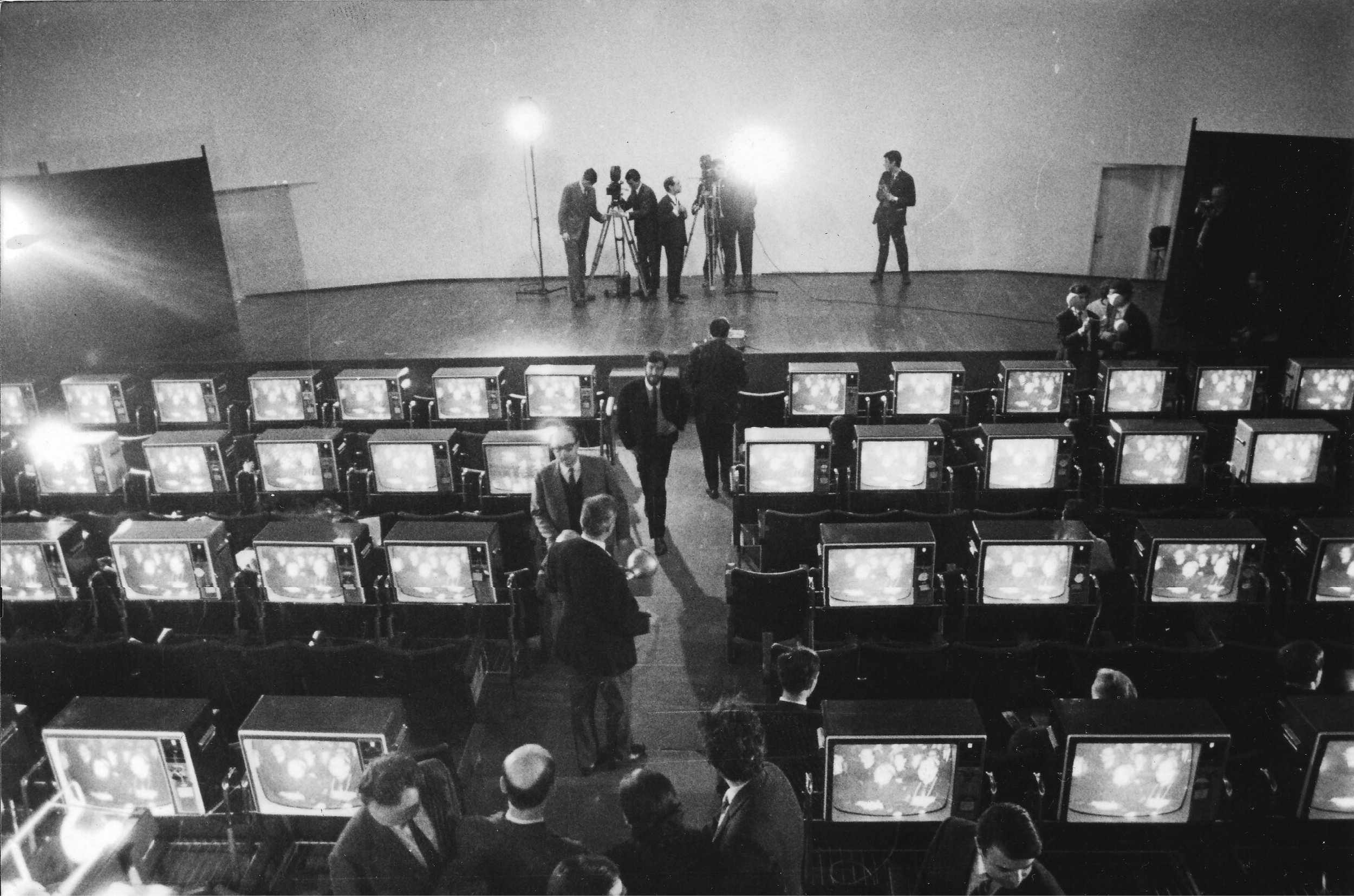
Documentation of Simultaneidad en simultaneidad (Simultaneity in Simultaneity), 1966

OBRIST: There’s a clear connection between the Soft Gallery and La Destrucción. With the Soft Gallery, you wanted to create aspace where people could experience art in a softer, more sensorial way. But you also opened it up by inviting artists like Charlotte Moorman, Juan Downey, and Carolee Schneemann to stage performances and events there. In a way, that collaborative and performative dimension had already begun with La Destrucción in 1963.

MINUJÍN: I love happenings—I really love happenings. La Destrucción, yes. In that work, everything was destroyed. A lot of my works, destroyed. After that, in early 1965, I staged a huge happening called Suceso Plástico in a football stadium in Uruguay. I was very influenced by Fellini at the time. It was completely crazy: there was a helicopter dropping live chickens, people with chickens on their heads, motorcycles roaring through the crowd, and participants performing all sorts of theatrical acts. It’s hard to explain—it was so complex—but it all came together as this wild, chaotic, immersive spectacle.

OBRIST: Another really key happening was Mayhem, or La Menesunda. It remains one of your most important works to this day. You had David Lamelas and many other artists involved, and it included sixteen different urban environments. It took place at the Di Tella Institute on Florida Street in Buenos Aires. Can you tell us about it? In a way, it might be your biggest project, because you weren’t just making art—you wanted to reproduce the city itself.

MINUJÍN: Art critic, Pierre Restany called La Menesunda “Pop Lunfardo.” The title itself—menesunda, meaning “mayhem” in Lunfardo, which is slang—captures the chaotic energy of Buenos Aires streets, which we wanted to represent in the installation. I developed the idea with the artist Santantonín, and we invited others to help, but most left for grants, so only David Lamelas stayed. The piece reflects both the disorder and the rhythm of the city—it’s Pop Art, but very local, very Buenos Aires.

OBRIST: You described it as a labyrinth: one room was a refrigerator, another smelled like a dentist’s office, and in another, a couple lay in a bed. The installation even included scents, and it caused a scandal at the time. Can you tell me more about how it was a portrait of Buenos Aires?

MINUJÍN: I like people who don’t know anything about art. My idea is that people should live in art, not just look at it. Like a happening—you enter and are surprised by everything. Anything can happen.

OBRIST: You wanted to create surprise for the viewer.

MINUJÍN: Yes, people enter one by one, alone, and they have to react to each situation. Sometimes they’re completely enclosed and must dial a number to open the door. You find yourself inside an old telephone booth, and then you move on to another space. Each environment engages you differently. There are eleven situations inside. In one, a couple lies in bed—you can even talk with them. That couple stays in bed all day.

OBRIST: Like a living sculpture. And this was all at the Instituto Torcuato di Tella, which was integral to a major cultural moment in Argentina in the 1960s. What was so special about this institute?

MINUJÍN: At the Instituto Torcuato Di Tella, we took over the whole institute and shared the space among ourselves. It was an incredible time. It was fantastic because, at the same time that Pop started in New York, we were starting in Argentina. The director, Jorge Romero Brest, sponsored our work. He didn’t care that we were only twenty years old or that we wanted to destroy art—museums, galleries, everything. He was so open-minded, so smart, so fantastic. He became my best friend.

OBRIST: Where did Jorge Romero Brest get the money to support these projects?

MINUJÍN: Brest was also an art critic and a philosopher, but he sponsored the artists through the Di Tella family. Torcuato di Tella was a wealthy industrialist. They had the biggest art collection in Italy, and they brought it to Argentina. The institute only lasted four years.

OBRIST: Why did it close? Because of the dictatorship?

MINUJÍN It closed because of the Onganía dictatorship [1966-1970]. But Argentina is always going through a dictatorship.

OBRIST: At one point, your work entered a whole new dimension with technology, which is now inspiring many younger artists. Billy Klüver created Experiments in Art and Technology [EAT], bringing artists and engineers together, which you were involved in as well. From the mid‑’60s onward, you began exploring this approach. I wanted to ask specifically about Simultaneidad, which is a pioneering work in this area.

MINUJÍN: I was following Marshall McLuhan at the time and admired him greatly. I read his book—Understanding Media: The Extensions of Man (1964)—which completely captivated me. I was in Buenos Aires reading it, and it inspired me so much that I even went to Fordham University to try to meet him in person. His ideas about media as extensions of human senses and the way technology shapes our perception were revolutionary to me and influenced my approach to art. Before that, I had been doing happenings in Buenos Aires, but they weren’t technological. When I arrived in New York and finally met Allan Kaprow and Wolf Vostell, I asked them to collaborate on a Three Country Happening with me, using all kinds of media. This was one of the first times I integrated technology directly into performance. We communicated across different locations using telephone, radio, television, and even the Early Bird system, an interactive communication artwork I used to connect participants live across distances. Everything was carefully orchestrated so the audience became part of the work itself. Michael Kirby later wrote about that happening, recognizing its importance in merging art, technology, and audience participation. It was an incredible, pioneering experience, and it shaped the trajectory of my work from then on.

OBRIST: It’s interesting because Three Country Happening involved each artist creating a simultaneous happening in their own country: Vostell in Germany, Kaprow in the US, and you in Buenos Aires. You called your contribution Simultaneidad en simultaneidad (Simultaneity in Simultaneity). Can you explain how it worked, since it was so influenced by McLuhan and involved multiple screens?

MINUJÍN: For Simultaneidad, I invited sixty of the most famous people in Buenos Aires—actors, athletes, celebrities—because their presence was frequently covered in the newspapers. I asked them to come to the Instituto di Tella auditorium on two consecutive Mondays, dressed elegantly in black tie. I installed sixty TV sets, one for each participant. During the first session, we recorded their voices on the radio, took photographs, and filmed them as they arrived, sat down, and watched themselves on the television screens. When they returned the following Monday, all the film had been developed. They could see themselves on live television—broadcast through Buenos Aires’s two channels—and also watch Kaprow in the US and Vostell in Germany, performing simultaneously. The feeds were transmitted so they could experience these other happenings in real time. It was incredible: each person saw themselves on television while hearing their voices on the radio. Some participants even experienced a playful “media invasion”—a messenger would arrive at their home with a telegram or ring the bell unexpectedly, asking, ‘Are you this person?’ Then, they’d rush to pick up an old-fashioned telephone to engage with the event. At the time, this was an extraordinary invasion of media into daily life. Today, of course, we are completely saturated—everything comes through our iPhones, and our faces, voices, and actions are instantly documented and shared. Back then, it was a glimpse of how media couldtransform perception, identity, and experience.


Marta Minujín and Andy Warhol, El pago de la deuda externa argentina con maíz, “el oro latinoamericano” (Paying Off the Argentine Foreign Debt with Corn, “the Latinamerican corn”), 1985


Documentation of La destrucción (The Destruction), 1963


OBRIST: Before the iPhone, of course, we had the landline. Today, it’s almost an antique object—but in 1967, you created a visionary project called the Minuphone, which initially looked like a telephone booth. You worked with Per Biorn from Bell Telephone and connected with Billy Klüver’s Experiments in Art and Technology. How did it work?

MINUJÍN: Yes. I received a Guggenheim grant and used all the money to realize the project. Billy Klüver introduced me to an engineer who specialized in robotics, and together we built the Minuphone. I described all my ideas, and he made them a reality. We recreated a telephone booth so that when someone entered and made a call, unexpected effects would happen. Green water would rise and fall, then black water would obscure the view outside. It functioned like a color organ, with lights reacting to the interaction inside. As you spoke, your voice created an echo effect, so you might hear yourself repeating, “Hello ... hello? How are you?” The other person on the line could also hear this echo. At the same time, a screen with black light appeared, allowing you to play with your shadow, while numerous other interactive effects occurred. The most striking effect was a light directing you to look down, revealing yourself on a television embedded in the floor. A Polaroid camera would take your picture, so when you left, you could take home a snapshot of yourself in real time.In total, there were seven different interactive effects. On any given day, participants might experience variations—sometimes black light, sometimes the screen wouldn’t activate depending on the number dialed. Each experience was unique, which made the installation very dynamic and engaging.

OBRIST: In a way, the Minuphone led to the Minucode. I’m very interested in the Minucode because it represents a form of free technology—almost like an algorithmically determined dinner party that you designed.

MINUJÍN: Yes. I received a Rockefeller grant to create a project, and I decided to invest all the money into organizing a very unique event. I brought together forty economists, forty politicians, forty figures from the fashion world, and forty artists. It was a cocktail party with champagne, and I installed six cameras throughout the room so that the guests were filmed from every angle. They forgot they were being recorded, which created an intimate, spontaneous atmosphere. Before attending, each guest had to complete a questionnaire that was published in the newspapers. This way, everyone arrived having already seen the test and the others’ answers, so they were familiar with one another. I even tried to invite Robert Kennedy—I had seen him crossing the street in 1968, just before his assassination—and I asked his lawyer if he could attend. The party included fashion icons like Veruschka, designers, and models, as well as artists—though initially I had planned for only forty, eventually eighty artists showed up. People came even without formal invitations because, in American society at the time, everyone knew about events hosted by the Center for Inter-American Relations. Charlotte Moorman, for example, brought a cello and performed in a corner. The following week, I organized a structured interaction at a gallery with a projection of the event: each guest had ten minutes to move through different groups—politicians, economists, fashion figures, and artists. The idea was to create a dynamic, fluid social environment where everyone engaged across disciplines. Moorman’s performance was integrated into this setting, adding an artistic layer to the social experiment. The whole project was a combination of social choreography, technology, and participatory art.


OBRIST: Can you talk about your time in New York, meeting Andy Warhol.

MINUJÍN: I was a hippie. When I arrived in New York, I visited all the galleries and went to Leo Castelli’s. I met Andy Warhol, who became my best friend at the time, as well as Nam June Paik, Rauschenberg, and many others I admired. I spent time in the Cedar Bar with people like Carlos Slim. Then, someone introduced me to LSD, and I became fully immersed in the hippie lifestyle—I abandoned art for three years, living in Central Park until around 1970 or ’71. During that time, I met figures like Charlie Chaplin and musicians such as Jimi Hendrix and Johnny Winter, all part of Steve Paul’s scene. I took LSD daily, almost as a spiritual practice. Romero Brest visited me in New York, and I was living barefoot in the summer, never wearing shoes—which, as you can imagine, left my feet in poor condition. I decided to bring the hippie culture to Argentina. Romero Brest asked if I wanted to do something in detail, and I said yes. I imported psychedelic aesthetics, including lights, film, sound equipment, and techniques I had seen at rock concerts. I also brought acid and shared it with young people who helped me organize events. I had them dress like Hare Krishnas, and I transformed spaces with black lights, strobe lights, silver rooms, incense, and music. It became a full immersion in the hippie lifestyle, and many young people in Argentina followed this cultural wave. After some time, I returned to New York, and the hippie scene had vanished there. It was an intense, transformative period, both personally and culturally, that influenced my later work in immersive and participatory art.

OBRIST: You also created a performance-based economic exchange. In the 1980s, as Argentina faced a looming default on its foreign debt, you explained that, as the ‘Queen of Art’ in Argentina and Warhol the ‘King of New York,’ you symbolized your respective economic systems. You organized a performance in which you delivered his studio as a supportive act—connecting art, economy, and politics in a way that feels especially relevant today.

MINUJÍN: I became friends with Andy Warhol in the 1960s. I went to all the parties with him and even met Dalí, because Dalí would host underground artists every day at the Sunrise Hotel, and Andy was always there. After I returned to live in Argentina, I continued seeing Andy whenever I visited New York—we went to parties, exhibitions, and events together. I decided that, as the ‘Queen of Art’ in Argentina and Andy as the ‘King of New York,’ we could resolve things symbolically. I invited him to participate in a performance where I would pay Argentina’s debt to him in corn—because corn is Latin American gold. Historically, Latin America supplied food during the First and Second World Wars, so corn represented both sustenance and value. He accepted, and the project became a platform for performance, economy, and artistic exchange. I repeated this concept later with a Margaret Thatcher lookalike at the ICA in London, and with an Angela Merkel lookalike at Documenta 14 in Athens. Each time, the project combined economics, symbolism, and art in a performative and humorous way.

OBRIST: What’s fascinating about your work is its focus on process. This issue’s theme is work in progress—literally and philosophically, things are always evolving. That seems very true for your art, which is constantly in motion. The process never stops. “My idea is that people should live in art, not just look at it.”

MINUJÍN: My work is philosophical. And it never stops. With the Statue of Liberty lying down at the Venice Biennale, I always have the next project in mind.

OBRIST: Speaking of process, what does a day in your studio look like?

MINUJÍN: I go there to work, and new ideas come to me constantly. My mind never stops—I have too much imagination. When someone says, “I want to make a film,” I say, “Go for it!” It’s amazing.

OBRIST: I wanted to talk a little bit more about the show at Kurimunzutto. The title is To Live in Art. That seems to be a very important aspect linking many of your works—to live in art. Can you explain that a little bit?

MINUJÍN: Yes, because with everything—the Menesunda, all my work—the idea is that people live in art. They inhabit situations where you can’t say you’re outside of art; it’s completely immersive. Even with the monuments and all my other projects, it’s about living in art. I truly believe life could be richer if people experience art this way, because art creates something unique within each individual. But sometimes you have to guide them into it—they won’t necessarily sense the energy on their own, you see?

The Driven Artists Racing Team: Zoe Barry & Lyn St. James in Conversation

In motorsports, where just 4% of drivers are women, Zoe Barry and Lyn St. James break down the stakes, strategy, and survival on the racetrack.

interview by Zoe Barry
photography by Amanda Demme

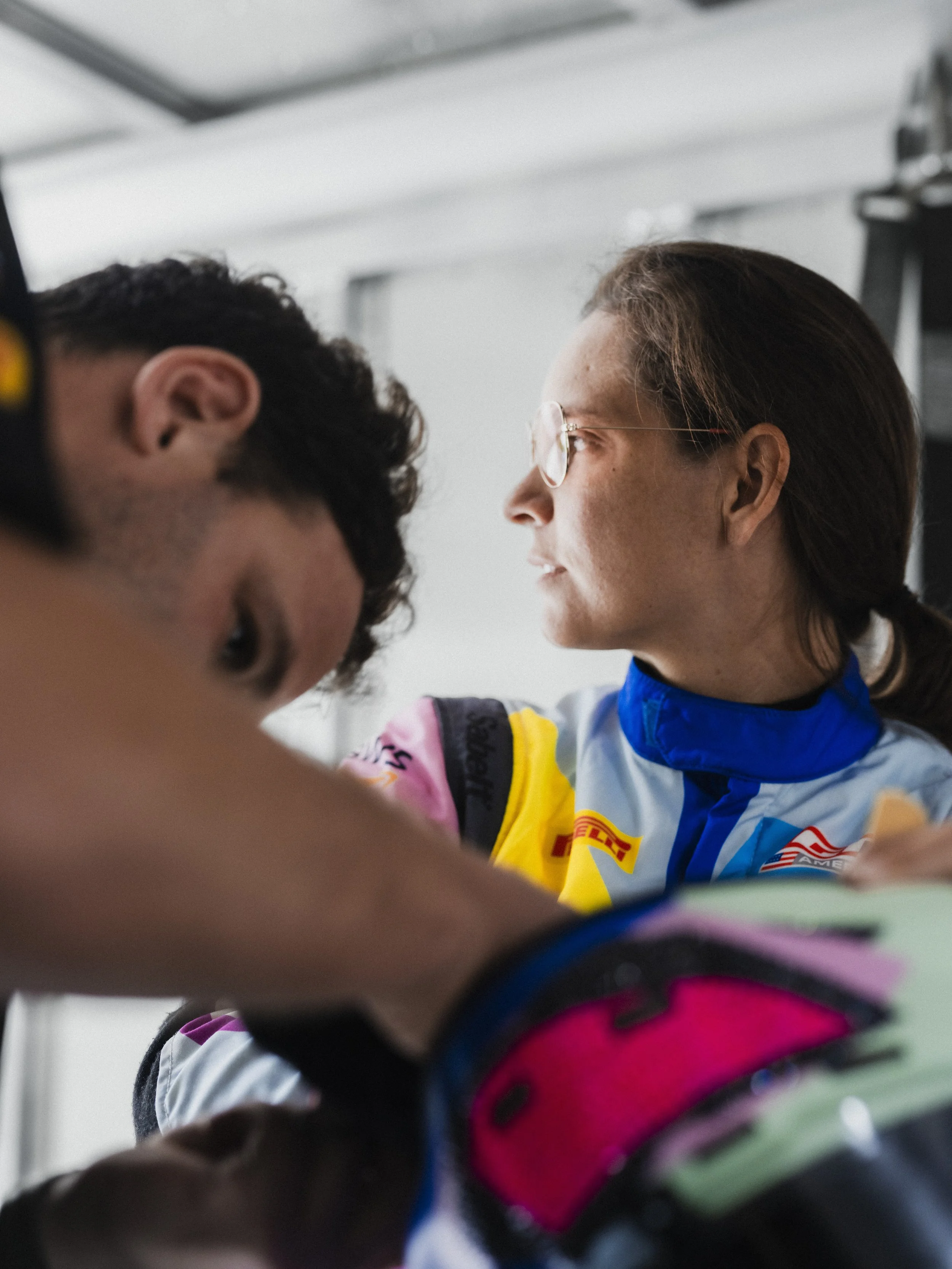
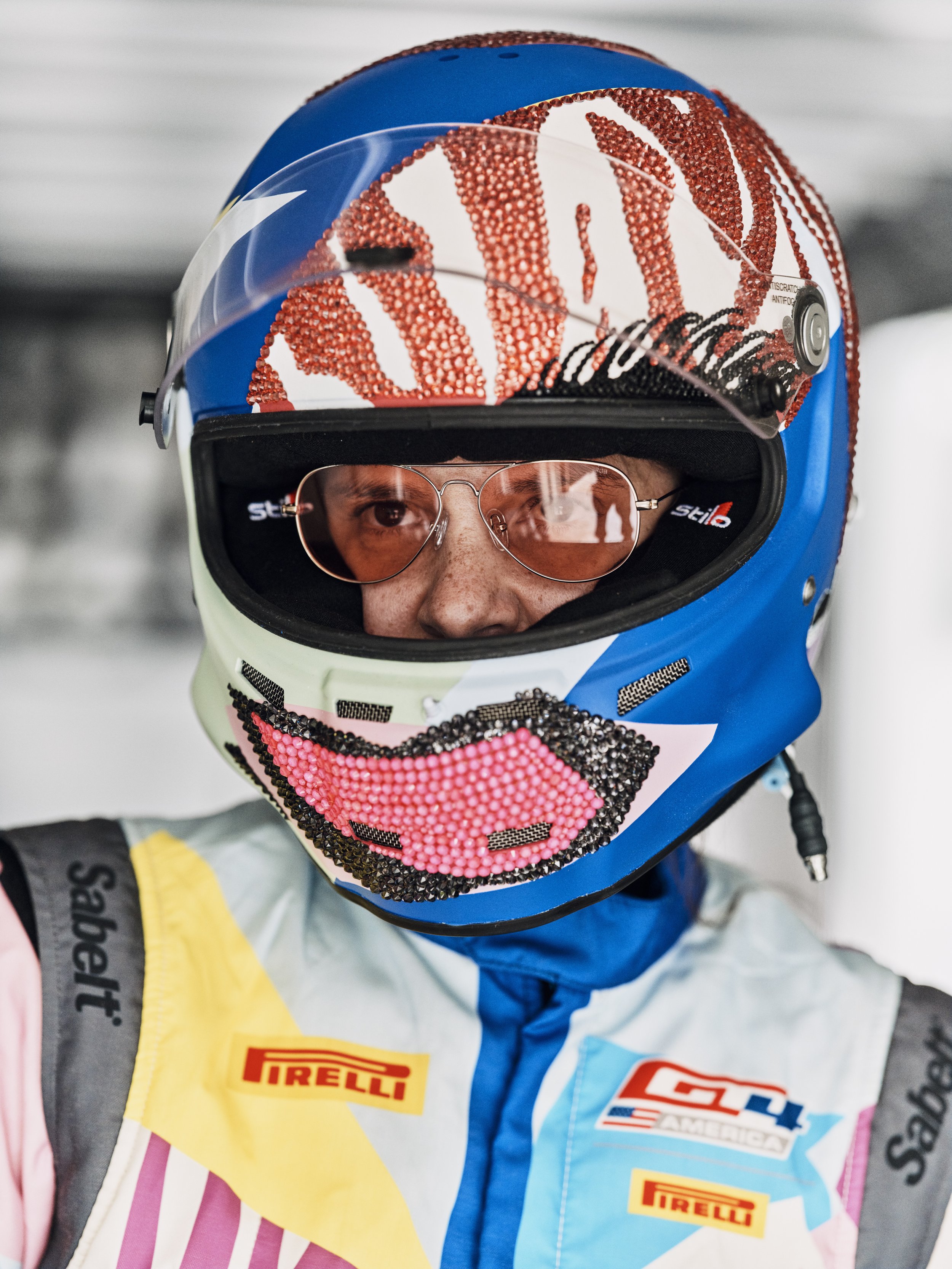
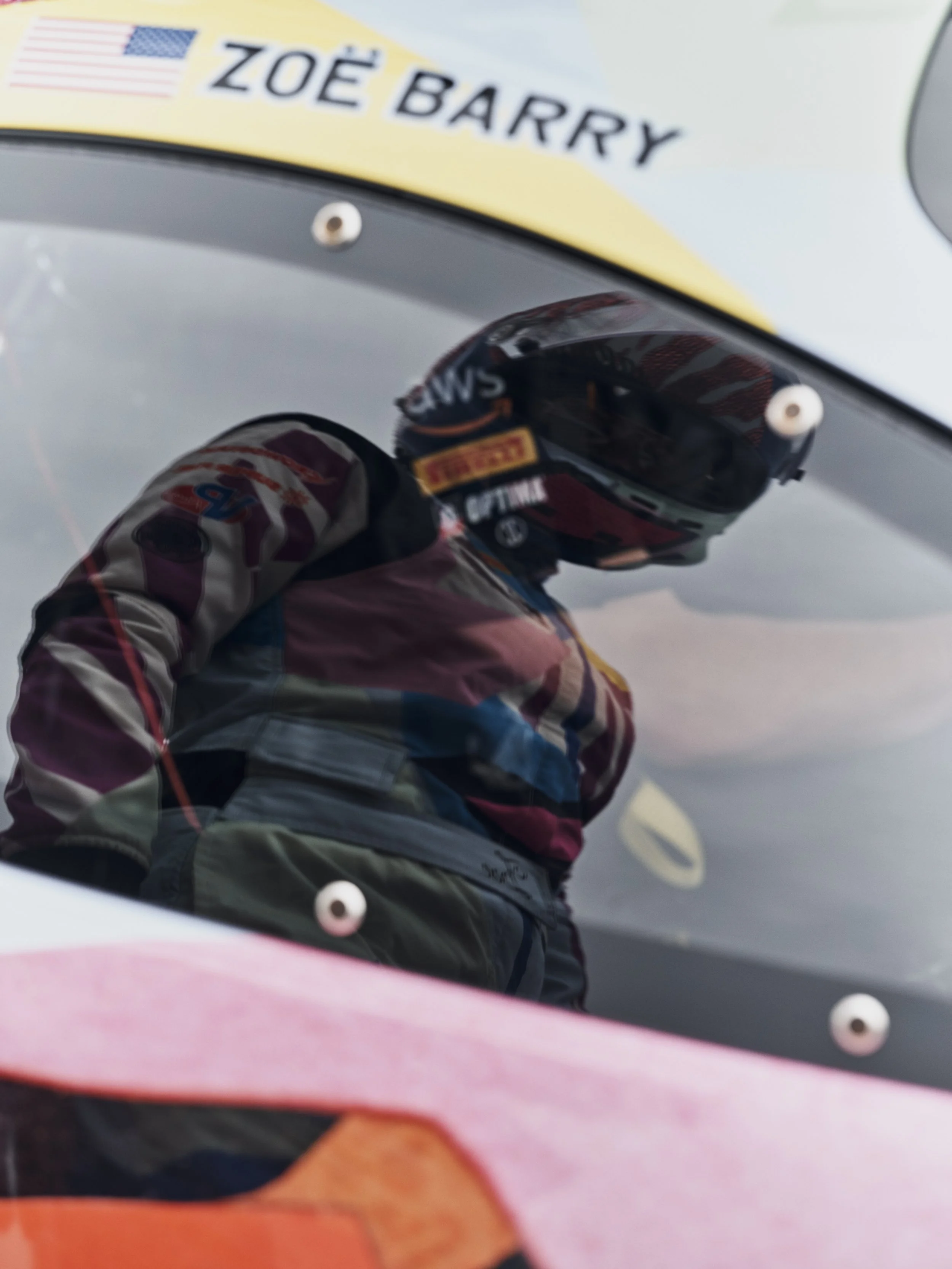
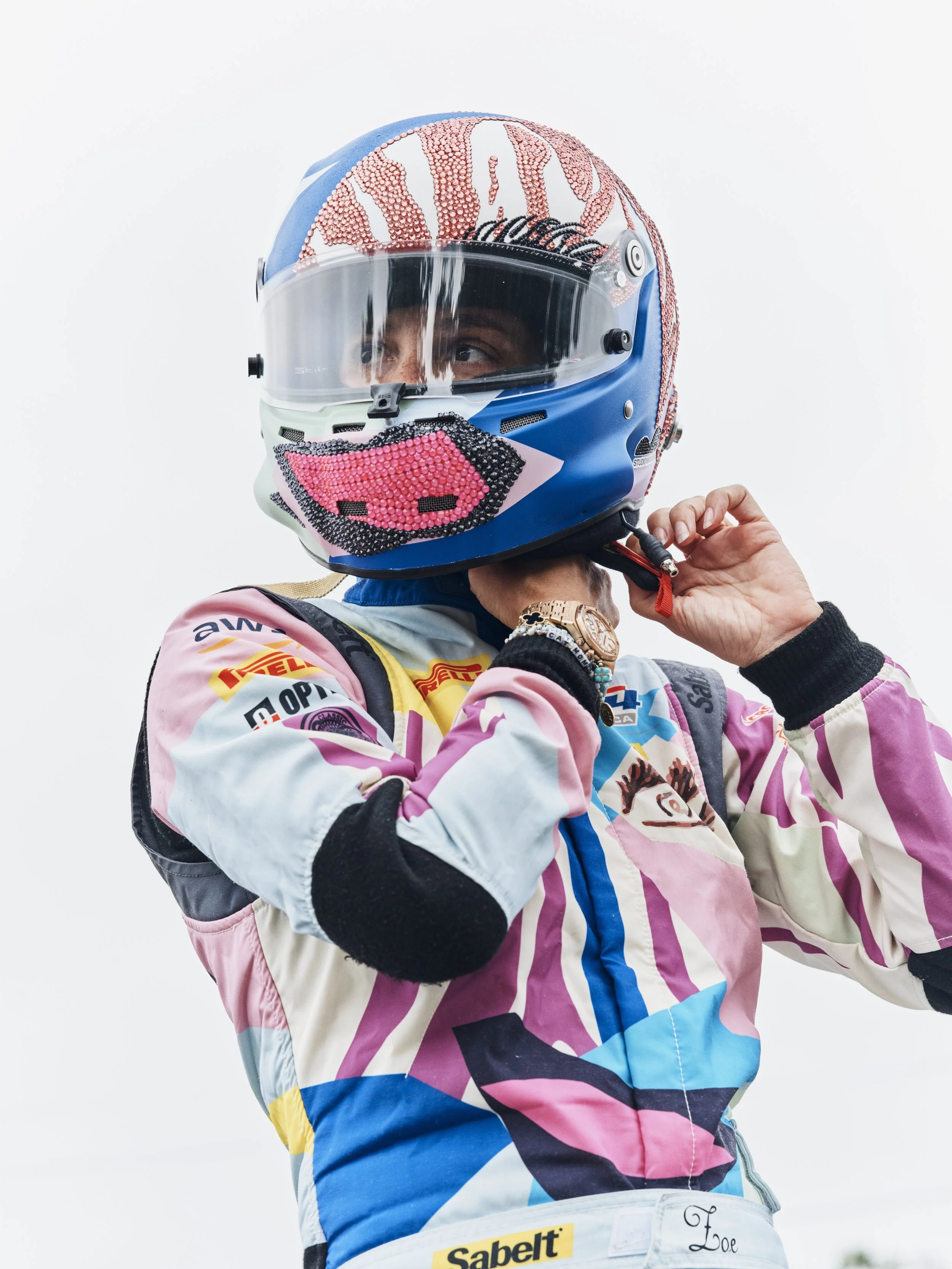
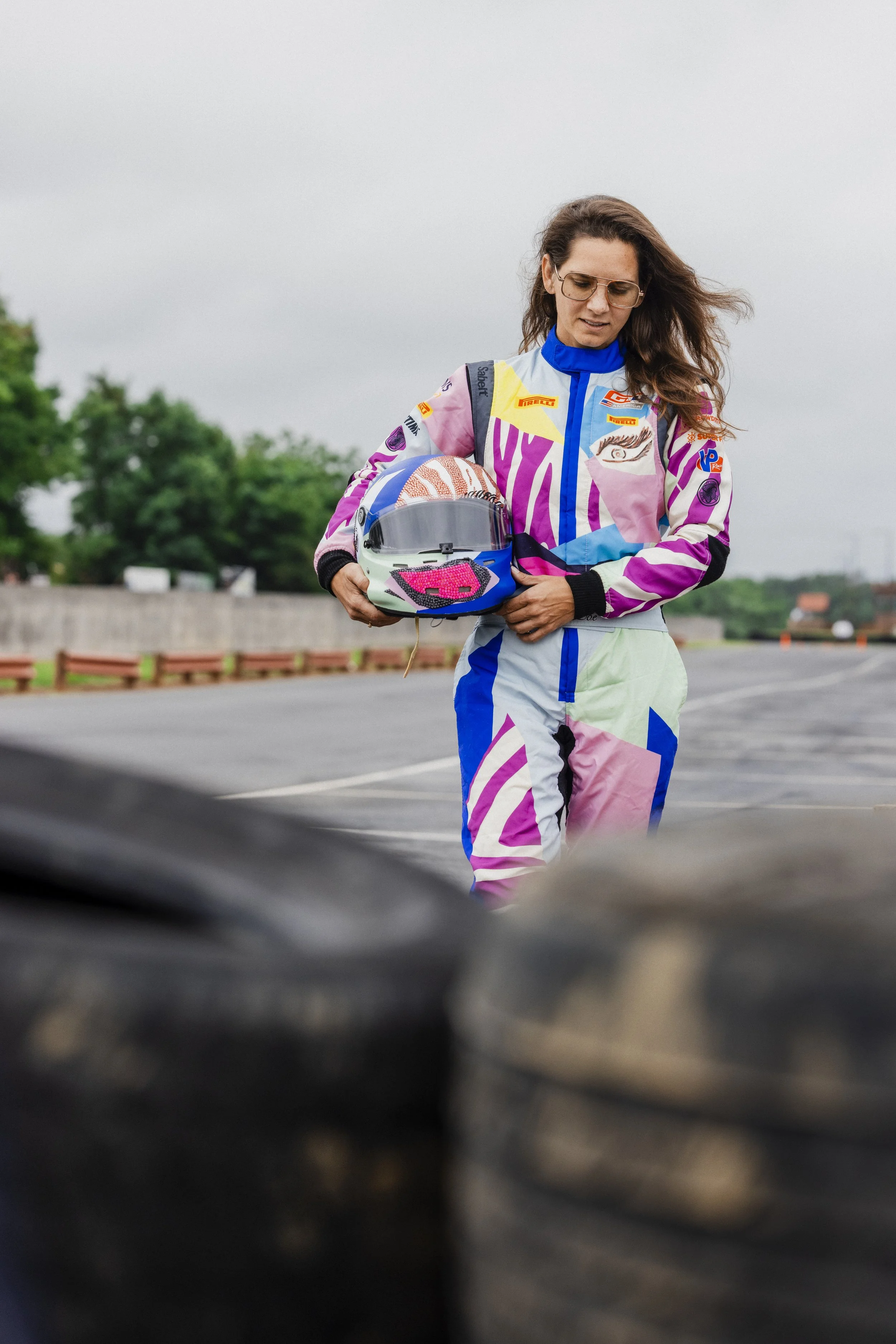
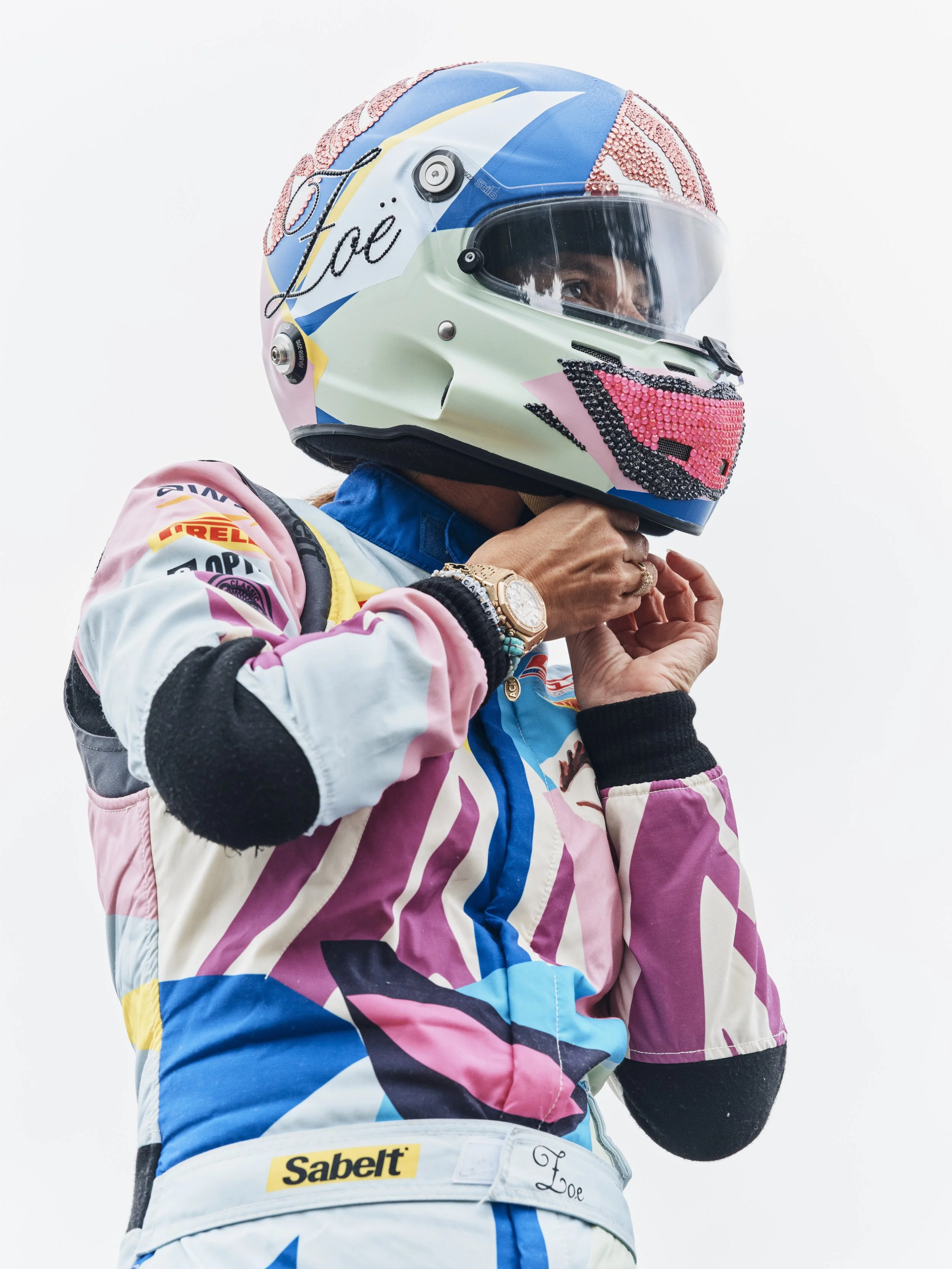
In one of the most dangerous and competitive sports in the world, Zoe Barry drives Car #44—a number that highlights the stark reality that only 4% of licensed professional racecar drivers are women, and only 4% of artworks sold at auction are by women. Behind the wheel of a McLaren Artura GT4, wrapped in a custom livery by contemporary artist Mickalene Thomas—who also designed the race suits and helmet—Barry focuses on one thing: winning. Yet in a world still dominated by male decision-making, from rivals on the track to corporate sponsors off it, she must confront stereotypes and misconceptions at every turn.

In 2025, she co-founded Driven Artists Racing Team (DART Car) with art advisor Spring McManus to champion women in motorsports and the arts—a first-of-its-kind initiative that fuses competition with creativity, proving that performance and cultural impact can drive change together. In January 2026, the team will compete in the 24H Series Middle East Trophy in Dubai and Abu Dhabi as the first all-female-led team in the series.

Lyn St. James, now a mentor in the field, is a living legend: the only woman to win an IMSA GT endurance race solo (1985 at Watkins Glen), the first woman to earn Indianapolis 500 Rookie of the Year (1992—a record unbroken for three decades), the holder of dozens of speed records, and the first woman to surpass 200 mph on a closed oval, reaching 204.233 mph at Talladega. Together with St. James, Barry explores the psychological and strategic challenges of racing—the constant risk of death on the track, the split-second decision-making, and the stamina and endurance required to outpace the competition.

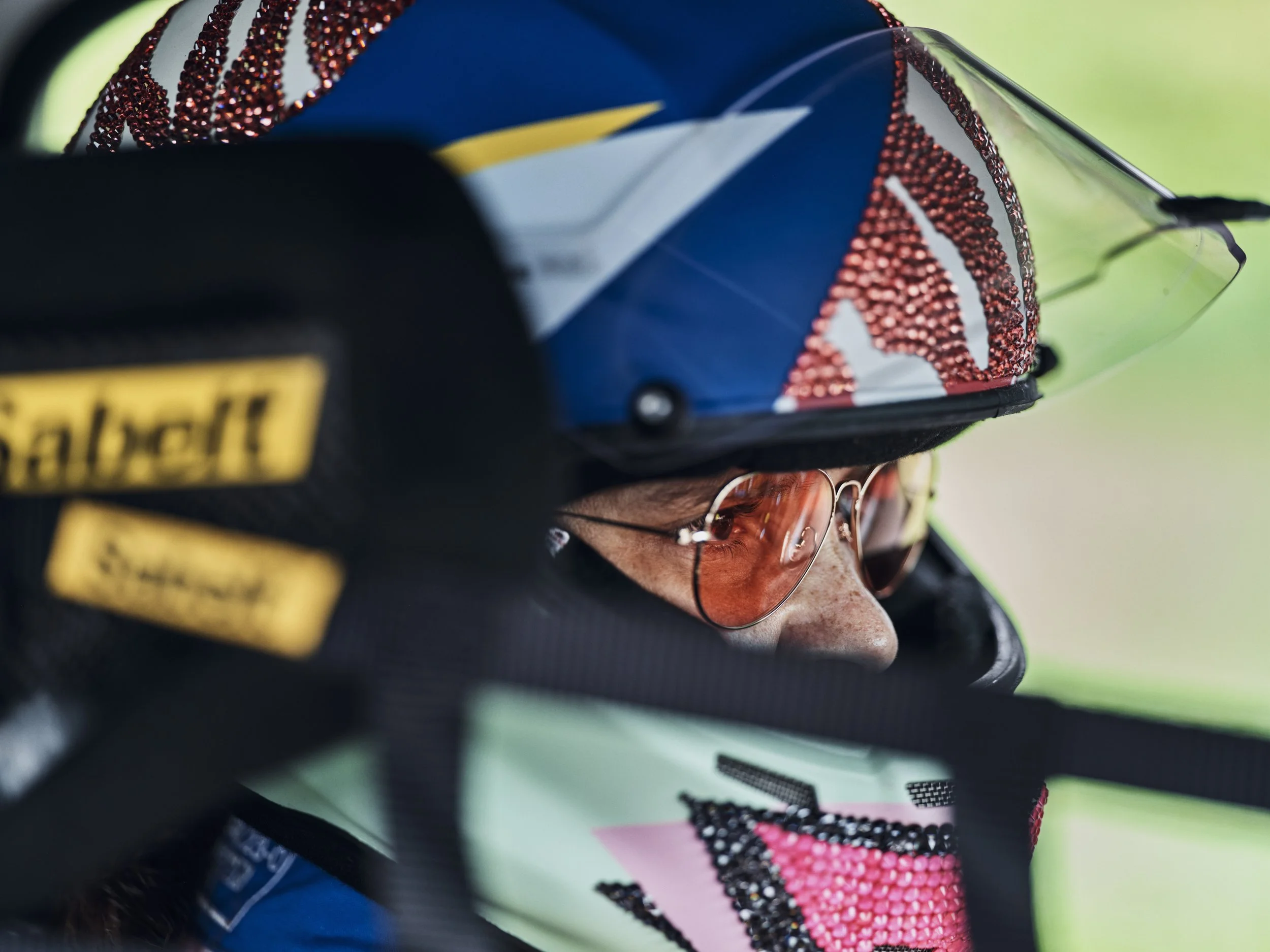
In a special photo feature supported by Caddis Eye Appliances—a champion of second acts in life, reflecting Barry’s leap into racing after a career in the corporate world—we followed Car #44 onto a practice track in West Virginia, capturing the raw grit and glamour of a day in the life of a champion racecar driver.


ZOE BARRY: Lyn, of course, people can Google you, but hearing you speak on a panel brought out the heart, the challenges, the soul behind the story. It reminded me of Einstein’s quote about standing on the shoulders of giants. Women like me can get behind the wheel today thanks to women like you who took those early risks and broke the stereotypes. Even now, only about 4% of racecar drivers are women. Unlike Olympians, who often follow a clear path, female drivers are competing alongside men in a world that doesn’t want to fund them, doubts their ability, and fears they’ll get hurt.

LYN ST. JAMES: Every woman in racing right now is an iconic, isolated story unto herself. There are so many different forms of motorsport, and unlike Olympic athletes—where there’s a fairly cookie-cutter pathway to the top—there’s no single route to get there in racing. I’ve had the luxury, through the Women’s Sports Foundation, to meet icons like Billie Jean King, and I’ve crossed paths with incredible athletes like Diana Nyad, Nancy Hogshead-Makar, and so many others I grew up watching on TV. Their accomplishments are extraordinary, and I’m not at all taking away from their abilities, their talents, or what they’ve achieved. But there is a fairly clear pattern for how to get there in those sports. Whether it’s through coaches, training centers, or established pipelines, there’s an infrastructure that helps guide the way.

In motorsports, there is no such infrastructure. There’s drag racing, oval track racing, stock car racing, road courses—so many different forms of the sport. And on top of that, there’s an enormous amount of politics and money involved. It’s constantly shifting, and every driver has to figure out their own path through it. But every female driver has to constantly carve out a niche and prove they belong there. Even to this day, what I’ve accomplished doesn’t necessarily make it easier for the women coming up now. At best, it might inspire them, give them confidence, or encourage them to try. But beyond that, you still have to prove yourself.

BARRY: (laughs) I'm working on it, Lyn.

ST. JAMES: I’m still here to mentor, to be an ally, and to help however I can—but I can’t get in the car, make the calls, or close the deals. In racing, you have to wear so many hats: raise money, manage your team, and convince sponsors to believe in you. And that’s the part people rarely talk about. I once heard a brilliant woman in the UK describe how, in many ways, we’re still in the caveman era—men are inherently wired to protect women. It’s just a deeply ingrained instinct we’re still navigating.


ZOE BARRY: And you can see it in the data. Years ago, if you had a three-year-old daughter, you’d put her in ballet. Today, parents don’t hesitate to put their kids—boys or girls—on skis, on a tricycle, or on a bike. But with racing, it’s different. Very few parents think, I’ll put my three-year-old daughter in a kart and let her go. That’s still where racecar drivers come from, and we haven’t broken through that mindset in the way we have in so many other sports.

ST. JAMES: Exactly. And that’s where racecar drivers come from—starting young. Fortunately, history has helped. Title IX in the ’70s changed things. Now we have parents who went to college, saw women compete in sports, and understand that women can push themselves physically just as hard as men. That’s progress. But there are still limitations. My daughter is in her forties, and I have a seven-year-old granddaughter. Would she put her daughter in a kart? No. Would she put her son in one? Yes. So it’s still very much about individual decisions, shaped by these cultural assumptions. We can’t ignore those realities. I’ve literally sat across from male sponsors who couldn’t bring themselves to say, “We won’t give you money because you could get killed.” But I knew they were thinking it. So, I said it for them, “I know I could die doing this. I’ve seen death on the track. I made a conscious choice to accept that risk. It’s that important to me.” Every racecar driver—male or female—has to reconcile that risk. But for women, it’s another layer of resistance to push against.

BARRY: Lyn, one thing I’ve noticed in my journey raising money is how similar it is to your experience securing sponsorship for racing. In tech, as a female founder, only 2% of the billions deployed in venture capital each year go to women. It’s similar in sports: women drive huge sales—Nike sneakers, for example—but female athletes are paid far less, sometimes 90% less than men. In racing, it’s the same: women get a fraction of the sponsorship, so they have to do so much more.

When I was in tech, there’s something called Keyman Insurance. If the key person—often the CEO or founder—dies, the business faces risk because they’re a major shareholder and driver of innovation. When I started racing, my chairman raised concerns with our lead investor about Keyman Insurance, implying my racing was a liability. I shot back: statistically, racing is safer than skiing. Are male CEOs stopped from skiing? No. Sometimes you counter with data, sometimes you confront it directly. You have to be upfront: yes, I could die doing this, but I’m doing it anyway. All the way up to F1, I don’t hear drivers having to defend their choice to be in a racecar, going over 200 miles an hour with the real risk of death. In all the conversations I’ve had with top athletes in this space, men simply don’t have to answer that question.

ST. JAMES: They don’t have to answer that question. In fact, it actually makes them more heroic, because people admire them all the more. When Eric Anden died, our sport stopped—literally. Not just Formula One, but the entire motorsports world. The same happened when Dale Earnhardt was killed. These were icons we never expected to lose in a racecar, and their deaths reminded everyone of the risks involved.

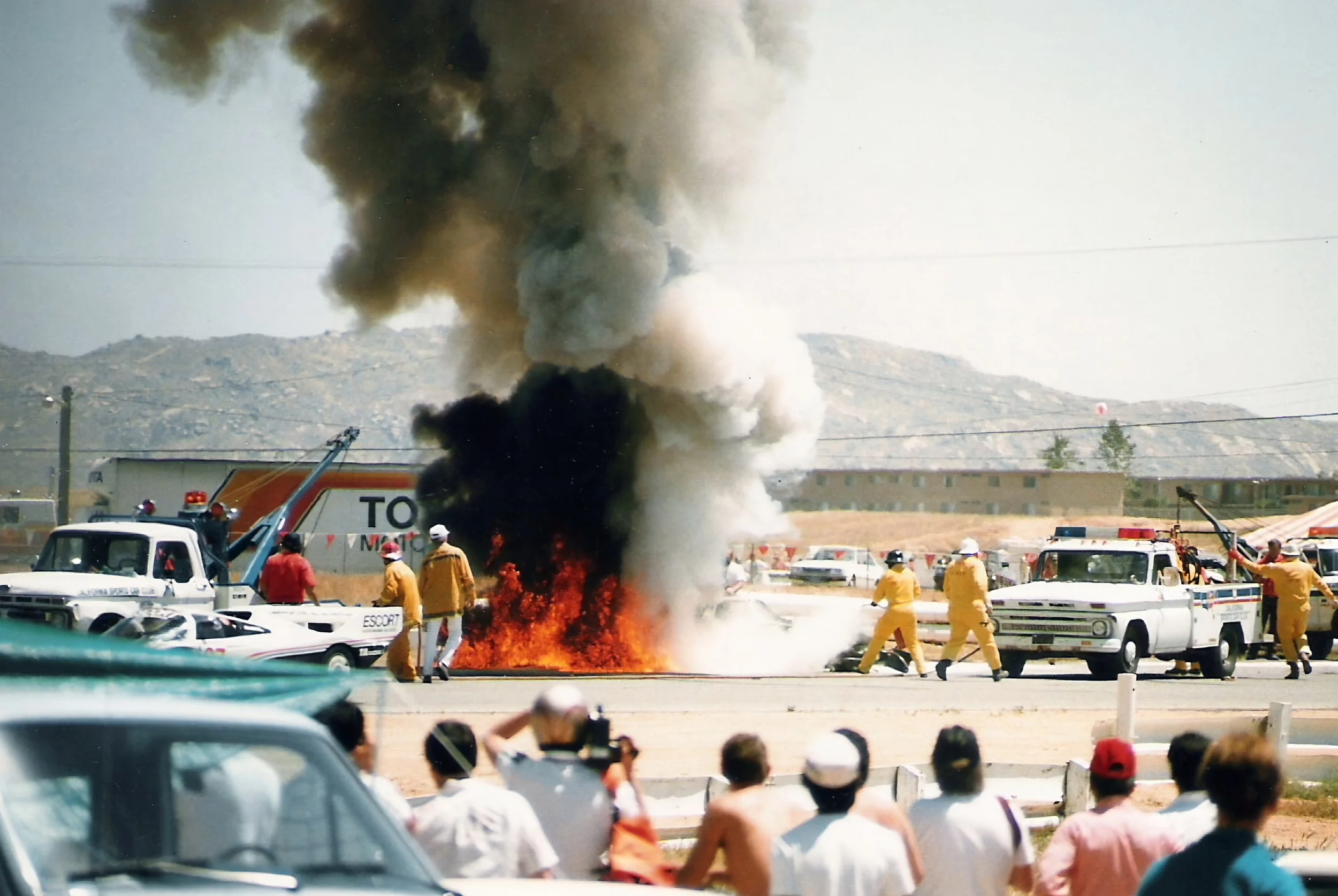
Women drivers are just as courageous. When Catherine Leg crashed at Road America years ago in an IndyCar, she walked out of the medical center after a horrific crash. I had a similar experience at Riverside in 1986. I was upside down and on fire, yet I crawled out and walked away. But now, we’re not always admired for it. I remember someone at Ford, who was sponsoring me at the time, saying, “Oh my God, she really drives just like the guys. And she didn’t cry.” I thought, You’ve got to be kidding me.

BARRY: Let’s go back to the beginning. How did you get started, Lyn?

ST. JAMES: It started when I discovered endurance racing—a form of motorsport I didn’t even know existed. I went to the 24 Hours of Daytona with my husband as a spectator, and I was blown away. These cars raced for a full twenty-four hours, and as a fan you could actually see the people—the crews, the human effort—behind it all. I called it seeing “real people” instead of superheroes, the way IndyCar or Formula One often felt. I was fascinated by how drivers with Corvettes, Camaros, Mustangs, and other so-called “back-of-the-pack” cars still managed to compete. That’s when I learned you needed a competition license. To get one, you had to join a club—so I became a member of the Sports Car Club of America. Then I found out you also had to attend a driver’s school before you could earn that license.

BARRY: How old were you at the time?

ST. JAMES: Well, I went to driver’s school and became a member of the Sports Car Club of America (SCCA) at twenty-seven and got my license a few years later. To participate, you needed a racecar, and there was a new class called Showroom Stock. You could take a production-based car, install a roll bar, a five-point seatbelt, and a five-pound fire extinguisher, and you could race. I bought a four-cylinder Pinto, which became my first racecar.

I drove it back and forth to work during the week and raced it for a couple of seasons. Eventually, I won the regional championship with it. That was the beginning, and it lit a fire in me. Going over a hundred miles an hour—on the front straightaway at Palm Beach International Raceway with a tailwind—it was exhilarating. I’ve always been a sucker for challenges, and every moment in a racecar tests you—your technique, your reactions, the car, your competition. It throws challenges at you constantly, and I just soaked it all up. I loved it, and I’ve never stopped loving it. I’ve never looked back.

BARRY: How many years to get your professional license?

ST. JAMES: To race professionally, I needed an IMSA (International Motor Sports Association) license. That was necessary to race in the Kelly American Challenge Series. I actually raced my husband’s Corvette at Daytona—not in the 24 Hours, but in one of the other events they held there. To get the IMSA license, you needed enough races under your belt, and you had to go through the licensing process, which is good—you really have to learn it. (laughs) Within a couple of years, I earned my professional license and I started racing in the Kelly American Challenge Series, which was a support race at IMSA events. They even offered a bonus prize for the top-finishing female driver in each race.

BARRY: That’s pretty progressive. They barely do top female finisher now.

ST. JAMES: Yeah, Kelly really needed to do something to support women in racing because of their history of primarily employing women as temporary secretaries, even as they expanded into light industrial work. I raced in all ten races in 1979—and I won in every race. That started to put me on the map because the race results were published in Speed Sport News, which didn’t have as wide a reach as today, but it mattered. They always noted the top female driver in the results, which helped get my name out.

Through that exposure, I was invited to race in the 24 Hours of Nürburgring as part of the BF Goodrich factory program, and we won our class. Around that time, I also started a company called Creative Images and used it to write sponsorship letters. I couldn’t sign my own name because it was promoting “Lyn St. James,” so I made up names of people in my company to make it seem bigger than it was. (laughs) One of the companies I targeted was Ford Motor Company. I’d seen a 1978 Car and Driver article titled “Ford and Feminism,” highlighting the company’s efforts to provide equal employment opportunities for women in non-traditional roles. I bombarded them with letters every time I raced and sent my results, relentlessly following up. In 1981, it paid off—I signed with Ford and became a factory driver. That was the tipping point in my career, the moment everything started to change.

BARRY: I’ve always been a daredevil—growing up in NYC, I was constantly taking risks, from gymnastics on rooftops to catching animals with my bare hands. I competed nationally in gymnastics, swimming, and sailing, but injuries and physical limits held me back. Then I discovered racecar driving—a sport where you can compete at a high level for decades. My first car was a racecar; I traded equity in my tech startup for a Mazda to start racing seriously. I went through racing school, club races, and learned the grind of back and mid-pack racing—the chaos, the carnage, and the challenge of getting to the front.

At forty, I earned my professional license. I applied a venture model to my racing team: raised funds, bought a GT4, and collaborated with artist Mickalene Thomas, who designed hand-painted helmets and suits. In our first pro race, we finished fourth. Now, my goal is historic: to run the 24H Series Middle East Trophy with an all-female team—a first for that race. For me, as an athlete, everything I did in gymnastics and swimming was sprint-focused. A gymnastics routine is only four minutes long. Swimming, of course, was pure sprint. In racing, our sprint events started with Mazdas in club racing—about twenty minutes long, but extremely fast. What were your early sprint races like?

LYN ST. JAMES: My early amateur races were about thirty minutes. In pro racing, sprints usually run forty-five minutes to an hour—single driver, no pit stops. You have to manage fuel and tires carefully, because a car can only go so far before running out or wearing down. Safety and refueling rigs are factors too. For example, in the TransAm series, races were an hour with no pit stops, so the car had to be built to last the full distance.

Endurance racing is a different beast. The crew becomes the most important part—not the drivers. We’re just the machines in the car, responsible for staying out of trouble, driving fast, and bringing the car home intact. The crew keeps the car running, handling refueling, tire changes, brake maintenance—sometimes nonstop for 24 hours. You learn exactly what every person on your crew—and your competition—is made of, because anything can happen. Plans go out the window, and it’s all about how people respond under pressure.

BARRY: People don’t usually think of the car as an athlete, but you should. In endurance racing, that becomes clear. You have to prep the car differently for a sprint, a driver change, or a 24-hour, long-haul race. The approach for a true long-haul endurance event is completely different.

ST. JAMES: Absolutely. Without a crew who understands the nuances, you’re in trouble. Every component—brakes, suspension, setup—has to be prepared differently for an endurance race versus a sprint.

BARRY: I haven’t done a full 24-hour race yet, but there’s so much that goes into it from a planning and logistics standpoint. In many ways, it reminds me of tech—using a Gantt chart or burn-down chart to map everything out. If your goal is to launch on a specific date, you need to identify all the pieces that must be in place beforehand. Then you have a fixed budget, and you have to decide where to allocate resources and which areas deserve the most focus.

ST. JAMES: This is an organic response, but I really like that you have a singular, unique goal. Not only is it an endurance race, it’s in Dubai—a location where not much racing happens outside of Formula One. And doing it with an all-female driver lineup adds another layer of significance. Ideally, you’d integrate some women into the crew as well, though having an entirely female team can be extremely challenging given the skill and experience required.

I highly recommend, before attempting this, that you get some endurance racing experience under your belt. One series that comes to mind is the WRL (World Racing League), which features six and eight-hour races. It didn’t exist when I was racing, but from what I understand, seats aren’t prohibitively expensive or hard to get. Participating in one of these races as part of a driver lineup would give you a chance to observe, understand, and truly experience what endurance racing demands.

BARRY: Oh, they have one coming up at Watkins Glen! The “blue bush.” (laughs) Just so people reading this know, Watkins Glen has almost no runoff space—just a narrow strip of grass, maybe two car widths, before you hit the guardrail. To make it feel less scary, they’ve painted the guardrails blue—but any mistake, and you hit the grass, then the “blue bush.” The cars are all banged up.

ST. JAMES: I love that track. I made history there. I was racing for Ford in a Mustang in the Serengeti 500, a 500-kilometer endurance race in the GTO division of what was then called the Camel GT series. That season, I ended up with a different co-driver almost every race. For this one, I had a replacement co-driver I knew was competent—but honestly I was in the groove completely, so I wasn’t thinking things through. When I came in for the scheduled pit stop—where we were supposed to change drivers, refuel, and swap tires—I didn’t get out of the car. I didn’t put the window net down; I just shook my head “no.” In a pit stop, you only have 30 seconds, so there’s no time for discussion. The team, my co-driver, and the managers exchanged glances as I stayed in the car. They changed the tires, fueled the car, and I took off, running the entire race myself—and won the GTO division.

No other single driver, male or female, had ever won an endurance race solo. Since then, the rules have been changed so no driver can do it alone. That victory came with a few funny and frustrating moments. At the podium, I was alone—no car, no co-driver, no crew. The trophy was handed to me by a Serengeti representative, a guy from their retail team, which was both hilarious and surreal. Later, when I returned to the garage, the car and crew were gone. They took me out of the next race, so I missed the points. I ended up paying a penalty from my team for making that split-second decision. It’s a moment in my career that brings me a lot of excitement and pride, but it’s also a reminder that when you don’t play by the rules, there are consequences.

BARRY: What do you think are the different qualifications that go into being a good racecar driver? For me, you need basic skills—hands-on feel for the car, quick reflexes, eyes up to anticipate what’s coming. Over time, you learn to anticipate crashes or mistakes, even guide someone off the track without touching them. For example, at Sebring, my home track, I know a turn where the correct line is left. If someone dives inside, they might hit a greasy spot and go off—totally legal, not my fault.

It also requires an appetite for risk. When you sign up for this sport, you know you might die. Most sports don’t ask that—basketball, swimming, gymnastics—you aren’t thinking, I could die today. High-performance sailboat racing is closer, but in racing, it’s constant. From there, it’s awareness—reading competitors, understanding how they’ll react. Then it’s emotional intelligence, knowing how to push someone without endangering yourself. And finally, it’s about the fear factor—can you manage it, or do you let it manage you?

ST. JAMES: I think you just have to have really good perception and vision. Not only good reaction time, but anticipatory reaction time. You have to be able to anticipate and definitely have a feel for the car. Whether it’s through your body completely—I mean, your feet, your butt, your hands—I mean, all of that. You really wear the car. You become one with the car. I call it desire. You have to have a hunger for outracing and outmaneuvering.

BARRY: When you level up—in a new car, a new series, or a higher league—you get picked on. You just have to accept it as part of the process. I feel like all I’ve been doing is crashing—not in racecar driving necessarily, but in every sport. In gymnastics, everything is about falling. In tech, there’s the saying, “fail fast.” In sailing, on your first day in a boat, all you do is find the edge. It’s a full day of learning how to capsize the boat, pulling yourself out of the water, getting wet, draining the boat, and sailing forward. Then the coach blows the whistle, and you capsize again.

For me, I’ve totaled several racecars—on average, probably every other year. You don’t want to, but it’s part of leveling up. Going from Mazda to Porsche is a huge jump in speed and cornering. Competition also gets more aggressive as you move from club to national to pro racing, so there’s a steep learning curve. You’re the greenest person on the track, and people take advantage of that. In sailing, we used to call it “finding the marshmallow.”

ST. JAMES: First of all, it’s an expensive sport. I’ve had some older competitors say that women can drive racecars, but the reason they’re not more successful is because they don’t want to hurt the car. Try having that conversation. (laughs) The idea being that women are mothers and are “meant to protect everything in the world.” But there’s always a risk–reward in every move you make. Over time, you learn that you can’t build a career if you’re known as a crasher. Fortunately, I didn’t crash a lot, but I was still worried about it. Whether it’s crashing or being too hard on the car, you can’t afford that reputation.

One piece of advice I always try to share—whether with other female drivers or anyone I mentor—is that the best drivers never ask more from the car than it’s willing to give. If you overdrive, eventually you’re going to crash or break the car. And if you do that often enough, people won’t want you in their car. To build a career, you need to be both available and desirable as a driver. If you’re known for wrecking cars, there’s always going to be someone else waiting with a helmet who doesn’t carry that reputation.

BARRY: At the second race in Sonoma, we didn’t run because it was a rain race. And I love the rain. That’s my time to shine. It’s my absolute favorite condition to drive in. My coach always says I’m a beast in the wet. (laughs) But they canceled. In the GT3 race, I want to say they lost about a third of the field—badly. Then, they had the McLaren Trophy, which also got cancelled because so many cars were destroyed or driven off track. It was nuts—torrential rain. So, by the time our race came around, a lot of us decided not to go out.

We had to make a decision—because we were running a Mickalene Thomas car, which is a multimillion-dollar car. Everyone else out there is in a $250,000 to $300,000 car. I’m in something worth $2 to $3 million. I’m not going to take that risk. I can be really aggressive with my driving at the right time. When I drove the Mickalene Thomas car, I went from the back of the pack to fourth place. I have that data. But there are also times when you have to say, “I can’t take a 25% chance of putting this car into a wall.” Or, even if I don’t make the mistake, if someone else hits me, or the track is statistically likely to send you off—then you weigh the risk differently.

ST. JAMES: Every opportunity is an opportunity to make a decision. You assess the situation and try to make the best call. Now, if you’re always going to raise your own money, run your own team, and drive your own cars—fine, do whatever you want. But if you want a career as a professional driver, you can’t be known as a crasher.

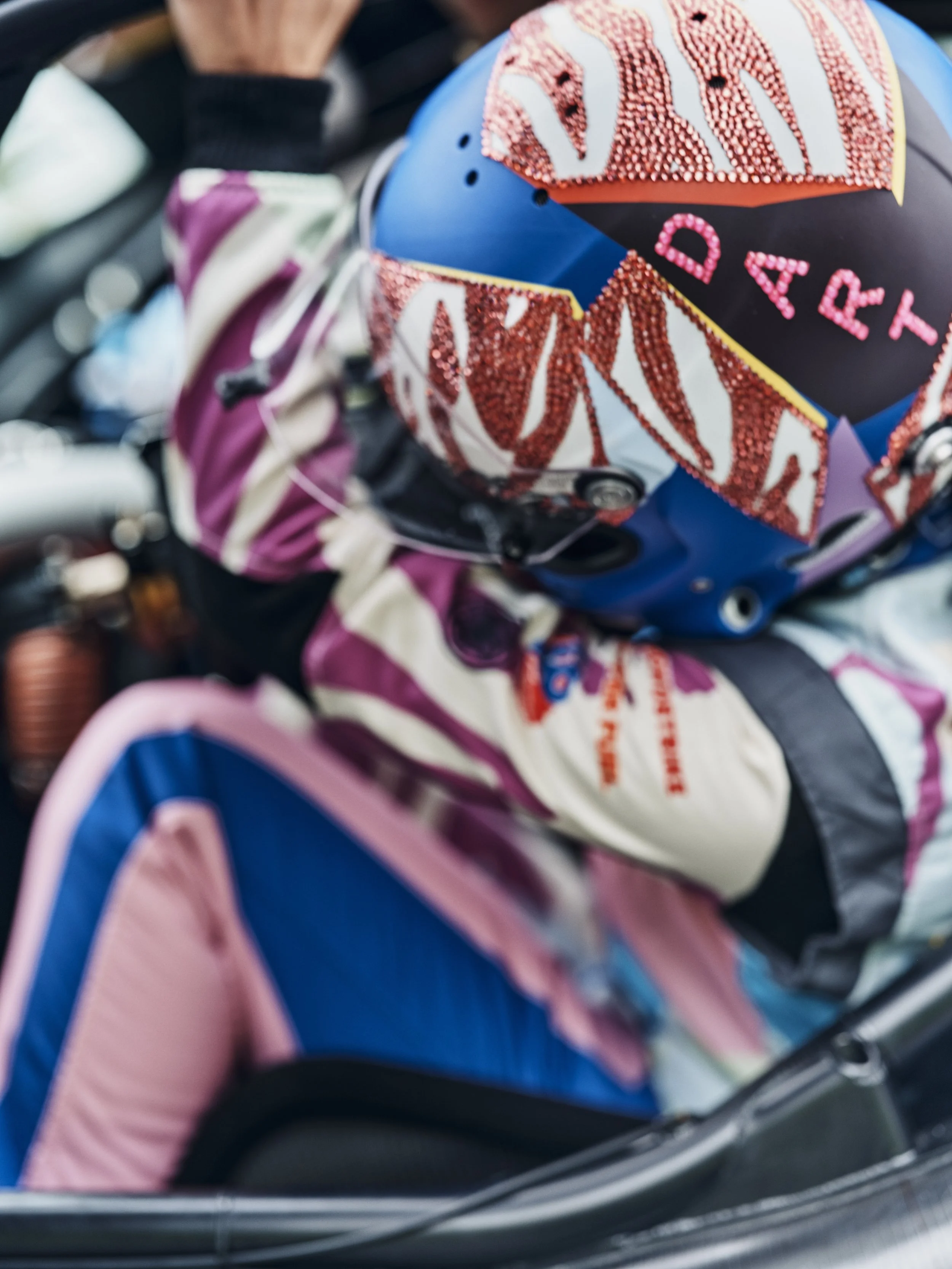
BARRY: One thing we haven’t talked about too deeply is the Mickalene Thomas art aspect of DART Car. I’m really proud of this part. I raised investor dollars and made sure part of that funding went directly to Mickalene for this work. We gave her full creative license and she delivered a bold, Cubist-inspired design with lips on the front and a winking eye motif.

That visual language carried through everything—the car, the helmets, the race suits, all with those lips. Mickalene jokes they’re “for all the kisses in all the special places.” It’s playful, but it resonates. People love it. And not just women—men too. You’d expect women to gravitate toward hot pink and crystals, but when the car was being wrapped in a private garage, collectors kept coming through asking for photos. And it wasn’t just collectors. When we went to the tech inspection, the crew—not museum-goers or gallery regulars—were holding the helmet like it was a treasure. At that time, none of us knew how the market would respond, but then my first helmet sold at auction at Silverstone, during the F1 event in July, for $150,000. Since then, collectors have been snapping up DART pieces, and that’s the mission: every sale funds more driving, gets more women behind the wheel, and raises visibility for female artists.

ST. JAMES: Sometimes that’s one of the unique roles women can play in this competitive world—where certain lines of demarcation get blurred. Women can bring a different lens, elevate the story, and shift the narrative. This is one of those examples.