
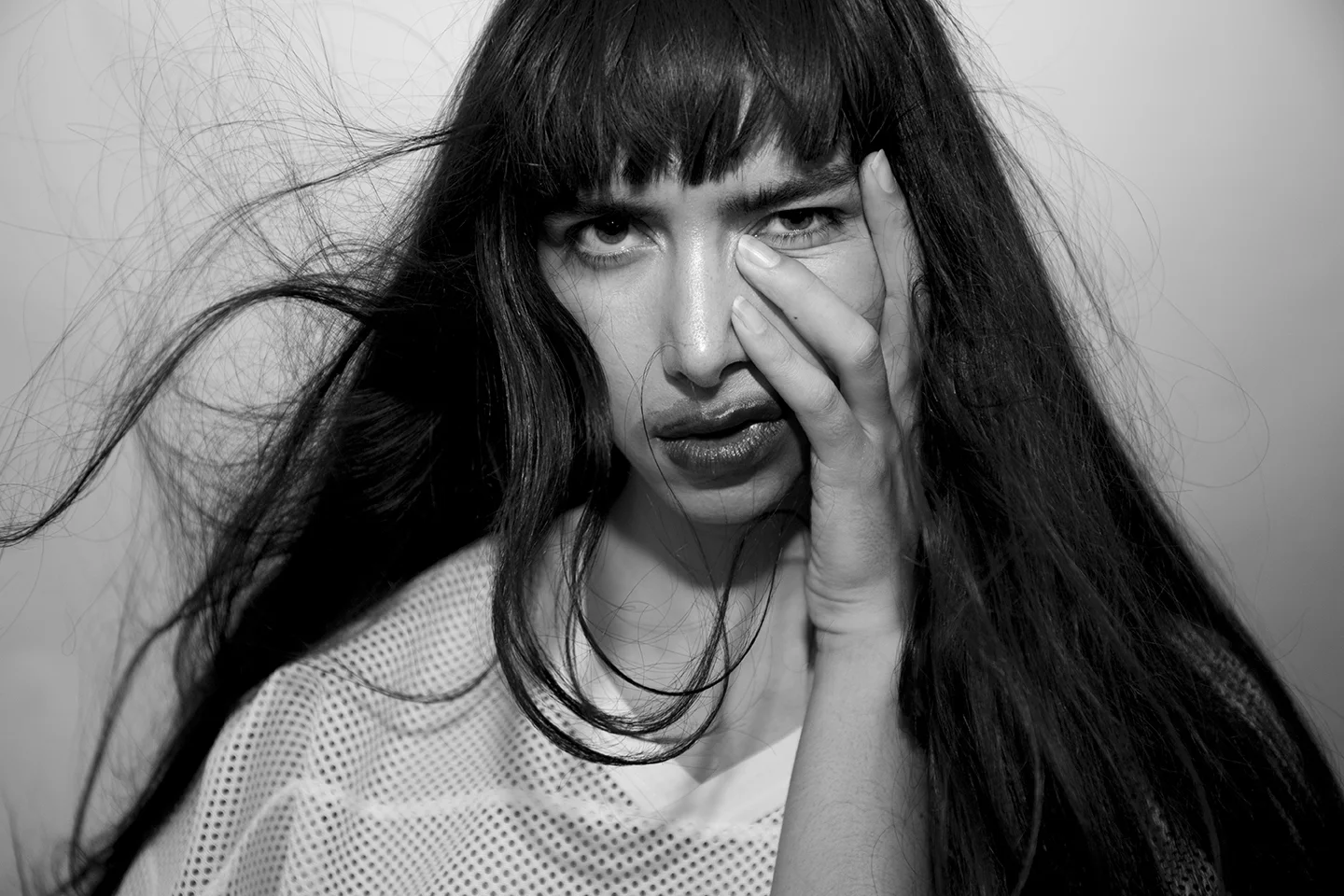
Martine Gutierrez - a name that fits the glamour. I met Martine about ten years ago during a MICA pre-college program. We were both sixteen and as I remember, she beamed. Tall, colorful clothes and gender-ambiguous, us suburban kids were pleasantly perplexed. She had supermodel looks and a bright and bouncy personality; it’s almost as if she had a gravitational pull, her particular brand of sexiness notwithstanding. When you’re that age, it’s hard to know why you’re interested in something. You mostly go off of feeling or intuition to guide you but you know when something is good and right. Martine seemed to possess both a deep sincerity and gentleness combined with the ability to laugh at oneself and be direct. She embodied the human spirit, thoughtful and kind, goddess that was both retro and future. To my young mind, this was what was good and right in the world. Seeing her recent work, this still rings true and it comes as no surprise that others have been just as enchanted. Martine has been featured in numerous magazines including Interview, i-D, PAPER, and Vogue. She is represented by Ryan Lee Gallery and recently opened her solo show WE & THEM & ME at CAM Raleigh. She continues to be herself against a world that can be damning, slow on the uptake, and the results, like herself, are flexible in context and challenge ideas of what it means to be a woman today.
AUDRA WIST: I see you using your body in a positive way that's both direct and sensitive, which is something I feel like doesn't happen so much. I see a lot of pain and suffering being expressed, but I wondered if you think about circumventing that pain and suffering instead of just reflecting it back.
MARTINE GUTIERREZ: The fear of stigma and labels is definitely still an underpinning of mainstream media, affecting all of us since we’re all constantly surrounded by it. I put added effort into looking hyper feminine in my work, but for someone like me that’s also a process of my everyday life. It’s easier and safer to “pass” in public than to go to the grocery store with scruff and breasts. But fem pressure really affects all women. Hair styling, uncomfortable shoes, makeup, objectifying ourselves…but for who? If we’re aware of the male gaze, who are we dressing for and why? These are some of the questions I feel affect my choices when performing characters.
I think one of the recurrent personas my work’s been spiraling around is that of the ‘Supermodel’. She physically embodies ethnographic ideals through the eyes of the oppressive culture on a hyperbolic level. The Supermodel isn’t just skinny and tall—she's epitomized as perfection. It’s all so ingrained within cis culture that anyone who is Trans or non-gender binary is forced to maneuver though the Supermodel propaganda as well. No matter the trends or decades, “feminine” or “masculine”, its all just drag— accentuating features that are culturally assigned as female or male.
WIST: Yeah I’ve always thought that way about how contouring has been appropriated by mainstream entities like Kim Kardashian. That’s drag. Contouring is drag.
GUTIERREZ: Oh yeah, the Kardashians are like nude drag queens. Kim has had more surgeries than most of the T girls I know. That family is pumped, beat, and woven just to sit in the kitchen—there's no separation between home glam and the red carpet. It's like a lifestyle of perpetual photo shoots and it’s amazing. I mean I personally don’t have the stamina; I don’t like wearing makeup or the feeling of it. But I think that also comes from the pressure to feminize, more now than ever—to pass when I'm on the street. I began hormone replacement therapy on New Year’s of last year and my beard still grows, so I will wear makeup if I'm really trying to pass, and even then when people look at me I feel like they’re examining the makeup and what its covering. Even with cis women who have a lot of makeup on riding the train, I’m guilty of studying.
WIST: The question I have that pertains to this is because you are beautiful and modelesque, it does feel like you have a keen awareness of that position or role that you take up of looking a particular way. What do you think the relationship is between fashion and art?
GUTIERREZ: First off, thank you for calling me beautiful! I think I'm connected to fashion media and merchandising media subconsciously, in part because it was at one point an avenue I really wanted to be celebrated in. I remember being a teenager and watching ANTM and wanting to be on the show so badly, and studying—taking notes. I was 18 and printed the paperwork on my mom’s printer with a friend and she was like, “Do it, you could win!” and we’d scream and giggle like dreams were coming true; but listed at the bottom of the application was a requirement that you were female, so I never sent it in.
And at the same time, I would do photo shoots by myself at home, or in the woods, or in parking lots, trying to master what exactly made this look legit and glossy. I wanted the budget and the lifestyle—the whole fantasy. I wanted to be Richard Avedon and Nastassja Kinski with a boa constrictor coiled around her naked body. I had a brief stint with the fashion world right out of college and realized the glam was just merchandising. For the major houses it's all just clothing that’s being shown to us with a halo of light around it.
WIST: I don't want to put words in your mouth but it seems like you’re concerned with the mechanisms behind what we want in that context instead of just saying oh, this is cool, this is trendy, boop. Also you’re an autonomous person in the world as opposed to Gucci.
GUTIERREZ: In the beginning, as I began to call performative actions art, the work became more than just self-portraits—my aspirations began to build the rhetoric behind it. I also simultaneously started going into the world with a much louder appearance. I was introduced to queer theory and ‘gender-fuck’ and started sporting face paint, red and turquoise hair and bright mismatched patterns—teen gender rebellion antics. I wasn’t comfortable with other people taking my portrait for a really long time, which is in part why I started developing the skills to execute all the aspects of image making—hair and makeup, setting and lighting. It took a long time for me just to be comfortable and trust other people behind the lens, to allow someone else to take my picture.
WIST: What do you think the line is between narcissism and self-reflection or productive use of your body and self-aggrandizing? Or is there a line/does there need to be a line?
GUTIERREZ: I think it’s just perception, unless the artist themselves has made a statement that they’re a narcissist or the artwork is about being obsessed with themselves. I don't think about narcissism when I'm making my work and maybe it's partly because on numerous occasions I have been right next to gallery goers at my own show who talk about the “girl in the picture,” with no idea that she is me, or that I was born male. That person in real life and this person in the image are rarely the same person, and that degree of separation is crucial when I hear them chatting about my “very flat chest”, or asking “why does she have a mustache drawn on?” I’ll be standing beside someone visual probing my body, and I'm just like, This is insane! I don't even have to wear sunglasses and they don’t recognize me! So at the end of the day I'm not even taking pictures of myself—I’m taking pictures of another woman.
WIST: I feel the same way in terms of the artworks I’ve made. I don't feel like myself totally - it’s like projections of myself or people or things that we might all experience, or I hope that these are things that are others people’s experiences and feelings of the way they look or they act. I don’t know where I came up with this hypothesis, but I want to say that your parents were pretty accepting from an early age. Is that true? Or am I making that up?
GUTIERREZ: Yeah. Well – my mom was and my dad is still an ongoing conversation.
WIST: So do you think that has affected your self-perception? Again, I’ve gone through the same thing of having to tell them that I'm a sex worker and it ended up with my dad being more supportive than my mom at first.
GUTIERREZ: I think it was crucial in feeling supported at a young age, because it took a long time for me to meet people that I felt expressed themselves in the same way that I did, or in parallel ways with diverse pronouns and greater self-awareness, or people who had already been on hormones for years. It’s not just Avril Lavigne, Misunderstood syndrome. It’s like, on top of trying to navigate my own self-awareness, anyone who is of Trans experience is simultaneously dealing with the binaries of sexual orientation. The reality is that the same cis guys who used to call me a faggot on the street now slap me on the ass. I have no way of knowing if the guy who is attracted to me, that I meet randomly on the street or in the club, will turn around and hurt me once we’re feeling each other up. It’s so much easier for me to interact with other women. With men I need to be forthcoming from the start in a way, and it should not be my problem that some rando is insecure about his own sexuality, but he could turn around and kill me and throw me in a dumpster. It’s real, and it’s terrifying. Cis men are terrifying—cis white men have been the worst.
"I’d love it if gender could be seen outside of the LGBTQ community as a possibility, not just assigned or borrowing from the binary. Club kids have been living that ideal for years, punks and drag queens mainstreamed it, today’s queer community embraces it, and the fashion world always appropriates the philosophy as a fad or style inspiration."
WIST: How do you see the role of Trans artists changing in the context of history i.e. Vaginal Davis, Greer Lankton, and even somebody like Orlan who isn't a transgender woman but has been changing her looks for years now?
GUTIERREZ: I think it’s really important for the younger generation. It would be amazing to see artists of gay and Trans experience be referenced within the context of history and art history; it just doesn’t happen unless you pursue something like Gender Studies, specifically in higher education. Trans women still face violence and fetishism, manifested physically on the street or quietly in the workplace. This is especially true for Trans women of color, who are cast outside the norm as a concentrated minority within their own minority. But I’d hope that with time the work of Trans and non-binary artists will stand to represent much more than the identity of the maker. Academia and media needs to stop othering artists as ‘gay’, ‘trans’, ‘black’, ‘Latino’, ‘Asian’ etc.– it’s like, they’re also people of broad subcultural experiences. We’re definitely not there yet.
WIST: Yeah, I feel like the people I listed too I think are considered to be playthings? They’re always shown in the context of some lightness, when the actual experience is pretty serious. You go through shit when you’re a person working with your own body and it seems to be shown in this light teehee way.
GUTIERREZ: I’d love it if gender could be seen outside of the LGBTQ community as a possibility, not just assigned or borrowing from the binary. Club kids have been living that ideal for years, punks and drag queens mainstreamed it, today’s queer community embraces it, and the fashion world always appropriates the philosophy as a fad or style inspiration. That appropriation is a huge disservice, and makes me skeptical of all the “progress” people keep yammering on about. I naively thought transitioning would be easy or seamless but I was so wrong. I mean, the concept being simple as an individual I think is true, but the reality of living in our world in a body that is beginning to reflect “feminine” versus “masculine” in a binary way…. I'm being treated completely differently. It’s definitely a new awareness—of everything. It's the treatment of women's bodies that is so different. I mean, it’s not difficult to literally be a woman because I have always been one. I’m just not used to being groped and stalked and catcalled to this extent.
WIST: Yeah, that must be a total trip. Welcome!
GUTIERREZ: It’s crazy, and I'm not even dressed in a provocative way when it happens.
WIST: I think it's because a lot of straight men do not know what it’s like to be penetrated. The gaze is penetration. It’s funny; a lot of the men that I have been with aren’t necessarily kinky or BDSM-minded. I think they recognize that after meeting me they are “safe” or safe to let their guard down a bit since they know I won’t judge based on their sexual interests. All of a sudden a switch goes off and I get a flood of interesting texts. The tables are turned and even the sounds that they’re making in bed, sheesh. I feel like if more straight men could give in—
GUTIERREZ: If anal stimulation or getting pegged were socially celebrated as being really masculine and manly, we’d be living in a different world.
WIST: I think that too! It would create a different, more balanced vibe.
GUTIERREZ: It’d be like ancient Greece where they didn’t use the label gay. Men had sex with men and women. Men could be each other’s lovers—and they were! That’s why the 300 soldiers fought so hard in battle, because they loved each other.
WIST: Because there was a real emotional bond and vulnerability!
GUTIERREZ: It didn't make any of them less of a man. I mean, you would think two really masculine guys, whatever that means… I guess really hairy, buff, and…I'm going into bear territory. Like, who are the manly dudes everyone has a crush on? Zac Efron and…
WIST: Zayn!
GUTIERREZ: Omg yes! You would think that these two men Zac Efron and Zayn…
WIST: Could get each other off!
GUTIERREZ: Yeah, you would think two dudes, dude-ing each other around all ruff, pounding one another other all night would be manly! But no, culturally somehow that makes them feminine and by default weak?
WIST: I know it’s crazy. Not one, but two dicks!
GUTIERREZ: Isn't the phallus manly? Wouldn't adding more testosterone be more manly?
WIST: Oh man, I totally agree. More men need to be fucked. Or be okay with being in the grey area. But like you said, things take time. We need more public figure examples of different types of “other” because then it just becomes more varied and people can realize there’s more than just one type or two types or whatever the fuck of an idea they have.
GUTIERREZ: Laverne Cox is amazing. Thank god her voice is out there. She's so smart and beautiful.
WIST: Yeah I can’t think of anyone else off the top of my head besides her, but maybe it’s gonna be you. I could see it, I would love it! You’d be great; it’d be a full circle for you.
GUTIERREZ: I am definitely captivated by celebrity and the media that surrounds people who are spectacles, but truthfully, I don't really like performing live and anytime I do (which has become more and more rare) I end up hiding from people who compliment me. I don’t know if they are necessarily fans, but if I don’t know them it just makes me so uncomfortable! I would much rather release things onto the Internet and send them into the ether like a message in a bottle.
WIST: What excites you the most about making work today in 2016?
GUTIERREZ: That I'm older. I'm only twenty-seven years old but I feel like I’ve purged a lot of idealism out already. For a long time I have been living fluid concepts of gender with an awareness that the space between the binaries is the only place to find complete freedom. I didn’t want to necessarily hit people over the head with these themes. I wanted the viewer to walk away with some new awareness about their own perceptions of gender and sexual reality—and I still feel this way. People need to question themselves and be confused. That’s how we grow and evolve. Confusion is good, and so much more self-reflective than giving someone a summary of what it is that they’re supposed to be taking away from the work. When you’re left confused, you have to keep thinking.
I feel like I was using a lot of cis mechanisms and like I said before, the Supermodel was very much an influence. I didn’t fully understand when I was still going by Martín that my fem aspirations were so controlled by social aspirations. Society’s importance for women to look a certain way built the Supermodel, not me. I knew this and still I wanted to be seen as her. I know now that she’s begging to be rebuilt. I wish I had this awareness years ago, but I know now. Today is better.
Martine Gutierrez's exhibition "True Story" will be on view until December 11, 2016 at Faye G., Jo, and James Stone Gallery, 855 Commonwealth Avenue in Boston. text and interview by Audra Wist. photographs by Martine Gutierrez. You can explore more of Martine's work on her website or follow her on Instagram: @MARTINE.TV. Follow Autre on Instagram: @AUTREMAGAZINE
